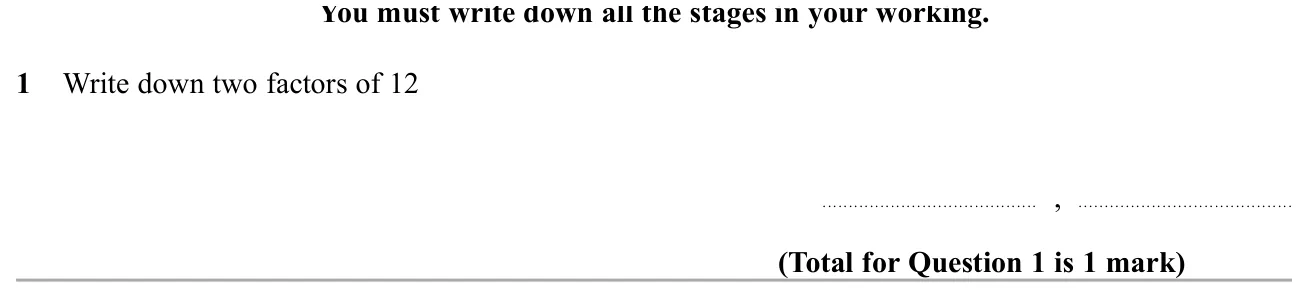
© Pearson Education Ltd. November 2019 Paper 3 (Foundation, calculator), question 1.
Answer Any two of 1, 2, 3, 4, 6, 12 1 mark
Worked solution Checked against the mark scheme
The factor pairs of 12 are 1 × 12 1\times12 1 × 12 2 × 6 2\times6 2 × 6 3 × 4 3\times4 3 × 4
So any two of 1, 2, 3, 4, 6, 12 will do, for example 3 and 4.
Watch out: Giving multiples of 12 such as 24 instead of factors.
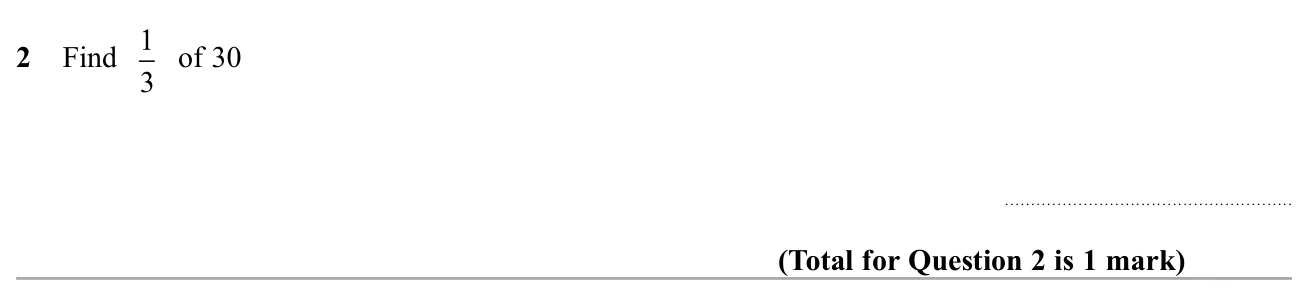
© Pearson Education Ltd. November 2019 Paper 3 (Foundation, calculator), question 2.
Worked solution Checked against the mark scheme
To find 1 3 \frac{1}{3} 3 1
30 ÷ 3 = 10 30 \div 3 = 10 30 ÷ 3 = 10
Watch out: Multiplying by 3 to get 90.
© Pearson Education Ltd. November 2019 Paper 3 (Foundation, calculator), question 3.
Answer 7 10 \frac{7}{10} 10 7 1 mark
Worked solution Checked against the mark scheme
The 7 is in the tenths column, so 0.7 = 7 10 0.7 = \frac{7}{10} 0.7 = 10 7
Watch out: Writing 7/100 or 1/7.
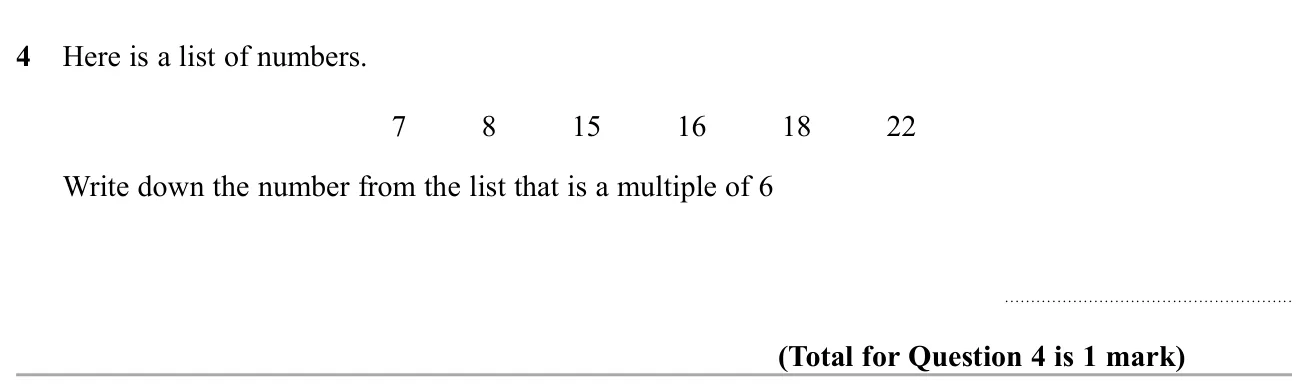
© Pearson Education Ltd. November 2019 Paper 3 (Foundation, calculator), question 4.
Worked solution Checked against the mark scheme
The 6 times table goes 6, 12, 18, 24, ...
The only one in the list is 18.
Watch out: Choosing 16 or 22 because they are even.
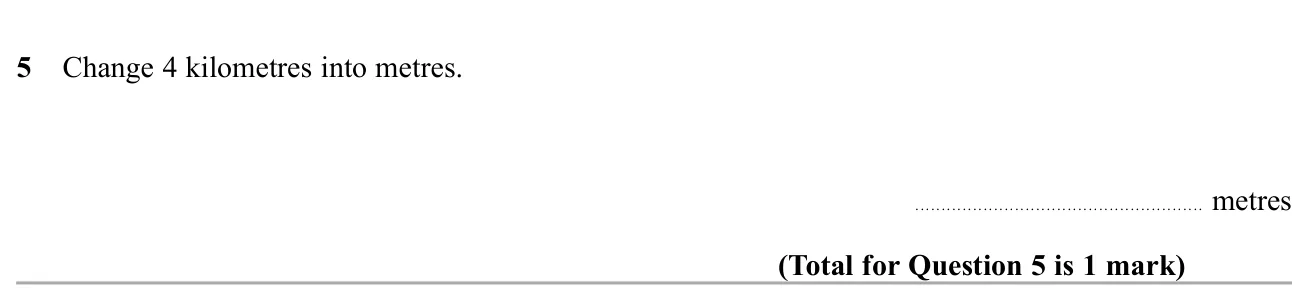
© Pearson Education Ltd. November 2019 Paper 3 (Foundation, calculator), question 5.
Worked solution Checked against the mark scheme
There are 1000 metres in a kilometre.
4 × 1000 = 4000 4 \times 1000 = 4000 4 × 1000 = 4000
Watch out: Multiplying by 100 to get 400.
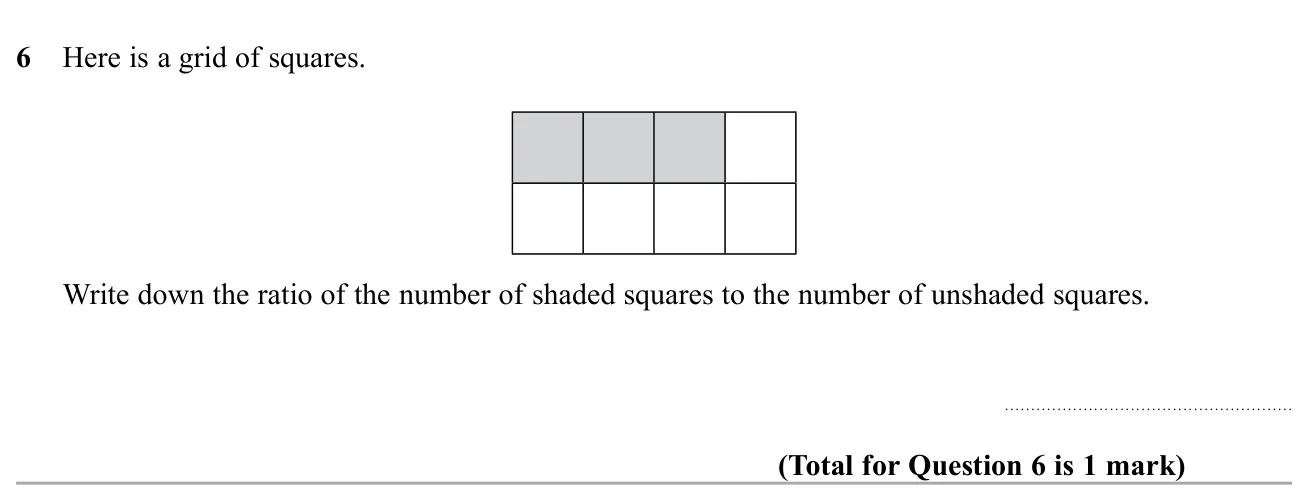
Question 6 Ratio 1 mark Grade 1 Calculator © Pearson Education Ltd. November 2019 Paper 3 (Foundation, calculator), question 6.
Worked solution Checked against the mark scheme
Count: 3 squares are shaded and 8 − 3 = 5 8 - 3 = 5 8 − 3 = 5
Shaded : unshaded = 3 : 5 = 3 : 5 = 3 : 5
Watch out: Writing 3 : 8, which compares shaded with the total.
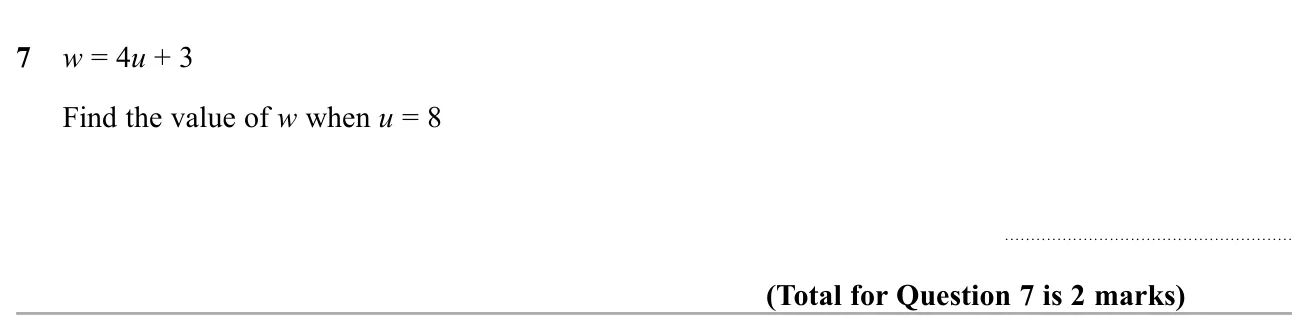
© Pearson Education Ltd. November 2019 Paper 3 (Foundation, calculator), question 7.
Worked solution Checked against the mark scheme
Replace u u u
w = 4 × 8 + 3 = 32 + 3 = 35 w = 4 \times 8 + 3 = 32 + 3 = 35 w = 4 × 8 + 3 = 32 + 3 = 35
Watch out: Treating 4u as 48 and getting 51.
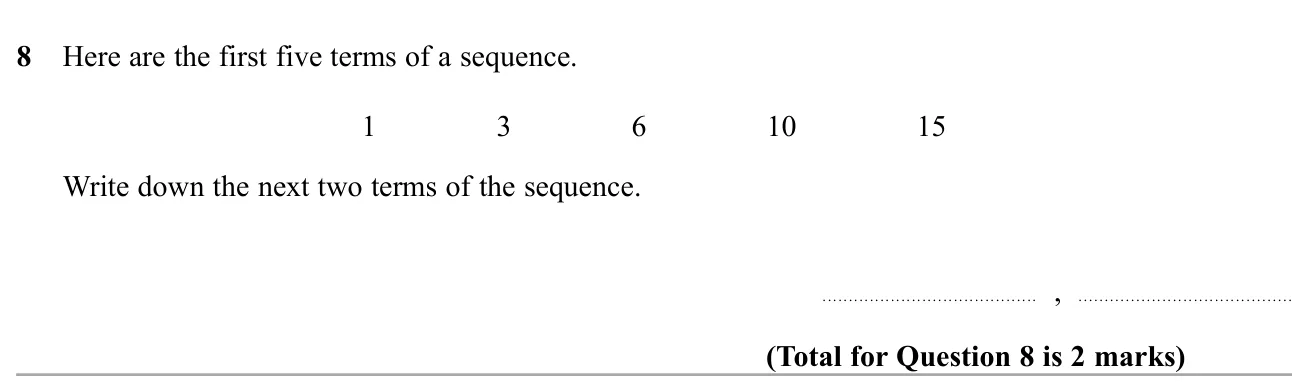
© Pearson Education Ltd. November 2019 Paper 3 (Foundation, calculator), question 8.
Worked solution Checked against the mark scheme
The gaps go up by one each time: + 2 , + 3 , + 4 , + 5 +2, +3, +4, +5 + 2 , + 3 , + 4 , + 5
Next gaps are + 6 +6 + 6 + 7 +7 + 7 15 + 6 = 21 15 + 6 = 21 15 + 6 = 21 21 + 7 = 28 21 + 7 = 28 21 + 7 = 28
Watch out: Adding 5 each time to get 20 and 25.
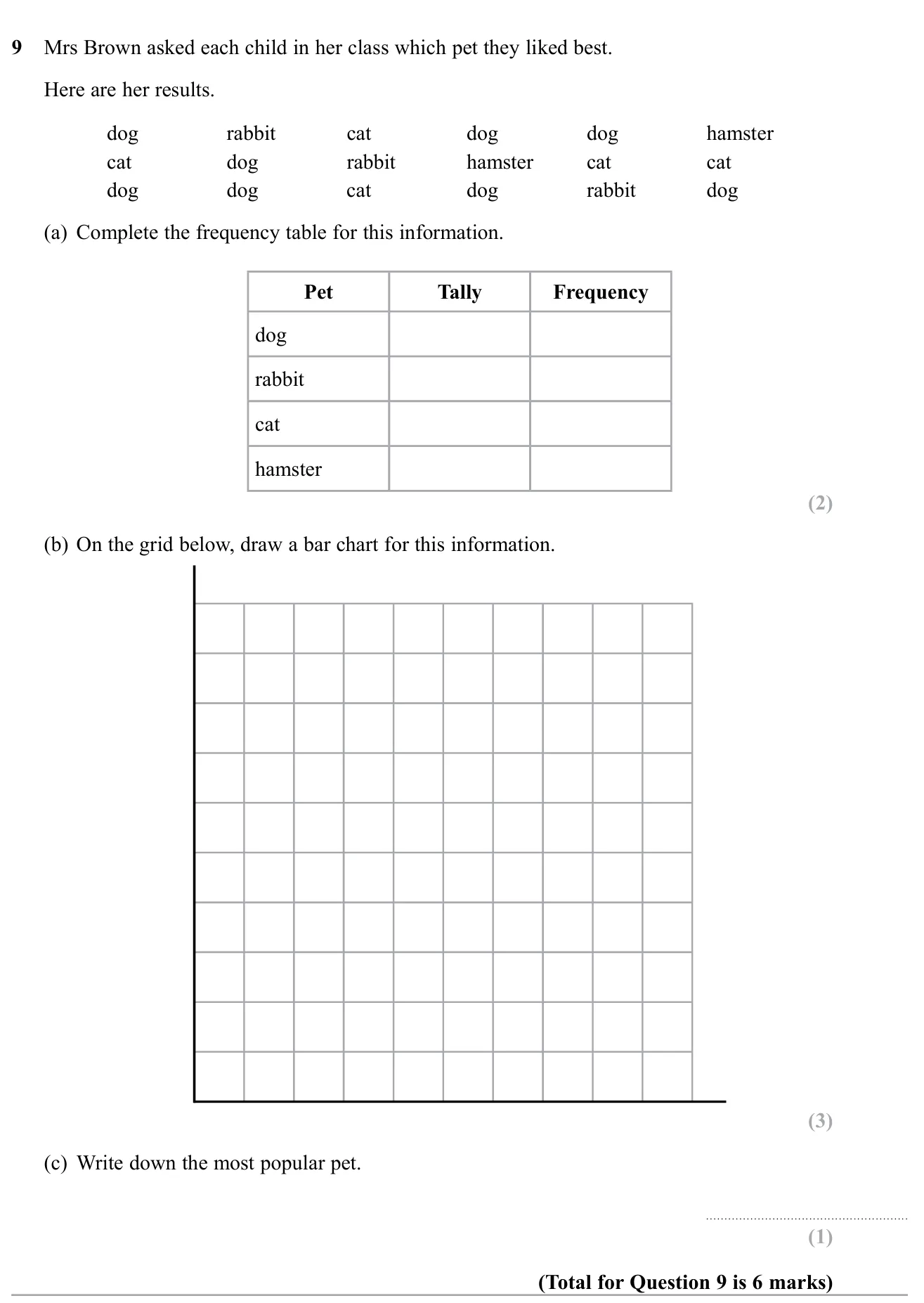
© Pearson Education Ltd. November 2019 Paper 3 (Foundation, calculator), question 9.
(a) dog 8, rabbit 3, cat 5, hamster 2 2 marks (b) Bar chart with heights 8, 3, 5, 2 3 marks (c) dog 1 mark
Worked solution Checked against the mark scheme
(a) Count each pet: dog 8, rabbit 3, cat 5, hamster 2 (total 18).
(b) Put the pets along the bottom, a frequency scale going up in 1s, and draw bars of heights 8, 3, 5 and 2.
(c) Dog has the tallest bar, so it is the most popular.
Watch out: Miscounting the list, so the frequencies do not add up to 18.
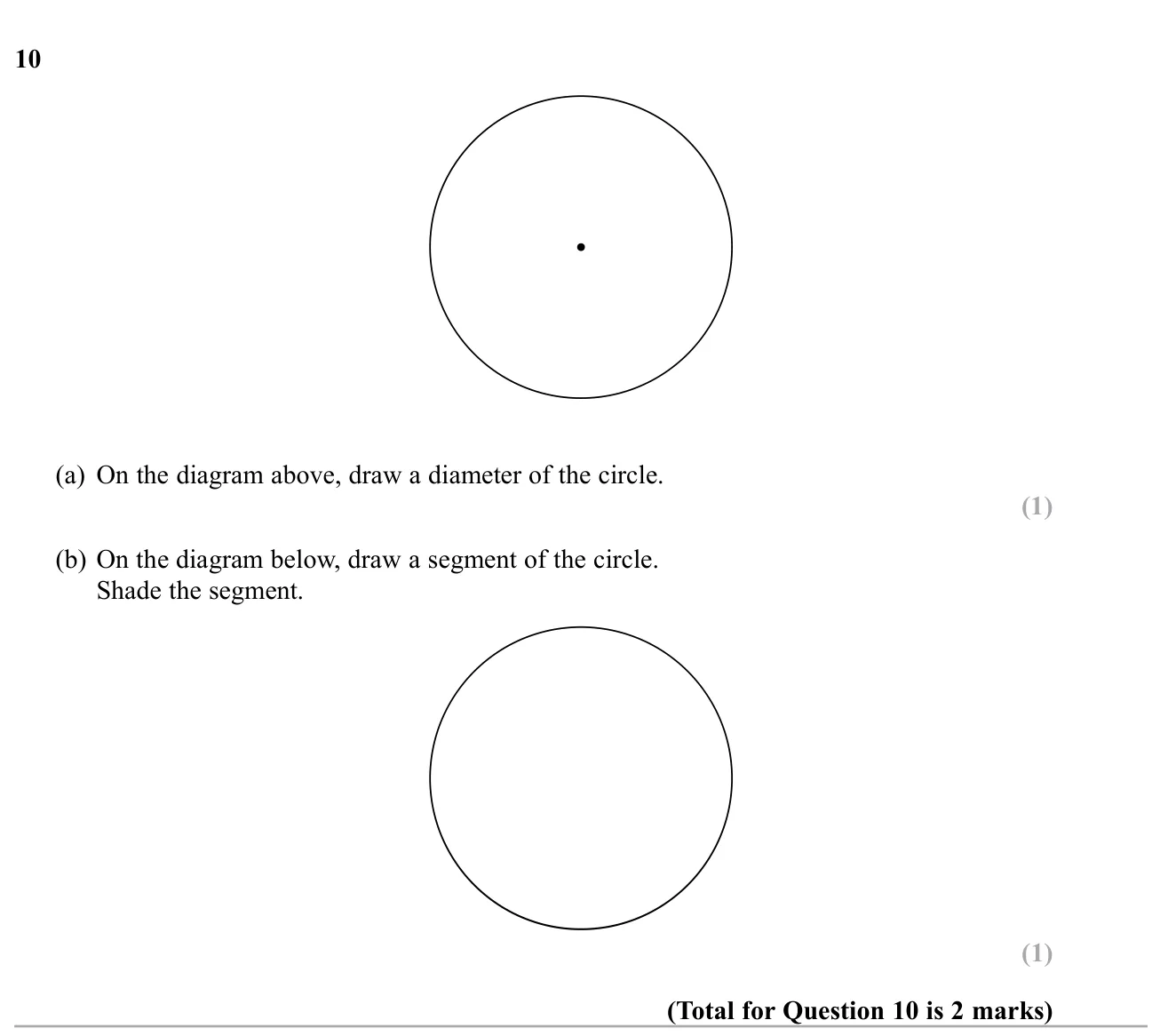
© Pearson Education Ltd. November 2019 Paper 3 (Foundation, calculator), question 10.
(a) A straight line through the centre from edge to edge 1 mark (b) A chord drawn and the region between it and the arc shaded 1 mark
Worked solution Checked against the mark scheme
(a) A diameter is a straight line from one side of the circle to the other that passes through the centre.
(b) Draw any chord (a line joining two points on the circle), then shade the smaller region between the chord and the curved edge. That region is a segment.
Watch out: Shading a sector (bounded by two radii) instead of a segment.
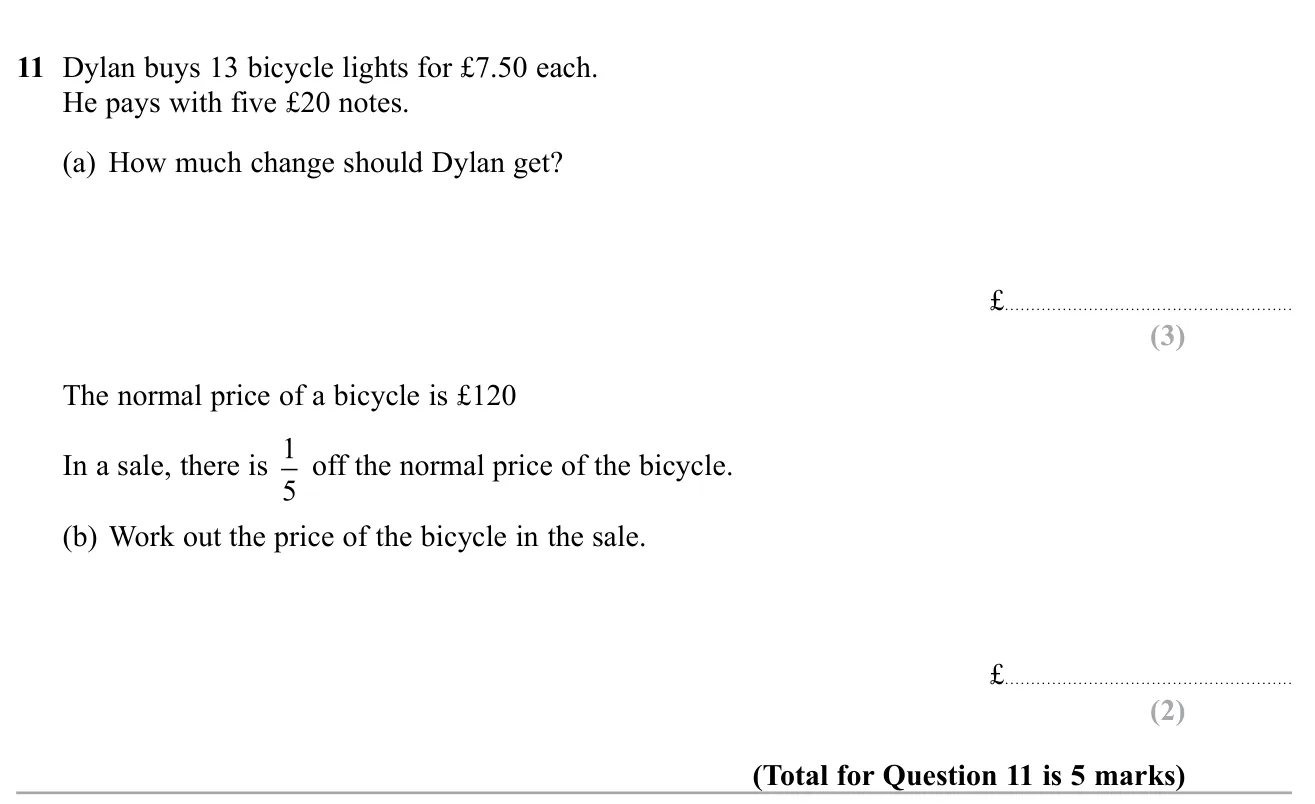
© Pearson Education Ltd. November 2019 Paper 3 (Foundation, calculator), question 11.
(a) £2.50 3 marks (b) £96 2 marks
Worked solution Checked against the mark scheme
(a) Cost: 13 × 7.50 = £ 97.50 13 \times 7.50 = £97.50 13 × 7.50 = £97.50 5 × 20 = £ 100 5 \times 20 = £100 5 × 20 = £100
Change = 100 − 97.50 = £ 2.50 = 100 - 97.50 = £2.50 = 100 − 97.50 = £2.50
(b) 1 5 \frac{1}{5} 5 1 = 24 = 24 = 24 120 − 24 = £ 96 120 - 24 = £96 120 − 24 = £96
Watch out: In (b), giving the reduction £24 as the sale price.
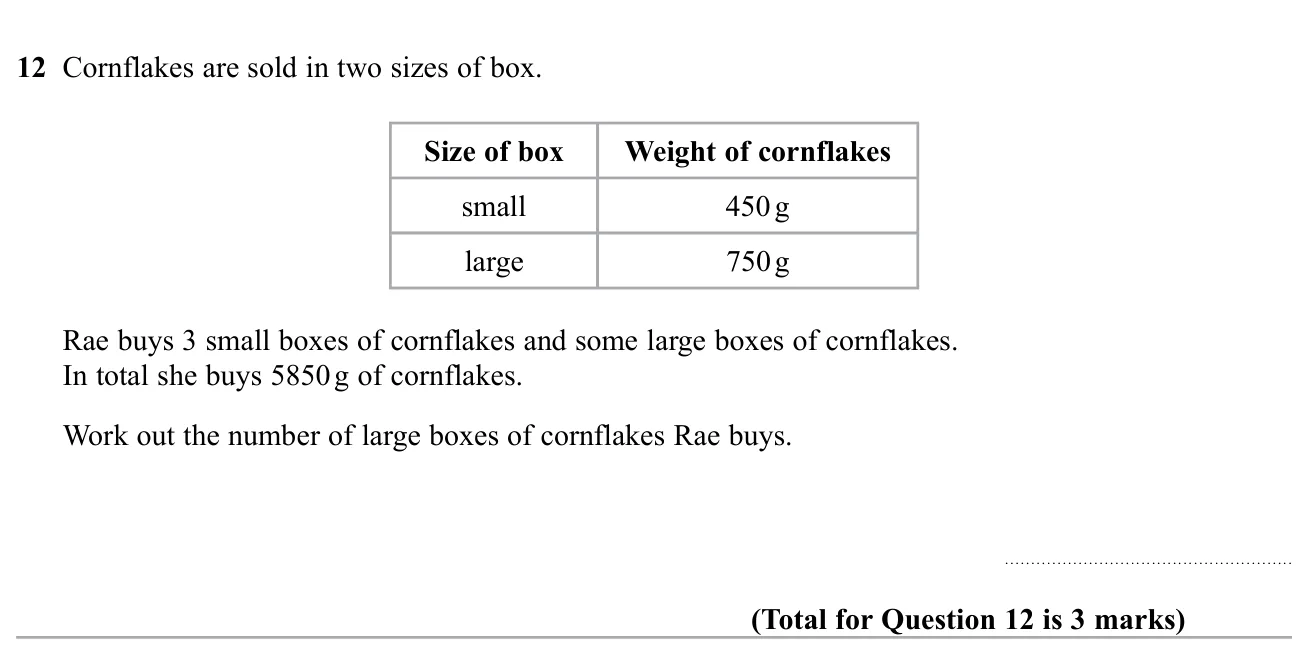
© Pearson Education Ltd. November 2019 Paper 3 (Foundation, calculator), question 12.
Worked solution Checked against the mark scheme
Small boxes: 3 × 450 = 1350 3 \times 450 = 1350 3 × 450 = 1350
Left for large boxes: 5850 − 1350 = 4500 5850 - 1350 = 4500 5850 − 1350 = 4500
4500 ÷ 750 = 6 4500 \div 750 = 6 4500 ÷ 750 = 6
Watch out: Dividing 5850 by 750 without removing the small boxes first.
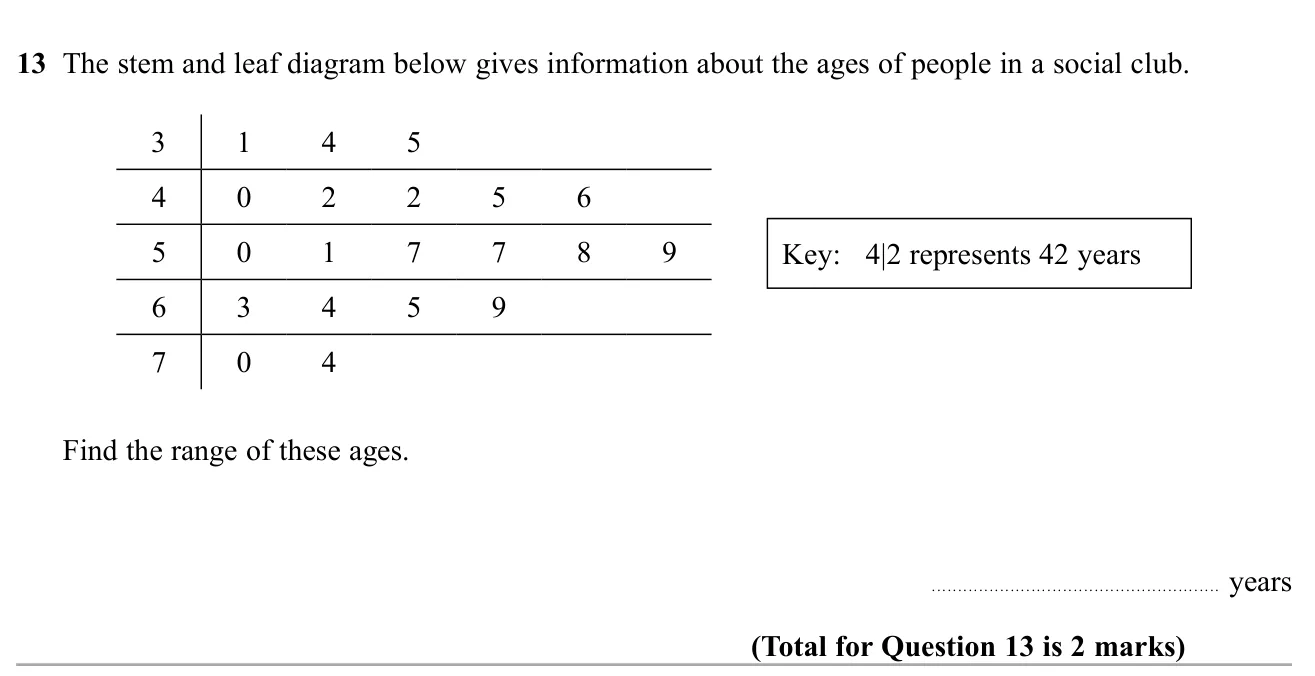
© Pearson Education Ltd. November 2019 Paper 3 (Foundation, calculator), question 13.
Worked solution Checked against the mark scheme
Smallest age: stem 3, leaf 1, which is 31.
Largest age: stem 7, leaf 4, which is 74.
Range = 74 − 31 = 43 = 74 - 31 = 43 = 74 − 31 = 43
Watch out: Using the leaves only, e.g. 9 − 0 9 - 0 9 − 0
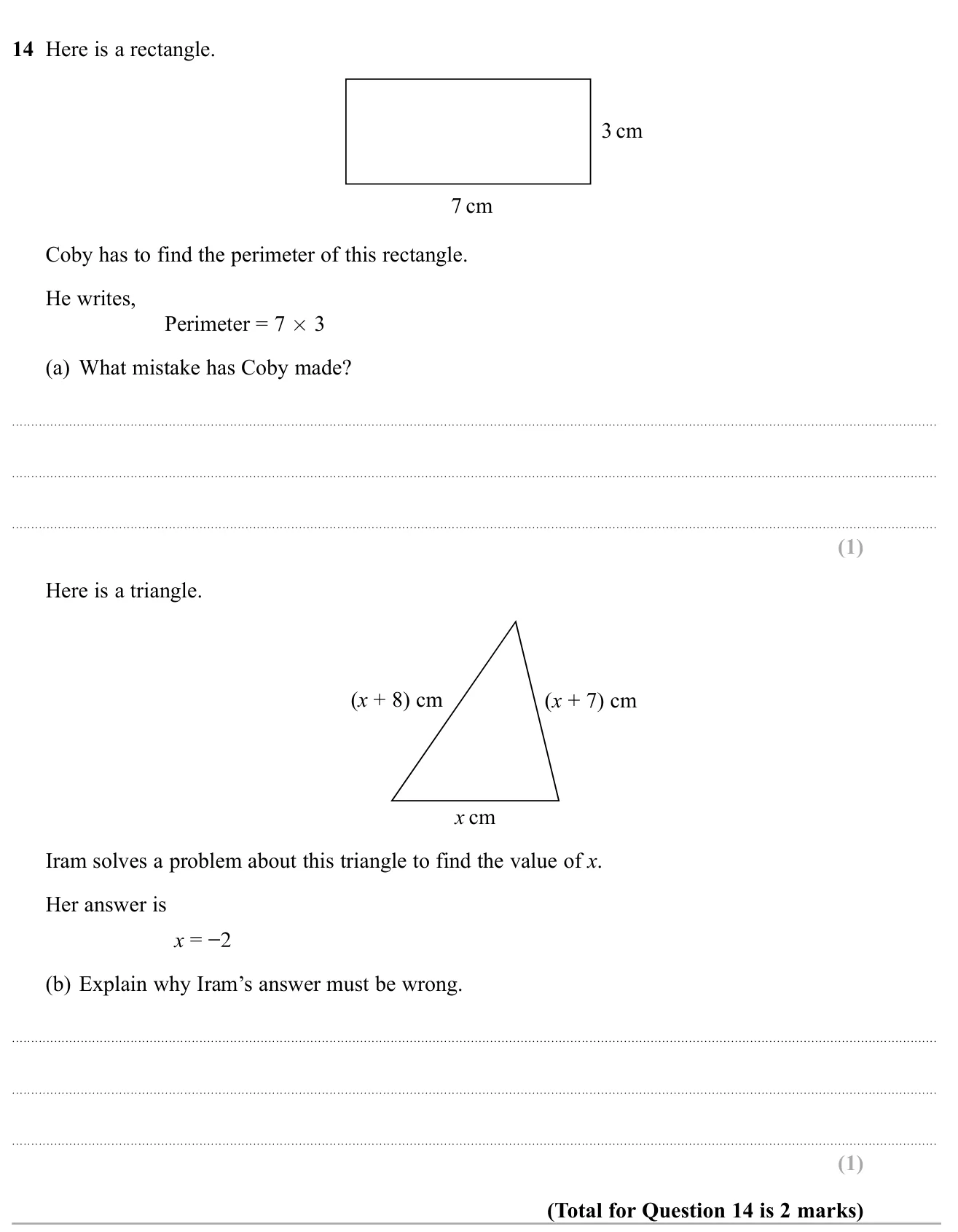
© Pearson Education Ltd. November 2019 Paper 3 (Foundation, calculator), question 14.
(a) He multiplied, which gives the area; the perimeter is 7 + 3 + 7 + 3 = 20 7 + 3 + 7 + 3 = 20 7 + 3 + 7 + 3 = 20 1 mark (b) A length cannot be negative, so x = − 2 x = -2 x = − 2 1 mark
Worked solution Checked against the mark scheme
(a) 7 × 3 7 \times 3 7 × 3 7 + 3 + 7 + 3 = 20 7 + 3 + 7 + 3 = 20 7 + 3 + 7 + 3 = 20
(b) One side is x x x x = − 2 x = -2 x = − 2 − 2 -2 − 2
Watch out: In (b), talking about angles adding to 180° instead of the length being negative.
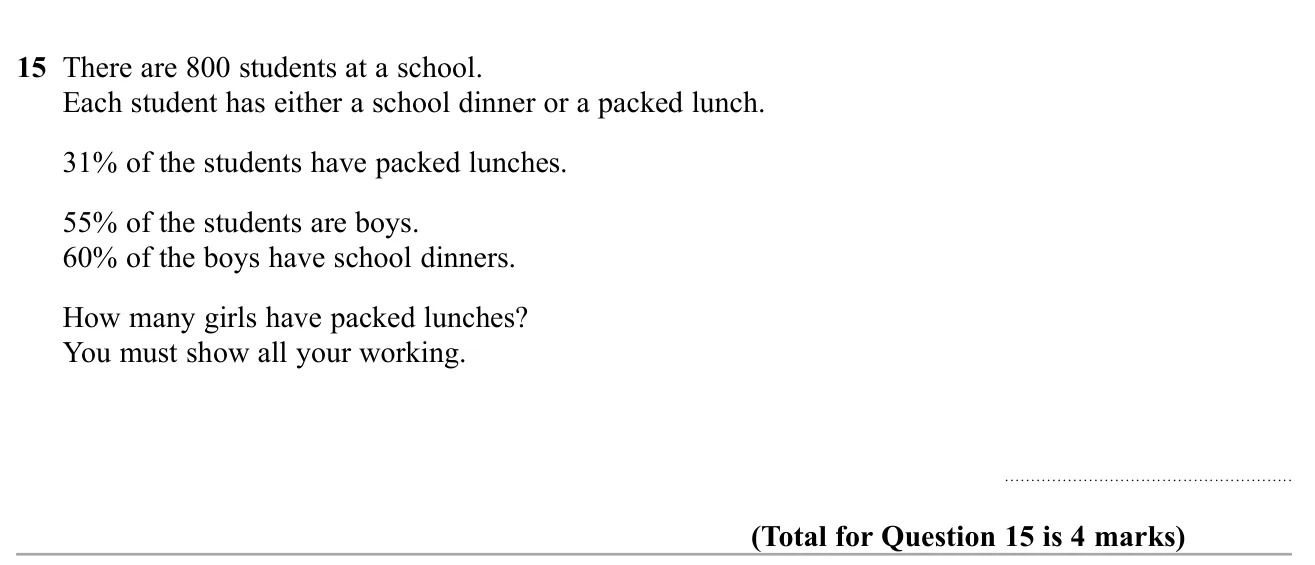
© Pearson Education Ltd. November 2019 Paper 3 (Foundation, calculator), question 15.
Worked solution Checked against the mark scheme
Boys: 0.55 × 800 = 440 0.55 \times 800 = 440 0.55 × 800 = 440
Boys with packed lunch: 0.4 × 440 = 176 0.4 \times 440 = 176 0.4 × 440 = 176
All packed lunches: 0.31 × 800 = 248 0.31 \times 800 = 248 0.31 × 800 = 248
Girls with packed lunch: 248 − 176 = 72 248 - 176 = 72 248 − 176 = 72
Watch out: Using 60% of the boys (school dinners) as the boys with packed lunches.
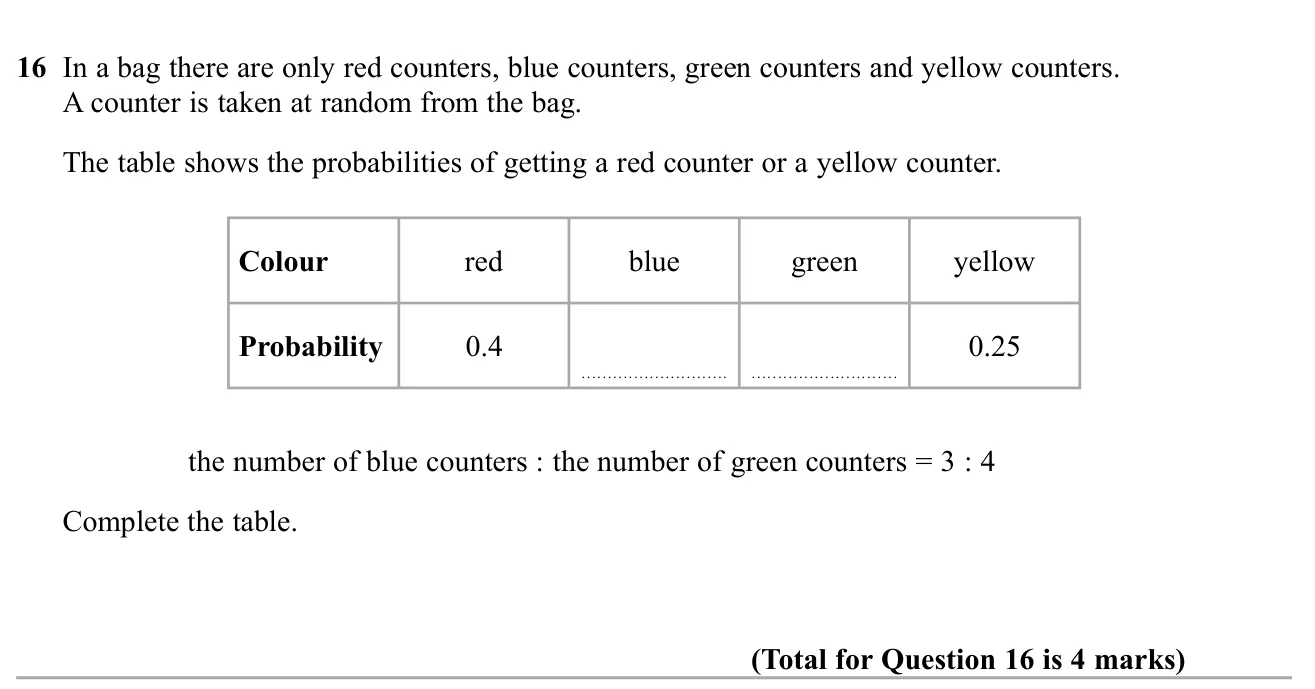
© Pearson Education Ltd. November 2019 Paper 3 (Foundation, calculator), question 16.
Answer blue 0.15 0.15 0.15 0.2 0.2 0.2 4 marks
Worked solution Checked against the mark scheme
Probabilities add to 1: 1 − 0.4 − 0.25 = 0.35 1 - 0.4 - 0.25 = 0.35 1 − 0.4 − 0.25 = 0.35
Share 0.35 in the ratio 3 : 4 3 : 4 3 : 4 = 0.35 ÷ 7 = 0.05 = 0.35 \div 7 = 0.05 = 0.35 ÷ 7 = 0.05
Blue = 3 × 0.05 = 0.15 = 3 \times 0.05 = 0.15 = 3 × 0.05 = 0.15 = 4 × 0.05 = 0.2 = 4 \times 0.05 = 0.2 = 4 × 0.05 = 0.2
Watch out: Swapping the values so blue is 0.2 and green is 0.15.
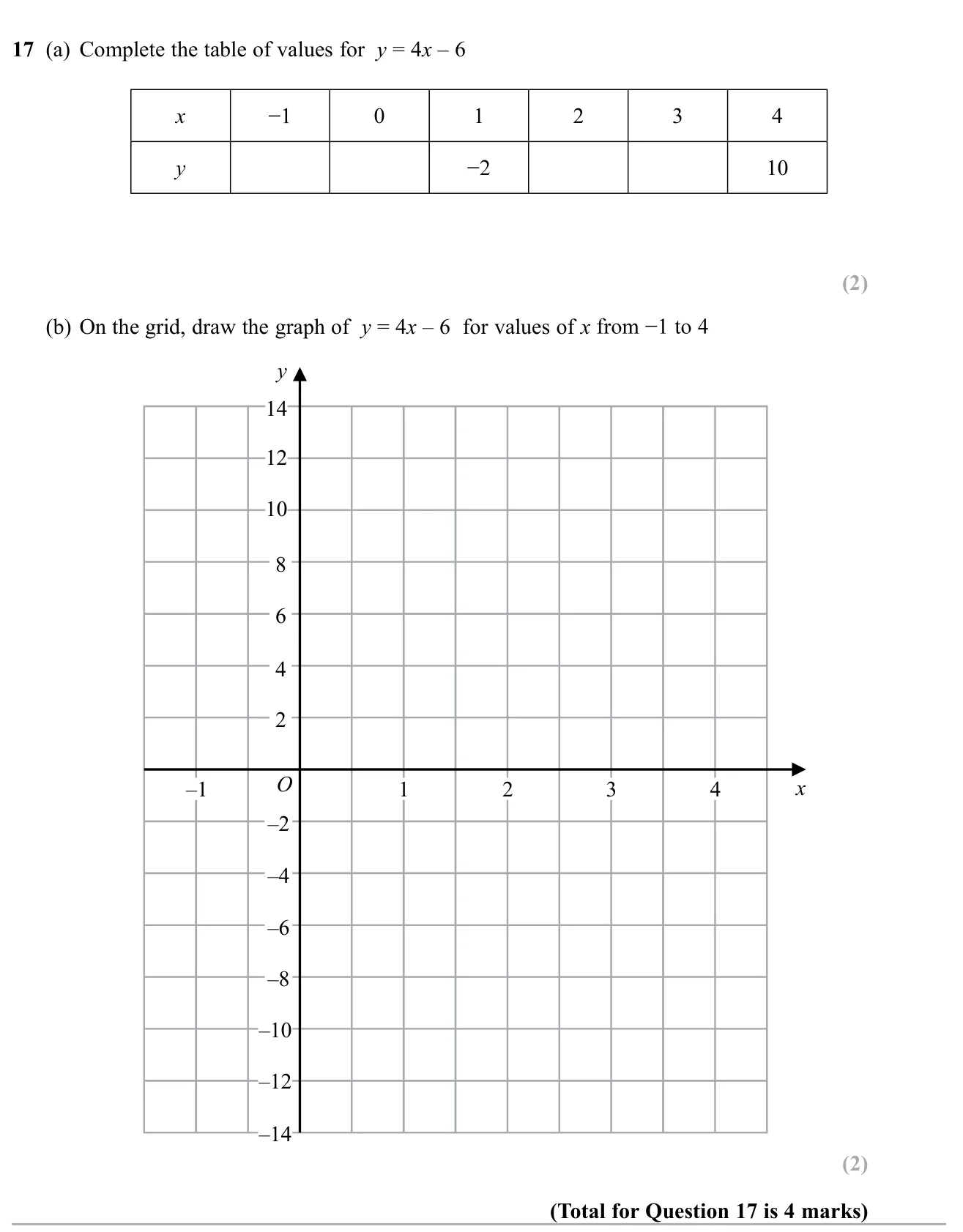
© Pearson Education Ltd. November 2019 Paper 3 (Foundation, calculator), question 17.
(a) − 10 , − 6 , 2 , 6 -10, -6, 2, 6 − 10 , − 6 , 2 , 6 2 marks (b) Straight line through ( − 1 , − 10 ) (-1, -10) ( − 1 , − 10 ) ( 4 , 10 ) (4, 10) ( 4 , 10 ) 2 marks
Worked solution Checked against the mark scheme
(a) Put each x x x 4 x − 6 4x - 6 4 x − 6
x = − 1 x=-1 x = − 1 − 4 − 6 = − 10 -4-6=-10 − 4 − 6 = − 10 x = 0 x=0 x = 0 − 6 -6 − 6 x = 2 x=2 x = 2 2 2 2 x = 3 x=3 x = 3 6 6 6
(b) Plot the six points from ( − 1 , − 10 ) (-1,-10) ( − 1 , − 10 ) ( 4 , 10 ) (4,10) ( 4 , 10 )
Watch out: Getting 4 × ( − 1 ) − 6 = − 2 4\times(-1) - 6 = -2 4 × ( − 1 ) − 6 = − 2
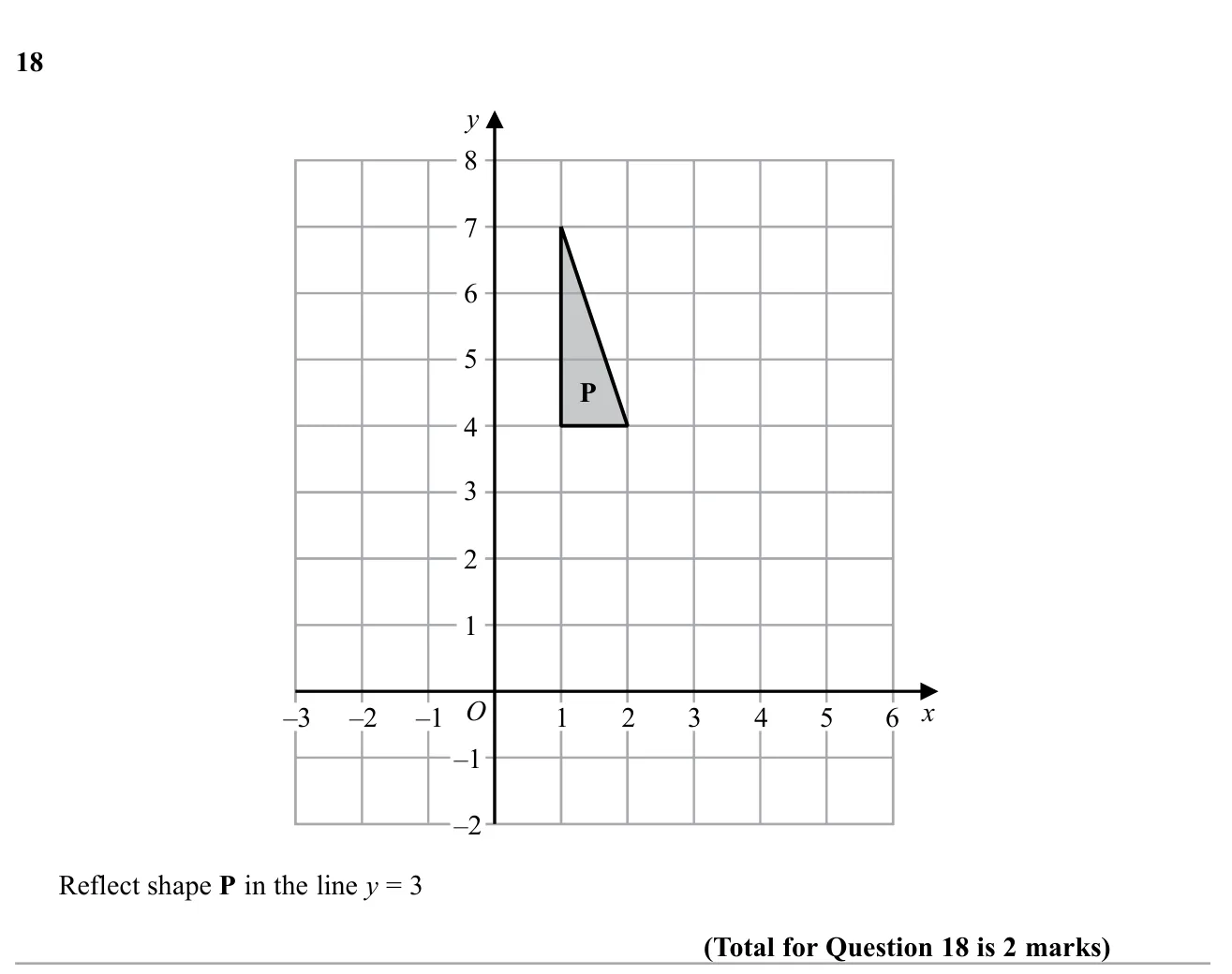
© Pearson Education Ltd. November 2019 Paper 3 (Foundation, calculator), question 18.
Answer Triangle with vertices ( 1 , 2 ) (1, 2) ( 1 , 2 ) ( 2 , 2 ) (2, 2) ( 2 , 2 ) ( 1 , − 1 ) (1, -1) ( 1 , − 1 ) 2 marks
Worked solution Checked against the mark scheme
Each point moves to the same distance on the other side of y = 3 y = 3 y = 3
( 1 , 4 ) (1, 4) ( 1 , 4 ) ( 1 , 2 ) (1, 2) ( 1 , 2 ) ( 2 , 4 ) (2, 4) ( 2 , 4 ) ( 2 , 2 ) (2, 2) ( 2 , 2 ) ( 1 , 7 ) (1, 7) ( 1 , 7 ) ( 1 , − 1 ) (1, -1) ( 1 , − 1 )
Watch out: Reflecting in the line x = 3 instead.
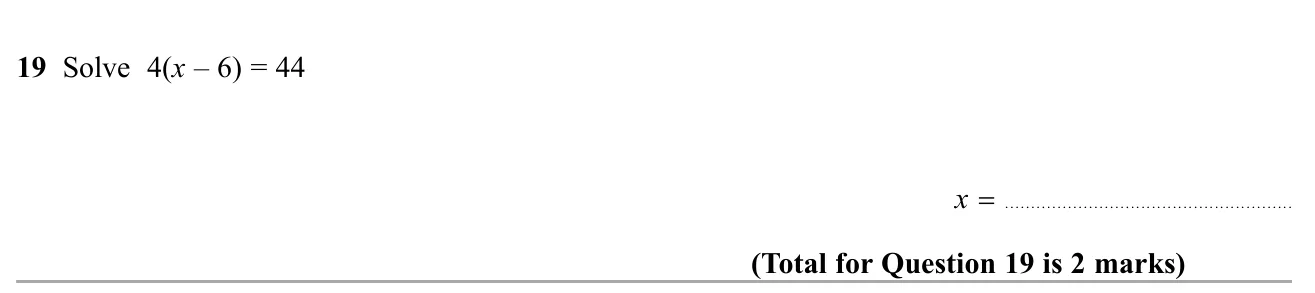
© Pearson Education Ltd. November 2019 Paper 3 (Foundation, calculator), question 19.
Answer x = 17 x = 17 x = 17 2 marks
Worked solution Checked against the mark scheme
Divide both sides by 4: x − 6 = 11 x - 6 = 11 x − 6 = 11
Add 6: x = 17 x = 17 x = 17
Watch out: Expanding as 4 x − 6 = 44 4x - 6 = 44 4 x − 6 = 44
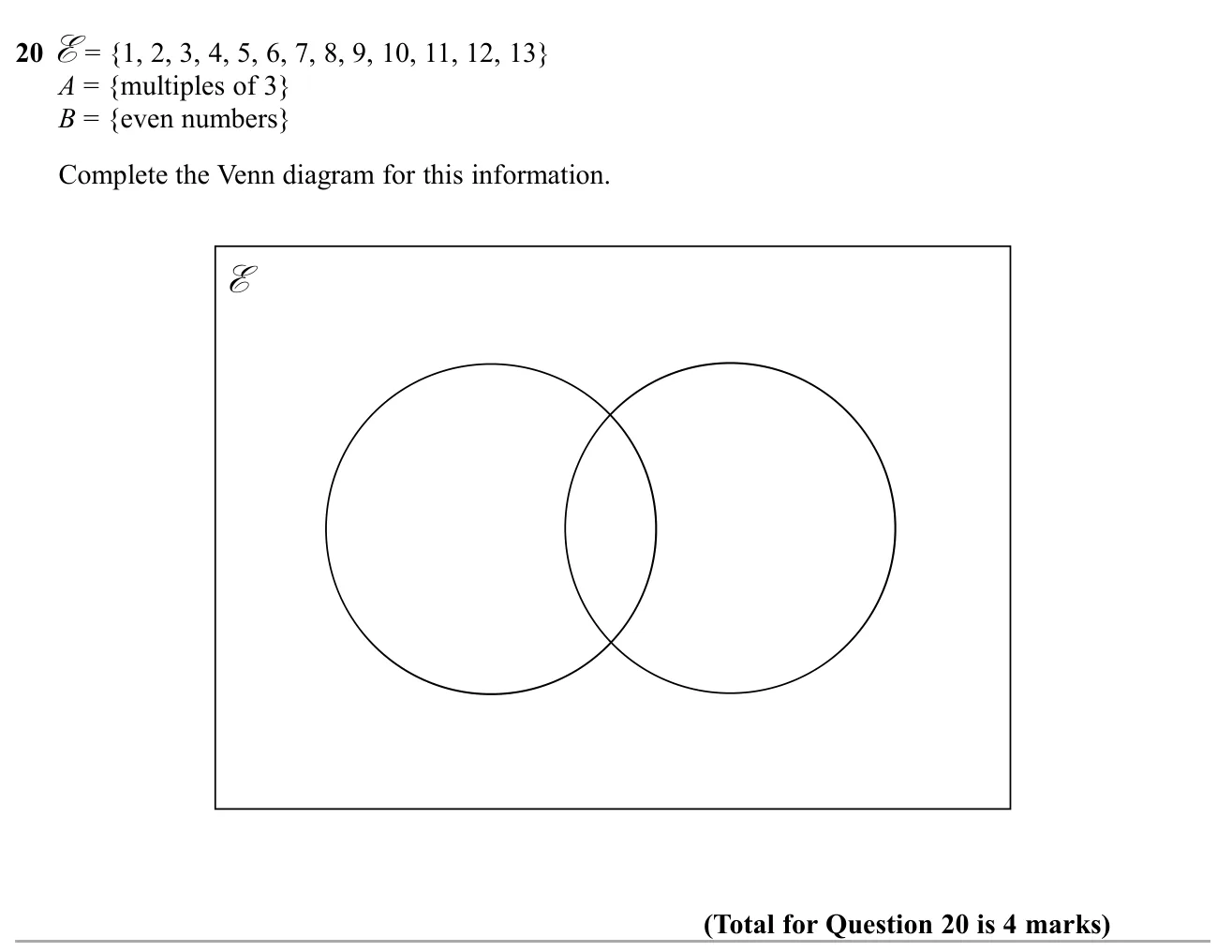
© Pearson Education Ltd. November 2019 Paper 3 (Foundation, calculator), question 20.
Answer Both: 6, 12. Multiples of 3 only: 3, 9. Even only: 2, 4, 8, 10. Outside: 1, 5, 7, 11, 13 4 marks
Worked solution Checked against the mark scheme
Multiples of 3: 3, 6, 9, 12. Even: 2, 4, 6, 8, 10, 12.
In both (overlap): 6, 12
Multiples of 3 only: 3, 9. Even only: 2, 4, 8, 10
Outside both circles: 1, 5, 7, 11, 13
Watch out: Putting 6 and 12 in both circles separately rather than in the overlap.
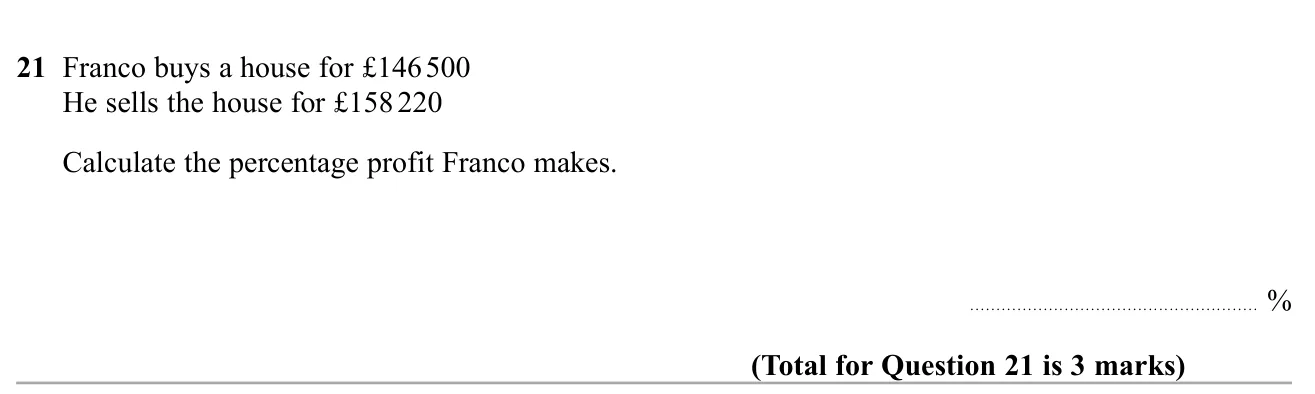
© Pearson Education Ltd. November 2019 Paper 3 (Foundation, calculator), question 21.
Worked solution Checked against the mark scheme
Profit: 158 220 − 146 500 = 11 720 158\,220 - 146\,500 = 11\,720 158 220 − 146 500 = 11 720
Percentage profit = 11 720 146 500 × 100 = 8 % = \frac{11\,720}{146\,500} \times 100 = 8\% = 146 500 11 720 × 100 = 8%
Watch out: Dividing by the selling price instead of the buying price.
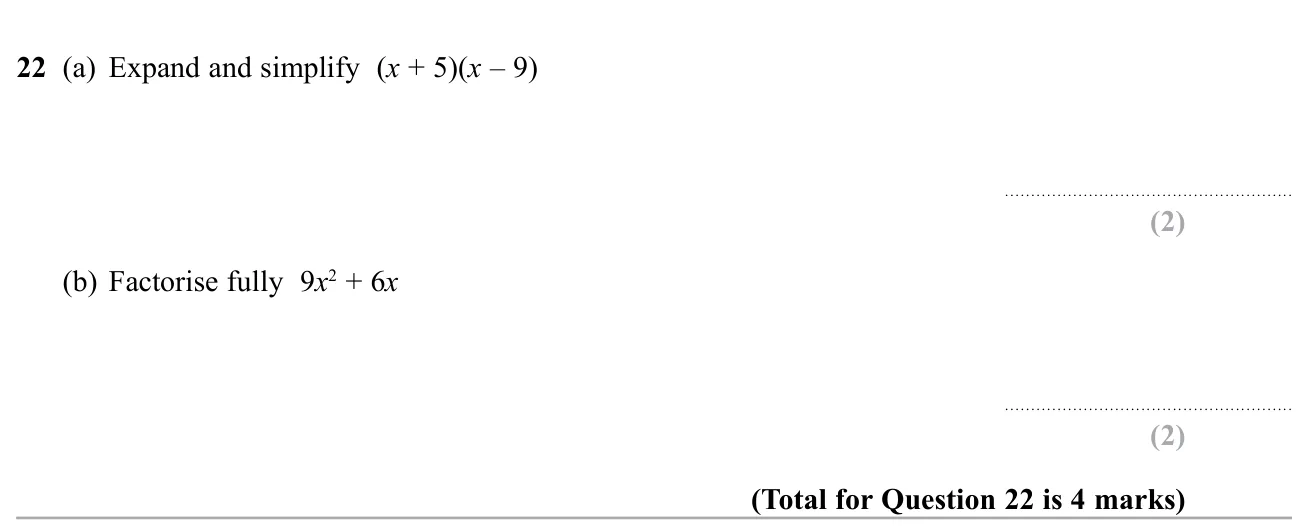
© Pearson Education Ltd. November 2019 Paper 3 (Foundation, calculator), question 22.
(a) x 2 − 4 x − 45 x^2 - 4x - 45 x 2 − 4 x − 45 2 marks (b) 3 x ( 3 x + 2 ) 3x(3x + 2) 3 x ( 3 x + 2 ) 2 marks
Worked solution Checked against the mark scheme
(a) x × x = x 2 x \times x = x^2 x × x = x 2 x × ( − 9 ) = − 9 x x \times (-9) = -9x x × ( − 9 ) = − 9 x 5 × x = 5 x 5 \times x = 5x 5 × x = 5 x 5 × ( − 9 ) = − 45 5 \times (-9) = -45 5 × ( − 9 ) = − 45
x 2 − 9 x + 5 x − 45 = x 2 − 4 x − 45 x^2 - 9x + 5x - 45 = x^2 - 4x - 45 x 2 − 9 x + 5 x − 45 = x 2 − 4 x − 45
(b) The highest common factor of 9 x 2 9x^2 9 x 2 6 x 6x 6 x 3 x 3x 3 x 3 x ( 3 x + 2 ) 3x(3x + 2) 3 x ( 3 x + 2 )
Watch out: In (b), only taking out 3 to get 3 ( 3 x 2 + 2 x ) 3(3x^2 + 2x) 3 ( 3 x 2 + 2 x )
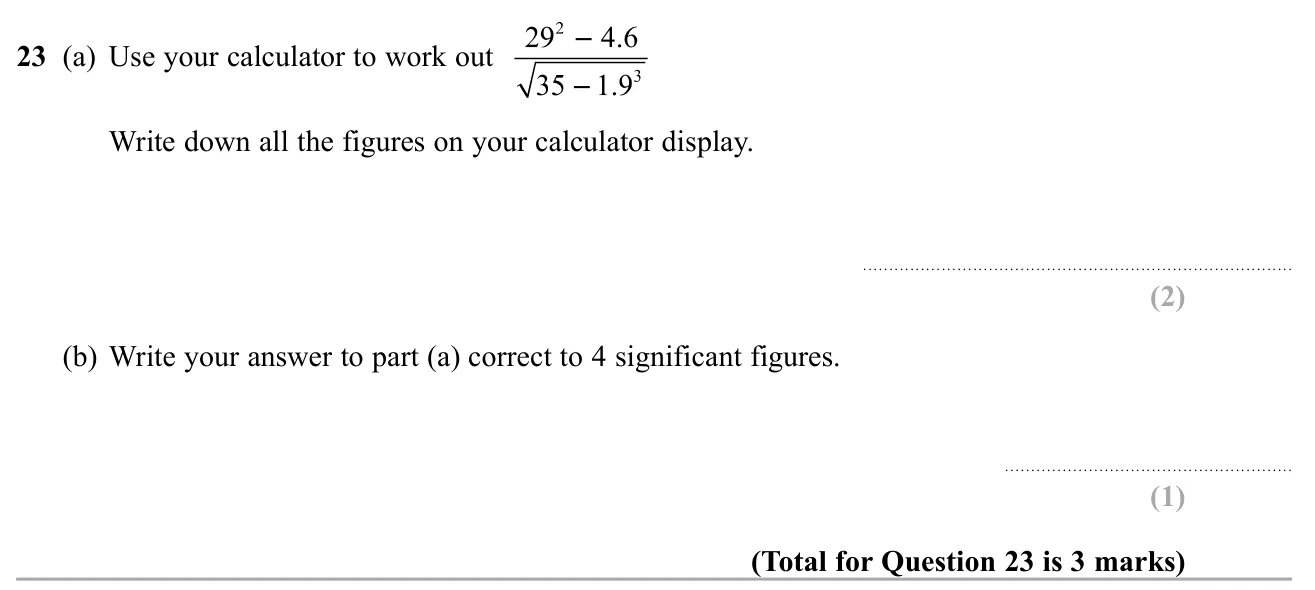
© Pearson Education Ltd. November 2019 Paper 3 (Foundation, calculator), question 23.
(a) 157.668255... 2 marks (b) 157.7 1 mark
Worked solution Checked against the mark scheme
(a) Top: 29 2 − 4.6 = 836.4 29^2 - 4.6 = 836.4 2 9 2 − 4.6 = 836.4 35 − 6.859 = 28.141 = 5.30481... \sqrt{35 - 6.859} = \sqrt{28.141} = 5.30481... 35 − 6.859 = 28.141 = 5.30481...
836.4 ÷ 5.30481... = 157.668255... 836.4 \div 5.30481... = 157.668255... 836.4 ÷ 5.30481... = 157.668255...
(b) The 4th significant figure is 6 and the next digit is 6, so round up: 157.7 157.7 157.7
Watch out: Typing it in without brackets so the calculator only divides 4.6 by the root.
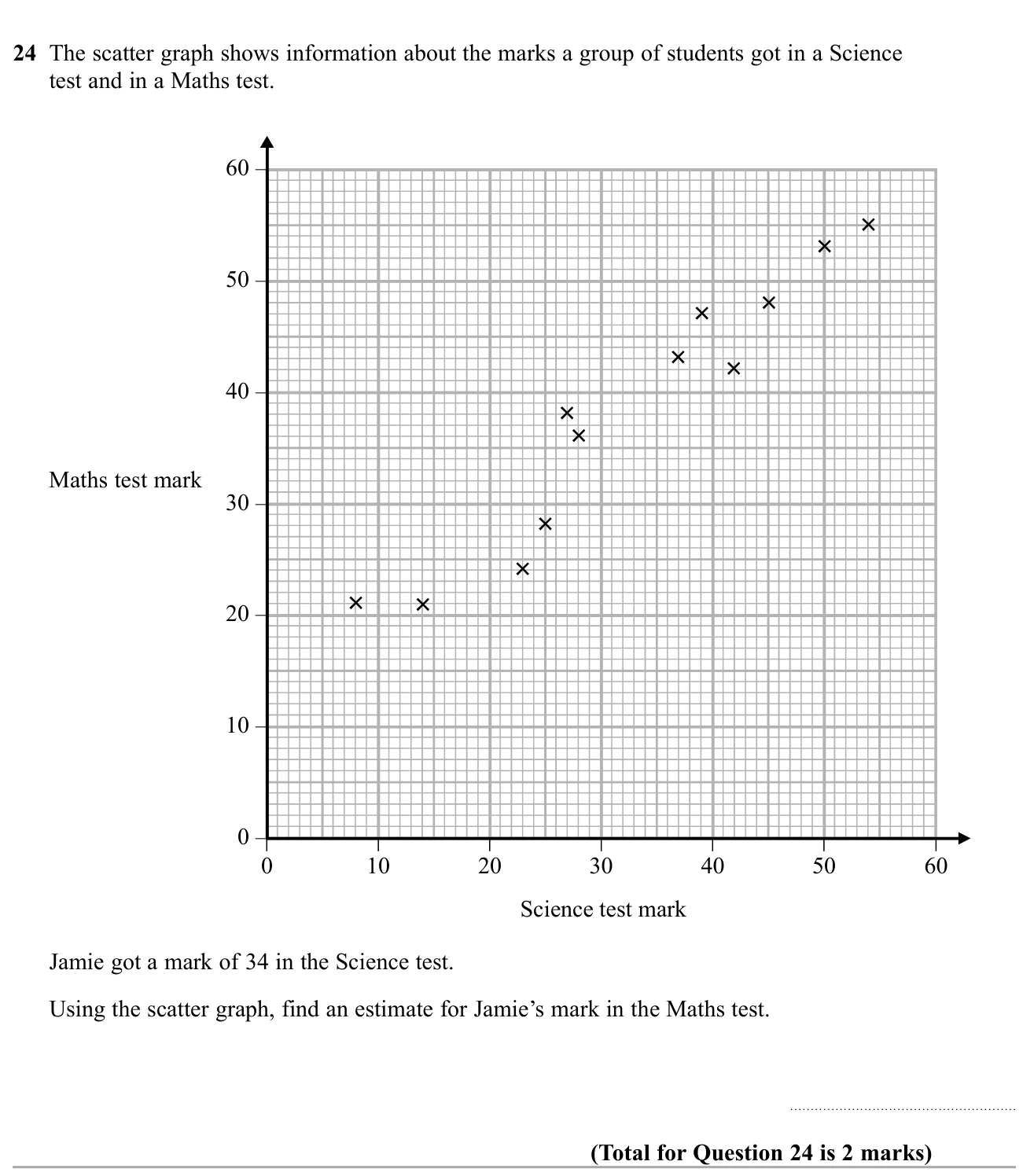
© Pearson Education Ltd. November 2019 Paper 3 (Foundation, calculator), question 24.
Answer About 40 (35 to 42 accepted) 2 marks
Worked solution Checked against the mark scheme
Draw a line of best fit through the middle of the crosses.
Go up from 34 on the Science axis to the line, then across to the Maths axis. This reads about 40.
Watch out: Reading off a single nearby cross instead of using a line of best fit.
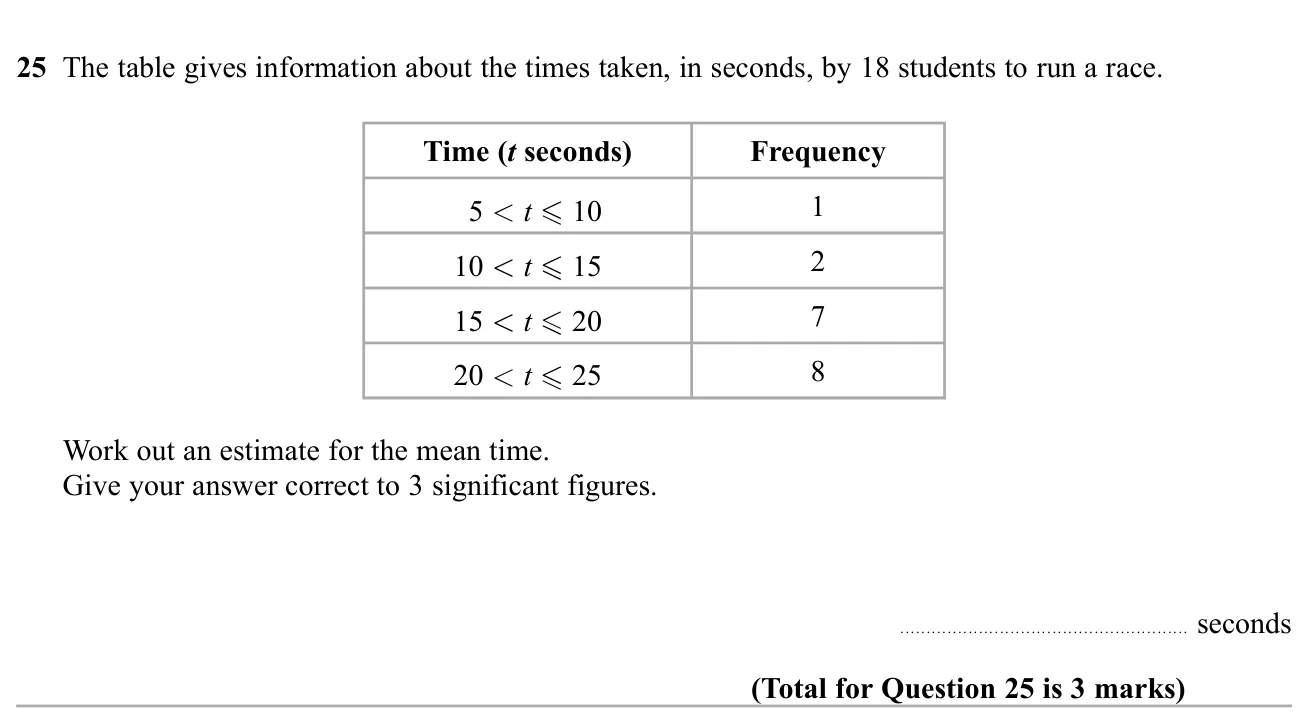
© Pearson Education Ltd. November 2019 Paper 3 (Foundation, calculator), question 25.
Answer 18.6 seconds 3 marks
Worked solution Checked against the mark scheme
Midpoints: 7.5, 12.5, 17.5, 22.5
∑ f x = 7.5 + 25 + 122.5 + 180 = 335 \sum fx = 7.5 + 25 + 122.5 + 180 = 335 ∑ f x = 7.5 + 25 + 122.5 + 180 = 335
Mean ≈ 335 ÷ 18 = 18.61... = 18.6 \approx 335 \div 18 = 18.61... = 18.6 ≈ 335 ÷ 18 = 18.61... = 18.6
Watch out: Dividing by 4 (the number of classes) instead of 18.
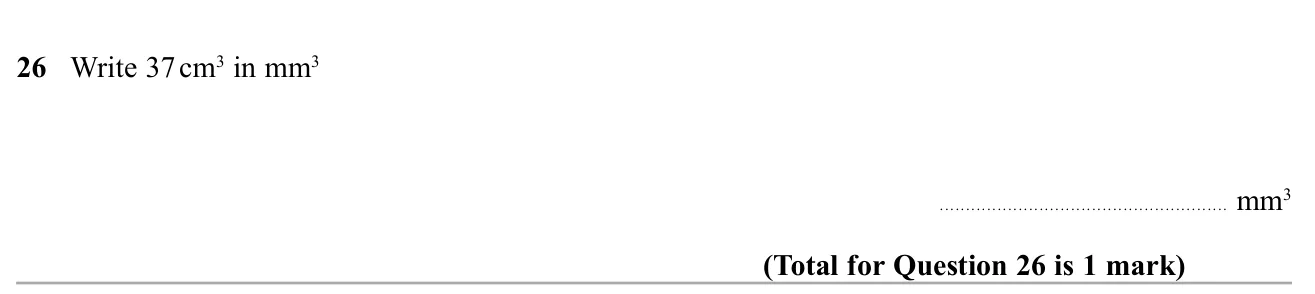
© Pearson Education Ltd. November 2019 Paper 3 (Foundation, calculator), question 26.
Worked solution Checked against the mark scheme
1 cm = 10 = 10 = 10 1 cm 3 = 10 × 10 × 10 = 1000 mm 3 1\text{ cm}^3 = 10 \times 10 \times 10 = 1000\text{ mm}^3 1 cm 3 = 10 × 10 × 10 = 1000 mm 3
37 × 1000 = 37 000 mm 3 37 \times 1000 = 37\,000\text{ mm}^3 37 × 1000 = 37 000 mm 3
Watch out: Multiplying by 10 to get 370.
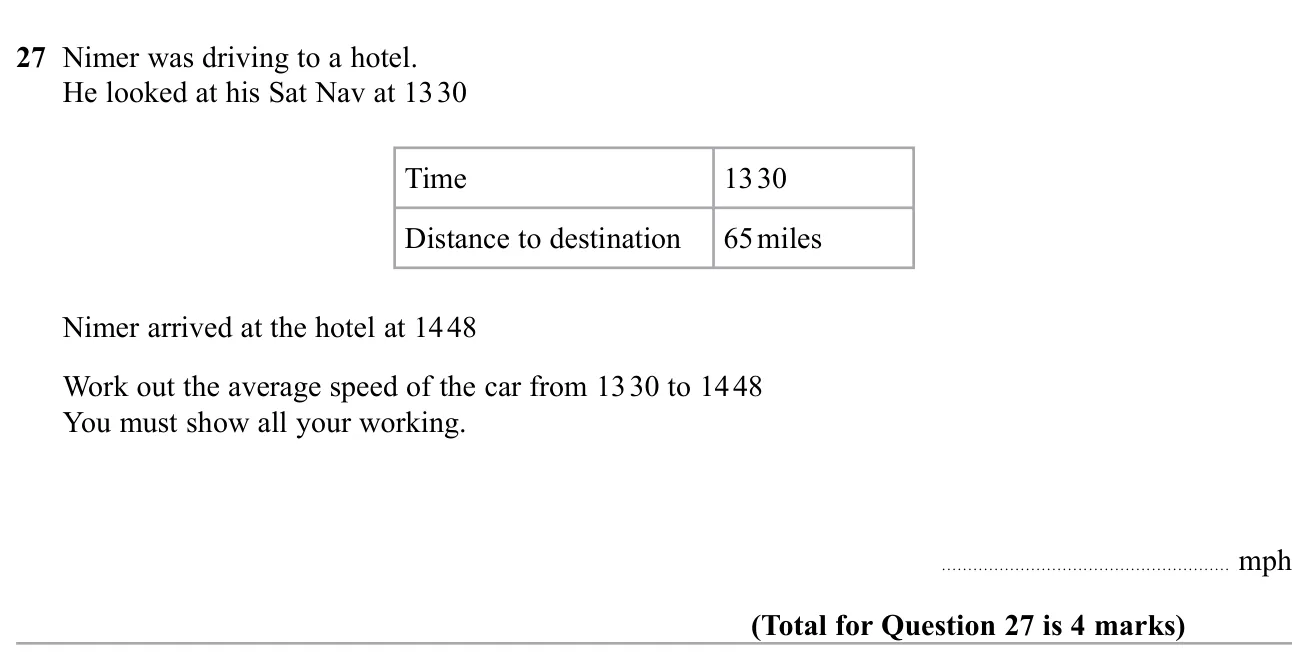
© Pearson Education Ltd. November 2019 Paper 3 (Foundation, calculator), question 27.
Worked solution Checked against the mark scheme
Time: 13 30 to 14 48 is 1 hour 18 minutes = 78 = 78 = 78
In hours: 78 ÷ 60 = 1.3 78 \div 60 = 1.3 78 ÷ 60 = 1.3
Speed = 65 ÷ 1.3 = 50 = 65 \div 1.3 = 50 = 65 ÷ 1.3 = 50
Watch out: Using 1.18 hours for 1 hour 18 minutes.
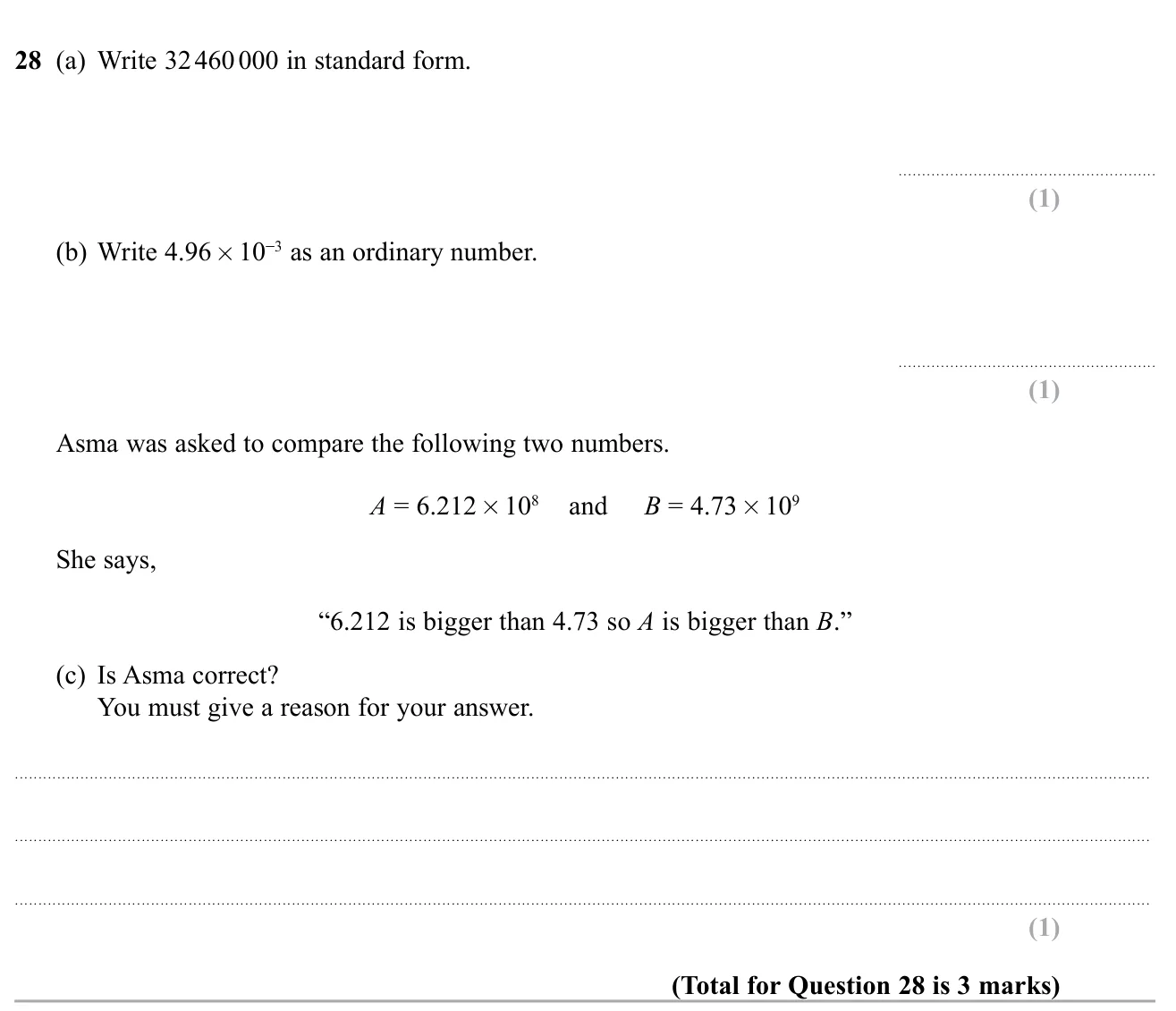
© Pearson Education Ltd. November 2019 Paper 3 (Foundation, calculator), question 28.
(a) 3.246 × 10 7 3.246 \times 10^7 3.246 × 1 0 7 1 mark (b) 0.00496 1 mark (c) No: 10 9 10^9 1 0 9 10 8 10^8 1 0 8 B B B 1 mark
Worked solution Checked against the mark scheme
(a) Put the decimal point after the first digit: 3.246 3.246 3.246 3.246 × 10 7 3.246 \times 10^7 3.246 × 1 0 7
(b) Move the point 3 places left: 0.00496 0.00496 0.00496
(c) No. A = 621 200 000 A = 621\,200\,000 A = 621 200 000 B = 4 730 000 000 B = 4\,730\,000\,000 B = 4 730 000 000 B B B
Watch out: In (b), moving the point the wrong way to get 4960.
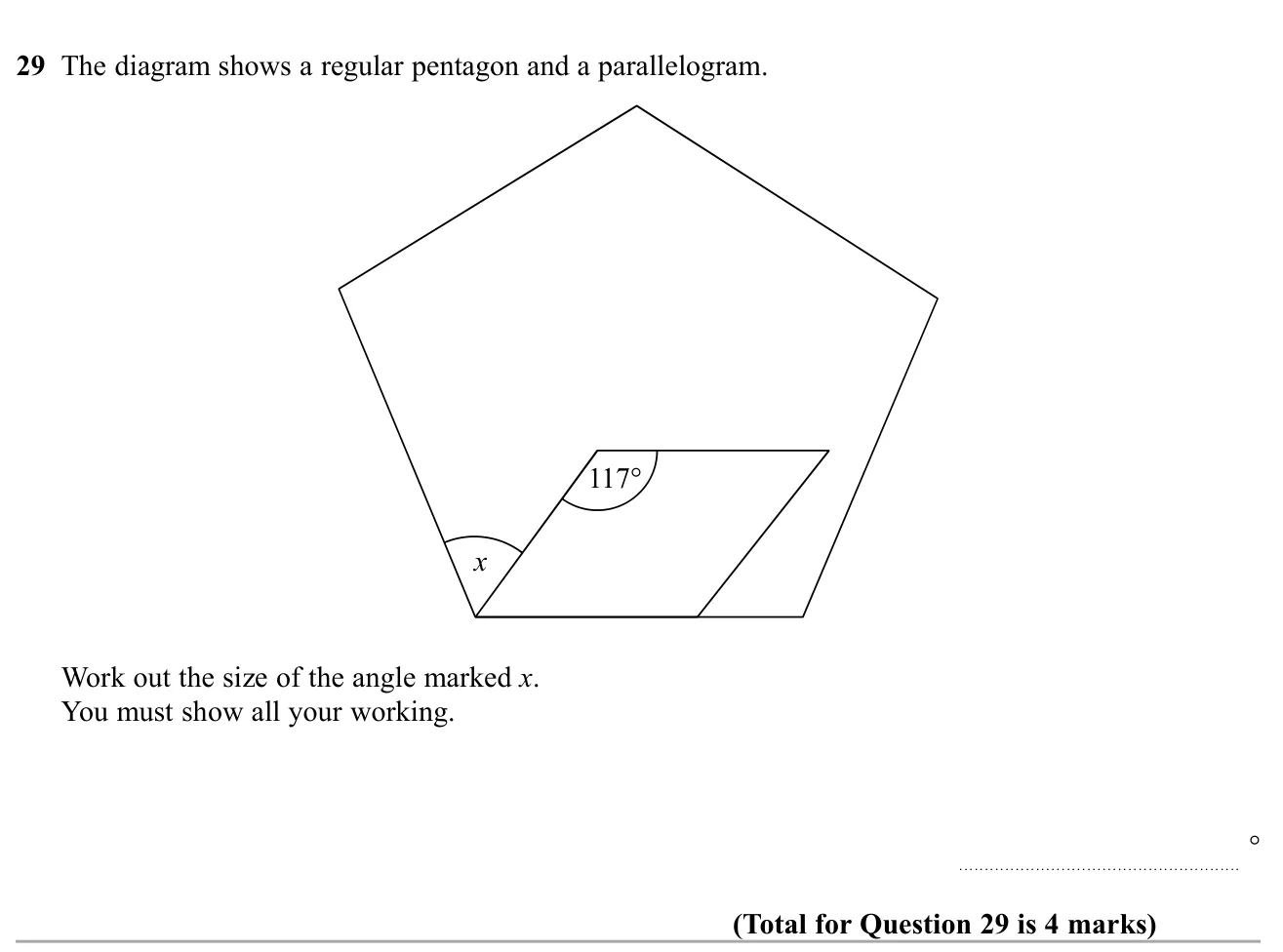
© Pearson Education Ltd. November 2019 Paper 3 (Foundation, calculator), question 29.
Worked solution Checked against the mark scheme
Co-interior angles in the parallelogram add to 180°: 180 − 117 = 63 ° 180 - 117 = 63° 180 − 117 = 63°
Interior angle of a regular pentagon: ( 5 − 2 ) × 180 ÷ 5 = 108 ° (5-2) \times 180 \div 5 = 108° ( 5 − 2 ) × 180 ÷ 5 = 108°
x = 108 − 63 = 45 ° x = 108 - 63 = 45° x = 108 − 63 = 45°
Watch out: Using 72° (the exterior angle) as the pentagon's interior angle.
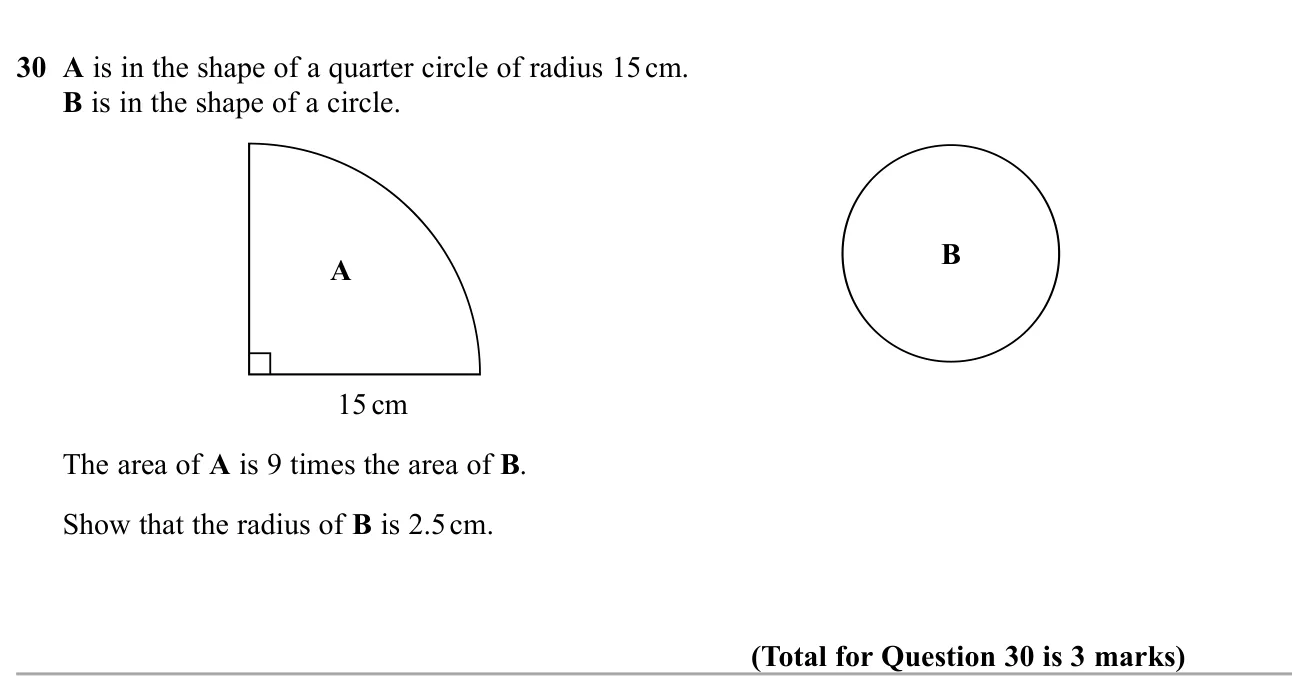
© Pearson Education Ltd. November 2019 Paper 3 (Foundation, calculator), question 30.
Answer Radius of B = 2.5 B = 2.5 B = 2.5 3 marks
Worked solution Checked against the mark scheme
Area of A = 1 4 × π × 15 2 = 56.25 π = \frac{1}{4} \times \pi \times 15^2 = 56.25\pi = 4 1 × π × 1 5 2 = 56.25 π
Area of B = 56.25 π ÷ 9 = 6.25 π = 56.25\pi \div 9 = 6.25\pi = 56.25 π ÷ 9 = 6.25 π
π r 2 = 6.25 π \pi r^2 = 6.25\pi π r 2 = 6.25 π r 2 = 6.25 r^2 = 6.25 r 2 = 6.25 r = 6.25 = 2.5 r = \sqrt{6.25} = 2.5 r = 6.25 = 2.5
Watch out: Forgetting to divide by 4 for the quarter circle.
Finished the paper? Add up your marks for all three papers and see what grade that would have been.