Question 1
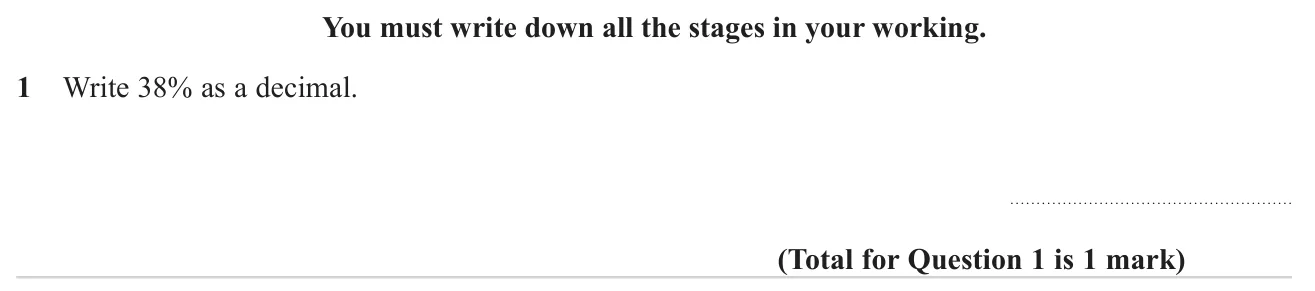
© Pearson Education Ltd. June 2023 Paper 1 (Foundation, non-calculator), question 1.
Show answer
| Answer | 1 mark |
|---|
Worked solution Checked against the mark scheme
Per cent means out of 100, so divide by 100.
Watch out: Writing 3.8
Edexcel GCSE Maths · 1MA1
Non-calculator · 31 questions · 80 marks · 1 hour 30 minutes. Try each question on paper, then press "Show answer".
© Pearson Education Ltd. June 2023 Paper 1 (Foundation, non-calculator), question 1.
| Answer | 1 mark |
|---|
Worked solution Checked against the mark scheme
Per cent means out of 100, so divide by 100.
Watch out: Writing 3.8
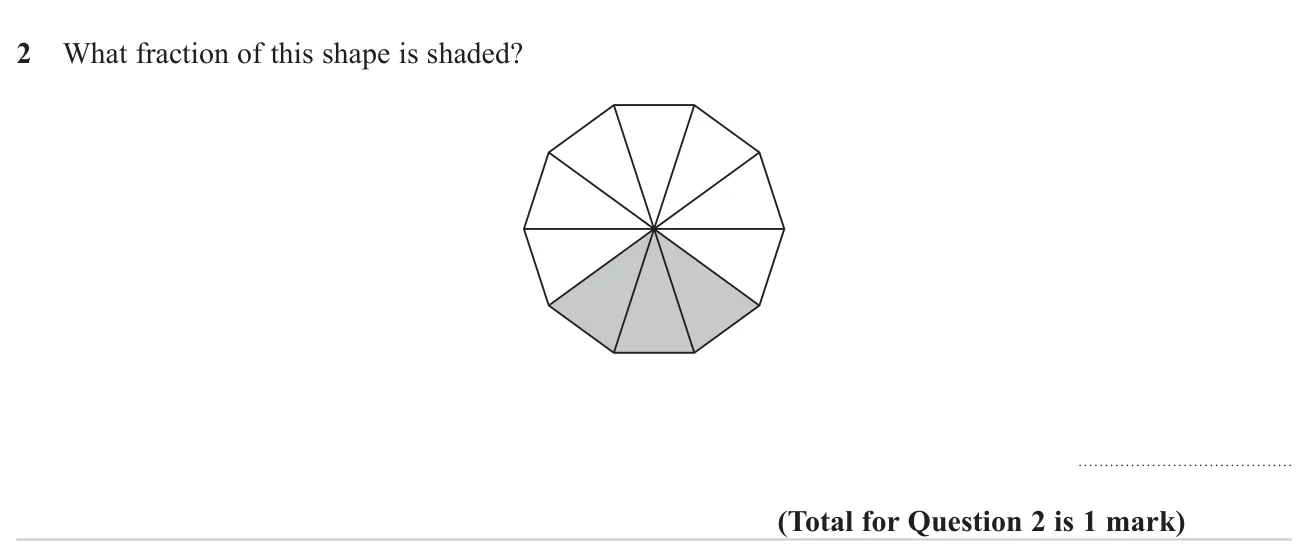
© Pearson Education Ltd. June 2023 Paper 1 (Foundation, non-calculator), question 2.
| Answer | 1 mark |
|---|
Worked solution Checked against the mark scheme
The shape is split into 10 equal triangles and 3 of them are shaded.
So the fraction shaded is .
Watch out: Writing the ratio 3 : 10 or 3 : 7 instead of a fraction.
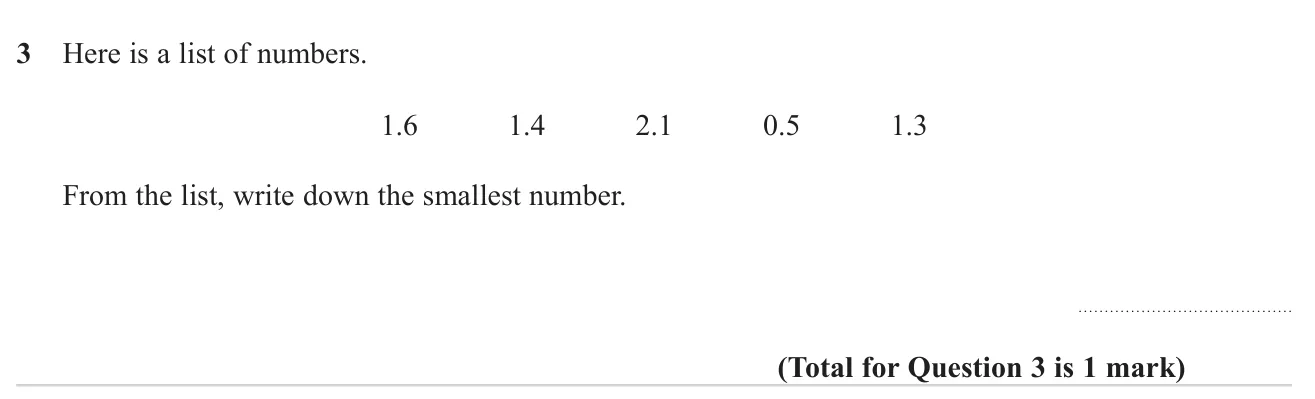
© Pearson Education Ltd. June 2023 Paper 1 (Foundation, non-calculator), question 3.
| Answer | 1 mark |
|---|
Worked solution Checked against the mark scheme
Compare the whole-number parts first: only 0.5 starts with 0.
So the smallest is .
Watch out: Choosing 1.3 by looking only at the digits after the point.

© Pearson Education Ltd. June 2023 Paper 1 (Foundation, non-calculator), question 4.
| Answer | 1 mark |
|---|
Worked solution Checked against the mark scheme
Start at on a number line and move 5 to the right.
Watch out: Giving 4 or −14.
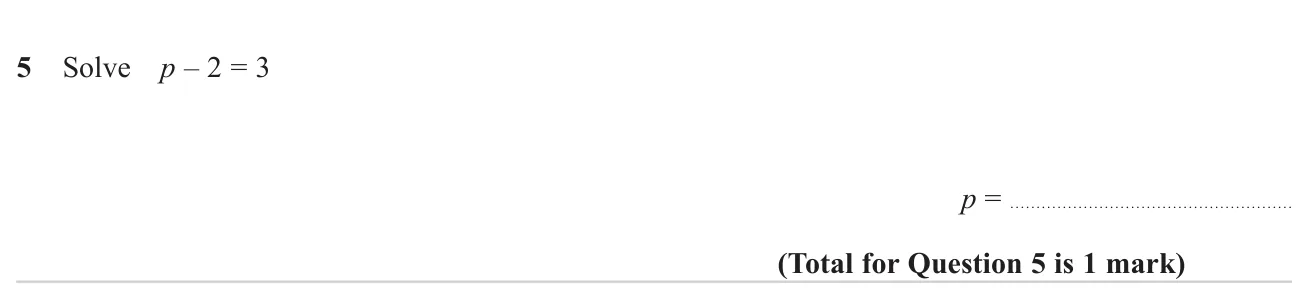
© Pearson Education Ltd. June 2023 Paper 1 (Foundation, non-calculator), question 5.
| Answer | 1 mark |
|---|
Worked solution Checked against the mark scheme
Add 2 to both sides.
Watch out: Subtracting instead of adding, giving 1.
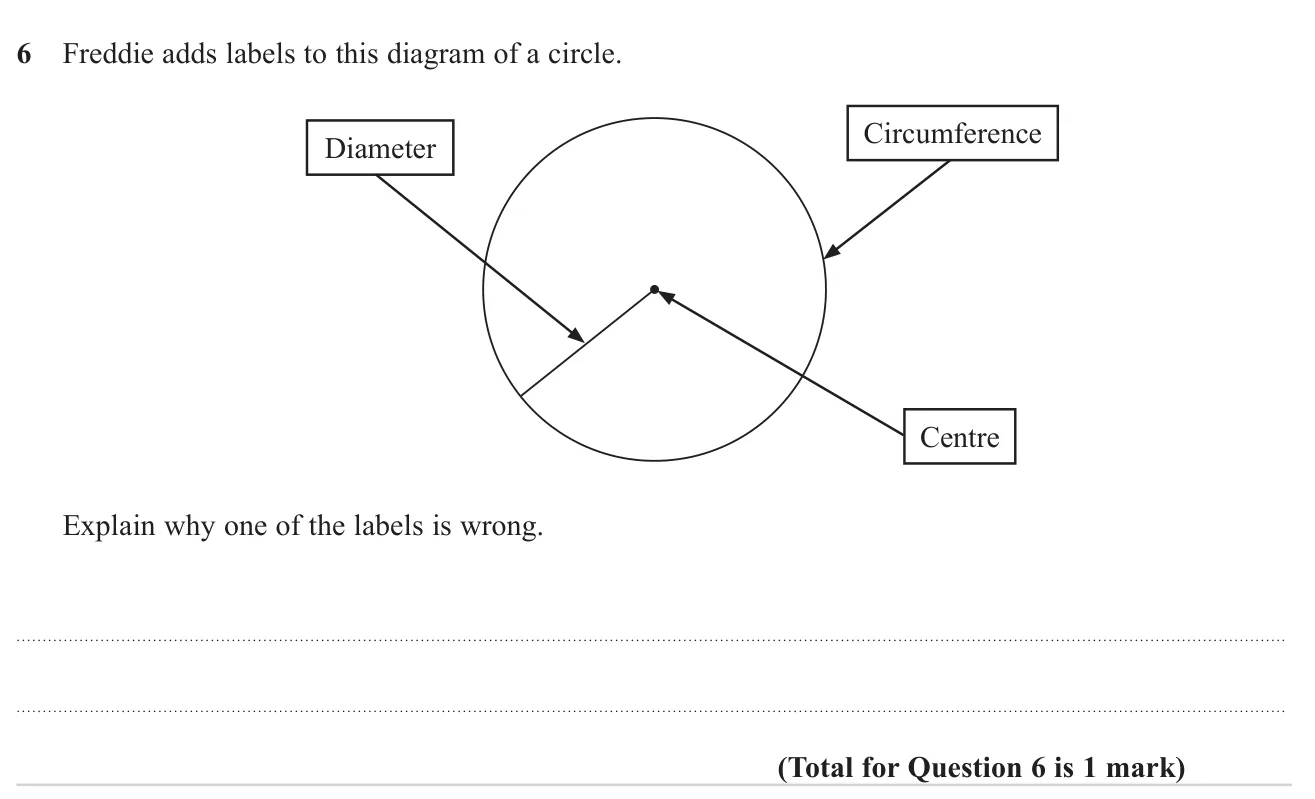
© Pearson Education Ltd. June 2023 Paper 1 (Foundation, non-calculator), question 6.
| Answer | The line labelled diameter only goes from the centre to the edge, so it is a radius | 1 mark |
|---|
Worked solution Checked against the mark scheme
The labelled line starts at the centre and stops at the circle.
A line like that is a radius. A diameter goes right across the circle through the centre, so the 'Diameter' label is wrong.
Watch out: Just saying 'a label is wrong' without naming which or why.
© Pearson Education Ltd. June 2023 Paper 1 (Foundation, non-calculator), question 7.
| Answer | Any three of | 2 marks |
|---|
Worked solution Checked against the mark scheme
Find the factor pairs of 20: , , .
So the factors are 1, 2, 4, 5, 10, 20. Any three of these will do, e.g. 2, 4, 5.
Watch out: Writing multiples of 20 such as 40 or 60.
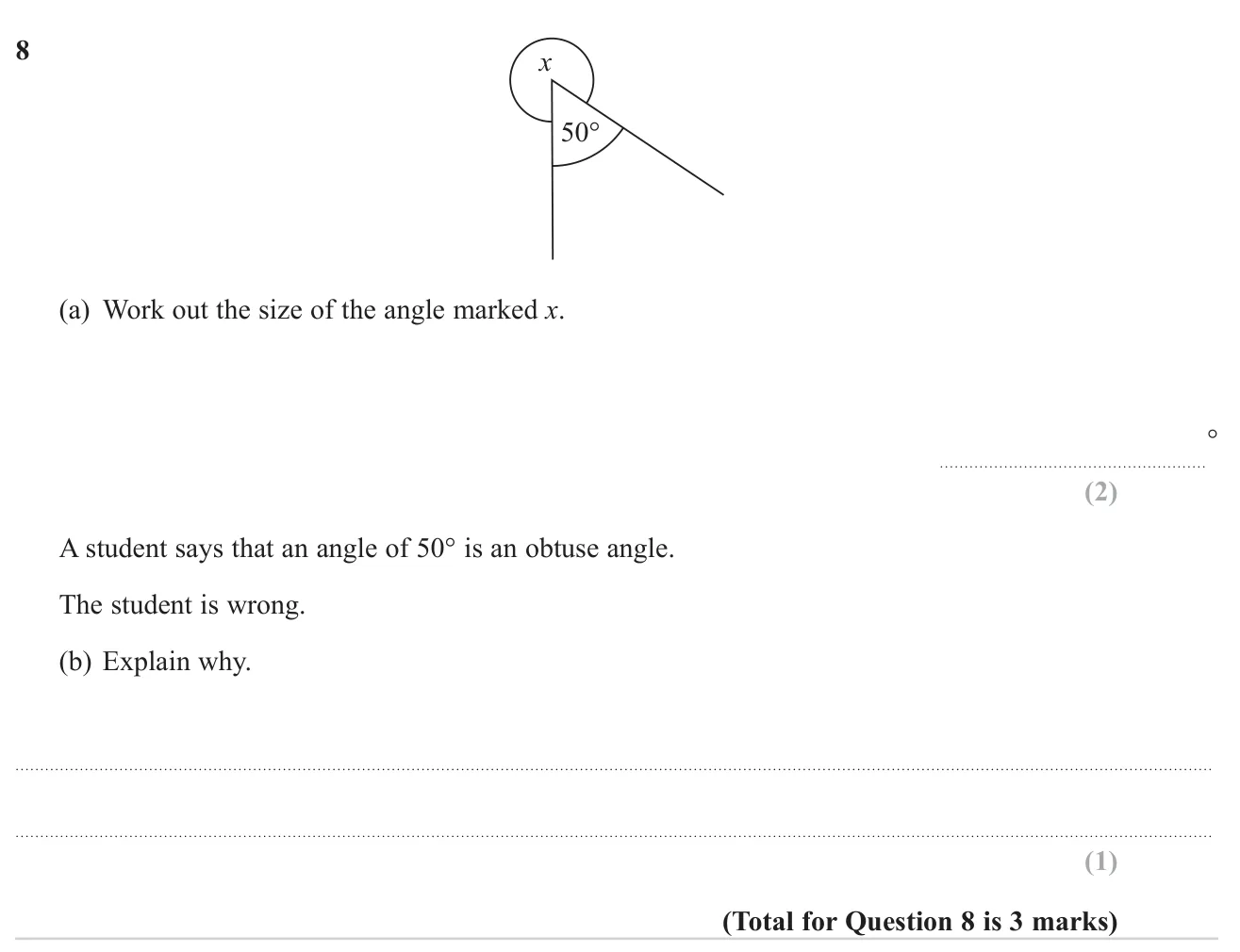
© Pearson Education Ltd. June 2023 Paper 1 (Foundation, non-calculator), question 8.
| (a) | 2 marks | |
|---|---|---|
| (b) | is less than , so it is acute, not obtuse | 1 mark |
Worked solution Checked against the mark scheme
(a) Angles around a point add up to .
(b) An obtuse angle is between and . is less than , so it is an acute angle.
Watch out: Using 180 instead of 360 in (a), giving 130.
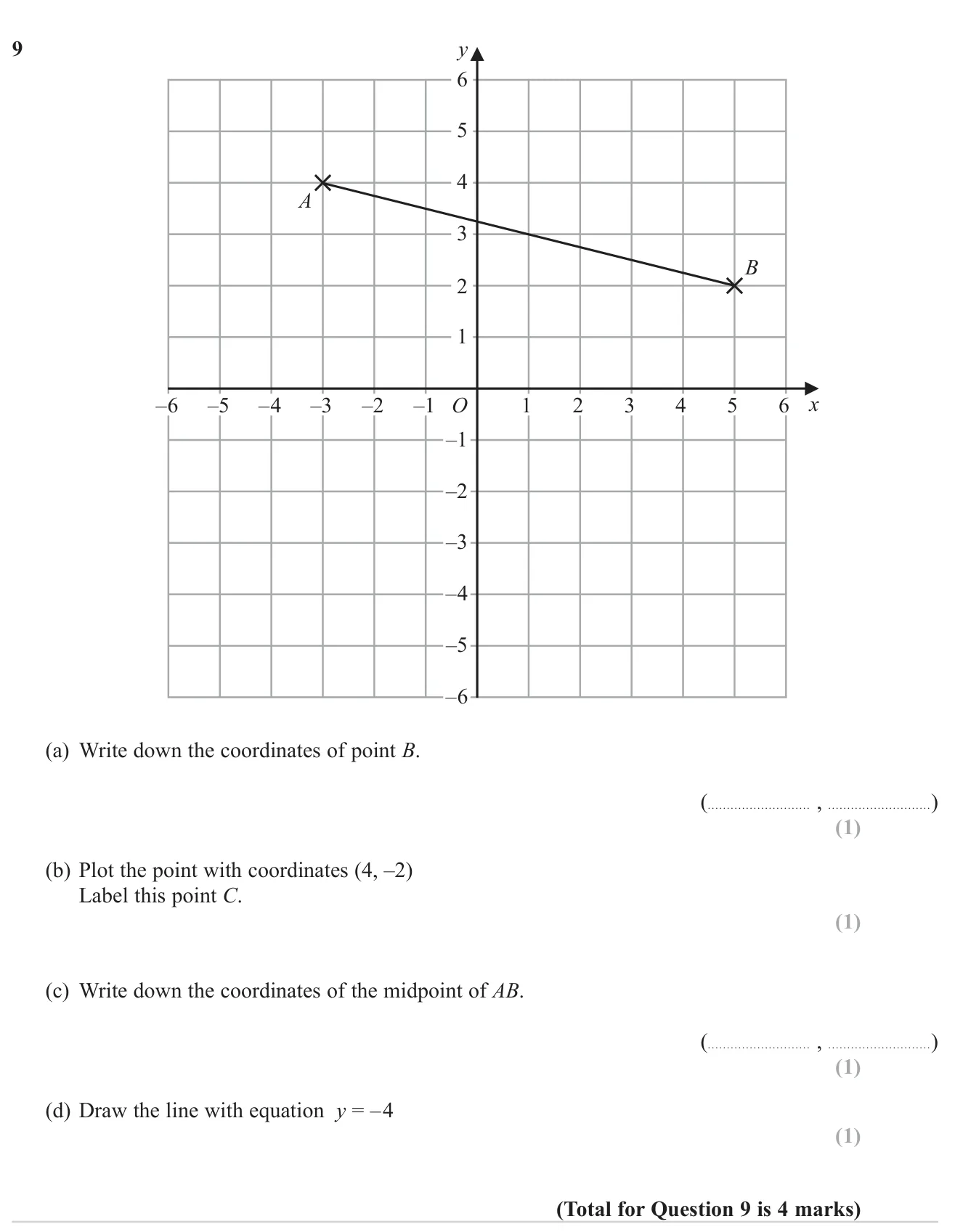
© Pearson Education Ltd. June 2023 Paper 1 (Foundation, non-calculator), question 9.
| (a) | 1 mark | |
|---|---|---|
| (b) | Point plotted at | 1 mark |
| (c) | 1 mark | |
| (d) | Horizontal line through | 1 mark |
Worked solution Checked against the mark scheme
(a) is 5 across and 2 up: .
(b) Go 4 right and 2 down, and mark .
(c) . Midpoint
(d) is the horizontal line through every point with -coordinate .
Watch out: Drawing a vertical line x = −4 in (d).
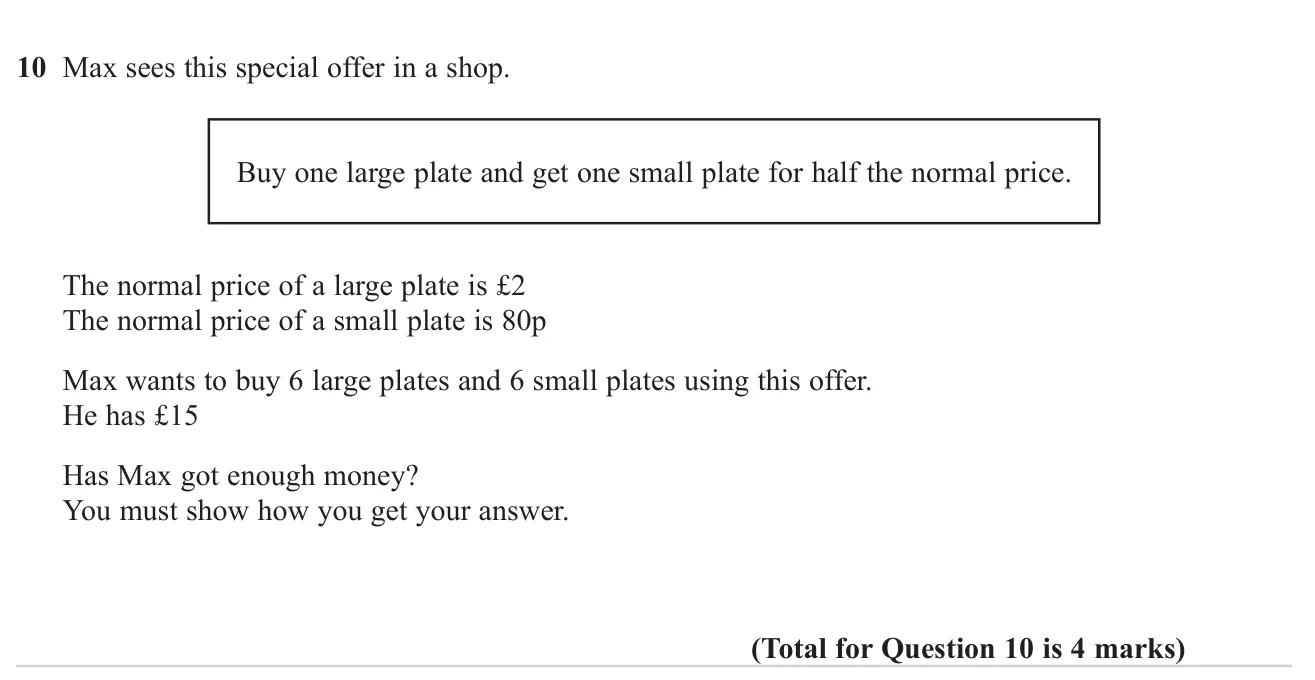
© Pearson Education Ltd. June 2023 Paper 1 (Foundation, non-calculator), question 10.
| Answer | Yes: the plates cost £14.40, which is less than £15 | 4 marks |
|---|
Worked solution Checked against the mark scheme
Large plates:
Each small plate is half price: , so
Total
, so yes, he has enough (with 60p left over).
Watch out: Forgetting to halve the small plate price, getting £16.80.
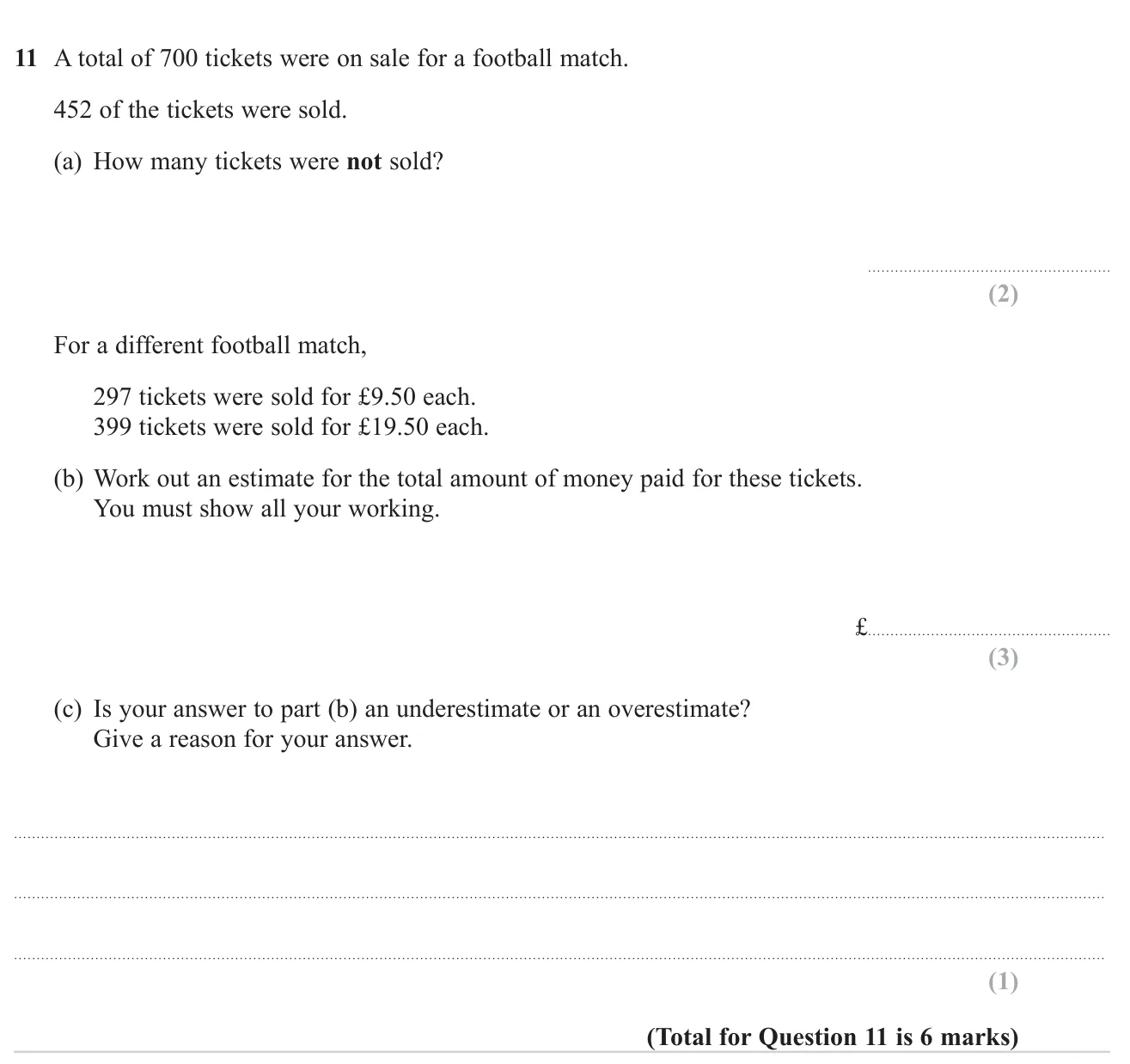
© Pearson Education Ltd. June 2023 Paper 1 (Foundation, non-calculator), question 11.
| (a) | 2 marks | |
|---|---|---|
| (b) | £11 000 | 3 marks |
| (c) | Overestimate, because every value was rounded up | 1 mark |
Worked solution Checked against the mark scheme
(a)
(b) Round to 1 s.f.: and
Estimate
(c) Overestimate: all four numbers were rounded up, so the true total is smaller.
Watch out: In (c), saying underestimate or talking about rounding the final answer.
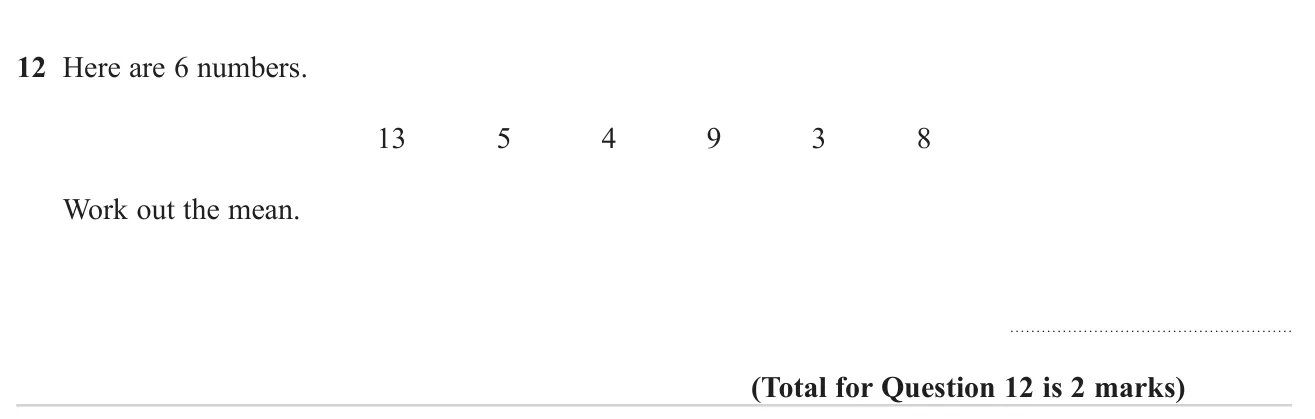
© Pearson Education Ltd. June 2023 Paper 1 (Foundation, non-calculator), question 12.
| Answer | 2 marks |
|---|
Worked solution Checked against the mark scheme
Add them:
Divide by how many there are:
Watch out: Dividing by 5 or giving the median.
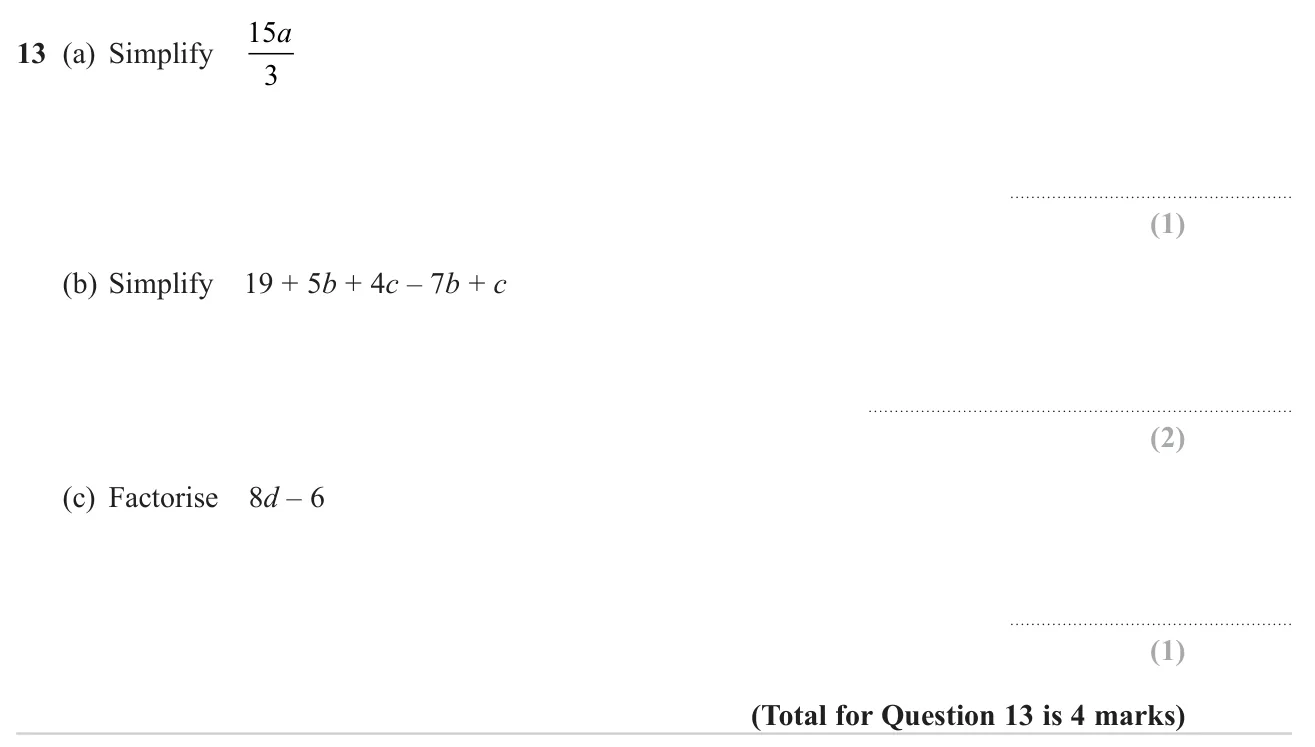
© Pearson Education Ltd. June 2023 Paper 1 (Foundation, non-calculator), question 13.
| (a) | 1 mark | |
|---|---|---|
| (b) | 2 marks | |
| (c) | 1 mark |
Worked solution Checked against the mark scheme
(a)
(b) terms: . terms: .
So
(c) The highest common factor of 8 and 6 is 2:
Watch out: In (b), writing +2b instead of −2b, or treating c as 0c.
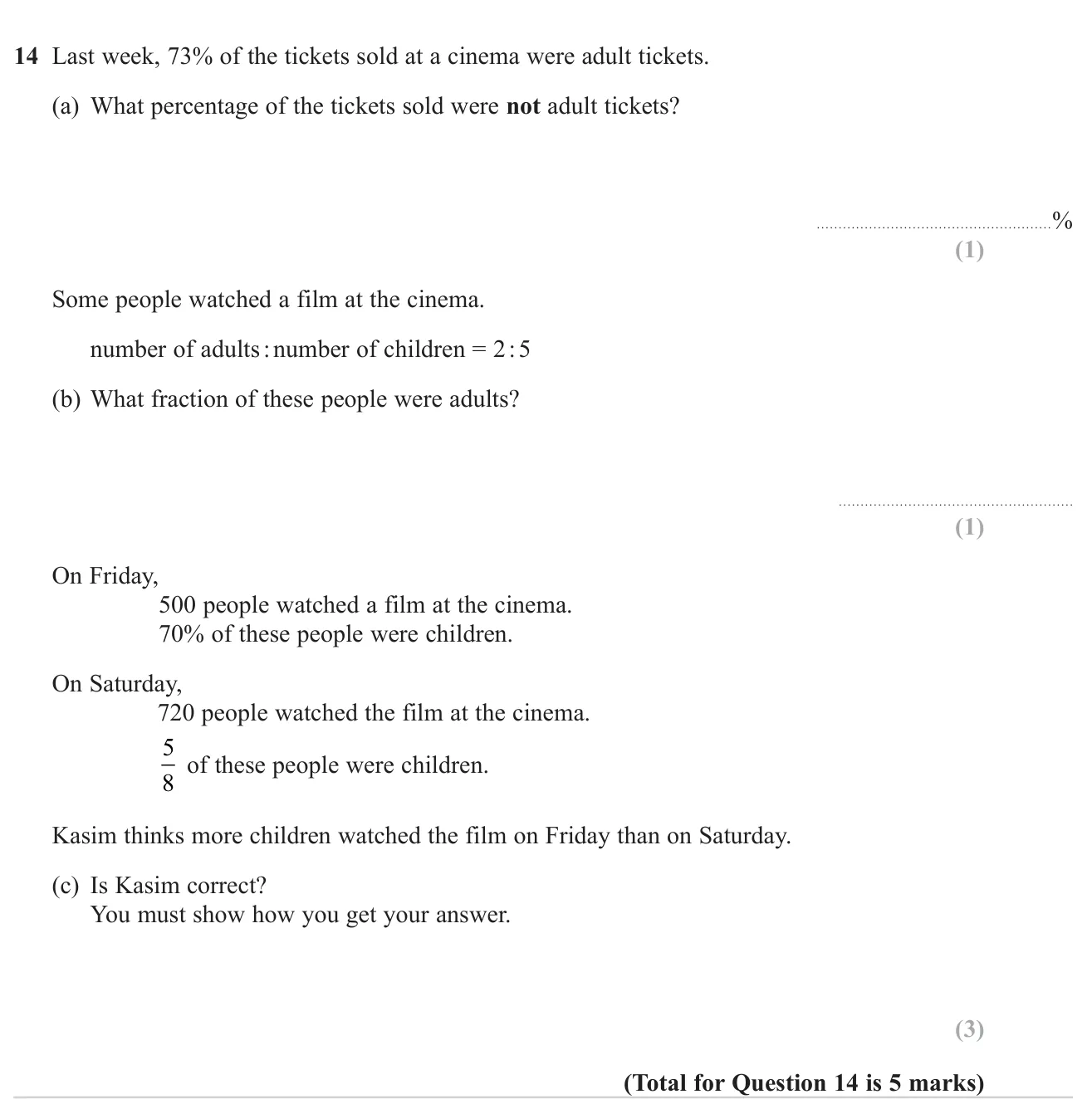
© Pearson Education Ltd. June 2023 Paper 1 (Foundation, non-calculator), question 14.
| (a) | 1 mark | |
|---|---|---|
| (b) | 1 mark | |
| (c) | No: 350 children on Friday, 450 on Saturday | 3 marks |
Worked solution Checked against the mark scheme
(a)
(b) Total parts , so adults are .
(c) Friday: children
Saturday: children
, so no, Kasim is wrong.
Watch out: In (b), writing 2/5 instead of 2/7.
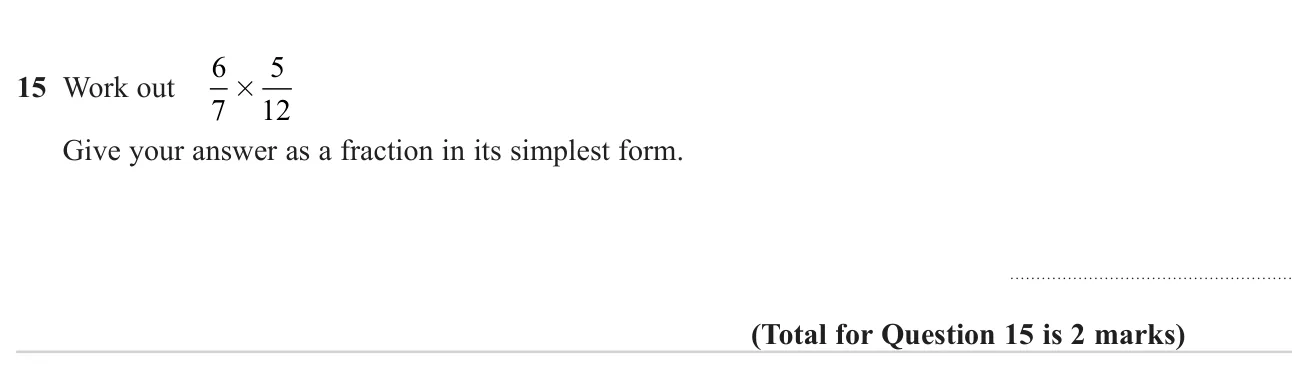
© Pearson Education Ltd. June 2023 Paper 1 (Foundation, non-calculator), question 15.
| Answer | 2 marks |
|---|
Worked solution Checked against the mark scheme
Multiply tops and bottoms:
Divide top and bottom by 6:
Watch out: Stopping at 30/84 without simplifying.
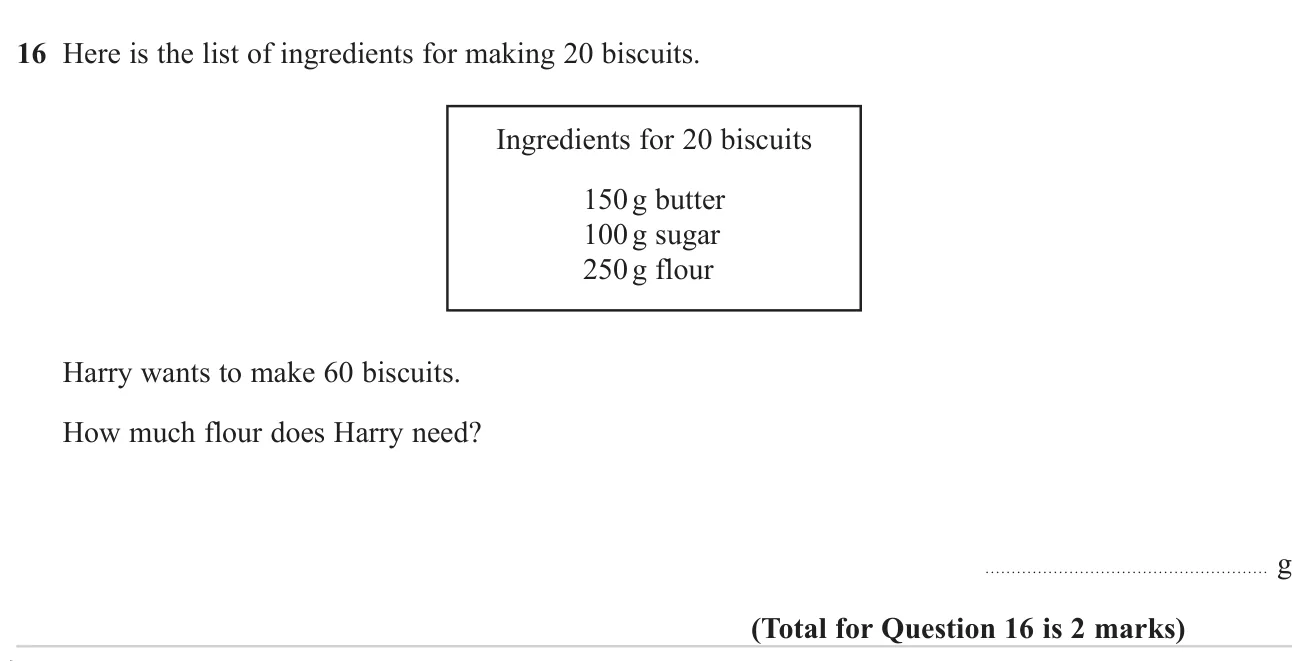
© Pearson Education Ltd. June 2023 Paper 1 (Foundation, non-calculator), question 16.
| Answer | g | 2 marks |
|---|
Worked solution Checked against the mark scheme
60 biscuits is times as many.
Flour: g
Watch out: Using the butter amount instead of the flour, getting 450.
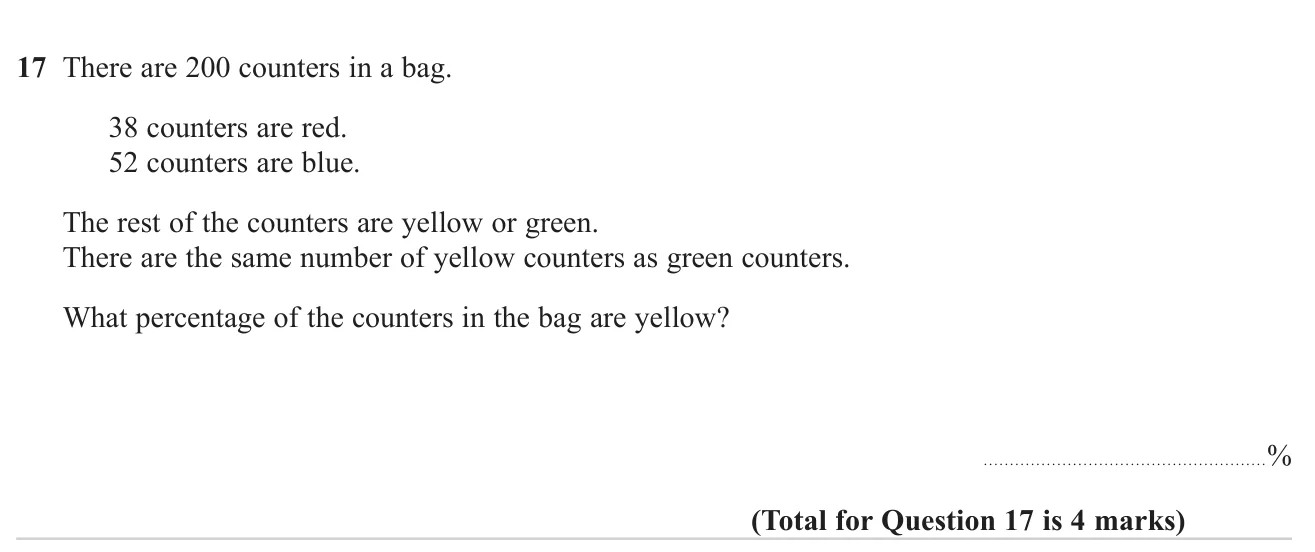
© Pearson Education Ltd. June 2023 Paper 1 (Foundation, non-calculator), question 17.
| Answer | 4 marks |
|---|
Worked solution Checked against the mark scheme
Yellow and green together:
Yellow:
Percentage:
Watch out: Giving 55% by forgetting to halve.
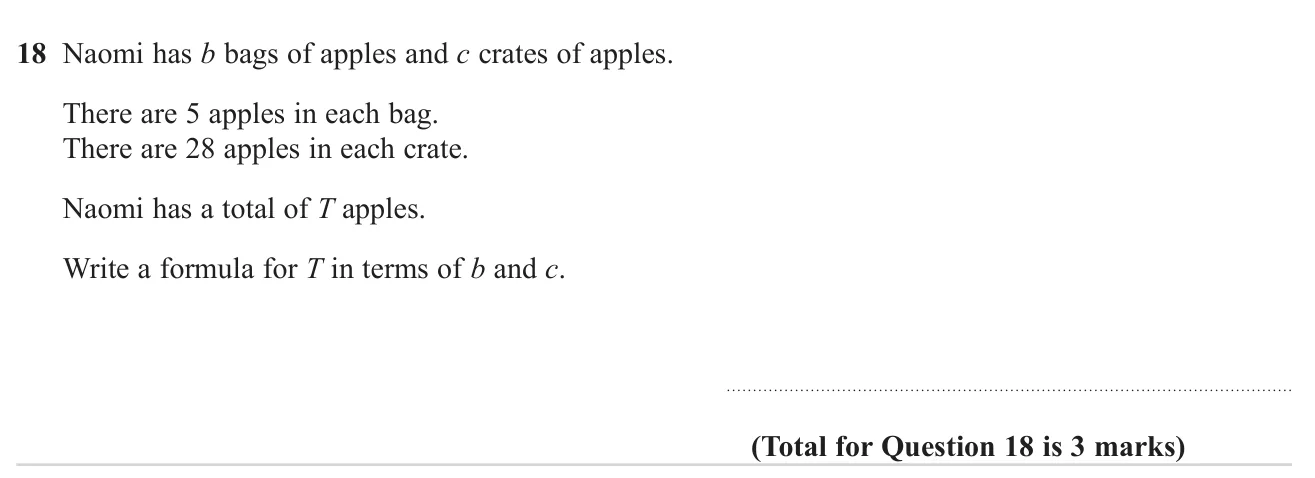
© Pearson Education Ltd. June 2023 Paper 1 (Foundation, non-calculator), question 18.
| Answer | 3 marks |
|---|
Worked solution Checked against the mark scheme
Each bag has 5 apples, so bags hold .
Each crate has 28 apples, so crates hold .
Watch out: Leaving out 'T =' or writing b + c = T.
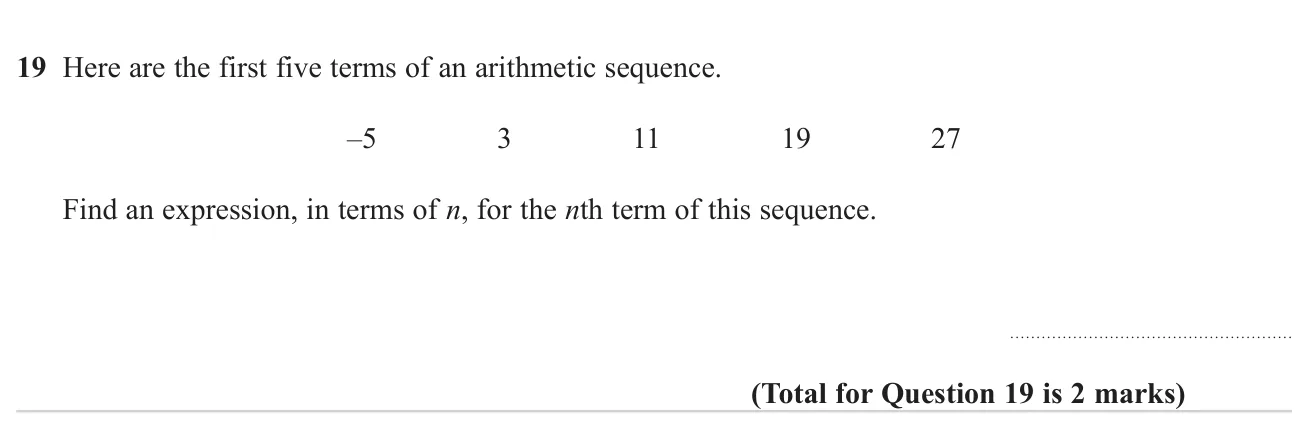
© Pearson Education Ltd. June 2023 Paper 1 (Foundation, non-calculator), question 19.
| Answer | 2 marks |
|---|
Worked solution Checked against the mark scheme
The terms go up by 8, so start with : 8, 16, 24, ...
Each term of the sequence is 13 less: .
nth term
Watch out: Writing 8n − 5 by using the first term as the constant.
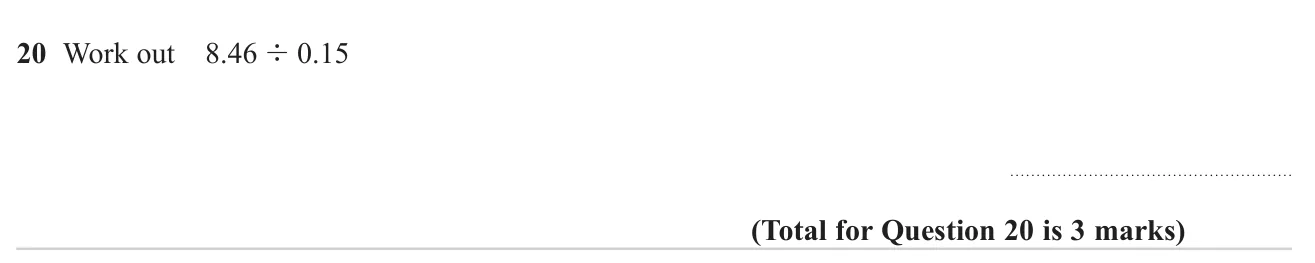
© Pearson Education Ltd. June 2023 Paper 1 (Foundation, non-calculator), question 20.
| Answer | 3 marks |
|---|
Worked solution Checked against the mark scheme
Multiply both numbers by 100:
, remainder 6, and
So the answer is
Watch out: Misplacing the decimal point, giving 5.64 or 564.
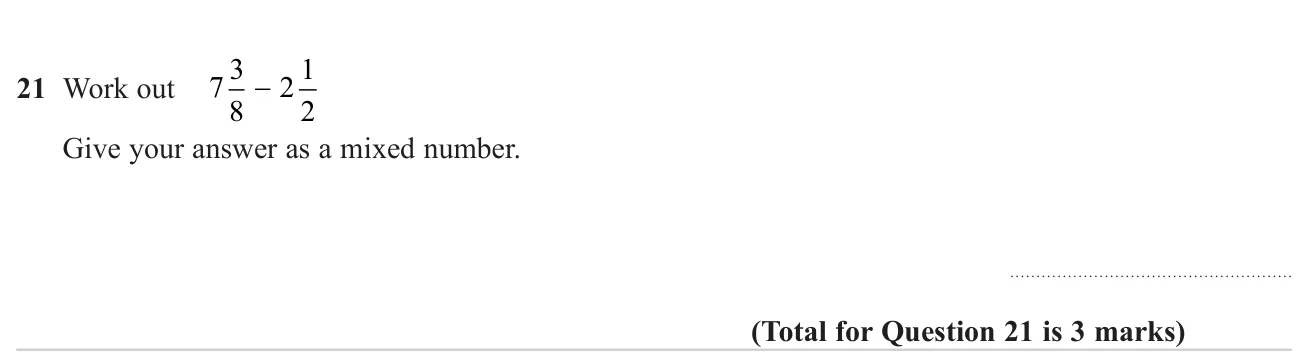
© Pearson Education Ltd. June 2023 Paper 1 (Foundation, non-calculator), question 21.
| Answer | 3 marks |
|---|
Worked solution Checked against the mark scheme
Make improper fractions: ,
Watch out: Doing the wrong way round, giving .
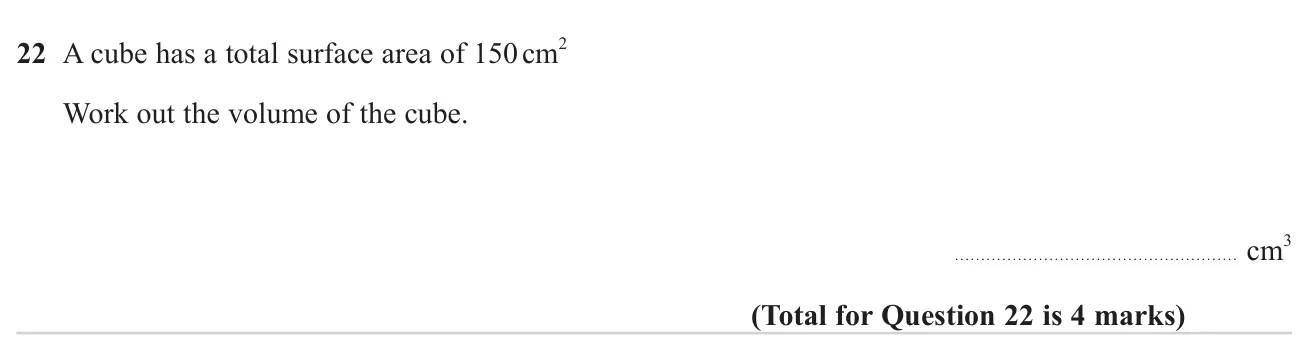
© Pearson Education Ltd. June 2023 Paper 1 (Foundation, non-calculator), question 22.
| Answer | 4 marks |
|---|
Worked solution Checked against the mark scheme
A cube has 6 equal faces: cm²
Edge length: cm
Volume: cm³
Watch out: Dividing by 4 or cube-rooting 150.
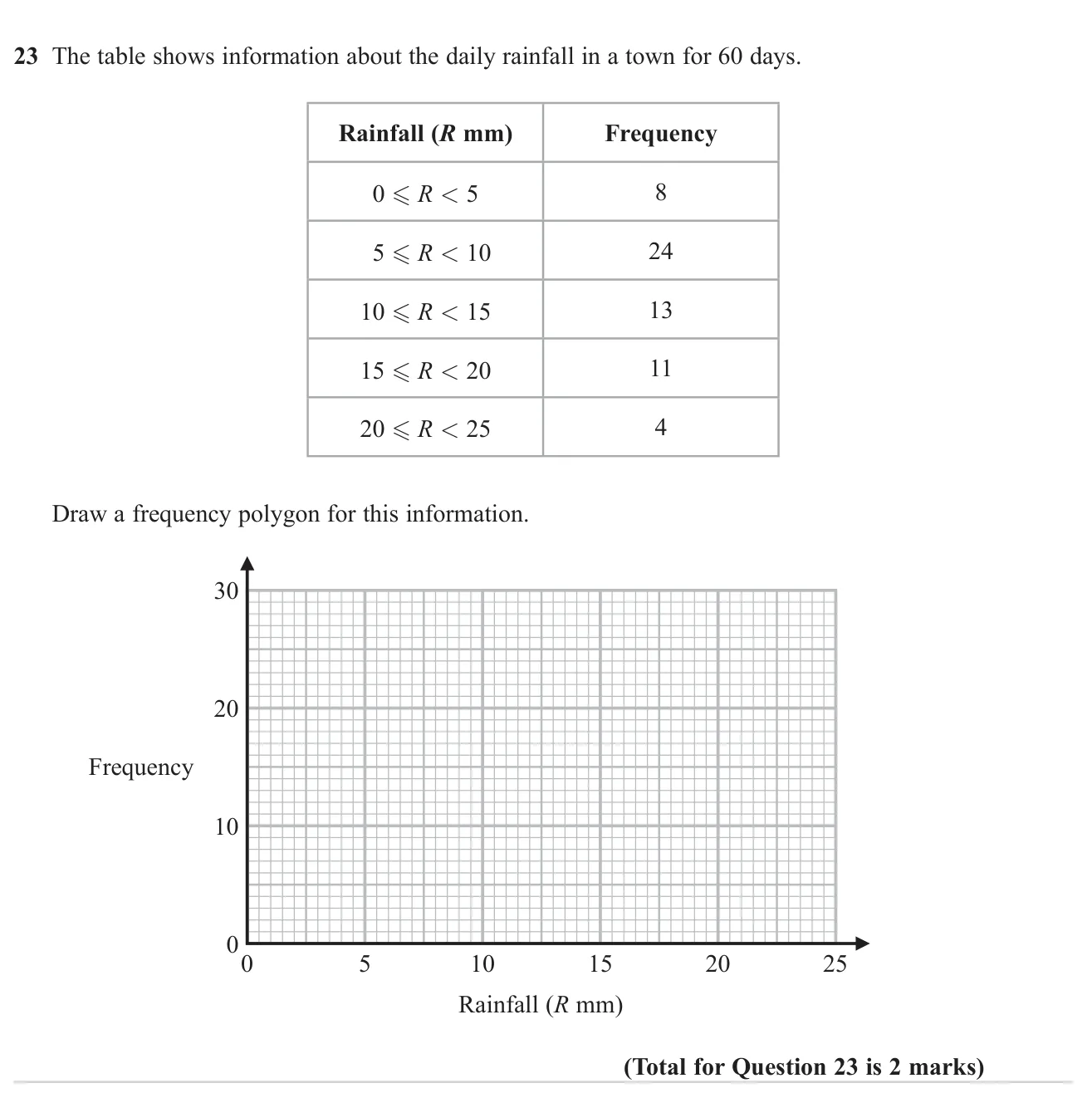
© Pearson Education Ltd. June 2023 Paper 1 (Foundation, non-calculator), question 23.
| Answer | Points at joined with straight lines | 2 marks |
|---|
Worked solution Checked against the mark scheme
Plot each frequency above the middle of its class: 2.5, 7.5, 12.5, 17.5, 22.5.
Points:
Join them in order with a ruler. Do not join the last point back to the first.
Watch out: Plotting at the class boundaries (0, 5, 10, …) instead of the midpoints.
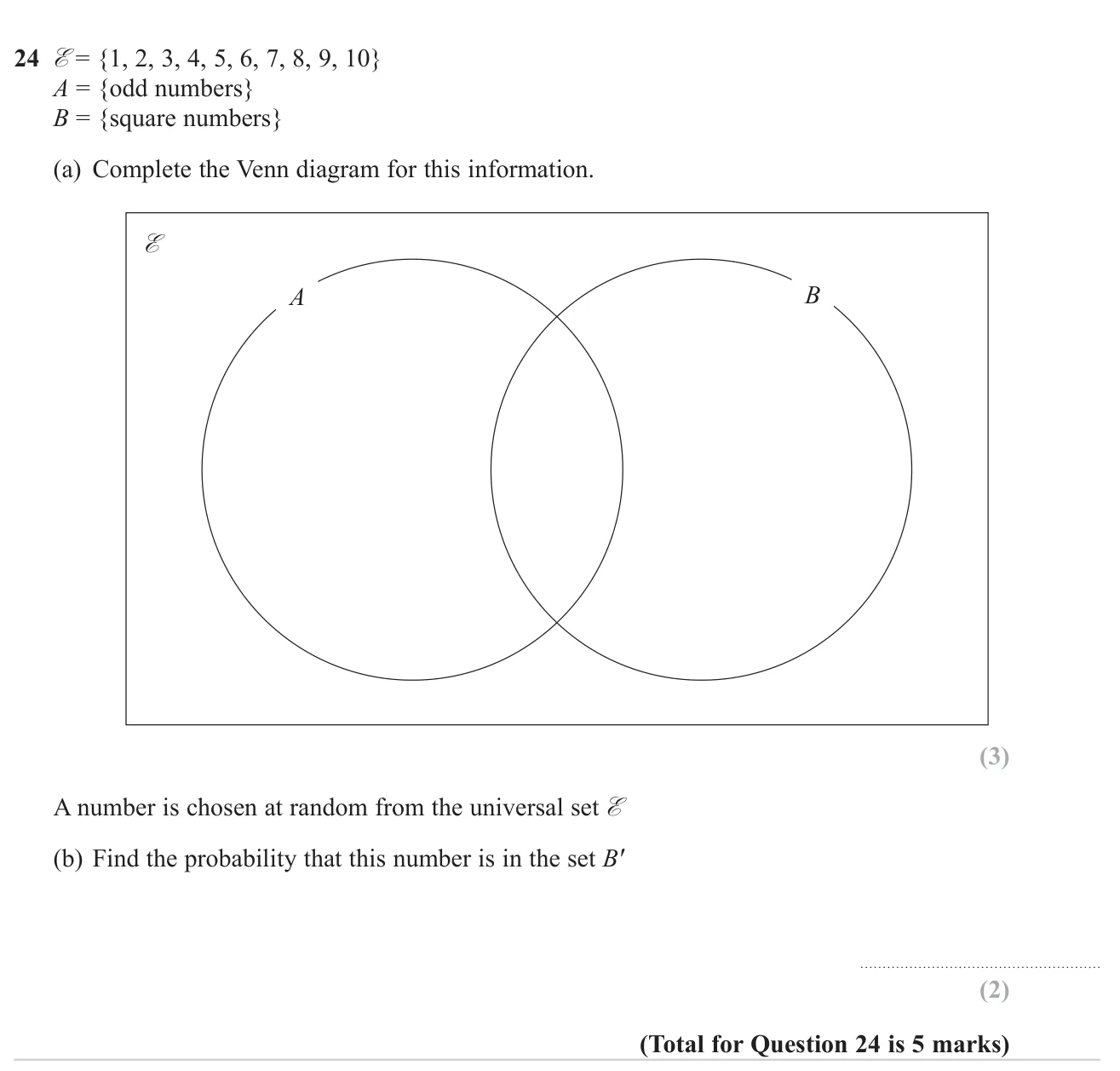
© Pearson Education Ltd. June 2023 Paper 1 (Foundation, non-calculator), question 24.
| (a) | only: 3, 5, 7; both: 1, 9; only: 4; outside: 2, 6, 8, 10 | 3 marks |
|---|---|---|
| (b) | 2 marks |
Worked solution Checked against the mark scheme
(a) Odd: 1, 3, 5, 7, 9. Square: 1, 4, 9.
In both: 1, 9. Odd only: 3, 5, 7. Square only: 4. Neither: 2, 6, 8, 10.
(b) means not square: numbers, so
Watch out: Forgetting that 1 is a square number.
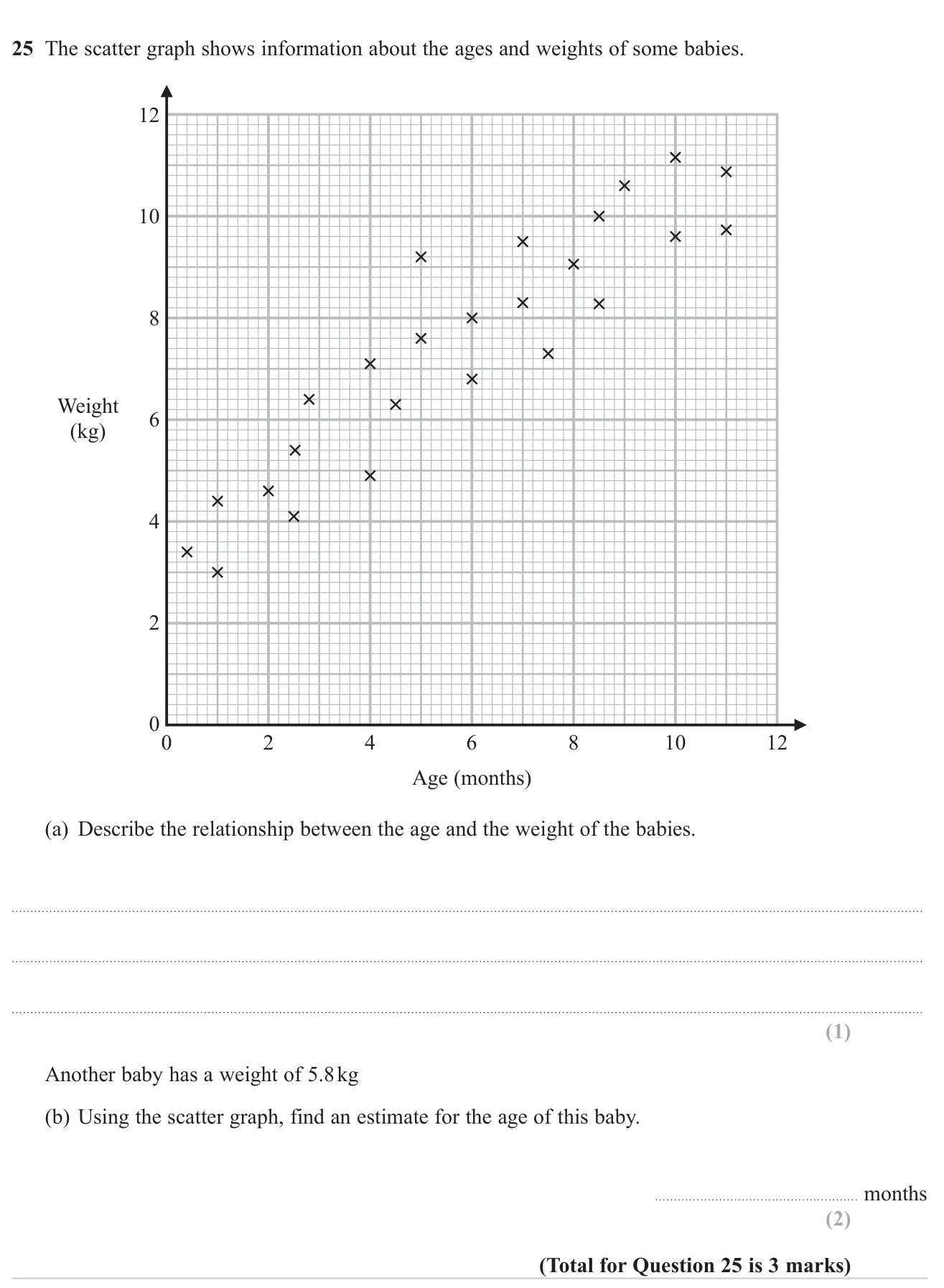
© Pearson Education Ltd. June 2023 Paper 1 (Foundation, non-calculator), question 25.
| (a) | Positive correlation: older babies tend to weigh more | 1 mark |
|---|---|---|
| (b) | About 3.5 months (accept 2.5 to 4.5) | 2 marks |
Worked solution Checked against the mark scheme
(a) As age increases, weight increases: positive correlation.
(b) Draw a line of best fit. Go across from 5.8 kg to the line, then down to the age axis.
This gives about 3.5 months.
Watch out: In (a), writing just 'positive' without saying correlation or describing the trend.
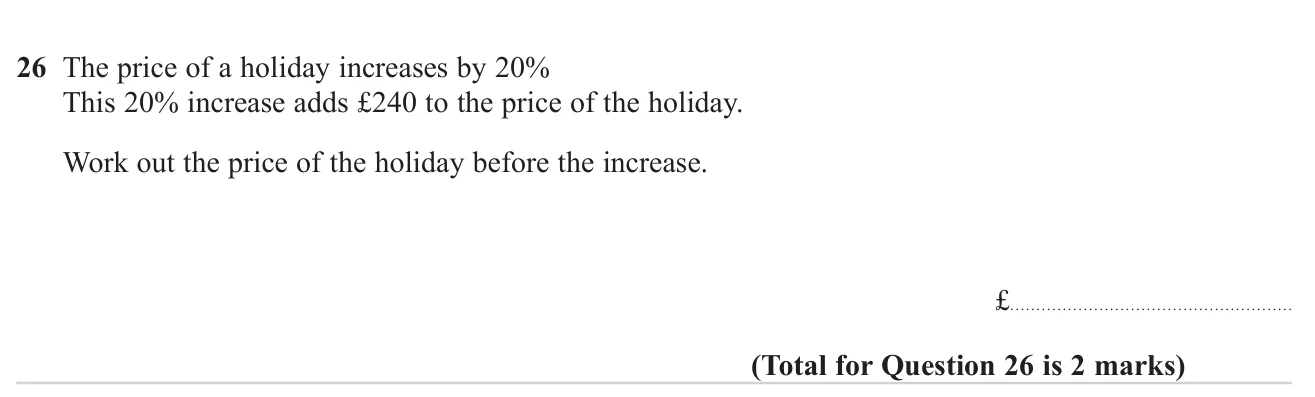
© Pearson Education Ltd. June 2023 Paper 1 (Foundation, non-calculator), question 26.
| Answer | £1200 | 2 marks |
|---|
Worked solution Checked against the mark scheme
20% of the price is £240.
10% is £120, so 100% is
Watch out: Adding 20% to 240 or finding 20% of 240.
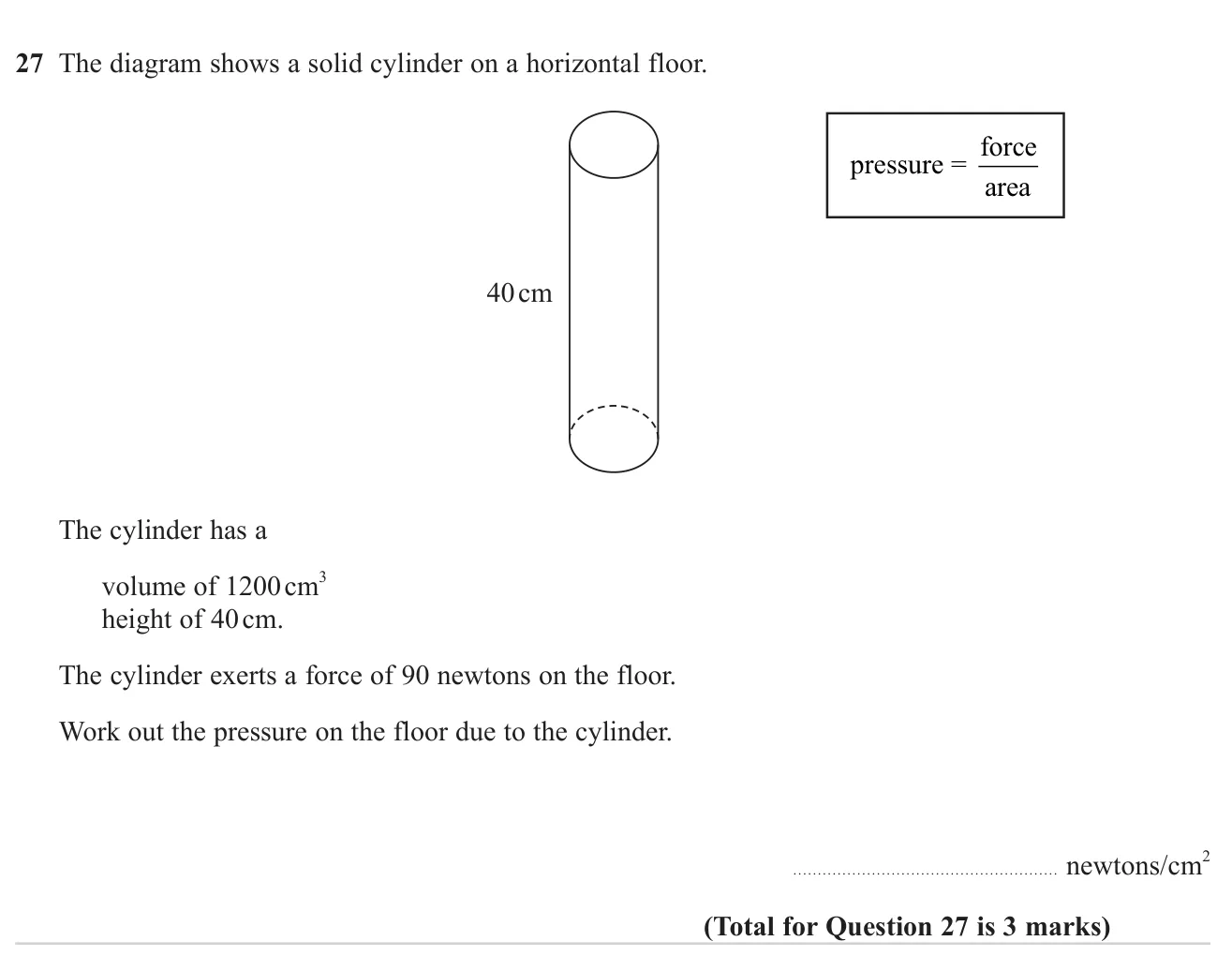
© Pearson Education Ltd. June 2023 Paper 1 (Foundation, non-calculator), question 27.
| Answer | 3 marks |
|---|
Worked solution Checked against the mark scheme
Volume = base area × height, so base area cm²
Pressure newtons/cm²
Watch out: Dividing 90 by 1200 without finding the base area.
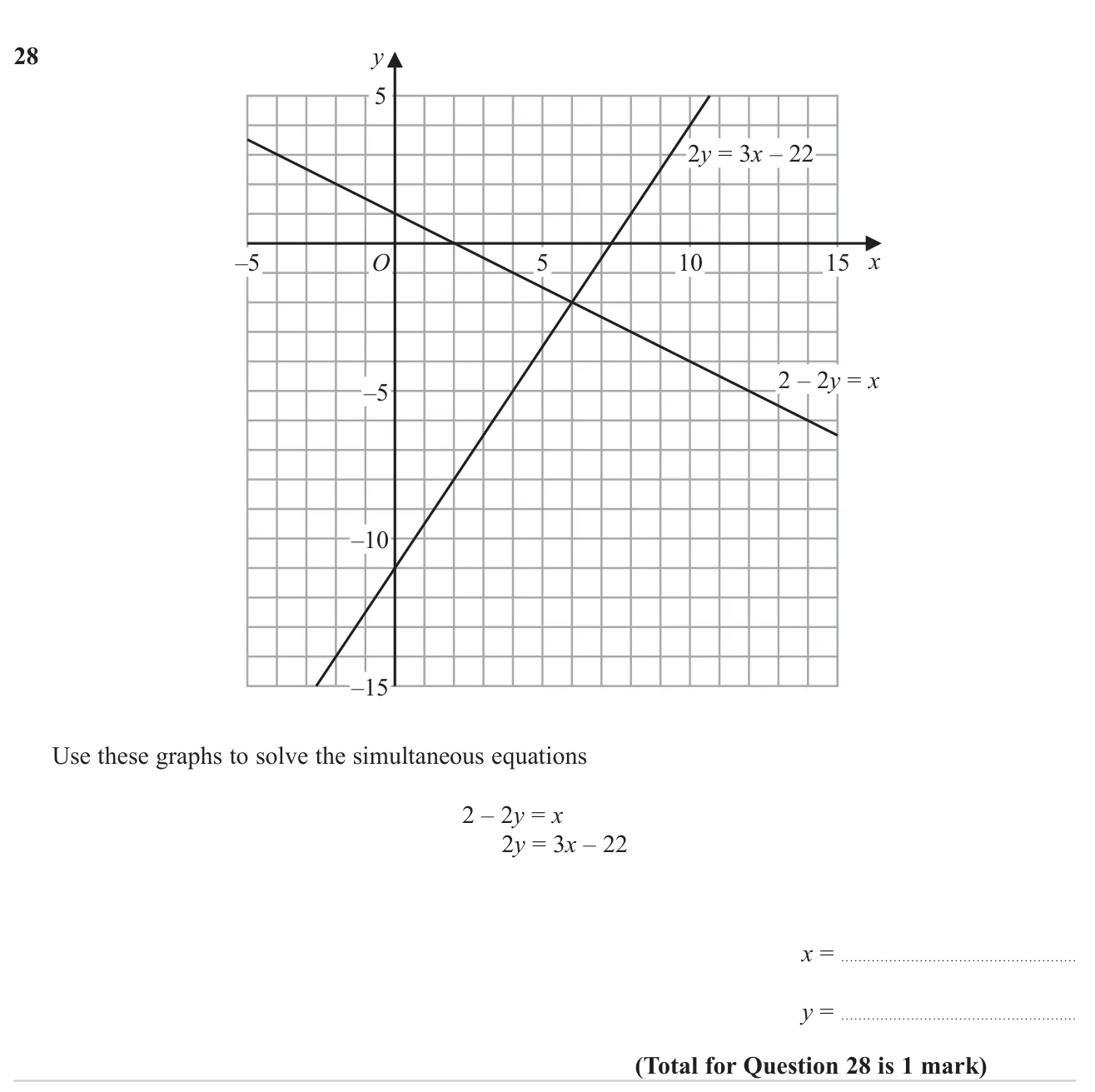
© Pearson Education Ltd. June 2023 Paper 1 (Foundation, non-calculator), question 28.
| Answer | 1 mark |
|---|
Worked solution Checked against the mark scheme
The solution is where the two lines meet, at .
Check: ✓ and ✓
So , .
Watch out: Swapping x and y.
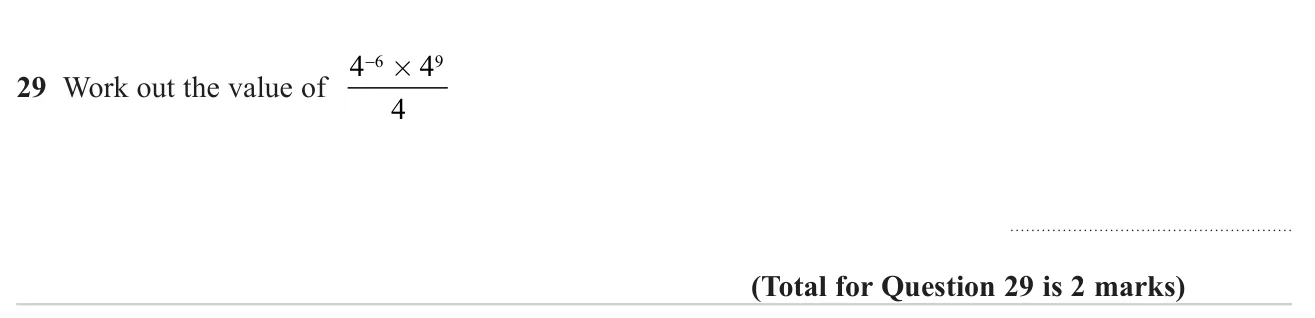
© Pearson Education Ltd. June 2023 Paper 1 (Foundation, non-calculator), question 29.
| Answer | 2 marks |
|---|
Worked solution Checked against the mark scheme
Multiplying: add the powers, , so the top is .
Dividing by : subtract the powers,
Watch out: Stopping at or writing 8.

© Pearson Education Ltd. June 2023 Paper 1 (Foundation, non-calculator), question 30.
| Answer | 1 mark |
|---|
Worked solution Checked against the mark scheme
This is one of the exact trig values to learn.
Watch out: Confusing with sin 60°, giving √3/2.
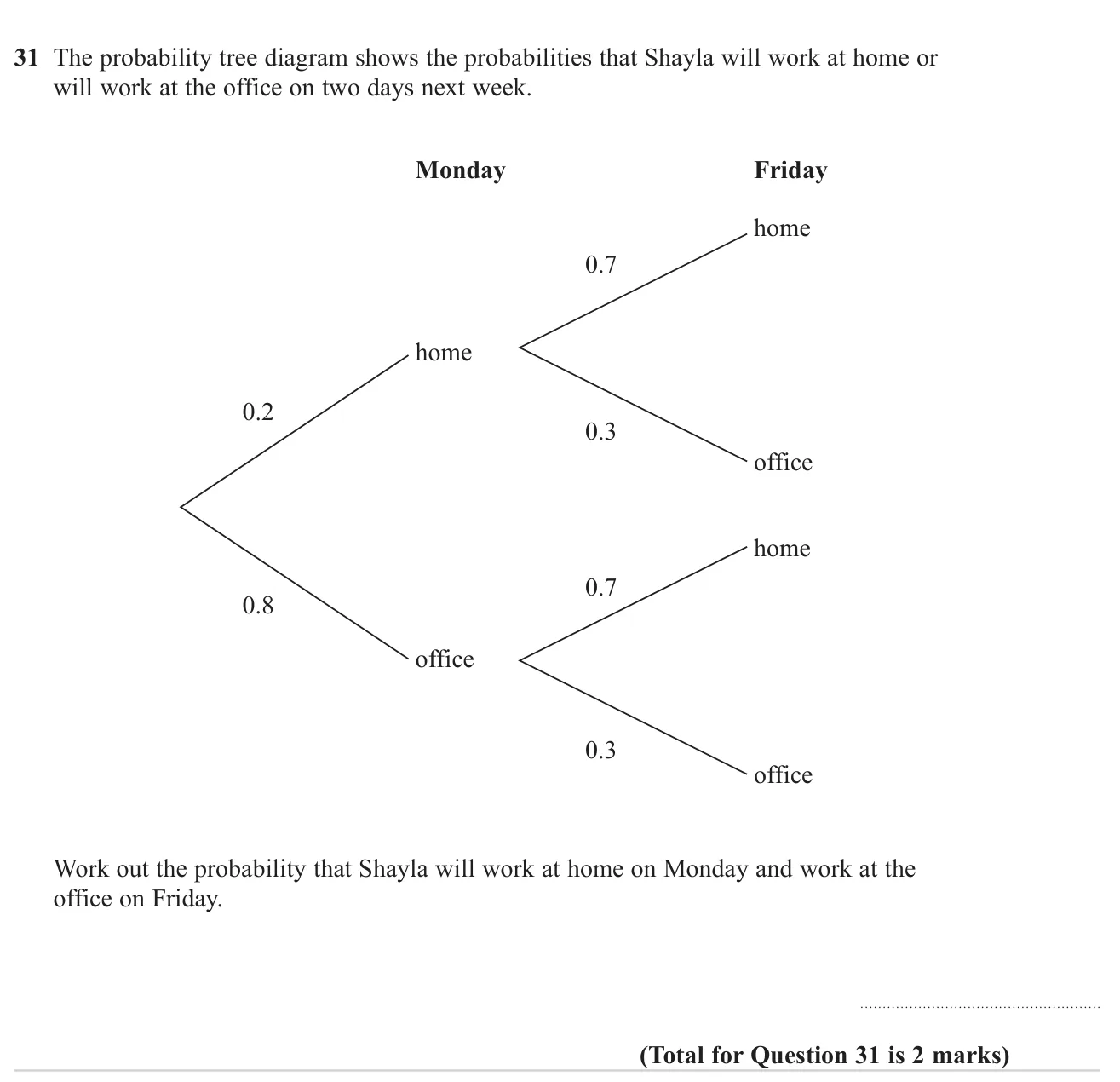
© Pearson Education Ltd. June 2023 Paper 1 (Foundation, non-calculator), question 31.
| Answer | 2 marks |
|---|
Worked solution Checked against the mark scheme
Follow the branches: home on Monday (0.2), then office on Friday (0.3).
Multiply along the branches:
Watch out: Adding the probabilities to get 0.5.
Add up your marks for all three papers and see what grade that would have been.