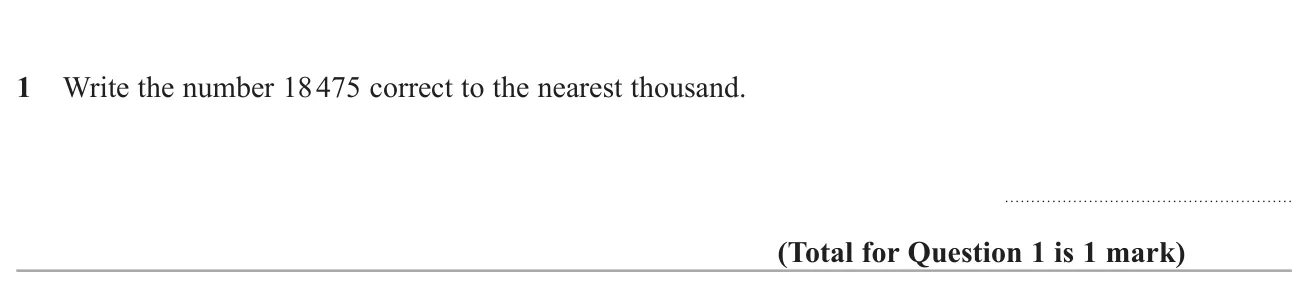
© Pearson Education Ltd. June 2024 Paper 1 (Foundation, non-calculator), question 1.
Show answer
| Answer | 18000 | 1 mark |
|---|
Worked solution Checked against the mark scheme
The thousands digit is 8 and the next digit is 4.
Since 4<5, round down: 18475≈18000.
Watch out: Rounding up to 19 000 or writing 18.
© Pearson Education Ltd. June 2024 Paper 1 (Foundation, non-calculator), question 2.
Show answer
Worked solution Checked against the mark scheme
Multiply by 100: 0.3×100=30, so 0.3=30%.
Watch out: Writing 3%.
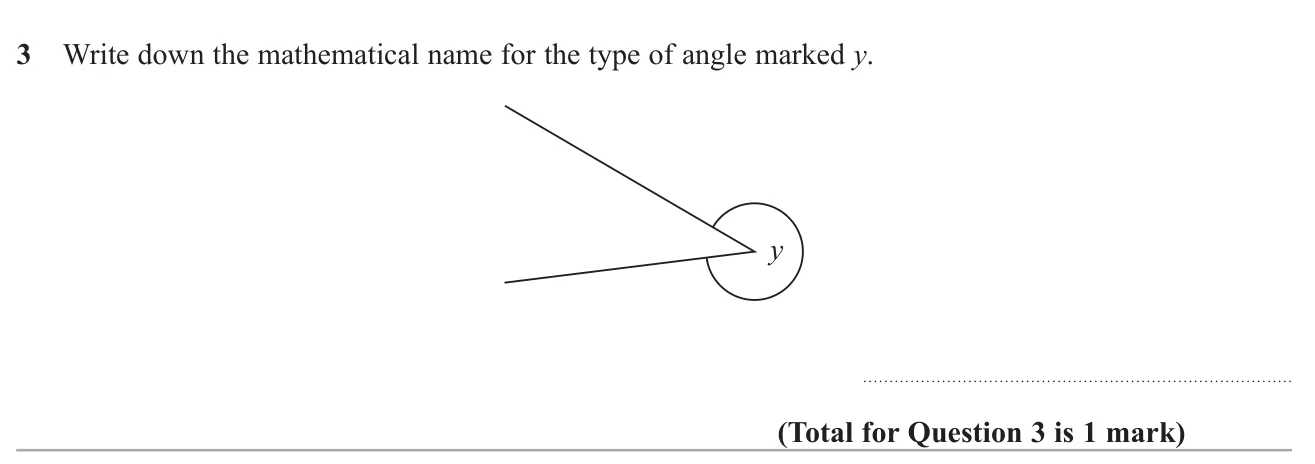
© Pearson Education Ltd. June 2024 Paper 1 (Foundation, non-calculator), question 3.
Show answer
Worked solution Checked against the mark scheme
The marked angle is bigger than 180∘ but less than 360∘, so it is a reflex angle.
Watch out: Calling it obtuse.
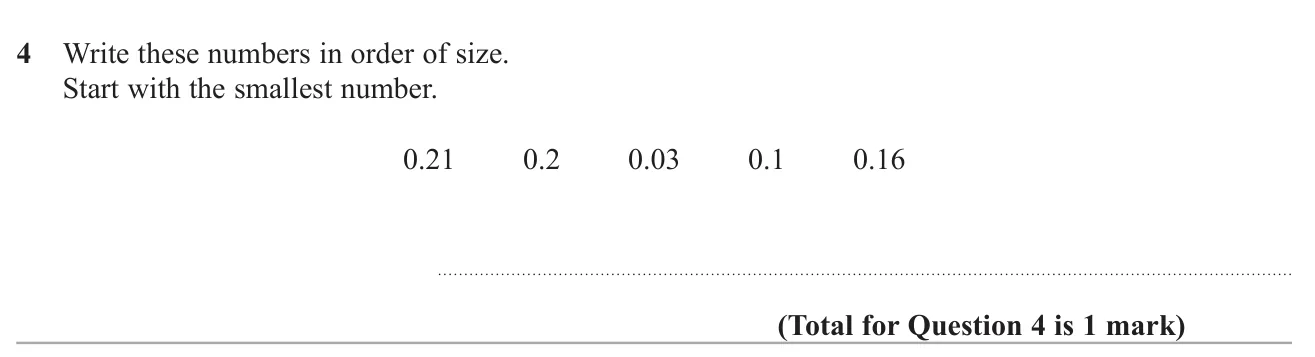
© Pearson Education Ltd. June 2024 Paper 1 (Foundation, non-calculator), question 4.
Show answer
| Answer | 0.03, 0.1, 0.16, 0.2, 0.21 | 1 mark |
|---|
Worked solution Checked against the mark scheme
Write each with two decimal places: 0.21, 0.20, 0.03, 0.10, 0.16.
Order: 0.03, 0.1, 0.16, 0.2, 0.21.
Watch out: Thinking 0.16 is bigger than 0.2 because 16 > 2.
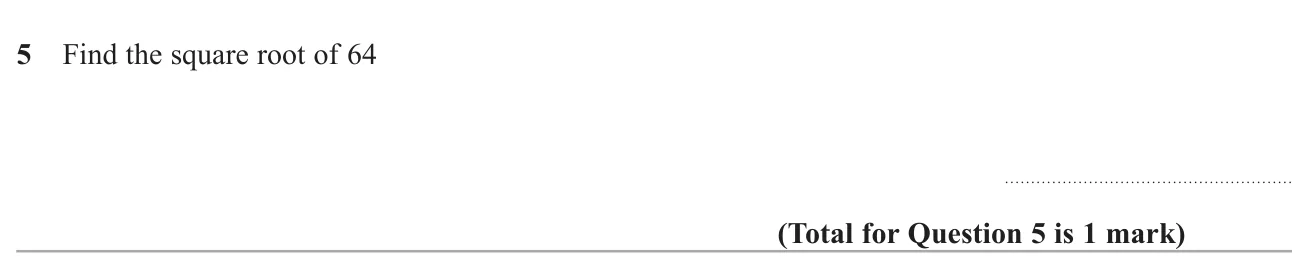
© Pearson Education Ltd. June 2024 Paper 1 (Foundation, non-calculator), question 5.
Show answer
Worked solution Checked against the mark scheme
8×8=64, so 64=8.
Watch out: Halving to get 32.
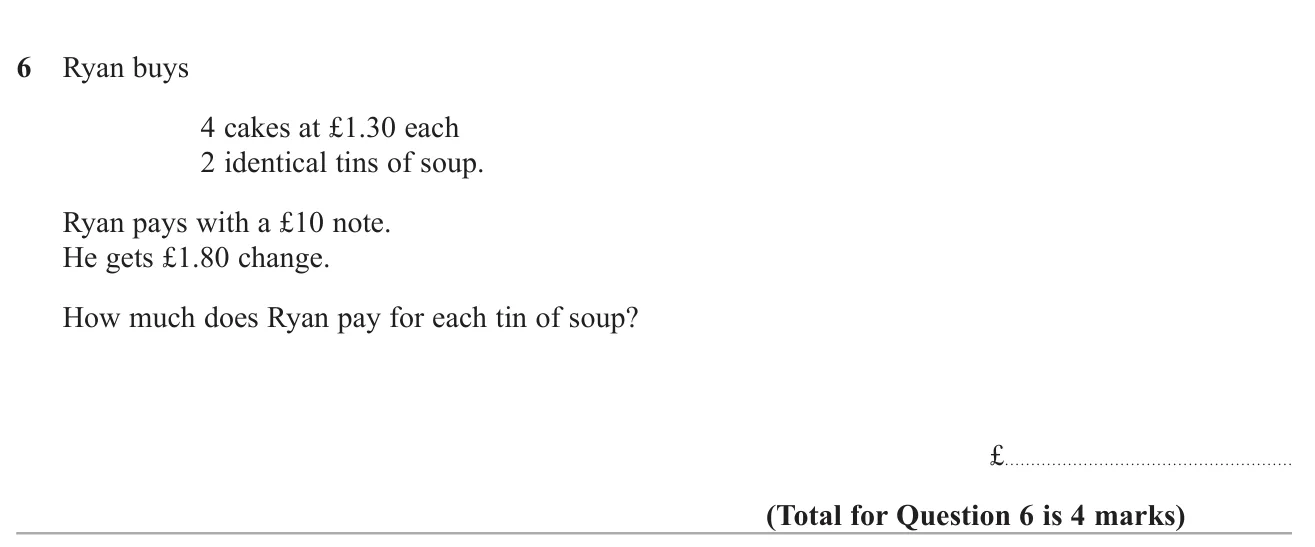
© Pearson Education Ltd. June 2024 Paper 1 (Foundation, non-calculator), question 6.
Show answer
Worked solution Checked against the mark scheme
Cakes: 4×£1.30=£5.20
Spent: £10−£1.80=£8.20
Two tins: £8.20−£5.20=£3.00
One tin: £3.00÷2=£1.50
Watch out: Forgetting to divide by 2 at the end (giving £3).
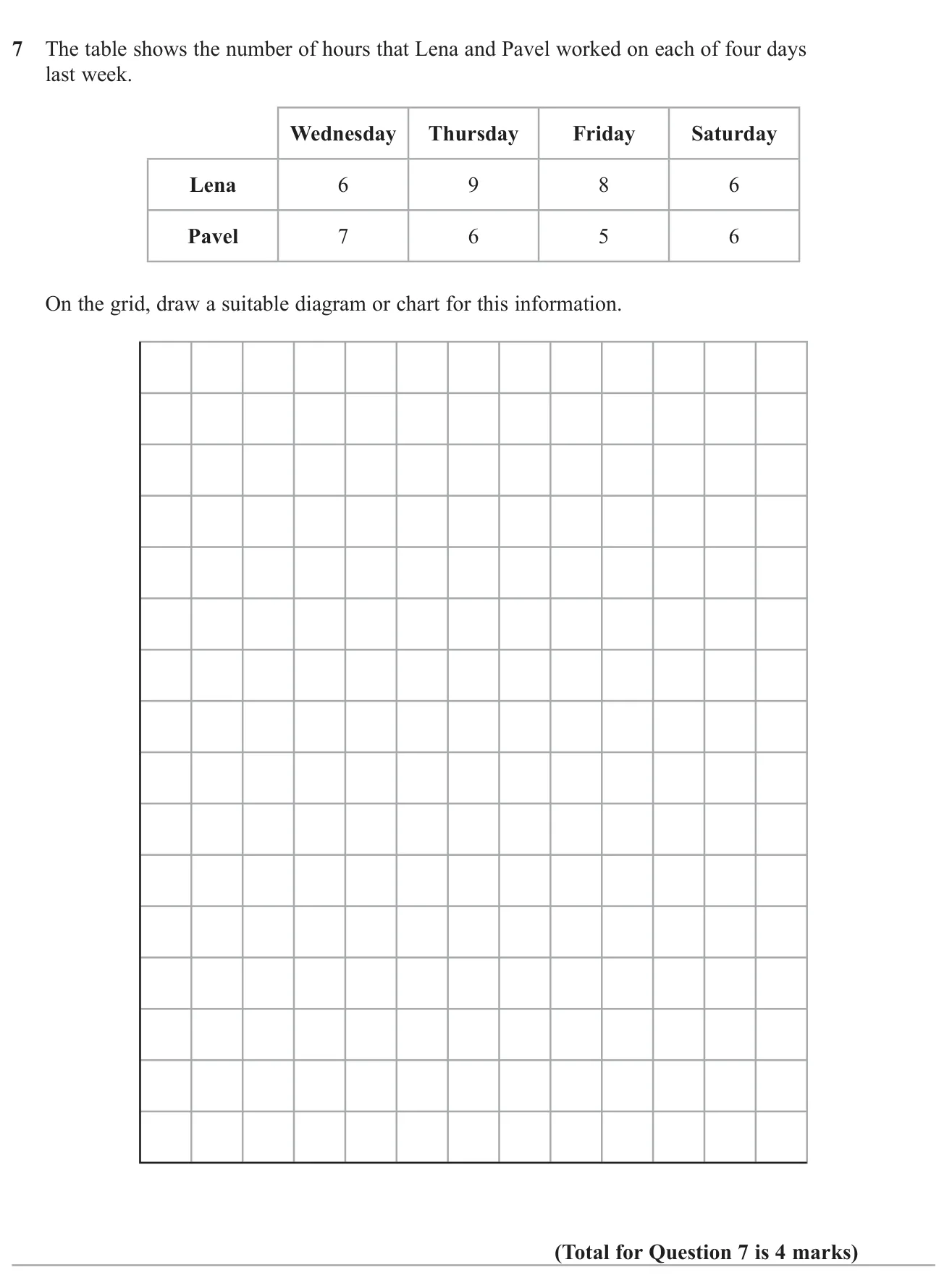
© Pearson Education Ltd. June 2024 Paper 1 (Foundation, non-calculator), question 7.
Show answer
| Answer | A dual bar chart (or similar) with days labelled, a linear hours scale from 0 and a key for Lena and Pavel | 4 marks |
|---|
Worked solution Checked against the mark scheme
Draw a dual bar chart: days along the horizontal axis, hours (0 to 10) up the vertical axis.
For each day draw two bars side by side, e.g. Wednesday: Lena 6, Pavel 7.
Add a key showing which bar is Lena and which is Pavel, and label the vertical axis 'Hours'.
Watch out: Leaving out the key or using a scale that is not evenly spaced.
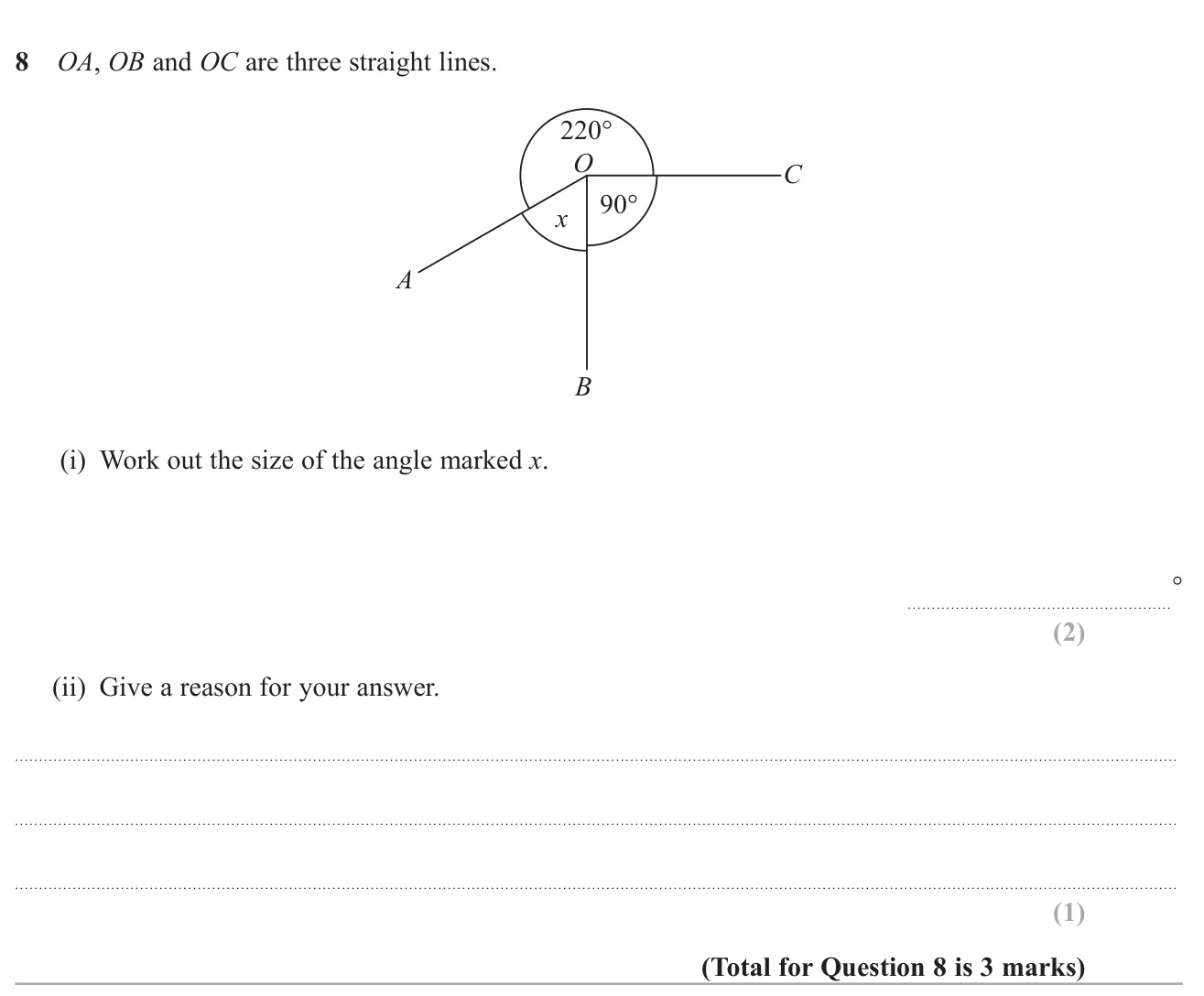
© Pearson Education Ltd. June 2024 Paper 1 (Foundation, non-calculator), question 8.
Show answer
| (i) | 50∘ | 2 marks |
|---|
| (ii) | Angles at a point add up to 360∘ | 1 mark |
|---|
Worked solution Checked against the mark scheme
Angles at a point add up to 360∘.
x=360−220−90=50∘
Watch out: Saying 'angles in a circle add to 360', which is not accepted.
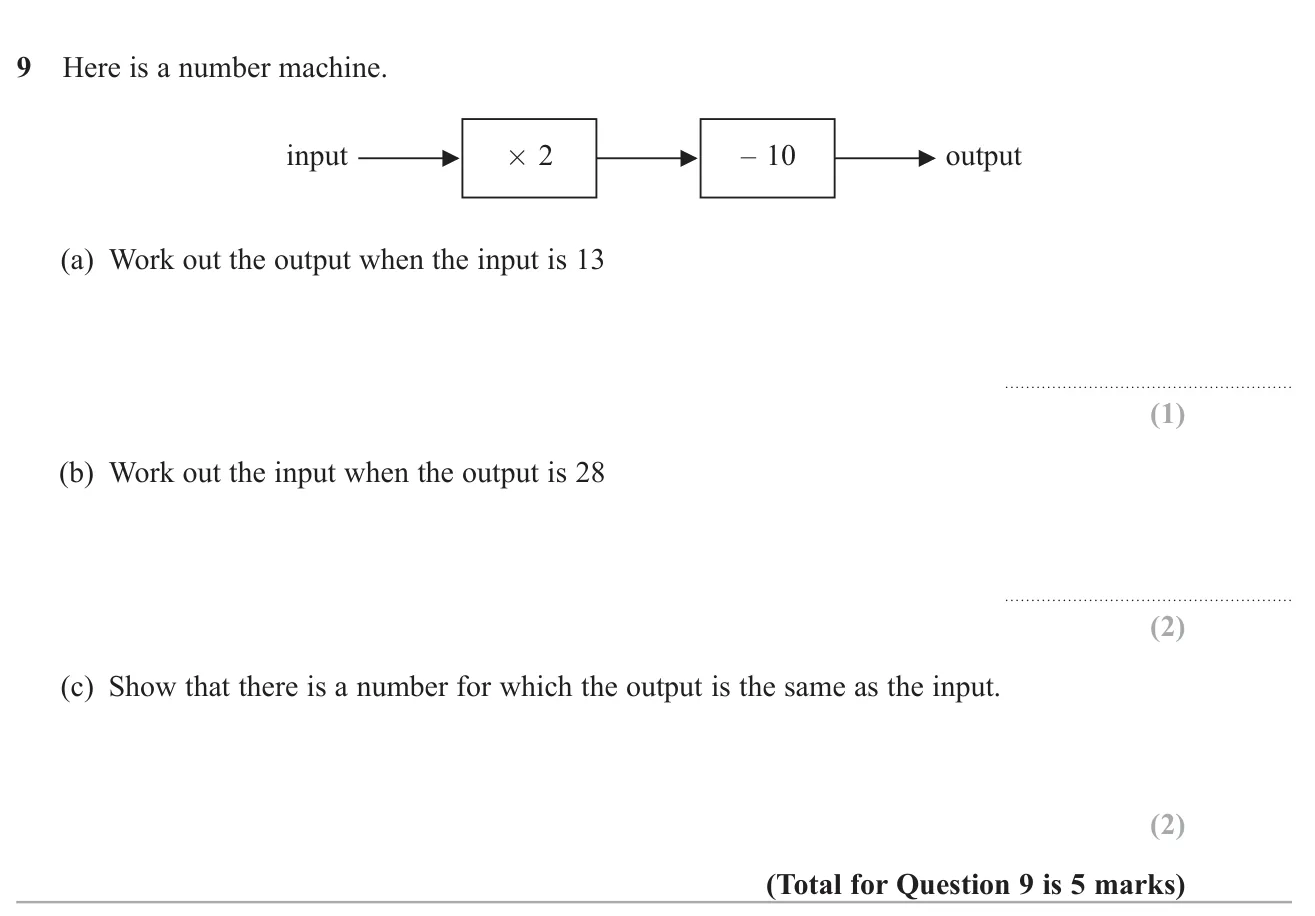
© Pearson Education Ltd. June 2024 Paper 1 (Foundation, non-calculator), question 9.
Show answer
| (a) | 16 | 1 mark |
|---|
| (b) | 19 | 2 marks |
|---|
| (c) | An input of 10 gives 10×2−10=10 | 2 marks |
|---|
Worked solution Checked against the mark scheme
(a) 13×2=26, 26−10=16
(b) Work backwards: 28+10=38, 38÷2=19
(c) Solve 2x−10=x to get x=10. Check: 10×2=20, 20−10=10.
Watch out: In (b), doing the inverse operations in the wrong order (28 ÷ 2 + 10 = 24).
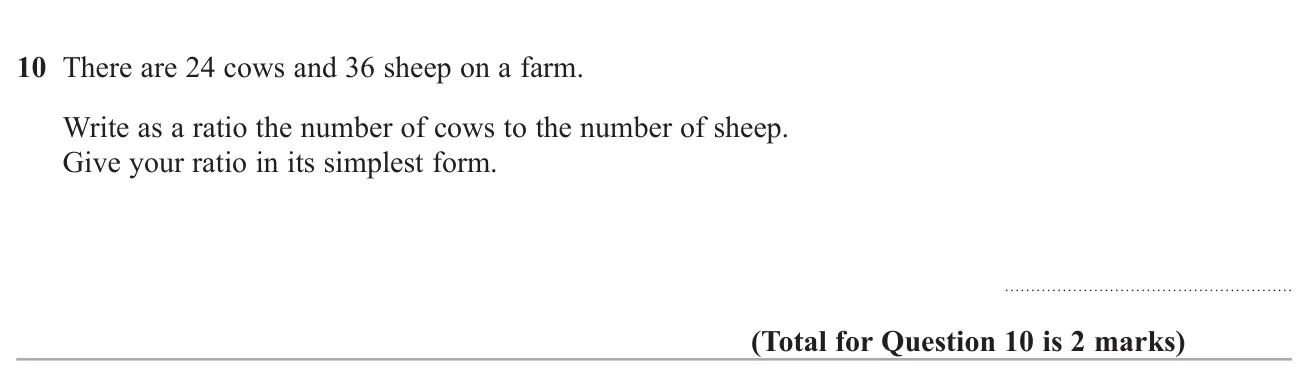
Question 10
Ratio2 marksGrade 2No calculator © Pearson Education Ltd. June 2024 Paper 1 (Foundation, non-calculator), question 10.
Show answer
Worked solution Checked against the mark scheme
Cows : sheep =24:36
Divide both by the HCF, 12: 2:3
Watch out: Writing the ratio the wrong way round (3 : 2).
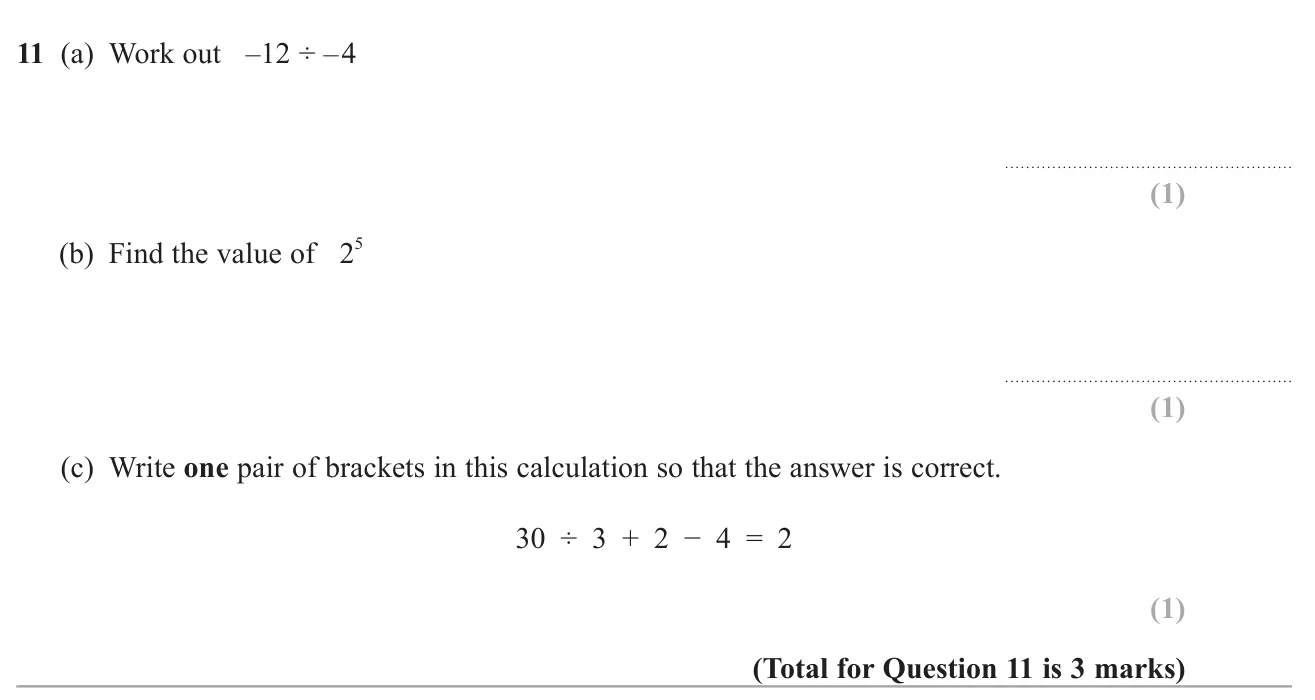
© Pearson Education Ltd. June 2024 Paper 1 (Foundation, non-calculator), question 11.
Show answer
| (a) | 3 | 1 mark |
|---|
| (b) | 32 | 1 mark |
|---|
| (c) | 30÷(3+2)−4=2 | 1 mark |
|---|
Worked solution Checked against the mark scheme
(a) Negative ÷ negative is positive: −12÷−4=3
(b) 25=2×2×2×2×2=32
(c) 30÷(3+2)−4=30÷5−4=6−4=2
Watch out: In (b), working out 2 × 5 = 10.
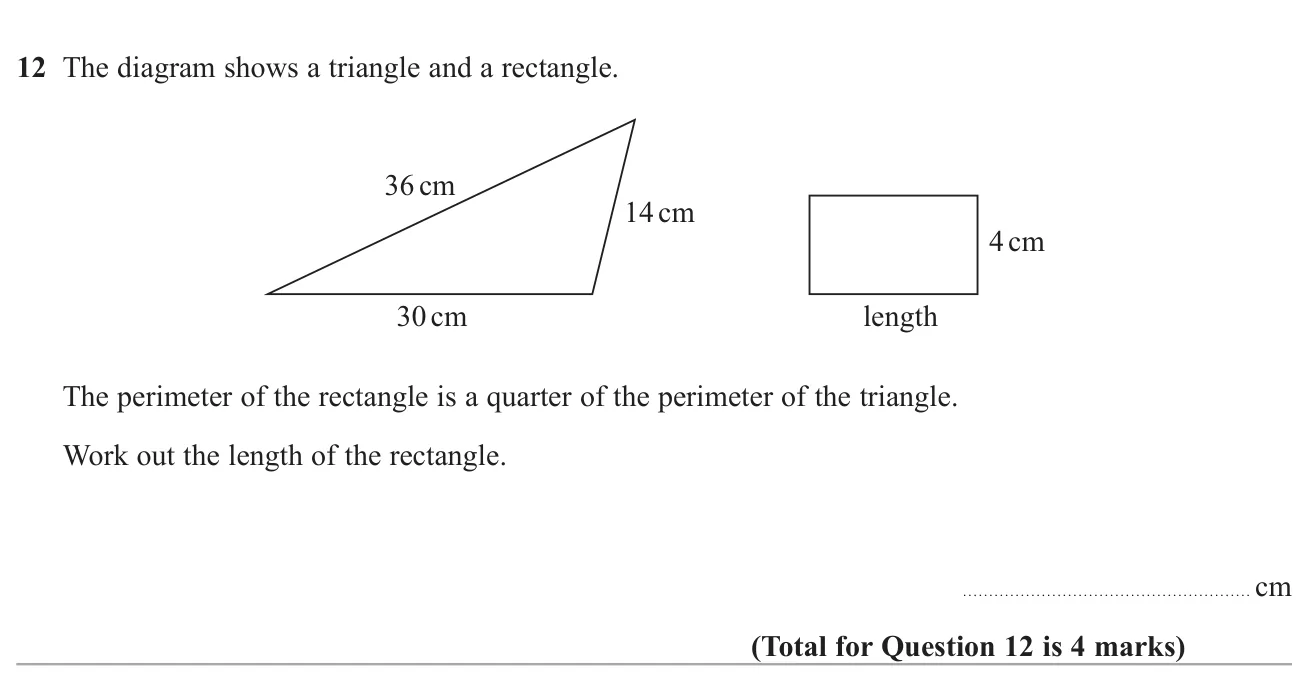
© Pearson Education Ltd. June 2024 Paper 1 (Foundation, non-calculator), question 12.
Show answer
Worked solution Checked against the mark scheme
Triangle perimeter: 30+36+14=80 cm
Rectangle perimeter: 80÷4=20 cm
Two widths: 2×4=8 cm, so two lengths =12 cm
Length =12÷2=6 cm
Watch out: Subtracting only one width of 4 cm (giving 16 ÷ 2 = 8).
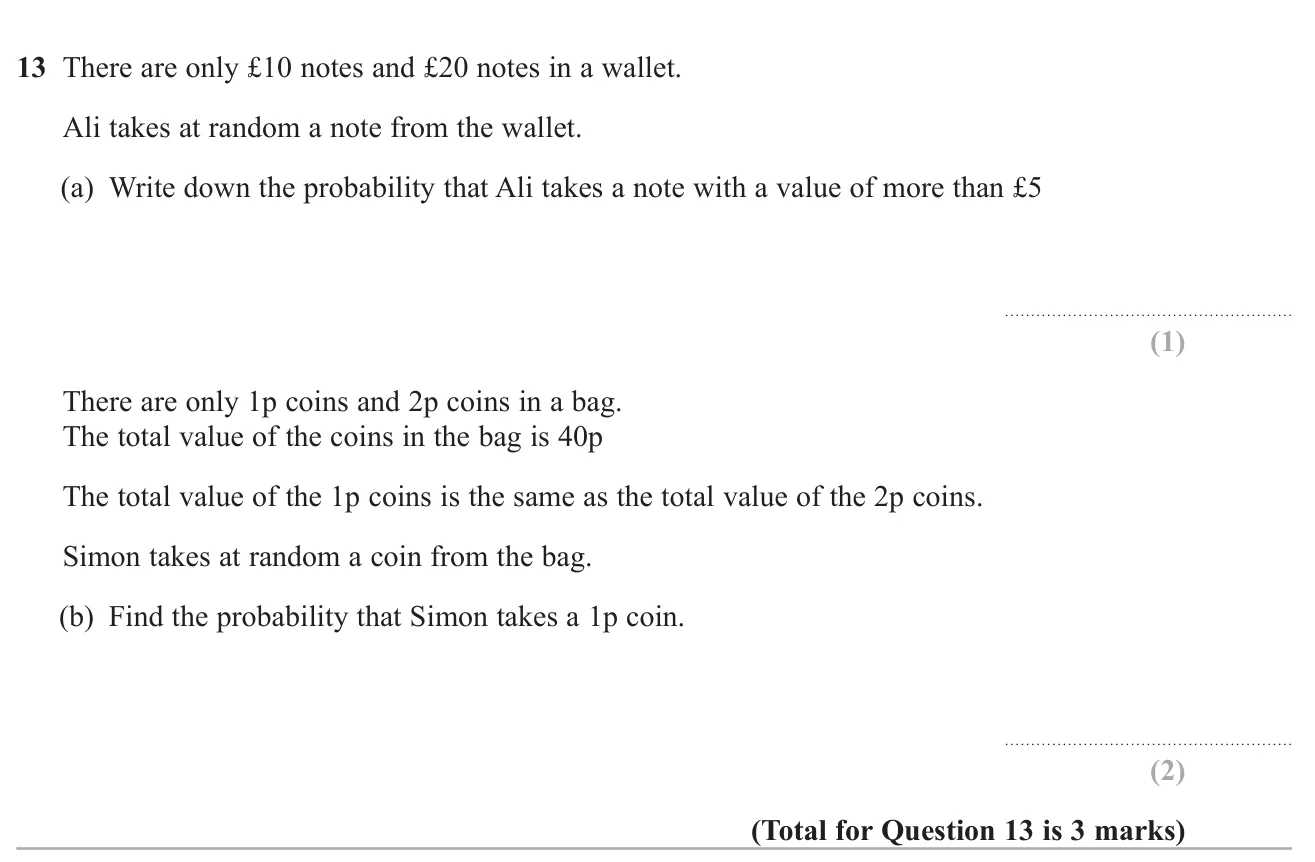
© Pearson Education Ltd. June 2024 Paper 1 (Foundation, non-calculator), question 13.
Show answer
| (a) | 1 | 1 mark |
|---|
| (b) | 32 | 2 marks |
|---|
Worked solution Checked against the mark scheme
(a) Every note is worth more than £5, so the probability is 1.
(b) Each type is worth 20p: twenty 1p coins and ten 2p coins, so 30 coins.
P(1p)=3020=32
Watch out: In (b), assuming equal numbers of each coin and giving 1/2.
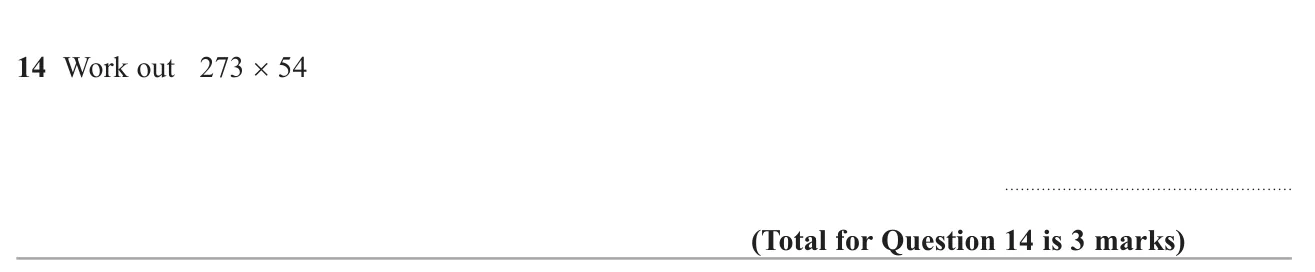
© Pearson Education Ltd. June 2024 Paper 1 (Foundation, non-calculator), question 14.
Show answer
| Answer | 14742 | 3 marks |
|---|
Worked solution Checked against the mark scheme
273×50=13650
273×4=1092
13650+1092=14742
Watch out: Forgetting the place-value zero when multiplying by 50.
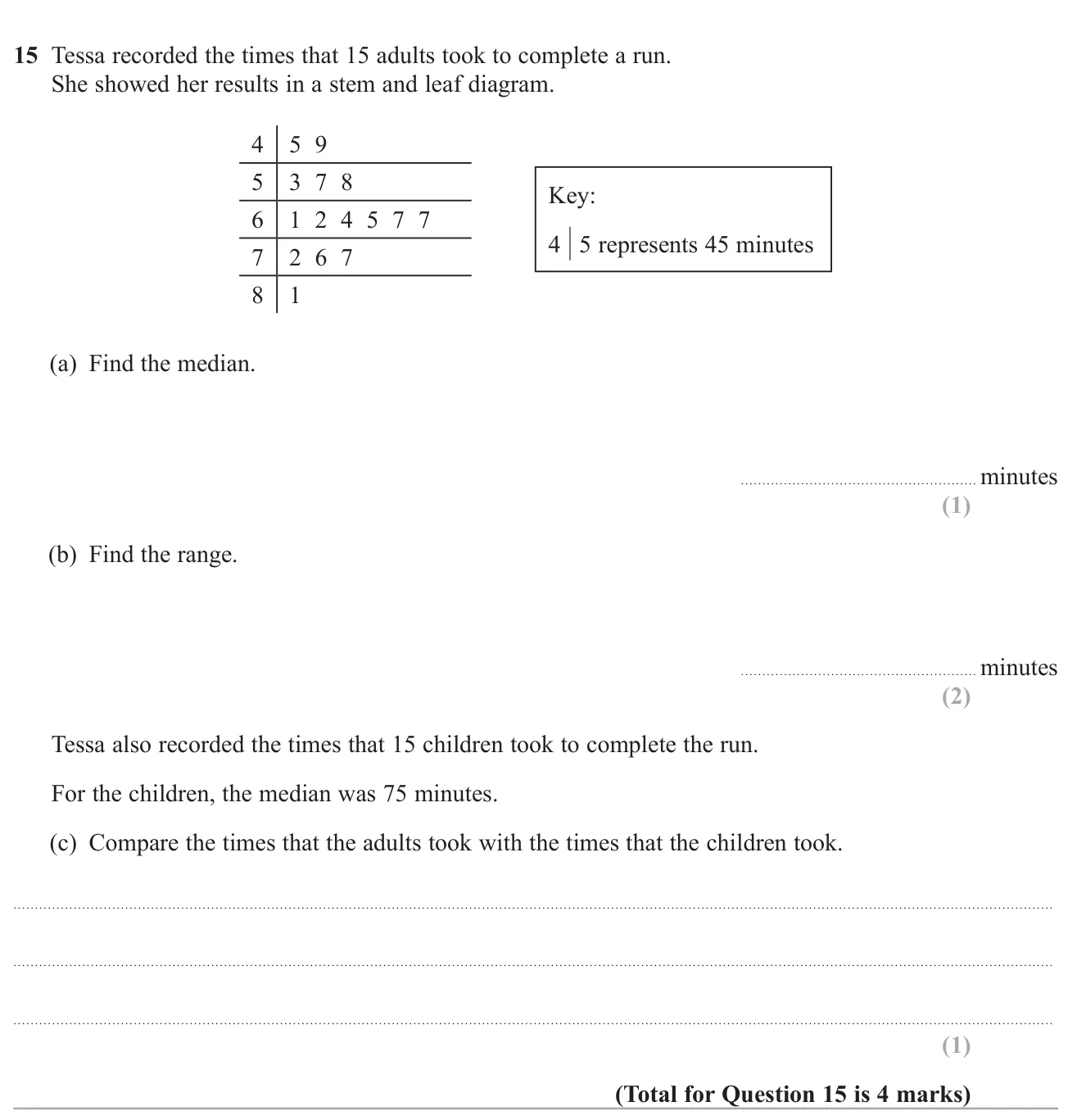
© Pearson Education Ltd. June 2024 Paper 1 (Foundation, non-calculator), question 15.
Show answer
| (a) | 64 minutes | 1 mark |
|---|
| (b) | 36 minutes | 2 marks |
|---|
| (c) | The adults were faster on average (their median of 64 is lower than 75) | 1 mark |
|---|
Worked solution Checked against the mark scheme
(a) 15 values, so the median is the 8th: 64 minutes.
(b) Range =81−45=36 minutes.
(c) Adults' median 64 < children's median 75, so on average the adults took less time.
Watch out: Using the leaves only, e.g. range 9 − 5 = 4.
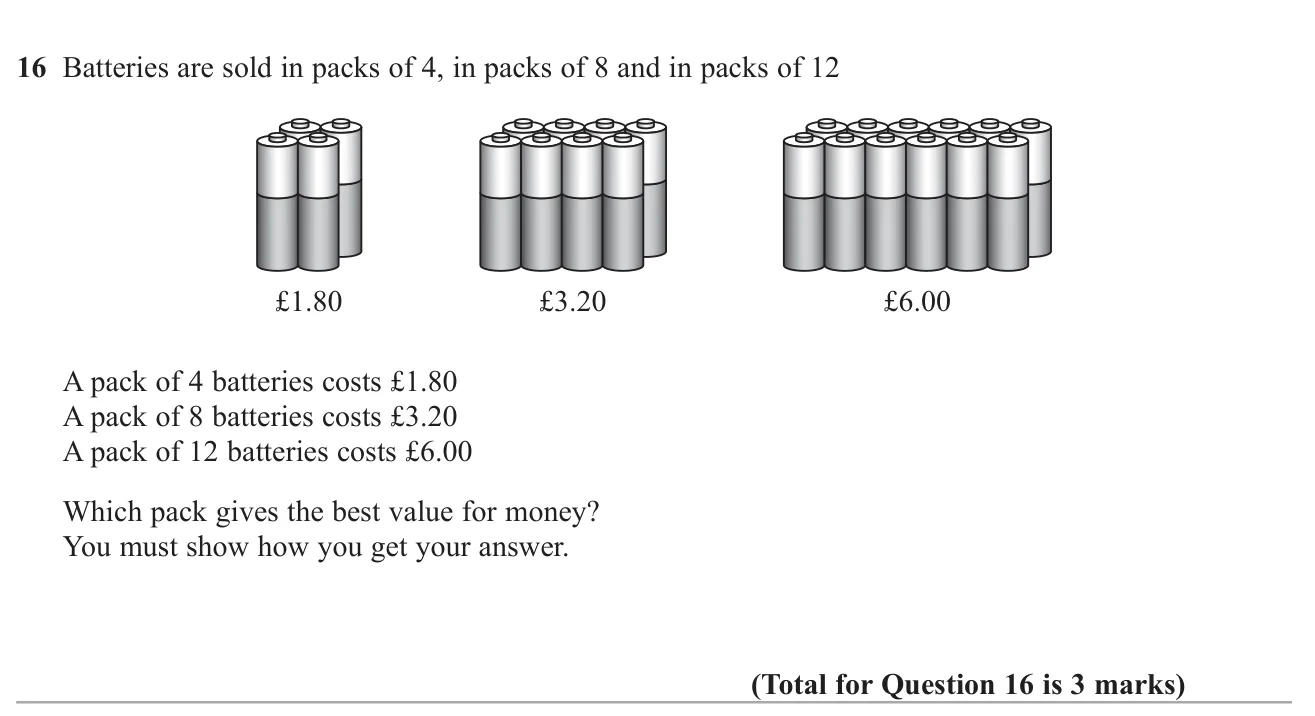
© Pearson Education Ltd. June 2024 Paper 1 (Foundation, non-calculator), question 16.
Show answer
| Answer | Pack of 8 (40p per battery, compared with 45p and 50p) | 3 marks |
|---|
Worked solution Checked against the mark scheme
Cost per battery:
4-pack: 180÷4=45p
8-pack: 320÷8=40p
12-pack: 600÷12=50p
The pack of 8 is best value.
Watch out: Assuming the biggest pack is always best value.
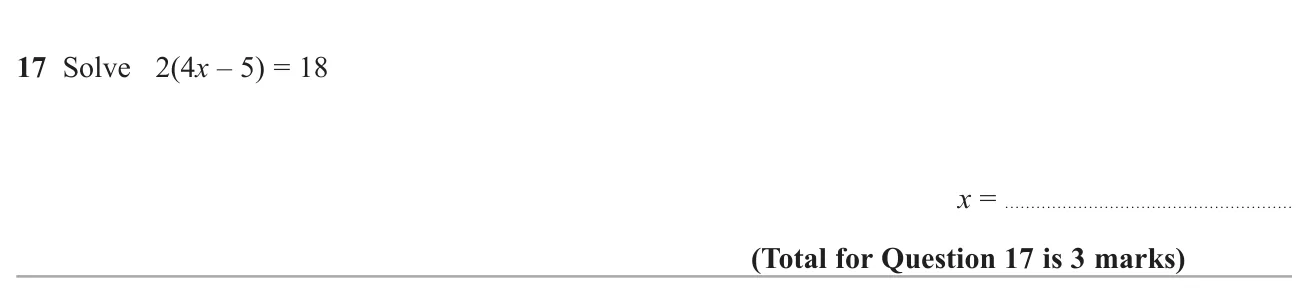
© Pearson Education Ltd. June 2024 Paper 1 (Foundation, non-calculator), question 17.
Show answer
| Answer | x=3.5 | 3 marks |
|---|
Worked solution Checked against the mark scheme
2(4x−5)=18
4x−5=9
4x=14
x=3.5
Watch out: Expanding as 8x − 5.
© Pearson Education Ltd. June 2024 Paper 1 (Foundation, non-calculator), question 18.
Show answer
Worked solution Checked against the mark scheme
Any non-zero number to the power 0 equals 1, so 100=1.
Watch out: Answering 0 or 10.
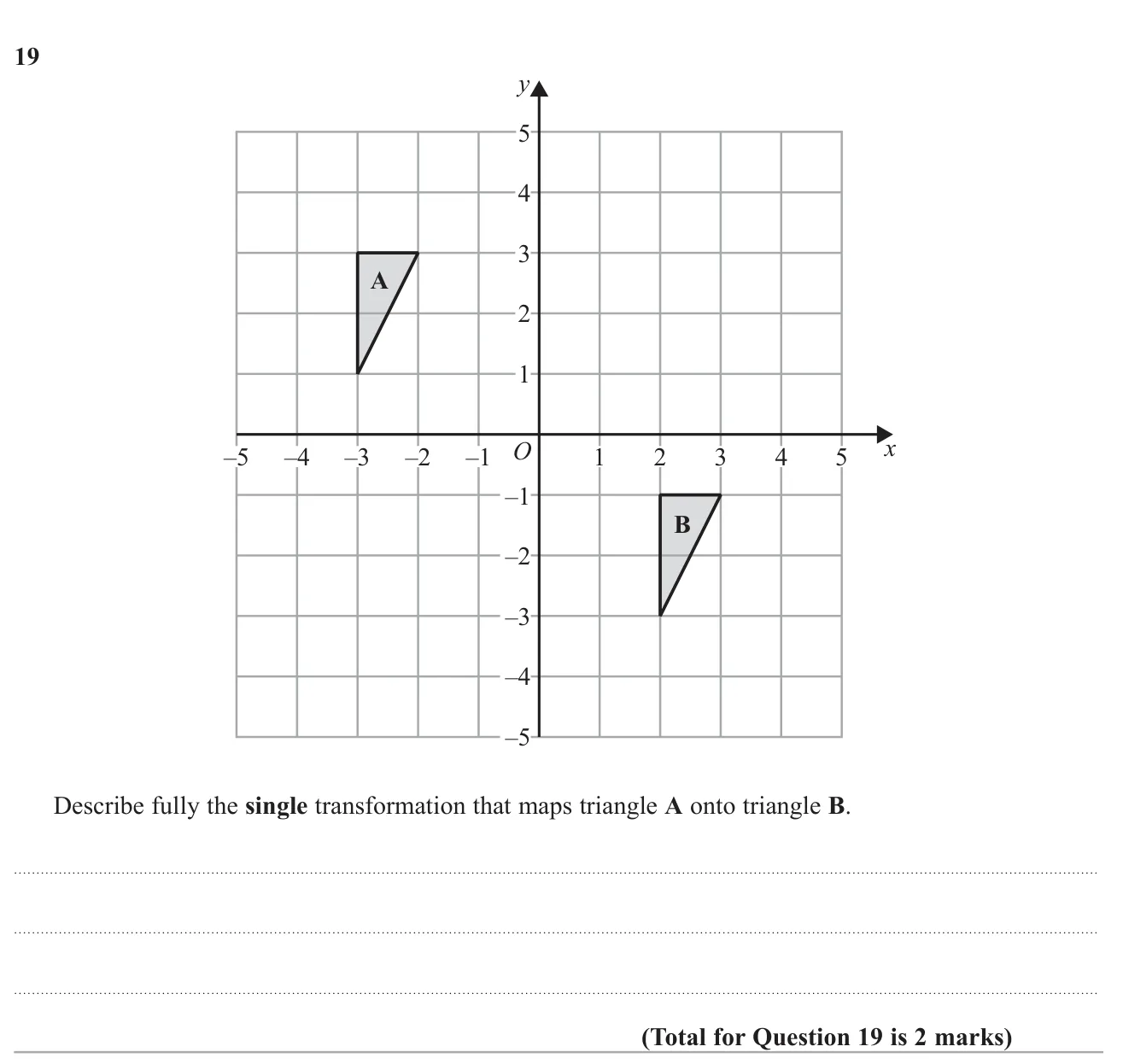
© Pearson Education Ltd. June 2024 Paper 1 (Foundation, non-calculator), question 19.
Show answer
| Answer | Translation by (5−4) | 2 marks |
|---|
Worked solution Checked against the mark scheme
Corner (−3,1) of A moves to (2,−3) on B.
That is 5 right and 4 down, with no turning or flipping.
Translation by (5−4)
Watch out: Writing the vector as a coordinate (5, −4) or giving two transformations.
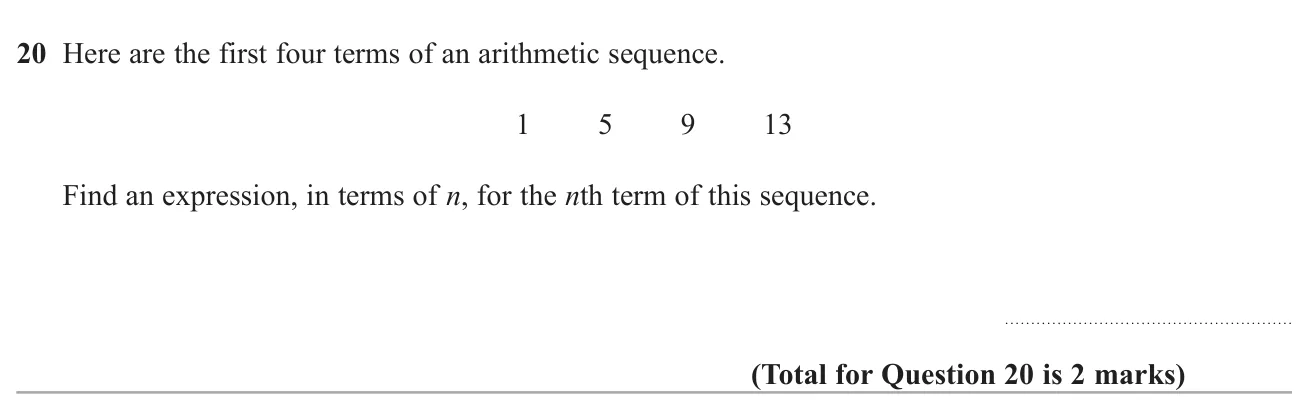
© Pearson Education Ltd. June 2024 Paper 1 (Foundation, non-calculator), question 20.
Show answer
| Answer | 4n−3 | 2 marks |
|---|
Worked solution Checked against the mark scheme
The terms go up by 4, so start with 4n.
4n gives 4, 8, 12, ... Each term is 3 less, so the nth term is 4n−3.
Watch out: Writing n + 4.
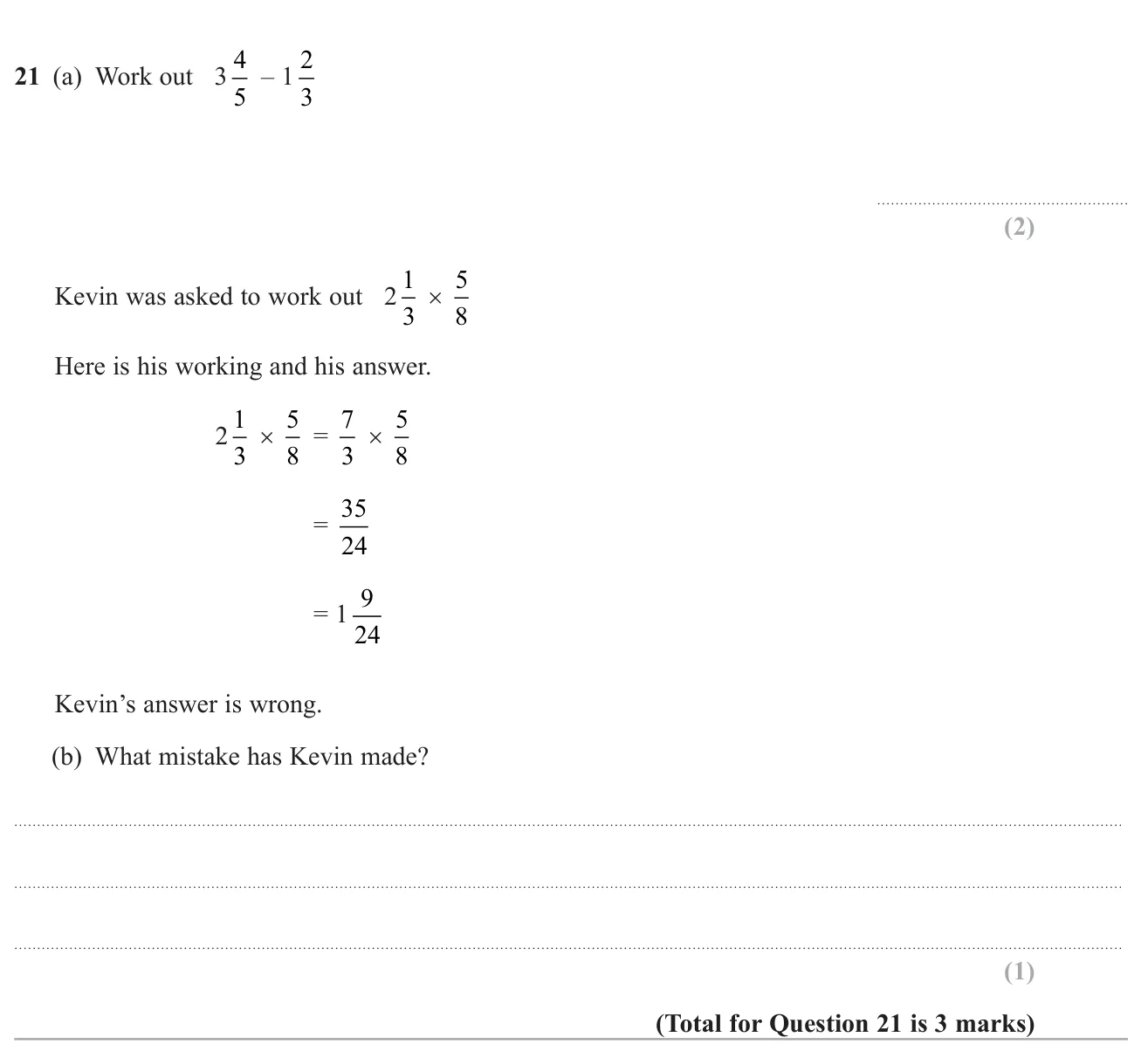
Question 21
Fractions3 marksGrade 4No calculatorOn both tiers © Pearson Education Ltd. June 2024 Paper 1 (Foundation, non-calculator), question 21.
Show answer
| (a) | 2152 | 2 marks |
|---|
| (b) | He converted 2435 wrongly: it should be 12411, not 1249 | 1 mark |
|---|
Worked solution Checked against the mark scheme
(a) 354−132=1557−1525=1532=2152
(b) 35−24=11, so 2435=12411. Kevin wrote 9 instead of 11 in the numerator.
Watch out: In (a), subtracting numerators and denominators separately.
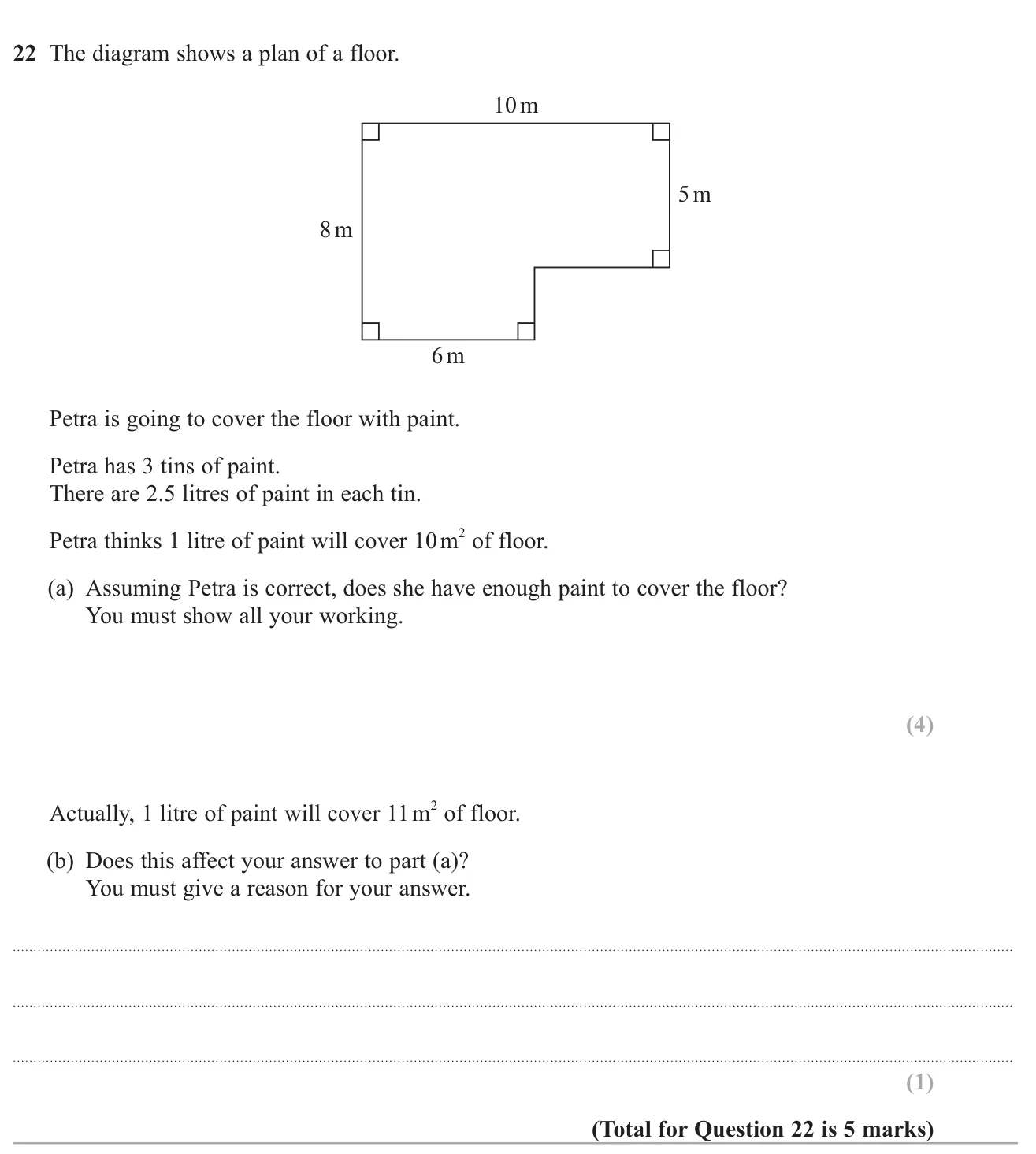
© Pearson Education Ltd. June 2024 Paper 1 (Foundation, non-calculator), question 22.
Show answer
| (a) | Yes: area 68 m2 and the paint covers 75 m2 | 4 marks |
|---|
| (b) | No effect: each litre covers more, so she still has enough | 1 mark |
|---|
Worked solution Checked against the mark scheme
(a) Area =10×8−4×3=80−12=68 m2
Paint: 3×2.5=7.5 litres, covering 7.5×10=75 m2
75>68, so yes, she has enough.
(b) With 11 m² per litre it covers 82.5 m2, even more, so the answer does not change.
Watch out: Multiplying 10 × 8 and forgetting to remove the cut-out corner.
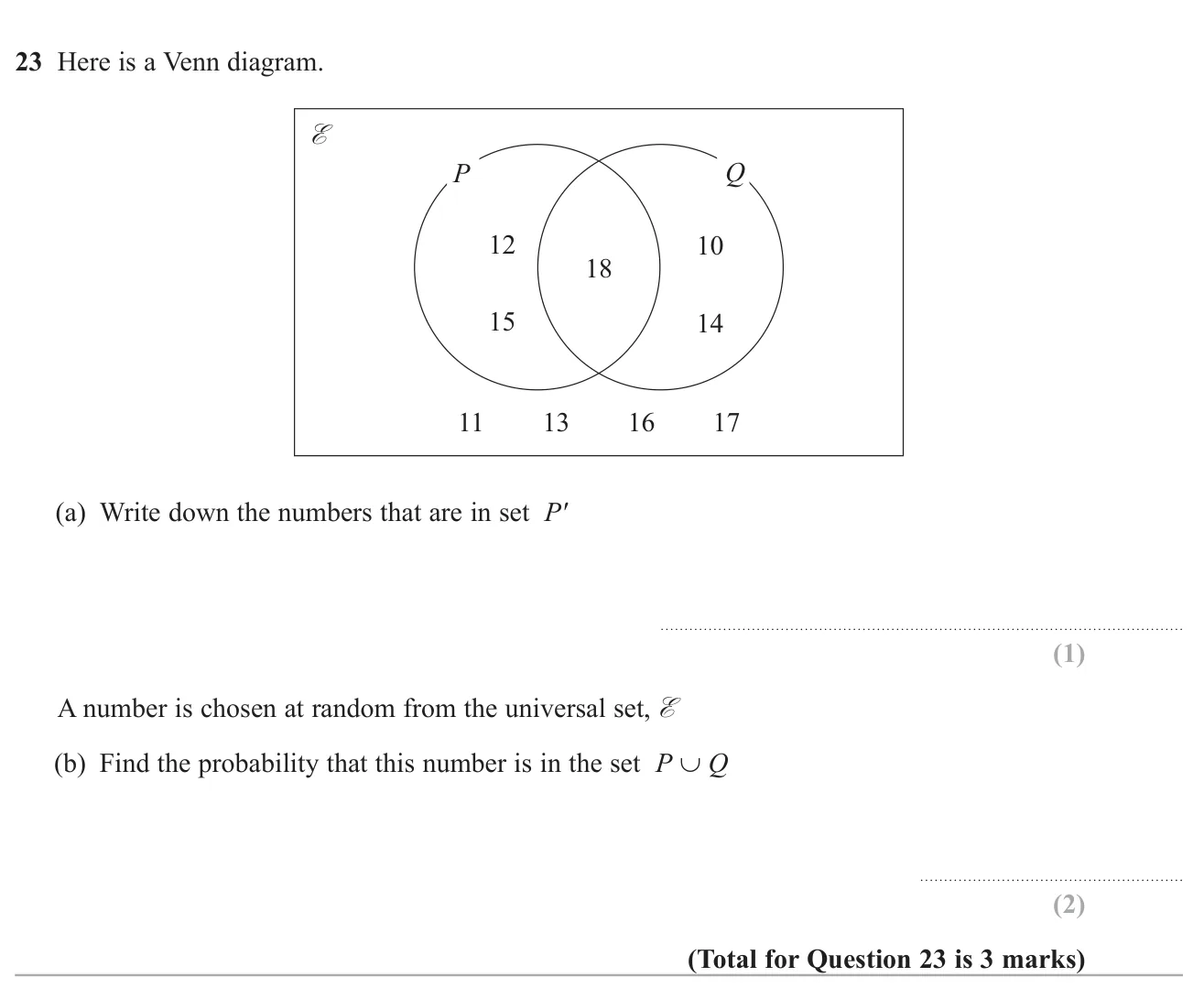
© Pearson Education Ltd. June 2024 Paper 1 (Foundation, non-calculator), question 23.
Show answer
| (a) | 10,11,13,14,16,17 | 1 mark |
|---|
| (b) | 95 | 2 marks |
|---|
Worked solution Checked against the mark scheme
(a) P′ is everything not in P: 10,11,13,14,16,17
(b) P∪Q={10,12,14,15,18}, which is 5 of the 9 numbers.
Probability =95
Watch out: Leaving out the numbers outside both circles in (a), or only counting the overlap in (b).
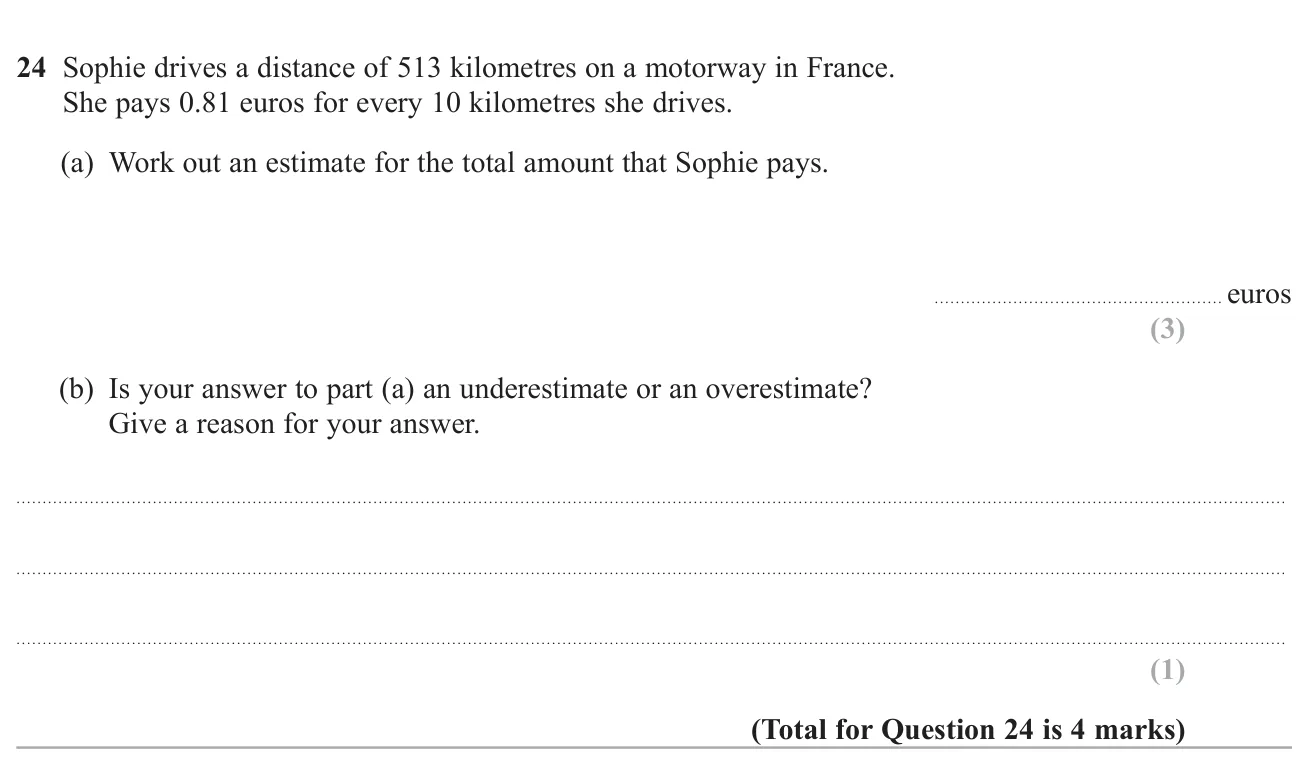
© Pearson Education Ltd. June 2024 Paper 1 (Foundation, non-calculator), question 24.
Show answer
| (a) | About 40 euros (e.g. 500÷10×0.8) | 3 marks |
|---|
| (b) | Underestimate, because both numbers were rounded down | 1 mark |
|---|
Worked solution Checked against the mark scheme
(a) Round: 513≈500 km and 0.81≈0.8 euros.
500÷10=50 lots of 10 km, 50×0.8=40 euros.
(b) Underestimate: both values were rounded down.
Watch out: Rounding 0.81 to 1, which the mark scheme does not accept for the accuracy mark.
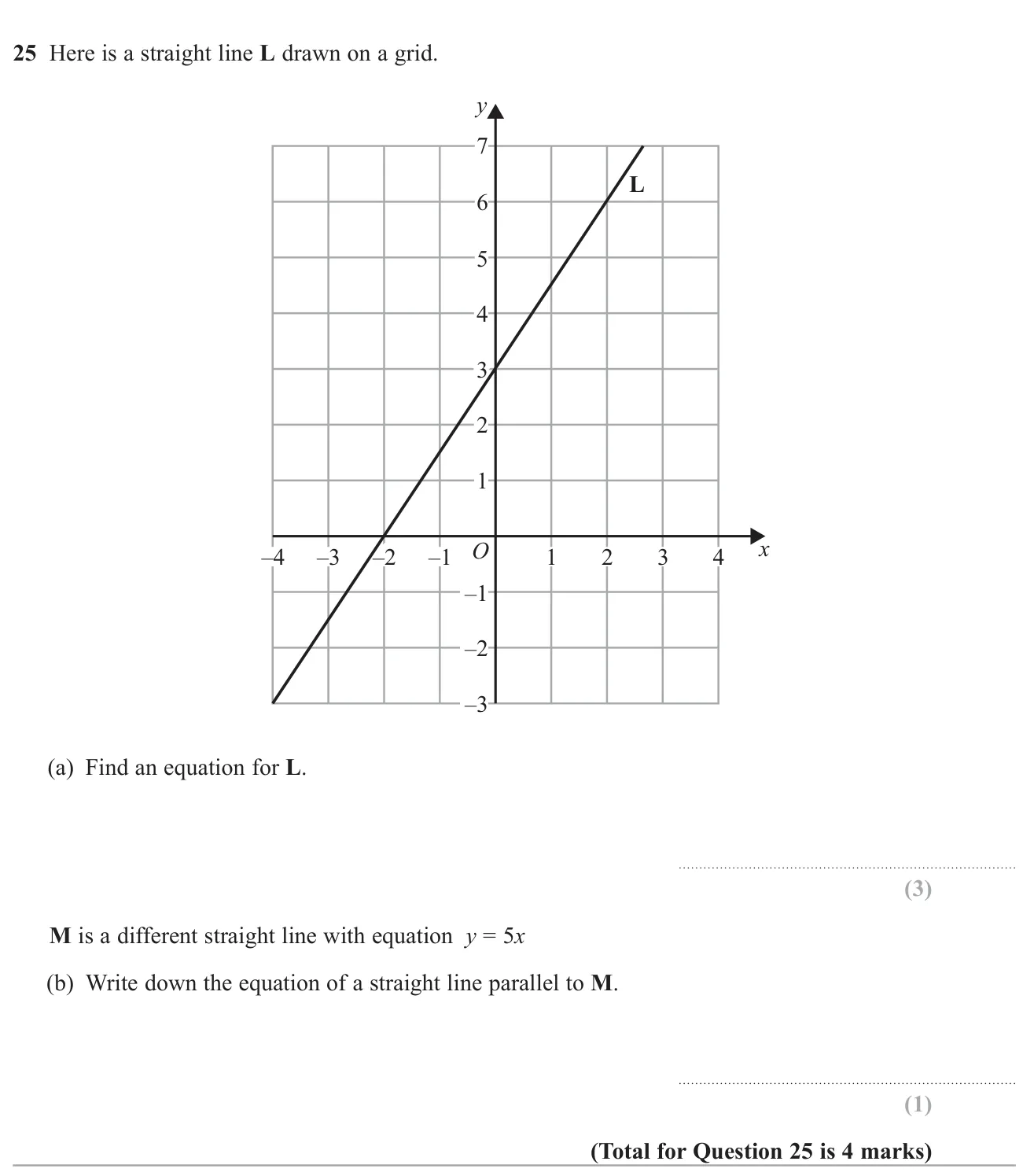
© Pearson Education Ltd. June 2024 Paper 1 (Foundation, non-calculator), question 25.
Show answer
| (a) | y=23x+3 | 3 marks |
|---|
| (b) | e.g. y=5x+1 | 1 mark |
|---|
Worked solution Checked against the mark scheme
(a) The line crosses the y-axis at 3.
From (0,3) to (2,6): gradient =2−06−3=23
y=23x+3
(b) Parallel lines have the same gradient, e.g. y=5x+1.
Watch out: Working out the gradient as change in x over change in y (2/3).
Question 26
Ratio5 marksGrade 5No calculatorOn both tiers © Pearson Education Ltd. June 2024 Paper 1 (Foundation, non-calculator), question 26.
Show answer
| Answer | 7.5% | 5 marks |
|---|
Worked solution Checked against the mark scheme
Empty jars: 83×400=150
S : M =3:4 and M : L =1:2=4:8, so S : M : L =3:4:8
Small empty: 153×150=30
Percentage: 40030×100=7.5%
Watch out: Giving the percentage of the empty jars (20%) instead of all 400 jars.
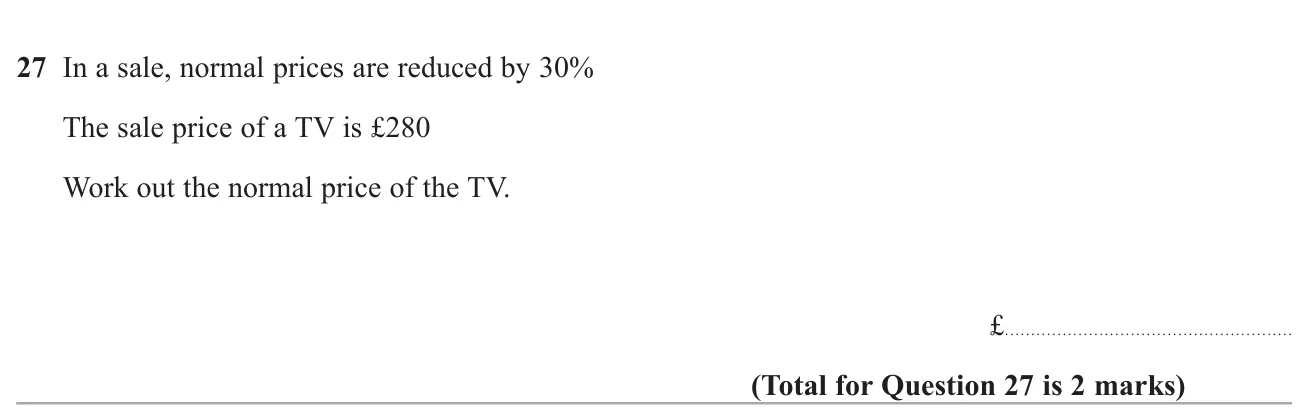
© Pearson Education Ltd. June 2024 Paper 1 (Foundation, non-calculator), question 27.
Show answer
Worked solution Checked against the mark scheme
After a 30% reduction the sale price is 70% of the normal price.
70%=£280, so 10%=£40 and 100%=£400.
Watch out: Adding 30% of £280 to get £364.
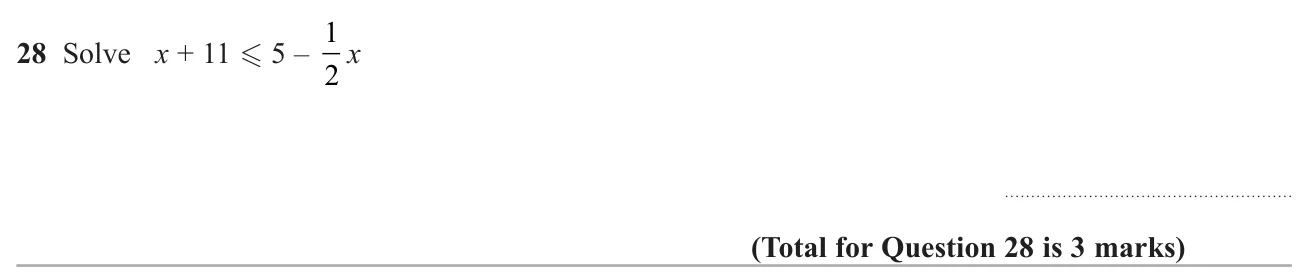
© Pearson Education Ltd. June 2024 Paper 1 (Foundation, non-calculator), question 28.
Show answer
| Answer | x≤−4 | 3 marks |
|---|
Worked solution Checked against the mark scheme
x+11≤5−21x
23x≤−6
x≤−4
Watch out: Giving just −4 or x = −4 without the inequality sign.
Finished the paper?
Add up your marks for all three papers and see what grade that would have been.