Revision guide by The Full Marks
Sine rule, cosine rule and area of a triangle: what you need to know The sine rule and cosine rule let you find sides and angles in triangles that have no right angle, and 1 2 a b sin C \frac{1}{2}ab\sin C 2 1 ab sin C
Key facts Label sides with lower case letters opposite the matching angle: side a a a A A A Sine rule: a sin A = b sin B = c sin C \frac{a}{\sin A} = \frac{b}{\sin B} = \frac{c}{\sin C} s i n A a = s i n B b = s i n C c sin A a = sin B b \frac{\sin A}{a} = \frac{\sin B}{b} a s i n A = b s i n B Cosine rule: a 2 = b 2 + c 2 − 2 b c cos A a^2 = b^2 + c^2 - 2bc\cos A a 2 = b 2 + c 2 − 2 b c cos A cos A = b 2 + c 2 − a 2 2 b c \cos A = \frac{b^2 + c^2 - a^2}{2bc} cos A = 2 b c b 2 + c 2 − a 2 Area of a triangle = 1 2 a b sin C = \frac{1}{2}ab\sin C = 2 1 ab sin C C C C a a a b b b Non-calculator questions use exact values: sin 30 ∘ = 1 2 \sin 30^\circ = \frac{1}{2} sin 3 0 ∘ = 2 1 sin 45 ∘ = 2 2 \sin 45^\circ = \frac{\sqrt{2}}{2} sin 4 5 ∘ = 2 2 sin 60 ∘ = 3 2 \sin 60^\circ = \frac{\sqrt{3}}{2} sin 6 0 ∘ = 2 3 Choosing the right rule Know a side and its opposite angle, plus one more side or angle? Use the sine rule. (Missing an angle? Angles in a triangle add up to 180 ∘ 180^\circ 18 0 ∘ Know two sides and the angle between them, or all three sides? Use the cosine rule. Need the area and know two sides with the angle between them? Use 1 2 a b sin C \frac{1}{2}ab\sin C 2 1 ab sin C In two-part problems, find a shared side with one rule, then use it in the next triangle. Worked examples Example 1 Higher · grade 6
Triangle P Q R PQR P QR P Q = 7 PQ = 7 P Q = 7 P R = 9 PR = 9 P R = 9 Q P R = 40 ∘ QPR = 40^\circ QP R = 4 0 ∘
Show the solution The 40 ∘ 40^\circ 4 0 ∘ = 1 2 × 7 × 9 × sin 40 ∘ = \frac{1}{2} \times 7 \times 9 \times \sin 40^\circ = 2 1 × 7 × 9 × sin 4 0 ∘ = 20.247 … = 20.247\ldots = 20.247 … = 20.2 = 20.2 = 20.2 2 ^2 2
Example 2 Higher · grade 7
In triangle A B C ABC A B C A B = 8 AB = 8 A B = 8 A C = 11 AC = 11 A C = 11 B A C = 65 ∘ BAC = 65^\circ B A C = 6 5 ∘ B C BC B C A B C ABC A B C
Show the solution Two sides and the angle between them, so use the cosine rule.B C 2 = 8 2 + 11 2 − 2 × 8 × 11 × cos 65 ∘ BC^2 = 8^2 + 11^2 - 2 \times 8 \times 11 \times \cos 65^\circ B C 2 = 8 2 + 1 1 2 − 2 × 8 × 11 × cos 6 5 ∘ = 185 − 74.38 … = 110.61 … = 185 - 74.38\ldots = 110.61\ldots = 185 − 74.38 … = 110.61 … B C = 10.517 … = 10.5 BC = 10.517\ldots = 10.5 B C = 10.517 … = 10.5 A C = 11 AC = 11 A C = 11 B B B sin B = 11 × sin 65 ∘ 10.517 … = 0.9479 … \sin B = \frac{11 \times \sin 65^\circ}{10.517\ldots} = 0.9479\ldots sin B = 10.517 … 11 × s i n 6 5 ∘ = 0.9479 … B = 71.4 ∘ B = 71.4^\circ B = 71. 4 ∘
Common mistakes Pairing a side with the wrong angle in the sine rule. Each side must go with the angle opposite it. Working out b 2 + c 2 − 2 b c b^2 + c^2 - 2bc b 2 + c 2 − 2 b c cos A \cos A cos A 2 b c cos A 2bc\cos A 2 b c cos A Using 1 2 × \frac{1}{2} \times 2 1 × × \times × Exam tips Learn the sine rule, the cosine rule and 1 2 a b sin C \frac{1}{2}ab\sin C 2 1 ab sin C Keep the full calculator value between steps; rounding B C BC B C Inverse sine always gives an acute angle. If the angle you want could be obtuse, find it with the cosine rule instead. Check your calculator is in degrees. Questions people ask When do you use the sine rule and when the cosine rule? Use the sine rule when you know a side and the angle opposite it. Use the cosine rule when you know two sides and the angle between them, or all three sides.
Is the sine rule on the Foundation paper? No. The sine rule, cosine rule and 1 2 a b sin C \frac{1}{2}ab\sin C 2 1 ab sin C
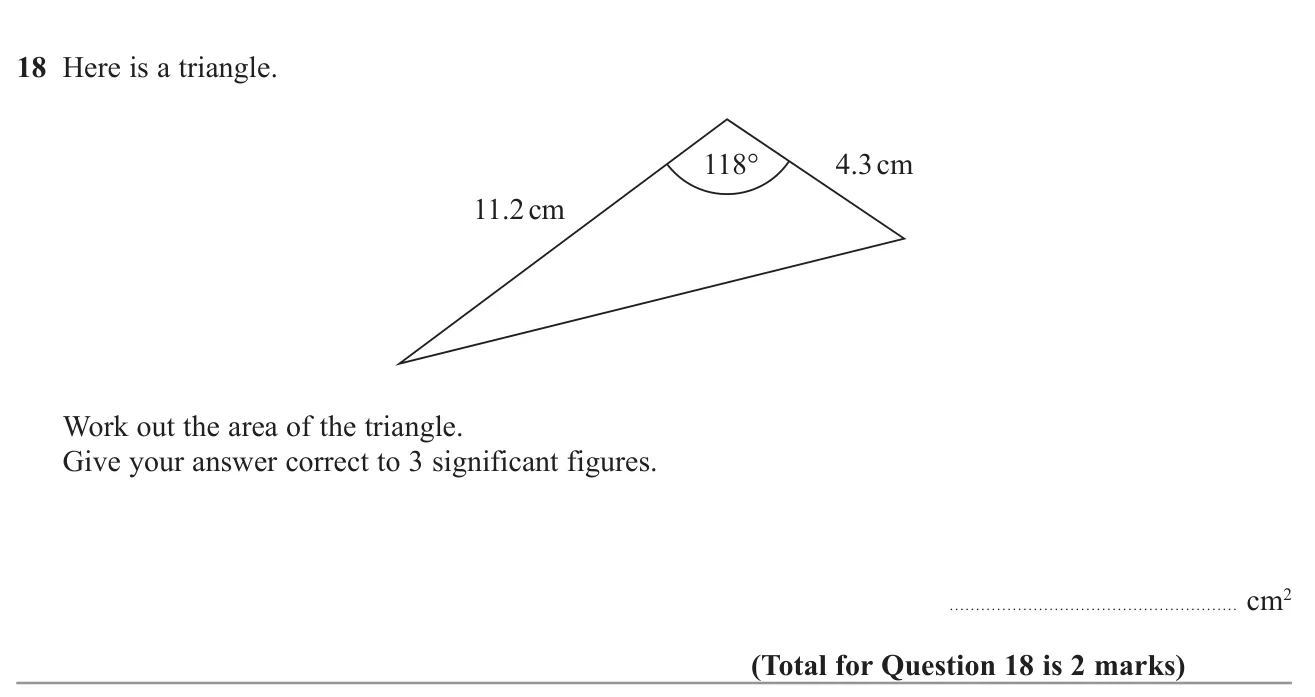
Exam questions: Sine rule, cosine rule and area of a triangle (19, easiest first) © Pearson Education Ltd. November 2022 Paper 2 (Higher, calculator), question 18.
Answer 21.3 cm 2 21.3\text{ cm}^2 21.3 cm 2 2 marks
Worked solution Checked against the mark scheme
Area = 1 2 a b sin C = \frac{1}{2}ab\sin C = 2 1 ab sin C
= 1 2 × 11.2 × 4.3 × sin 118 ° = 21.26... = \frac{1}{2} \times 11.2 \times 4.3 \times \sin 118° = 21.26... = 2 1 × 11.2 × 4.3 × sin 118° = 21.26...
Area = 21.3 cm 2 = 21.3\text{ cm}^2 = 21.3 cm 2
Watch out: Using ½ × base × height with the two given sides.
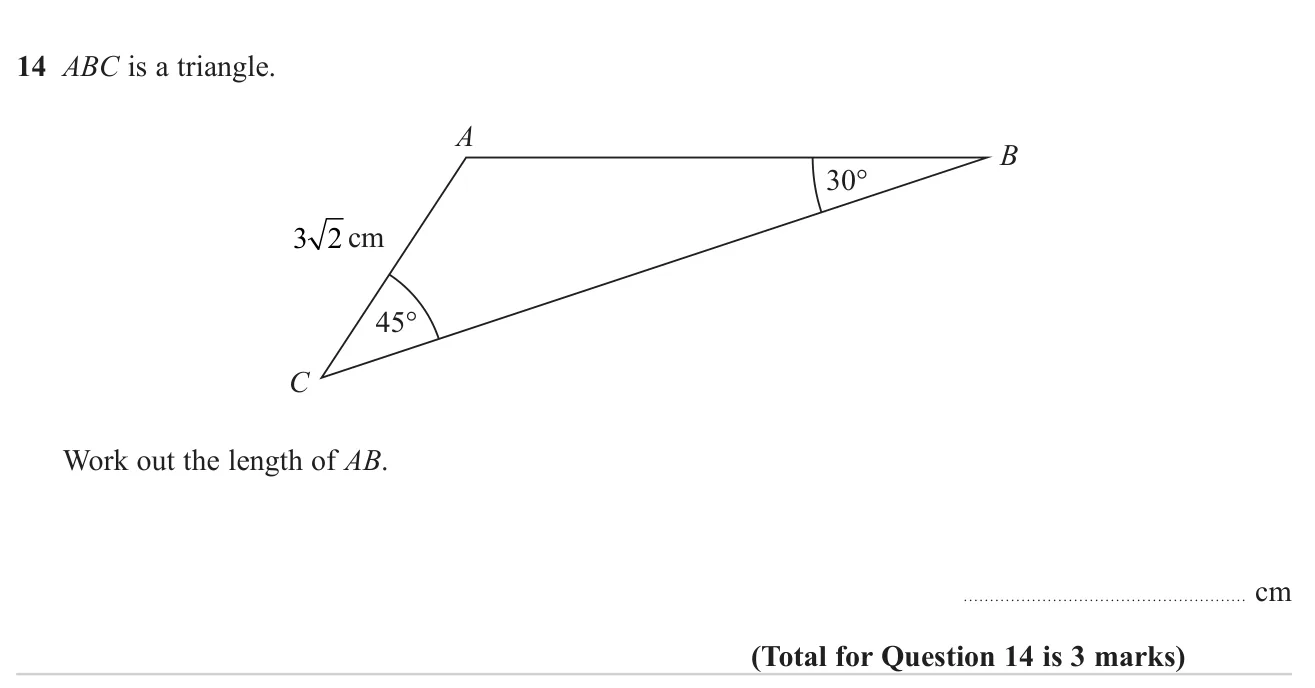
© Pearson Education Ltd. November 2024 Paper 1 (Higher, non-calculator), question 14.
Worked solution Checked against the mark scheme
Sine rule: A B sin 45 ° = 3 2 sin 30 ° \frac{AB}{\sin 45°} = \frac{3\sqrt{2}}{\sin 30°} s i n 45° A B = s i n 30° 3 2
sin 45 ° = 2 2 \sin 45° = \frac{\sqrt{2}}{2} sin 45° = 2 2 sin 30 ° = 1 2 \sin 30° = \frac{1}{2} sin 30° = 2 1
A B = 3 2 × 2 2 ÷ 1 2 = 3 2 × 2 = 6 AB = 3\sqrt{2} \times \frac{\sqrt{2}}{2} \div \frac{1}{2} = 3\sqrt{2} \times \sqrt{2} = 6 A B = 3 2 × 2 2 ÷ 2 1 = 3 2 × 2 = 6
Watch out: Matching each side with the wrong opposite angle.
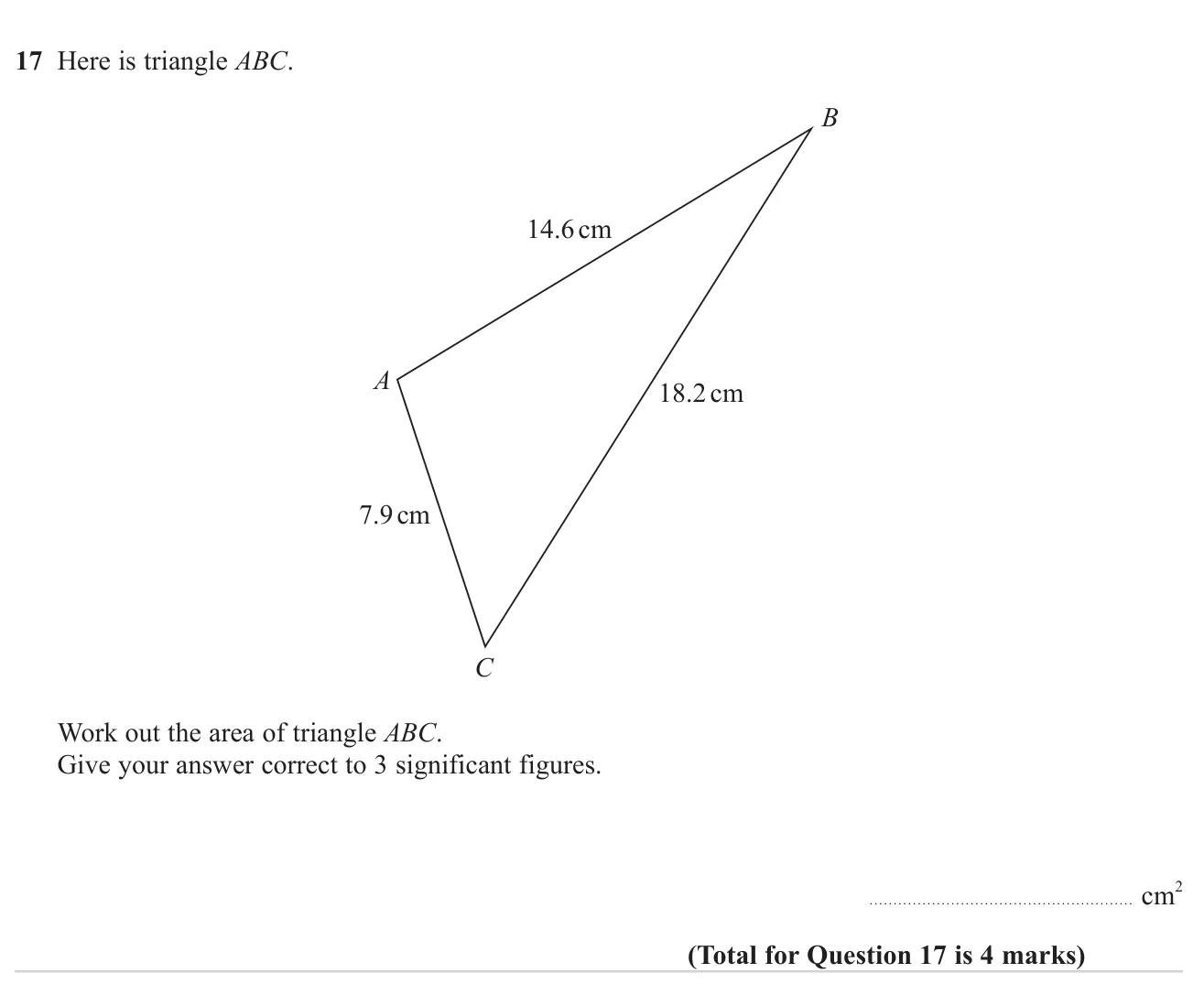
© Pearson Education Ltd. November 2024 Paper 3 (Higher, calculator), question 17.
Answer 56.0 56.0 56.0 4 marks
Worked solution Checked against the mark scheme
Angle A is between 14.6 and 7.9 cm:
cos A = 14.6 2 + 7.9 2 − 18.2 2 2 × 14.6 × 7.9 = − 0.2413... \cos A = \frac{14.6^2 + 7.9^2 - 18.2^2}{2 \times 14.6 \times 7.9} = -0.2413... cos A = 2 × 14.6 × 7.9 14. 6 2 + 7. 9 2 − 18. 2 2 = − 0.2413... A = 103.97 ∘ A = 103.97^\circ A = 103.9 7 ∘
Area = 1 2 × 14.6 × 7.9 × sin 103.97 ∘ = 55.97 ≈ 56.0 = \frac{1}{2} \times 14.6 \times 7.9 \times \sin 103.97^\circ = 55.97 \approx 56.0 = 2 1 × 14.6 × 7.9 × sin 103.9 7 ∘ = 55.97 ≈ 56.0
Watch out: Pairing an angle with the wrong two sides in the area formula.
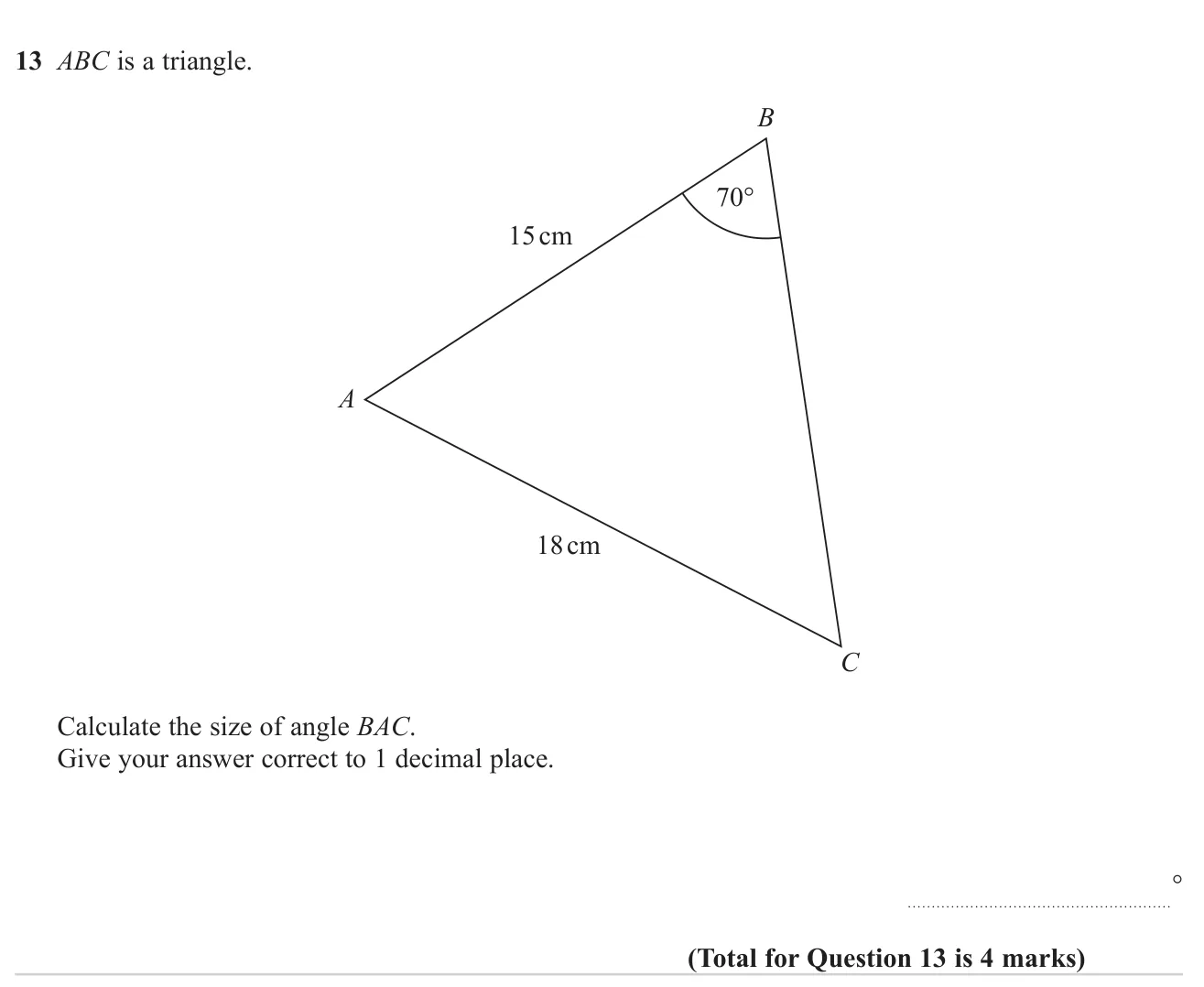
© Pearson Education Ltd. June 2023 Paper 2 (Higher, calculator), question 13.
Answer 58.5 ° 58.5° 58.5° 4 marks
Worked solution Checked against the mark scheme
Angle C C C A B = 15 AB = 15 A B = 15 B = 70 ° B = 70° B = 70° A C = 18 AC = 18 A C = 18
sin C 15 = sin 70 ° 18 \frac{\sin C}{15} = \frac{\sin 70°}{18} 15 s i n C = 18 s i n 70° sin C = 15 sin 70 ° 18 = 0.7830... \sin C = \frac{15 \sin 70°}{18} = 0.7830... sin C = 18 15 s i n 70° = 0.7830...
C = 51.54... ° C = 51.54...° C = 51.54...°
B A C = 180 − 70 − 51.54... = 58.5 ° BAC = 180 - 70 - 51.54... = 58.5° B A C = 180 − 70 − 51.54... = 58.5°
Watch out: Stopping at angle C (51.5°) instead of going on to find angle A.
© Pearson Education Ltd. November 2023 Paper 2 (Higher, calculator), question 16.
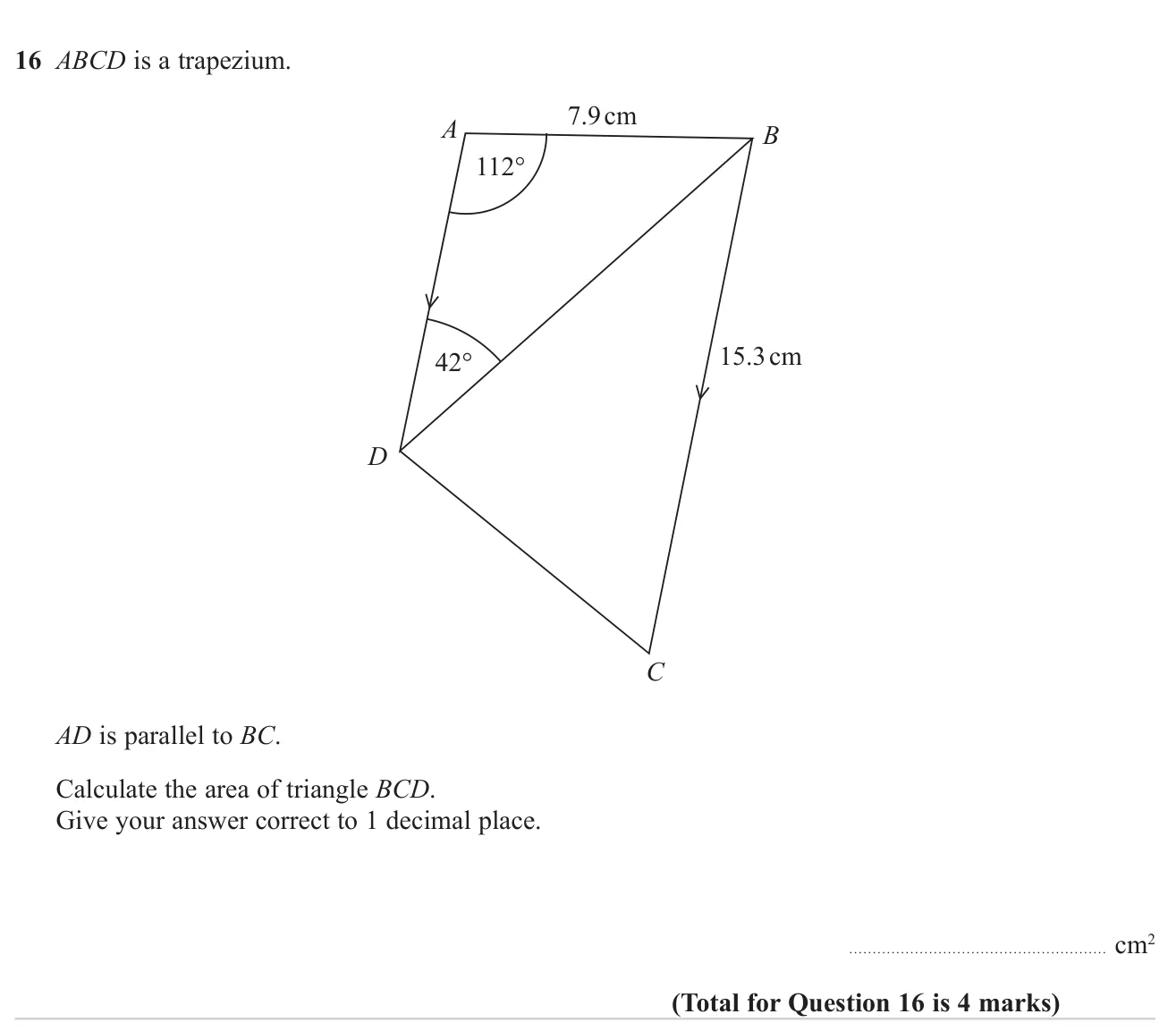
Answer 56.0 56.0 56.0 4 marks
Worked solution Checked against the mark scheme
In triangle A B D ABD A B D B D sin 112 ° = 7.9 sin 42 ° \frac{BD}{\sin 112°} = \frac{7.9}{\sin 42°} s i n 112° B D = s i n 42° 7.9 B D = 10.946... BD = 10.946... B D = 10.946...
AD is parallel to BC, so angle D B C = 42 ° DBC = 42° D B C = 42°
Area of B C D = 1 2 × 10.946... × 15.3 × sin 42 ° = 56.03... ≈ 56.0 BCD = \frac{1}{2} \times 10.946... \times 15.3 \times \sin 42° = 56.03... \approx 56.0 B C D = 2 1 × 10.946... × 15.3 × sin 42° = 56.03... ≈ 56.0
Watch out: Not spotting that angle DBC equals 42° by alternate angles.
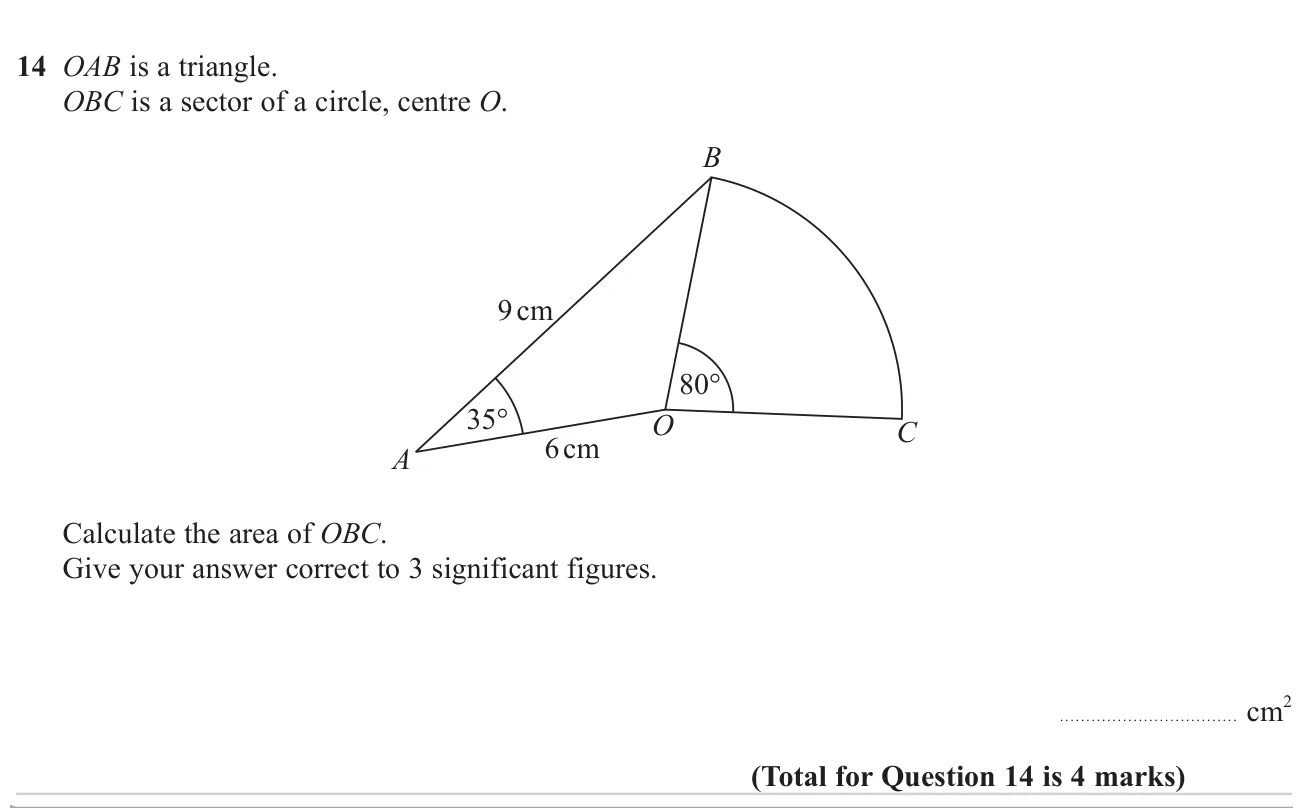
© Pearson Education Ltd. June 2023 Paper 3 (Higher, calculator), question 14.
Worked solution Checked against the mark scheme
Cosine rule: O B 2 = 9 2 + 6 2 − 2 × 9 × 6 cos 35 ° = 28.53... OB^2 = 9^2 + 6^2 - 2 \times 9 \times 6 \cos 35° = 28.53... O B 2 = 9 2 + 6 2 − 2 × 9 × 6 cos 35° = 28.53...
O B = 5.341... OB = 5.341... O B = 5.341...
Sector area = 80 360 × π × 28.53... = 19.918... = \dfrac{80}{360} \times \pi \times 28.53... = 19.918... = 360 80 × π × 28.53... = 19.918...
= 19.9 = 19.9 = 19.9
Watch out: Working out 81 + 36 − 108 81 + 36 - 108 81 + 36 − 108 cos 35 ° \cos 35° cos 35°
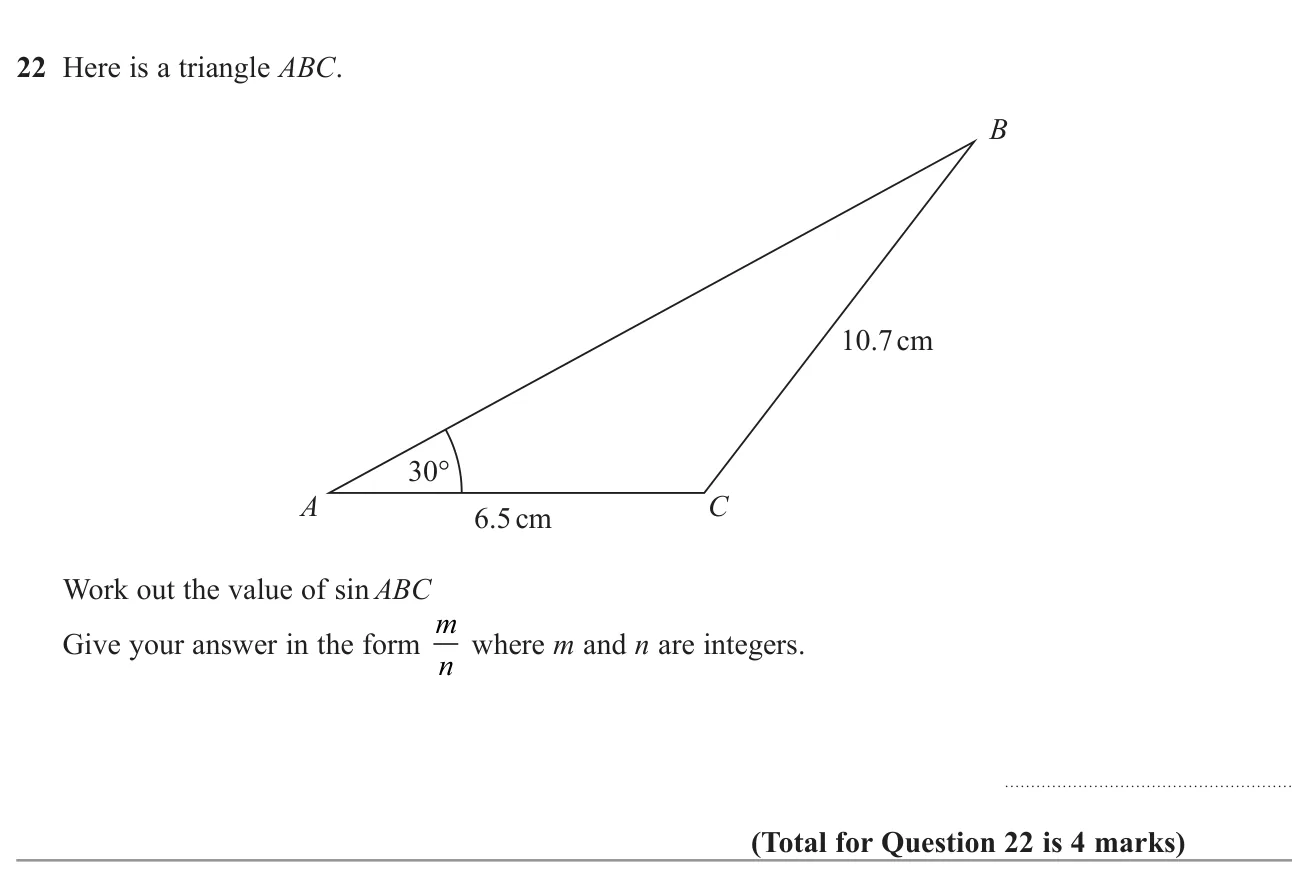
© Pearson Education Ltd. November 2022 Paper 1 (Higher, non-calculator), question 22.
Answer 65 214 \frac{65}{214} 214 65 4 marks
Worked solution Checked against the mark scheme
Sine rule: sin A B C 6.5 = sin 30 ° 10.7 \frac{\sin ABC}{6.5} = \frac{\sin 30°}{10.7} 6.5 s i n A B C = 10.7 s i n 30°
sin A B C = 6.5 × 0.5 10.7 = 3.25 10.7 \sin ABC = \frac{6.5 \times 0.5}{10.7} = \frac{3.25}{10.7} sin A B C = 10.7 6.5 × 0.5 = 10.7 3.25
Multiply top and bottom by 20: 65 214 \frac{65}{214} 214 65
Watch out: Pairing 6.5 with the 30° angle instead of 10.7.
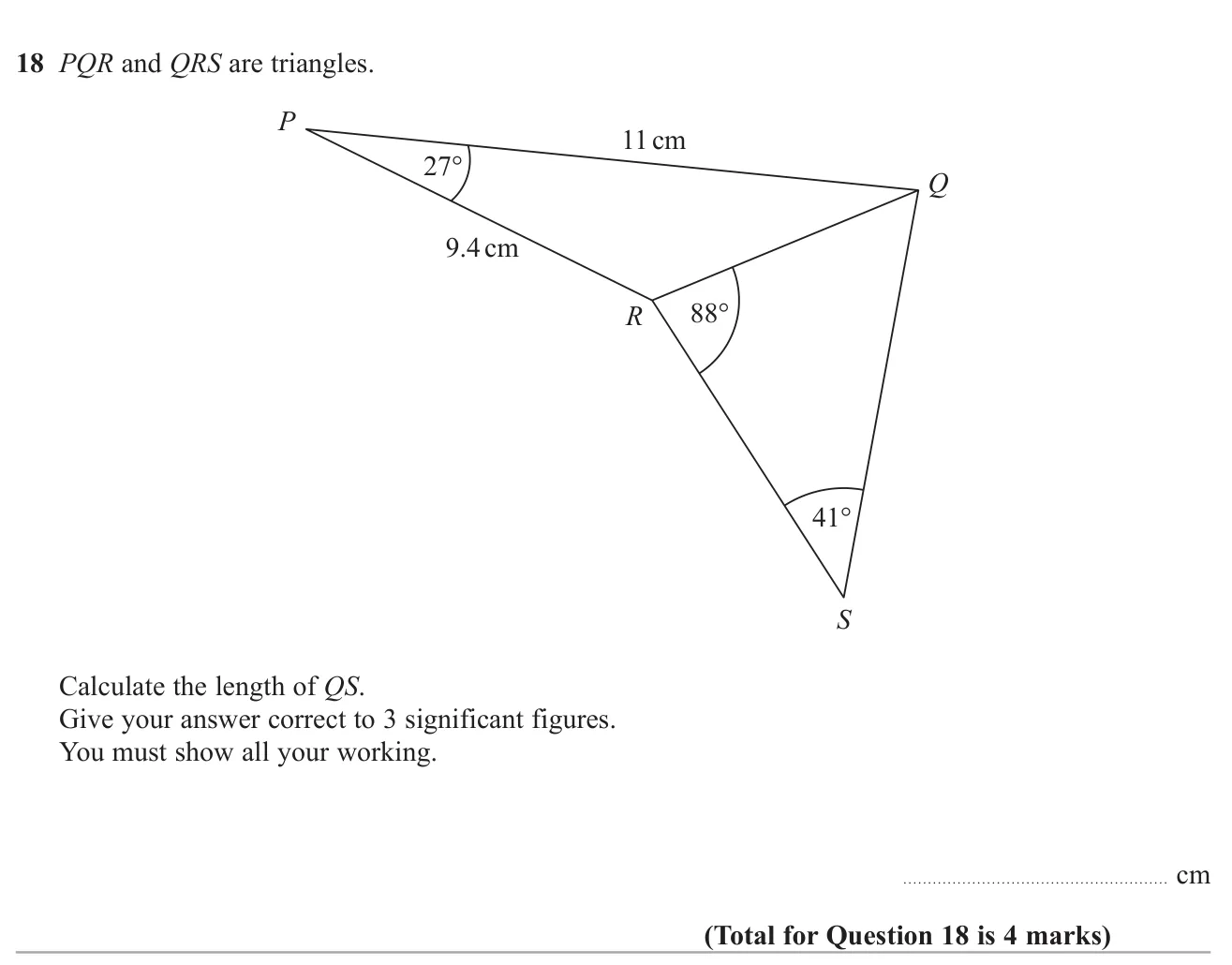
© Pearson Education Ltd. June 2022 Paper 2 (Higher, calculator), question 18.
Answer 7.63 cm 7.63\text{ cm} 7.63 cm 4 marks
Worked solution Checked against the mark scheme
Triangle PQR: Q R 2 = 11 2 + 9.4 2 − 2 × 11 × 9.4 cos 27 ∘ = 25.09... QR^2 = 11^2 + 9.4^2 - 2 \times 11 \times 9.4 \cos 27^\circ = 25.09... Q R 2 = 1 1 2 + 9. 4 2 − 2 × 11 × 9.4 cos 2 7 ∘ = 25.09... Q R = 5.0099... QR = 5.0099... QR = 5.0099...
Triangle QRS: Q S sin 88 ∘ = Q R sin 41 ∘ \frac{QS}{\sin 88^\circ} = \frac{QR}{\sin 41^\circ} s i n 8 8 ∘ QS = s i n 4 1 ∘ QR
Q S = 5.0099... × sin 88 ∘ sin 41 ∘ = 7.6318... QS = \frac{5.0099... \times \sin 88^\circ}{\sin 41^\circ} = 7.6318... QS = s i n 4 1 ∘ 5.0099... × s i n 8 8 ∘ = 7.6318... Q S = 7.63 QS = 7.63 QS = 7.63
Watch out: Pairing QS with the wrong angle in the sine rule (it is opposite the 88° angle).
© Pearson Education Ltd. November 2021 Paper 2 (Higher, calculator), question 15.
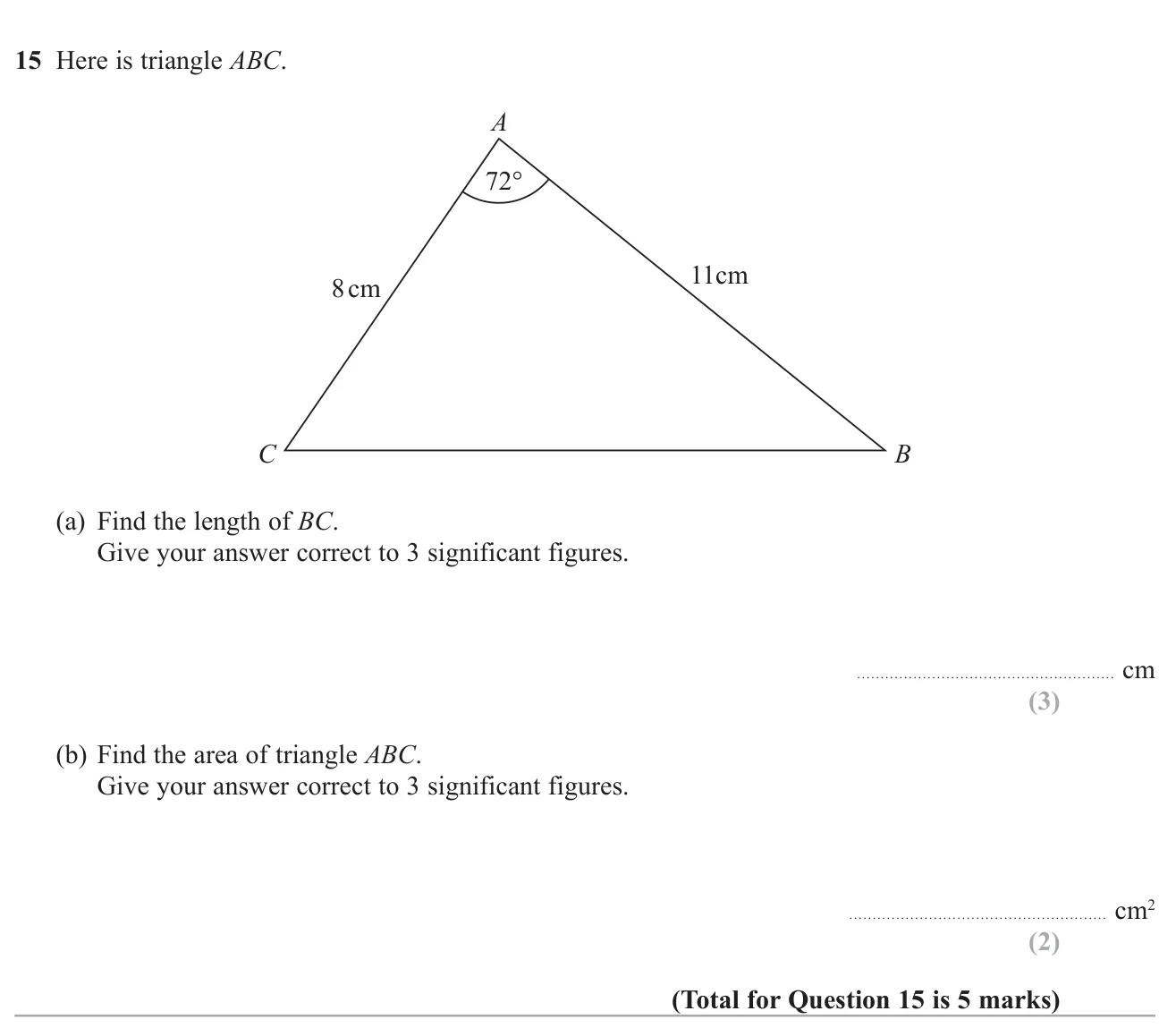
(a) 11.4 11.4 11.4 3 marks (b) 41.8 41.8 41.8 2 marks
Worked solution Checked against the mark scheme
(a) B C 2 = 8 2 + 11 2 − 2 × 8 × 11 cos 72 ° = 185 − 54.38 = 130.61... BC^2 = 8^2 + 11^2 - 2 \times 8 \times 11 \cos 72° = 185 - 54.38 = 130.61... B C 2 = 8 2 + 1 1 2 − 2 × 8 × 11 cos 72° = 185 − 54.38 = 130.61...
B C = 130.61... = 11.4 BC = \sqrt{130.61...} = 11.4 B C = 130.61... = 11.4
(b) Area = 1 2 × 8 × 11 × sin 72 ° = 41.8 = \frac{1}{2} \times 8 \times 11 \times \sin 72° = 41.8 = 2 1 × 8 × 11 × sin 72° = 41.8
Watch out: Working out 185 − 176 185 - 176 185 − 176
© Pearson Education Ltd. November 2020 Paper 2 (Higher, calculator), question 13.
Worked solution Checked against the mark scheme
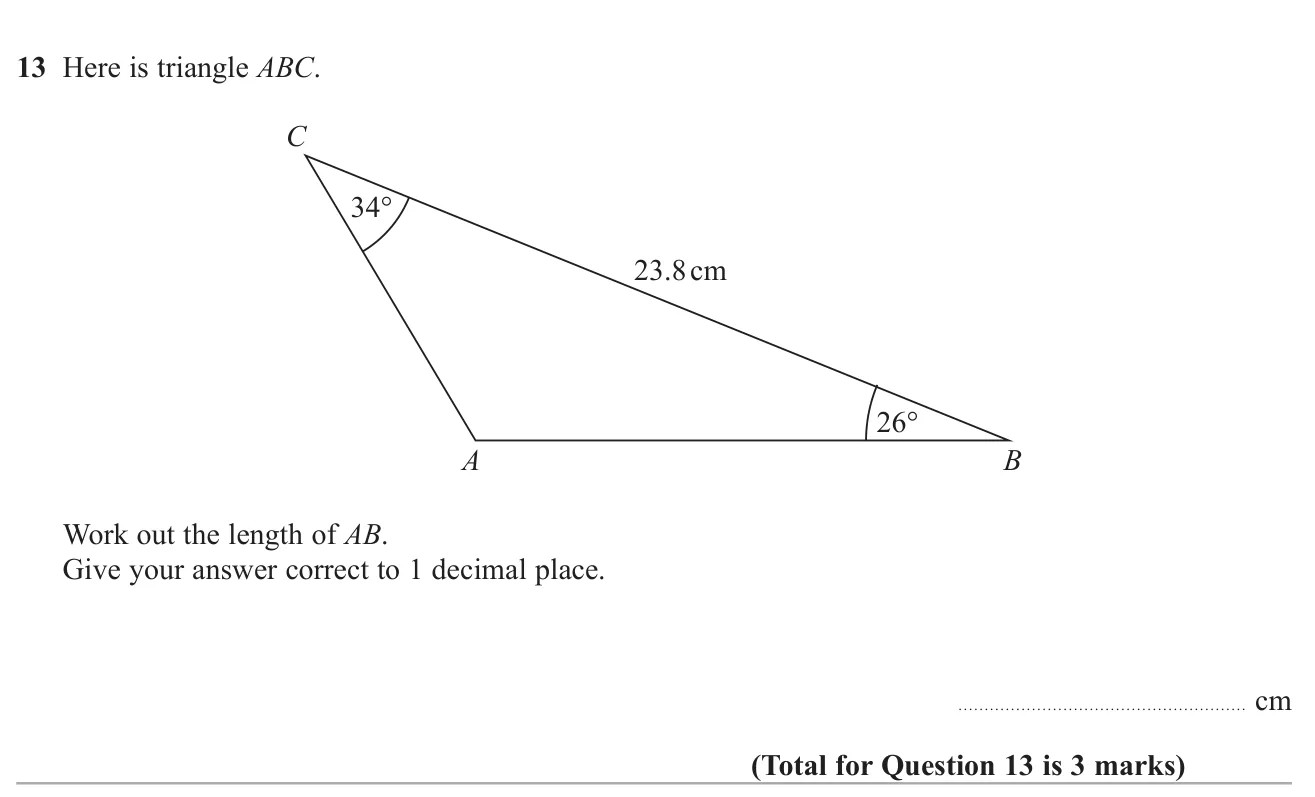
Angle A = 180 ° − 34 ° − 26 ° = 120 ° A = 180° - 34° - 26° = 120° A = 180° − 34° − 26° = 120°
A B sin 34 ° = 23.8 sin 120 ° \frac{AB}{\sin 34°} = \frac{23.8}{\sin 120°} s i n 34° A B = s i n 120° 23.8
A B = 23.8 × sin 34 ° sin 120 ° = 15.367... AB = \frac{23.8 \times \sin 34°}{\sin 120°} = 15.367... A B = s i n 120° 23.8 × s i n 34° = 15.367...
A B = 15.4 AB = 15.4 A B = 15.4
Watch out: Pairing 23.8 cm with 26° or 34° instead of the opposite angle, 120°.
© Pearson Education Ltd. June 2019 Paper 3 (Higher, calculator), question 14.
Worked solution Checked against the mark scheme
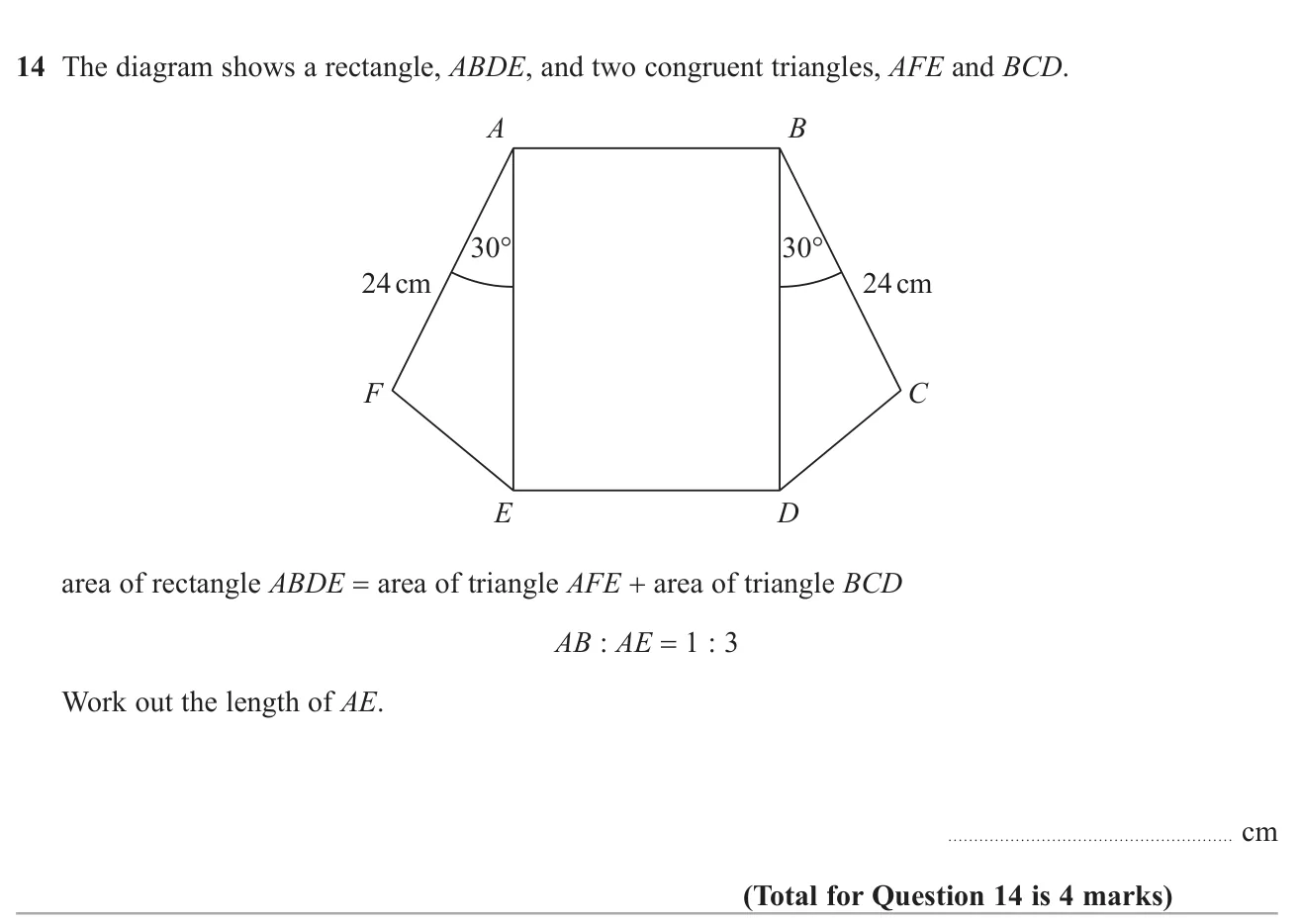
Area of triangle A F E = 1 2 × 24 × A E × sin 30 ° = 6 A E AFE = \frac{1}{2} \times 24 \times AE \times \sin 30° = 6\,AE A F E = 2 1 × 24 × A E × sin 30° = 6 A E
Two triangles: 12 A E 12\,AE 12 A E
Rectangle: A B × A E = 12 A E AB \times AE = 12\,AE A B × A E = 12 A E A B = 12 AB = 12 A B = 12
A E = 3 × A B = 36 AE = 3 \times AB = 36 A E = 3 × A B = 36
Watch out: Using ½ × base × height with 24 as the height.
© Pearson Education Ltd. June 2018 Paper 3 (Higher, calculator), question 17.
Answer 13.1 13.1 13.1 5 marks
Worked solution Checked against the mark scheme
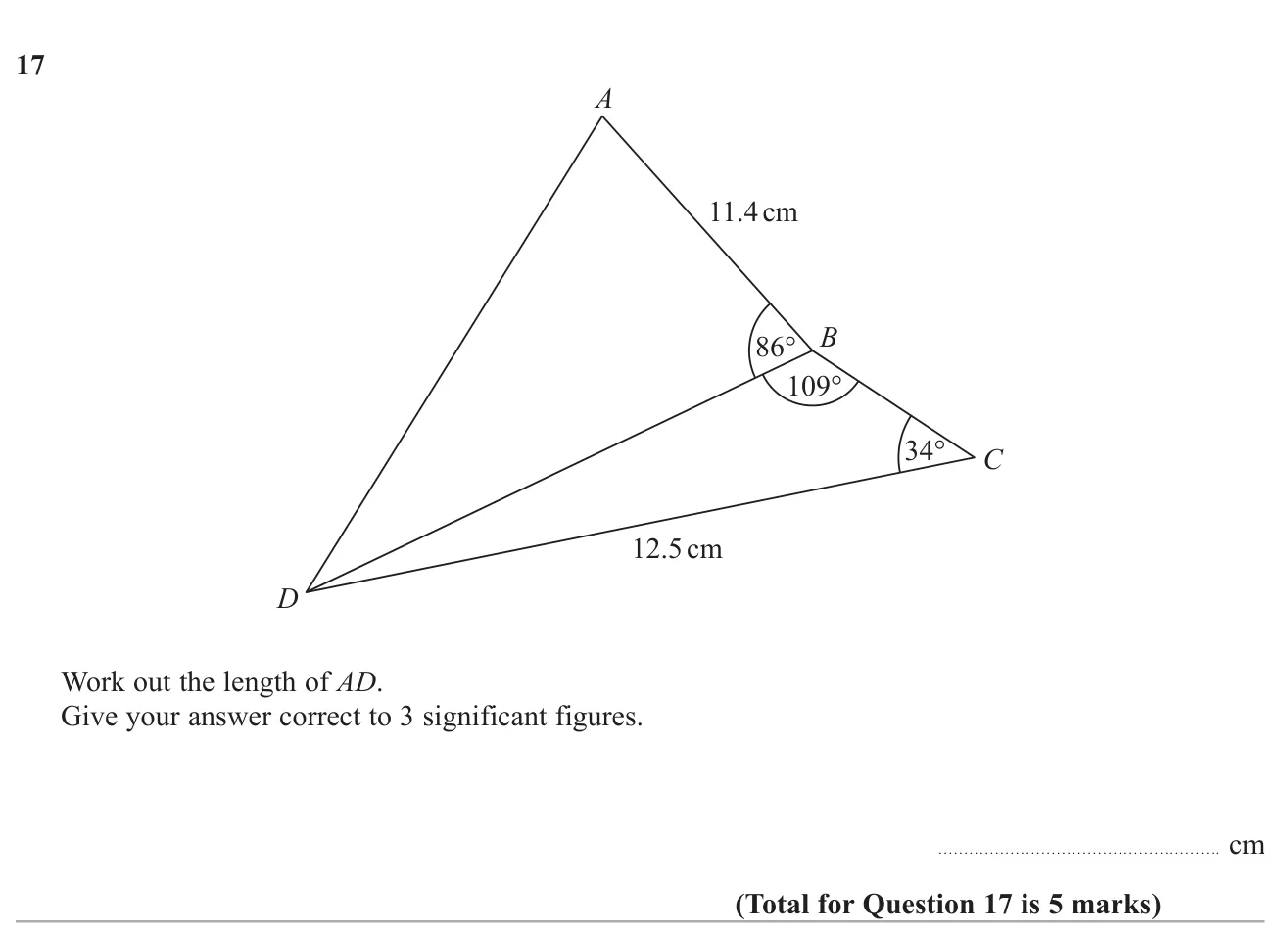
In triangle B C D BCD B C D B D sin 34 ° = 12.5 sin 109 ° \frac{BD}{\sin 34°} = \frac{12.5}{\sin 109°} s i n 34° B D = s i n 109° 12.5
B D = 12.5 sin 34 ° sin 109 ° = 7.393 BD = \frac{12.5 \sin 34°}{\sin 109°} = 7.393 B D = s i n 109° 12.5 s i n 34° = 7.393
In triangle A B D ABD A B D A D 2 = 11.4 2 + 7.393 2 − 2 ( 11.4 ) ( 7.393 ) cos 86 ° AD^2 = 11.4^2 + 7.393^2 - 2(11.4)(7.393)\cos 86° A D 2 = 11. 4 2 + 7.39 3 2 − 2 ( 11.4 ) ( 7.393 ) cos 86°
A D 2 = 129.96 + 54.65 − 11.76 = 172.85 AD^2 = 129.96 + 54.65 - 11.76 = 172.85 A D 2 = 129.96 + 54.65 − 11.76 = 172.85
A D = 13.1 AD = 13.1 A D = 13.1
Watch out: Working out ( 129.96 + 54.65 − 2 × 11.4 × 7.393 ) × cos 86 ° (129.96 + 54.65 - 2 \times 11.4 \times 7.393) \times \cos 86° ( 129.96 + 54.65 − 2 × 11.4 × 7.393 ) × cos 86°
© Pearson Education Ltd. June 2024 Paper 3 (Higher, calculator), question 18.
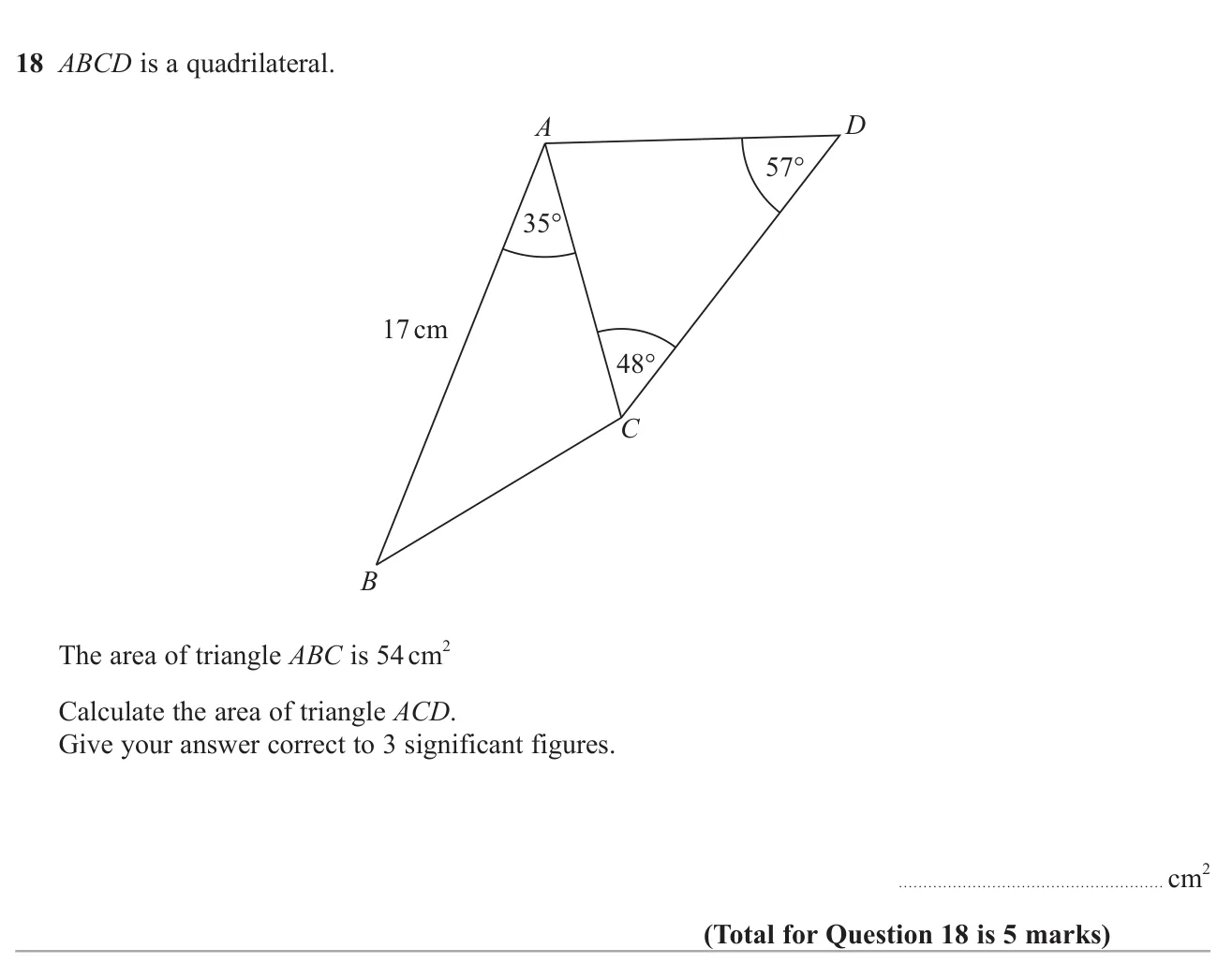
Answer 52.5 52.5 52.5 5 marks
Worked solution Checked against the mark scheme
1 2 × 17 × A C × sin 35 ° = 54 ⇒ A C = 11.076 \frac12 \times 17 \times AC \times \sin 35° = 54 \Rightarrow AC = 11.076 2 1 × 17 × A C × sin 35° = 54 ⇒ A C = 11.076
Angle C A D = 180 ° − 48 ° − 57 ° = 75 ° CAD = 180° - 48° - 57° = 75° C A D = 180° − 48° − 57° = 75°
C D = 11.076 sin 75 ° sin 57 ° = 12.757 CD = \dfrac{11.076 \sin 75°}{\sin 57°} = 12.757 C D = sin 57° 11.076 sin 75° = 12.757
Area = 1 2 × 11.076 × 12.757 × sin 48 ° = 52.5 = \frac12 \times 11.076 \times 12.757 \times \sin 48° = 52.5 = 2 1 × 11.076 × 12.757 × sin 48° = 52.5
Watch out: Using 17 cm as a side of triangle ACD, or rounding AC too early.
© Pearson Education Ltd. November 2023 Paper 1 (Higher, non-calculator), question 20.
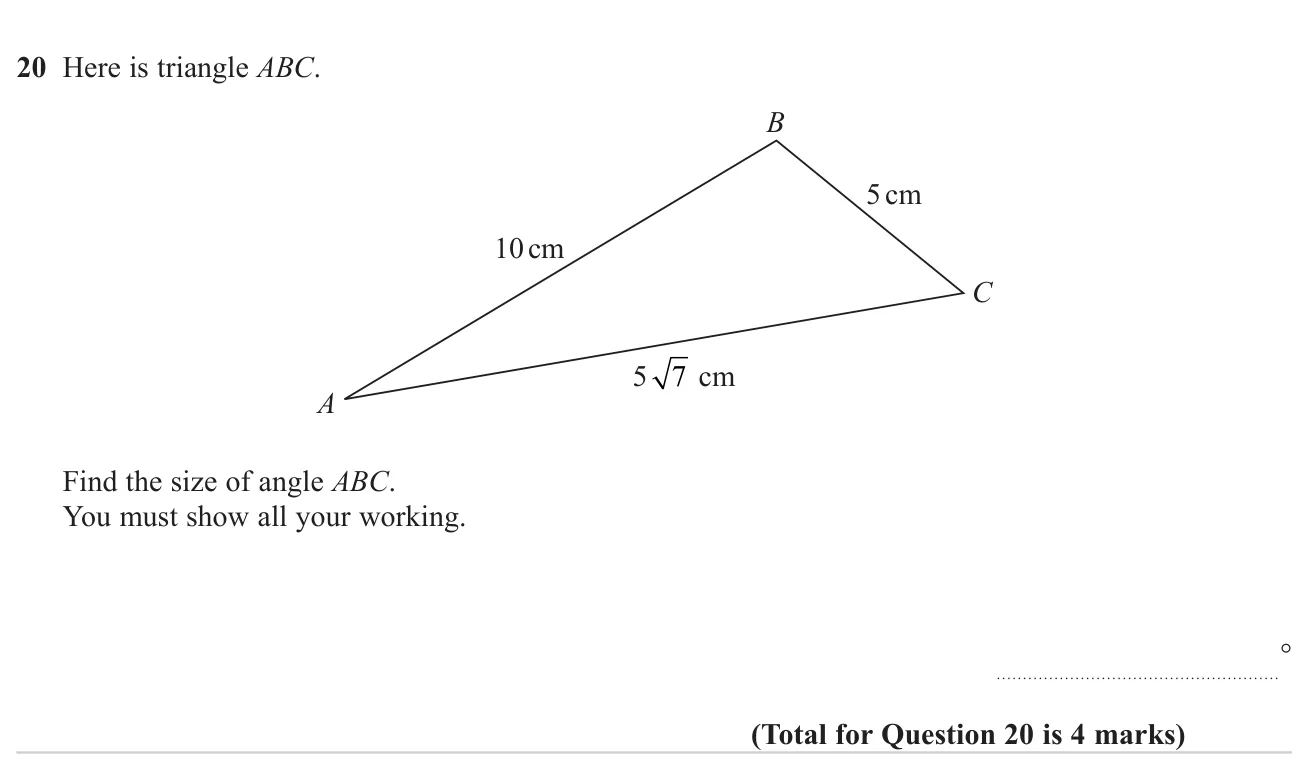
Answer 120 ° 120° 120° 4 marks
Worked solution Checked against the mark scheme
( 5 7 ) 2 = 25 × 7 = 175 (5\sqrt{7})^2 = 25 \times 7 = 175 ( 5 7 ) 2 = 25 × 7 = 175
cos B = 10 2 + 5 2 − 175 2 × 10 × 5 = 125 − 175 100 = − 1 2 \cos B = \frac{10^2 + 5^2 - 175}{2 \times 10 \times 5} = \frac{125 - 175}{100} = -\frac{1}{2} cos B = 2 × 10 × 5 1 0 2 + 5 2 − 175 = 100 125 − 175 = − 2 1
cos 60 ° = 1 2 \cos 60° = \frac{1}{2} cos 60° = 2 1 B = 180 ° − 60 ° = 120 ° B = 180° - 60° = 120° B = 180° − 60° = 120°
Watch out: Squaring 5√7 as 35 or 5 × 49.
© Pearson Education Ltd. November 2022 Paper 3 (Higher, calculator), question 26.
Worked solution Checked against the mark scheme
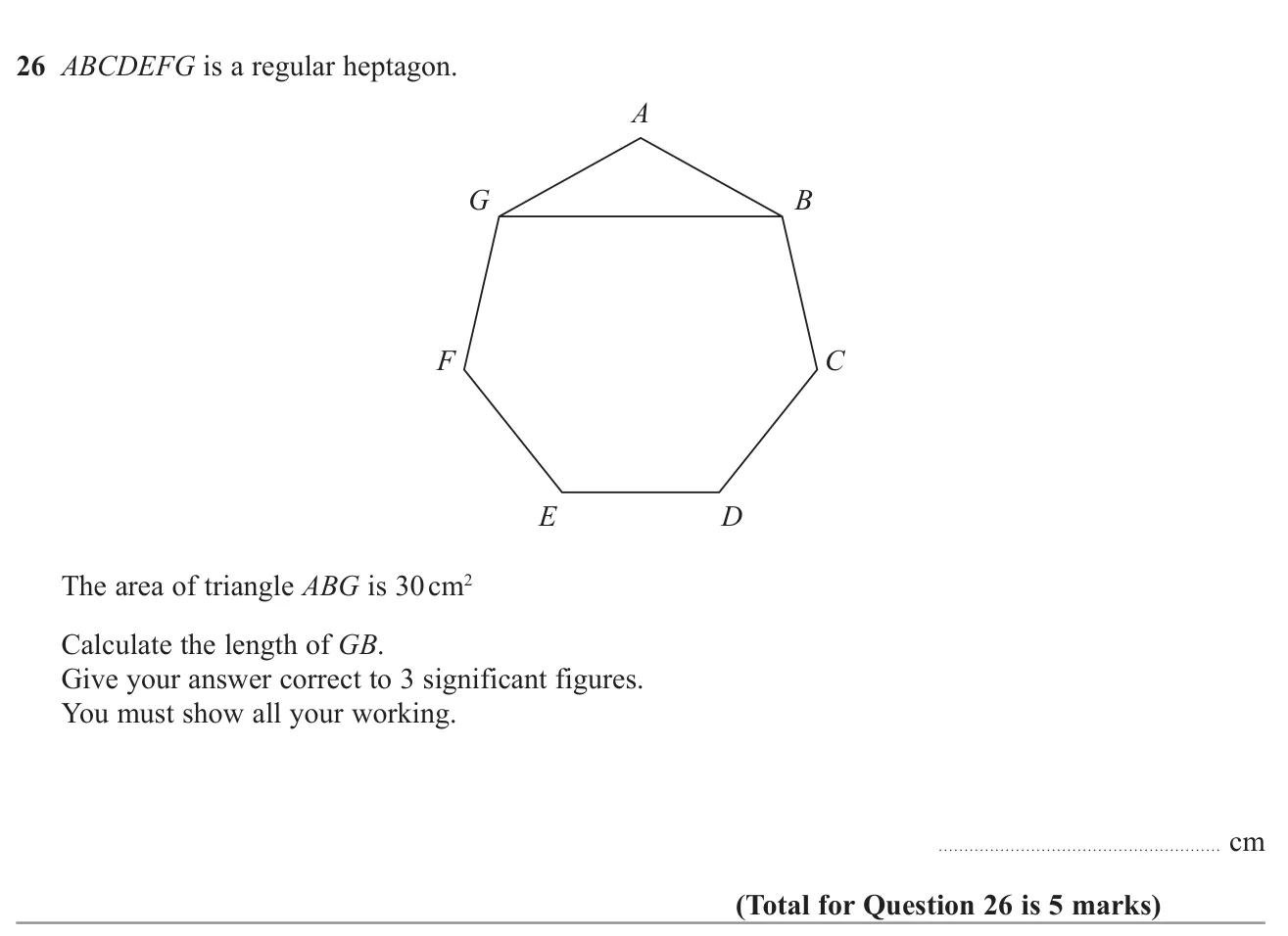
Interior angle: 180 − 360 ÷ 7 ≈ 128.57 ∘ 180 - 360 \div 7 \approx 128.57^\circ 180 − 360 ÷ 7 ≈ 128.5 7 ∘
Area: 1 2 s 2 sin 128.57 ∘ = 30 \frac{1}{2}s^2 \sin 128.57^\circ = 30 2 1 s 2 sin 128.5 7 ∘ = 30 s = 60 ÷ sin 128.57 ∘ ≈ 8.760 s = \sqrt{60 \div \sin 128.57^\circ} \approx 8.760 s = 60 ÷ sin 128.5 7 ∘ ≈ 8.760
Cosine rule: G B 2 = 2 s 2 − 2 s 2 cos 128.57 ∘ ≈ 249.2 GB^2 = 2s^2 - 2s^2 \cos 128.57^\circ \approx 249.2 G B 2 = 2 s 2 − 2 s 2 cos 128.5 7 ∘ ≈ 249.2
G B ≈ 15.8 GB \approx 15.8 GB ≈ 15.8
Watch out: Using the exterior angle (51.4°) in the area formula.
© Pearson Education Ltd. June 2019 Paper 3 (Higher, calculator), question 23.
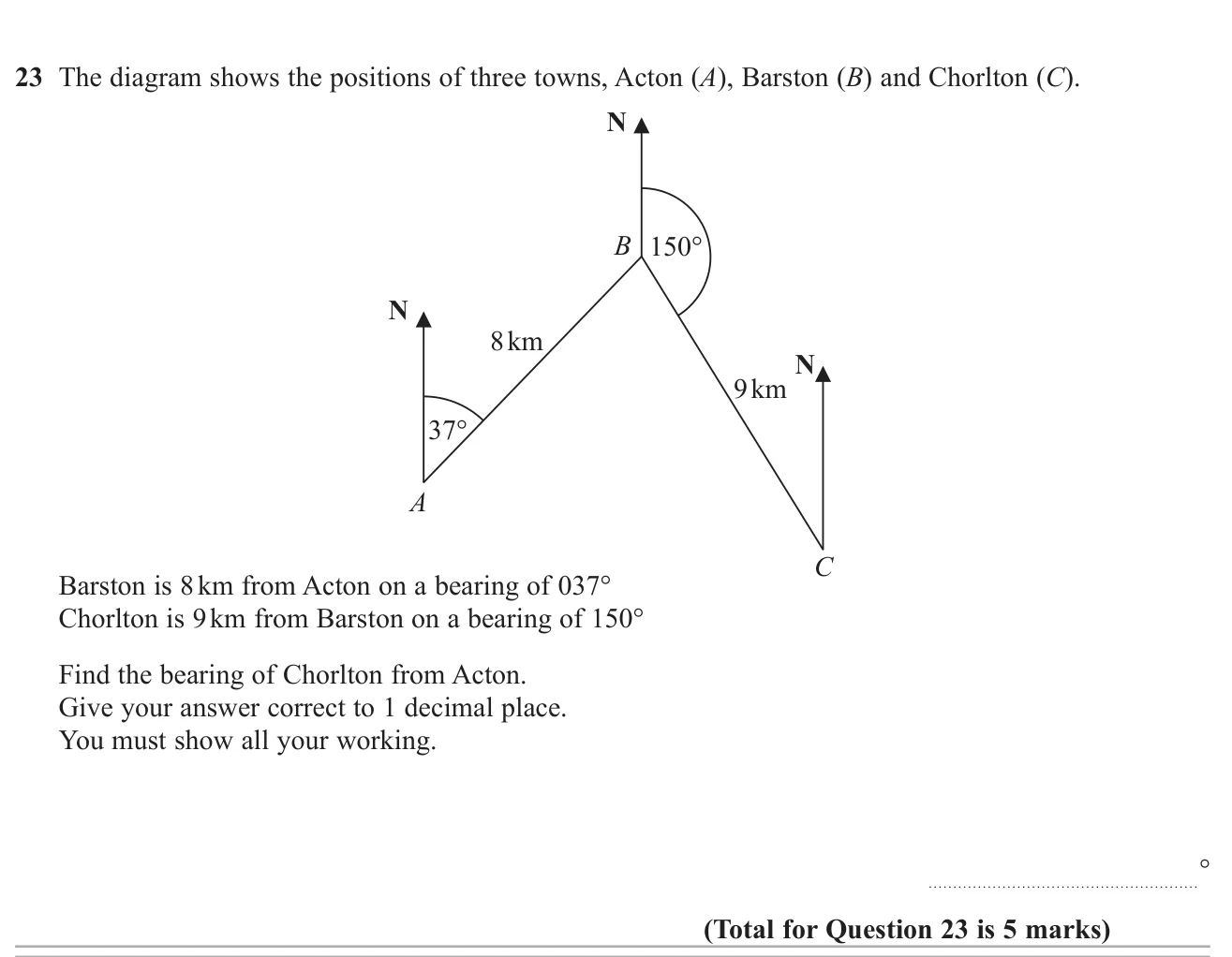
Answer 098.6 ° 098.6° 098.6° 5 marks
Worked solution Checked against the mark scheme
The back-bearing of A A A B B B 217 ° 217° 217° A B C = 217 − 150 = 67 ° ABC = 217 - 150 = 67° A B C = 217 − 150 = 67°
A C 2 = 8 2 + 9 2 − 2 × 8 × 9 cos 67 ° = 88.73 AC^2 = 8^2 + 9^2 - 2 \times 8 \times 9 \cos 67° = 88.73 A C 2 = 8 2 + 9 2 − 2 × 8 × 9 cos 67° = 88.73 A C = 9.420 AC = 9.420 A C = 9.420
sin B A C = 9 sin 67 ° 9.420 ⇒ B A C = 61.58 ° \sin BAC = \frac{9 \sin 67°}{9.420} \Rightarrow BAC = 61.58° sin B A C = 9.420 9 s i n 67° ⇒ B A C = 61.58°
Bearing = 37 + 61.58 = 098.6 ° = 37 + 61.58 = 098.6° = 37 + 61.58 = 098.6°
Watch out: Using 150° − 37° = 113° as angle ABC.
© Pearson Education Ltd. November 2019 Paper 3 (Higher, calculator), question 18.
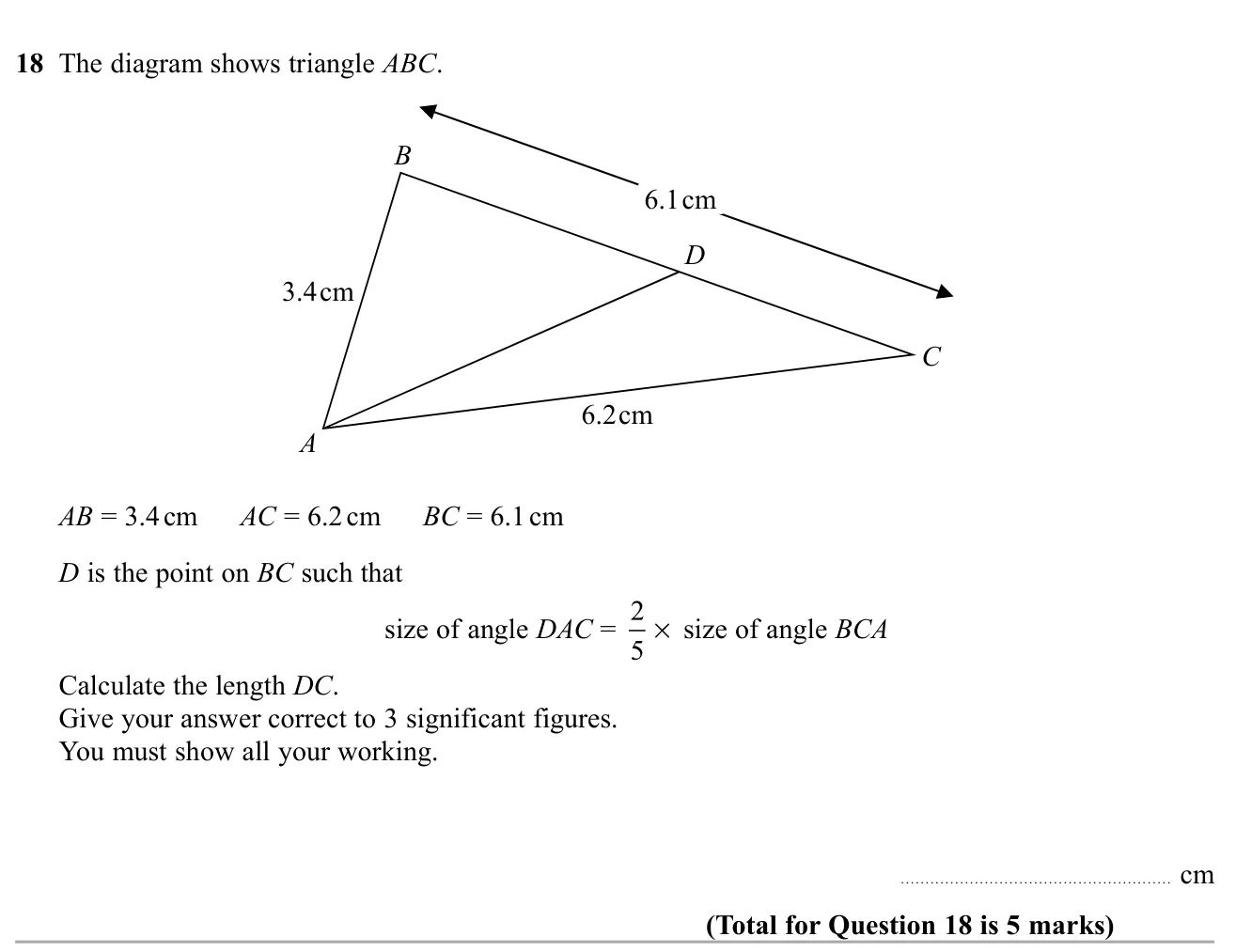
Answer 1.95 1.95 1.95 5 marks
Worked solution Checked against the mark scheme
Cosine rule: cos C = 6.1 2 + 6.2 2 − 3.4 2 2 × 6.1 × 6.2 \cos C = \dfrac{6.1^2 + 6.2^2 - 3.4^2}{2 \times 6.1 \times 6.2} cos C = 2 × 6.1 × 6.2 6. 1 2 + 6. 2 2 − 3. 4 2 C = 32.08 ° C = 32.08° C = 32.08°
Angle DAC = 2 5 × 32.08 = 12.83 ° = \frac{2}{5} \times 32.08 = 12.83° = 5 2 × 32.08 = 12.83°
Angle ADC = 180 − 32.08 − 12.83 = 135.09 ° = 180 - 32.08 - 12.83 = 135.09° = 180 − 32.08 − 12.83 = 135.09°
Sine rule: D C = 6.2 sin 12.83 ° sin 135.09 ° = 1.95 DC = \dfrac{6.2 \sin 12.83°}{\sin 135.09°} = 1.95 D C = sin 135.09° 6.2 sin 12.83° = 1.95
Watch out: Using 6.1 cm (BC) as the side opposite angle ADC instead of AC.
© Pearson Education Ltd. November 2018 Paper 3 (Higher, calculator), question 16.
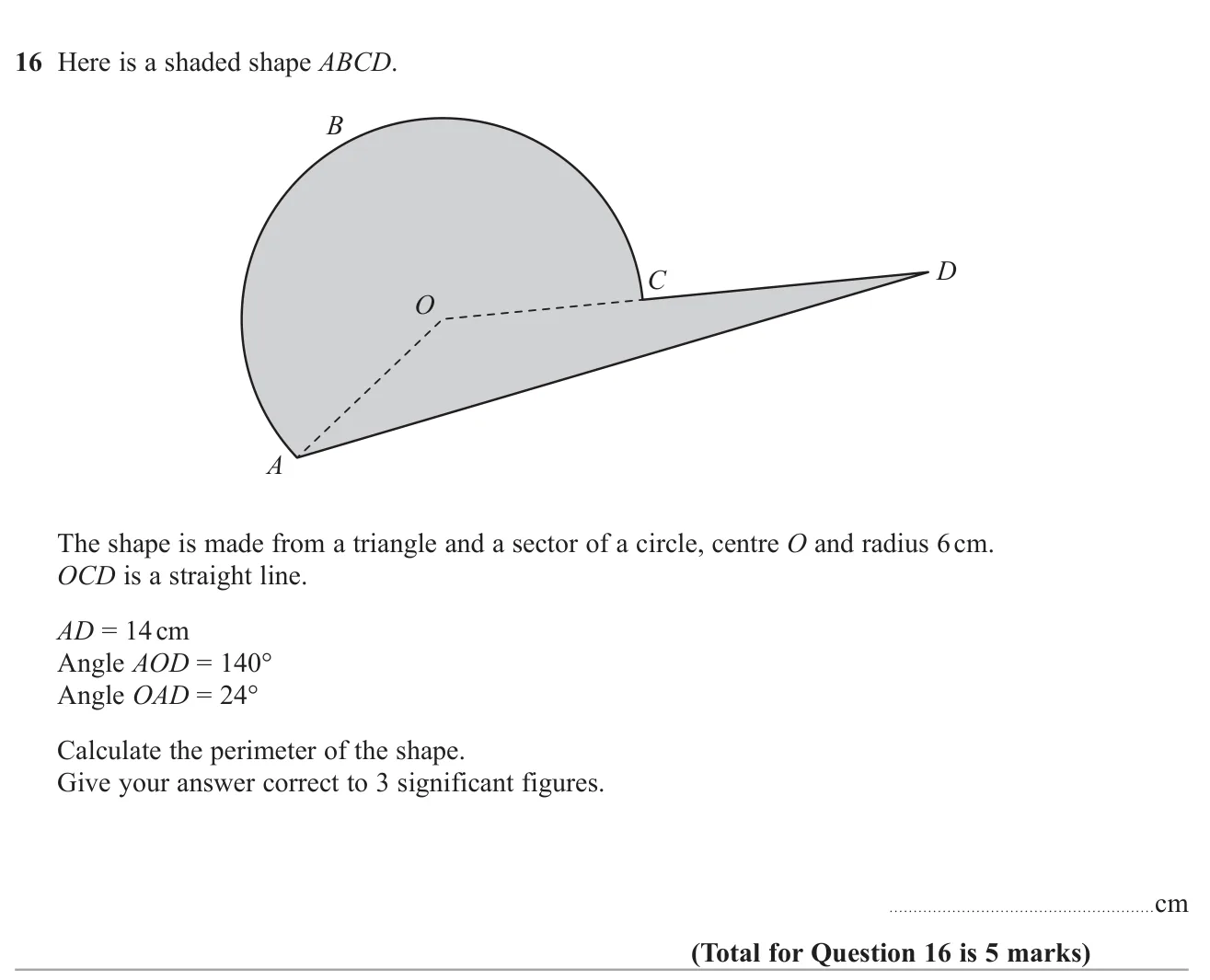
Answer 39.9 39.9 39.9 5 marks
Worked solution Checked against the mark scheme
The sector's outer arc uses 360 − 140 = 220 ° 360 - 140 = 220° 360 − 140 = 220°
Arc = 220 360 × 2 π × 6 = 23.04 = \frac{220}{360} \times 2\pi \times 6 = 23.04 = 360 220 × 2 π × 6 = 23.04
Sine rule in triangle AOD: O D sin 24 ° = 14 sin 140 ° \frac{OD}{\sin 24°} = \frac{14}{\sin 140°} s i n 24° O D = s i n 140° 14 O D = 8.859 OD = 8.859 O D = 8.859
C D = O D − 6 = 2.859 CD = OD - 6 = 2.859 C D = O D − 6 = 2.859
Perimeter = 23.04 + 14 + 2.859 = 39.9 = 23.04 + 14 + 2.859 = 39.9 = 23.04 + 14 + 2.859 = 39.9
Watch out: Using the 140° minor arc instead of the 220° major arc.
© Pearson Education Ltd. November 2021 Paper 3 (Higher, calculator), question 23.
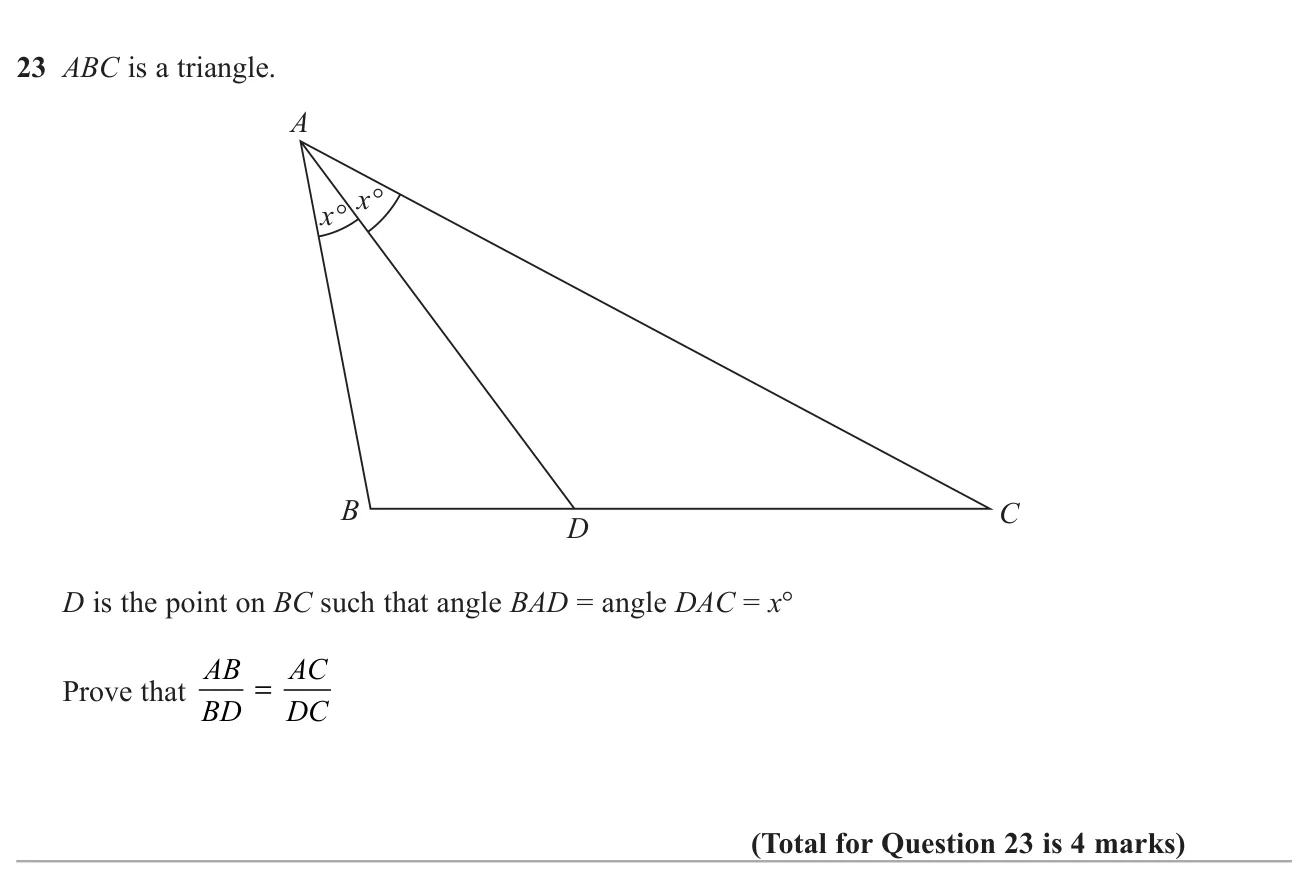
Answer Proof using the sine rule in both small triangles and sin ( 180 ∘ − y ) = sin y \sin(180^\circ - y) = \sin y sin ( 18 0 ∘ − y ) = sin y 4 marks
Worked solution Checked against the mark scheme
Let angle A D B = y ADB = y A D B = y A D C = 180 ∘ − y ADC = 180^\circ - y A D C = 18 0 ∘ − y
Sine rule in A B D ABD A B D A B sin y = B D sin x \frac{AB}{\sin y} = \frac{BD}{\sin x} s i n y A B = s i n x B D A B B D = sin y sin x \frac{AB}{BD} = \frac{\sin y}{\sin x} B D A B = s i n x s i n y
Sine rule in A D C ADC A D C A C D C = sin ( 180 ∘ − y ) sin x \frac{AC}{DC} = \frac{\sin(180^\circ - y)}{\sin x} D C A C = s i n x s i n ( 18 0 ∘ − y )
Since sin ( 180 ∘ − y ) = sin y \sin(180^\circ - y) = \sin y sin ( 18 0 ∘ − y ) = sin y sin y sin x \frac{\sin y}{\sin x} s i n x s i n y A B B D = A C D C \frac{AB}{BD} = \frac{AC}{DC} B D A B = D C A C
Watch out: Not justifying why the sines of the two angles at D are equal.
Also tested in these questions Their main topic is different, but part of each one tests this topic.