Ratio, proportion and rates of change

Speed, density and pressure

41 past-paper questions, easiest first. Try each one, then reveal the answer.

Foundation & Higher30 of 41 from Foundation papers

Revision guide by The Full Marks

Speed, density and pressure: what you need to know

A compound measure combines two units, like speed (km per hour), density (g per cm³) or pressure (newtons per m²). Questions test whether you can pick the right formula, rearrange it and keep the units consistent.

Key facts

  • Speed =distancetime= \dfrac{\text{distance}}{\text{time}}, so distance == speed ×\times time.
  • Density =massvolume= \dfrac{\text{mass}}{\text{volume}}, so mass == density ×\times volume.
  • Pressure =forcearea= \dfrac{\text{force}}{\text{area}}, so force == pressure ×\times area. Units: N/m² (or N/cm² if the area is in cm²).
  • To change m/s to km/h, multiply by 36003600 (seconds in an hour) then divide by 10001000: 1515 m/s =54= 54 km/h.
  • Changing a decimal of an hour to minutes: multiply the decimal part by 6060, e.g. 2.752.75 hours =2= 2 hours 4545 minutes.
  • Rates of pay and unit prices work the same way: £ per hour, pence per gram.

Using a compound measure formula

  1. Write down the formula and what you know.
  2. Make sure the units match the answer's units (e.g. minutes to hours for km/h).
  3. Rearrange if needed, then substitute and calculate.
  4. Give units in your answer, e.g. km/h or g/cm³.

Mixtures

  1. Find the mass of each part: mass == density ×\times volume (or volume == mass ÷\div density if you are given the mass).
  2. Add the masses and add the volumes.
  3. Density of the mixture == total mass ÷\div total volume. Never just average the densities.

Worked examples

Example 1 Foundation · grade 4

Owen cycles 2727 km in 11 hour 1515 minutes. Work out his average speed in km/h.

Show the solution

1515 minutes =1560=0.25= \frac{15}{60} = 0.25 hours, so the time is 1.251.25 hours.
Speed =27÷1.25=21.6= 27 \div 1.25 = 21.6
Answer: 21.621.6 km/h

Example 2 Higher · grade 6

300 cm3300\text{ cm}^3 of liquid A (density 0.80.8 g/cm³) is mixed with 200 cm3200\text{ cm}^3 of liquid B (density 1.21.2 g/cm³). Find the density of the mixture.

Show the solution

Mass of A =0.8×300=240= 0.8 \times 300 = 240 g
Mass of B =1.2×200=240= 1.2 \times 200 = 240 g
Total mass =480= 480 g, total volume =500 cm3= 500\text{ cm}^3
Density =480÷500=0.96= 480 \div 500 = 0.96 g/cm³

Common mistakes

  • Writing 1 hour 15 minutes as 1.15 hours, or 2.75 hours as 2 hours 75 minutes. Divide minutes by 60 to get hours; multiply the decimal part by 60 to get minutes.
  • Averaging two speeds or two densities. Use totals: total distance over total time.
  • Mixing units, e.g. an area in cm² with a pressure asked for in N/m².
  • For pressure, using the volume (or the perimeter) instead of the area the object rests on.

Exam tips

  • A formula triangle is fine, but write the calculation you are doing (e.g. 27÷1.2527 \div 1.25): it can earn a method mark even if the arithmetic slips.
  • Learn the formulas for speed, density and pressure. A question may sometimes give you one, but do not rely on it.

Questions people ask

What is the formula for density?

Density = mass ÷ volume. If mass is in grams and volume in cm³, density is in g/cm³.

How do you work out average speed?

Divide the total distance by the total time taken, with the time in hours if you want km/h or mph.

Exam questions: Speed, density and pressure (41, easiest first)

Speed, density and pressure2 marksGrade 2CalculatorFoundation
November 2023 · Paper 2 Foundation · Q12
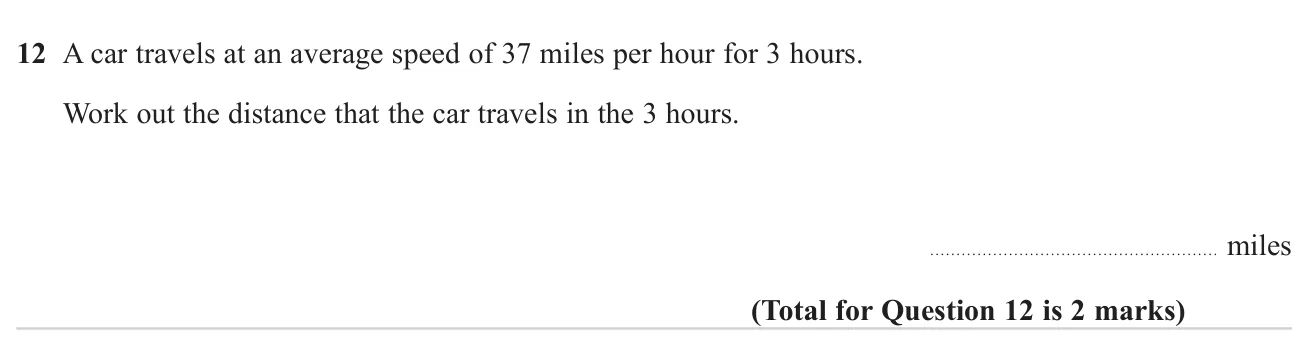
Find the distance covered from an average speed and a time.

© Pearson Education Ltd. November 2023 Paper 2 (Foundation, calculator), question 12.

Show answer
Answer111 miles2 marks

Worked solution Checked against the mark scheme

Distance == speed ×\times time

37×3=11137 \times 3 = 111 miles

Watch out: Dividing 37 by 3 instead of multiplying.
Speed, density and pressure3 marksGrade 3CalculatorFoundation
June 2023 · Paper 2 Foundation · Q16
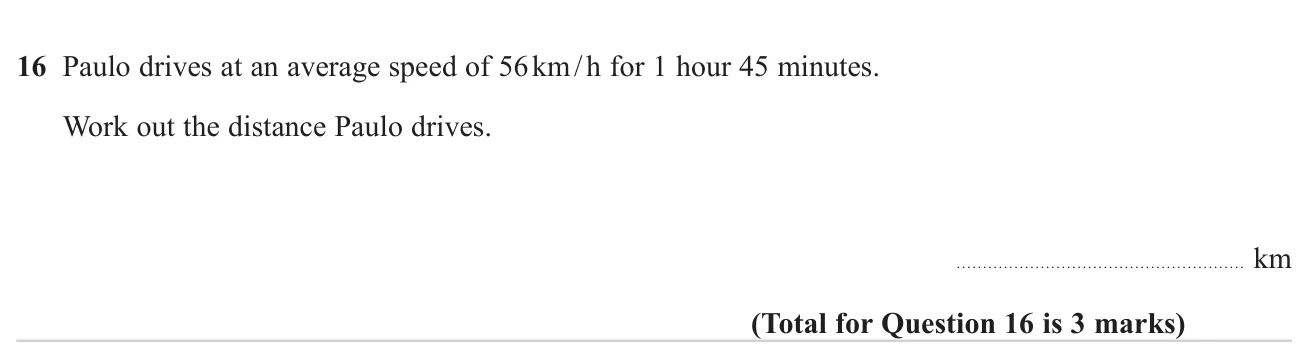
Work out a distance from an average speed and a time in hours and minutes.

© Pearson Education Ltd. June 2023 Paper 2 (Foundation, calculator), question 16.

Show answer
Answer98 km3 marks

Worked solution Checked against the mark scheme

45 minutes =4560=0.75= \frac{45}{60} = 0.75 hours, so the time is 1.751.75 hours.

Distance = speed × time =56×1.75=98= 56 \times 1.75 = 98 km

Watch out: Using 1.45 hours for 1 hour 45 minutes.
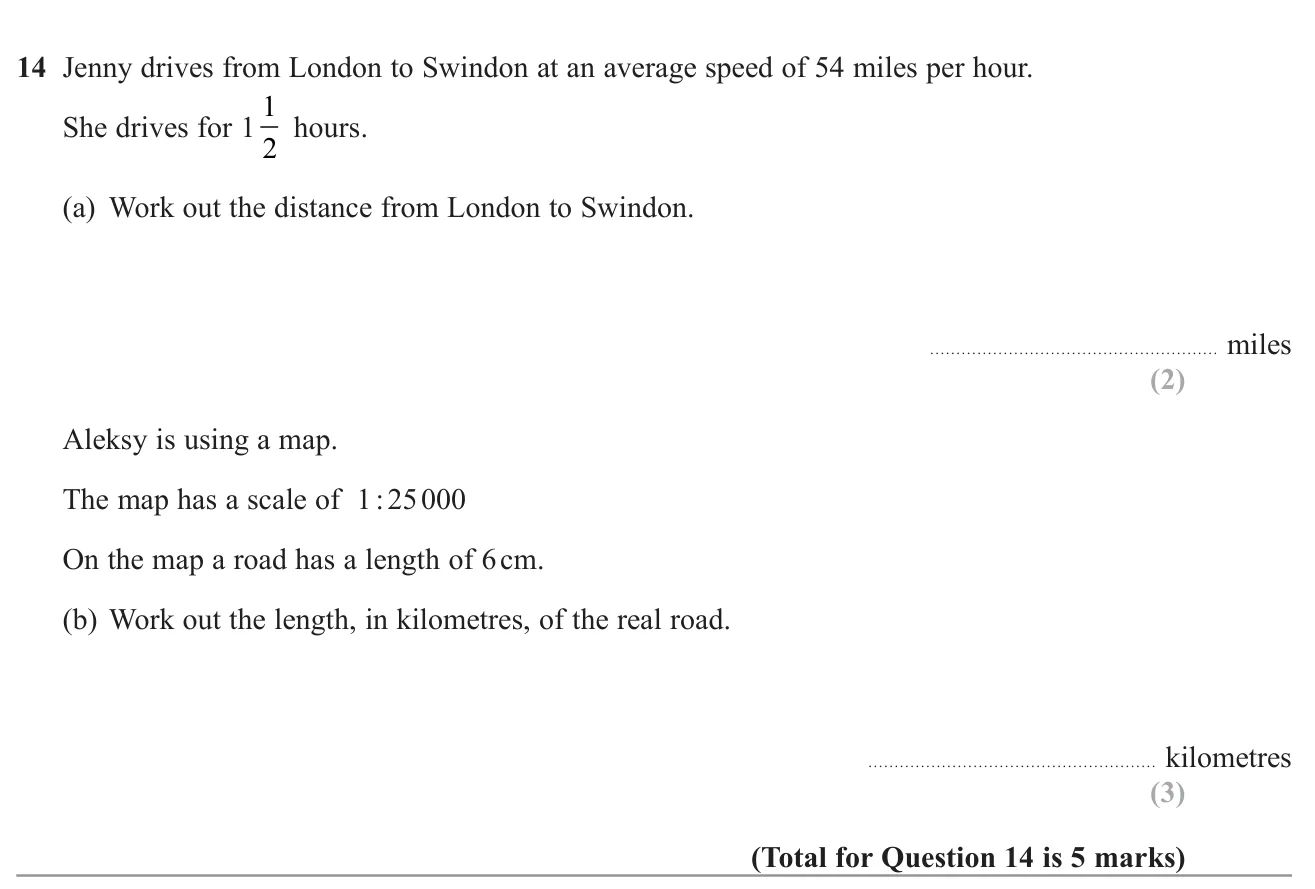
Speed, density and pressure5 marksGrade 3No calculatorFoundation
November 2022 · Paper 1 Foundation · Q14
Find a distance from a speed and a time in hours and a half, then convert a map length to real kilometres using a scale.

© Pearson Education Ltd. November 2022 Paper 1 (Foundation, non-calculator), question 14.

Show answer
(a)8181 miles2 marks
(b)1.51.5 km3 marks

Worked solution Checked against the mark scheme

(a) Distance = speed × time =54×1.5=81= 54 \times 1.5 = 81 miles

(b) Real length =6×25 000=150 000= 6 \times 25\,000 = 150\,000 cm

150 000÷100=1500150\,000 \div 100 = 1500 m, and 1500÷1000=1.51500 \div 1000 = 1.5 km

Watch out: In (a), using 1.30 hours as the time.
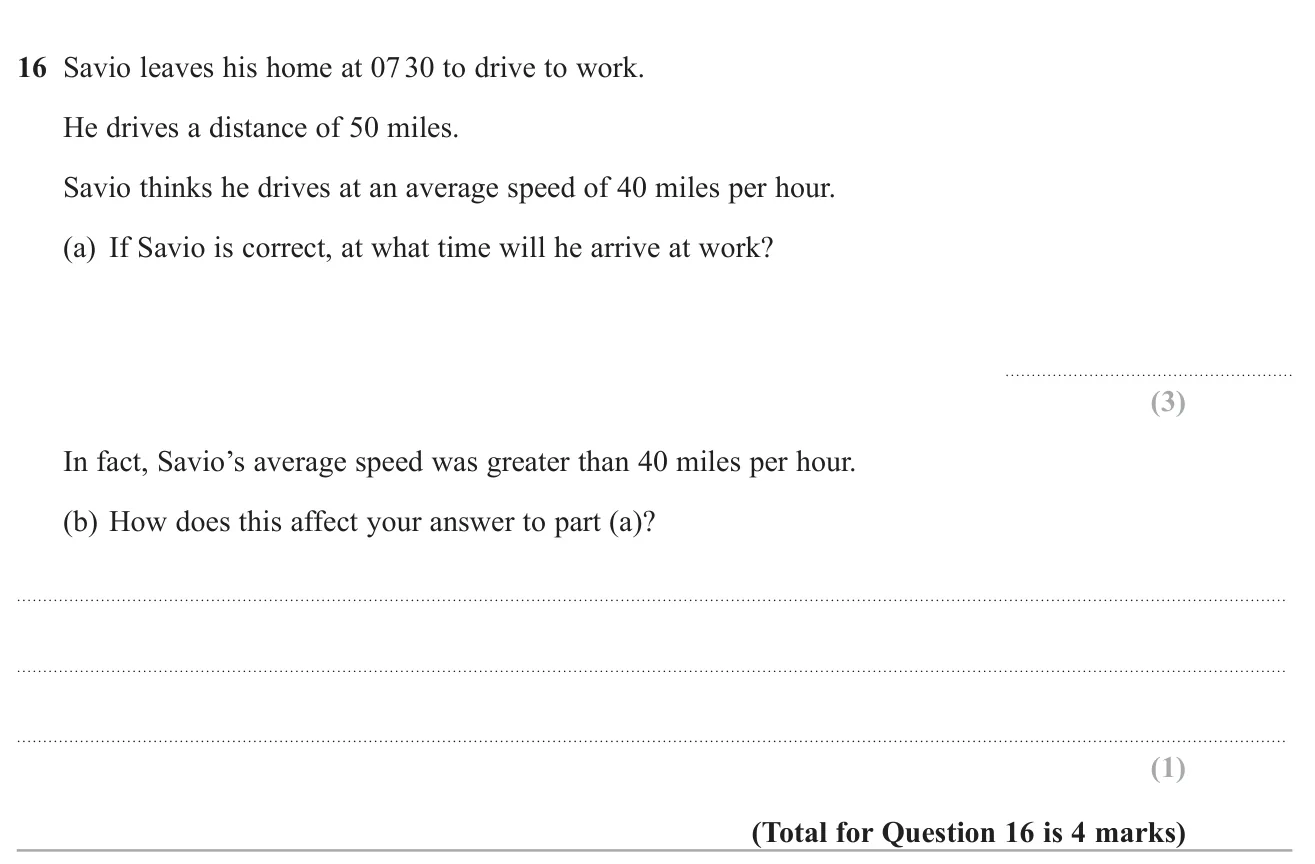
Speed, density and pressure4 marksGrade 3No calculatorFoundation
June 2022 · Paper 1 Foundation · Q16
Use distance and average speed to find an arrival time, then say how a faster speed changes it.

© Pearson Education Ltd. June 2022 Paper 1 (Foundation, non-calculator), question 16.

Show answer
(a)08 453 marks
(b)He will arrive earlier1 mark

Worked solution Checked against the mark scheme

(a) Time =50÷40=1.25= 50 \div 40 = 1.25 hours

0.25×60=150.25 \times 60 = 15, so 1 hour 15 minutes.

07 30 + 1 h 15 min = 08 45

(b) Going faster over the same distance takes less time, so he arrives earlier.

Watch out: Treating 1.25 hours as 1 hour 25 minutes, giving 08 55.
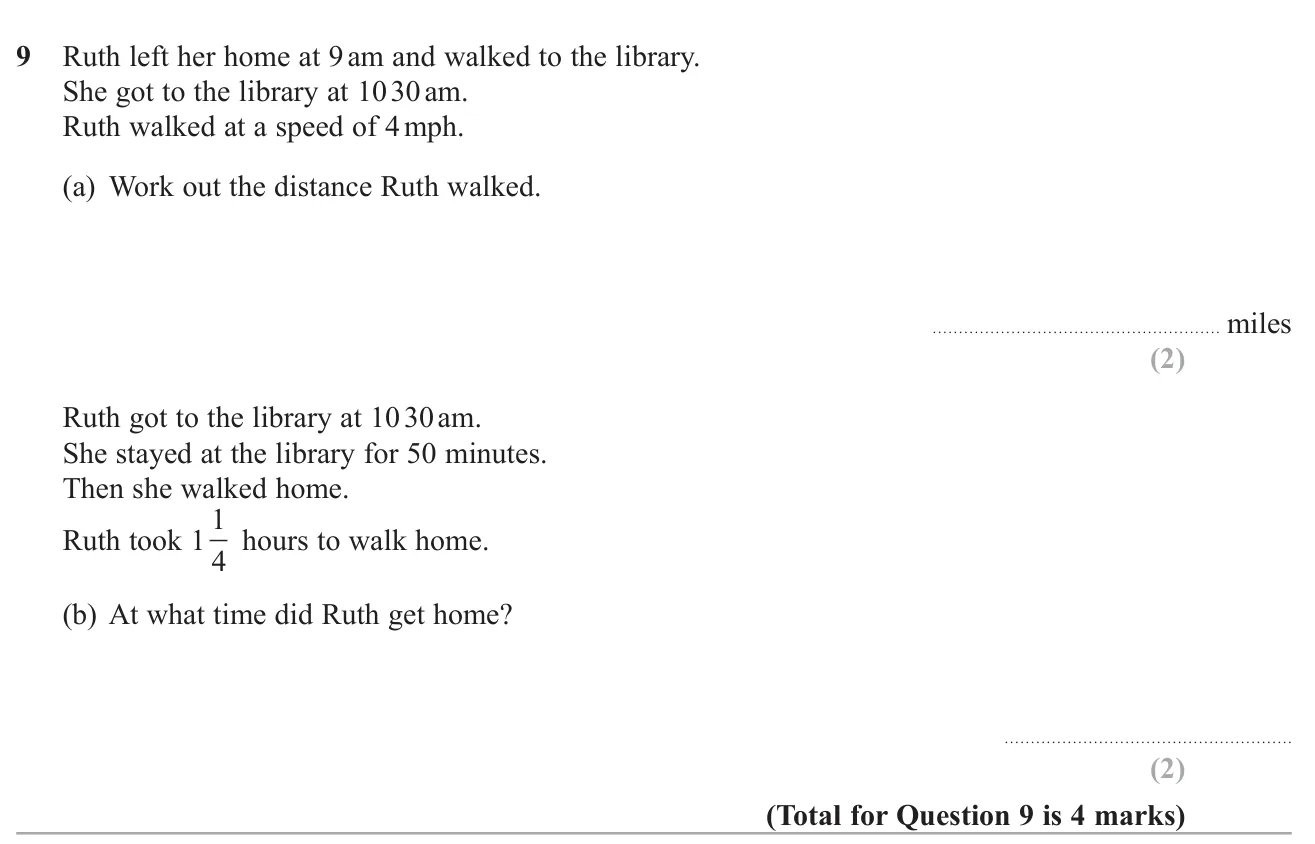
Speed, density and pressure4 marksGrade 3No calculatorFoundation
June 2019 · Paper 1 Foundation · Q9
Use speed and time to find a distance walked, then add durations to find an arrival time.

© Pearson Education Ltd. June 2019 Paper 1 (Foundation, non-calculator), question 9.

Show answer
(a)6 miles2 marks
(b)12 35 pm2 marks

Worked solution Checked against the mark scheme

(a) 9 am to 10 30 am is 1.5 hours.

Distance =4×1.5=6= 4 \times 1.5 = 6 miles

(b) Leaves library: 10 30 + 50 min = 11 20 am

1141\frac{1}{4} hours is 1 hour 15 minutes: 11 20 + 1 h 15 min = 12 35 pm

Watch out: Treating 1 hour 30 minutes as 1.3 hours, or 1141\frac{1}{4} hours as 1 hour 25 minutes.

Speed, density and pressure3 marksGrade 3CalculatorFoundation
November 2019 · Paper 2 Foundation · Q10
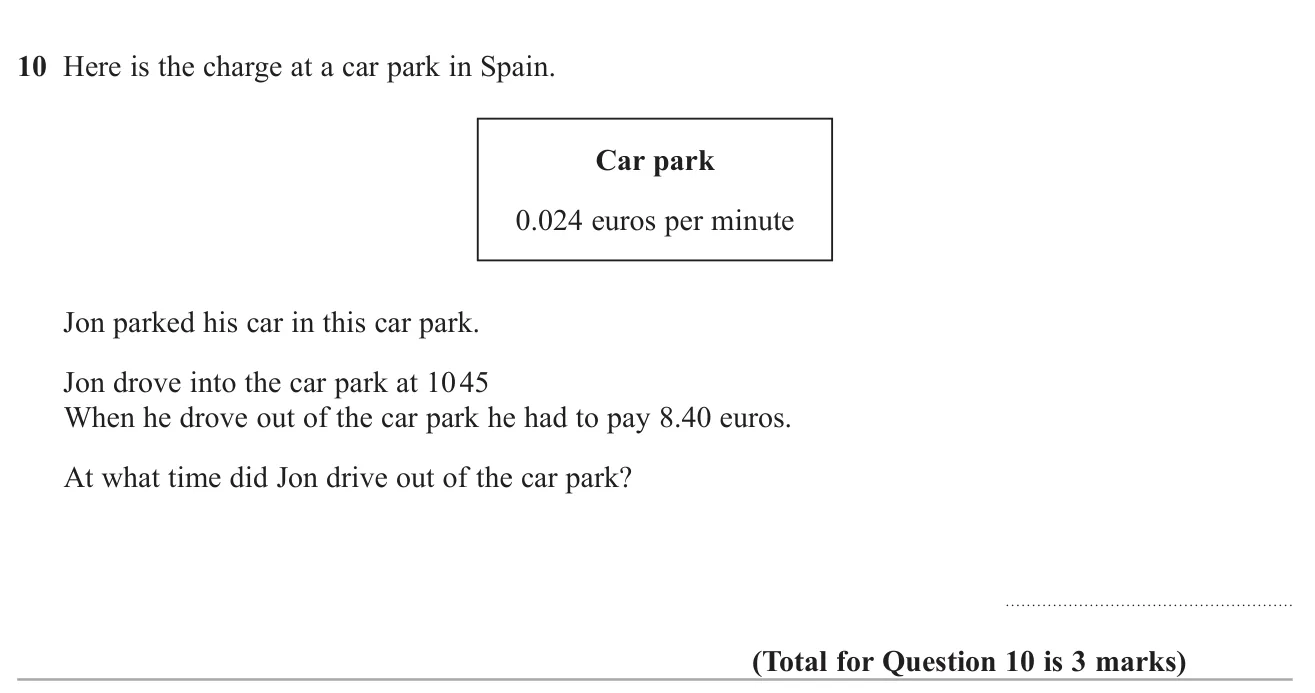
Use a per-minute parking charge to find how long a car was parked and the time it left.

© Pearson Education Ltd. November 2019 Paper 2 (Foundation, calculator), question 10.

Show answer
Answer16:35 (4:35 pm)3 marks

Worked solution Checked against the mark scheme

Minutes parked: 8.40÷0.024=3508.40 \div 0.024 = 350 minutes

350350 minutes =5= 5 hours 5050 minutes

10:45+5 h 50 min=16:3510{:}45 + 5\text{ h }50\text{ min} = 16{:}35

Watch out: Treating 5.83 hours as 5 hours 83 minutes.
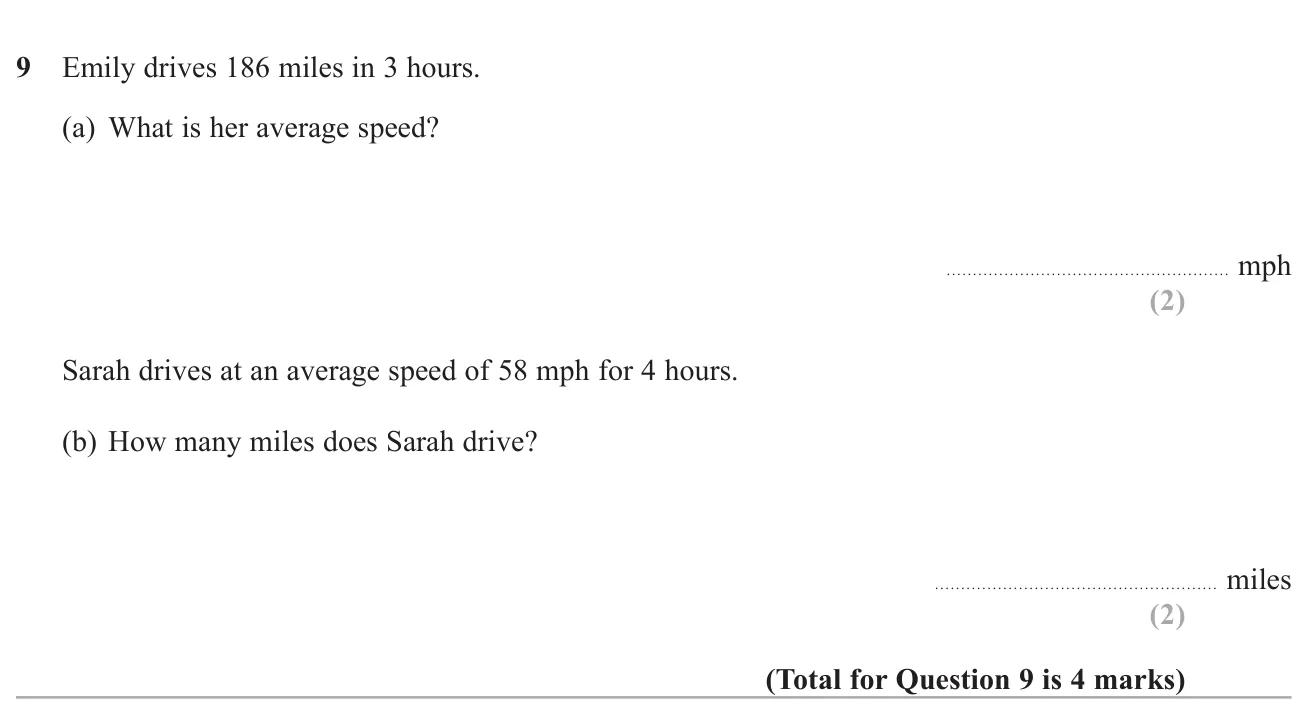
Speed, density and pressure4 marksGrade 3CalculatorFoundation
June 2018 · Paper 2 Foundation · Q9
Use distance, speed and time to find an average speed and then a distance travelled.

© Pearson Education Ltd. June 2018 Paper 2 (Foundation, calculator), question 9.

Show answer
(a)6262 mph2 marks
(b)232232 miles2 marks

Worked solution Checked against the mark scheme

(a) Speed =distancetime=186÷3=62= \frac{\text{distance}}{\text{time}} = 186 \div 3 = 62 mph

(b) Distance == speed ×\times time =58×4=232= 58 \times 4 = 232 miles

Watch out: Multiplying instead of dividing in (a).
Speed, density and pressure5 marksGrade 3CalculatorFoundation
June 2024 · Paper 2 Foundation · Q14
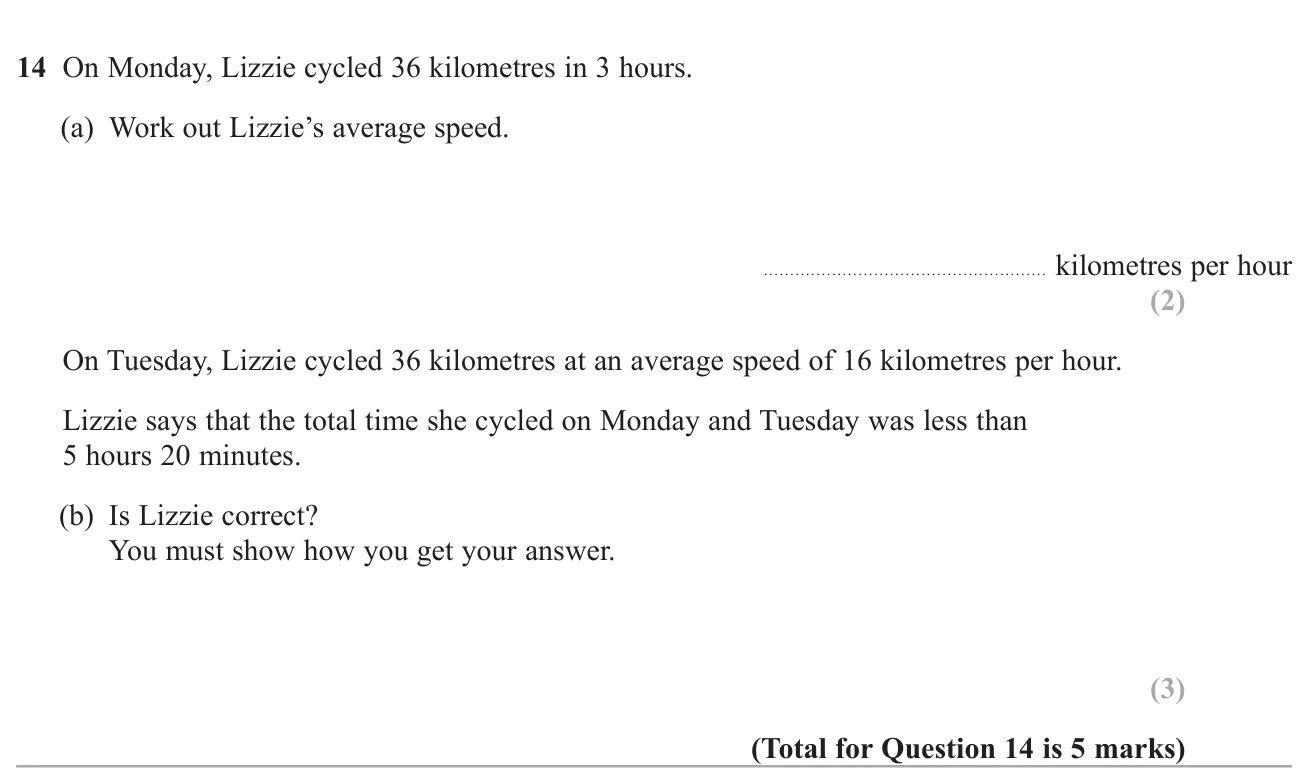
Work out average speed, then check whether total cycling time over two days is under a given time.

© Pearson Education Ltd. June 2024 Paper 2 (Foundation, calculator), question 14.

Show answer
(a)1212 km/h2 marks
(b)Yes: total time is 5 hours 15 minutes, which is less than 5 hours 20 minutes3 marks

Worked solution Checked against the mark scheme

(a) Speed =36÷3=12= 36 \div 3 = 12 km/h

(b) Tuesday time =36÷16=2.25= 36 \div 16 = 2.25 hours =2= 2 h 1515 min

Total =3= 3 h +2+ 2 h 1515 min =5= 5 h 1515 min

55 h 1515 min <5< 5 h 2020 min, so Lizzie is correct.

Watch out: Treating 2.25 hours as 2 hours 25 minutes.
Speed, density and pressure4 marksGrade 4No calculatorOn both tiers
November 2024 · Paper 1 Foundation · Q22
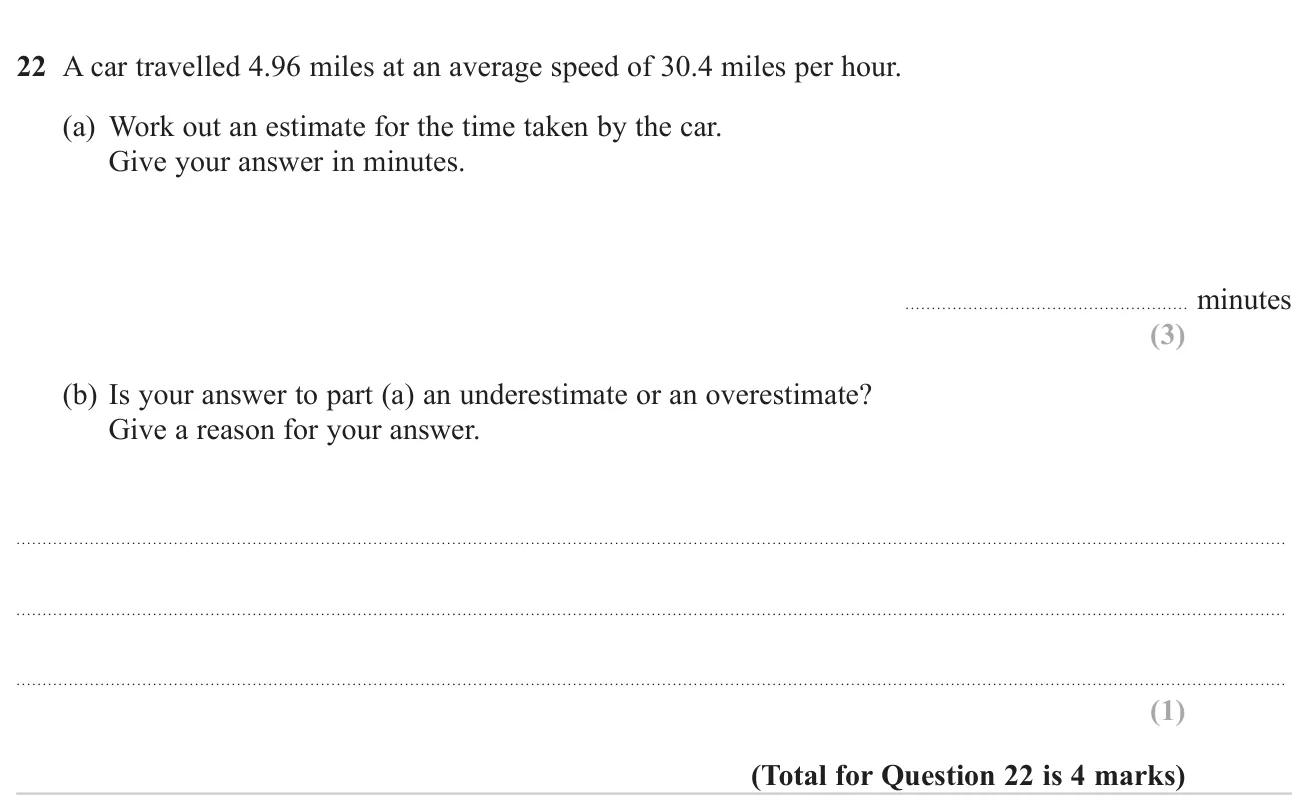
Estimate a journey time in minutes by rounding distance and speed, and say whether it is an over- or underestimate.

© Pearson Education Ltd. November 2024 Paper 1 (Foundation, non-calculator), question 22.

Show answer
(a)1010 minutes3 marks
(b)Overestimate: distance rounded up and speed rounded down1 mark

Worked solution Checked against the mark scheme

(a) Round: 4.96≈54.96 \approx 5 miles, 30.4≈3030.4 \approx 30 mph

Time =5÷30=16= 5 \div 30 = \frac{1}{6} hour =10= 10 minutes

(b) The distance was rounded up and the speed rounded down, so the estimate is too big: an overestimate.

Watch out: In (a), leaving the answer as 0.17 hours or 1/6.
Speed, density and pressure3 marksGrade 4CalculatorFoundation
November 2023 · Paper 3 Foundation · Q17
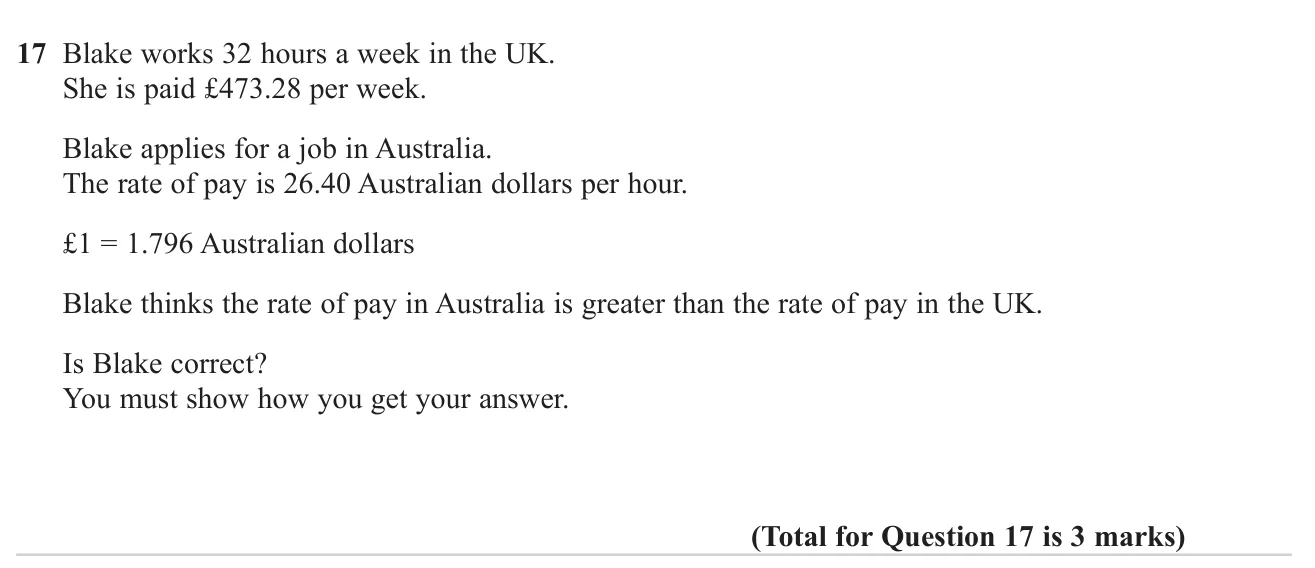
Compare an hourly pay rate abroad with UK pay using an exchange rate.

© Pearson Education Ltd. November 2023 Paper 3 (Foundation, calculator), question 17.

Show answer
AnswerNo: the Australian rate is about £14.70 an hour, less than £14.79 in the UK3 marks

Worked solution Checked against the mark scheme

UK hourly pay: 473.28÷32=£14.79473.28 \div 32 = £14.79

Australian hourly pay in pounds: 26.40÷1.796=£14.699...26.40 \div 1.796 = £14.699...

£14.70<£14.79£14.70 < £14.79, so no, Blake is not correct.

Watch out: Multiplying by 1.796 instead of dividing when changing dollars to pounds.
Speed, density and pressure3 marksGrade 4CalculatorOn both tiers
November 2023 · Paper 3 Foundation · Q26
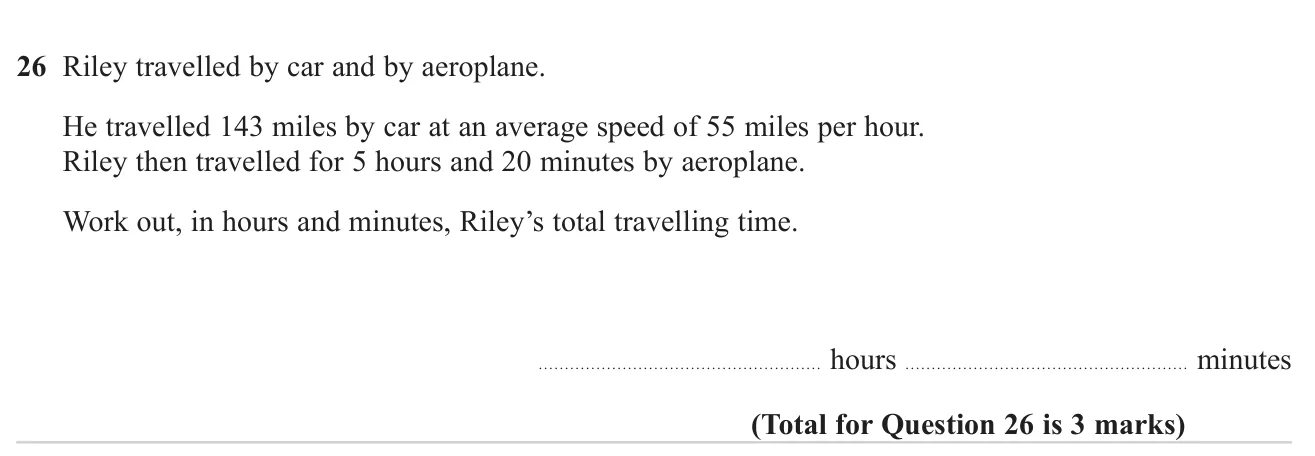
Find total journey time from a car leg using speed and a flight time.

© Pearson Education Ltd. November 2023 Paper 3 (Foundation, calculator), question 26.

Show answer
Answer7 hours 56 minutes3 marks

Worked solution Checked against the mark scheme

Car time =143÷55=2.6= 143 \div 55 = 2.6 hours =2= 2 hours 36 minutes (0.6×60=360.6 \times 60 = 36).

Total =2= 2 h 36 min +5+ 5 h 20 min =7= 7 hours 56 minutes

Watch out: Reading 2.6 hours as 2 hours 60 minutes.
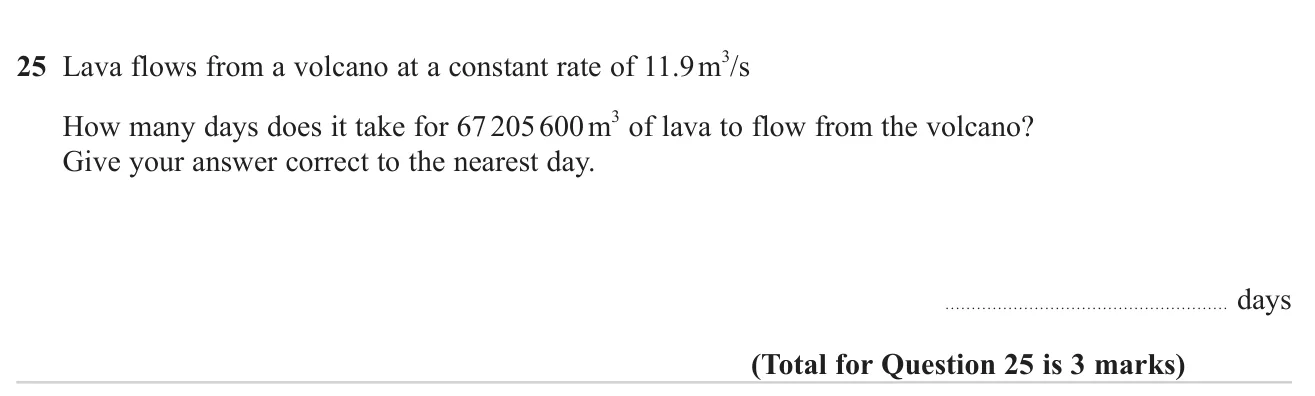
Speed, density and pressure3 marksGrade 4CalculatorOn both tiers
June 2023 · Paper 3 Foundation · Q25
Use a flow rate in cubic metres per second to find a time in days.

© Pearson Education Ltd. June 2023 Paper 3 (Foundation, calculator), question 25.

Show answer
Answer653 marks

Worked solution Checked against the mark scheme

Seconds: 67 205 600÷11.9=5 647 529.4...67\,205\,600 \div 11.9 = 5\,647\,529.4...

Seconds in a day: 24×60×60=86 40024 \times 60 \times 60 = 86\,400

5 647 529.4÷86 400=65.36...5\,647\,529.4 \div 86\,400 = 65.36..., so 6565 days

Watch out: Dividing by 60 only once or twice instead of converting fully to days.
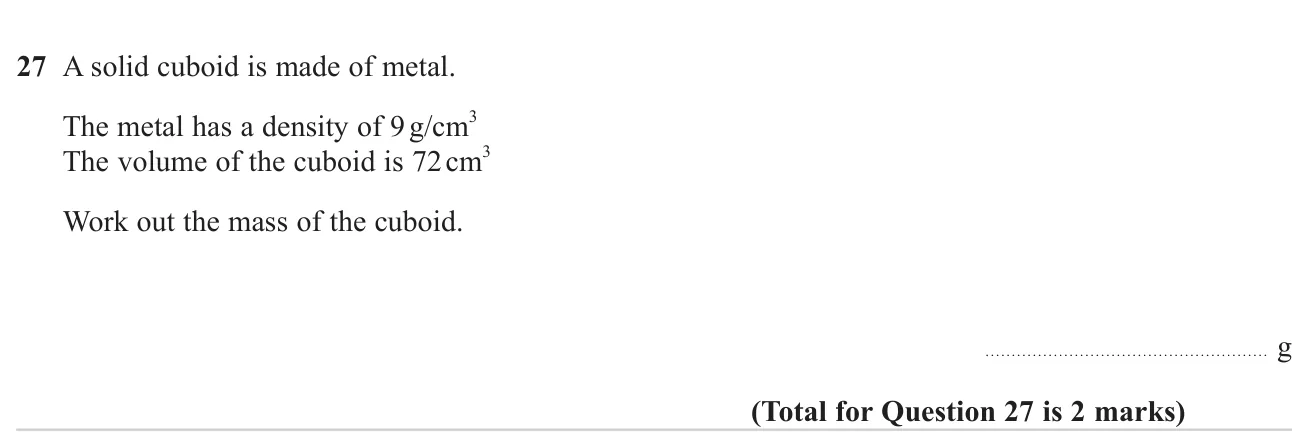
Speed, density and pressure2 marksGrade 4CalculatorOn both tiers
June 2023 · Paper 3 Foundation · Q27
Use density and volume to find mass.

© Pearson Education Ltd. June 2023 Paper 3 (Foundation, calculator), question 27.

Show answer
Answer6482 marks

Worked solution Checked against the mark scheme

Mass = density × volume

9×72=6489 \times 72 = 648 g

Watch out: Dividing 72 by 9 to get 8.
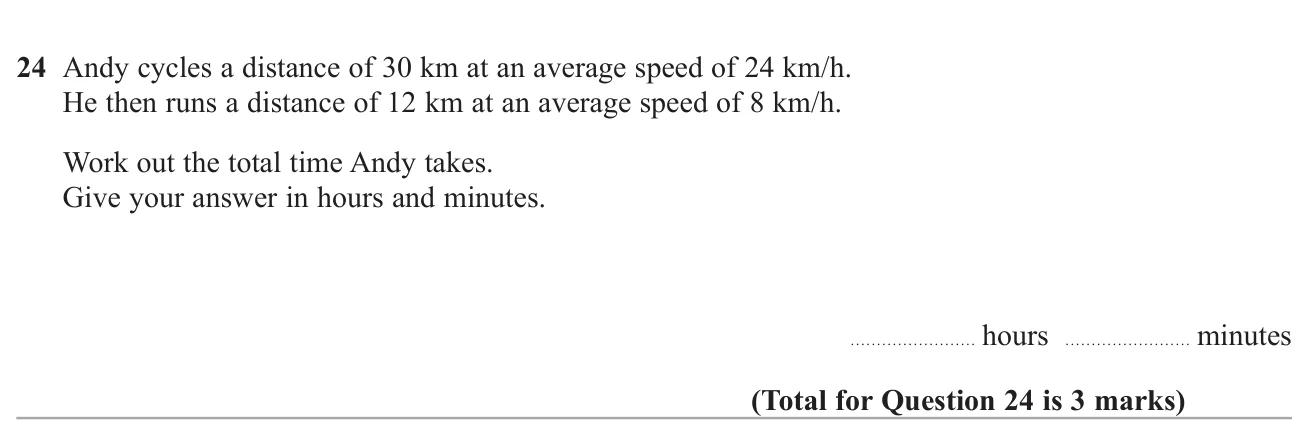
Speed, density and pressure3 marksGrade 4CalculatorOn both tiers
November 2020 · Paper 3 Foundation · Q24
Find total time for two stages of a journey given distances and speeds, in hours and minutes.

© Pearson Education Ltd. November 2020 Paper 3 (Foundation, calculator), question 24.

Show answer
Answer2 hours 45 minutes3 marks

Worked solution Checked against the mark scheme

Cycling: 30÷24=1.2530 \div 24 = 1.25 h

Running: 12÷8=1.512 \div 8 = 1.5 h

Total: 2.752.75 h =2= 2 hours 4545 minutes

Watch out: Writing 2.75 hours as 2 hours 75 minutes.
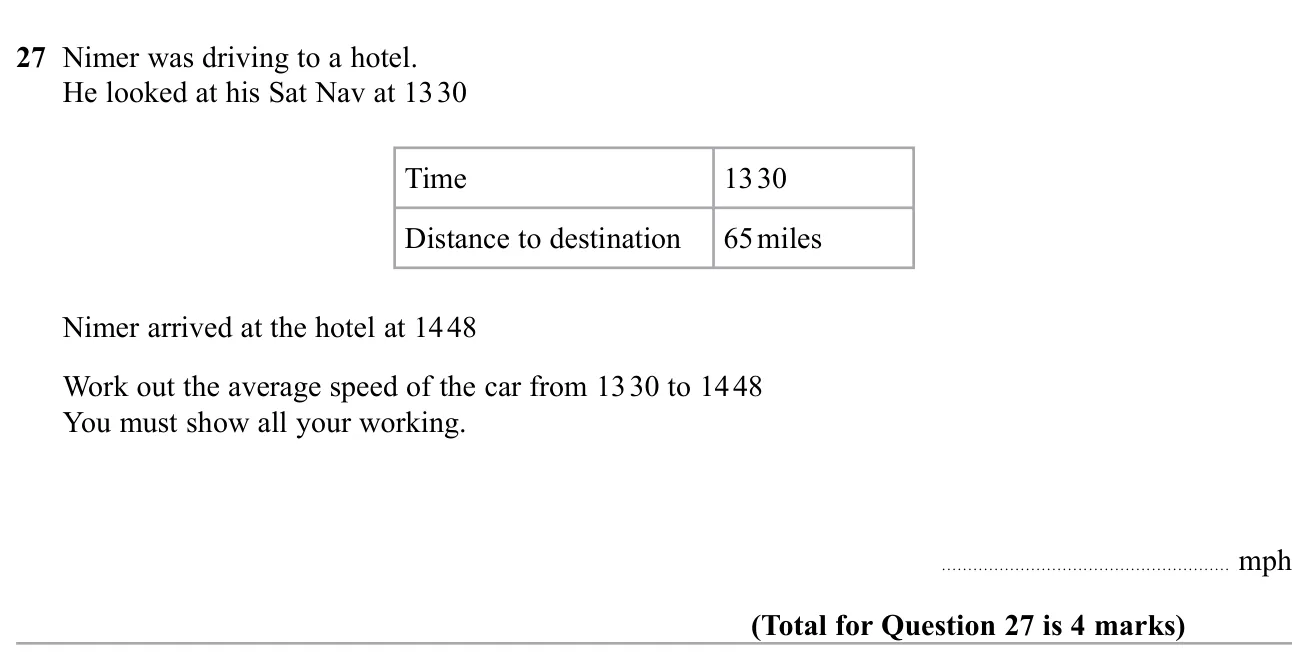
Speed, density and pressure4 marksGrade 4CalculatorOn both tiers
November 2019 · Paper 3 Foundation · Q27
Find an average speed in mph from a distance and start and finish clock times.

© Pearson Education Ltd. November 2019 Paper 3 (Foundation, calculator), question 27.

Show answer
Answer50 mph4 marks

Worked solution Checked against the mark scheme

Time: 13 30 to 14 48 is 1 hour 18 minutes =78= 78 minutes.

In hours: 78÷60=1.378 \div 60 = 1.3

Speed =65÷1.3=50= 65 \div 1.3 = 50 mph

Watch out: Using 1.18 hours for 1 hour 18 minutes.
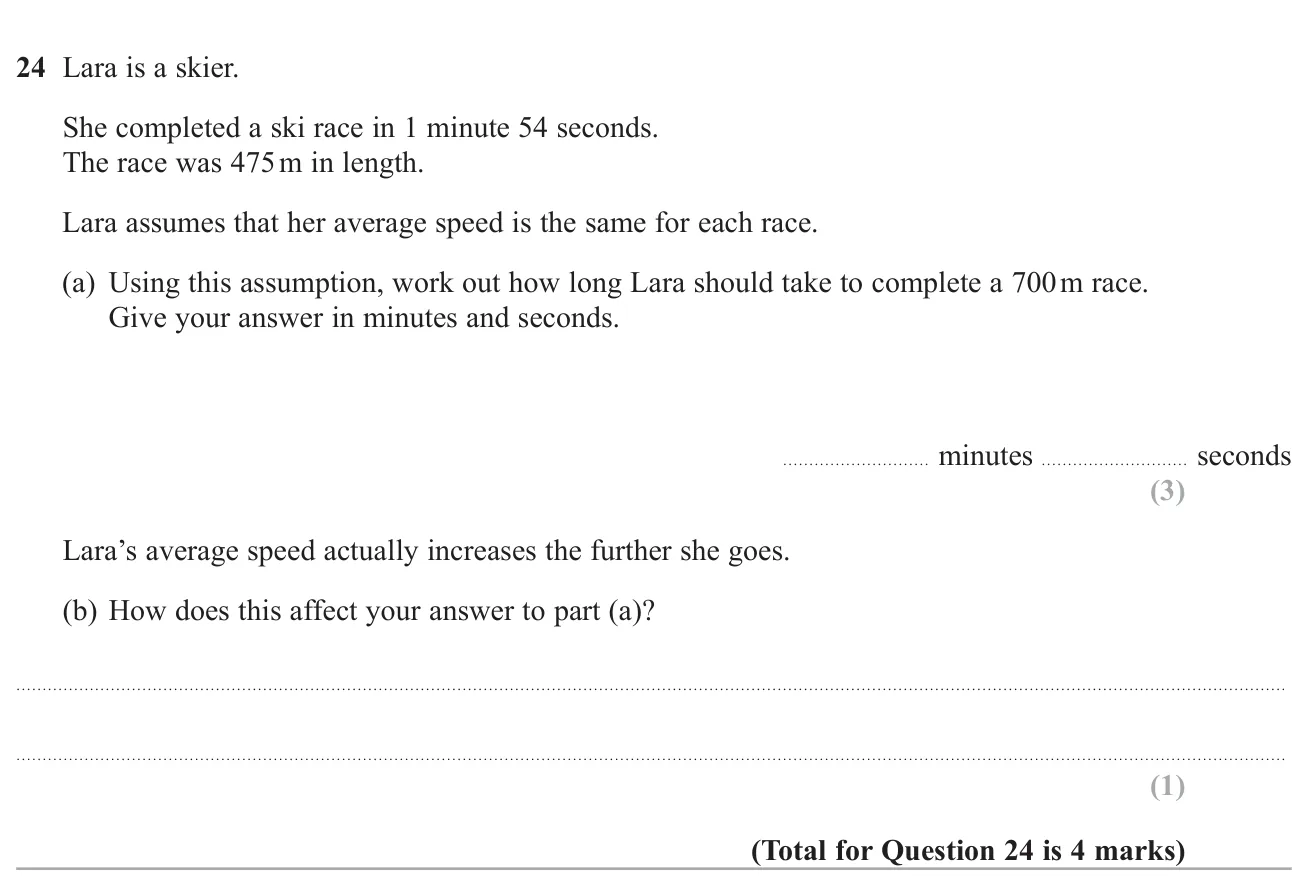
Speed, density and pressure4 marksGrade 4CalculatorOn both tiers
November 2018 · Paper 3 Foundation · Q24
Scale a race time up to a longer distance at the same speed, then say how rising speed affects that answer.

© Pearson Education Ltd. November 2018 Paper 3 (Foundation, calculator), question 24.

Show answer
(a)2 minutes 48 seconds3 marks
(b)It would take less time than the answer to (a)1 mark

Worked solution Checked against the mark scheme

(a) 1 min 54 s =114= 114 s

Time =700475×114=168= \frac{700}{475} \times 114 = 168 s

168168 s =2= 2 minutes 4848 seconds

(b) If she speeds up over a longer race, she will finish more quickly, so the real time is less than 2 min 48 s.

Watch out: Treating 1 minute 54 seconds as 1.54 minutes.
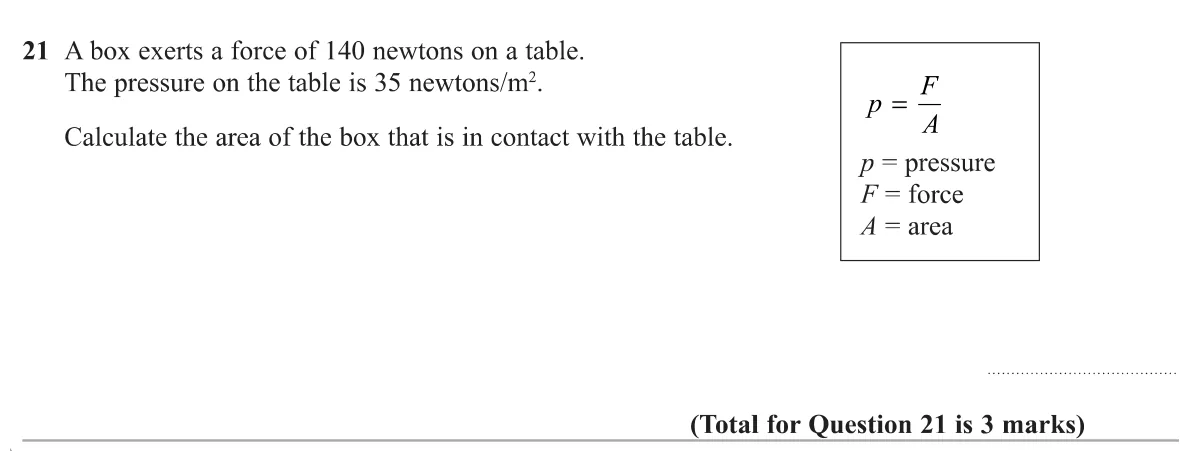
Speed, density and pressure3 marksGrade 4No calculatorFoundation
Specimen · Paper 1 Foundation · Q21
Rearrange the pressure formula to find a contact area from a given force and pressure.

© Pearson Education Ltd. Specimen Paper 1 (Foundation, non-calculator), question 21.

Show answer
Answer44 m²3 marks

Worked solution Checked against the mark scheme

p=FAp = \frac{F}{A}, so A=FpA = \frac{F}{p}.

A=14035=4A = \frac{140}{35} = 4 m²

Watch out: Multiplying 140 × 35 instead of dividing.
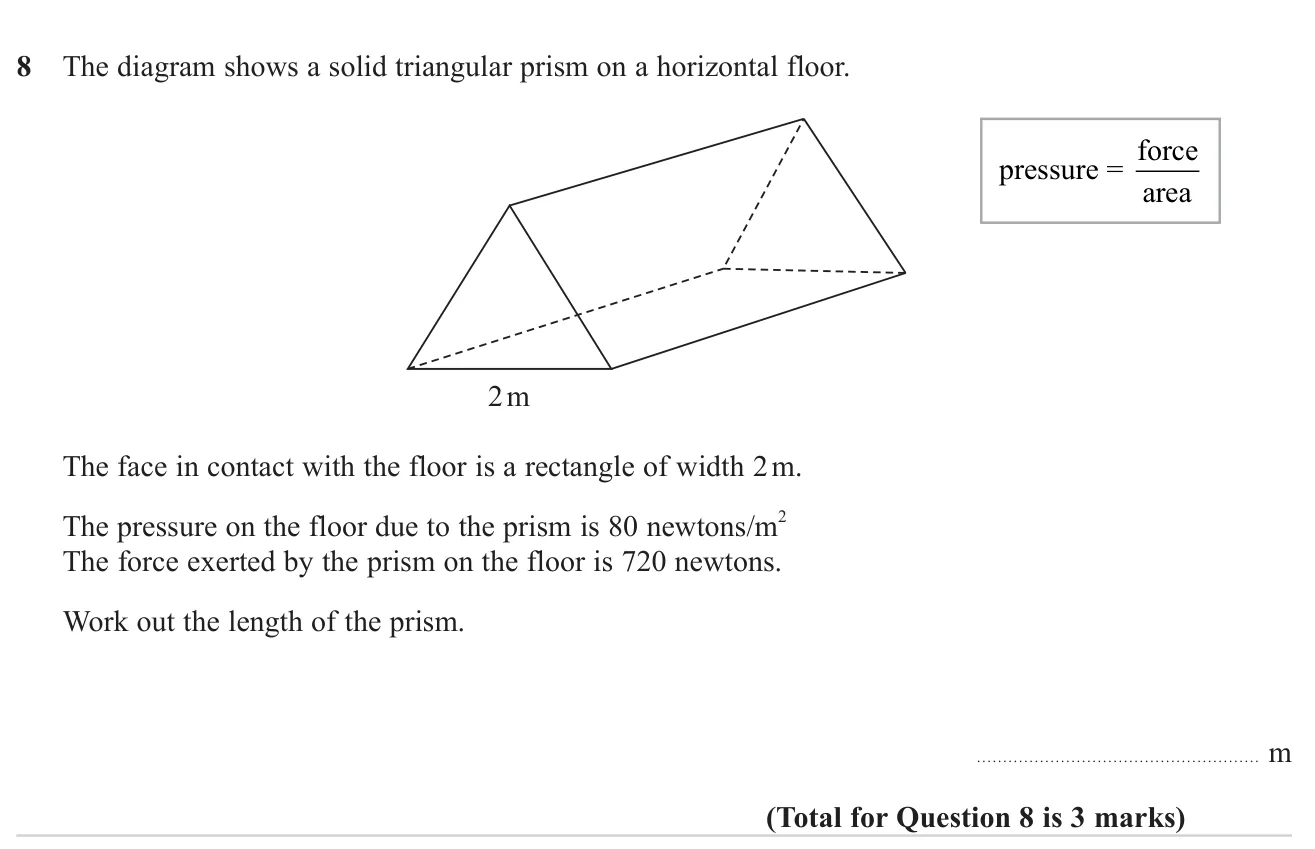
Speed, density and pressure3 marksGrade 5No calculatorHigher
November 2024 · Paper 1 Higher · Q8
Use pressure and force to find the contact area of a prism, then its length given the width.

© Pearson Education Ltd. November 2024 Paper 1 (Higher, non-calculator), question 8.

Show answer
Answer4.54.5 m3 marks

Worked solution Checked against the mark scheme

Area =force÷pressure=720÷80=9 m2= \text{force} \div \text{pressure} = 720 \div 80 = 9\text{ m}^2

Length =9÷2=4.5= 9 \div 2 = 4.5 m

Watch out: Multiplying 720 by 80 instead of dividing.
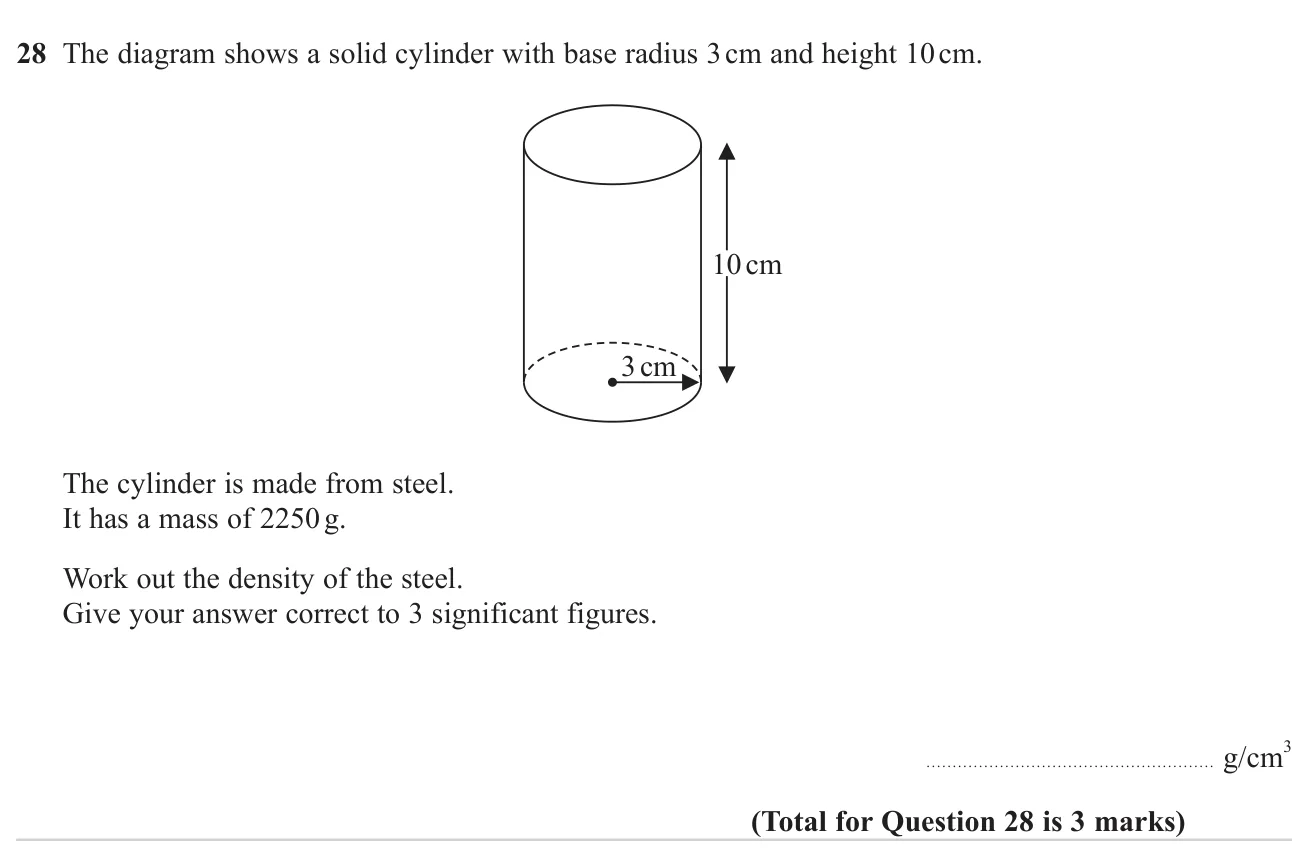
Speed, density and pressure3 marksGrade 5CalculatorFoundation
November 2024 · Paper 2 Foundation · Q28
Find the density of a solid cylinder from its dimensions and mass.

© Pearson Education Ltd. November 2024 Paper 2 (Foundation, calculator), question 28.

Show answer
Answer7.963 marks

Worked solution Checked against the mark scheme

Volume =π×32×10=90π=282.74... cm3= \pi \times 3^2 \times 10 = 90\pi = 282.74...\text{ cm}^3

Density =2250÷282.74...=7.957...= 2250 \div 282.74... = 7.957...

=7.96 g/cm3= 7.96\text{ g/cm}^3 (3 s.f.)

Watch out: Using π×3×10\pi \times 3 \times 10 or diameter instead of radius squared.
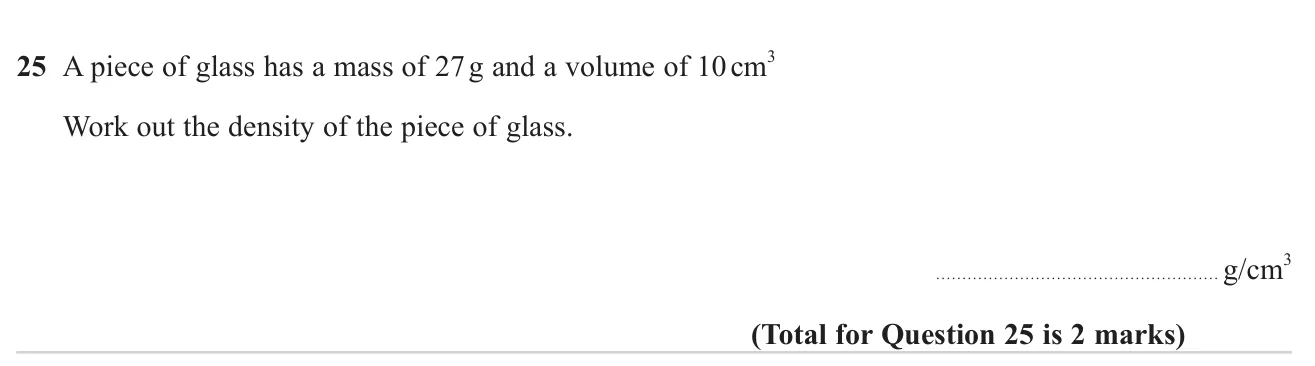
Speed, density and pressure2 marksGrade 5No calculatorFoundation
November 2023 · Paper 1 Foundation · Q25
Calculate density from a given mass and volume.

© Pearson Education Ltd. November 2023 Paper 1 (Foundation, non-calculator), question 25.

Show answer
Answer2.7 g/cm³2 marks

Worked solution Checked against the mark scheme

Density = mass ÷ volume

27÷10=2.727 \div 10 = 2.7 g/cm³

Watch out: Multiplying to get 270.
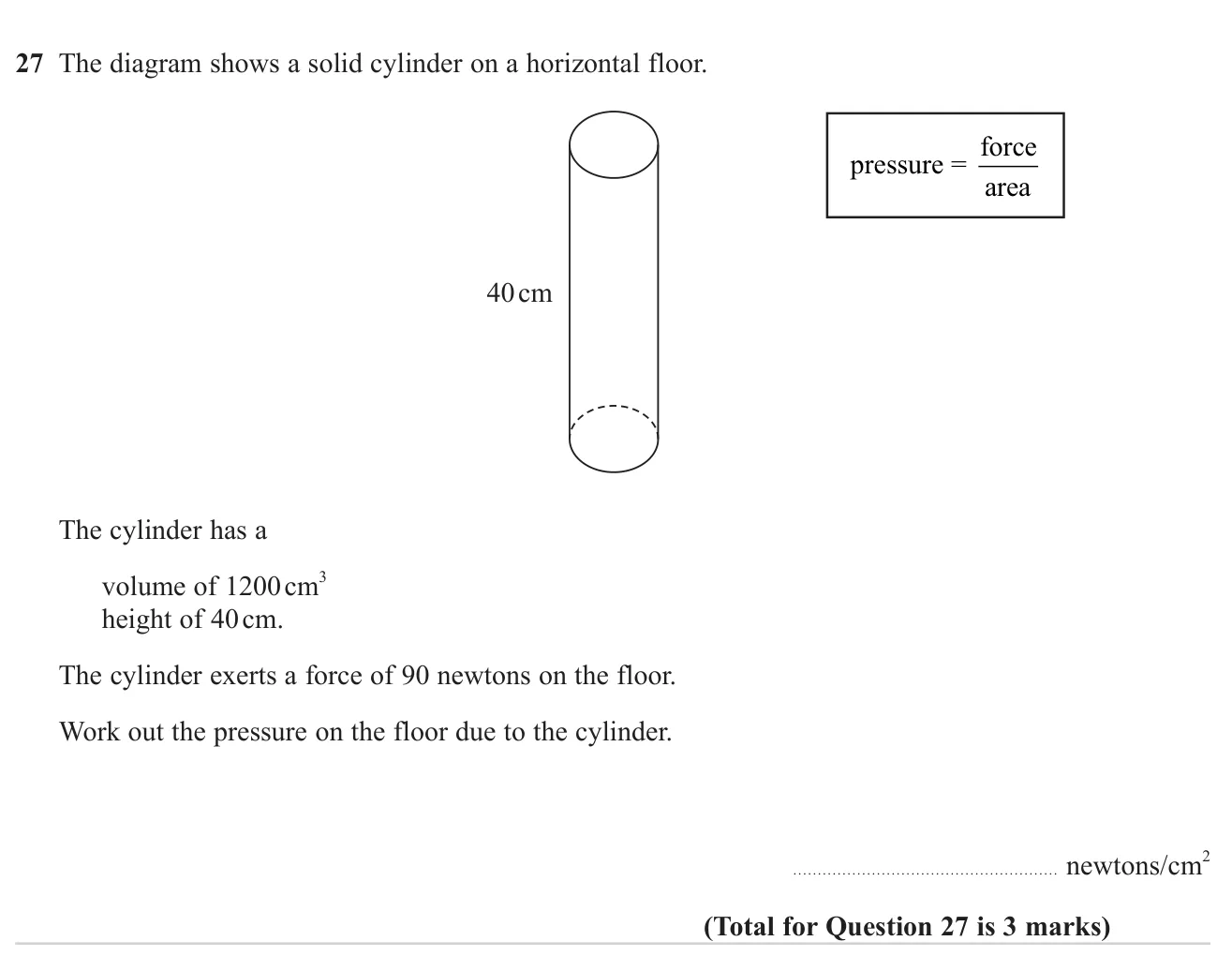
Speed, density and pressure3 marksGrade 5No calculatorOn both tiers
June 2023 · Paper 1 Foundation · Q27
Find the pressure a cylinder exerts using its volume, height and force.

© Pearson Education Ltd. June 2023 Paper 1 (Foundation, non-calculator), question 27.

Show answer
Answer333 marks

Worked solution Checked against the mark scheme

Volume = base area × height, so base area =1200÷40=30= 1200 \div 40 = 30 cm²

Pressure =9030=3= \frac{90}{30} = 3 newtons/cm²

Watch out: Dividing 90 by 1200 without finding the base area.
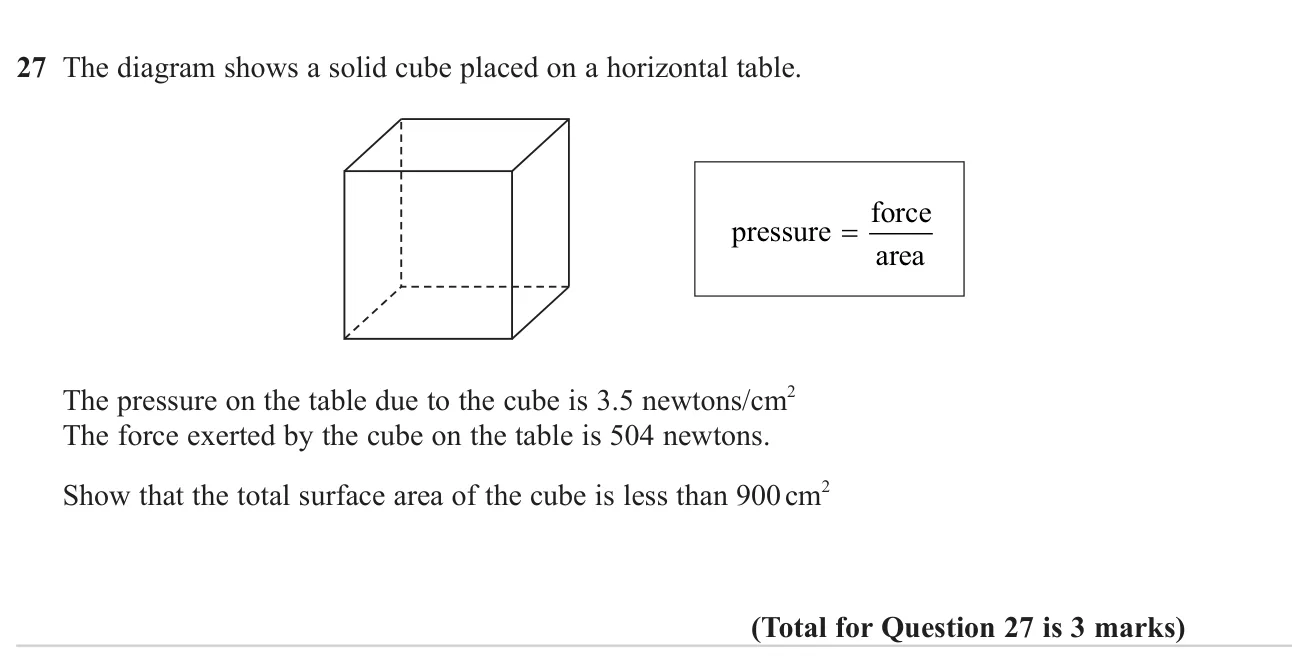
Speed, density and pressure3 marksGrade 5CalculatorOn both tiers
November 2023 · Paper 3 Foundation · Q27
Use pressure, force and area to show a cube's surface area is under a given value.

© Pearson Education Ltd. November 2023 Paper 3 (Foundation, calculator), question 27.

Show answer
AnswerFace area 144 cm², so surface area 864<900864 < 900 cm²3 marks

Worked solution Checked against the mark scheme

Area of face on the table =force÷pressure=504÷3.5=144= \text{force} \div \text{pressure} = 504 \div 3.5 = 144 cm²

A cube has 6 equal faces: 6×144=8646 \times 144 = 864 cm²

864<900864 < 900, so the surface area is less than 900 cm².

Watch out: Multiplying force by pressure instead of dividing.
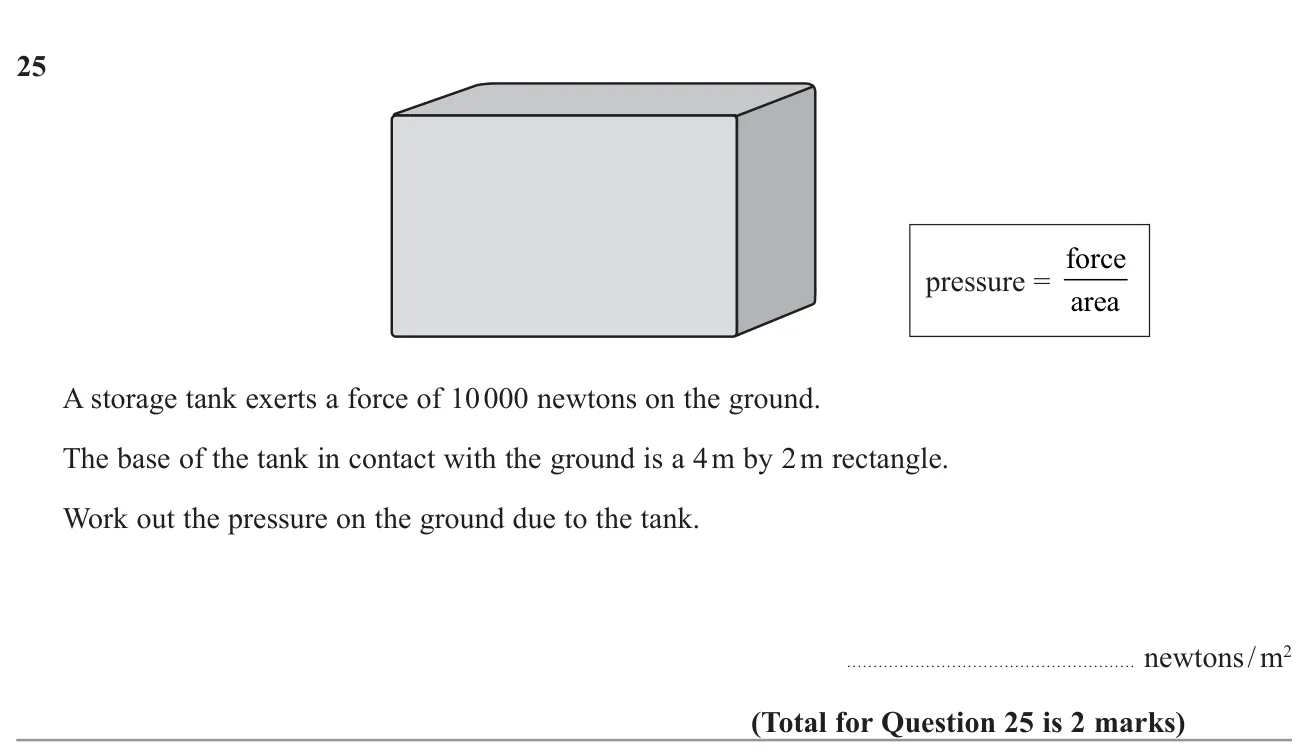
Speed, density and pressure2 marksGrade 5No calculatorOn both tiers
November 2022 · Paper 1 Foundation · Q25
Use a formula to find pressure from a force and a rectangular base area.

© Pearson Education Ltd. November 2022 Paper 1 (Foundation, non-calculator), question 25.

Show answer
Answer12501250 N/m2^22 marks

Worked solution Checked against the mark scheme

Area =4×2=8 m2= 4 \times 2 = 8\text{ m}^2

Pressure =10 0008=1250= \frac{10\,000}{8} = 1250 N/m2^2

Watch out: Dividing by the perimeter or by 4 + 2.
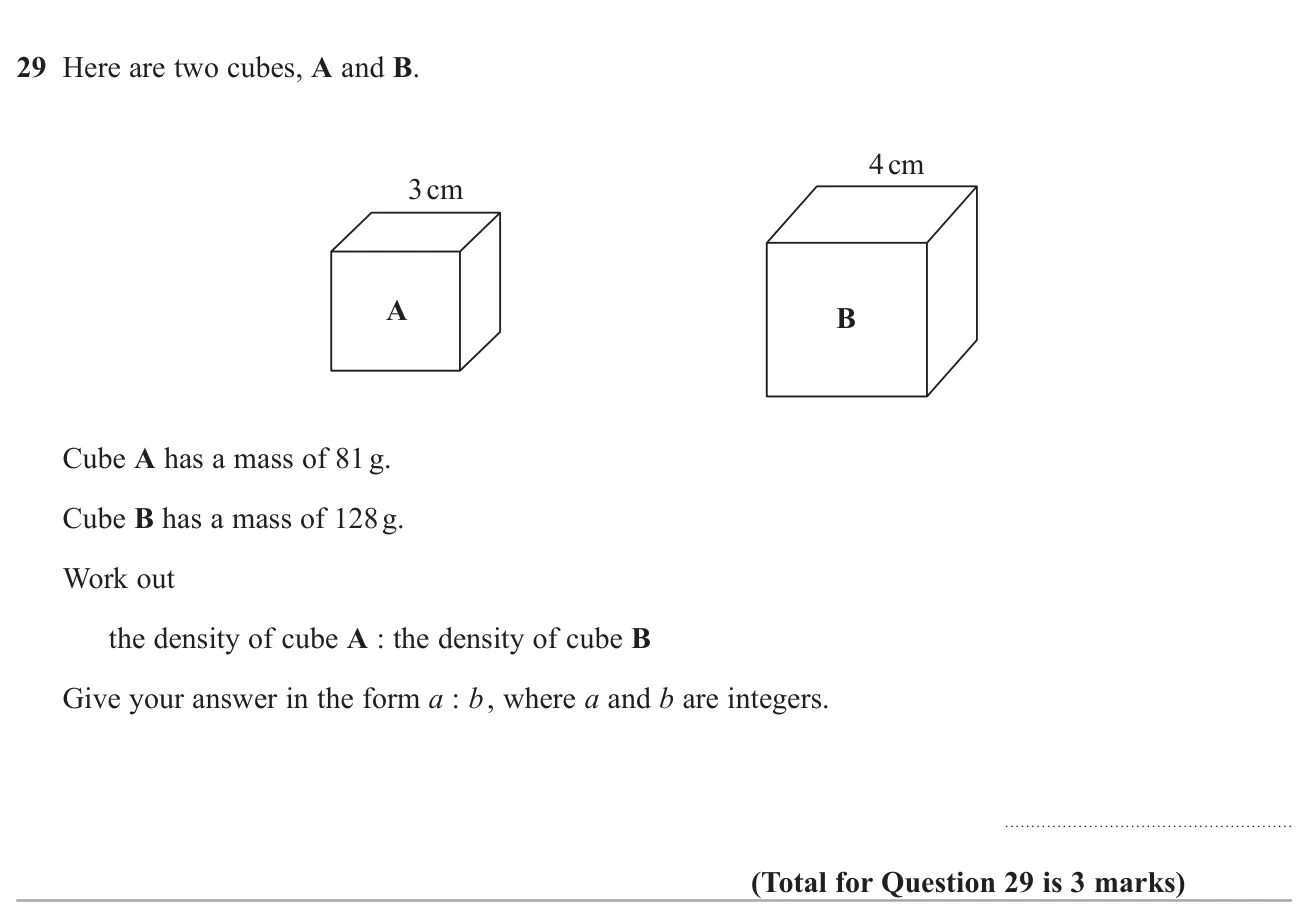
Speed, density and pressure3 marksGrade 5No calculatorOn both tiers
June 2022 · Paper 1 Foundation · Q29
Find the densities of two cubes from their side lengths and masses and write them as a simplified ratio.

© Pearson Education Ltd. June 2022 Paper 1 (Foundation, non-calculator), question 29.

Show answer
Answer3 : 23 marks

Worked solution Checked against the mark scheme

Volumes: 33=273^3 = 27 cm³ and 43=644^3 = 64 cm³

Densities: 81÷27=381 \div 27 = 3 g/cm³ and 128÷64=2128 \div 64 = 2 g/cm³

Ratio: 3:23 : 2

Watch out: Using side length times 6 or squaring instead of cubing.
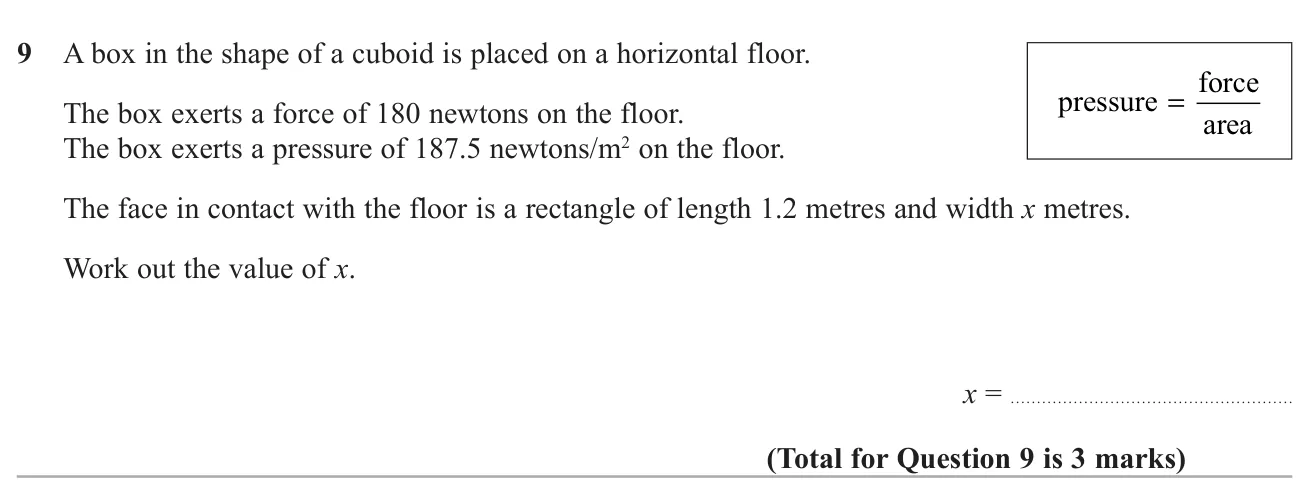
Speed, density and pressure3 marksGrade 5CalculatorHigher
June 2022 · Paper 2 Higher · Q9
Use the pressure formula to find the missing width of the face of a box resting on the floor.

© Pearson Education Ltd. June 2022 Paper 2 (Higher, calculator), question 9.

Show answer
Answerx=0.8x = 0.83 marks

Worked solution Checked against the mark scheme

Area =force÷pressure=180÷187.5=0.96 m2= \text{force} \div \text{pressure} = 180 \div 187.5 = 0.96\text{ m}^2

Area =1.2×x= 1.2 \times x, so x=0.96÷1.2=0.8x = 0.96 \div 1.2 = 0.8

Watch out: Multiplying force by pressure instead of dividing.
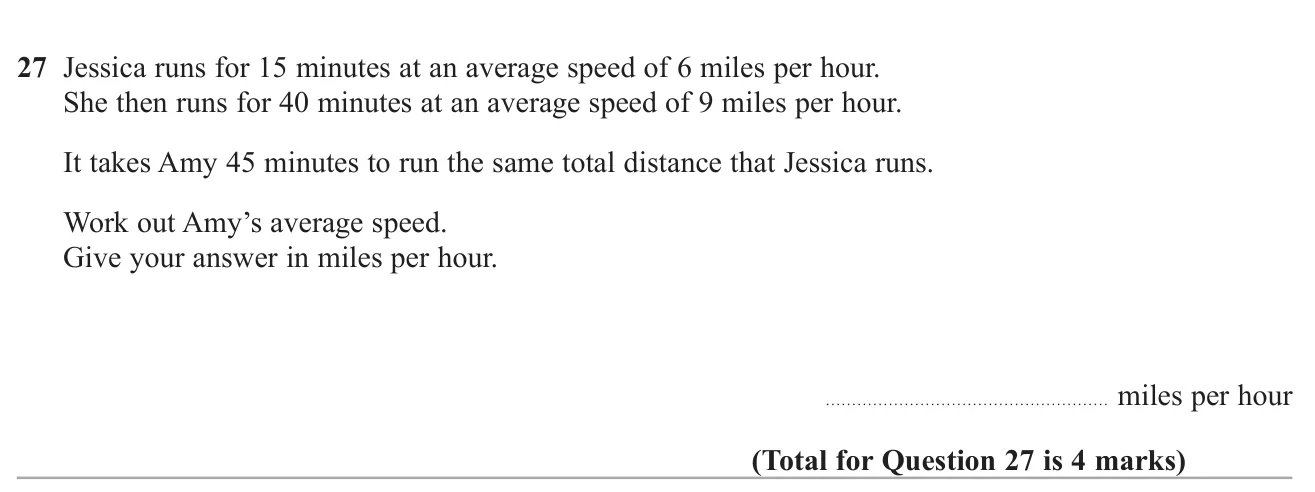
Speed, density and pressure4 marksGrade 5CalculatorOn both tiers
June 2022 · Paper 3 Foundation · Q27
Find a runner's total distance over two stages, then the speed another runner needs to cover it in a given time.

© Pearson Education Ltd. June 2022 Paper 3 (Foundation, calculator), question 27.

Show answer
Answer104 marks

Worked solution Checked against the mark scheme

Stage 1: 6×1560=1.56 \times \frac{15}{60} = 1.5 miles

Stage 2: 9×4060=69 \times \frac{40}{60} = 6 miles

Total = 7.5 miles

Amy: 7.5÷0.75=107.5 \div 0.75 = 10 mph

Watch out: Using 45 hours instead of 0.75 hours, or averaging the two speeds.
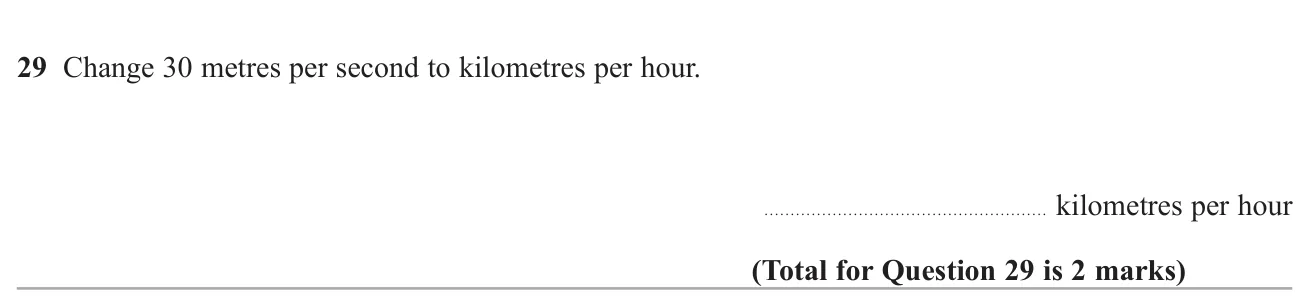
Speed, density and pressure2 marksGrade 5CalculatorFoundation
June 2022 · Paper 3 Foundation · Q29
Convert a speed from metres per second to kilometres per hour.

© Pearson Education Ltd. June 2022 Paper 3 (Foundation, calculator), question 29.

Show answer
Answer1082 marks

Worked solution Checked against the mark scheme

In one hour: 30×3600=108 00030 \times 3600 = 108\,000 metres

108 000÷1000=108108\,000 \div 1000 = 108 km/h

Watch out: Multiplying by 60 only once, giving 1.8 km/h.
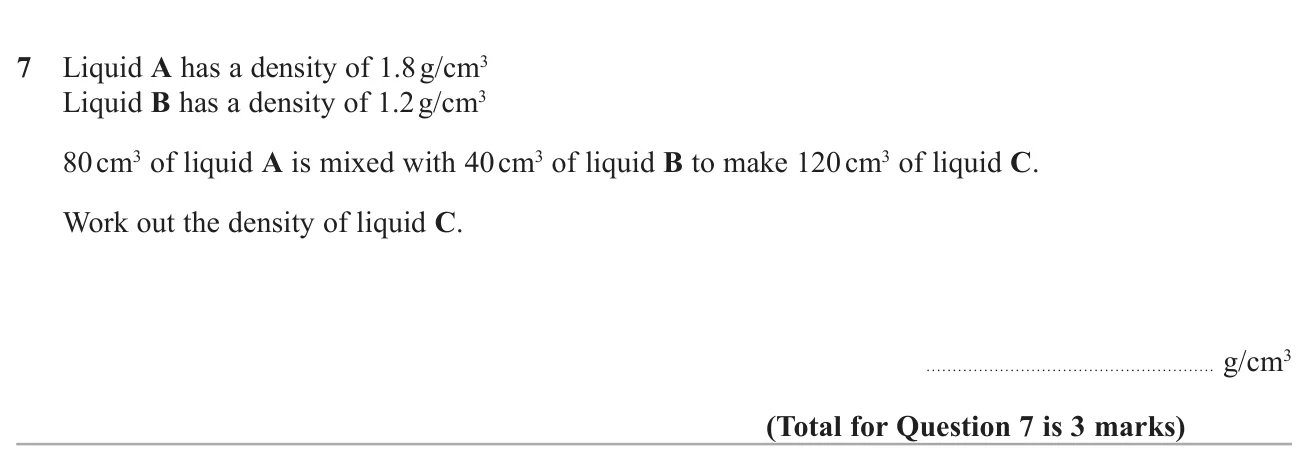
Speed, density and pressure3 marksGrade 5CalculatorHigher
November 2021 · Paper 2 Higher · Q7
Mix two liquids of known density and volume and find the density of the mixture.

© Pearson Education Ltd. November 2021 Paper 2 (Higher, calculator), question 7.

Show answer
Answer1.61.6 g/cm³3 marks

Worked solution Checked against the mark scheme

Mass of A =1.8×80=144= 1.8 \times 80 = 144 g. Mass of B =1.2×40=48= 1.2 \times 40 = 48 g.

Total mass =192= 192 g, total volume =120= 120 cm³.

Density =192÷120=1.6= 192 \div 120 = 1.6 g/cm³.

Watch out: Averaging the two densities to get 1.5, ignoring the different volumes.
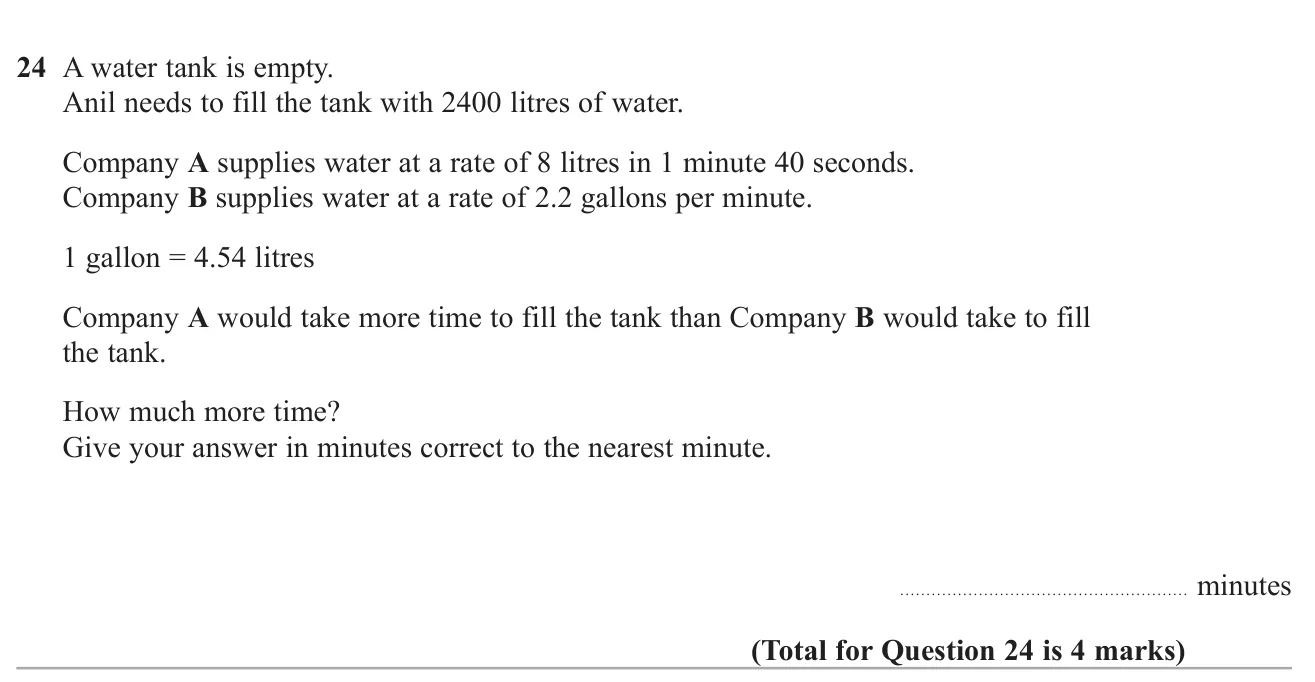
Speed, density and pressure4 marksGrade 5CalculatorOn both tiers
November 2021 · Paper 3 Foundation · Q24
Compare how long two suppliers take to fill a tank using different rates and units, and find the time difference.

© Pearson Education Ltd. November 2021 Paper 3 (Foundation, calculator), question 24.

Show answer
Answer260 minutes4 marks

Worked solution Checked against the mark scheme

Company A: 1 min 40 s =53= \frac{5}{3} min, so the rate is 8÷53=4.88 \div \frac{5}{3} = 4.8 litres per minute.

Time A =2400÷4.8=500= 2400 \div 4.8 = 500 min.

Company B: 2.2×4.54=9.9882.2 \times 4.54 = 9.988 litres per minute.

Time B =2400÷9.988=240.29= 2400 \div 9.988 = 240.29 min.

Difference =500−240.29=259.7= 500 - 240.29 = 259.7, about 260 minutes.

Watch out: Treating 1 minute 40 seconds as 1.4 minutes.
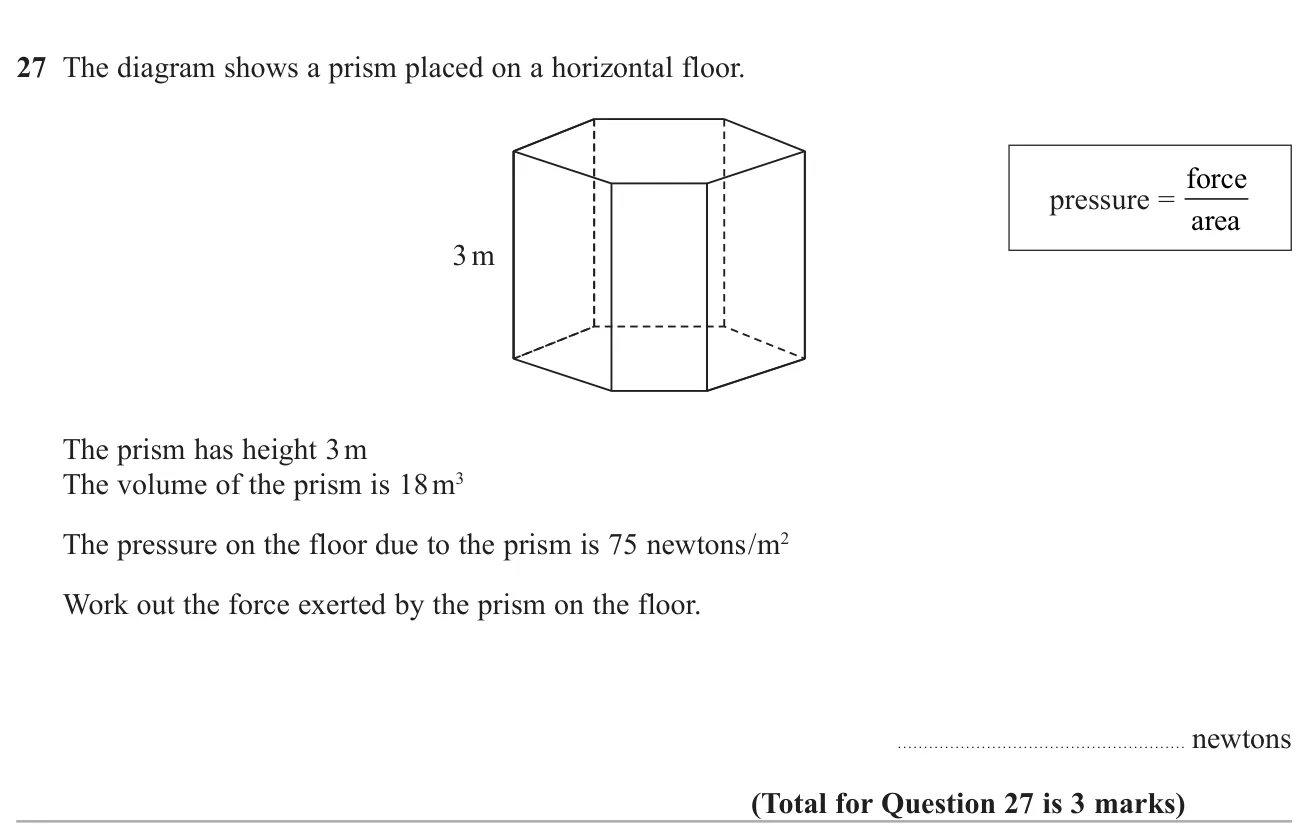
Speed, density and pressure3 marksGrade 5No calculatorOn both tiers
November 2020 · Paper 1 Foundation · Q27
Find the base area of a prism from its volume and height, then use the pressure formula to find the force.

© Pearson Education Ltd. November 2020 Paper 1 (Foundation, non-calculator), question 27.

Show answer
Answer450 newtons3 marks

Worked solution Checked against the mark scheme

Base area =183=6 m2= \frac{18}{3} = 6\text{ m}^2.

Force == pressure ×\times area =75×6=450= 75 \times 6 = 450 N.

Watch out: Using the volume in place of the area: 75×1875 \times 18.

Speed, density and pressure3 marksGrade 5CalculatorFoundation
November 2020 · Paper 3 Foundation · Q29
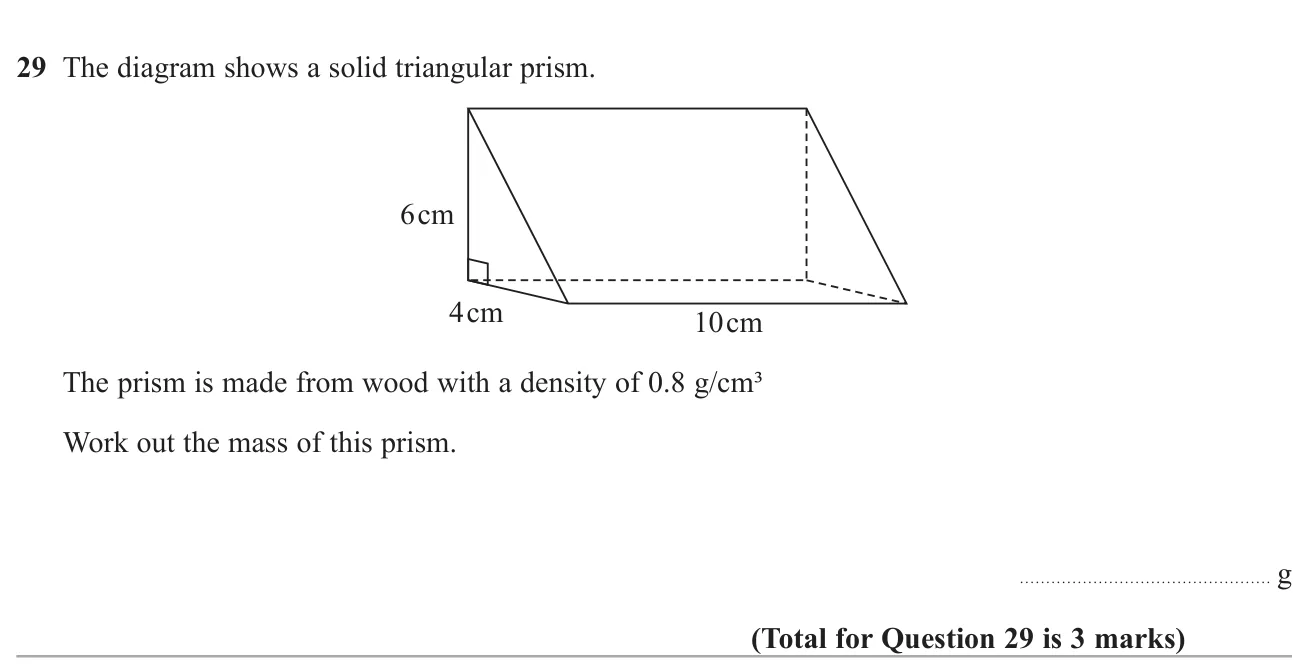
Find the mass of a triangular prism from its dimensions and density.

© Pearson Education Ltd. November 2020 Paper 3 (Foundation, calculator), question 29.

Show answer
Answer96 g3 marks

Worked solution Checked against the mark scheme

Triangle area: 12×4×6=12\frac{1}{2} \times 4 \times 6 = 12 cm²

Volume: 12×10=12012 \times 10 = 120 cm³

Mass: 120×0.8=96120 \times 0.8 = 96 g

Watch out: Forgetting to halve for the triangle, giving 192 g.
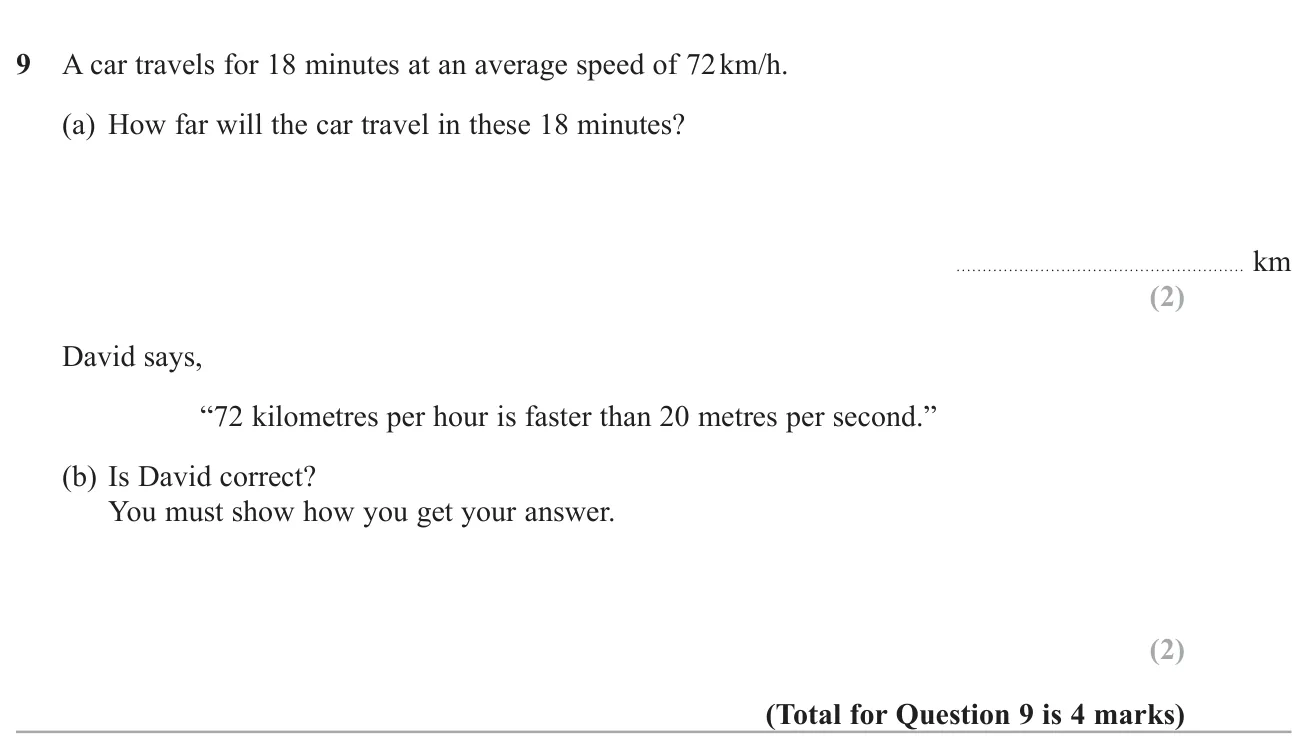
Speed, density and pressure4 marksGrade 5No calculatorHigher
November 2019 · Paper 1 Higher · Q9
Find the distance travelled in a number of minutes, then compare a speed in km/h with one in m/s.

© Pearson Education Ltd. November 2019 Paper 1 (Higher, non-calculator), question 9.

Show answer
(a)21.621.6 km2 marks
(b)No: 72 km/h is exactly 20 m/s2 marks

Worked solution Checked against the mark scheme

(a) 18 minutes =1860=0.3= \frac{18}{60} = 0.3 hours

Distance =72×0.3=21.6= 72 \times 0.3 = 21.6 km

(b) 7272 km/h =72 000= 72\,000 m in 36003600 s

72 000÷3600=2072\,000 \div 3600 = 20 m/s. The speeds are the same, so David is not correct.

Watch out: Using 18 as the time in hours, or dividing by 60 twice.
Speed, density and pressure3 marksGrade 5No calculatorHigher
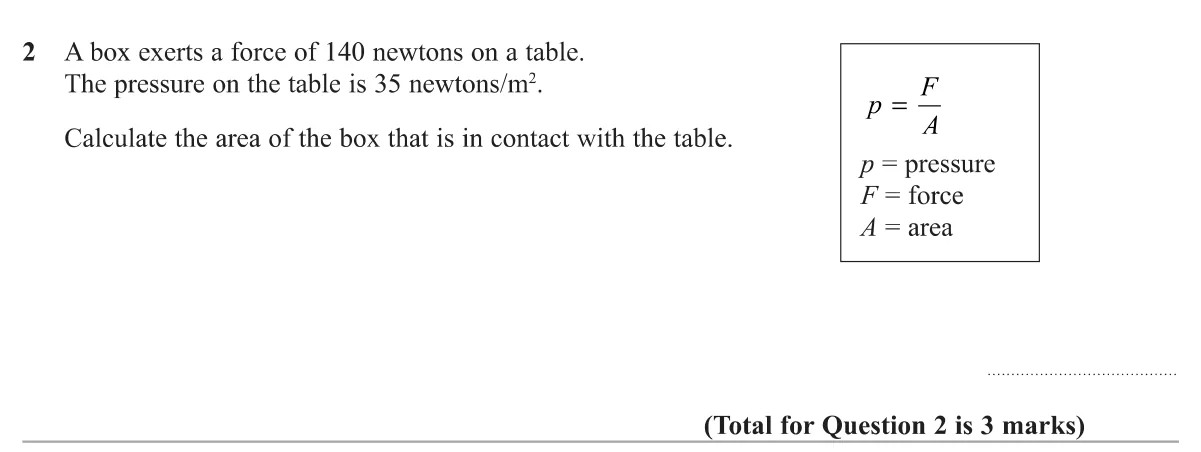
Specimen · Paper 1 Higher · Q2
Use the pressure formula to find a contact area from a given force and pressure, stating the units.

© Pearson Education Ltd. Specimen Paper 1 (Higher, non-calculator), question 2.

Show answer
Answer44 m²3 marks

Worked solution Checked against the mark scheme

Rearrange p=FAp = \frac{F}{A} to A=FpA = \frac{F}{p}.

A=14035=4A = \frac{140}{35} = 4

The area is 44 m².

Watch out: Multiplying 140 by 35 instead of dividing, or leaving out the units.
Speed, density and pressure4 marksGrade 5No calculatorHigher
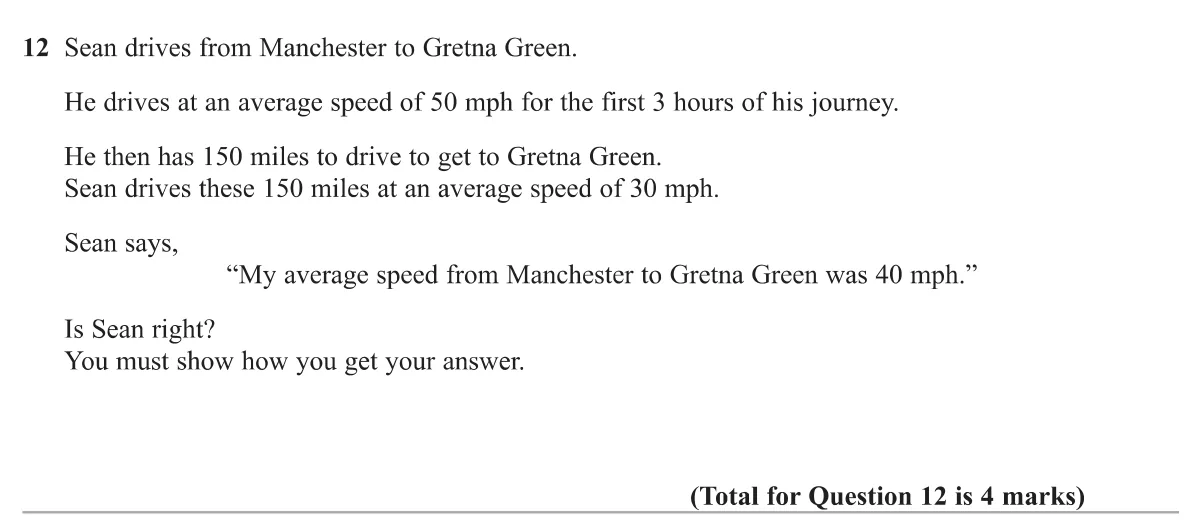
Specimen · Paper 1 Higher · Q12
Work out the average speed for a two-stage journey to test a claim.

© Pearson Education Ltd. Specimen Paper 1 (Higher, non-calculator), question 12.

Show answer
AnswerNo: the average speed is 37.537.5 mph4 marks

Worked solution Checked against the mark scheme

First part: 50×3=15050 \times 3 = 150 miles.

Second part: 150÷30=5150 \div 30 = 5 hours.

Total: 300300 miles in 88 hours.

Average speed =300÷8=37.5= 300 \div 8 = 37.5 mph, so Sean is wrong.

Watch out: Averaging the two speeds to get 40 mph.
Speed, density and pressure4 marksGrade 5CalculatorFoundation
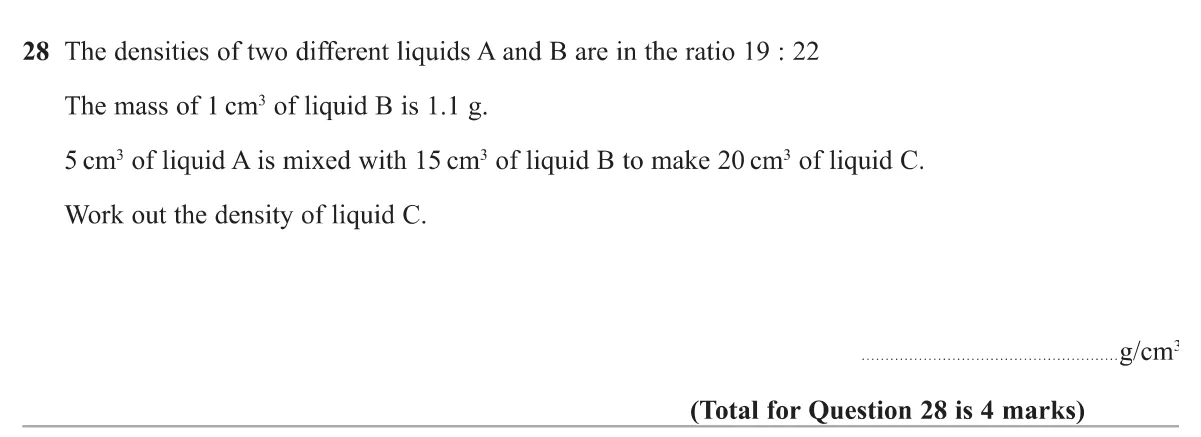
Specimen · Paper 3 Foundation · Q28
Use a ratio of densities and a known density to find the density of a mixture of two liquids.

© Pearson Education Ltd. Specimen Paper 3 (Foundation, calculator), question 28.

Show answer
Answer1.0625 g/cm³4 marks

Worked solution Checked against the mark scheme

Density of B is 1.1 g/cm³, so density of A =1922×1.1=0.95= \frac{19}{22} \times 1.1 = 0.95 g/cm³.

Mass of C =5×0.95+15×1.1=4.75+16.5=21.25= 5 \times 0.95 + 15 \times 1.1 = 4.75 + 16.5 = 21.25 g.

Density of C =21.25÷20=1.0625= 21.25 \div 20 = 1.0625 g/cm³.

Watch out: Averaging the two densities (1.025) without weighting by volume.
Speed, density and pressure4 marksGrade 5CalculatorOn both tiers
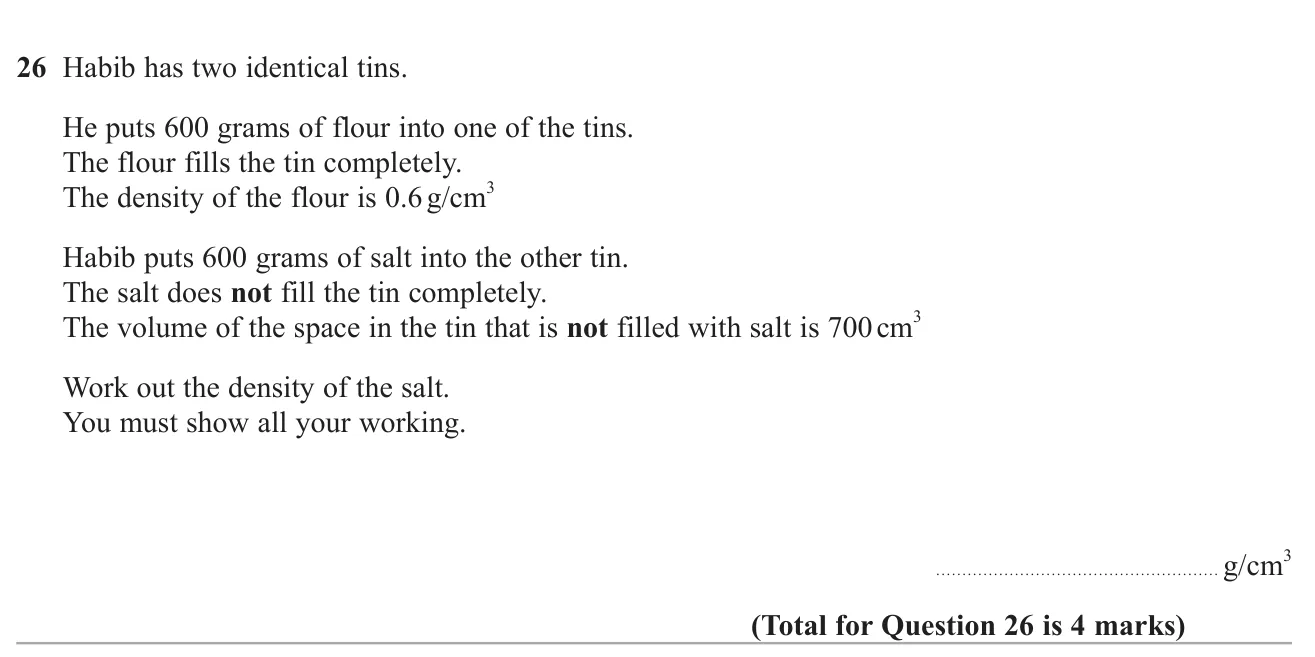
June 2024 · Paper 3 Foundation · Q26
Use a density to find the volume of a tin, then find the density of salt that part-fills it.

© Pearson Education Ltd. June 2024 Paper 3 (Foundation, calculator), question 26.

Show answer
Answer22 g/cm³4 marks

Worked solution Checked against the mark scheme

Volume of tin =massdensity=600÷0.6=1000= \frac{\text{mass}}{\text{density}} = 600 \div 0.6 = 1000 cm³

Volume of salt =1000−700=300= 1000 - 700 = 300 cm³

Density of salt =600÷300=2= 600 \div 300 = 2 g/cm³

Watch out: Using 700 cm³ as the volume of salt.
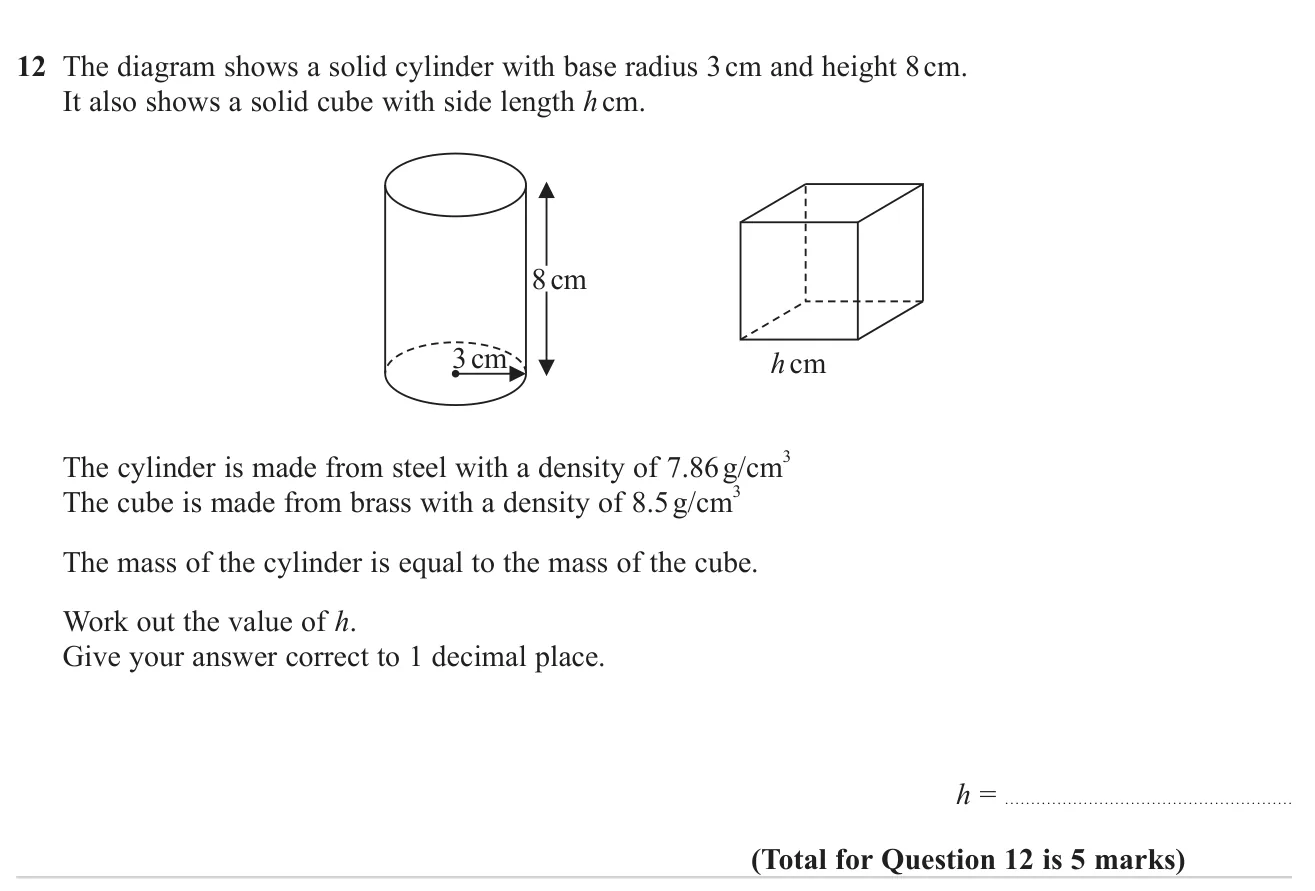
Speed, density and pressure5 marksGrade 6CalculatorHigher
November 2024 · Paper 2 Higher · Q12
Equate the masses of a steel cylinder and a brass cube using densities to find the cube's side length.

© Pearson Education Ltd. November 2024 Paper 2 (Higher, calculator), question 12.

Show answer
Answer5.95.95 marks

Worked solution Checked against the mark scheme

Cylinder volume =π×32×8=226.19…= \pi \times 3^2 \times 8 = 226.19… cm³

Mass =226.19…×7.86=1777.89…= 226.19… \times 7.86 = 1777.89… g

Cube volume =1777.89…÷8.5=209.16…= 1777.89… \div 8.5 = 209.16… cm³

h=209.16…3=5.936…≈5.9h = \sqrt[3]{209.16…} = 5.936… \approx 5.9

Watch out: Multiplying by the density to get the cube's volume instead of dividing.
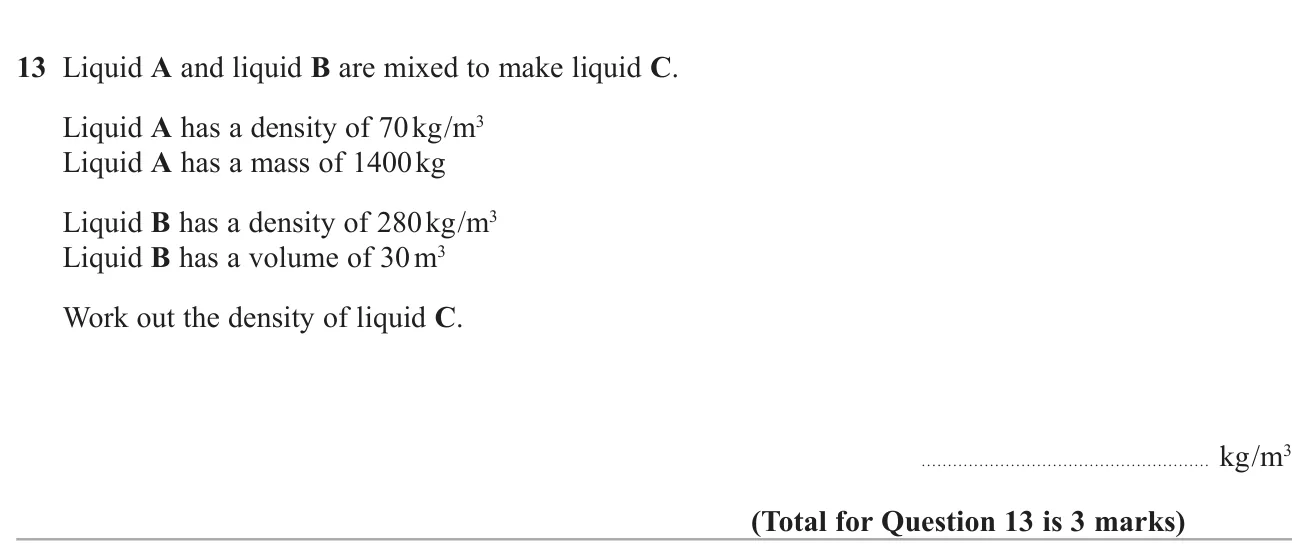
Speed, density and pressure3 marksGrade 6No calculatorHigher
November 2020 · Paper 1 Higher · Q13
Work out the density of a mixture of two liquids from one's mass and density and the other's volume and density.

© Pearson Education Ltd. November 2020 Paper 1 (Higher, non-calculator), question 13.

Show answer
Answer196 kg/m³3 marks

Worked solution Checked against the mark scheme

Volume of A =140070=20 m3= \frac{1400}{70} = 20\text{ m}^3

Mass of B =280×30=8400= 280 \times 30 = 8400 kg

Density of C =1400+840020+30=980050=196 kg/m3= \frac{1400 + 8400}{20 + 30} = \frac{9800}{50} = 196\text{ kg/m}^3

Watch out: Adding the two densities, or averaging them to get 175.
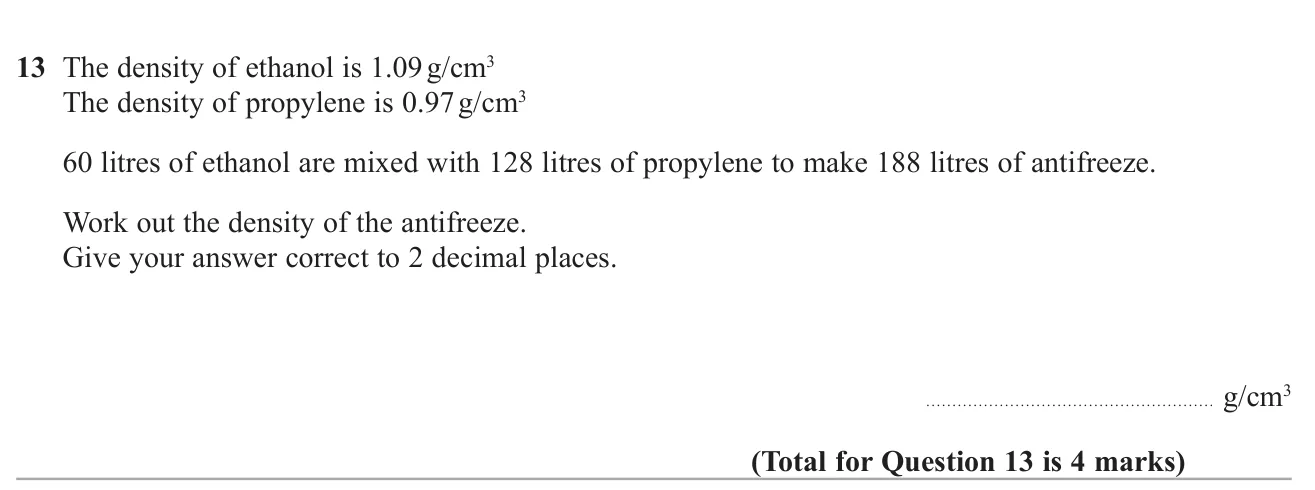
Speed, density and pressure4 marksGrade 6CalculatorHigher
June 2019 · Paper 3 Higher · Q13
Combine masses of two liquids to find the density of a mixture, to 2 decimal places.

© Pearson Education Ltd. June 2019 Paper 3 (Higher, calculator), question 13.

Show answer
Answer1.011.01 g/cm³4 marks

Worked solution Checked against the mark scheme

Work per cm³ scaled by litres (the conversion factor cancels):

Ethanol: 1.09×60=65.41.09 \times 60 = 65.4

Propylene: 0.97×128=124.160.97 \times 128 = 124.16

Density =65.4+124.16188=189.56188=1.008...≈1.01= \frac{65.4 + 124.16}{188} = \frac{189.56}{188} = 1.008... \approx 1.01 g/cm³

Watch out: Averaging the two densities (1.03) without weighting by volume.
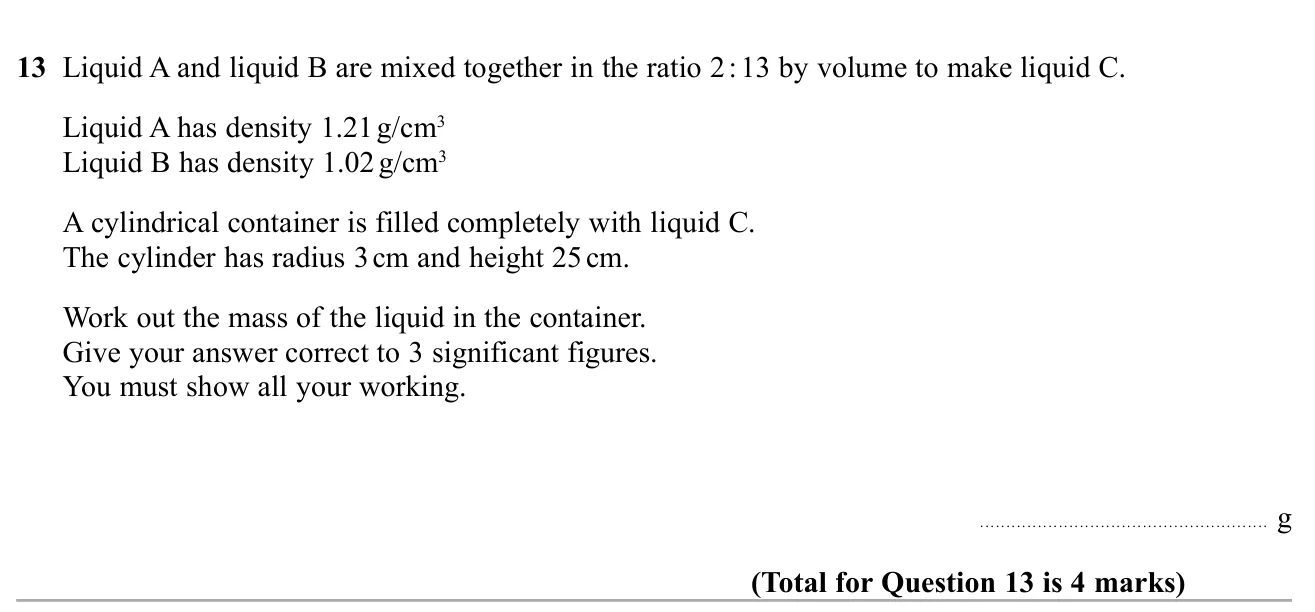
Speed, density and pressure4 marksGrade 6CalculatorHigher
November 2019 · Paper 3 Higher · Q13
Find the mass of a cylinder filled with two liquids mixed in a ratio, using their densities.

© Pearson Education Ltd. November 2019 Paper 3 (Higher, calculator), question 13.

Show answer
Answer739739 g4 marks

Worked solution Checked against the mark scheme

Volume =π×32×25=225π=706.86= \pi \times 3^2 \times 25 = 225\pi = 706.86 cm³

A: 215×225π=30π\frac{2}{15} \times 225\pi = 30\pi cm³, mass =30π×1.21=114.04= 30\pi \times 1.21 = 114.04 g

B: 1315×225π=195π\frac{13}{15} \times 225\pi = 195\pi cm³, mass =195π×1.02=624.86= 195\pi \times 1.02 = 624.86 g

Total =738.90...≈739= 738.90... \approx 739 g

Watch out: Averaging the two densities instead of weighting them by the ratio.
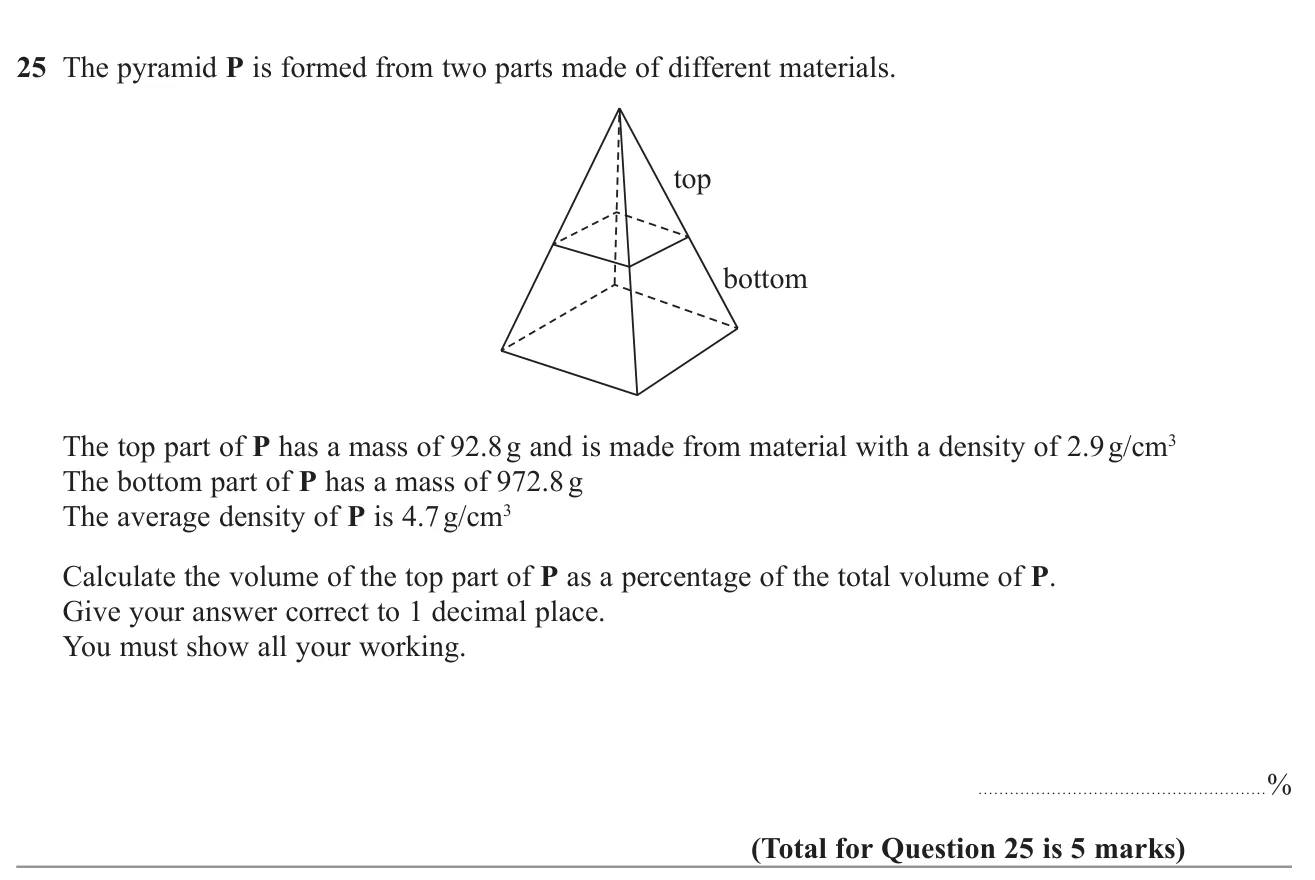
Speed, density and pressure5 marksGrade 7CalculatorHigher
November 2022 · Paper 3 Higher · Q25
Use masses and densities of two parts of a solid to find one part's share of the total volume as a percentage.

© Pearson Education Ltd. November 2022 Paper 3 (Higher, calculator), question 25.

Show answer
Answer14.1%5 marks

Worked solution Checked against the mark scheme

Top volume: 92.8÷2.9=32 cm392.8 \div 2.9 = 32\text{ cm}^3

Total mass: 92.8+972.8=1065.692.8 + 972.8 = 1065.6 g

Total volume: 1065.6÷4.7≈226.72 cm31065.6 \div 4.7 \approx 226.72\text{ cm}^3

Percentage: 32÷226.72×100≈14.1%32 \div 226.72 \times 100 \approx 14.1\%

Watch out: Using only the bottom part's mass with the average density.

Also tested in these questions

Their main topic is different, but part of each one tests this topic.