Edexcel GCSE Maths · 1MA1

November 2020 Paper 3 Higher

Calculator · 21 questions · 80 marks · 1 hour 30 minutes. Try each question on paper, then press "Show answer".

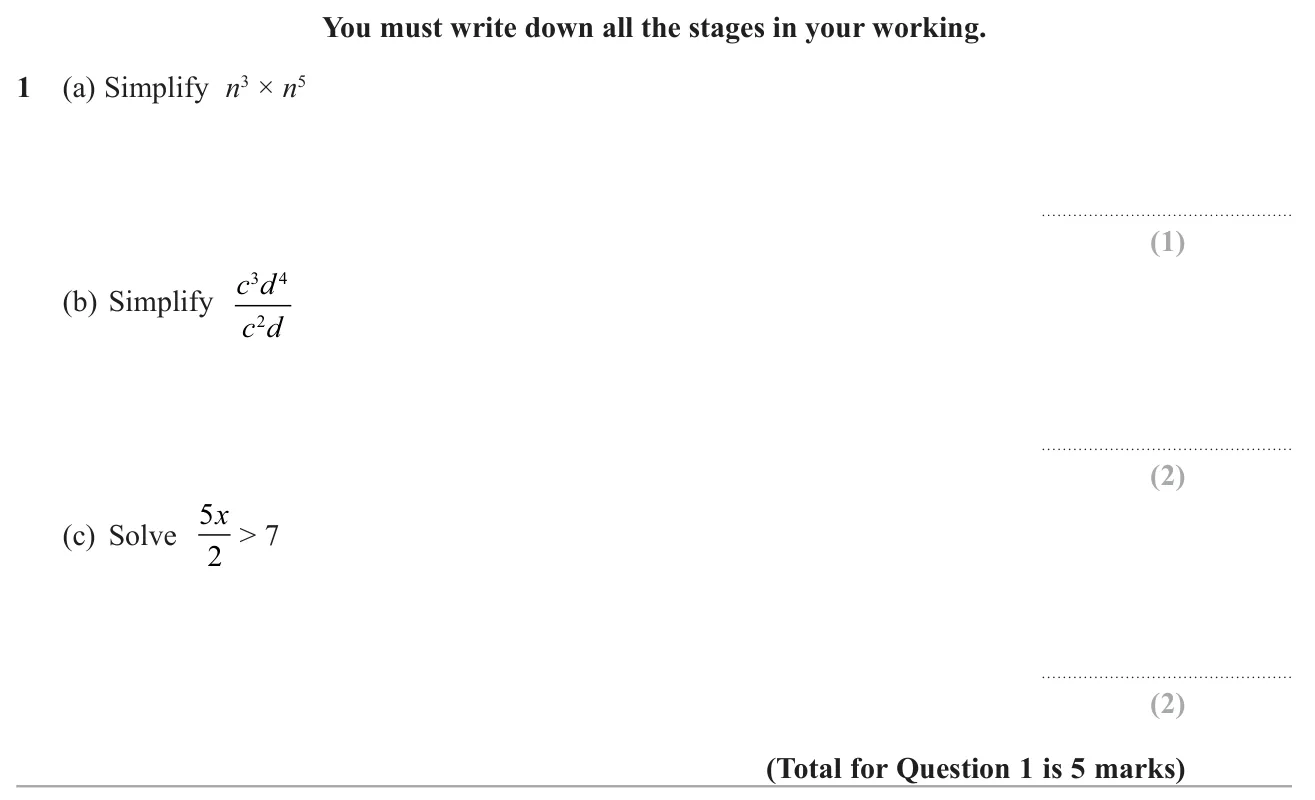
Question 1

Powers, roots and indices5 marksGrade 4CalculatorOn both tiers
Simplify using index laws and solve a linear inequality with a fraction.

© Pearson Education Ltd. November 2020 Paper 3 (Higher, calculator), question 1.

Show answer
(a)n8n^81 mark
(b)cd3cd^32 marks
(c)x>145x > \frac{14}{5}2 marks

Worked solution Checked against the mark scheme

(a) Add the powers: n3+5=n8n^{3+5} = n^8

(b) Subtract the powers: c3−2d4−1=cd3c^{3-2}d^{4-1} = cd^3

(c) 5x>145x > 14, so x>145=2.8x > \frac{14}{5} = 2.8

Watch out: In (a), multiplying powers to get n15n^{15}.

Question 2

Speed, density and pressure3 marksGrade 4CalculatorOn both tiers
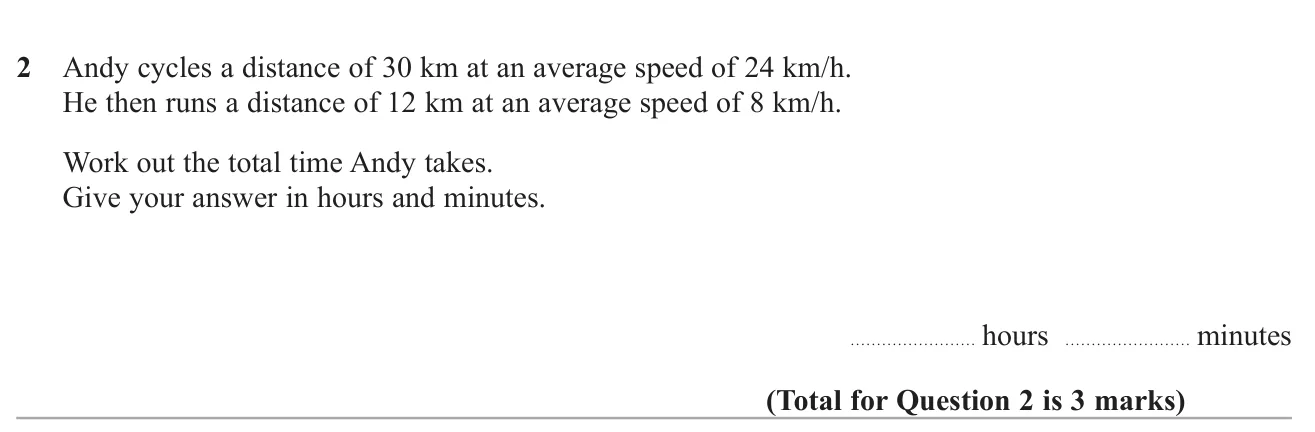
Find total time for two stages of a journey given distances and speeds, in hours and minutes.

© Pearson Education Ltd. November 2020 Paper 3 (Higher, calculator), question 2.

Show answer
Answer2 hours 45 minutes3 marks

Worked solution Checked against the mark scheme

Cycling: 30÷24=1.2530 \div 24 = 1.25 h

Running: 12÷8=1.512 \div 8 = 1.5 h

Total: 2.752.75 h =2= 2 hours 4545 minutes

Watch out: Writing 2.75 hours as 2 hours 75 minutes.

Question 3

Error intervals and bounds2 marksGrade 4CalculatorOn both tiers
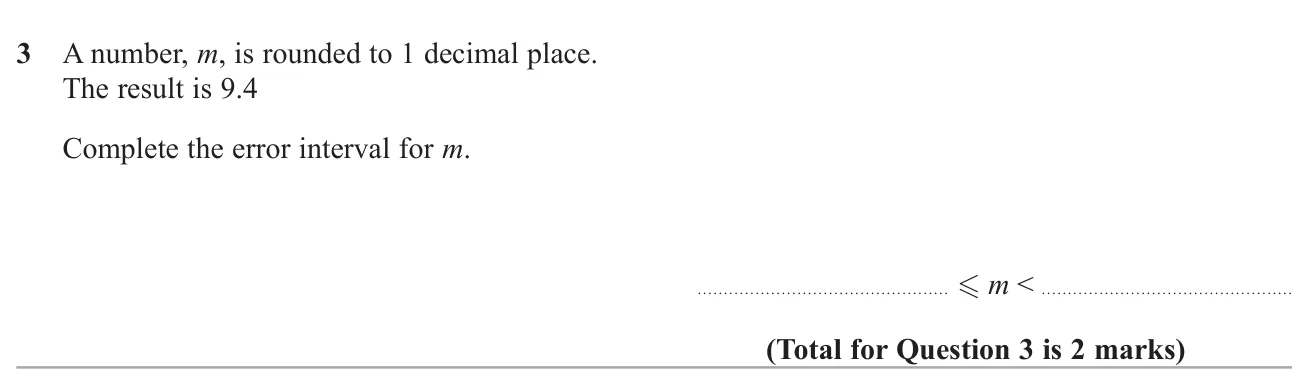
Write the error interval for a number rounded to one decimal place.

© Pearson Education Ltd. November 2020 Paper 3 (Higher, calculator), question 3.

Show answer
Answer9.35≤m<9.459.35 \le m < 9.452 marks

Worked solution Checked against the mark scheme

Half of 0.1 is 0.05.

Lower bound 9.4−0.05=9.359.4 - 0.05 = 9.35, upper bound 9.4+0.05=9.459.4 + 0.05 = 9.45

9.35≤m<9.459.35 \le m < 9.45

Watch out: Using 9.3 and 9.5 as the limits.

Question 4

Direct and inverse proportion5 marksGrade 5CalculatorOn both tiers
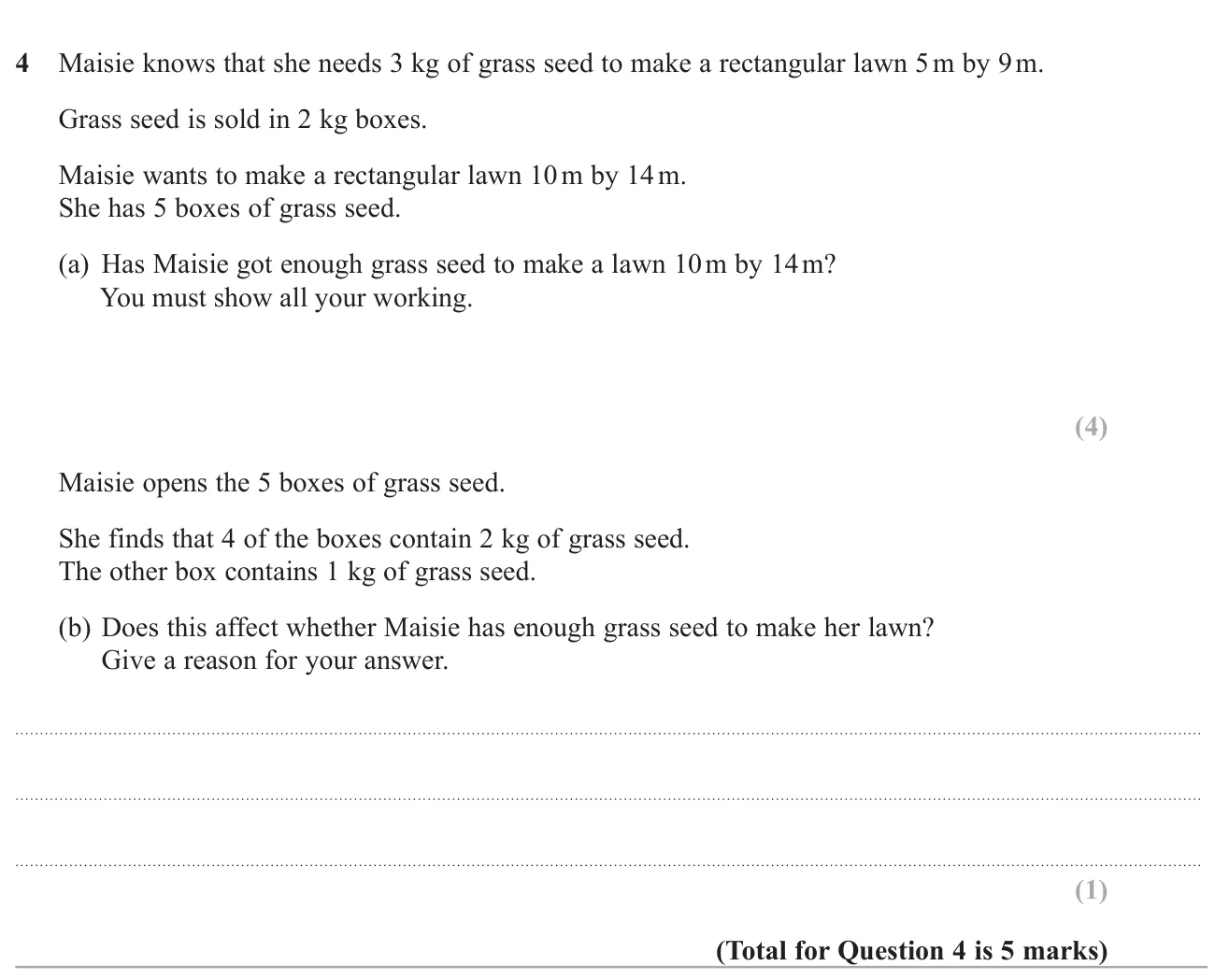
Scale up grass seed from one lawn area to another to decide if five boxes are enough, then reconsider with less seed.

© Pearson Education Ltd. November 2020 Paper 3 (Higher, calculator), question 4.

Show answer
(a)Yes: she needs about 9.3 kg and has 10 kg4 marks
(b)Yes, it now matters: she has 9 kg but needs about 9.3 kg1 mark

Worked solution Checked against the mark scheme

(a) 3 kg covers 5×9=455 \times 9 = 45 m², so 1 kg covers 1515 m².

New lawn: 10×14=14010 \times 14 = 140 m² needs 140÷15=9.33140 \div 15 = 9.33 kg.

She has 5×2=105 \times 2 = 10 kg, so yes.

(b) Now she has 4×2+1=94 \times 2 + 1 = 9 kg, less than 9.33 kg, so she does not have enough.

Watch out: Doubling the seed because the lengths roughly double, ignoring that area scales differently.

Question 5

Tree diagrams and combined events4 marksGrade 4CalculatorOn both tiers
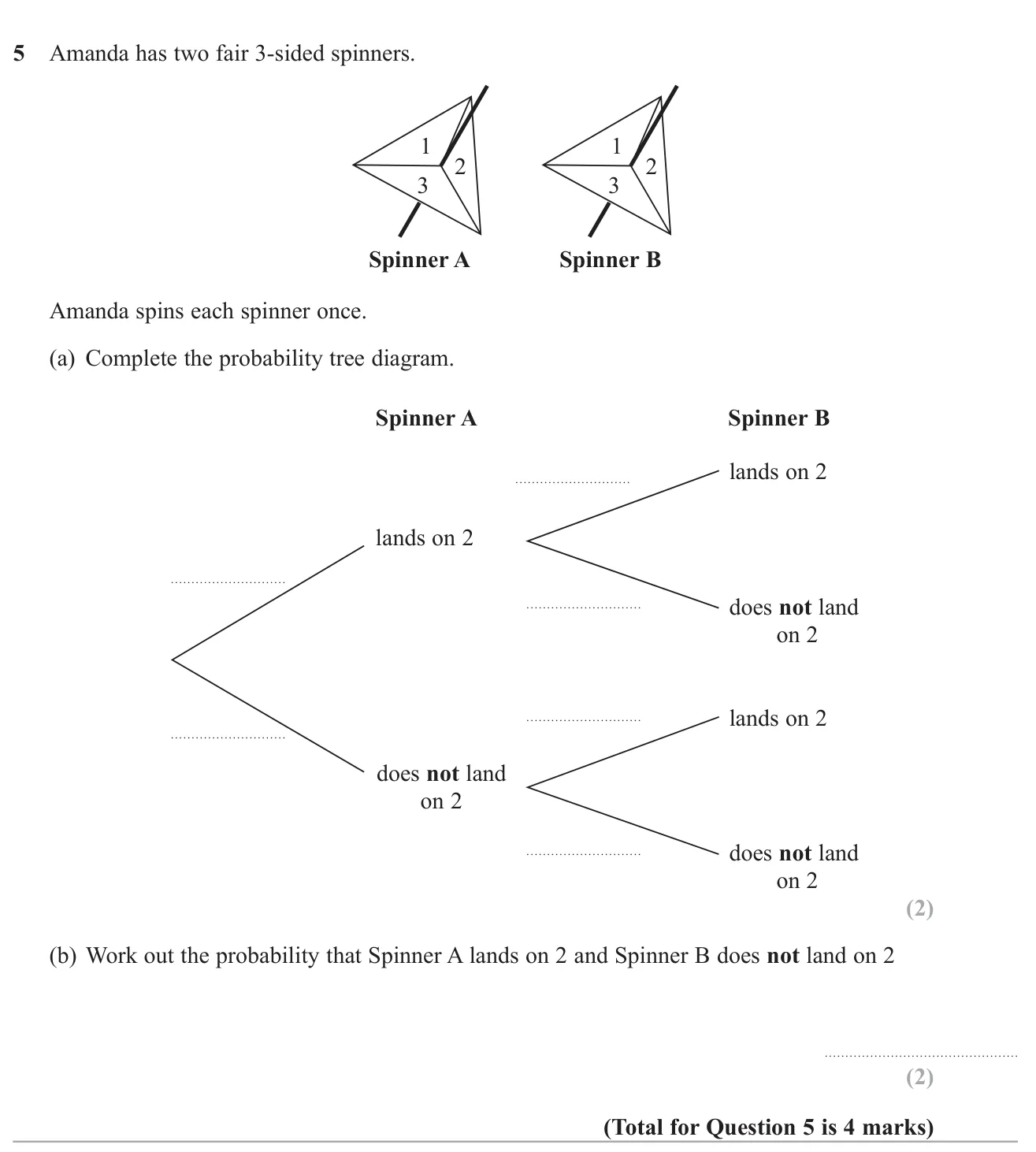
Complete a probability tree for two three-sided spinners and find the probability of one outcome on each.

© Pearson Education Ltd. November 2020 Paper 3 (Higher, calculator), question 5.

Show answer
(a)13\frac{1}{3} for each 'lands on 2' branch and 23\frac{2}{3} for each 'does not land on 2' branch2 marks
(b)29\frac{2}{9}2 marks

Worked solution Checked against the mark scheme

(a) Each spinner has 3 equal sections, one of which is 2: P(2)=13P(2) = \frac{1}{3}, P(not 2)=23P(\text{not } 2) = \frac{2}{3}

(b) 13×23=29\frac{1}{3} \times \frac{2}{3} = \frac{2}{9}

Watch out: In (b), adding the probabilities instead of multiplying.

Question 6

Quadratic graphs3 marksGrade 5CalculatorOn both tiers
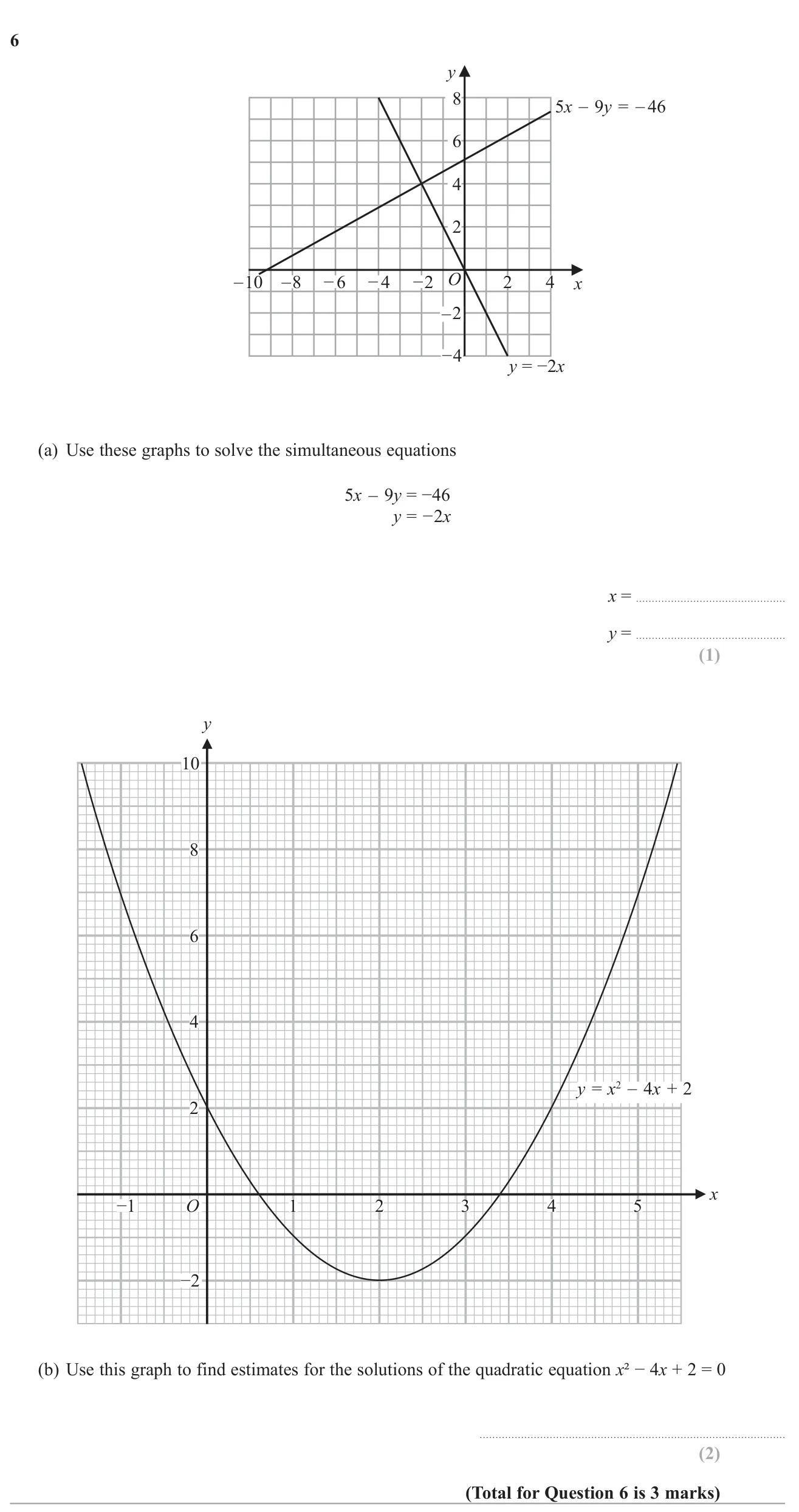
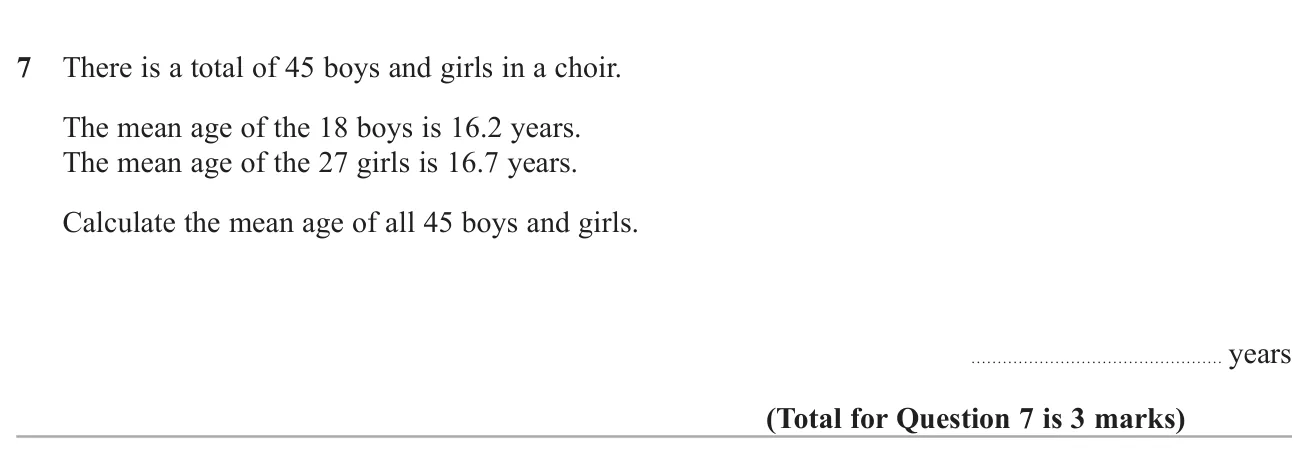
Read the solution of simultaneous equations from the intersection of two lines, and estimate the roots of a quadratic from its graph.

© Pearson Education Ltd. November 2020 Paper 3 (Higher, calculator), question 6.

Show answer
(a)x=−2x = -2, y=4y = 41 mark
(b)x≈0.6x \approx 0.6 and x≈3.4x \approx 3.4 (accept 0.55 to 0.65 and 3.35 to 3.45)2 marks

Worked solution Checked against the mark scheme

(a) The lines cross at (−2,4)(-2, 4), so x=−2x = -2, y=4y = 4.

Check: 5(−2)−9(4)=−465(-2) - 9(4) = -46 ✓

(b) Read where the curve meets the xx-axis: x≈0.6x \approx 0.6 and x≈3.4x \approx 3.4

Watch out: In (b), reading where the curve crosses the yy-axis (2).

Question 7

Averages and spread3 marksGrade 5Calculator
Combine the mean ages of a group of boys and a group of girls to find the mean age of the whole choir.

© Pearson Education Ltd. November 2020 Paper 3 (Higher, calculator), question 7.

Show answer
Answer16.516.5 years3 marks

Worked solution Checked against the mark scheme

Boys' total =18×16.2=291.6= 18 \times 16.2 = 291.6

Girls' total =27×16.7=450.9= 27 \times 16.7 = 450.9

Mean =291.6+450.945=742.545=16.5= \frac{291.6 + 450.9}{45} = \frac{742.5}{45} = 16.5 years

Watch out: Averaging 16.2 and 16.7 to get 16.45.

Question 8

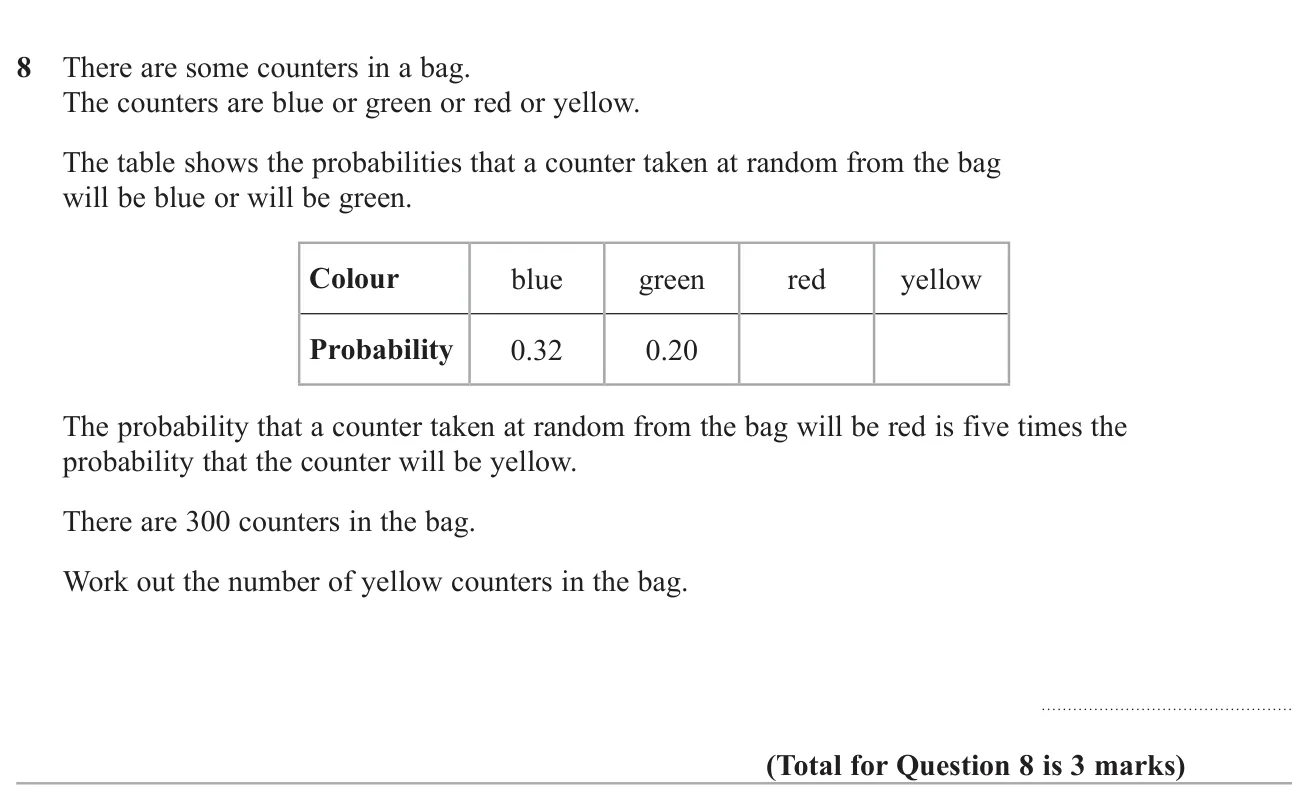
Use given probabilities for two colours and a five-to-one link between the other two to find how many of 300 counters are yellow.

© Pearson Education Ltd. November 2020 Paper 3 (Higher, calculator), question 8.

Show answer
Answer24243 marks

Worked solution Checked against the mark scheme

Red and yellow together: 1−0.32−0.20=0.481 - 0.32 - 0.20 = 0.48

Red =5×= 5 \times yellow, so 6×6 \times P(yellow) =0.48= 0.48, giving P(yellow) =0.08= 0.08

Yellow counters =0.08×300=24= 0.08 \times 300 = 24

Watch out: Dividing 0.48 by 5 instead of 6.

Question 9

Volume and surface area5 marksGrade 6Calculator
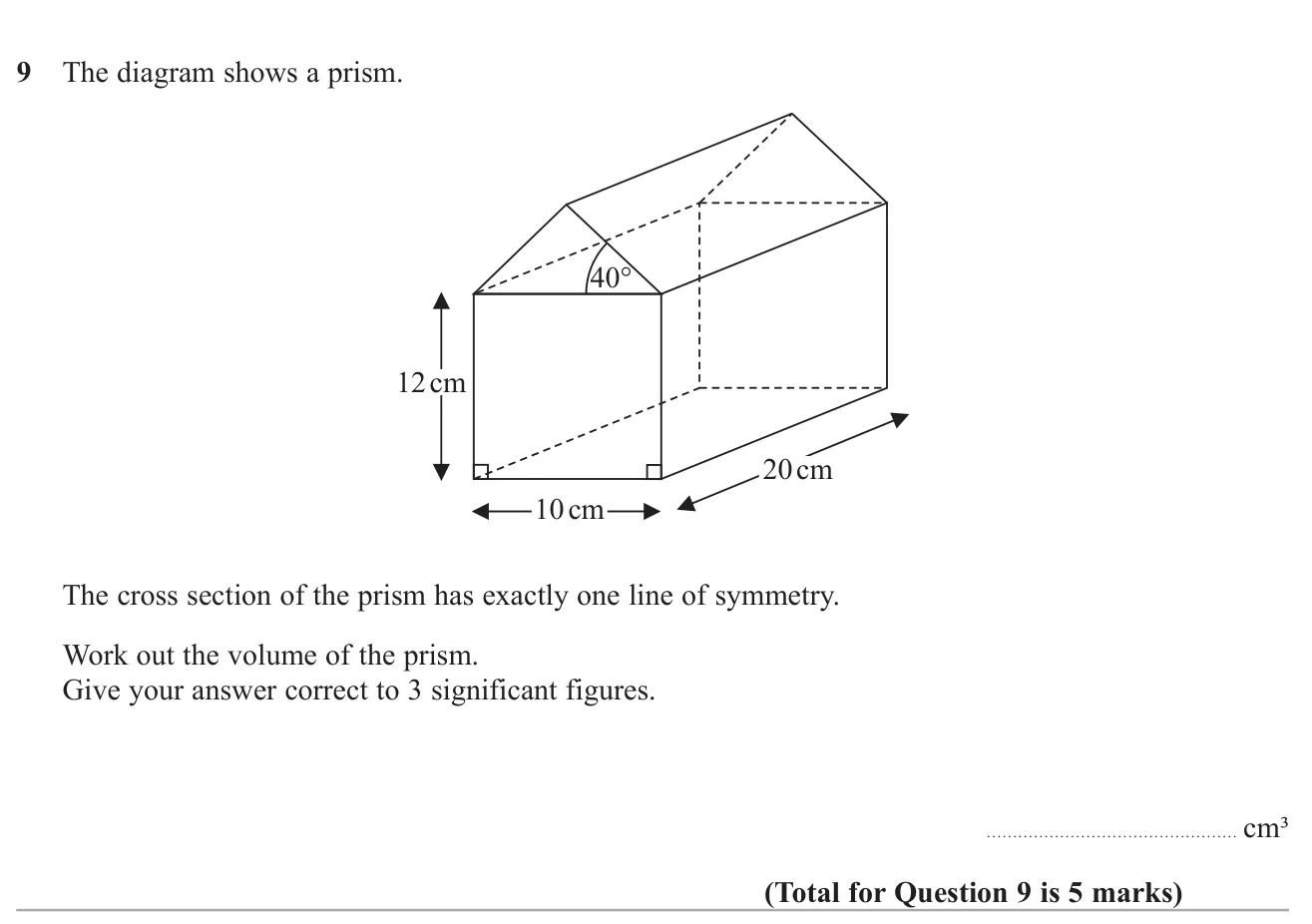
Find the volume of a prism whose cross-section is a rectangle topped by an isosceles triangle, using trigonometry for the triangle's height.

© Pearson Education Ltd. November 2020 Paper 3 (Higher, calculator), question 9.

Show answer
Answer28202820 cm³ (accept 2810 to 2820)5 marks

Worked solution Checked against the mark scheme

The triangle is isosceles, so split it into two right-angled triangles with base 55 cm.

Height h=5tan⁡40∘≈4.195h = 5\tan 40^\circ \approx 4.195 cm

Cross-section =10×12+12×10×4.195≈140.98= 10 \times 12 + \frac{1}{2} \times 10 \times 4.195 \approx 140.98 cm²

Volume =140.98×20≈2819.5≈2820= 140.98 \times 20 \approx 2819.5 \approx 2820 cm³

Watch out: Treating 40° as the apex angle or using 10 instead of 5 as the base of the right-angled triangle.

Question 10

Standard form4 marksGrade 5Calculator
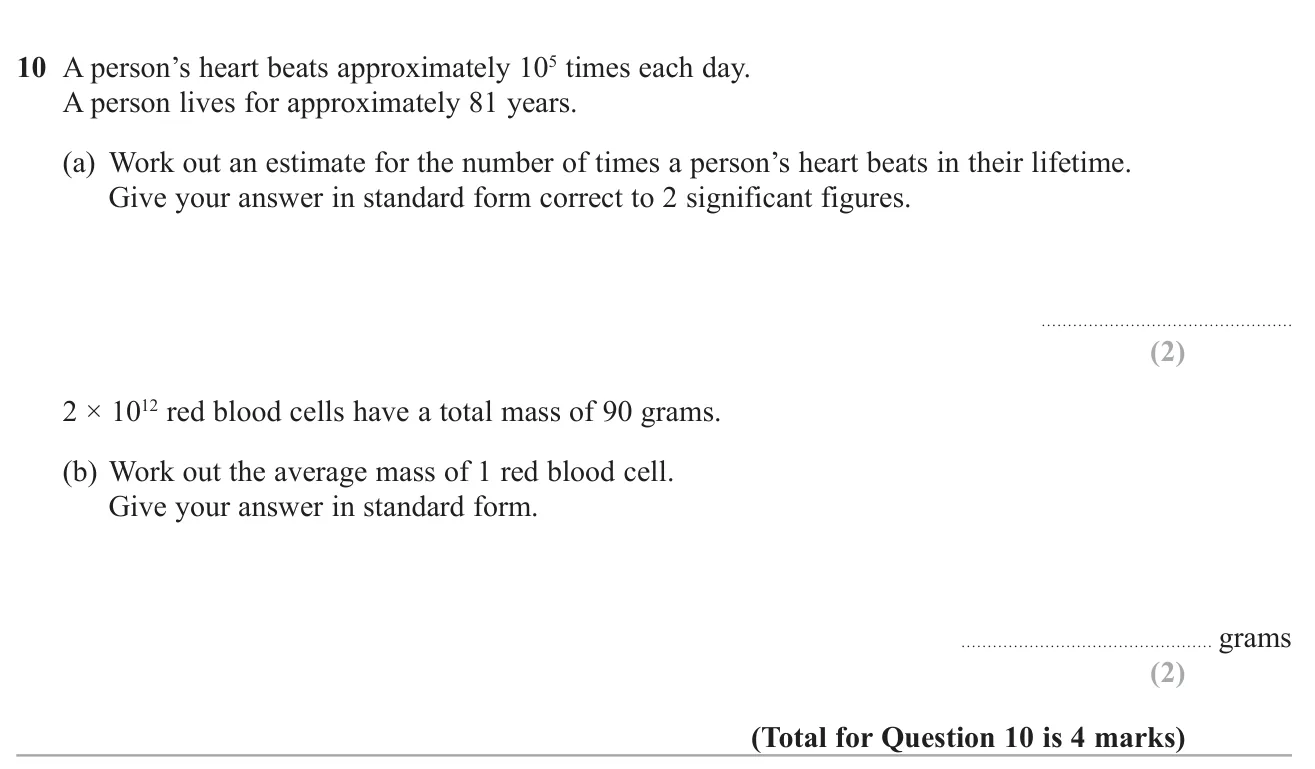
Estimate lifetime heartbeats in standard form, then divide a mass by a very large number of cells.

© Pearson Education Ltd. November 2020 Paper 3 (Higher, calculator), question 10.

Show answer
(a)3.0×1093.0 \times 10^9 (accept 2.8×1092.8 \times 10^9 to 4.0×1094.0 \times 10^9)2 marks
(b)4.5×10−114.5 \times 10^{-11} grams2 marks

Worked solution Checked against the mark scheme

(a) 105×365×81=2 956 500 000≈3.0×10910^5 \times 365 \times 81 = 2\,956\,500\,000 \approx 3.0 \times 10^9

(b) 90÷(2×10¹²)=45×10−12=4.5×10−1190 \div (2 \times 10^{12}) = 45 \times 10^{-12} = 4.5 \times 10^{-11} grams

Watch out: In (b) writing 45 × 10-12 and not converting to standard form.

Question 11

Transformations4 marksGrade 6Calculator
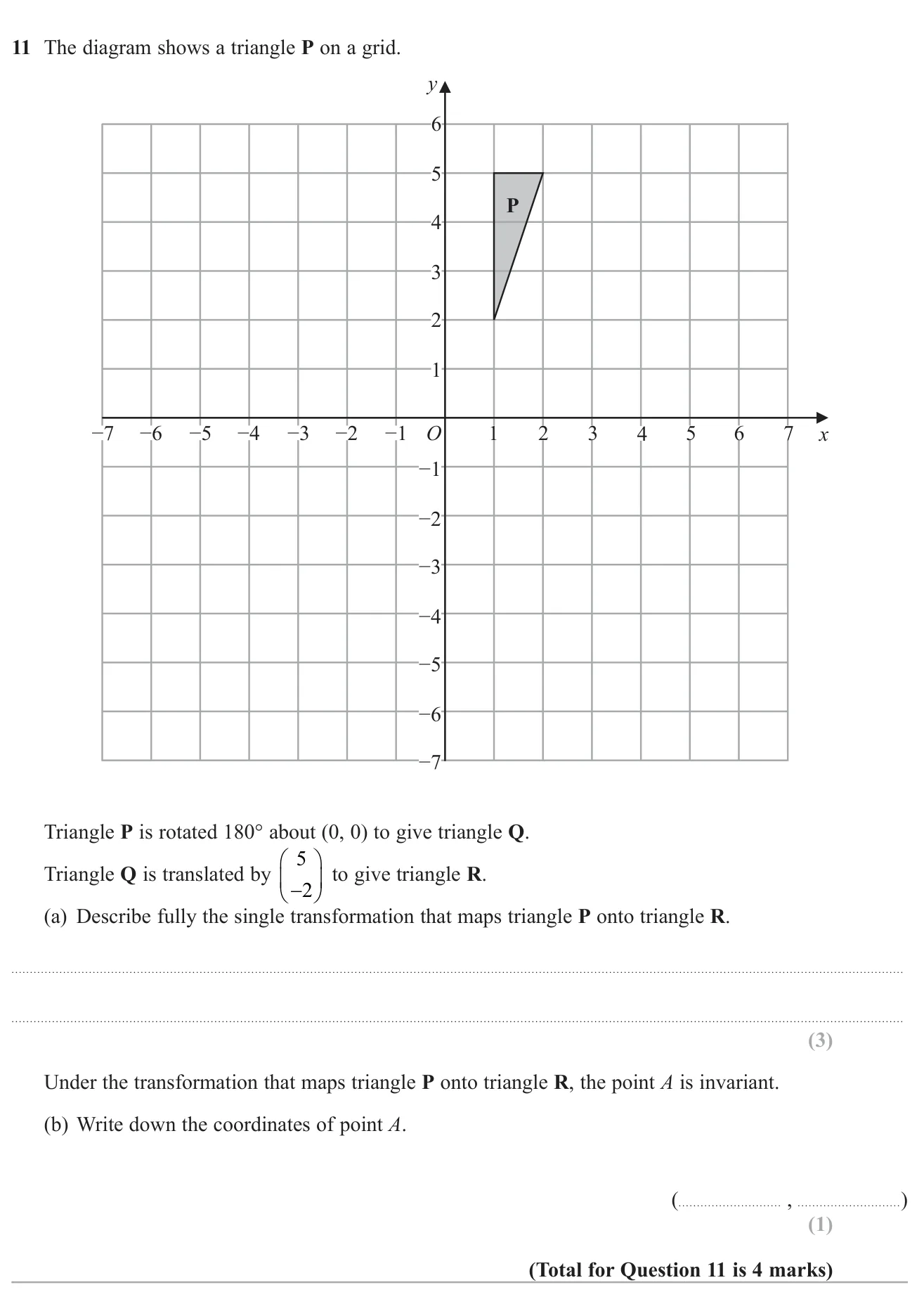
Combine a half-turn about the origin and a translation into one single transformation, and find its invariant point.

© Pearson Education Ltd. November 2020 Paper 3 (Higher, calculator), question 11.

Show answer
(a)Rotation 180∘180^\circ about (2.5,−1)(2.5, -1)3 marks
(b)(2.5,−1)(2.5, -1)1 mark

Worked solution Checked against the mark scheme

(a) P has vertices (1,2),(1,5),(2,5)(1,2), (1,5), (2,5).

Rotating 180∘180^\circ about O gives Q: (−1,−2),(−1,−5),(−2,−5)(-1,-2), (-1,-5), (-2,-5).

Translating by (5−2)\binom{5}{-2} gives R: (4,−4),(4,−7),(3,−7)(4,-4), (4,-7), (3,-7).

R is upside down relative to P, so it is a rotation of 180∘180^\circ. The centre is the midpoint of (1,2)(1,2) and its image (4,−4)(4,-4): (2.5,−1)(2.5, -1).

(b) The centre of rotation does not move, so A=(2.5,−1)A = (2.5, -1).

Watch out: Describing two transformations instead of one single transformation.

Question 12

Algebraic fractions6 marksGrade 7Calculator
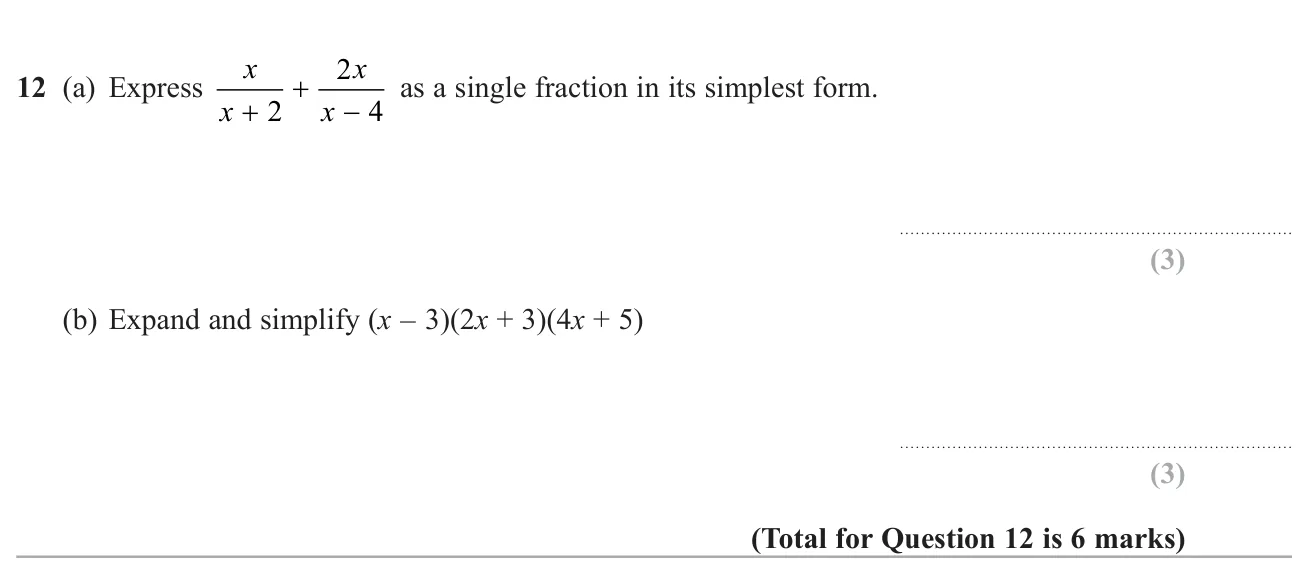
Add two algebraic fractions into one simplified fraction, and expand a product of three brackets.

© Pearson Education Ltd. November 2020 Paper 3 (Higher, calculator), question 12.

Show answer
(a)3x2(x+2)(x−4)\frac{3x^2}{(x+2)(x-4)}3 marks
(b)8x3−2x2−51x−458x^3 - 2x^2 - 51x - 453 marks

Worked solution Checked against the mark scheme

(a) x(x−4)+2x(x+2)(x+2)(x−4)=x2−4x+2x2+4x(x+2)(x−4)=3x2(x+2)(x−4)\frac{x(x-4) + 2x(x+2)}{(x+2)(x-4)} = \frac{x^2 - 4x + 2x^2 + 4x}{(x+2)(x-4)} = \frac{3x^2}{(x+2)(x-4)}

(b) (x−3)(2x+3)=2x2−3x−9(x-3)(2x+3) = 2x^2 - 3x - 9

(2x2−3x−9)(4x+5)=8x3+10x2−12x2−15x−36x−45(2x^2 - 3x - 9)(4x + 5) = 8x^3 + 10x^2 - 12x^2 - 15x - 36x - 45

=8x3−2x2−51x−45= 8x^3 - 2x^2 - 51x - 45

Watch out: Adding the numerators and denominators separately in (a).

Question 13

Inequalities5 marksGrade 7Calculator
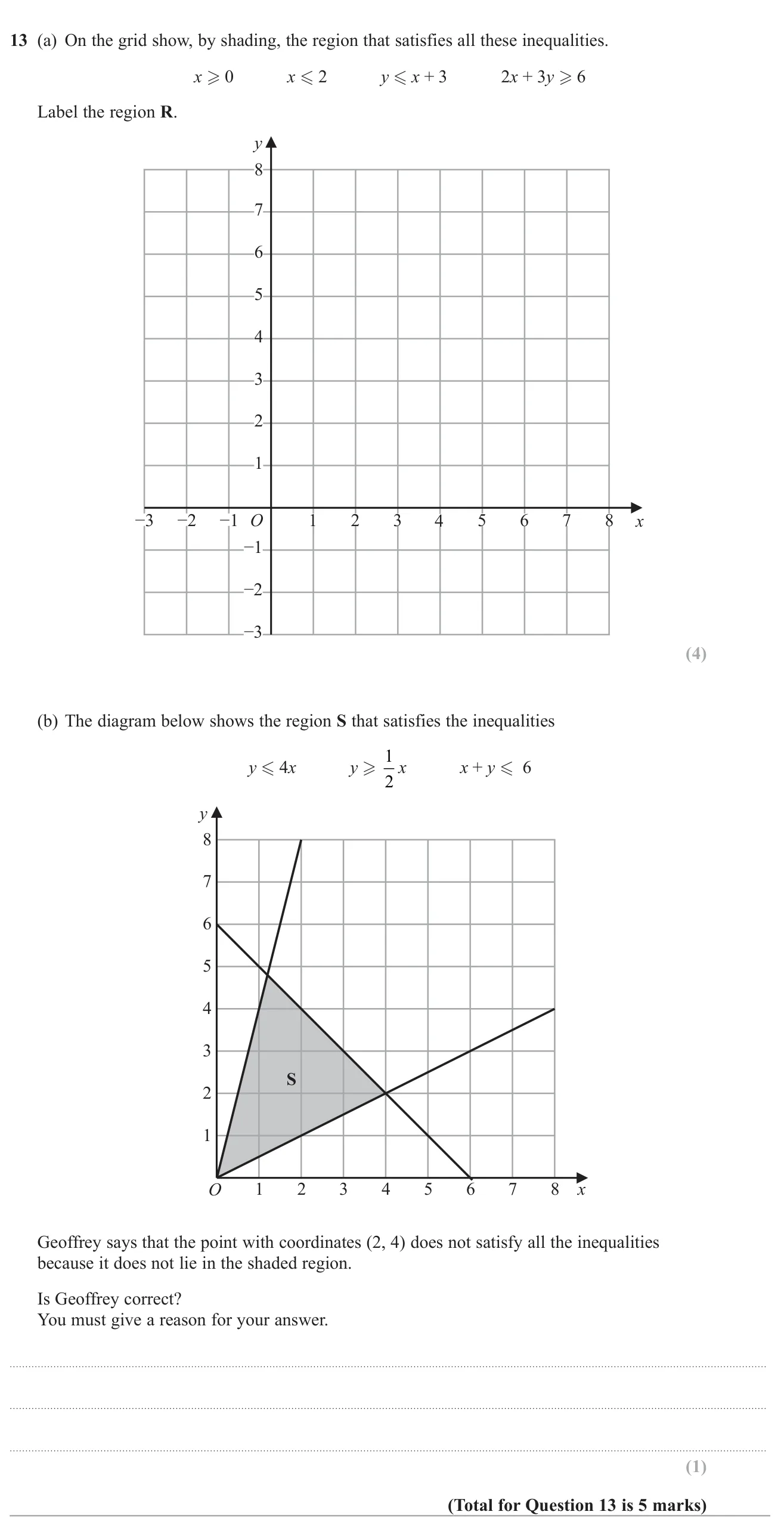
Draw three lines and shade the region meeting four inequalities, then judge whether a point on a boundary satisfies a set of inequalities.

© Pearson Education Ltd. November 2020 Paper 3 (Higher, calculator), question 13.

Show answer
(a)Region R bounded by x=0x = 0, x=2x = 2, y=x+3y = x + 3 and 2x+3y=62x + 3y = 6, shaded and labelled4 marks
(b)No: (2,4)(2, 4) lies on the line x+y=6x + y = 6, and the inequality includes the boundary, so it does satisfy them1 mark

Worked solution Checked against the mark scheme

(a) Draw x=2x = 2 (vertical), y=x+3y = x + 3 (through (0,3)(0,3) and (2,5)(2,5)) and 2x+3y=62x + 3y = 6 (through (0,2)(0,2) and (3,0)(3,0)).

The region is between x=0x = 0 and x=2x = 2, below y=x+3y = x + 3 and above 2x+3y=62x + 3y = 6. Label it R.

(b) At (2,4)(2, 4): y=4≤4x=8y = 4 \le 4x = 8, y=4≥12x=1y = 4 \ge \frac{1}{2}x = 1, and x+y=6≤6x + y = 6 \le 6. All are satisfied because the point is on the boundary, so Geoffrey is wrong.

Watch out: Forgetting that ≤ and ≥ include points on the boundary line.

Question 14

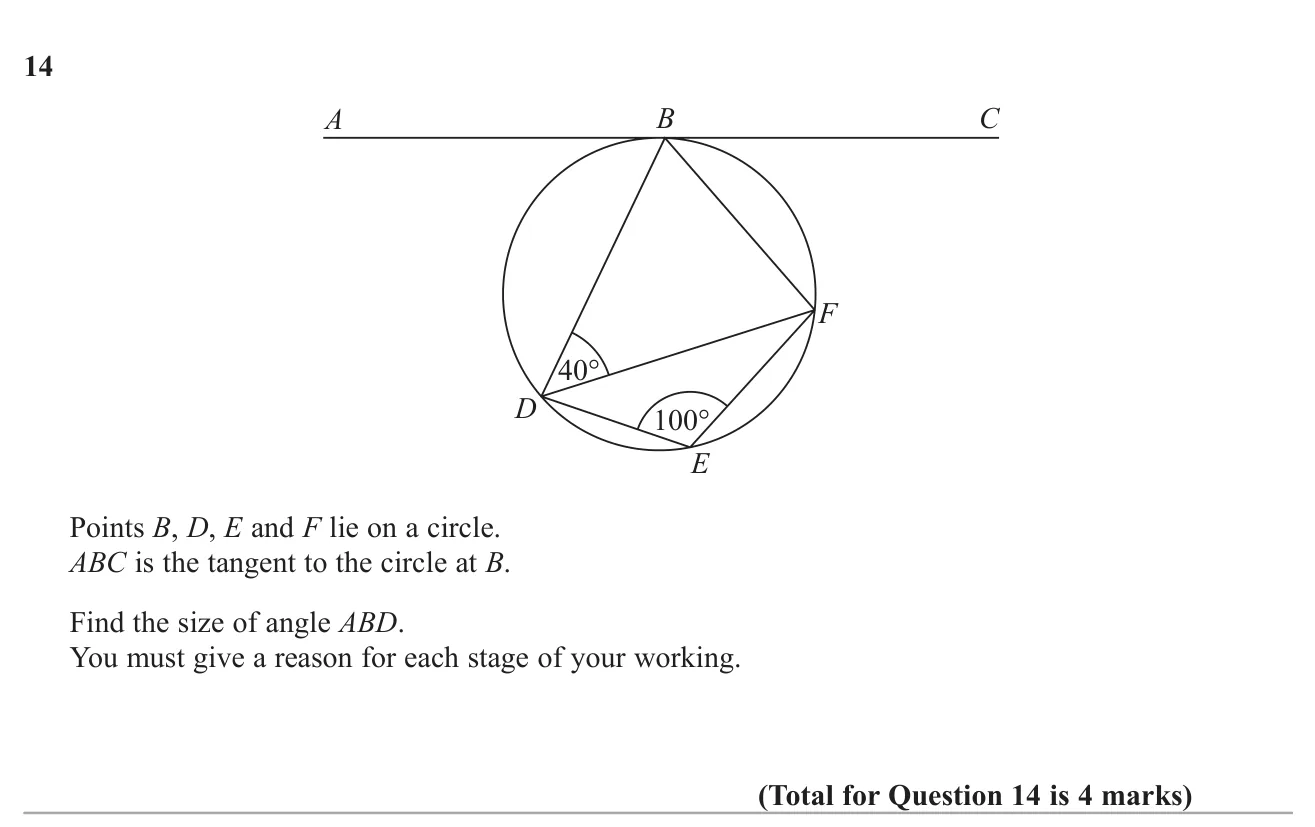
Circle theorems4 marksGrade 7Calculator
Use a cyclic quadrilateral, a triangle angle sum and the alternate segment theorem to find an angle between a tangent and a chord.

© Pearson Education Ltd. November 2020 Paper 3 (Higher, calculator), question 14.

Show answer
Answer60∘60^\circ with reasons4 marks

Worked solution Checked against the mark scheme

BDEFBDEF is a cyclic quadrilateral, so angle DBF=180∘−100∘=80∘DBF = 180^\circ - 100^\circ = 80^\circ (opposite angles of a cyclic quadrilateral add to 180∘180^\circ).

In triangle BDFBDF: angle BFD=180∘−80∘−40∘=60∘BFD = 180^\circ - 80^\circ - 40^\circ = 60^\circ (angles in a triangle add to 180∘180^\circ).

Angle ABDABD = angle BFD=60∘BFD = 60^\circ (alternate segment theorem).

Watch out: Giving the right angles but naming no circle theorems, which loses the reasoning mark.

Question 15

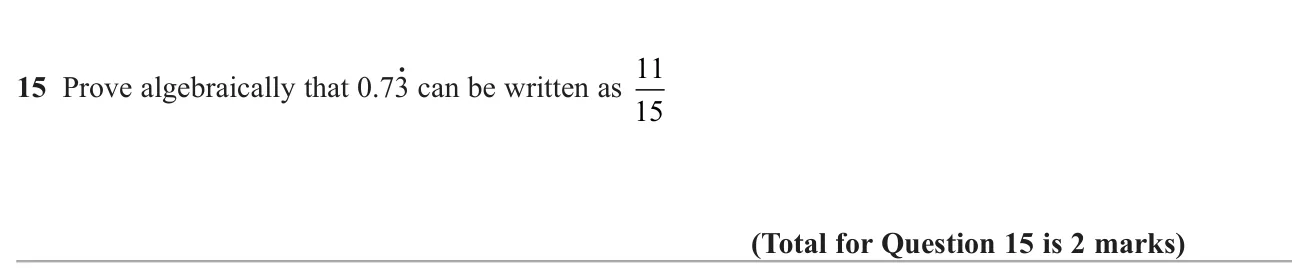
Prove algebraically that a recurring decimal equals a given fraction.

© Pearson Education Ltd. November 2020 Paper 3 (Higher, calculator), question 15.

Show answer
AnswerProof that 0.73˙=11150.7\dot{3} = \frac{11}{15}2 marks

Worked solution Checked against the mark scheme

Let x=0.7333…x = 0.7333\ldots

10x=7.333…10x = 7.333\ldots and 100x=73.333…100x = 73.333\ldots

100x−10x=90x=66100x - 10x = 90x = 66

x=6690=1115x = \frac{66}{90} = \frac{11}{15}

Watch out: Using x and 10x, which do not cancel the recurring part because the 7 does not repeat.

Question 16

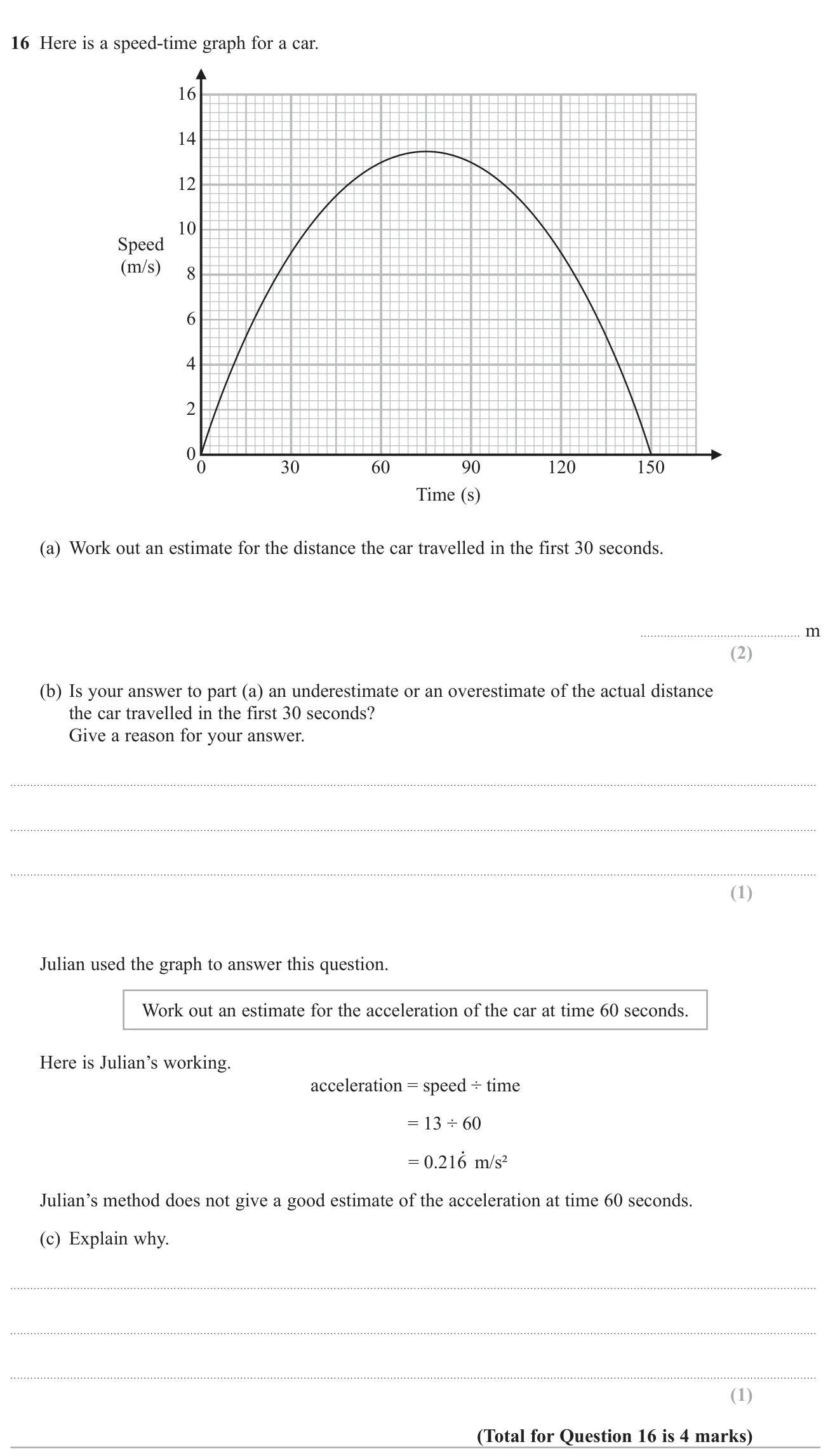
Estimate distance from the area under a curved speed-time graph, say whether it is an under- or overestimate, and explain why a worker's acceleration method is wrong.

© Pearson Education Ltd. November 2020 Paper 3 (Higher, calculator), question 16.

Show answer
(a)About 135135 m (accept 129 to 160)2 marks
(b)Underestimate: the curve lies above the straight line, so area is missed1 mark
(c)He found the average acceleration over 60 s; he should draw a tangent at 60 s and find its gradient1 mark

Worked solution Checked against the mark scheme

(a) At 30 s the speed is about 9 m/s. Treat the area as a triangle: 12×30×9=135\frac{1}{2} \times 30 \times 9 = 135 m

(b) The curve bulges above the straight line from (0,0)(0,0) to (30,9)(30,9), so the triangle misses some area: an underestimate.

(c) Speed ÷ time gives the average acceleration from 0 to 60 s. The acceleration at 60 s is the gradient of the tangent to the curve at that point.

Watch out: Using a rectangle 30 × 9 in (a), which overestimates.

Question 17

Histograms4 marksGrade 7Calculator
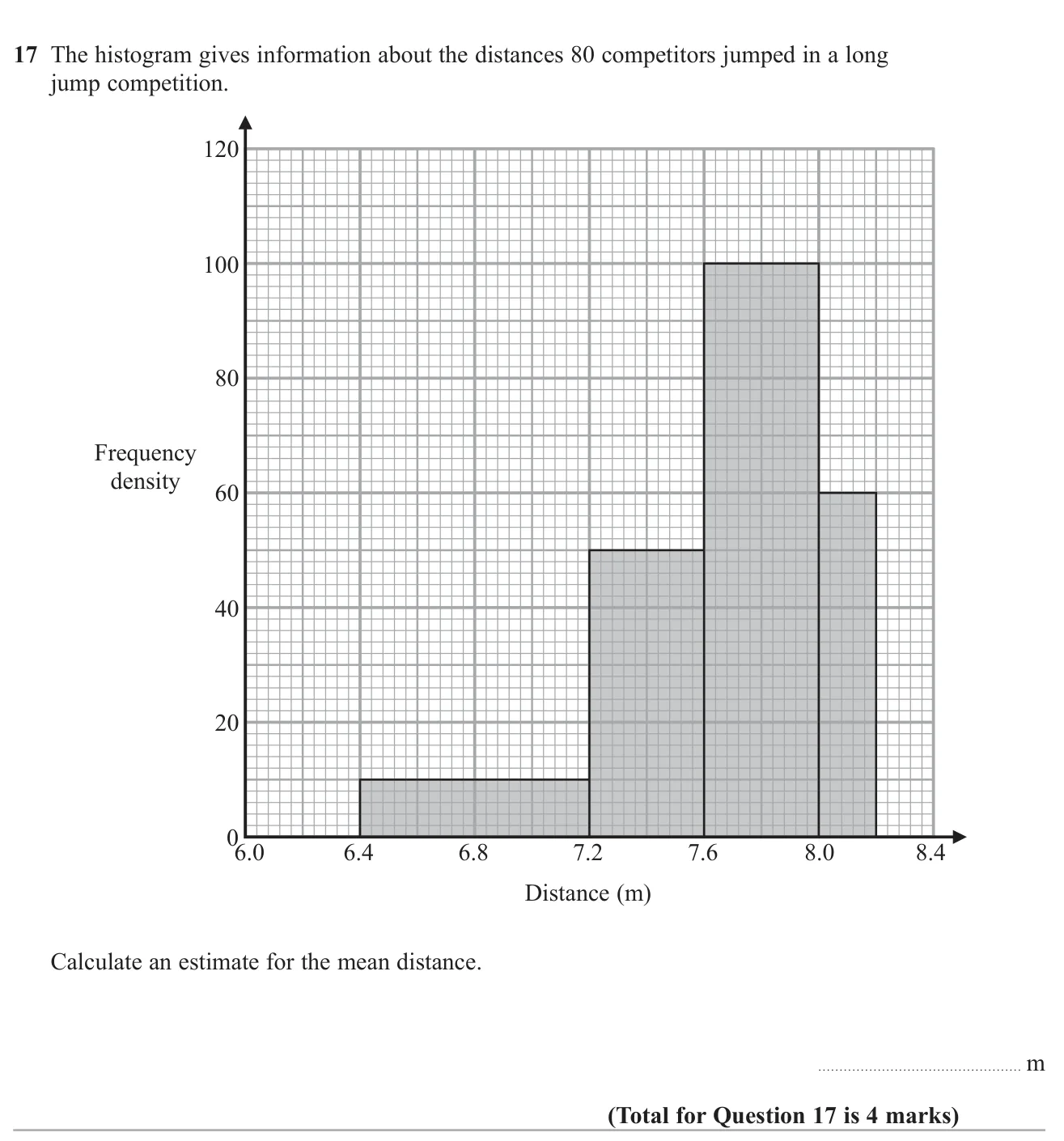
Work out class frequencies from a histogram and use midpoints to estimate the mean long-jump distance.

© Pearson Education Ltd. November 2020 Paper 3 (Higher, calculator), question 17.

Show answer
Answer7.6457.645 m (accept 7.65)4 marks

Worked solution Checked against the mark scheme

Frequencies = width × density:

0.8×10=80.8 \times 10 = 8, 0.4×50=200.4 \times 50 = 20, 0.4×100=400.4 \times 100 = 40, 0.2×60=120.2 \times 60 = 12 (total 80)

Mean =6.8×8+7.4×20+7.8×40+8.1×1280=611.680=7.645= \frac{6.8 \times 8 + 7.4 \times 20 + 7.8 \times 40 + 8.1 \times 12}{80} = \frac{611.6}{80} = 7.645 m

Watch out: Using the frequency densities as frequencies.

Question 18

Error intervals and bounds4 marksGrade 8Calculator
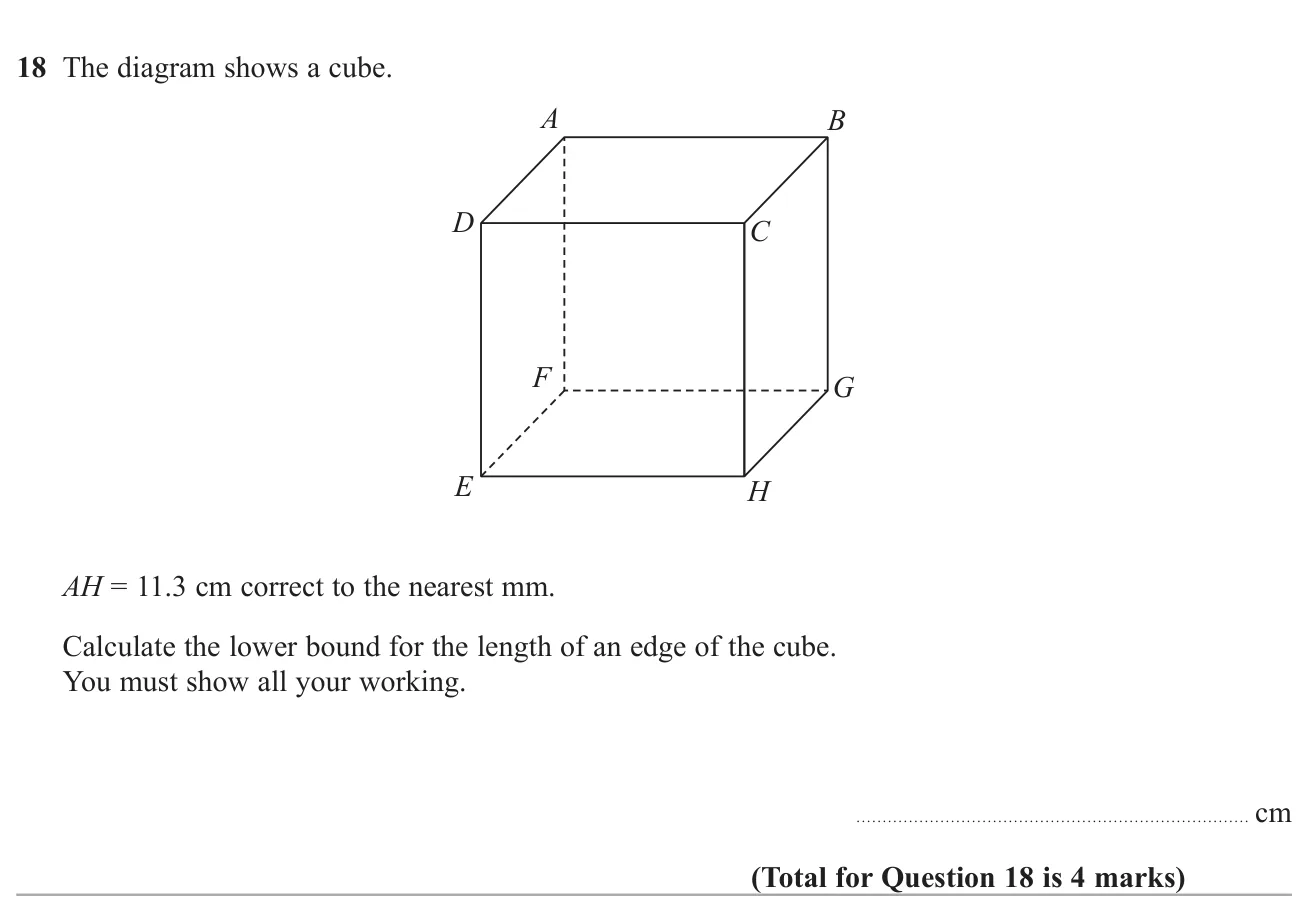
Find the lower bound of a cube's edge from the lower bound of its space diagonal using 3D Pythagoras.

© Pearson Education Ltd. November 2020 Paper 3 (Higher, calculator), question 18.

Show answer
Answer6.4956.495 cm (accept 6.49 to 6.50)4 marks

Worked solution Checked against the mark scheme

Lower bound of AH=11.25AH = 11.25 cm

For a cube of edge aa, the space diagonal satisfies a2+a2+a2=AH2a^2 + a^2 + a^2 = AH^2

3a2=11.2523a^2 = 11.25^2, so a=11.253≈6.495a = \frac{11.25}{\sqrt{3}} \approx 6.495 cm

Watch out: Using 2D Pythagoras for a face diagonal only.

Question 19

Similar shapes4 marksGrade 8Calculator
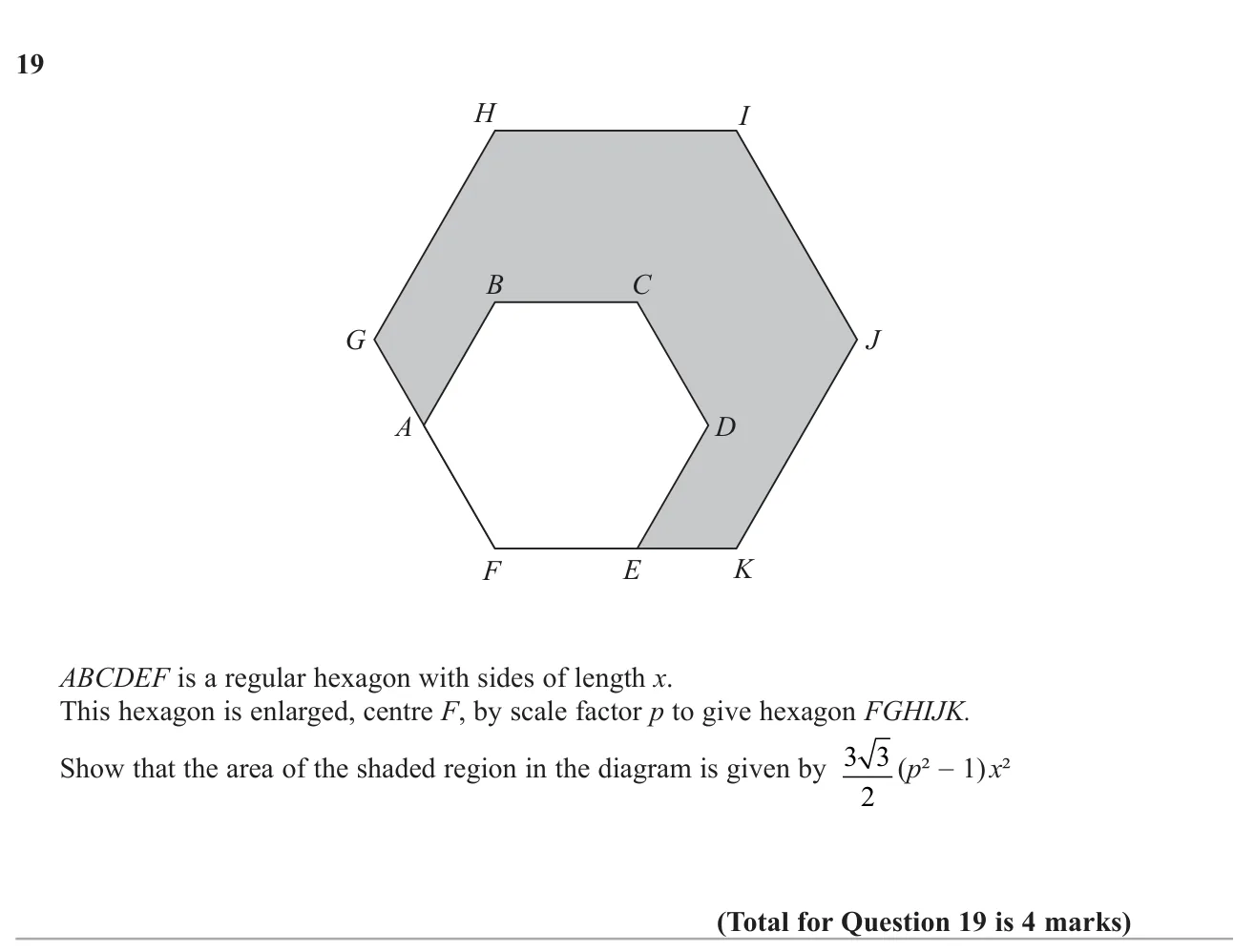
Show that the area between a regular hexagon and its enlargement by scale factor p is a given expression.

© Pearson Education Ltd. November 2020 Paper 3 (Higher, calculator), question 19.

Show answer
AnswerShown: 332(p2−1)x2\frac{3\sqrt{3}}{2}(p^2 - 1)x^24 marks

Worked solution Checked against the mark scheme

A regular hexagon of side xx is six equilateral triangles.

One triangle =12x2sin⁡60∘=34x2= \frac{1}{2}x^2\sin 60^\circ = \frac{\sqrt{3}}{4}x^2, so hexagon =332x2= \frac{3\sqrt{3}}{2}x^2

The enlarged hexagon has side pxpx, area 332p2x2\frac{3\sqrt{3}}{2}p^2x^2

Shaded =332p2x2−332x2=332(p2−1)x2= \frac{3\sqrt{3}}{2}p^2x^2 - \frac{3\sqrt{3}}{2}x^2 = \frac{3\sqrt{3}}{2}(p^2 - 1)x^2

Watch out: Multiplying the area by p instead of p².

Question 20

Factors, multiples and primes1 markGrade 7Calculator
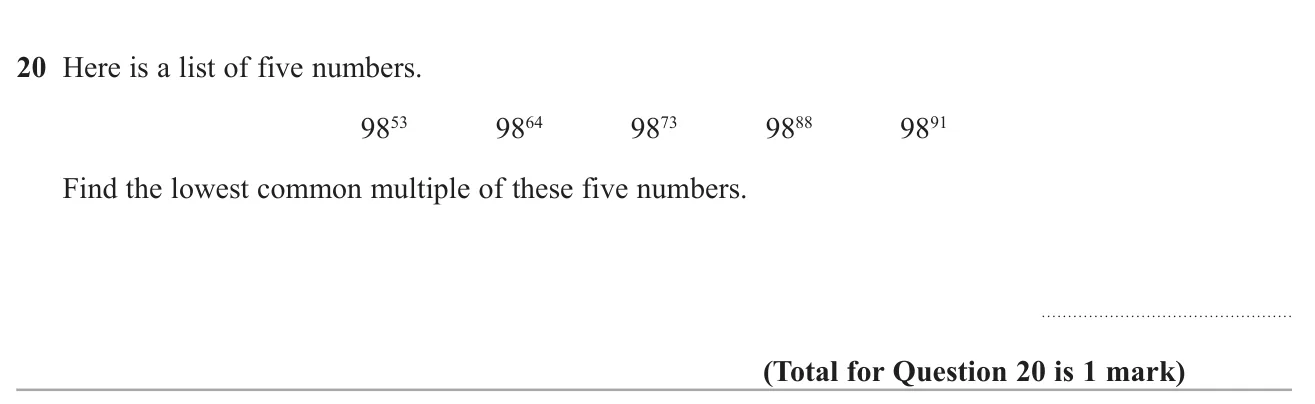
Find the lowest common multiple of five powers of the same number.

© Pearson Education Ltd. November 2020 Paper 3 (Higher, calculator), question 20.

Show answer
Answer989198^{91}1 mark

Worked solution Checked against the mark scheme

Every number in the list is a power of 98.

Each one divides the largest, 989198^{91}, so the lowest common multiple is 989198^{91}.

Watch out: Choosing the smallest power, which is the highest common factor.

Question 21

Ratio5 marksGrade 8Calculator
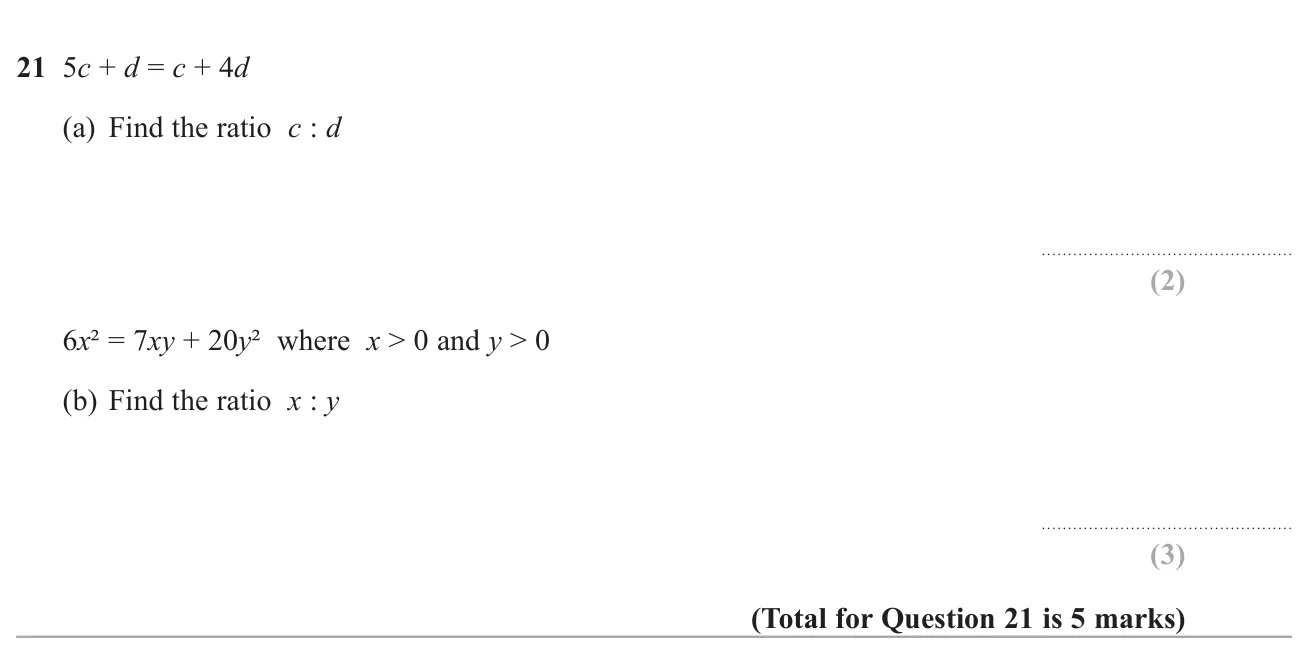
Rearrange a linear equation to find a ratio, then factorise a quadratic in two variables to find another ratio.

© Pearson Education Ltd. November 2020 Paper 3 (Higher, calculator), question 21.

Show answer
(a)3:43 : 42 marks
(b)5:25 : 23 marks

Worked solution Checked against the mark scheme

(a) 5c−c=4d−d5c - c = 4d - d, so 4c=3d4c = 3d, giving c:d=3:4c : d = 3 : 4

(b) 6x2−7xy−20y2=06x^2 - 7xy - 20y^2 = 0

(2x−5y)(3x+4y)=0(2x - 5y)(3x + 4y) = 0

Since x,y>0x, y > 0, 3x+4y≠03x + 4y \ne 0, so 2x=5y2x = 5y and x:y=5:2x : y = 5 : 2

Watch out: Writing the ratio the wrong way round, e.g. 4 : 3 in (a).

Finished the paper?

Add up your marks for all three papers and see what grade that would have been.