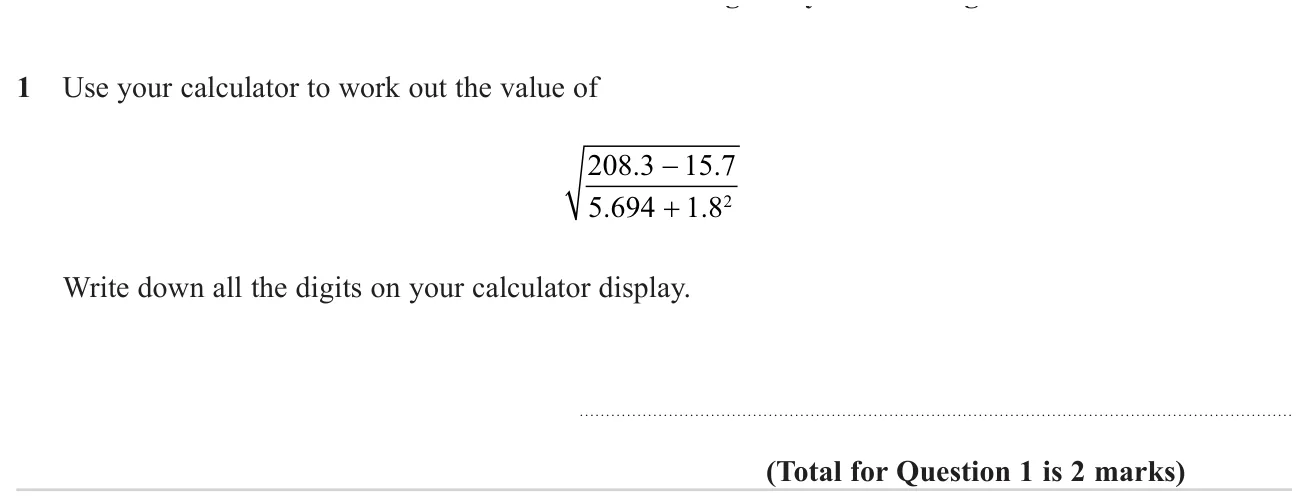
© Pearson Education Ltd. November 2024 Paper 2 (Higher, calculator), question 1.
Show answer
| Answer | 4.643069317 | 2 marks |
|---|
Worked solution Checked against the mark scheme
Top: 208.3−15.7=192.6
Bottom: 5.694+1.82=5.694+3.24=8.934
192.6÷8.934=21.5580…
21.5580…=4.643069317
Watch out: Not using brackets on the calculator, so only part of the numerator is divided.
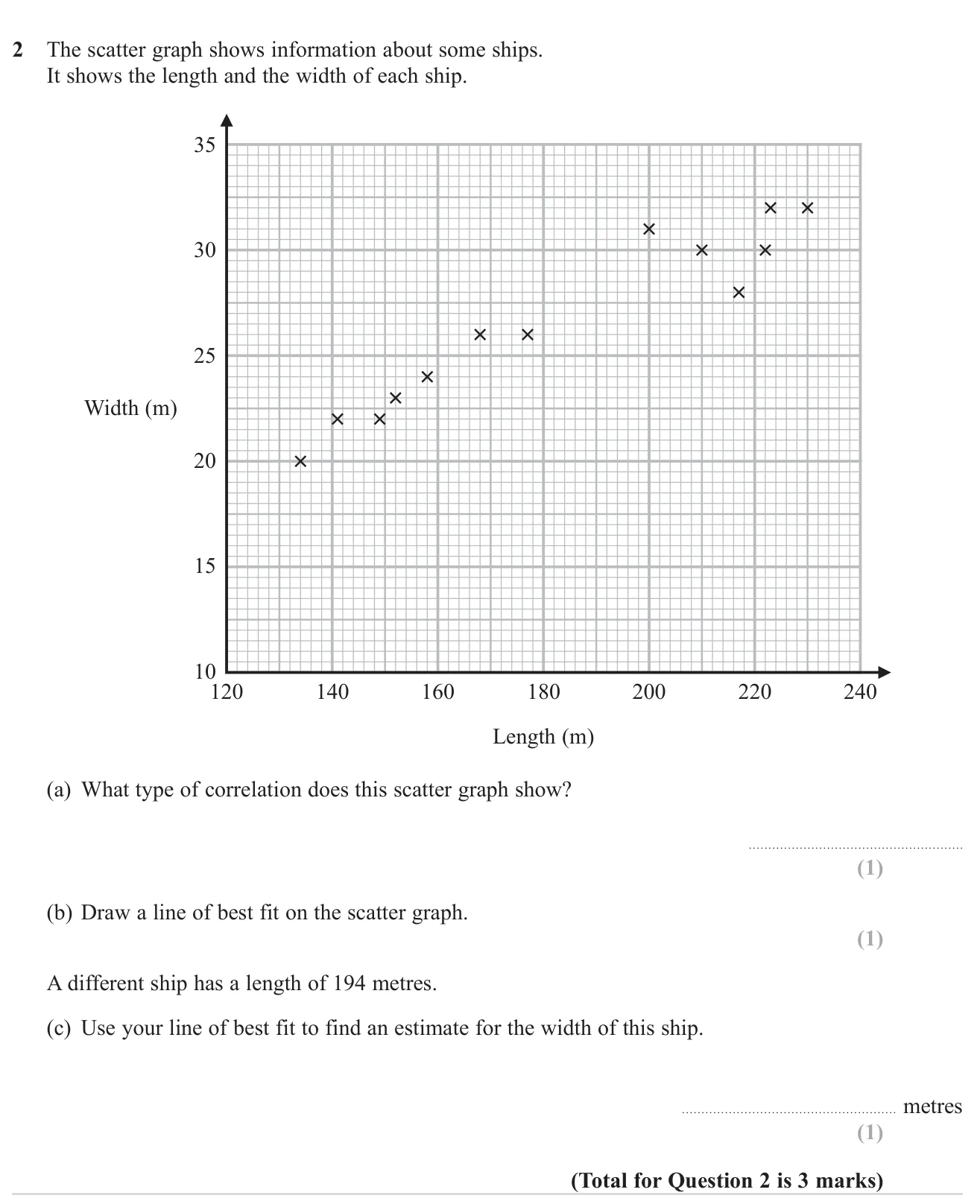
© Pearson Education Ltd. November 2024 Paper 2 (Higher, calculator), question 2.
Show answer
| (a) | Positive | 1 mark |
|---|
| (b) | Line of best fit drawn | 1 mark |
|---|
| (c) | About 28 m (26.5 to 29.5) | 1 mark |
|---|
Worked solution Checked against the mark scheme
(a) Longer ships tend to be wider, so the correlation is positive.
(b) Draw one straight line through the middle of the crosses, with roughly as many points above as below.
(c) Go up from 194 m on the length axis to the line, then across: about 28 m.
Watch out: Joining the points dot to dot instead of drawing one straight line.
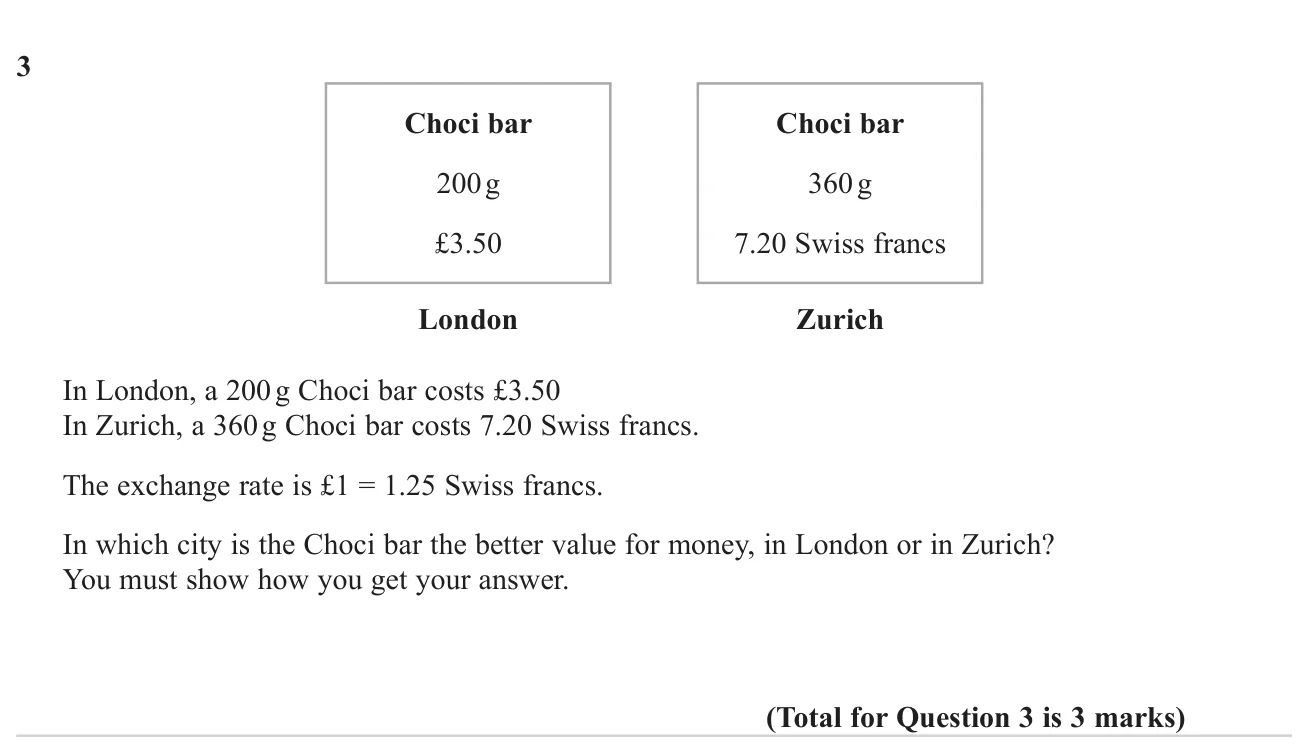
© Pearson Education Ltd. November 2024 Paper 2 (Higher, calculator), question 3.
Show answer
| Answer | Zurich (e.g. 200 g costs 4.00 francs in Zurich against 4.375 francs in London) | 3 marks |
|---|
Worked solution Checked against the mark scheme
Change the London price to francs: 3.50×1.25=4.375 francs for 200 g.
Zurich price for 200 g: 7.20÷360×200=4.00 francs.
4.00<4.375, so Zurich is better value.
Watch out: Dividing by 1.25 when changing pounds to francs.
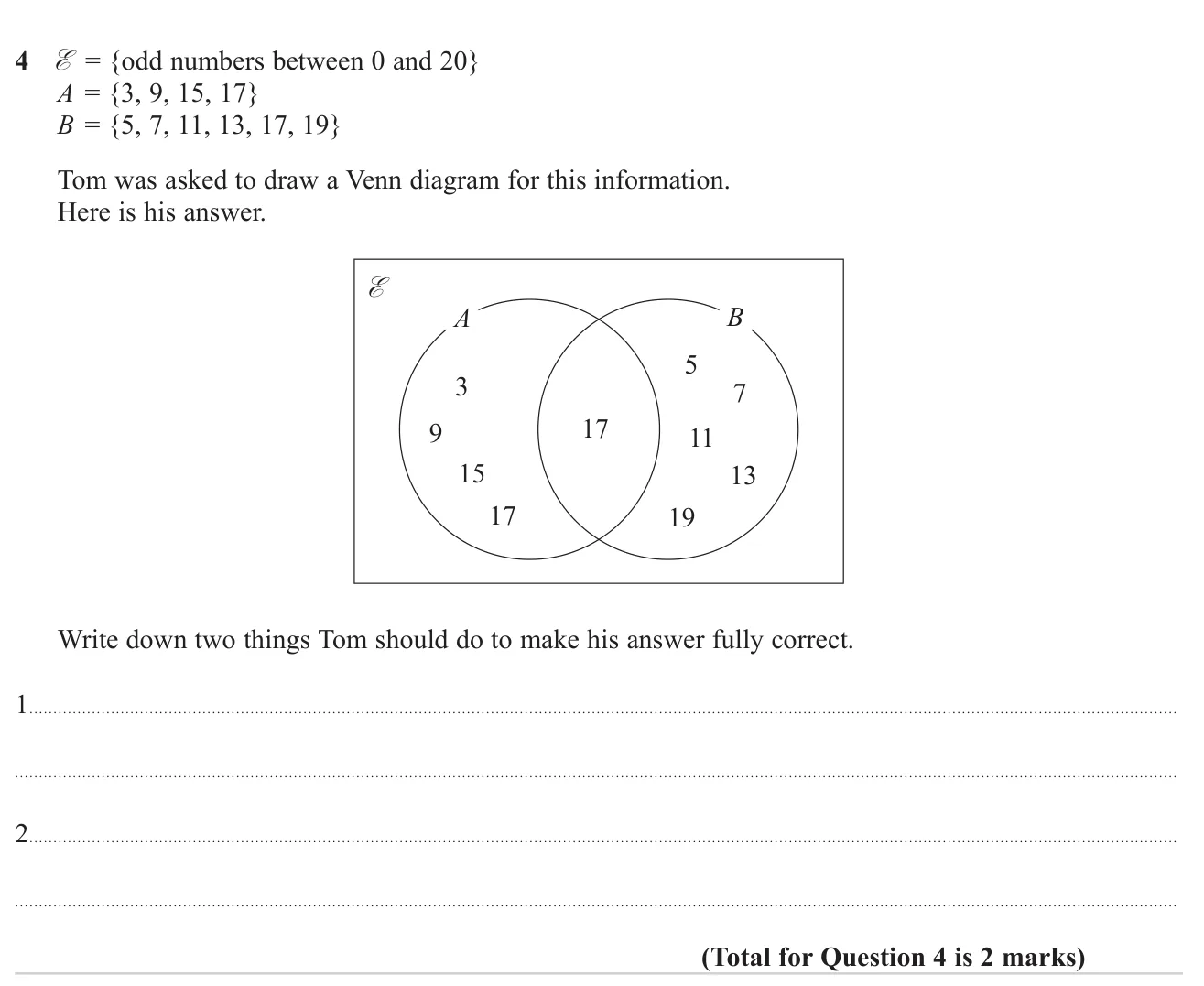
© Pearson Education Ltd. November 2024 Paper 2 (Higher, calculator), question 4.
Show answer
| Answer | Remove the 17 from 'A only' so it is only in the overlap; put 1 in the region outside both circles | 2 marks |
|---|
Worked solution Checked against the mark scheme
The universal set is 1, 3, 5, ..., 19.
17 is in both A and B, so it belongs only in the overlap; Tom also wrote it in A only.
1 is odd but in neither A nor B, so it must go inside the rectangle, outside both circles.
Watch out: Forgetting that 1 is an odd number between 0 and 20.
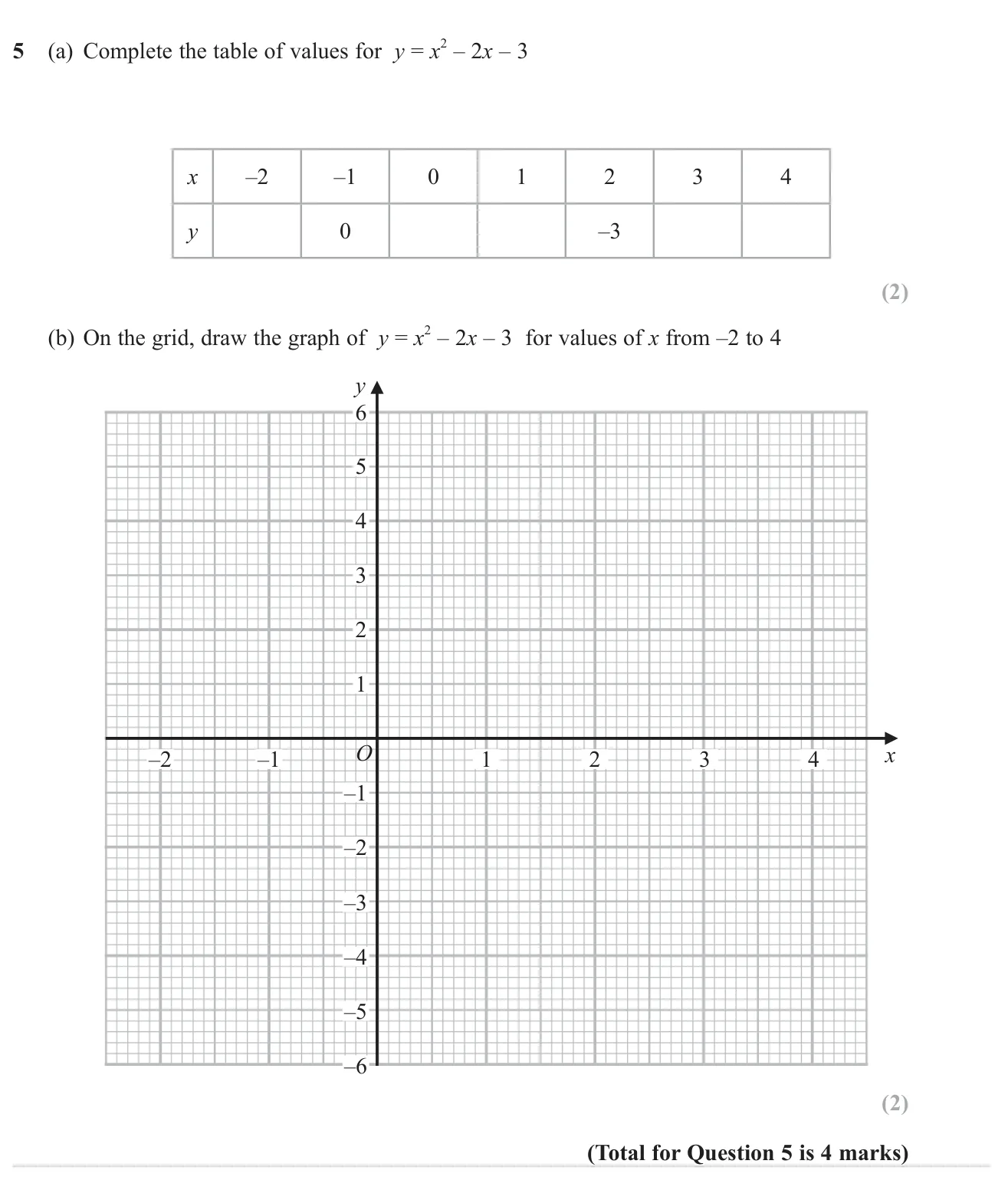
© Pearson Education Ltd. November 2024 Paper 2 (Higher, calculator), question 5.
Show answer
| (a) | 5,−3,−4,0,5 (for x=−2,0,1,3,4) | 2 marks |
|---|
| (b) | Smooth U-shaped curve through the points | 2 marks |
|---|
Worked solution Checked against the mark scheme
(a) x=−2: 4+4−3=5; x=0: −3; x=1: 1−2−3=−4; x=3: 9−6−3=0; x=4: 16−8−3=5.
(b) Plot (−2,5),(−1,0),(0,−3),(1,−4),(2,−3),(3,0),(4,5) and join them with a smooth curve.
Watch out: Working out (−2)2 as −4, or joining the points with straight lines.
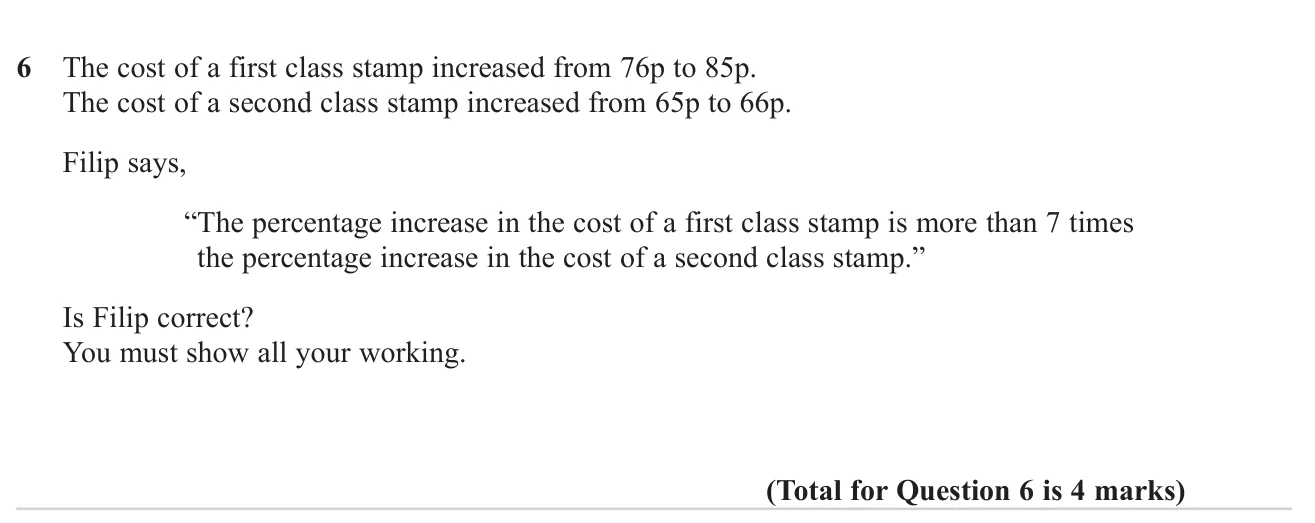
© Pearson Education Ltd. November 2024 Paper 2 (Higher, calculator), question 6.
Show answer
| Answer | Yes: 11.8% is more than 7×1.54%=10.8% | 4 marks |
|---|
Worked solution Checked against the mark scheme
First class: 7685−76×100=11.84%
Second class: 6566−65×100=1.54%
7×1.54=10.77%, and 11.84>10.77, so Filip is correct.
Watch out: Comparing the actual increases (9p and 1p) instead of percentages.
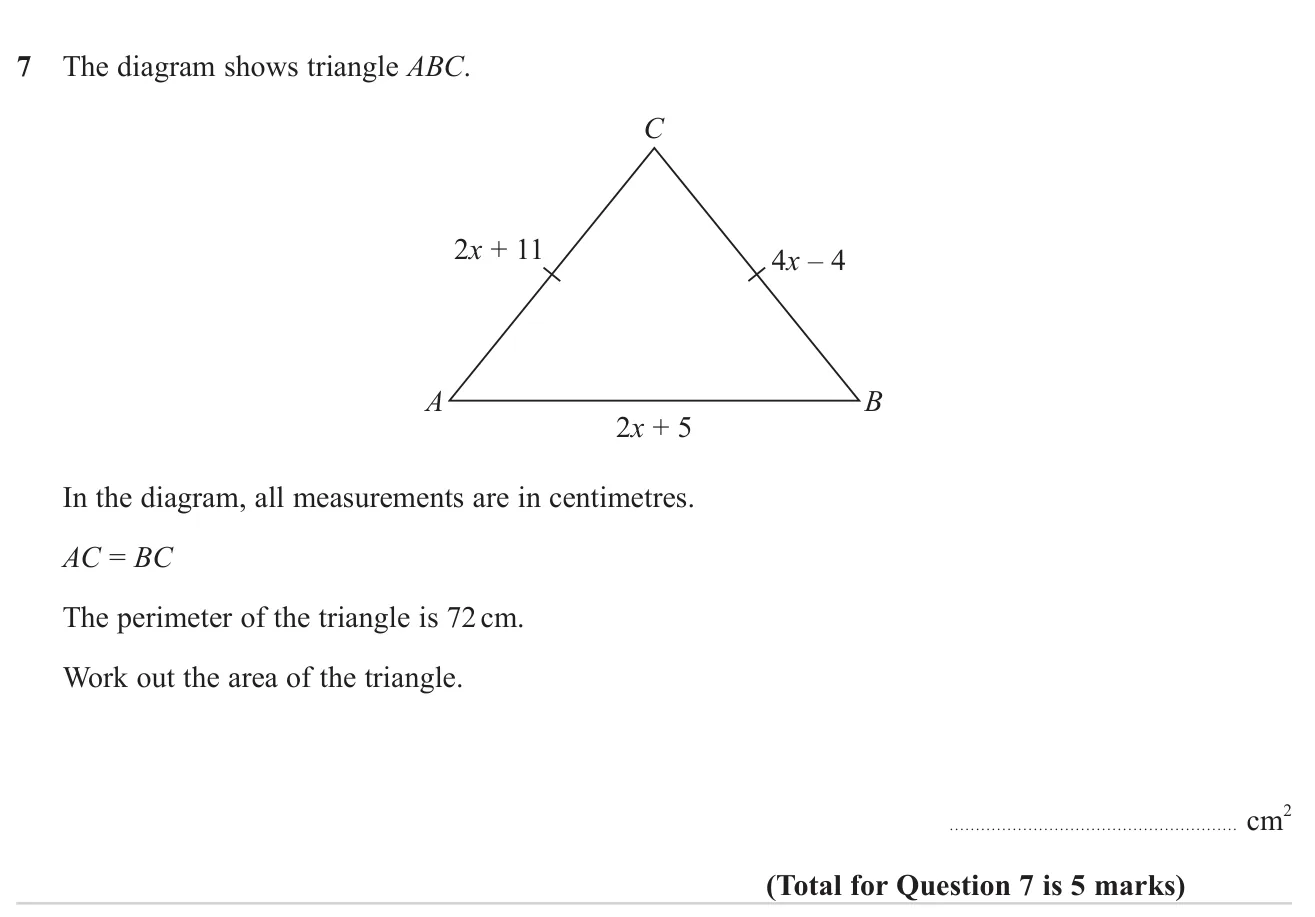
© Pearson Education Ltd. November 2024 Paper 2 (Higher, calculator), question 7.
Show answer
Worked solution Checked against the mark scheme
AC=BC: 2x+11=4x−4, so 2x=15 and x=7.5.
Sides: AC=BC=26, AB=20 (perimeter 72 ✓).
Height from C to the midpoint of AB: 262−102=576=24.
Area =21×20×24=240 cm2
Watch out: Using 26 as the height instead of finding the perpendicular height.
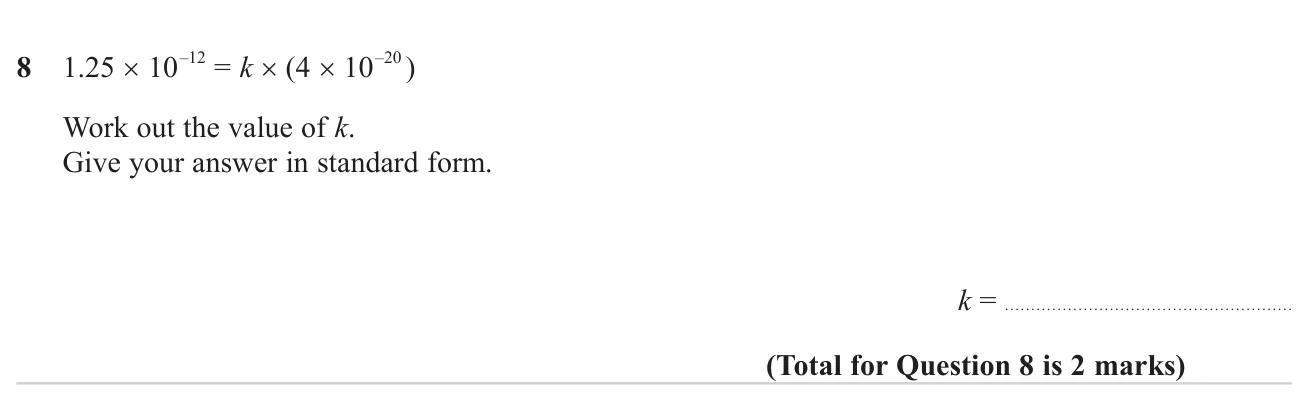
© Pearson Education Ltd. November 2024 Paper 2 (Higher, calculator), question 8.
Show answer
| Answer | 3.125×10⁷ | 2 marks |
|---|
Worked solution Checked against the mark scheme
k=4×10−201.25×10⁻¹²
1.25÷4=0.3125 and 10−12÷10−20=108
k=0.3125×108=3.125×10⁷
Watch out: Subtracting the powers the wrong way to get 10−32 or 10−8.
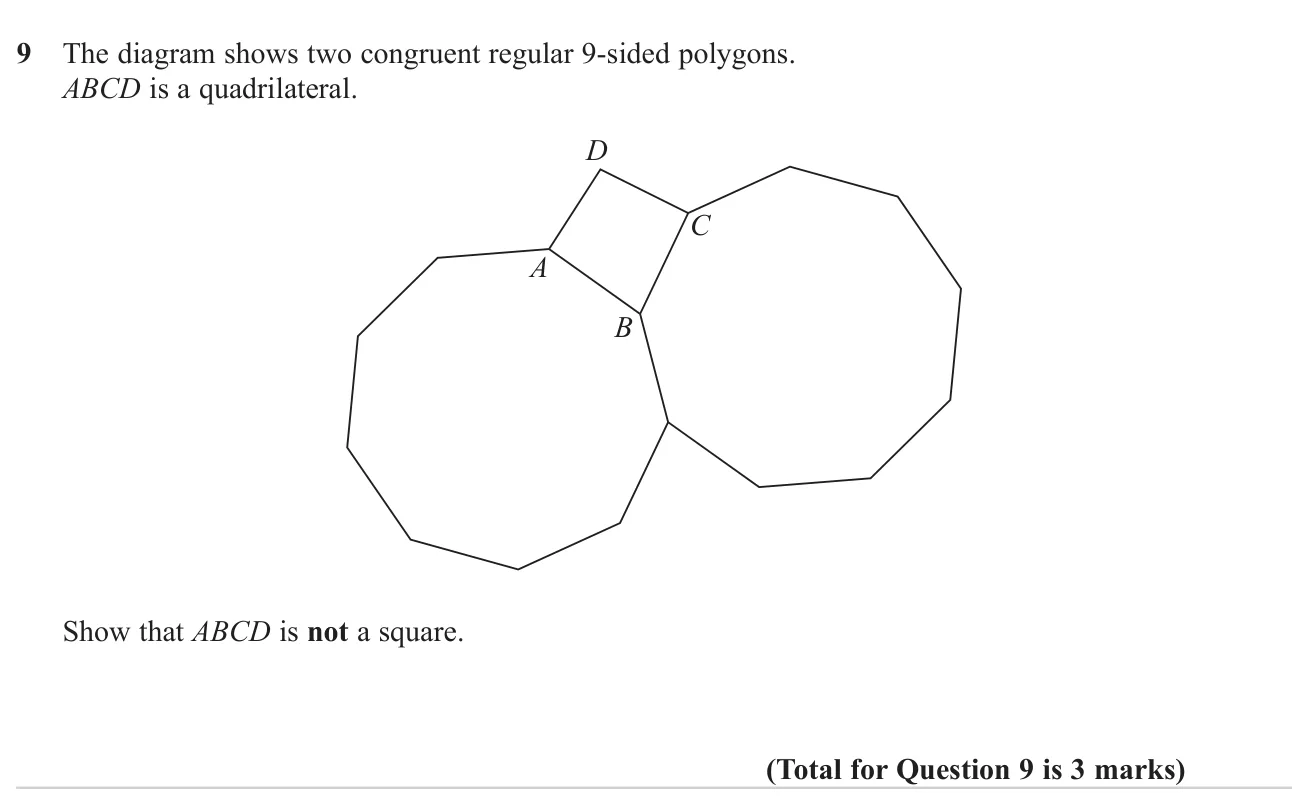
© Pearson Education Ltd. November 2024 Paper 2 (Higher, calculator), question 9.
Show answer
| Answer | Angle ABC=80°, not 90°, so ABCD is not a square | 3 marks |
|---|
Worked solution Checked against the mark scheme
Exterior angle =360÷9=40°, so interior angle =140°.
Angles at point B add to 360°: 360−140−140=80°.
A square has all angles 90°, but angle ABC=80°, so ABCD is not a square.
Watch out: Using the angle sum of the nonagon (1260°) as if it were one angle.
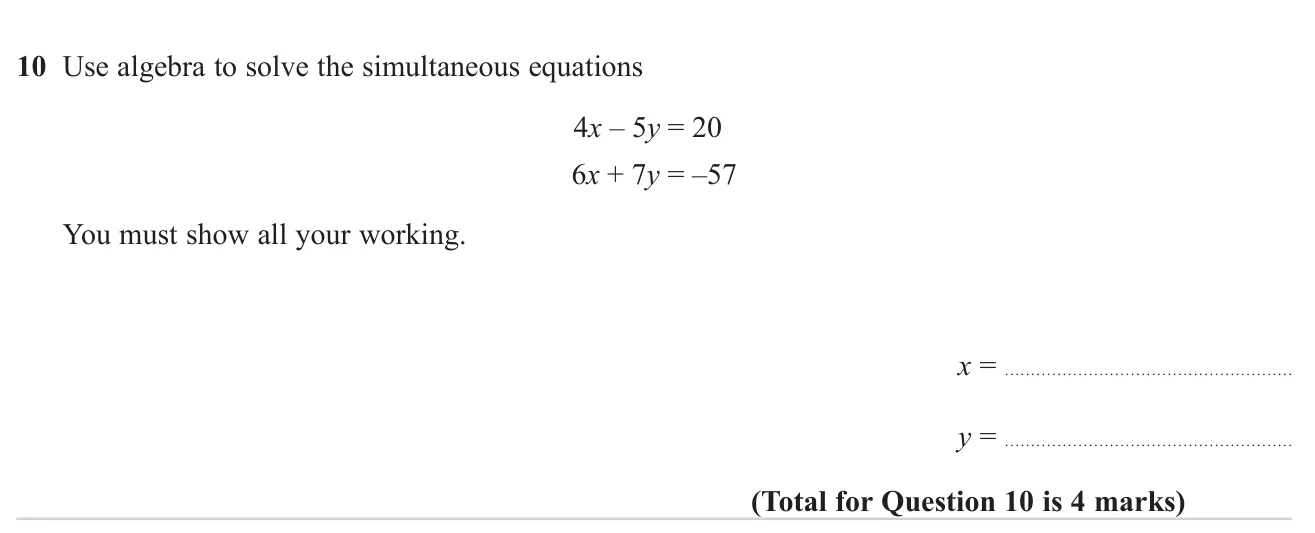
© Pearson Education Ltd. November 2024 Paper 2 (Higher, calculator), question 10.
Show answer
| Answer | x=−2.5, y=−6 | 4 marks |
|---|
Worked solution Checked against the mark scheme
Multiply the first by 7 and the second by 5:
28x−35y=140 and 30x+35y=−285
Add: 58x=−145, so x=−2.5
4(−2.5)−5y=20⇒−5y=30⇒y=−6
Watch out: Adding when the signs mean you should subtract, or a sign slip with the negatives.
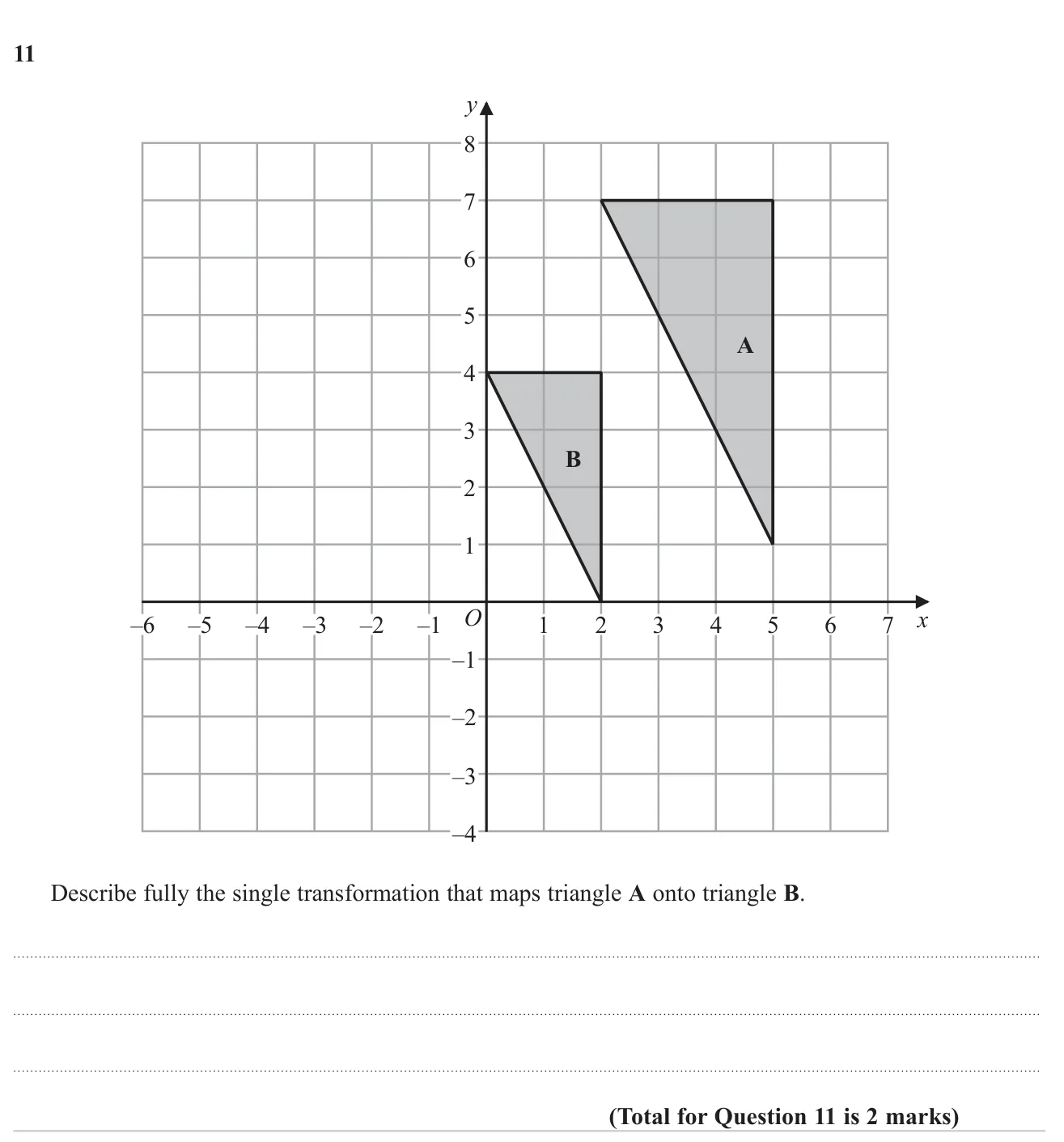
© Pearson Education Ltd. November 2024 Paper 2 (Higher, calculator), question 11.
Show answer
| Answer | Enlargement, scale factor 32, centre (−4,−2) | 2 marks |
|---|
Worked solution Checked against the mark scheme
B's sides are 32 of A's (height 6 → 4, width 3 → 2), so it is an enlargement with scale factor 32.
Join matching corners, e.g. (5,7) to (2,4) and (5,1) to (2,0), and extend the lines: they meet at (−4,−2).
Watch out: Giving scale factor 23 (mapping B to A) or omitting the centre.
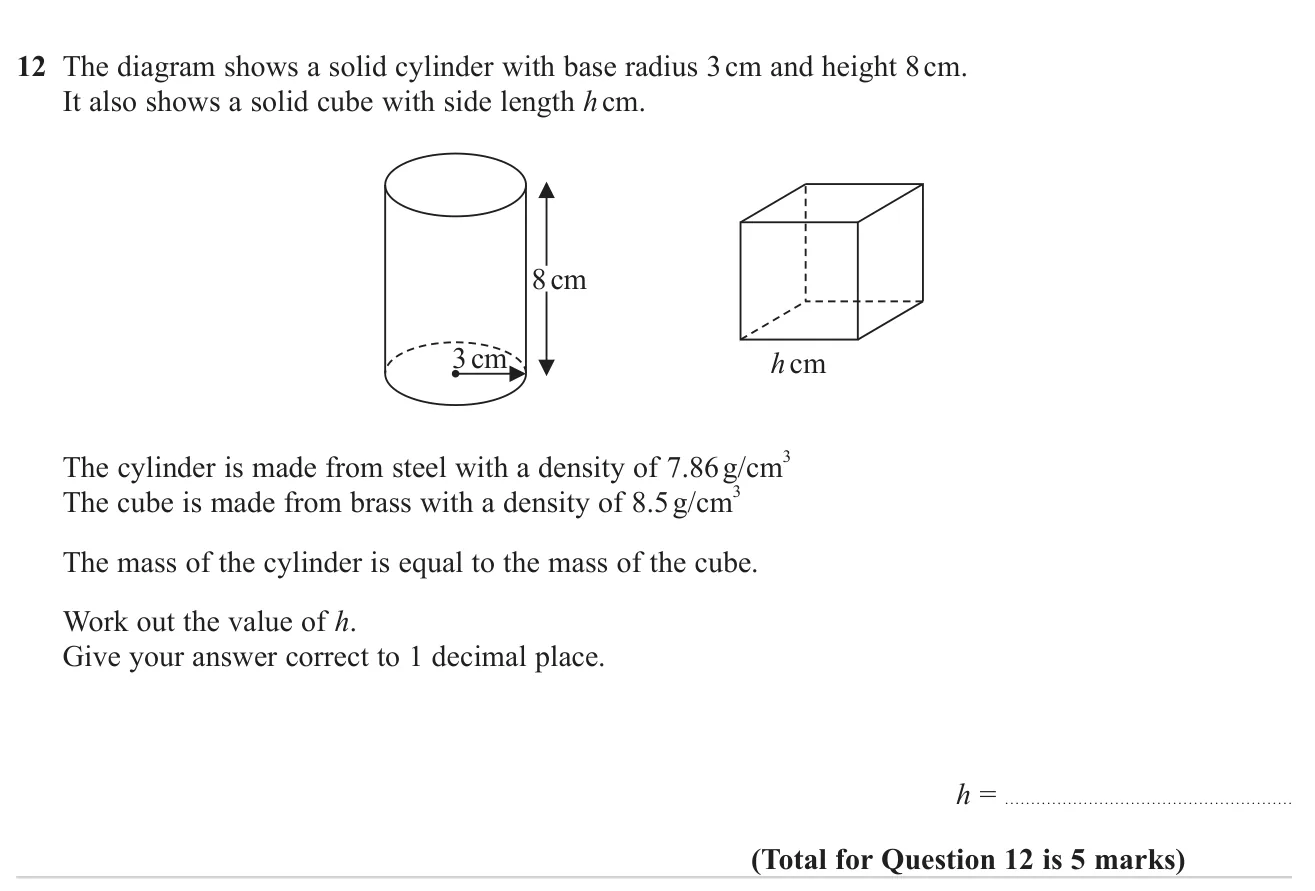
© Pearson Education Ltd. November 2024 Paper 2 (Higher, calculator), question 12.
Show answer
Worked solution Checked against the mark scheme
Cylinder volume =π×32×8=226.19… cm³
Mass =226.19…×7.86=1777.89… g
Cube volume =1777.89…÷8.5=209.16… cm³
h=3209.16…=5.936…≈5.9
Watch out: Multiplying by the density to get the cube's volume instead of dividing.
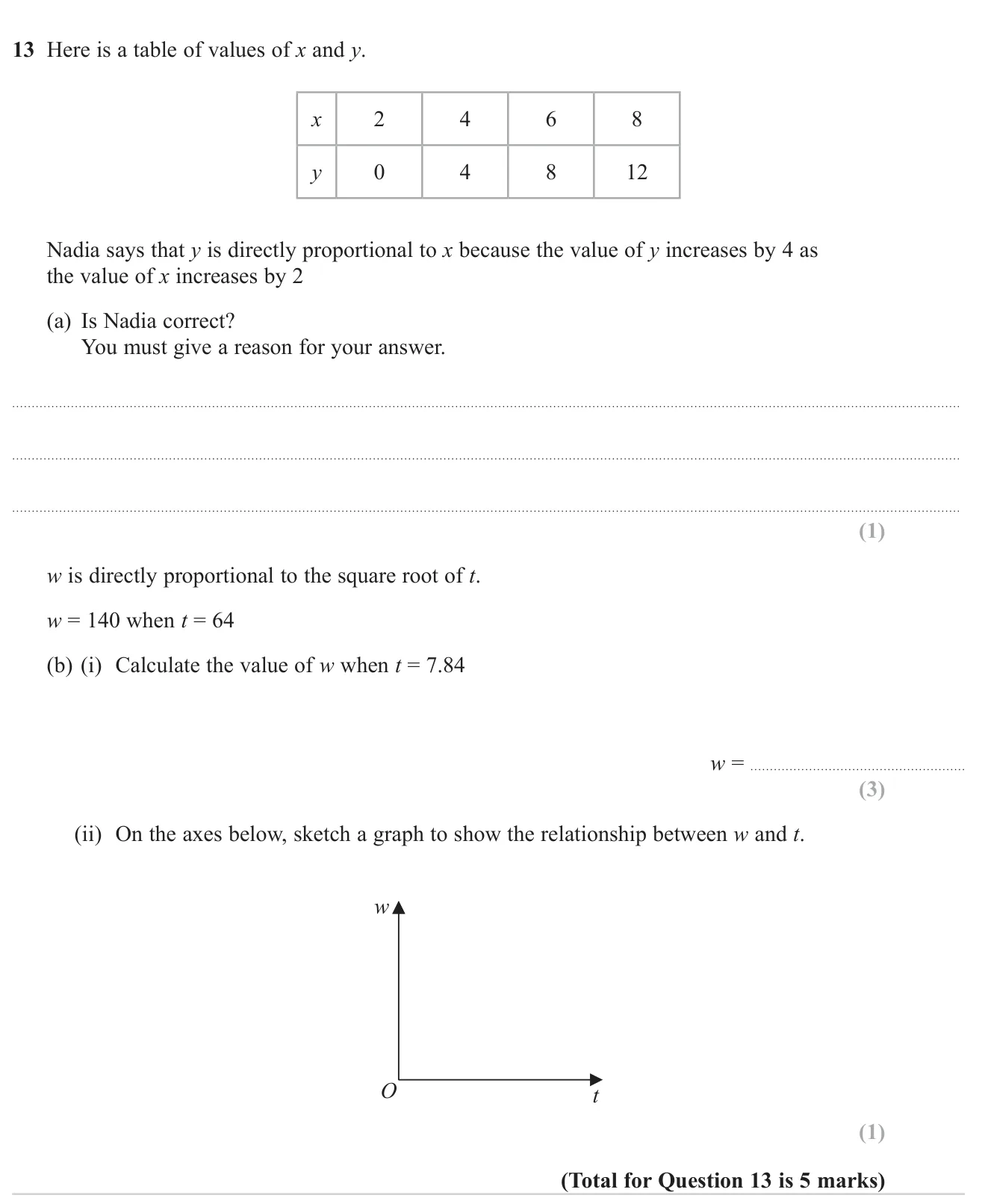
© Pearson Education Ltd. November 2024 Paper 2 (Higher, calculator), question 13.
Show answer
| (a) | No: y÷x is not constant (e.g. 4÷4=1 but 8÷6=1), and the graph would not pass through the origin | 1 mark |
|---|
| (b(i)) | 49 | 3 marks |
|---|
| (b(ii)) | Curve starting at the origin, increasing and getting less steep (shape of w=kt) | 1 mark |
|---|
Worked solution Checked against the mark scheme
(a) In direct proportion y÷x is constant. Here 0÷2=0 but 4÷4=1, so Nadia is wrong.
(b)(i) w=kt: 140=k×8, so k=17.5
w=17.5×7.84=17.5×2.8=49
(ii) Start at O and rise, curving so it gets less steep.
Watch out: Using t instead of t and getting k=140÷64.
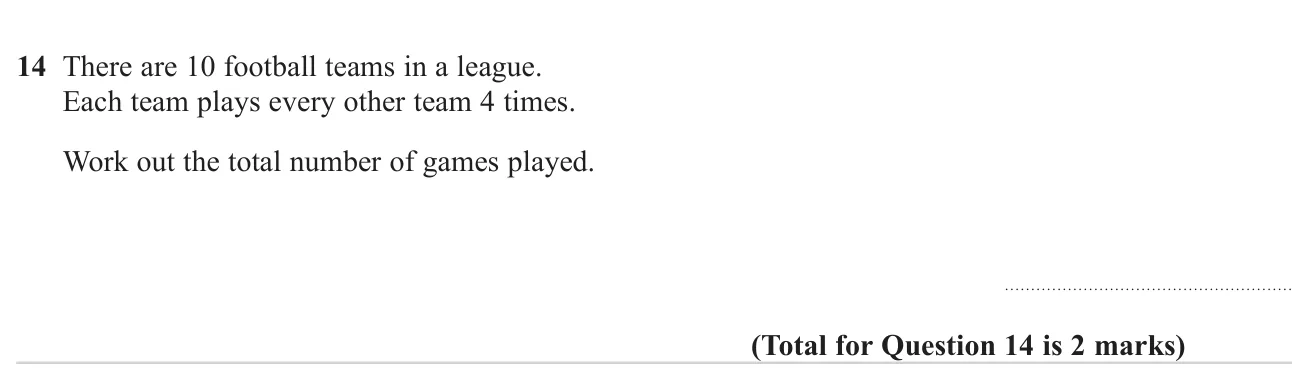
© Pearson Education Ltd. November 2024 Paper 2 (Higher, calculator), question 14.
Show answer
Worked solution Checked against the mark scheme
Number of pairs of teams: 210×9=45
Each pair plays 4 times: 45×4=180
Watch out: Forgetting to halve and giving 360.
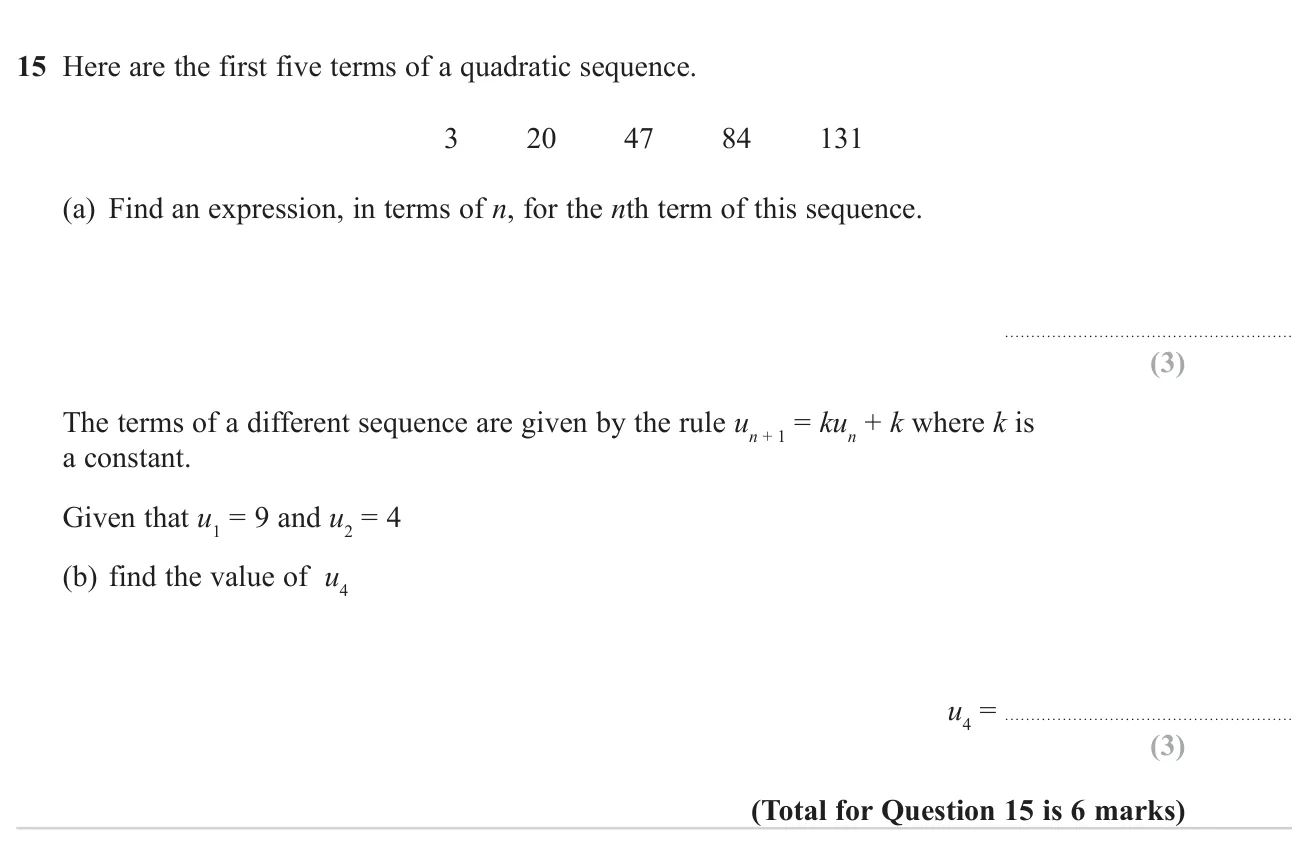
© Pearson Education Ltd. November 2024 Paper 2 (Higher, calculator), question 15.
Show answer
| (a) | 5n2+2n−4 | 3 marks |
|---|
| (b) | 1.2 | 3 marks |
|---|
Worked solution Checked against the mark scheme
(a) Differences: 17, 27, 37, 47; second difference 10, so 5n2.
Sequence − 5n2: −2,0,2,4,6, which is 2n−4.
nth term =5n2+2n−4
(b) u2=9k+k=10k=4, so k=0.4
u3=0.4×4+0.4=2, u4=0.4×2+0.4=1.2
Watch out: Using the second difference 10 as the coefficient of n2 instead of halving it.
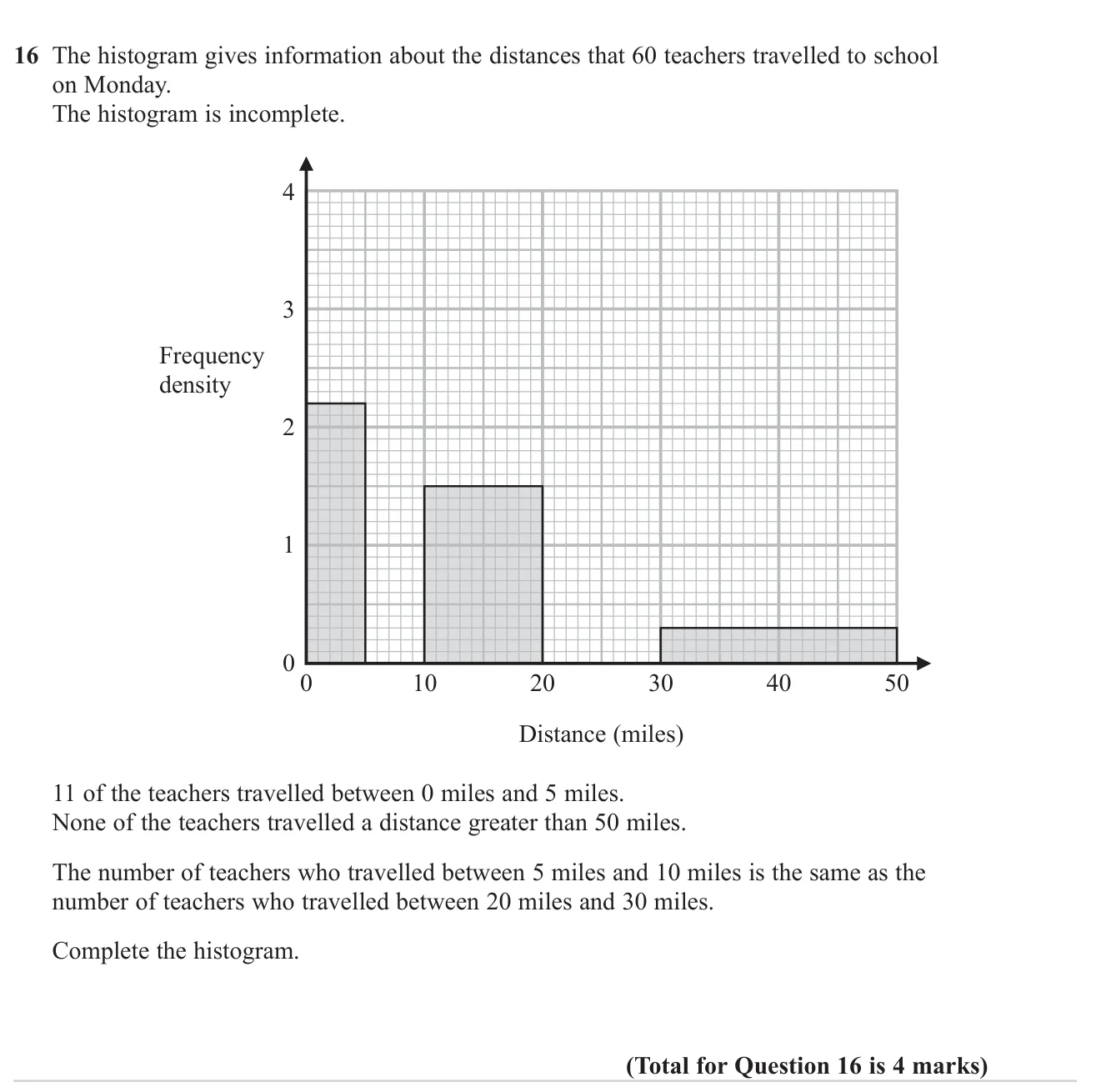
© Pearson Education Ltd. November 2024 Paper 2 (Higher, calculator), question 16.
Show answer
| Answer | Bar 5–10 at frequency density 2.8 and bar 20–30 at frequency density 1.4 | 4 marks |
|---|
Worked solution Checked against the mark scheme
Known frequencies: 0–5: 11; 10–20: 10×1.5=15; 30–50: 20×0.3=6
Left: 60−11−15−6=28, shared equally: 14 each.
5–10: 14÷5=2.8; 20–30: 14÷10=1.4
Watch out: Drawing bar heights as frequencies rather than frequency densities.
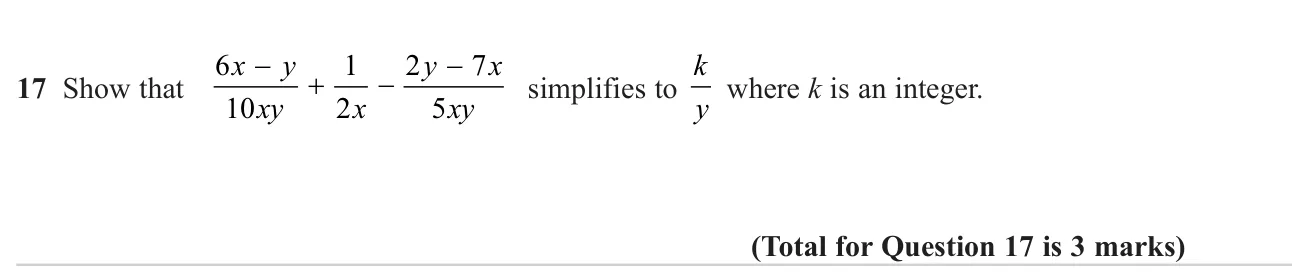
© Pearson Education Ltd. November 2024 Paper 2 (Higher, calculator), question 17.
Show answer
| Answer | y2 (so k=2) | 3 marks |
|---|
Worked solution Checked against the mark scheme
Common denominator 10xy:
10xy6x−y+10xy5y−10xy2(2y−7x)
=10xy6x−y+5y−4y+14x=10xy20x=y2
Watch out: Not multiplying the minus sign through the bracket, getting −14x instead of +14x.
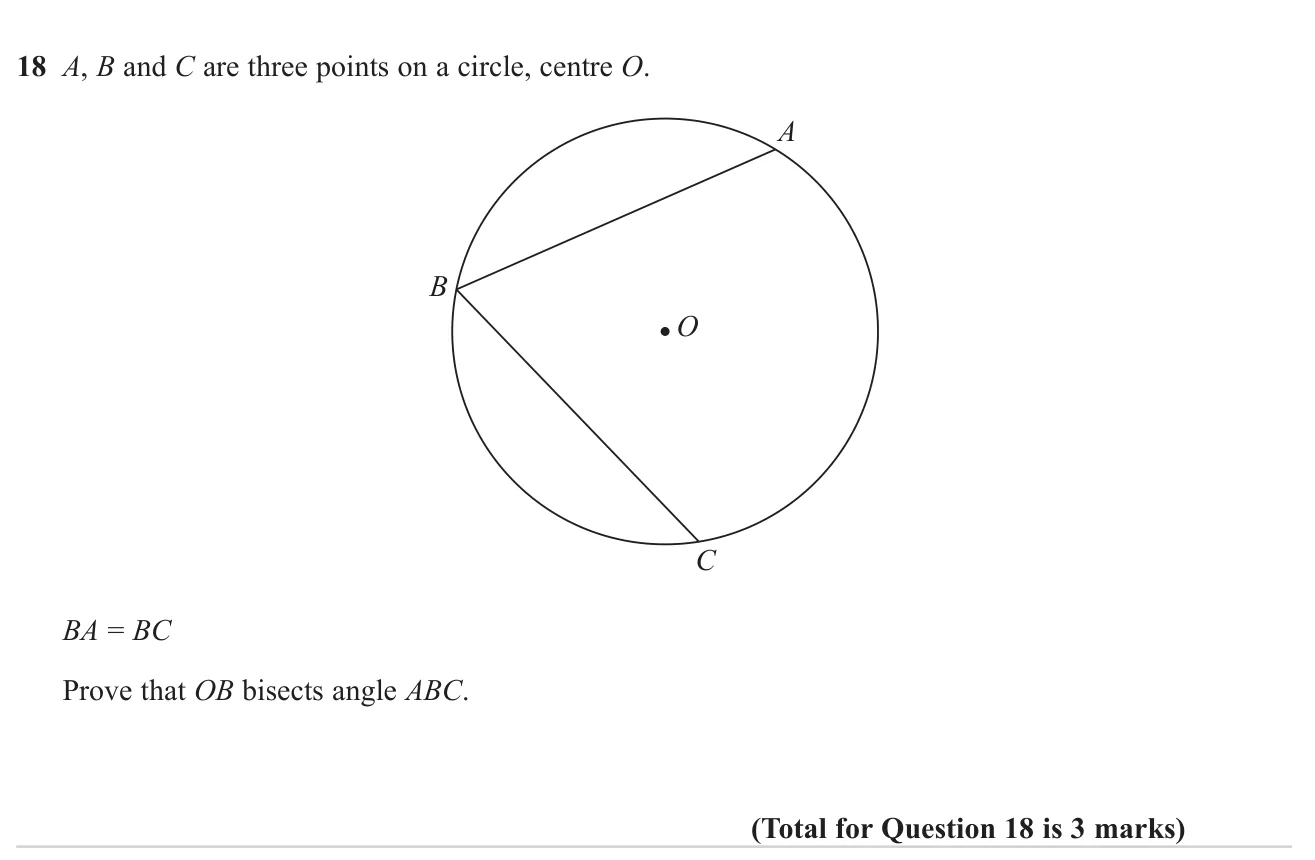
© Pearson Education Ltd. November 2024 Paper 2 (Higher, calculator), question 18.
Show answer
| Answer | Triangles ABO and CBO are congruent (SSS), so angle ABO = angle CBO | 3 marks |
|---|
Worked solution Checked against the mark scheme
BA=BC (given).
OA=OC (radii of the circle).
OB is common to both triangles.
So triangles ABO and CBO are congruent (SSS), and angle ABO = angle CBO: OB bisects angle ABC.
Watch out: Stating sides are equal without giving reasons, or assuming what must be proved.
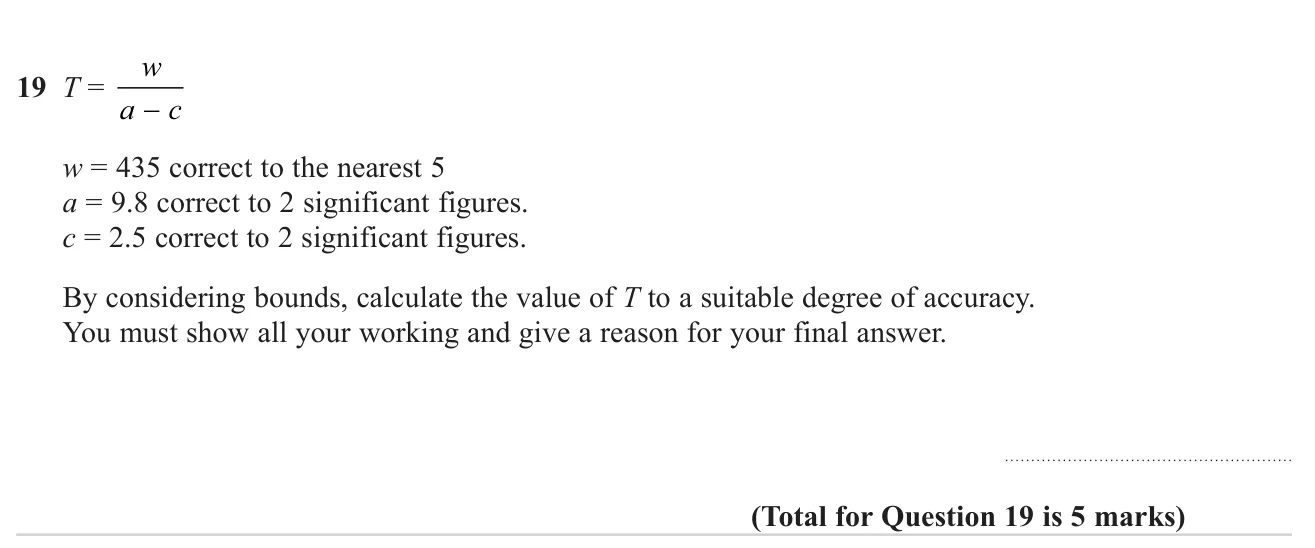
© Pearson Education Ltd. November 2024 Paper 2 (Higher, calculator), question 19.
Show answer
| Answer | 60, because both bounds (58.4… and 60.7…) round to 60 | 5 marks |
|---|
Worked solution Checked against the mark scheme
Bounds: w: 432.5 to 437.5; a: 9.75 to 9.85; c: 2.45 to 2.55
Lower bound of T=9.85−2.45432.5=58.44…
Upper bound of T=9.75−2.55437.5=60.76…
Both round to 60 (1 sf), so T=60.
Watch out: Using the upper bound of c in the lower bound of T, forgetting that subtracting reverses which bound is needed.
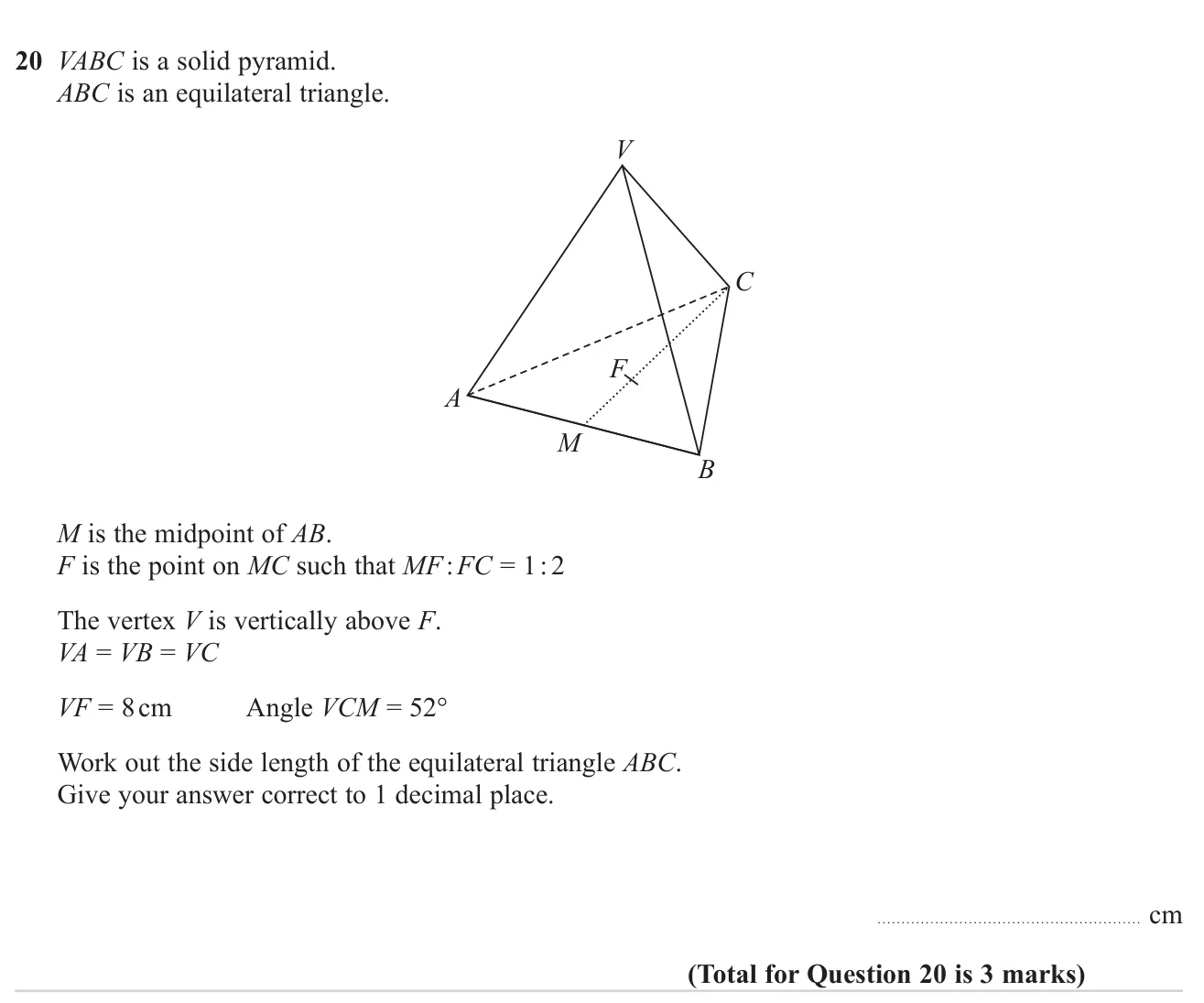
© Pearson Education Ltd. November 2024 Paper 2 (Higher, calculator), question 20.
Show answer
| Answer | 10.8 cm | 3 marks |
|---|
Worked solution Checked against the mark scheme
In triangle VFC: FC=tan52°8=6.250…
MF:FC=1:2, so MC=1.5×6.250…=9.375…
MC is the height of the equilateral triangle: side =sin60°9.375…=10.8 cm
Watch out: Taking FC as the full height MC of the triangle.
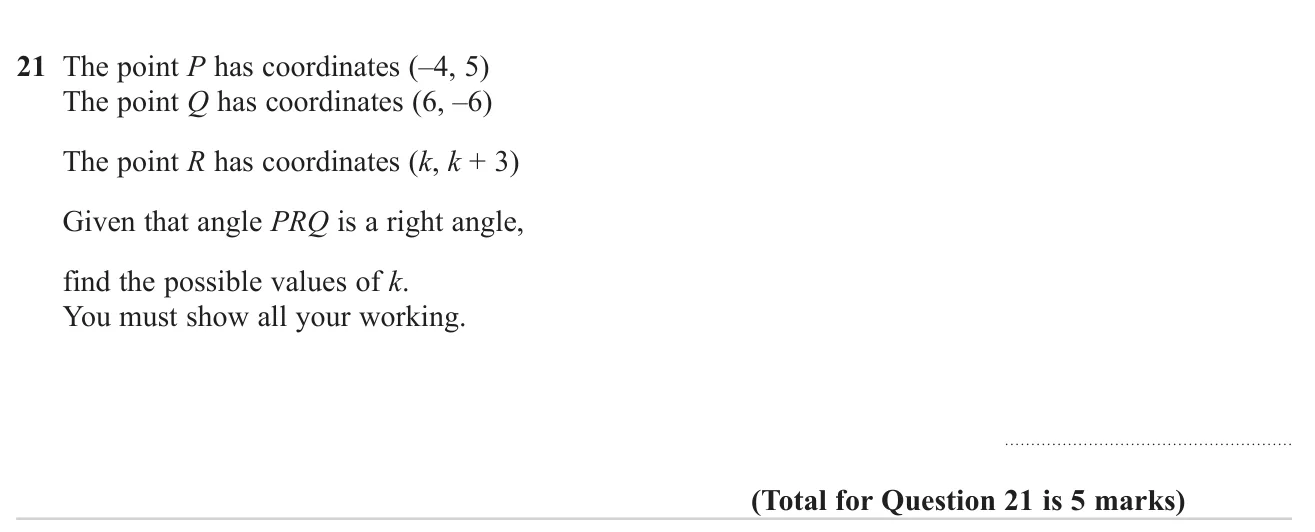
© Pearson Education Ltd. November 2024 Paper 2 (Higher, calculator), question 21.
Show answer
| Answer | k=−6 or k=3.5 | 5 marks |
|---|
Worked solution Checked against the mark scheme
Gradient PR=k+4k−2, gradient QR=k−6k+9
Perpendicular: k+4k−2×k−6k+9=−1
(k−2)(k+9)=−(k+4)(k−6)
k2+7k−18=−k2+2k+24⇒2k2+5k−42=0
(k+6)(2k−7)=0, so k=−6 or k=3.5
Watch out: Setting the gradients equal (parallel) instead of making their product −1.
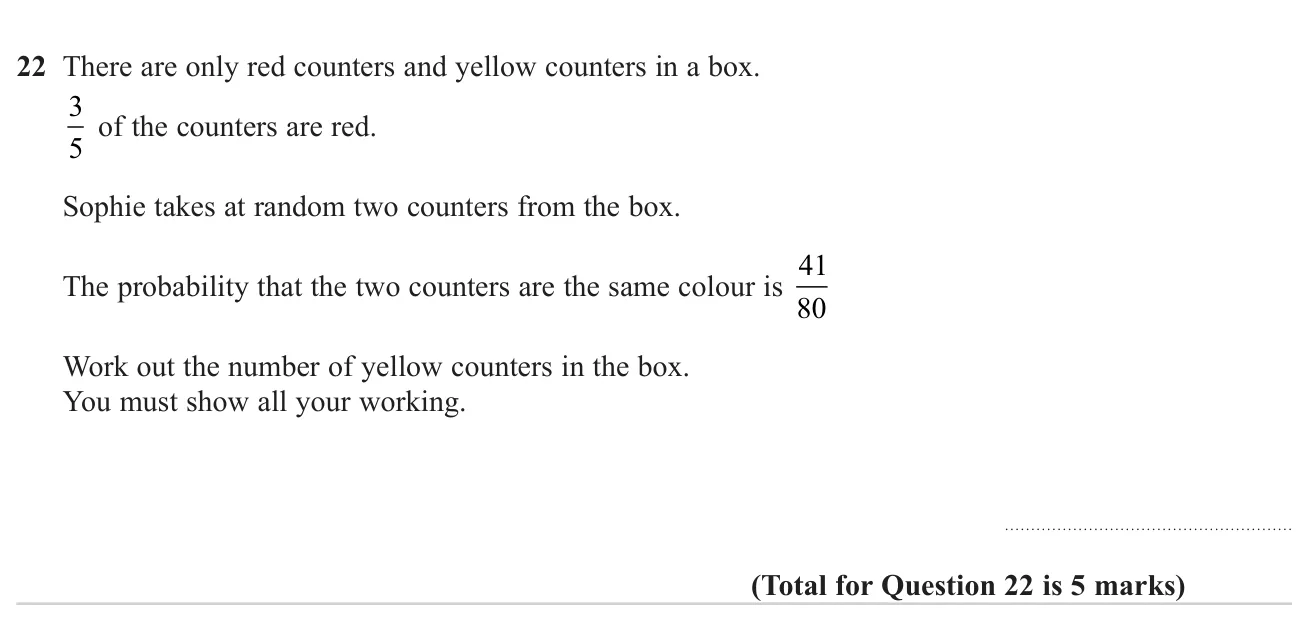
© Pearson Education Ltd. November 2024 Paper 2 (Higher, calculator), question 22.
Show answer
Worked solution Checked against the mark scheme
Let there be 5x counters: 3x red, 2x yellow.
5x3x×5x−13x−1+5x2x×5x−12x−1=8041
5(5x−1)13x−5=8041⇒1040x−400=1025x−205
15x=195, x=13, so yellow =2×13=26
Watch out: Treating the picks as with replacement, so the equation has no solution.
Finished the paper?
Add up your marks for all three papers and see what grade that would have been.