Edexcel GCSE Maths · 1MA1

November 2018 Paper 2 Higher

Calculator · 21 questions · 80 marks · 1 hour 30 minutes. Try each question on paper, then press "Show answer".

Question 1

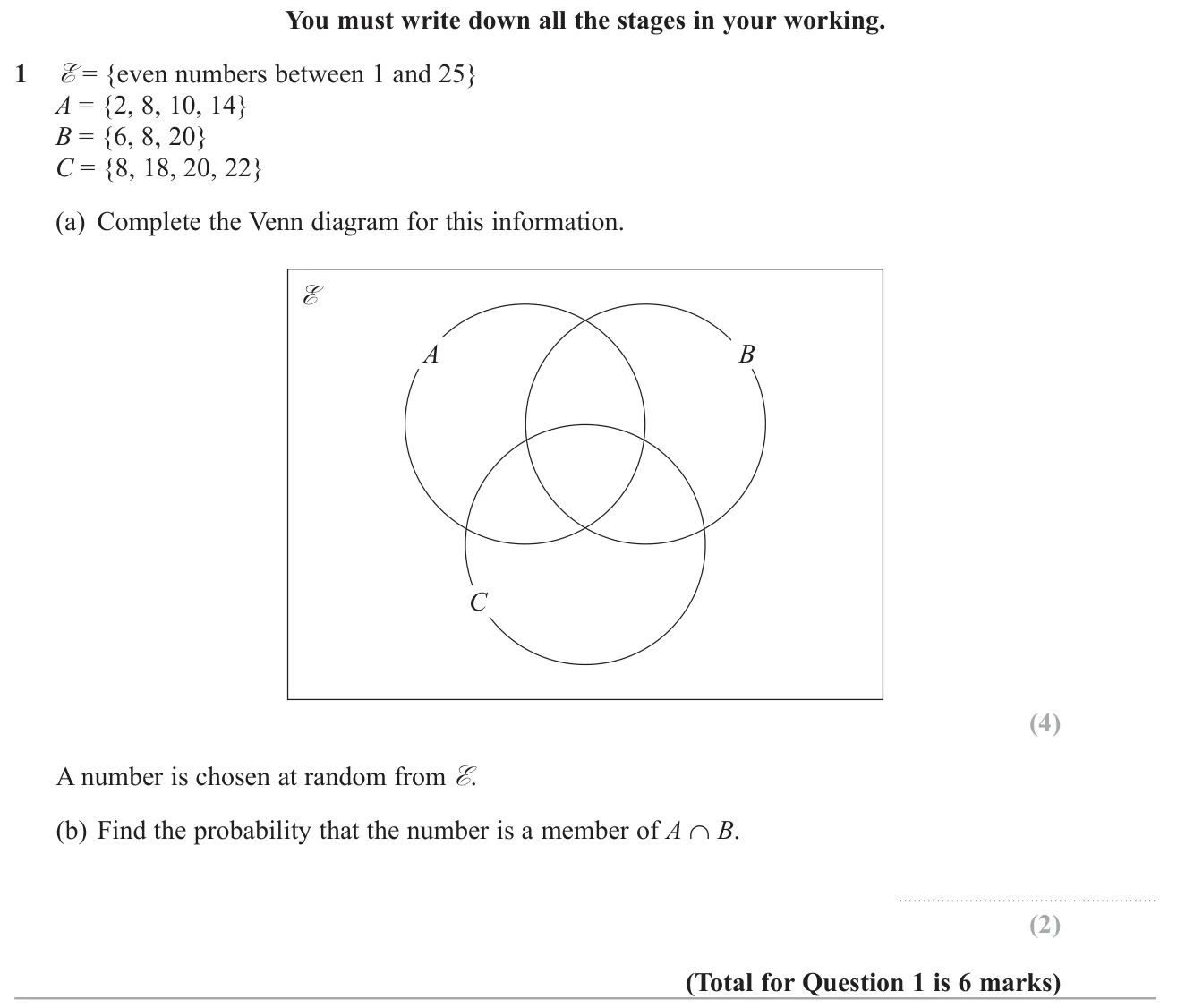
Venn diagrams and sets6 marksGrade 4CalculatorOn both tiers
Place set elements in a three-set Venn diagram, then find a probability for an intersection.

© Pearson Education Ltd. November 2018 Paper 2 (Higher, calculator), question 1.

Show answer
(a)A only: 2, 10, 14; A∩B∩C: 8; B only: 6; B∩C only: 20; C only: 18, 22; outside: 4, 12, 16, 244 marks
(b)112\frac{1}{12}2 marks

Worked solution Checked against the mark scheme

(a) E={2,4,6,...,24}\mathcal{E} = \{2, 4, 6, ..., 24\}, 12 numbers.

8 is in all three sets. 20 is in B and C only. 6 is B only; 2, 10, 14 are A only; 18, 22 are C only.

4, 12, 16, 24 go outside the circles.

(b) A∩B={8}A \cap B = \{8\}, so P =112= \frac{1}{12}

Watch out: Forgetting to place the numbers that are in no set.
Question 2

Scatter graphs and correlation2 marksGrade 3CalculatorOn both tiers
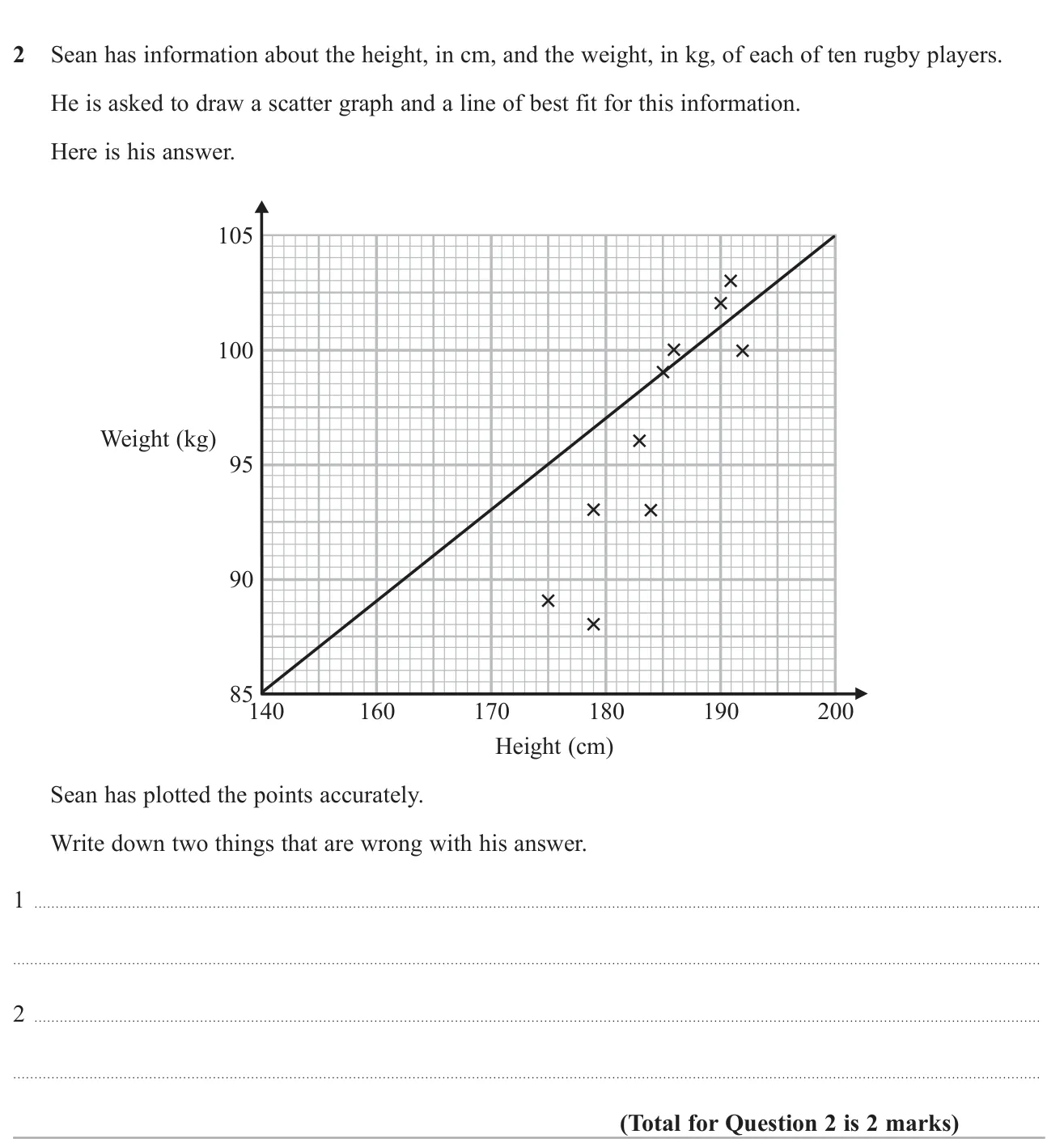
Identify two faults in a student's scatter graph and line of best fit.

© Pearson Education Ltd. November 2018 Paper 2 (Higher, calculator), question 2.

Show answer
AnswerThe line of best fit is wrong (it does not follow the points); the height scale is not evenly spaced (150 is missing)2 marks

Worked solution Checked against the mark scheme

Check the line: it should pass through the middle of the crosses with roughly equal numbers either side, which Sean's does not.

Check the axes: the height axis jumps from 140 to 160 in the same space as 160 to 170, so the scale is uneven.

Watch out: Saying there is no title or the axis should start at 0.

Question 3

Angle facts and parallel lines4 marksGrade 5CalculatorOn both tiers
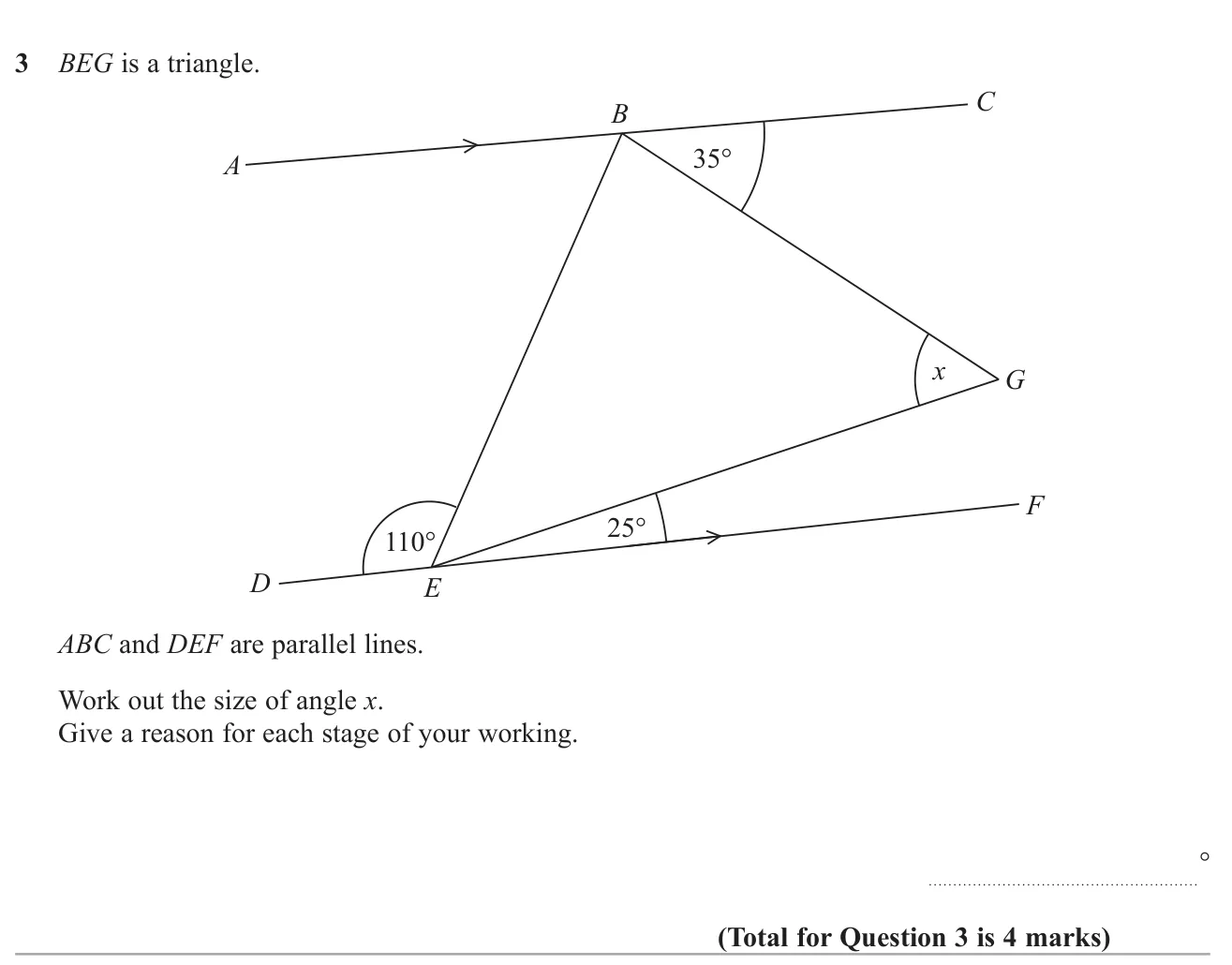
Find an angle in a triangle between parallel lines, giving reasons.

© Pearson Education Ltd. November 2018 Paper 2 (Higher, calculator), question 3.

Show answer
Answer60°60°4 marks

Worked solution Checked against the mark scheme

Angle ABE=180−110=70°ABE = 180 - 110 = 70° (co-interior angles add up to 180°)

Angle EBG=180−70−35=75°EBG = 180 - 70 - 35 = 75° (angles on a straight line add up to 180°)

Angle BEG=180−110−25=45°BEG = 180 - 110 - 25 = 45° (angles on a straight line)

x=180−75−45=60°x = 180 - 75 - 45 = 60° (angles in a triangle add up to 180°)

Watch out: Giving no reasons, or naming corresponding angles when they are alternate.

Question 4

Compound interest, growth and decay5 marksGrade 5CalculatorOn both tiers
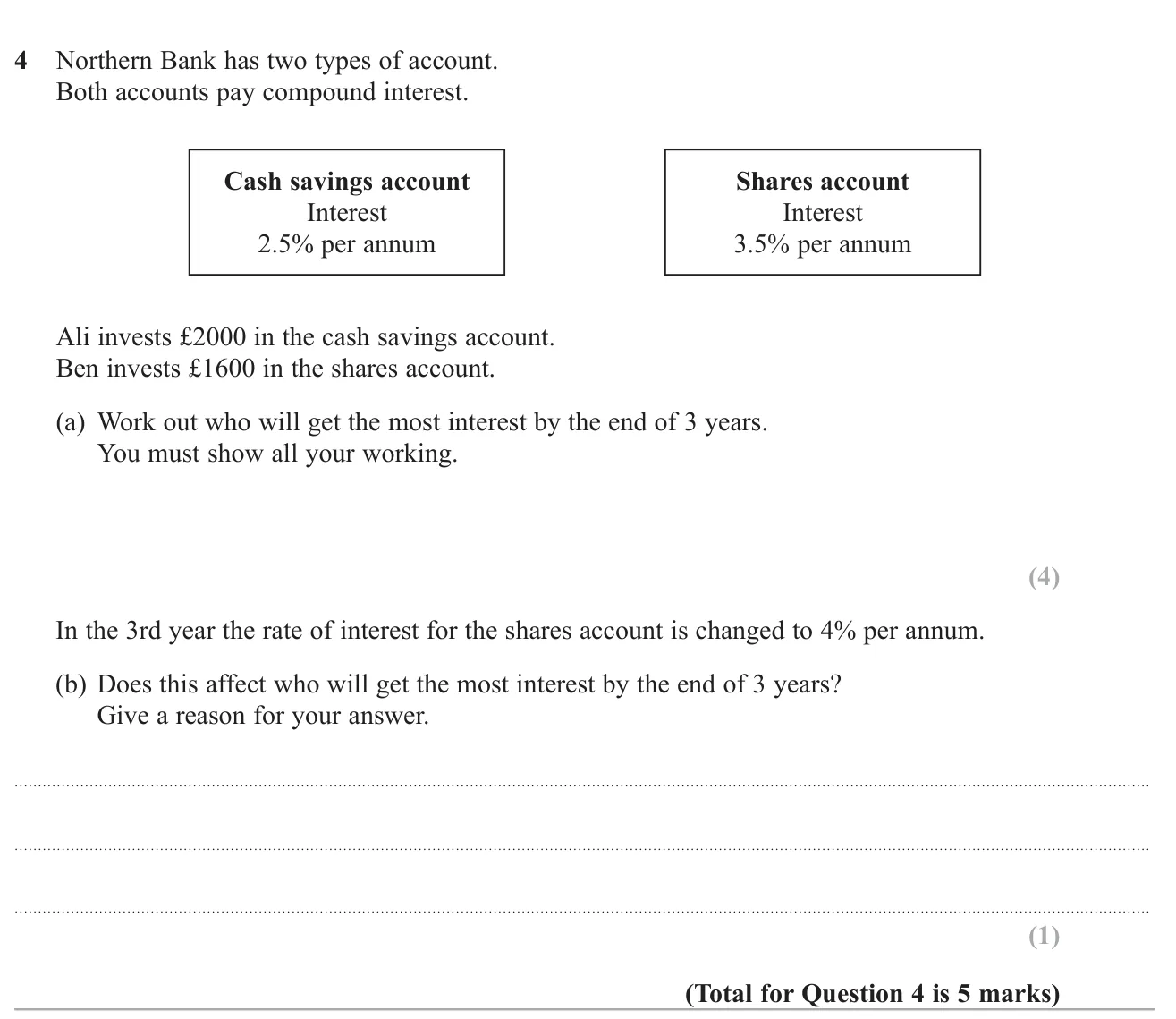
Compare compound interest on two accounts over 3 years, then decide if a rate change in year 3 alters the result.

© Pearson Education Ltd. November 2018 Paper 2 (Higher, calculator), question 4.

Show answer
(a)Ben: £173.95 interest against Ali's £153.784 marks
(b)No: Ben now gets about £182.52, still more than Ali1 mark

Worked solution Checked against the mark scheme

(a) Ali: 2000×1.0253=£2153.782000 \times 1.025^3 = £2153.78, interest £153.78£153.78

Ben: 1600×1.0353=£1773.951600 \times 1.035^3 = £1773.95, interest £173.95£173.95

Ben gets more.

(b) Ben: 1600×1.0352×1.04=£1782.521600 \times 1.035^2 \times 1.04 = £1782.52, interest £182.52£182.52. Still Ben, so no change.

Watch out: Using simple interest, or comparing final totals instead of interest.

Question 5

Area and perimeter5 marksGrade 5CalculatorOn both tiers
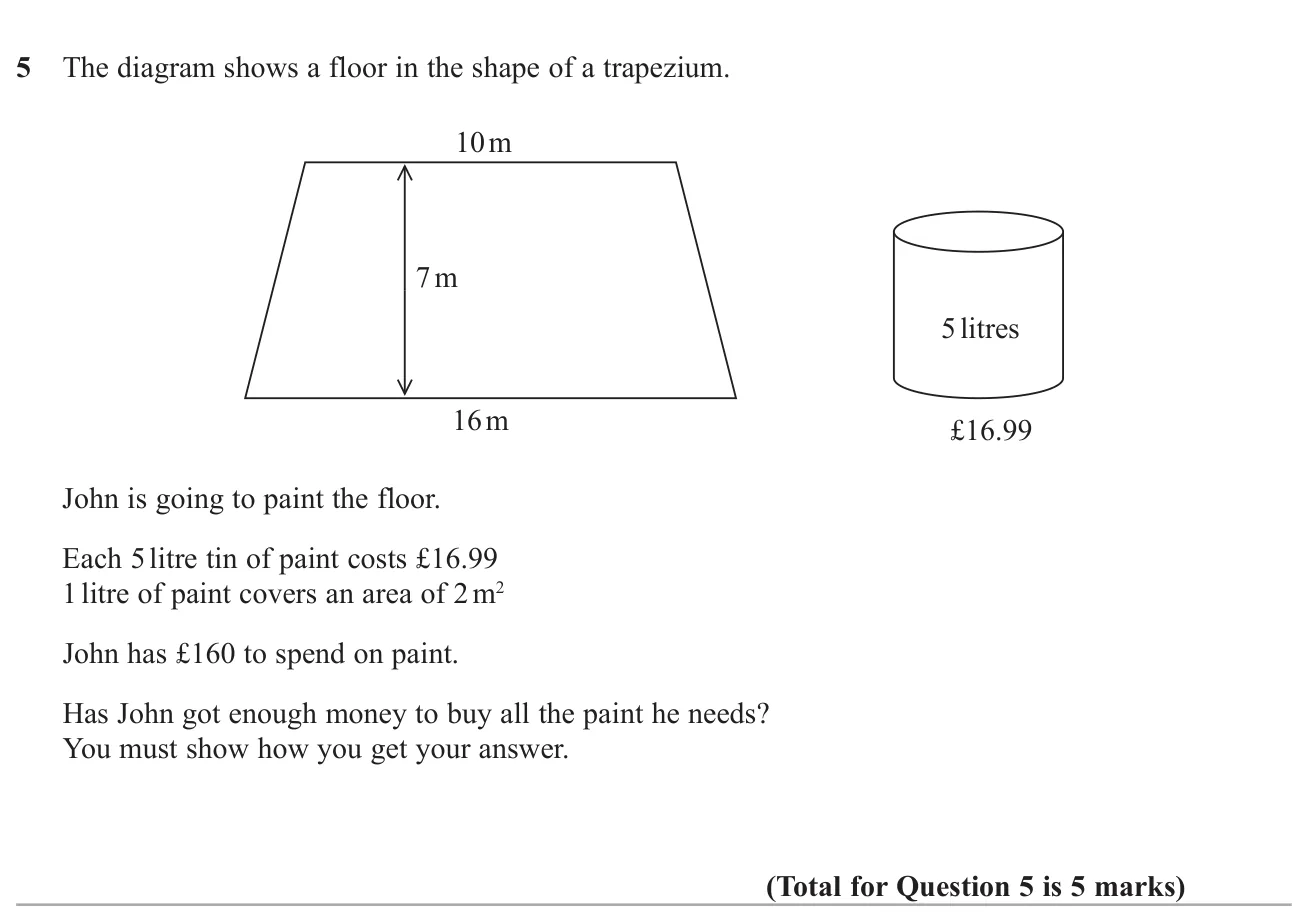
Find a trapezium floor's area, the paint needed and its cost, and decide if a budget is enough.

© Pearson Education Ltd. November 2018 Paper 2 (Higher, calculator), question 5.

Show answer
AnswerNo: he needs 10 tins costing £169.905 marks

Worked solution Checked against the mark scheme

Area =12(10+16)×7=91= \frac{1}{2}(10 + 16) \times 7 = 91 m²

Paint =91÷2=45.5= 91 \div 2 = 45.5 litres

Tins =45.5÷5=9.1= 45.5 \div 5 = 9.1, so 10 tins

Cost =10×16.99=£169.90>£160= 10 \times 16.99 = £169.90 > £160, so No.

Watch out: Rounding 9.1 down to 9 tins.

Question 6

Coordinates and straight-line graphs3 marksGrade 5CalculatorOn both tiers
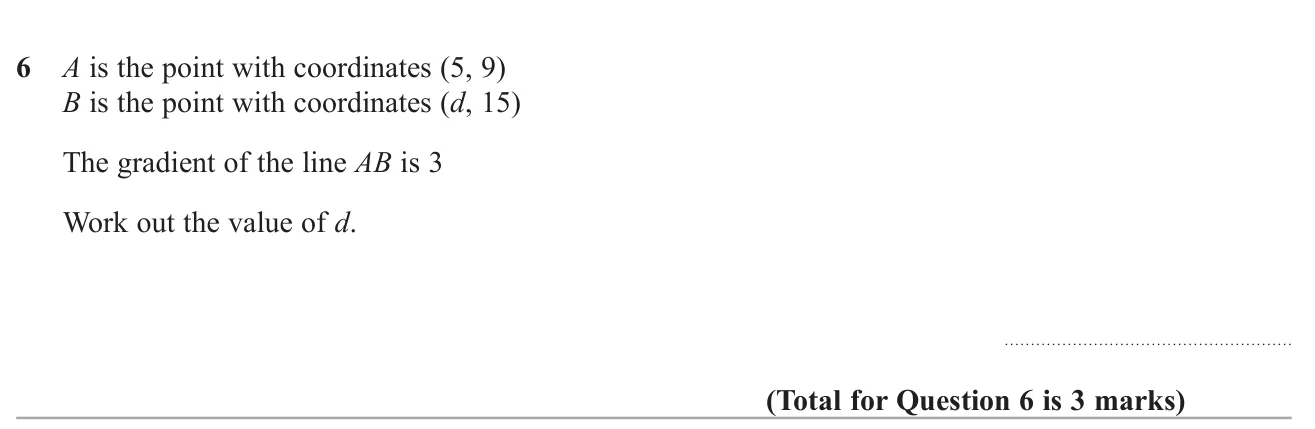
Find an unknown x-coordinate from two points and the gradient of the line joining them.

© Pearson Education Ltd. November 2018 Paper 2 (Higher, calculator), question 6.

Show answer
Answer73 marks

Worked solution Checked against the mark scheme

Gradient =change in ychange in x= \frac{\text{change in } y}{\text{change in } x}

Change in y=15−9=6y = 15 - 9 = 6, so change in x=6÷3=2x = 6 \div 3 = 2

d=5+2=7d = 5 + 2 = 7

Watch out: Using change in x over change in y, giving 23.

Question 7

Standard form3 marksGrade 5Calculator
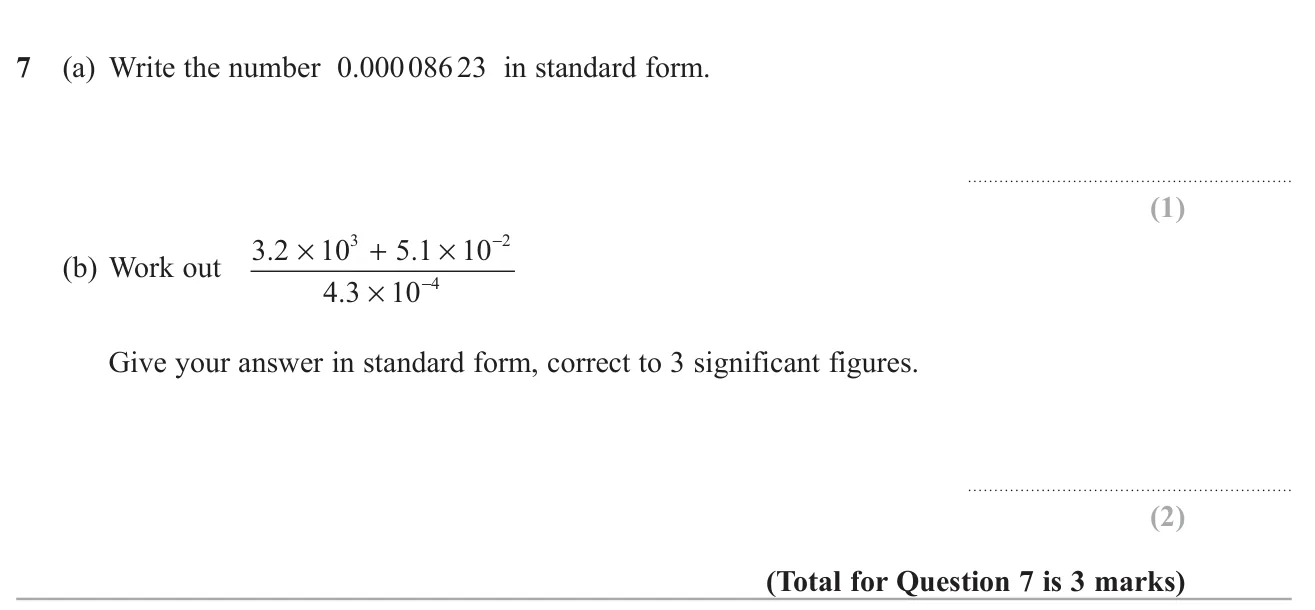
Write a small decimal in standard form, then evaluate a calculation with numbers in standard form to 3 significant figures.

© Pearson Education Ltd. November 2018 Paper 2 (Higher, calculator), question 7.

Show answer
(a)8.623×10−58.623 \times 10^{-5}1 mark
(b)7.44×1067.44 \times 10^{6}2 marks

Worked solution Checked against the mark scheme

(a) Move the decimal point 5 places: 8.623×10−58.623 \times 10^{-5}.

(b) 3200+0.0510.00043=3200.0510.00043=7 441 979.07...\frac{3200 + 0.051}{0.00043} = \frac{3200.051}{0.00043} = 7\,441\,979.07...

To 3 s.f. in standard form: 7.44×1067.44 \times 10^6.

Watch out: Only dividing the second term of the numerator by the denominator (no brackets on the calculator).

Question 8

Transformations3 marksGrade 6Calculator
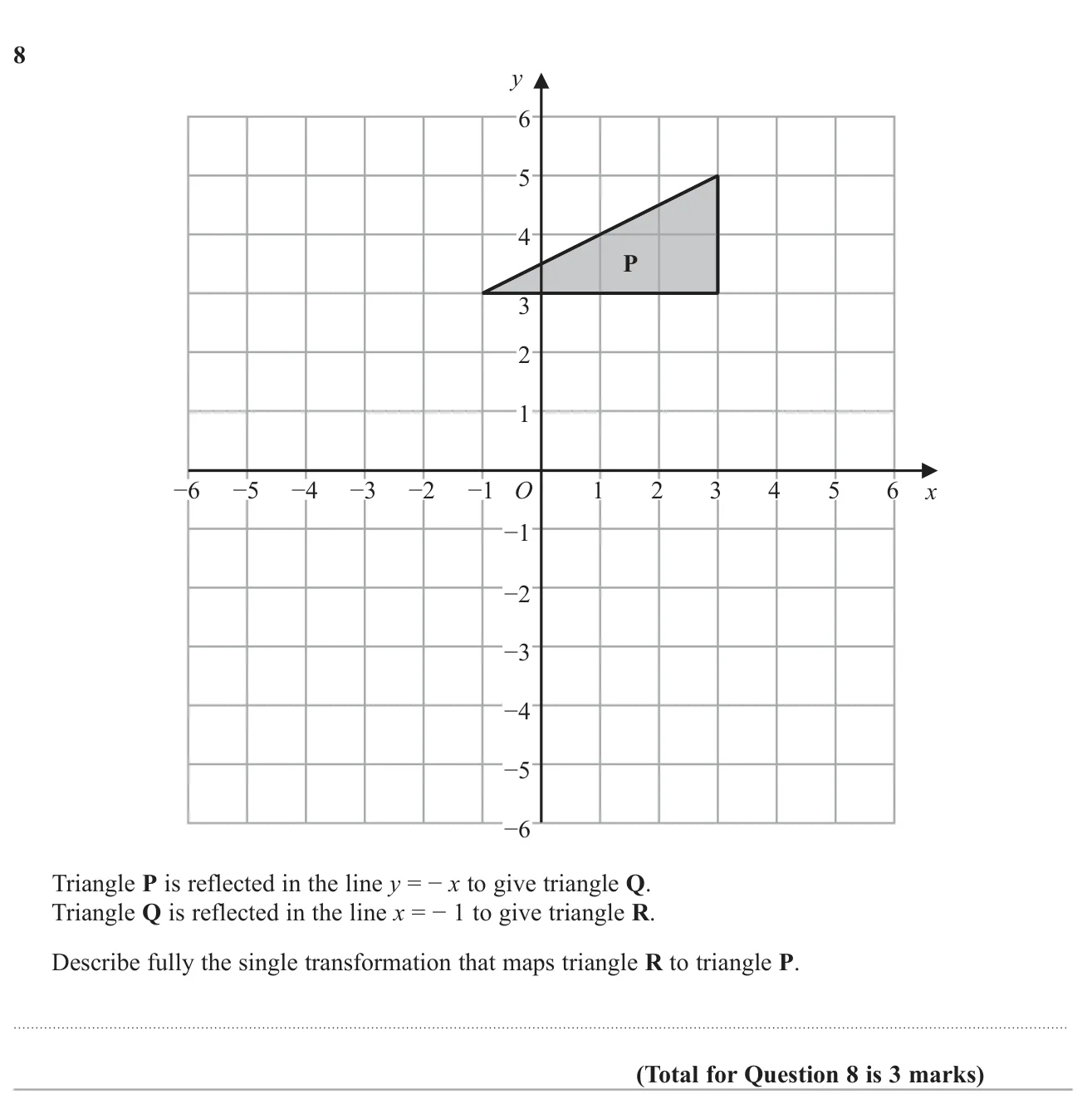
Carry out two reflections on a triangle and describe the single transformation from the final image back to the original.

© Pearson Education Ltd. November 2018 Paper 2 (Higher, calculator), question 8.

Show answer
AnswerRotation 90°90° anticlockwise about (−1,1)(-1, 1)3 marks

Worked solution Checked against the mark scheme

P has vertices (−1,3),(3,3),(3,5)(-1, 3), (3, 3), (3, 5).

Reflect in y=−xy = -x: Q is (−3,1),(−3,−3),(−5,−3)(-3, 1), (-3, -3), (-5, -3).

Reflect in x=−1x = -1: R is (1,1),(1,−3),(3,−3)(1, 1), (1, -3), (3, -3).

Turning R through 90°90° anticlockwise about (−1,1)(-1, 1) lands it exactly on P.

Watch out: Giving two transformations or leaving out the centre of rotation.

Question 9

Error intervals and bounds2 marksGrade 6Calculator
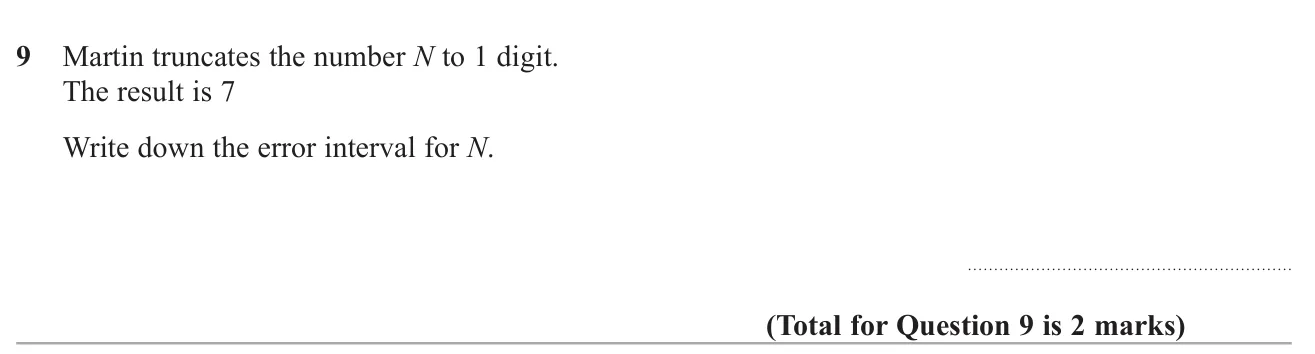
Write the error interval for a number that gives 7 when truncated to one digit.

© Pearson Education Ltd. November 2018 Paper 2 (Higher, calculator), question 9.

Show answer
Answer7≤N<87 \le N < 82 marks

Worked solution Checked against the mark scheme

Truncating chops off the digits after the first one, so N can be 7 itself or anything up to (but not including) 8.

7≤N<87 \le N < 8

Watch out: Treating it as rounding and writing 6.5≤N<7.56.5 \le N < 7.5.

Question 10

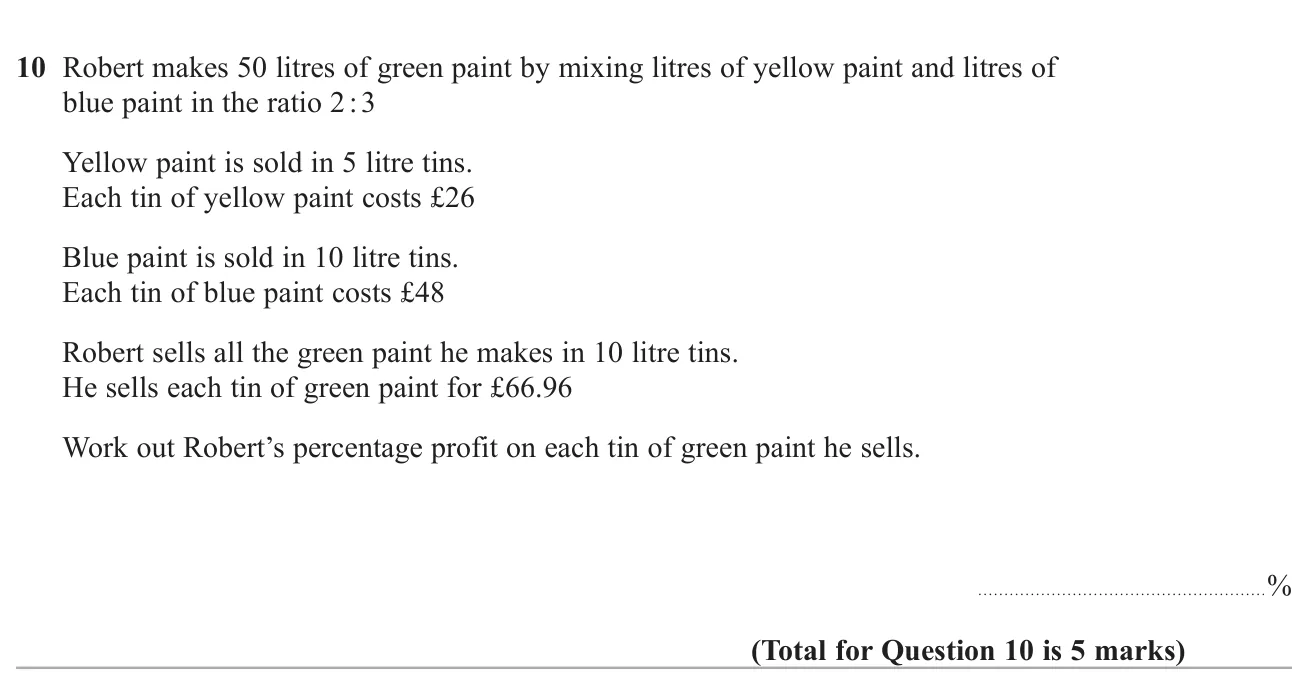
Find the cost of mixing paint from tins in a given ratio and work out the percentage profit on each tin sold.

© Pearson Education Ltd. November 2018 Paper 2 (Higher, calculator), question 10.

Show answer
Answer35%5 marks

Worked solution Checked against the mark scheme

Yellow =25×50=20= \frac{2}{5} \times 50 = 20 litres = 4 tins; blue =30= 30 litres = 3 tins.

Cost =4×26+3×48=104+144=£248= 4 \times 26 + 3 \times 48 = 104 + 144 = £248 for 50 litres.

Cost per 10 litre tin =248÷5=£49.60= 248 \div 5 = £49.60.

Profit =66.96−49.60=£17.36= 66.96 - 49.60 = £17.36

17.3649.60×100=35%\frac{17.36}{49.60} \times 100 = 35\%

Watch out: Dividing the profit by the selling price (66.96) instead of the cost.

Question 11

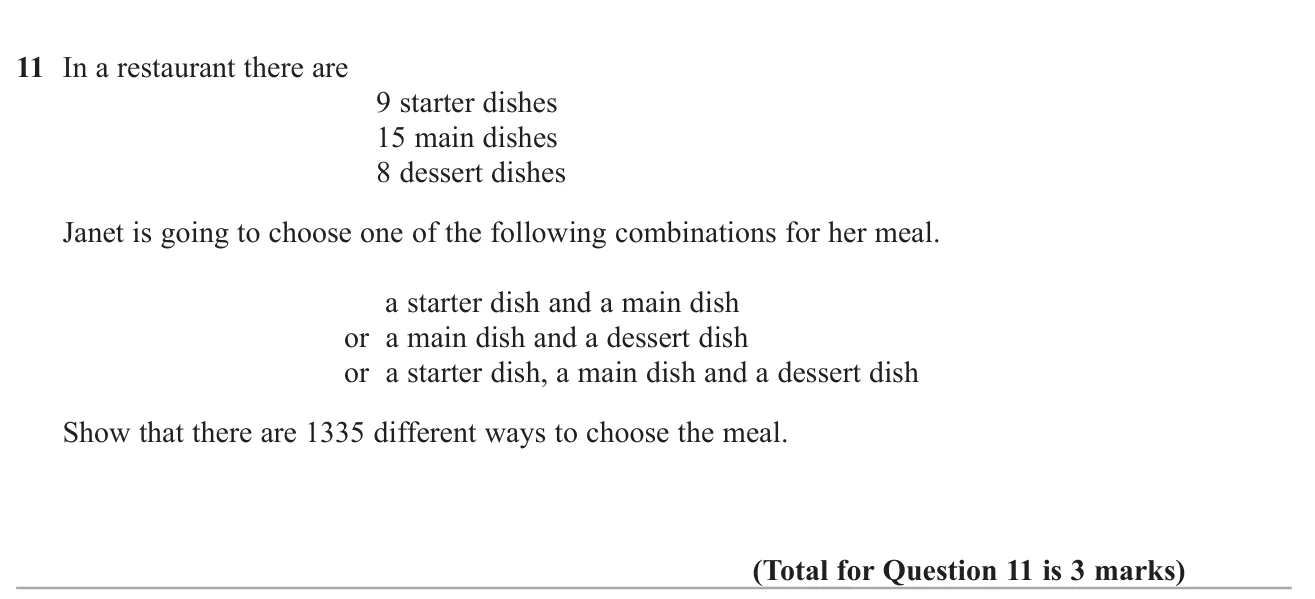
Show the total number of ways to choose a meal from three menu combinations using the product rule.

© Pearson Education Ltd. November 2018 Paper 2 (Higher, calculator), question 11.

Show answer
Answer135+120+1080=1335135 + 120 + 1080 = 13353 marks

Worked solution Checked against the mark scheme

Starter and main: 9×15=1359 \times 15 = 135

Main and dessert: 15×8=12015 \times 8 = 120

All three: 9×15×8=10809 \times 15 \times 8 = 1080

Total: 135+120+1080=1335135 + 120 + 1080 = 1335

Watch out: Adding the numbers of dishes instead of multiplying.

Question 12

Algebraic fractions6 marksGrade 8Calculator
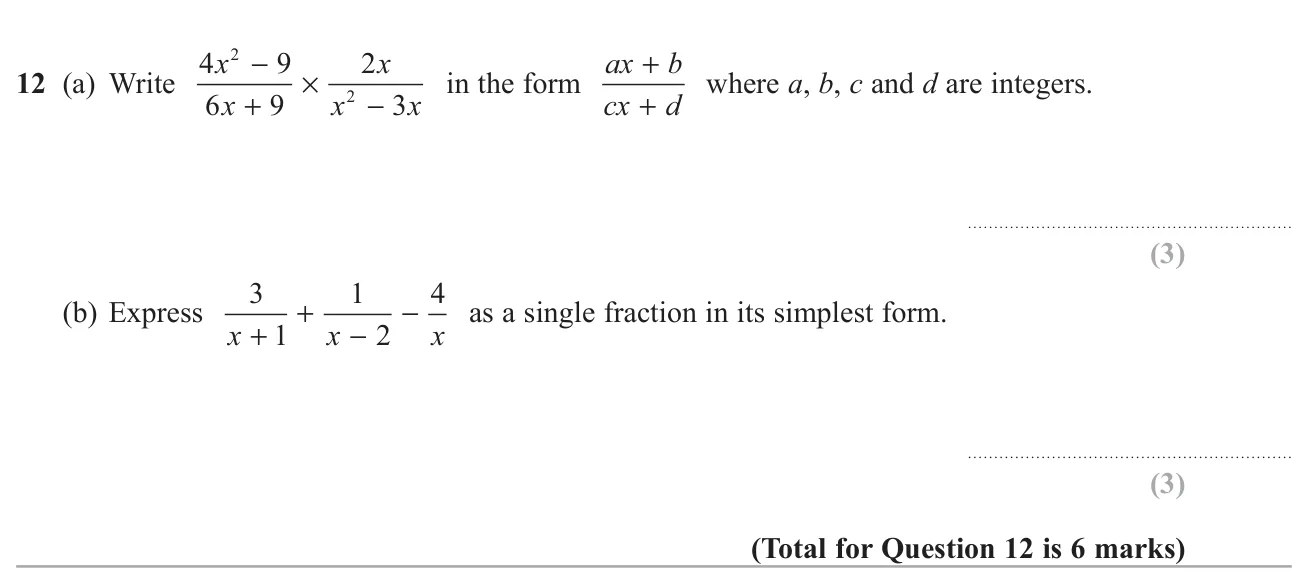
Simplify a product of algebraic fractions by factorising, and combine three algebraic fractions into one.

© Pearson Education Ltd. November 2018 Paper 2 (Higher, calculator), question 12.

Show answer
(a)4x−63x−9\frac{4x - 6}{3x - 9}3 marks
(b)8−xx(x+1)(x−2)\frac{8 - x}{x(x+1)(x-2)}3 marks

Worked solution Checked against the mark scheme

(a) (2x−3)(2x+3)3(2x+3)×2xx(x−3)=2(2x−3)3(x−3)=4x−63x−9\frac{(2x-3)(2x+3)}{3(2x+3)} \times \frac{2x}{x(x-3)} = \frac{2(2x-3)}{3(x-3)} = \frac{4x-6}{3x-9}

(b) Common denominator x(x+1)(x−2)x(x+1)(x-2).

Numerator: 3x(x−2)+x(x+1)−4(x+1)(x−2)3x(x-2) + x(x+1) - 4(x+1)(x-2)
=3x2−6x+x2+x−4x2+4x+8=8−x= 3x^2 - 6x + x^2 + x - 4x^2 + 4x + 8 = 8 - x

Answer: 8−xx(x+1)(x−2)\frac{8 - x}{x(x+1)(x-2)}

Watch out: Sign errors when subtracting 4(x+1)(x−2)4(x+1)(x-2).

Question 13

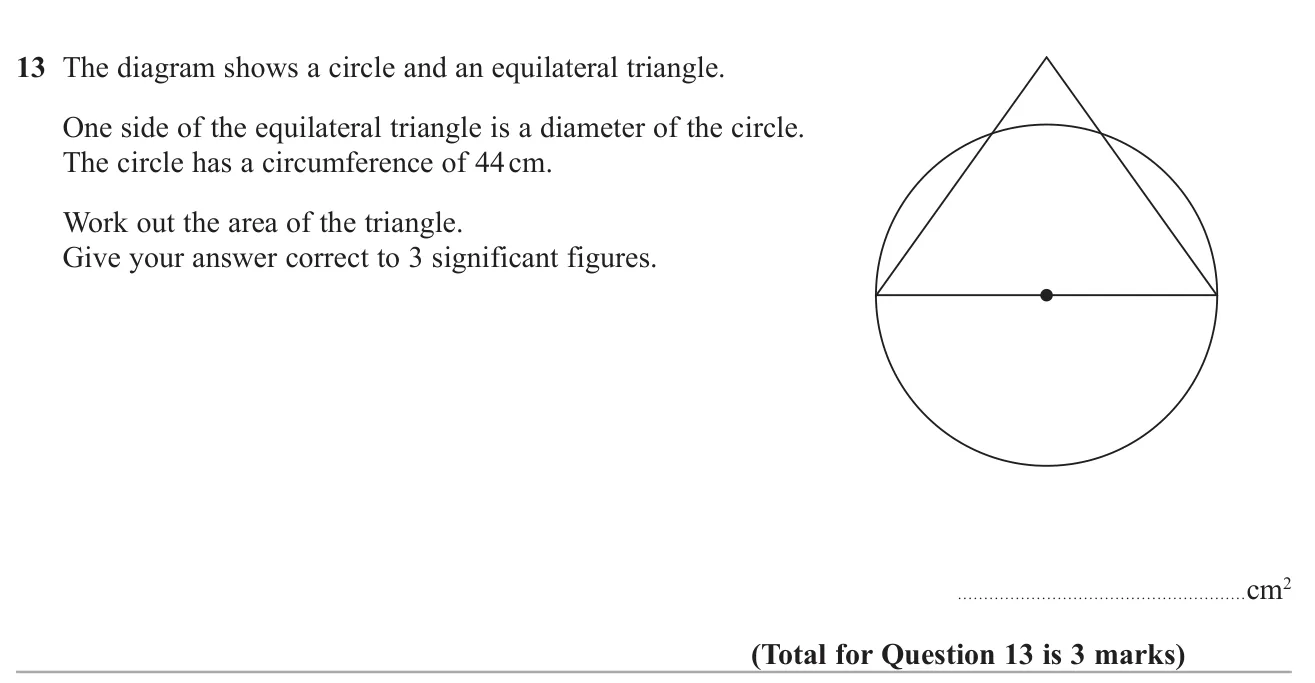
Use a circle's circumference to find its diameter, then find the area of an equilateral triangle built on that diameter.

© Pearson Education Ltd. November 2018 Paper 2 (Higher, calculator), question 13.

Show answer
Answer84.984.9 cm²3 marks

Worked solution Checked against the mark scheme

πd=44\pi d = 44, so d=44π=14.0056...d = \frac{44}{\pi} = 14.0056... cm

Area =12d2sin⁡60°=12×14.00562×sin⁡60°= \frac{1}{2} d^2 \sin 60° = \frac{1}{2} \times 14.0056^2 \times \sin 60°

=84.9= 84.9 cm² (3 s.f.)

Watch out: Using 2πr2\pi r but then taking the triangle side as the radius.

Question 14

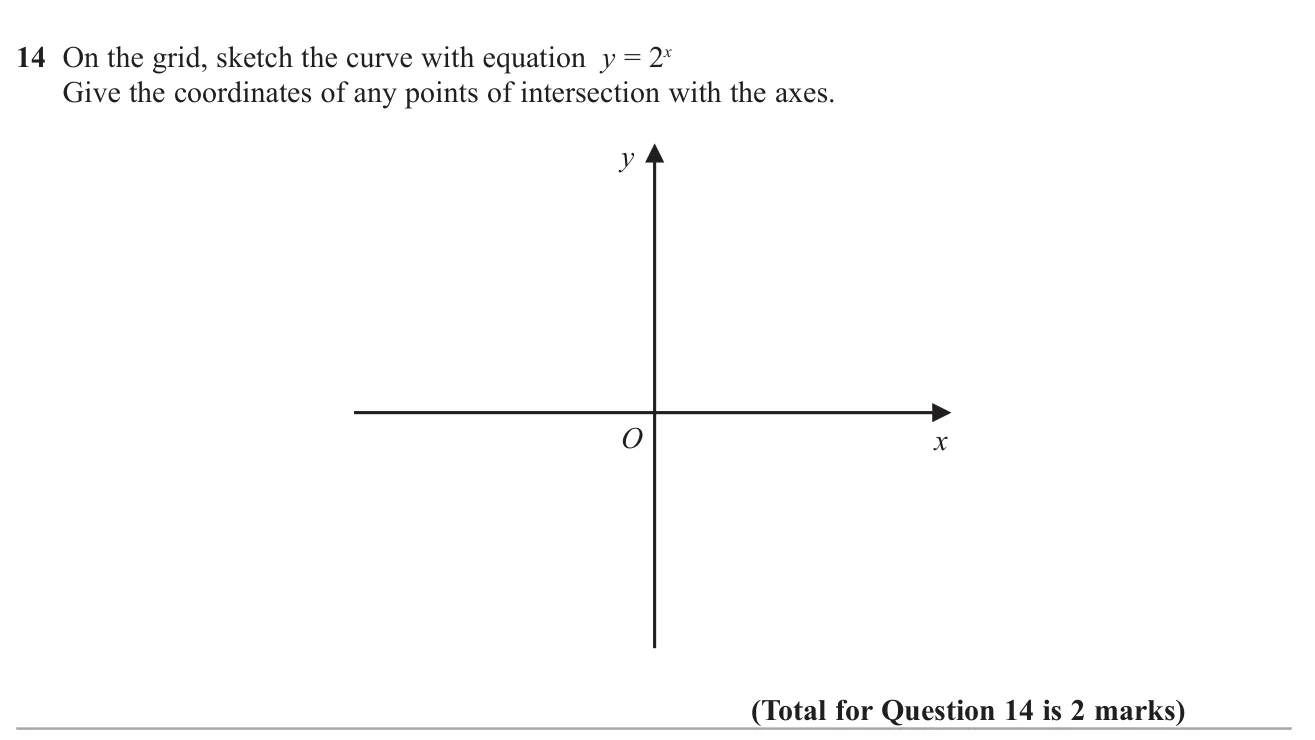
Sketch an exponential curve and mark where it meets the axes.

© Pearson Education Ltd. November 2018 Paper 2 (Higher, calculator), question 14.

Show answer
AnswerIncreasing exponential curve, above the x-axis for negative x, crossing the y-axis at (0,1)(0, 1)2 marks

Worked solution Checked against the mark scheme

2x2^x is always positive, so the curve never touches the x-axis.

When x=0x = 0, y=20=1y = 2^0 = 1, so it crosses the y-axis at (0,1)(0, 1).

It gets close to the x-axis on the left and rises ever more steeply on the right.

Watch out: Drawing the curve crossing the x-axis or passing through the origin.

Question 15

Equation of a circle1 markGrade 6Calculator
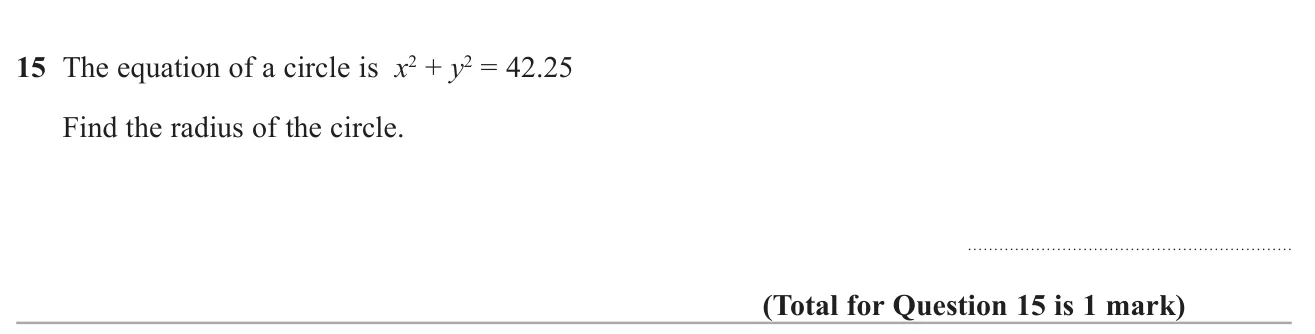
Find the radius of a circle from its equation.

© Pearson Education Ltd. November 2018 Paper 2 (Higher, calculator), question 15.

Show answer
Answer6.56.51 mark

Worked solution Checked against the mark scheme

x2+y2=r2x^2 + y^2 = r^2, so r2=42.25r^2 = 42.25

r=42.25=6.5r = \sqrt{42.25} = 6.5

Watch out: Halving 42.25 instead of square rooting.

Question 16

Tree diagrams and combined events4 marksGrade 6Calculator
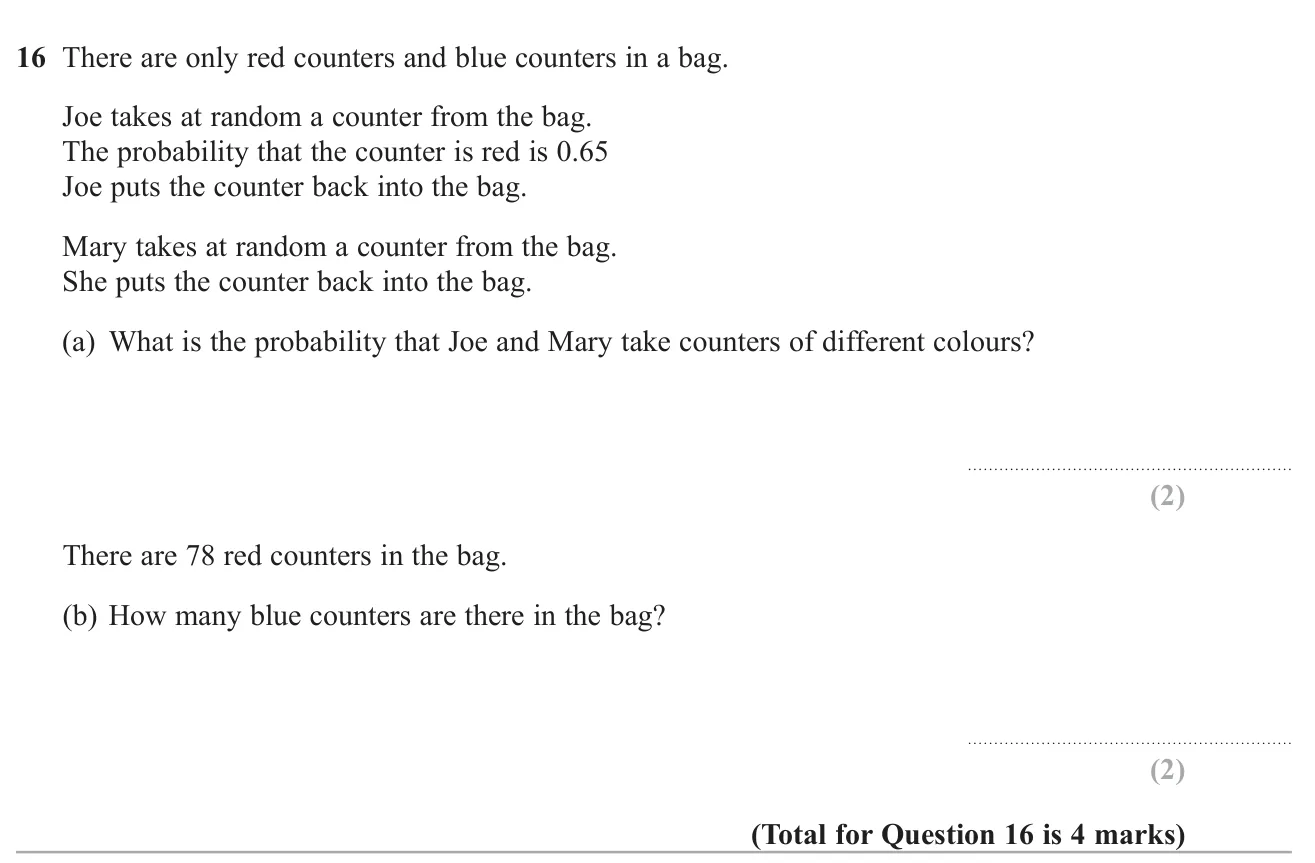
Find the probability two people with replacement pick different colours, and use a probability to find the number of blue counters.

© Pearson Education Ltd. November 2018 Paper 2 (Higher, calculator), question 16.

Show answer
(a)0.4550.4552 marks
(b)42422 marks

Worked solution Checked against the mark scheme

(a) P(blue)=1−0.65=0.35P(\text{blue}) = 1 - 0.65 = 0.35

P(different)=0.65×0.35+0.35×0.65=0.455P(\text{different}) = 0.65 \times 0.35 + 0.35 \times 0.65 = 0.455

(b) Total =78÷0.65=120= 78 \div 0.65 = 120 counters, so blue =120−78=42= 120 - 78 = 42.

Watch out: Only counting red then blue, giving 0.2275.

Question 17

Ratio5 marksGrade 8Calculator
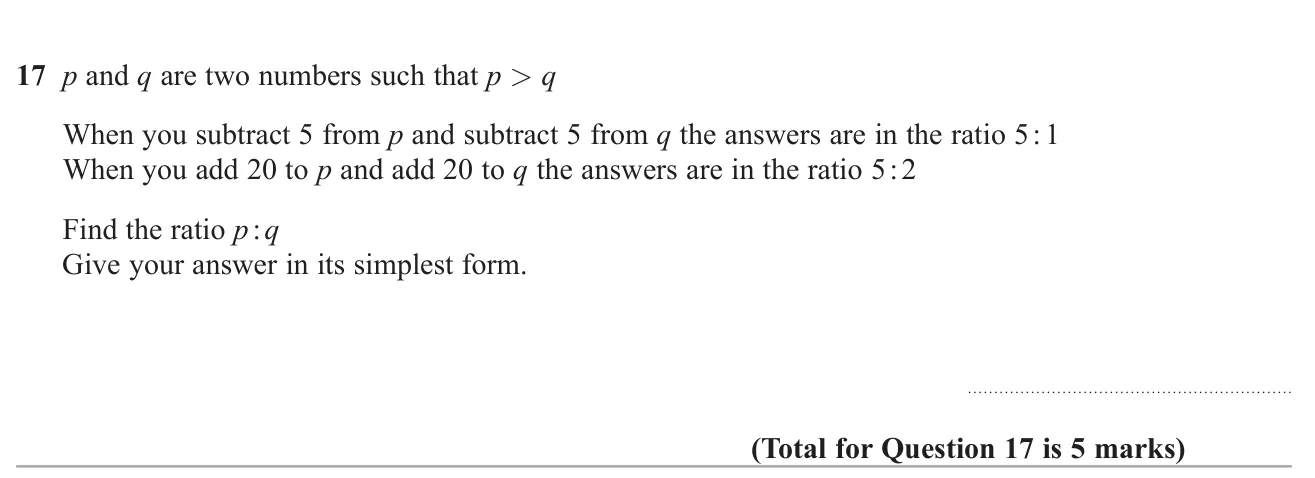
Form and solve simultaneous equations from two ratio conditions to find the ratio of two numbers.

© Pearson Education Ltd. November 2018 Paper 2 (Higher, calculator), question 17.

Show answer
Answer4:14 : 15 marks

Worked solution Checked against the mark scheme

p−5q−5=5\frac{p-5}{q-5} = 5 gives p=5q−20p = 5q - 20

p+20q+20=52\frac{p+20}{q+20} = \frac{5}{2} gives 2p+40=5q+1002p + 40 = 5q + 100

Substitute: 10q−40+40=5q+10010q - 40 + 40 = 5q + 100, so q=20q = 20 and p=80p = 80.

p:q=80:20=4:1p : q = 80 : 20 = 4 : 1

Watch out: Giving the ratio the wrong way round as 1:41 : 4.

Question 18

Coordinates and straight-line graphs4 marksGrade 7Calculator
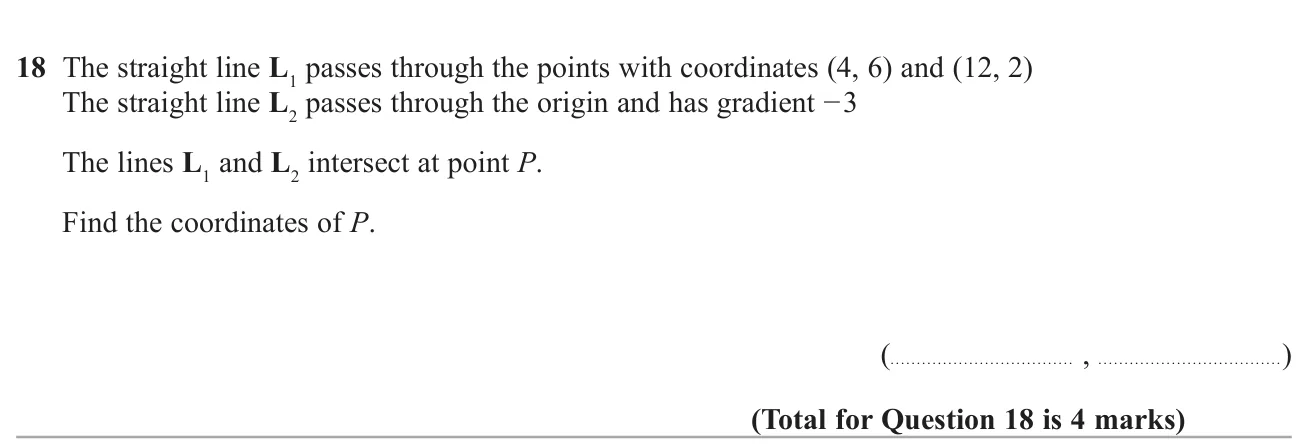
Find where a line through two points meets a line through the origin with a given gradient.

© Pearson Education Ltd. November 2018 Paper 2 (Higher, calculator), question 18.

Show answer
Answer(−165,485)\left(-\frac{16}{5}, \frac{48}{5}\right)4 marks

Worked solution Checked against the mark scheme

Gradient of L1 =2−612−4=−12= \frac{2 - 6}{12 - 4} = -\frac{1}{2}

6=−12(4)+c6 = -\frac{1}{2}(4) + c, so c=8c = 8: L1 is y=−12x+8y = -\frac{1}{2}x + 8

L2 is y=−3xy = -3x.

−12x+8=−3x⇒2.5x=−8⇒x=−3.2-\frac{1}{2}x + 8 = -3x \Rightarrow 2.5x = -8 \Rightarrow x = -3.2, y=9.6y = 9.6

P=(−3.2,9.6)P = (-3.2, 9.6)

Watch out: Getting the gradient sign wrong for L1.

Question 19

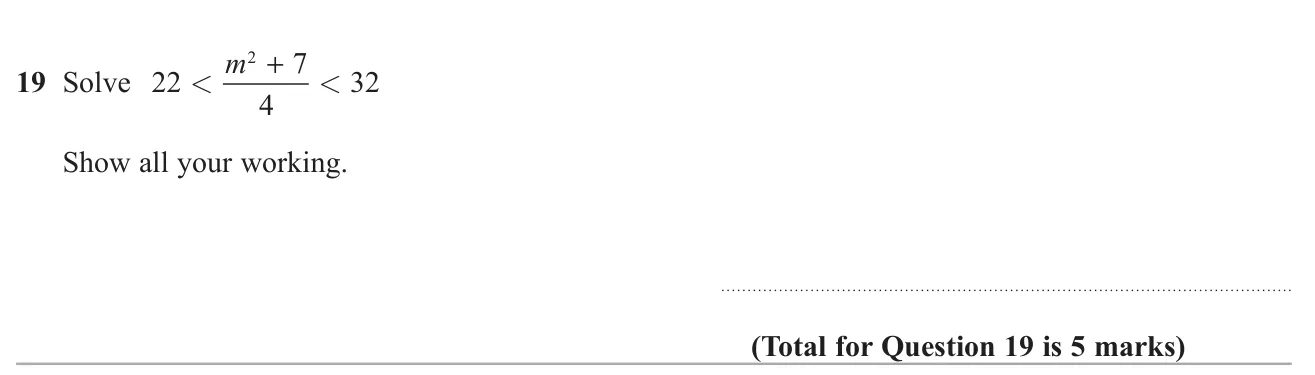
Inequalities5 marksGrade 8Calculator
Solve a double inequality involving a squared term, giving both ranges of solutions.

© Pearson Education Ltd. November 2018 Paper 2 (Higher, calculator), question 19.

Show answer
Answer9<m<119 < m < 11 or −11<m<−9-11 < m < -95 marks

Worked solution Checked against the mark scheme

Multiply by 4: 88<m2+7<12888 < m^2 + 7 < 128

Subtract 7: 81<m2<12181 < m^2 < 121

So 9<∣m∣<119 < |m| < 11.

9<m<119 < m < 11 or −11<m<−9-11 < m < -9

Watch out: Forgetting the negative range.

Question 20

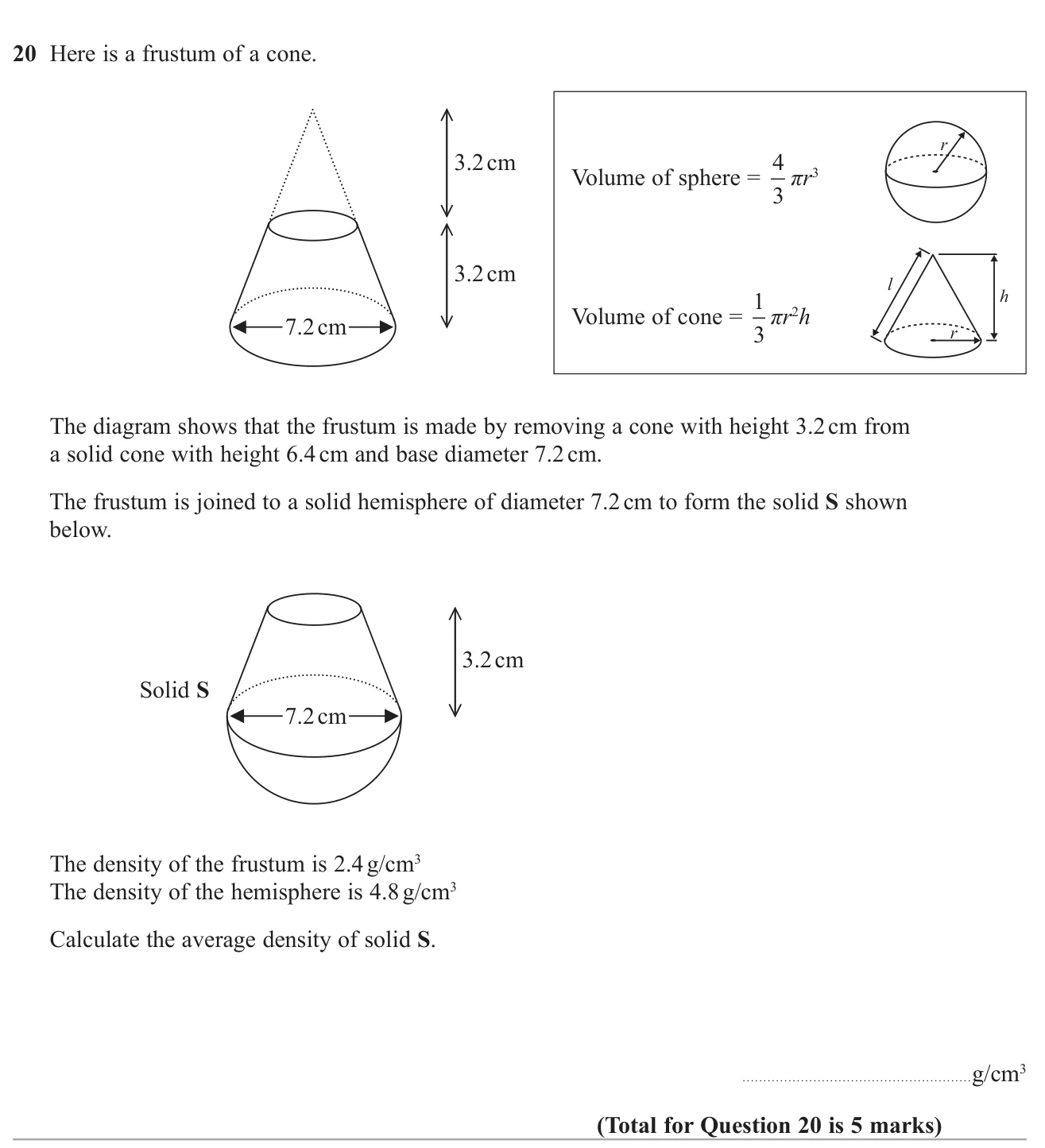
Volume and surface area5 marksGrade 8Calculator
Find the average density of a solid made from a frustum and a hemisphere with different densities.

© Pearson Education Ltd. November 2018 Paper 2 (Higher, calculator), question 20.

Show answer
Answer3.753.75 g/cm³5 marks

Worked solution Checked against the mark scheme

Frustum =13π(3.6)2(6.4)−13π(1.8)2(3.2)=76.00= \frac{1}{3}\pi(3.6)^2(6.4) - \frac{1}{3}\pi(1.8)^2(3.2) = 76.00 cm³

Hemisphere =23π(3.6)3=97.72= \frac{2}{3}\pi(3.6)^3 = 97.72 cm³

Mass =76.00×2.4+97.72×4.8=182.40+469.04=651.44= 76.00 \times 2.4 + 97.72 \times 4.8 = 182.40 + 469.04 = 651.44 g

Density =651.44173.72=3.75= \frac{651.44}{173.72} = 3.75 g/cm³

Watch out: Averaging the two densities (3.6) instead of using total mass over total volume.

Question 21

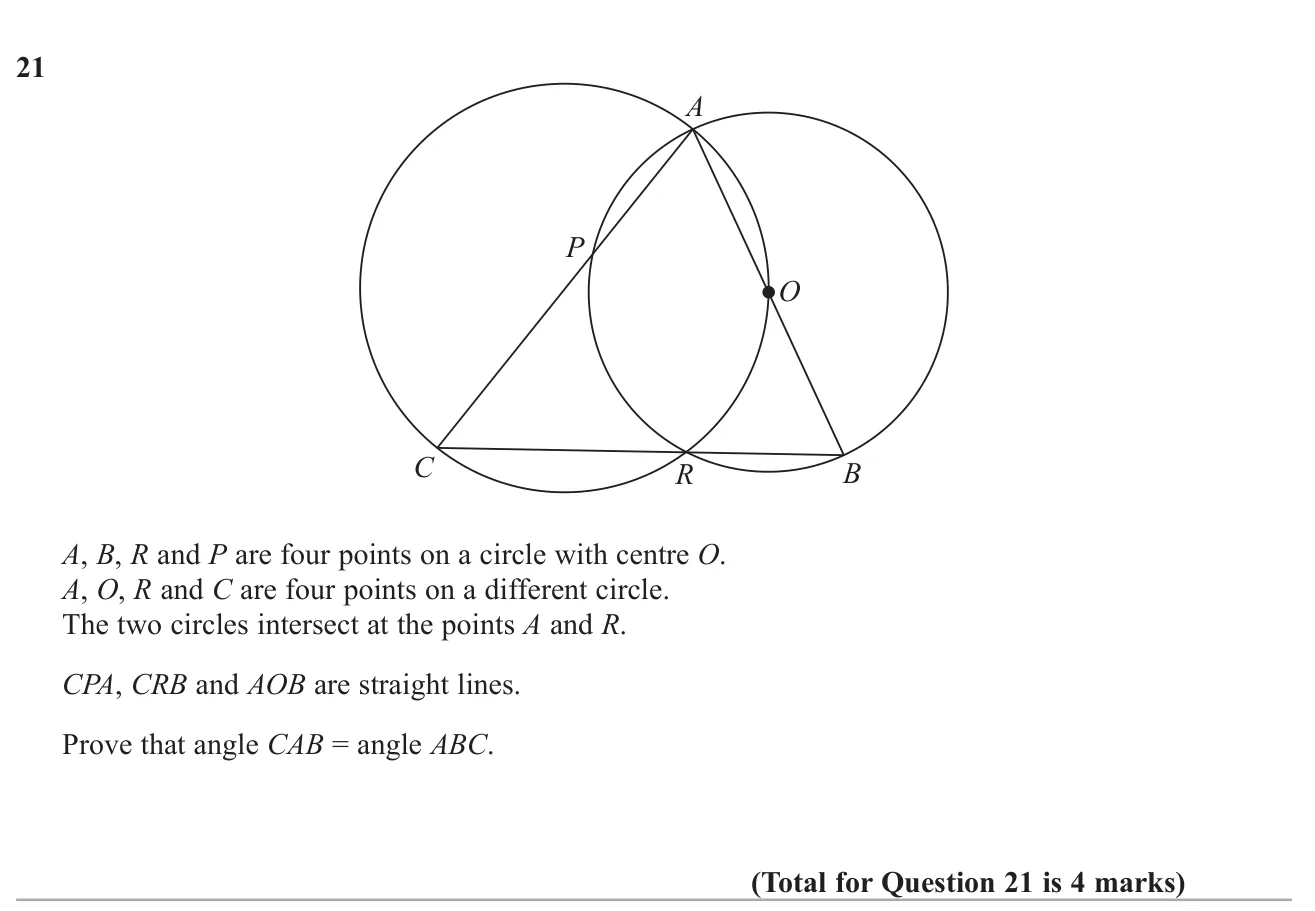
Circle theorems4 marksGrade 9Calculator
Prove two angles in a triangle are equal using a cyclic quadrilateral and an isosceles triangle formed by radii.

© Pearson Education Ltd. November 2018 Paper 2 (Higher, calculator), question 21.

Show answer
AnswerProof that angle CABCAB = angle ABCABC4 marks

Worked solution Checked against the mark scheme

Let angle CAB=xCAB = x.

AORCAORC is cyclic, so angle CRO=180−xCRO = 180 - x (opposite angles of a cyclic quadrilateral add up to 180°180°).

Angle ORB=180−(180−x)=xORB = 180 - (180 - x) = x (angles on a straight line add up to 180°180°).

OR=OBOR = OB (both radii), so triangle ORBORB is isosceles and angle OBR=xOBR = x (base angles are equal).

So angle ABC=x=ABC = x = angle CABCAB.

Watch out: Stating results without the reasons, or using the wrong circle for the cyclic quadrilateral.

Finished the paper?

Add up your marks for all three papers and see what grade that would have been.