© Pearson Education Ltd. June 2023 Paper 1 (Higher, non-calculator), question 1.
Show answer
| Answer | 56.4 | 3 marks |
|---|
Worked solution Checked against the mark scheme
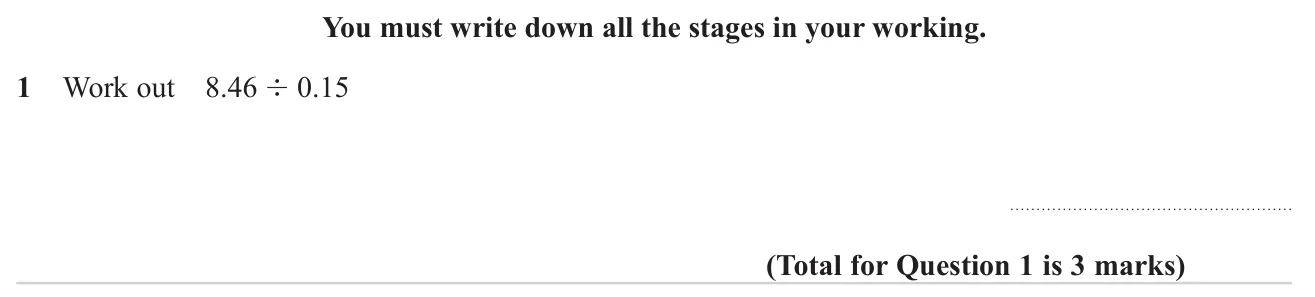
Multiply both numbers by 100: 8.46÷0.15=846÷15
15×56=840, remainder 6, and 6÷15=0.4
So the answer is 56.4
Watch out: Misplacing the decimal point, giving 5.64 or 564.
© Pearson Education Ltd. June 2023 Paper 1 (Higher, non-calculator), question 2.
Show answer
| Answer | 487 | 3 marks |
|---|
Worked solution Checked against the mark scheme
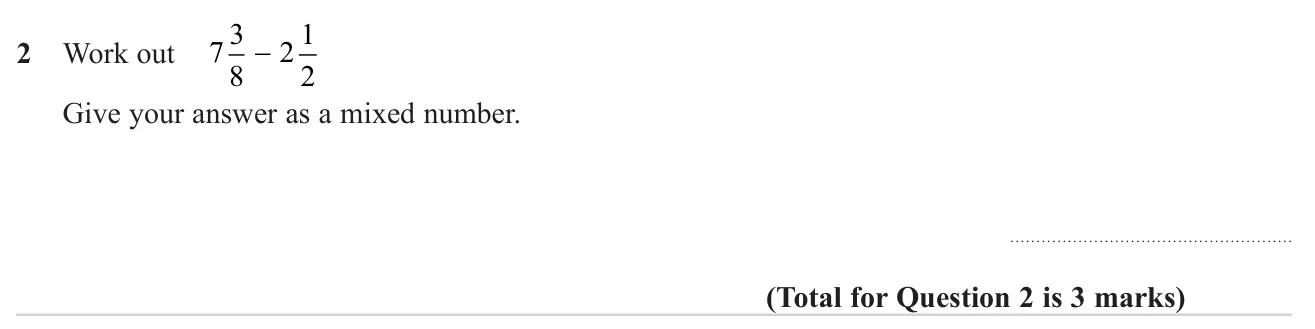
Make improper fractions: 783=859, 221=820
859−820=839=487
Watch out: Doing 83−21 the wrong way round, giving 581.
© Pearson Education Ltd. June 2023 Paper 1 (Higher, non-calculator), question 3.
Show answer
Worked solution Checked against the mark scheme
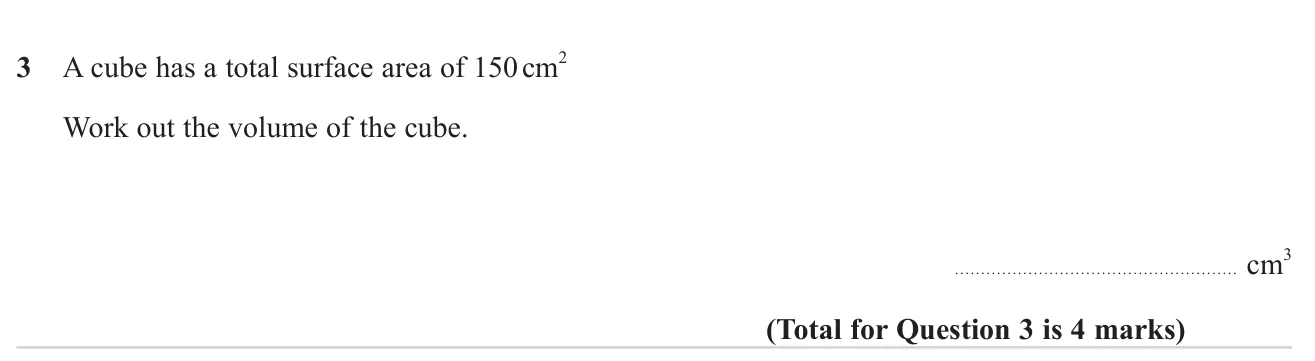
A cube has 6 equal faces: 150÷6=25 cm²
Edge length: 25=5 cm
Volume: 5×5×5=125 cm³
Watch out: Dividing by 4 or cube-rooting 150.
© Pearson Education Ltd. June 2023 Paper 1 (Higher, non-calculator), question 4.
Show answer
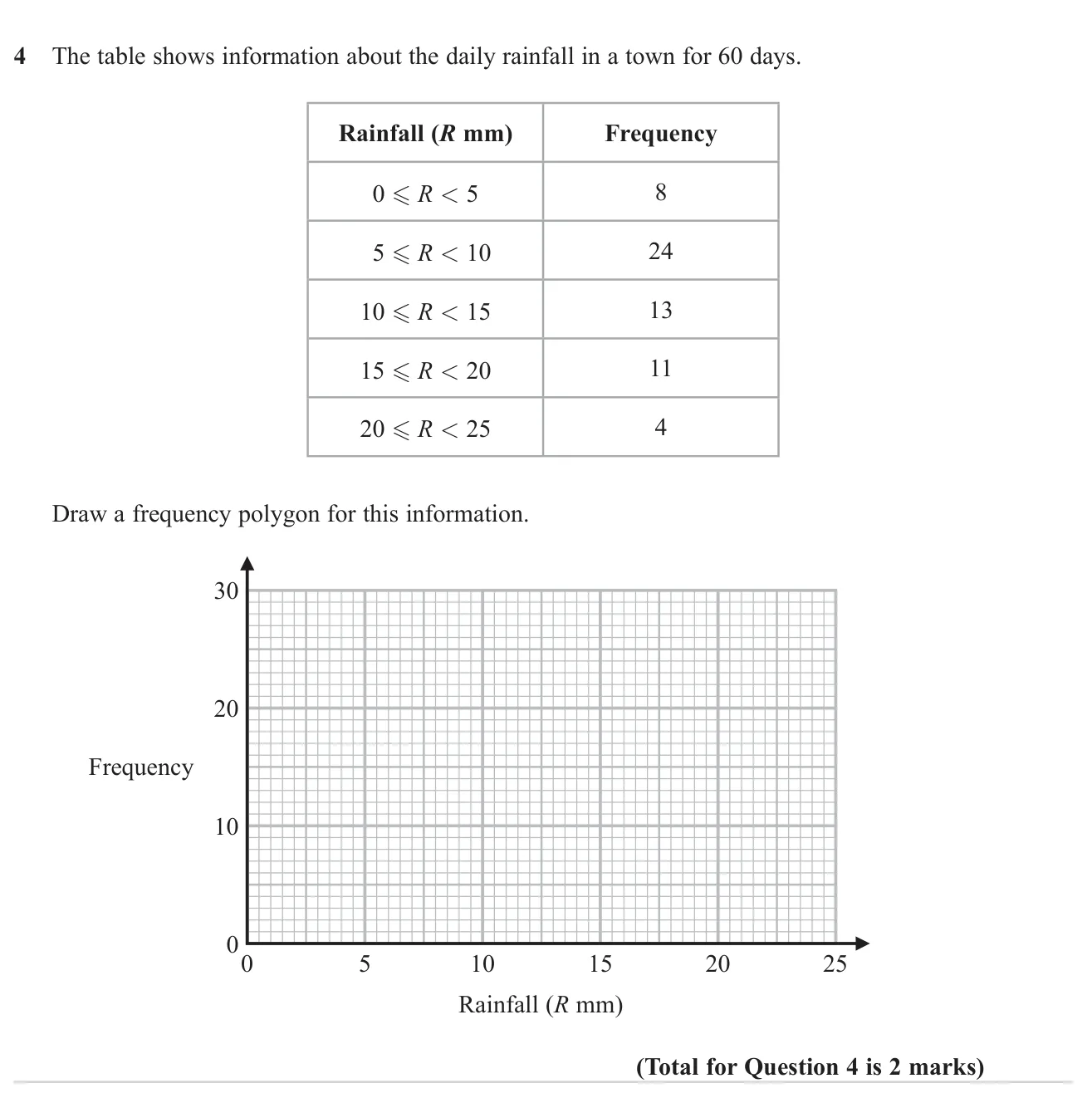
| Answer | Points at (2.5,8),(7.5,24),(12.5,13),(17.5,11),(22.5,4) joined with straight lines | 2 marks |
|---|
Worked solution Checked against the mark scheme
Plot each frequency above the middle of its class: 2.5, 7.5, 12.5, 17.5, 22.5.
Points: (2.5,8),(7.5,24),(12.5,13),(17.5,11),(22.5,4)
Join them in order with a ruler. Do not join the last point back to the first.
Watch out: Plotting at the class boundaries (0, 5, 10, …) instead of the midpoints.
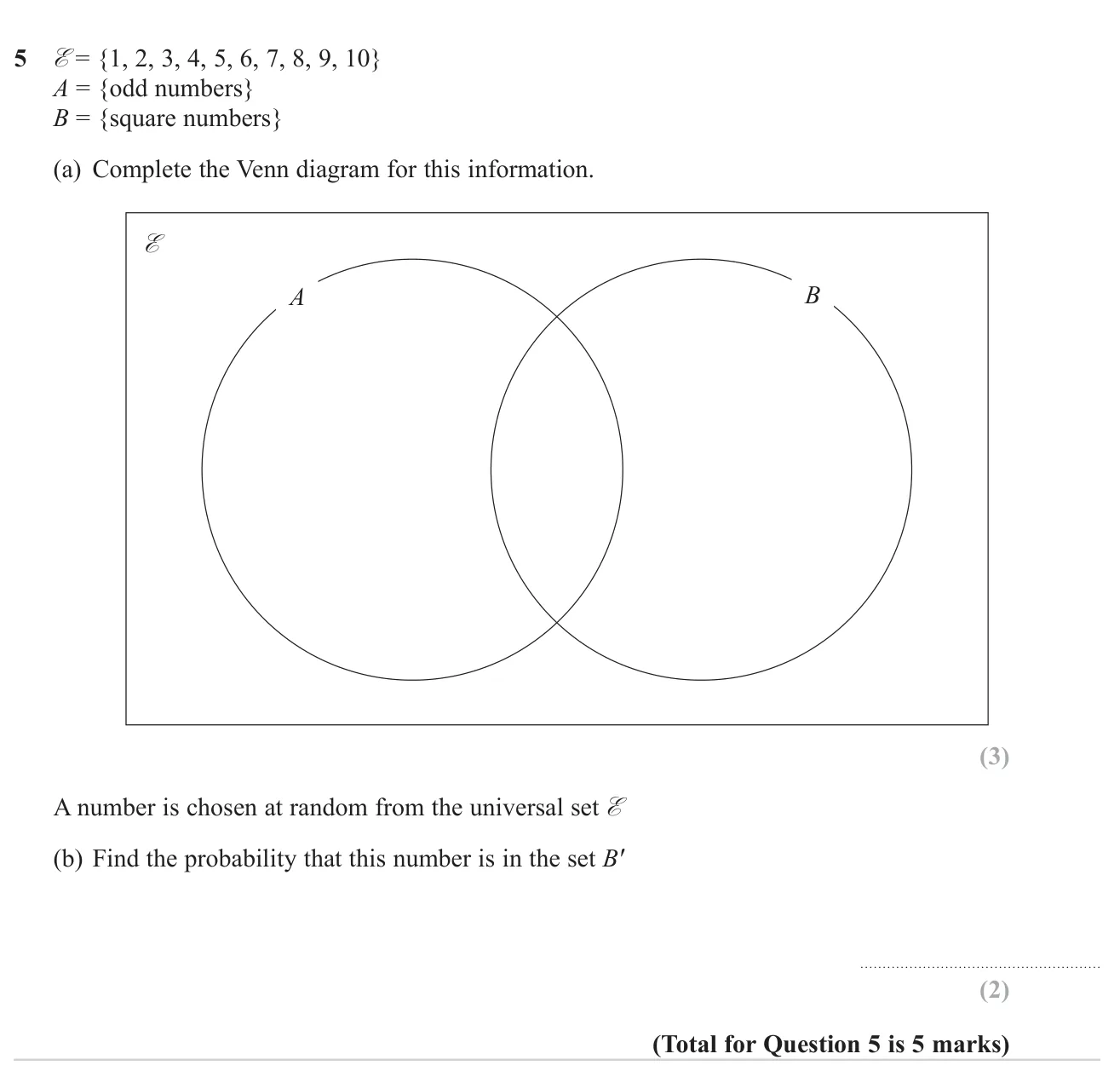
© Pearson Education Ltd. June 2023 Paper 1 (Higher, non-calculator), question 5.
Show answer
| (a) | A only: 3, 5, 7; both: 1, 9; B only: 4; outside: 2, 6, 8, 10 | 3 marks |
|---|
| (b) | 107 | 2 marks |
|---|
Worked solution Checked against the mark scheme
(a) Odd: 1, 3, 5, 7, 9. Square: 1, 4, 9.
In both: 1, 9. Odd only: 3, 5, 7. Square only: 4. Neither: 2, 6, 8, 10.
(b) B′ means not square: 10−3=7 numbers, so P=107
Watch out: Forgetting that 1 is a square number.
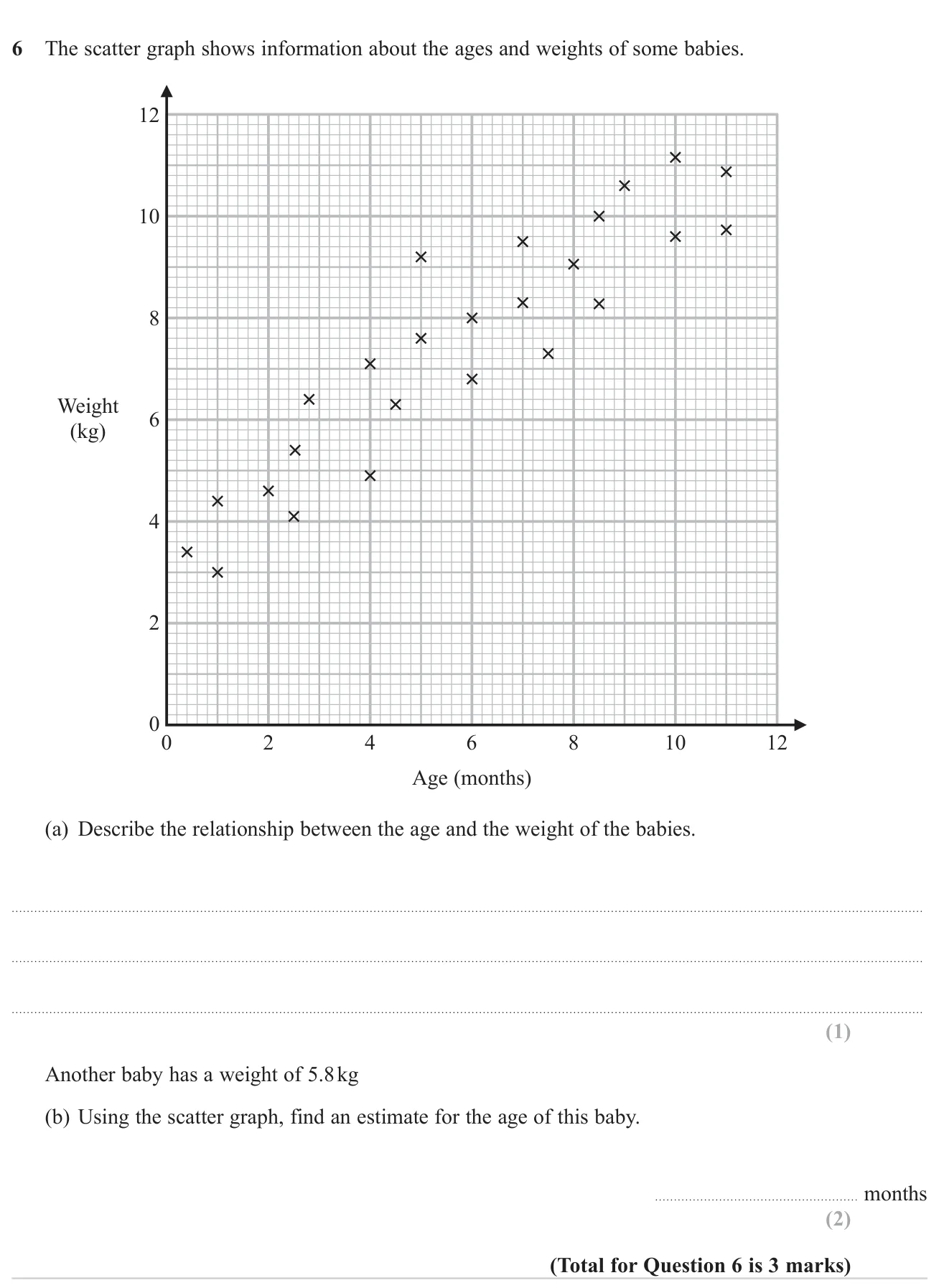
© Pearson Education Ltd. June 2023 Paper 1 (Higher, non-calculator), question 6.
Show answer
| (a) | Positive correlation: older babies tend to weigh more | 1 mark |
|---|
| (b) | About 3.5 months (accept 2.5 to 4.5) | 2 marks |
|---|
Worked solution Checked against the mark scheme
(a) As age increases, weight increases: positive correlation.
(b) Draw a line of best fit. Go across from 5.8 kg to the line, then down to the age axis.
This gives about 3.5 months.
Watch out: In (a), writing just 'positive' without saying correlation or describing the trend.
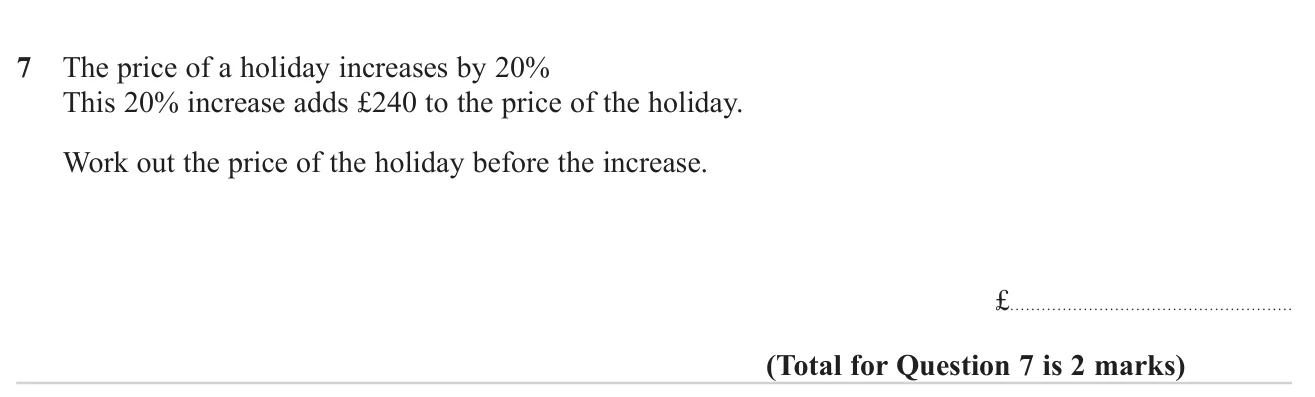
© Pearson Education Ltd. June 2023 Paper 1 (Higher, non-calculator), question 7.
Show answer
Worked solution Checked against the mark scheme
20% of the price is £240.
10% is £120, so 100% is 120×10=£1200
Watch out: Adding 20% to 240 or finding 20% of 240.
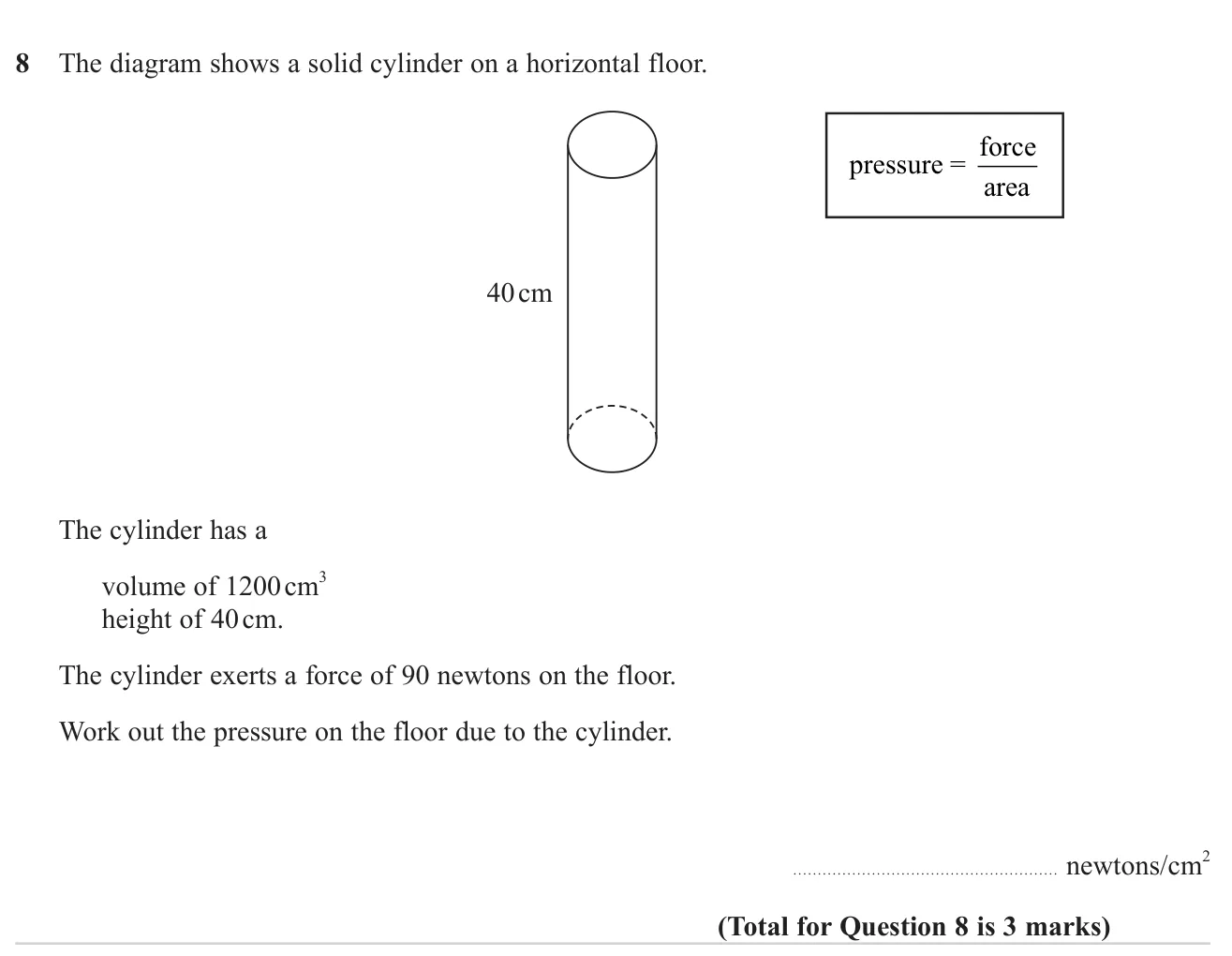
© Pearson Education Ltd. June 2023 Paper 1 (Higher, non-calculator), question 8.
Show answer
Worked solution Checked against the mark scheme
Volume = base area × height, so base area =1200÷40=30 cm²
Pressure =3090=3 newtons/cm²
Watch out: Dividing 90 by 1200 without finding the base area.
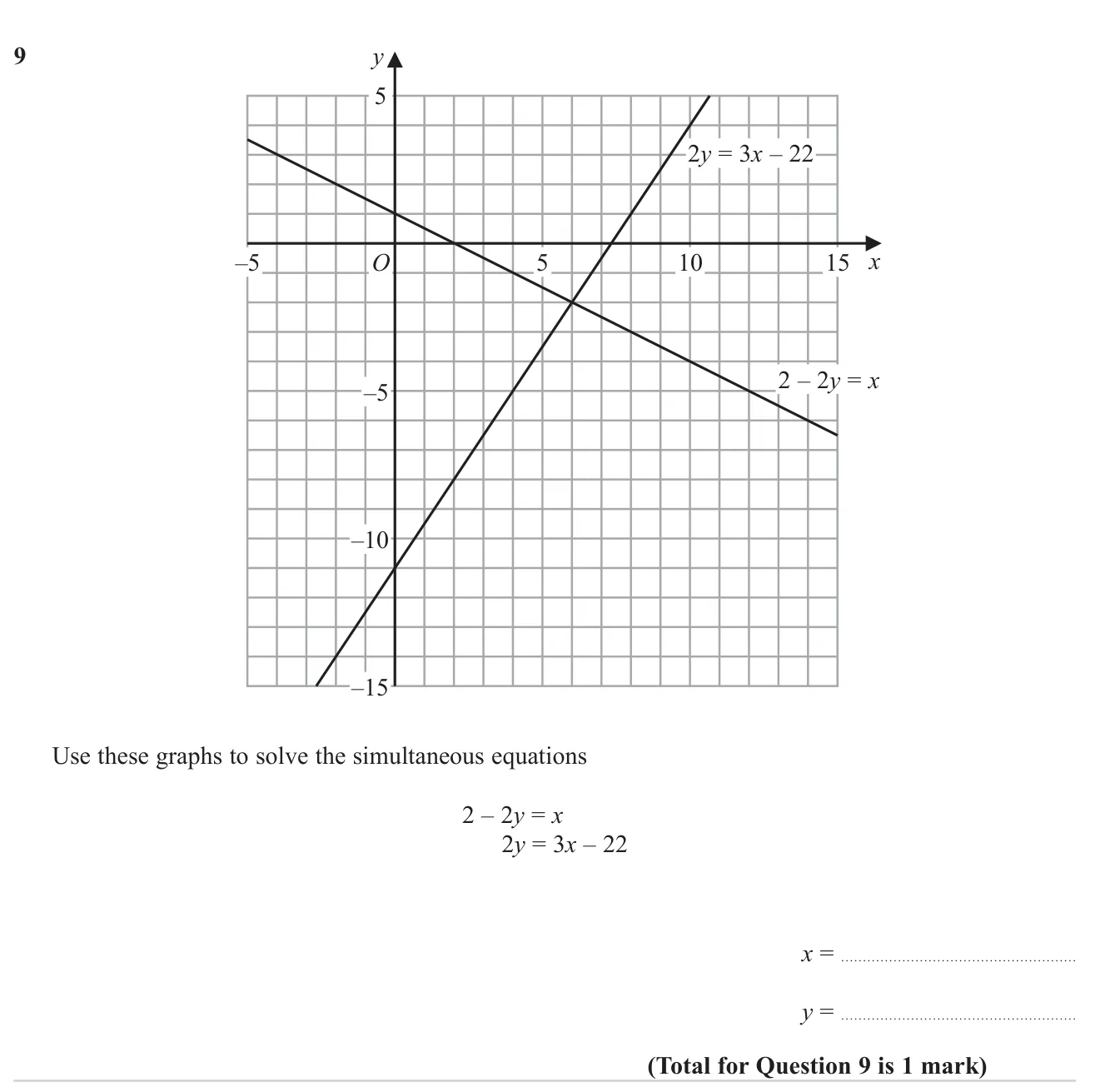
© Pearson Education Ltd. June 2023 Paper 1 (Higher, non-calculator), question 9.
Show answer
| Answer | x=6, y=−2 | 1 mark |
|---|
Worked solution Checked against the mark scheme
The solution is where the two lines meet, at (6,−2).
Check: 2−2(−2)=6 ✓ and 2(−2)=−4=3(6)−22 ✓
So x=6, y=−2.
Watch out: Swapping x and y.
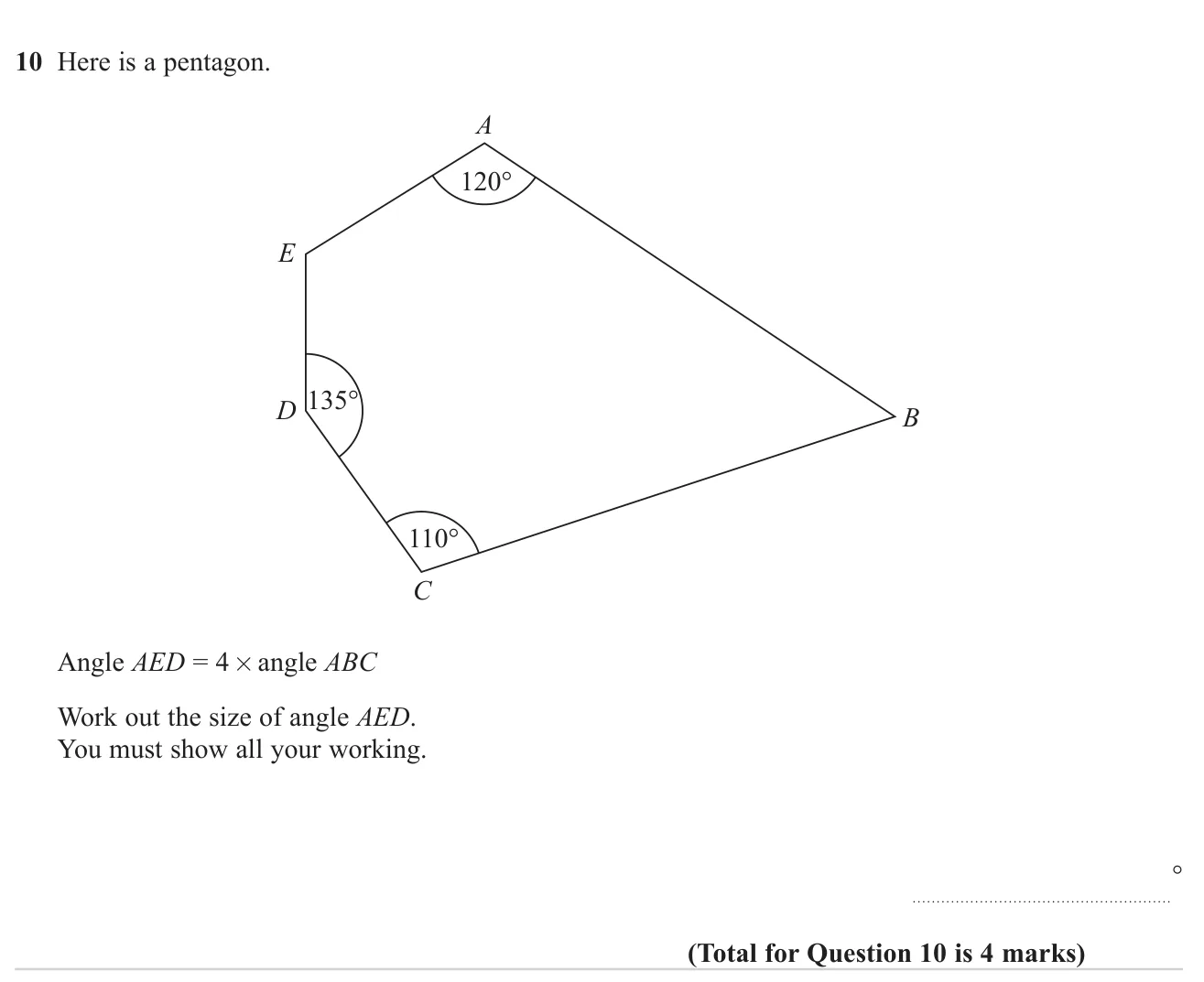
© Pearson Education Ltd. June 2023 Paper 1 (Higher, non-calculator), question 10.
Show answer
| Answer | 140∘ | 4 marks |
|---|
Worked solution Checked against the mark scheme
Angles in a pentagon add to (5−2)×180=540∘
The two unknown angles total 540−120−135−110=175∘
Let angle ABC=x, so angle AED=4x. Then 5x=175, so x=35
Angle AED=4×35=140∘
Watch out: Using 360° as the angle sum of a pentagon.
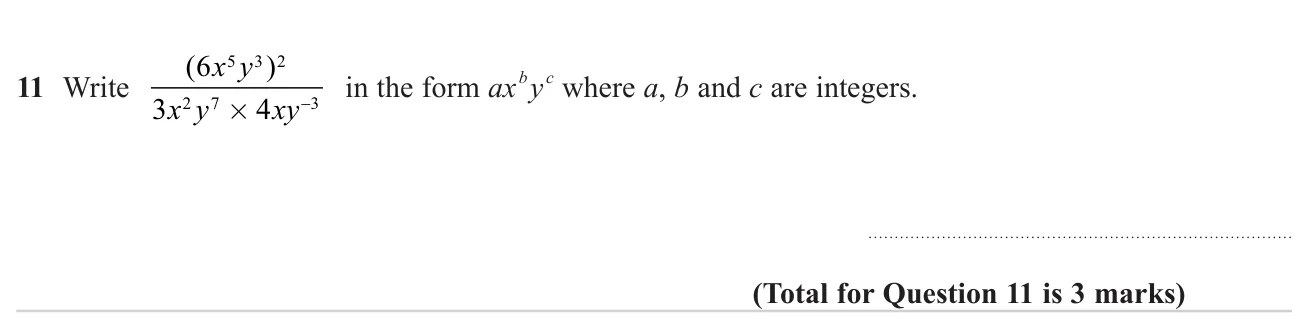
© Pearson Education Ltd. June 2023 Paper 1 (Higher, non-calculator), question 11.
Show answer
| Answer | 3x7y2 | 3 marks |
|---|
Worked solution Checked against the mark scheme
Numerator: (6x5y3)2=36x10y6
Denominator: 3x2y7×4xy−3=12x3y4
Divide: 1236=3, x10−3=x7, y6−4=y2
Answer: 3x7y2
Watch out: Squaring only the 6 or only the powers in the bracket, e.g. 6x10y6.
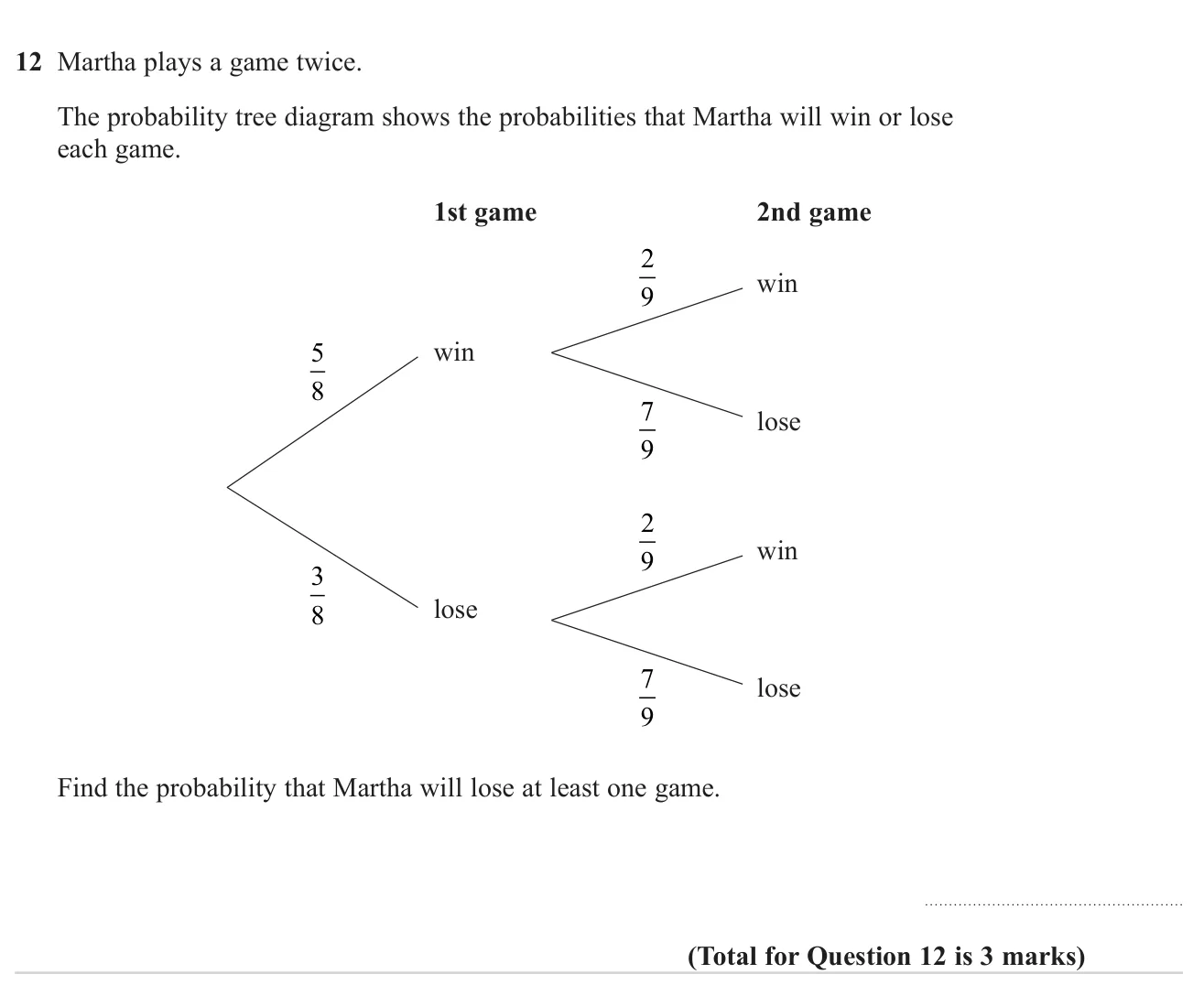
© Pearson Education Ltd. June 2023 Paper 1 (Higher, non-calculator), question 12.
Show answer
| Answer | 3631 | 3 marks |
|---|
Worked solution Checked against the mark scheme
The only outcome without a loss is win then win: 85×92=7210
So P(at least one loss) =1−7210=7262=3631
Watch out: Adding the branch probabilities along a path instead of multiplying.
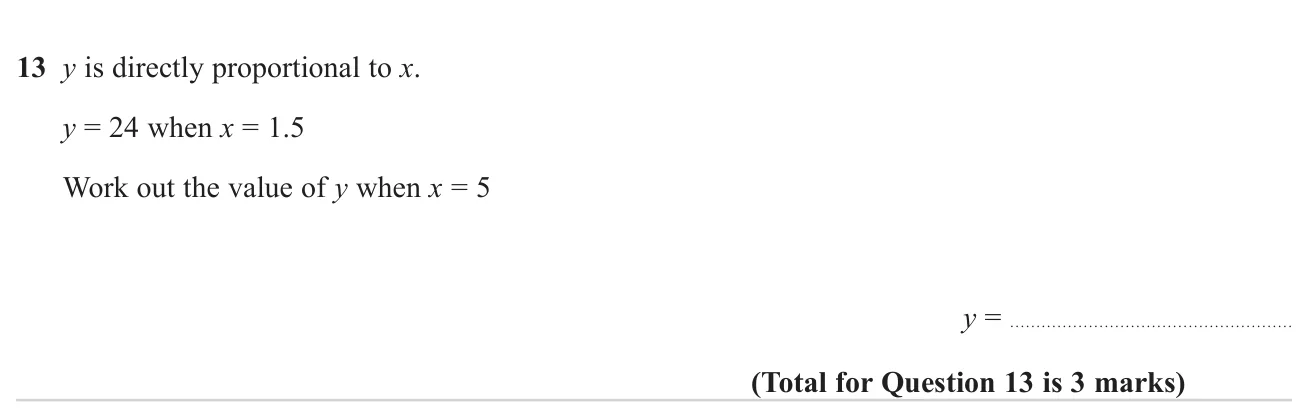
© Pearson Education Ltd. June 2023 Paper 1 (Higher, non-calculator), question 13.
Show answer
| Answer | y=80 | 3 marks |
|---|
Worked solution Checked against the mark scheme
y=kx, so 24=k×1.5 and k=16
When x=5: y=16×5=80
Watch out: Treating it as inverse proportion and dividing instead of multiplying.
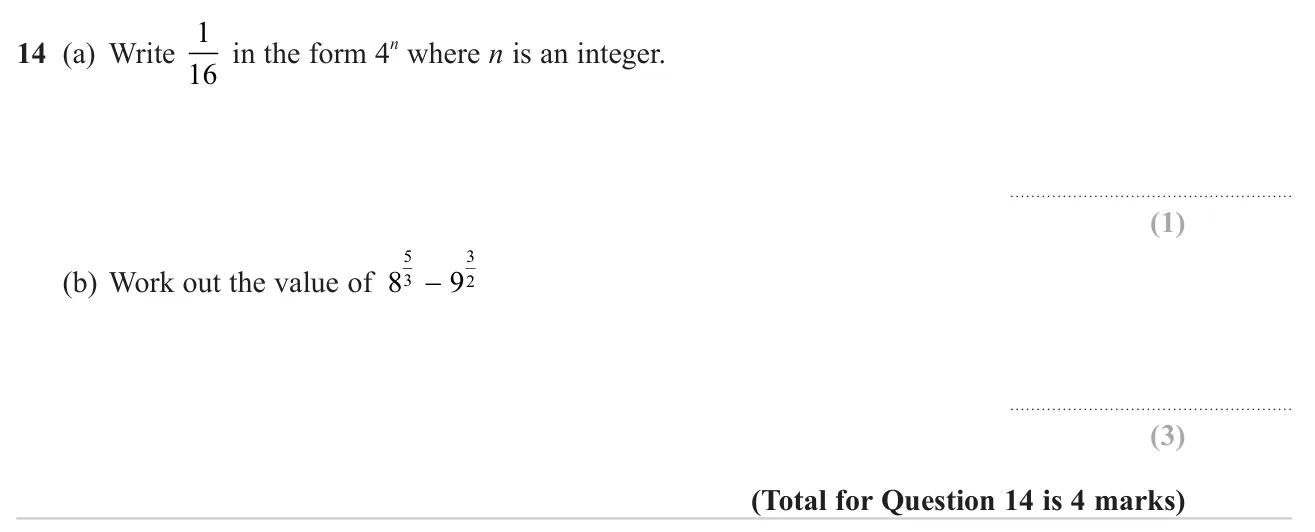
© Pearson Education Ltd. June 2023 Paper 1 (Higher, non-calculator), question 14.
Show answer
| (a) | 4−2 | 1 mark |
|---|
| (b) | 5 | 3 marks |
|---|
Worked solution Checked against the mark scheme
(a) 16=42, so 161=4−2
(b) 835=(38)5=25=32
923=(9)3=33=27
32−27=5
Watch out: Multiplying the base by the fraction, e.g. treating 835 as 8×35.
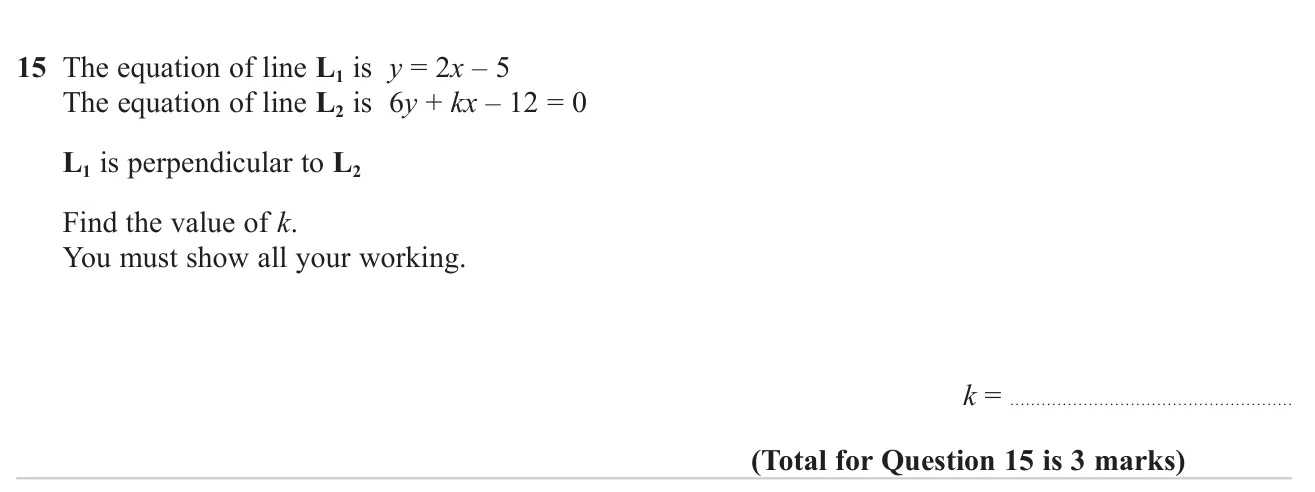
© Pearson Education Ltd. June 2023 Paper 1 (Higher, non-calculator), question 15.
Show answer
Worked solution Checked against the mark scheme
L1 has gradient 2, so a perpendicular line has gradient −21
Rearrange L2: 6y=12−kx, so y=2−6kx, with gradient −6k
−6k=−21 gives k=3
Watch out: Using the gradient of L2 as −k without dividing by 6, or using 21 instead of −21.
Question 16
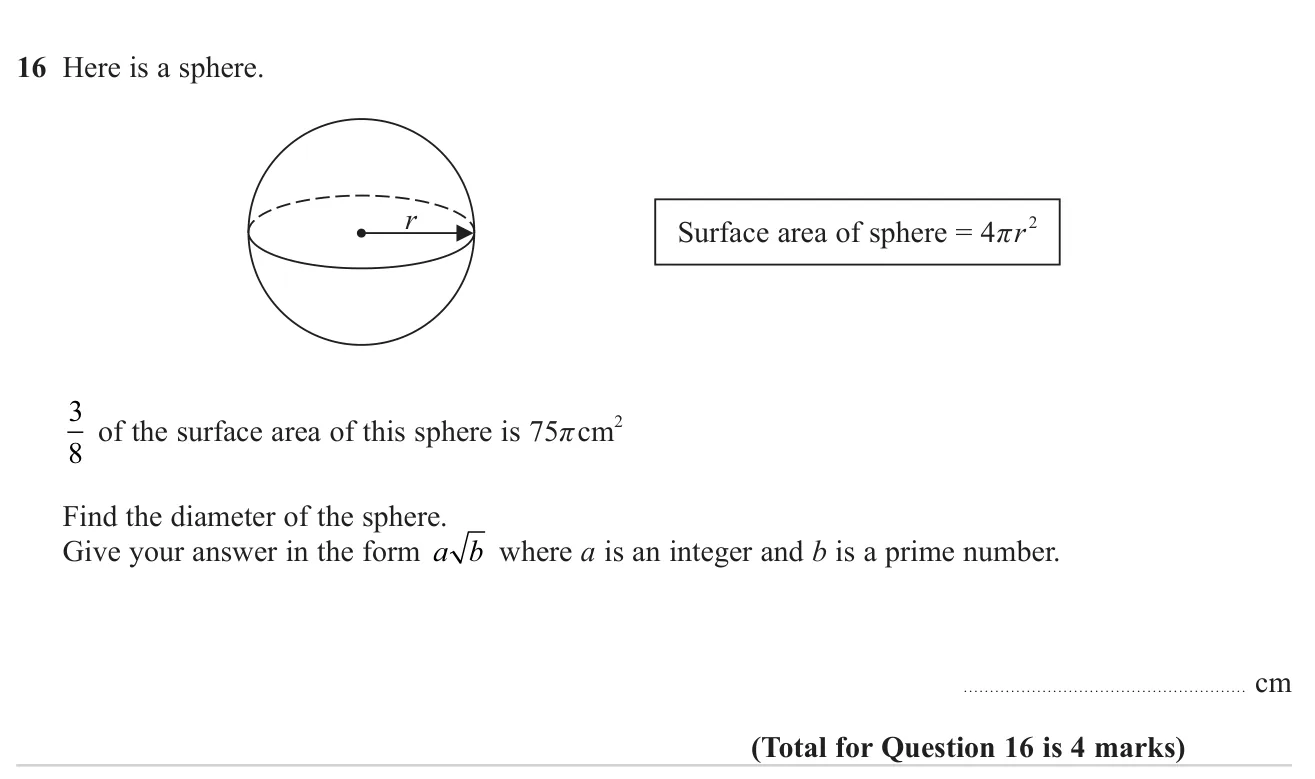
Surds4 marksGrade 7No calculator © Pearson Education Ltd. June 2023 Paper 1 (Higher, non-calculator), question 16.
Show answer
| Answer | 102 cm | 4 marks |
|---|
Worked solution Checked against the mark scheme
Whole surface area =75π÷3×8=200π
4πr2=200π, so r2=50 and r=50=52
Diameter =2×52=102 cm
Watch out: Giving the radius 52 instead of the diameter.
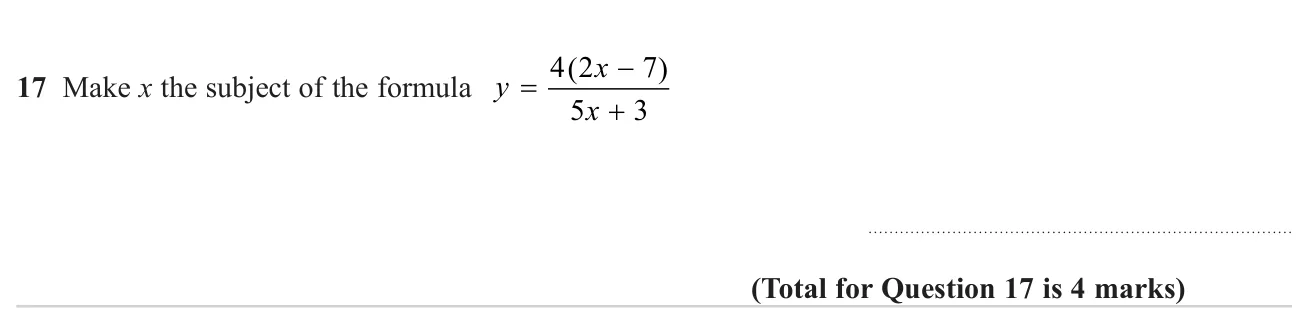
© Pearson Education Ltd. June 2023 Paper 1 (Higher, non-calculator), question 17.
Show answer
| Answer | x=8−5y3y+28 | 4 marks |
|---|
Worked solution Checked against the mark scheme
Multiply both sides by 5x+3: 5xy+3y=8x−28
Collect x terms on one side: 3y+28=8x−5xy
Factorise: 3y+28=x(8−5y)
Divide: x=8−5y3y+28
Watch out: Not factorising out x, leaving x on both sides.
Question 18
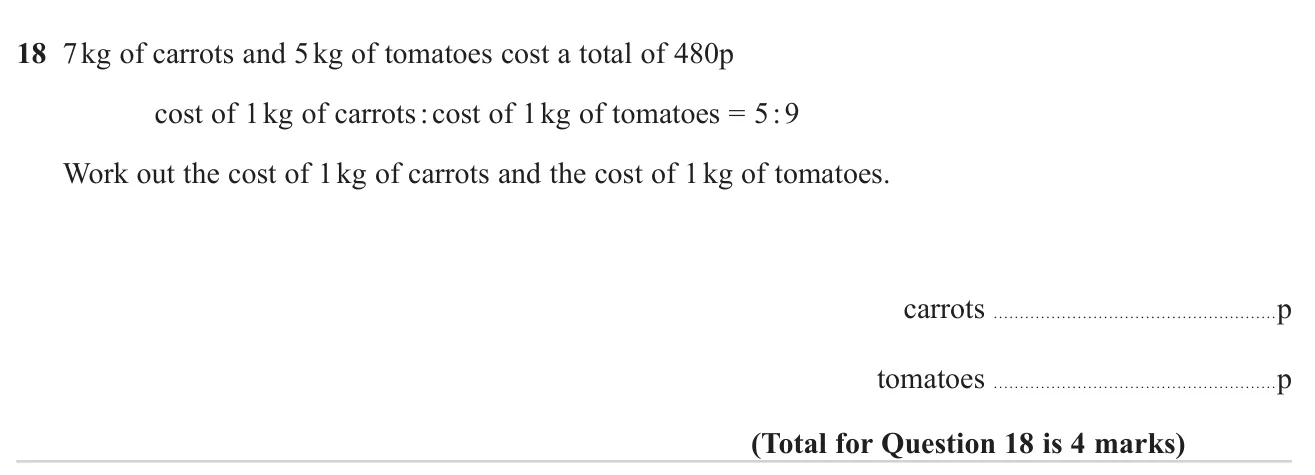
Ratio4 marksGrade 6No calculator © Pearson Education Ltd. June 2023 Paper 1 (Higher, non-calculator), question 18.
Show answer
| Answer | Carrots 30p, tomatoes 54p | 4 marks |
|---|
Worked solution Checked against the mark scheme
Let 1 kg of carrots cost 5k and 1 kg of tomatoes cost 9k.
7(5k)+5(9k)=480, so 35k+45k=80k=480 and k=6
Carrots: 5×6=30p. Tomatoes: 9×6=54p
Watch out: Sharing 480 in the ratio 5 : 9 without allowing for the different weights.
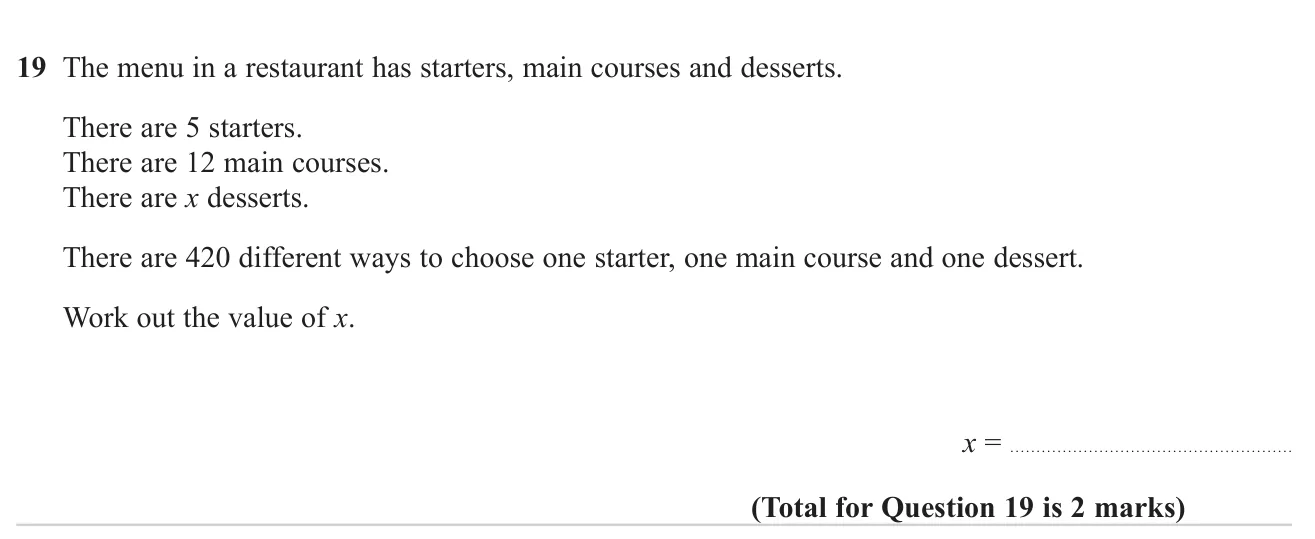
© Pearson Education Ltd. June 2023 Paper 1 (Higher, non-calculator), question 19.
Show answer
Worked solution Checked against the mark scheme
Number of meals =5×12×x=60x
60x=420, so x=7
Watch out: Adding the choices (5 + 12 + x = 420) instead of multiplying.
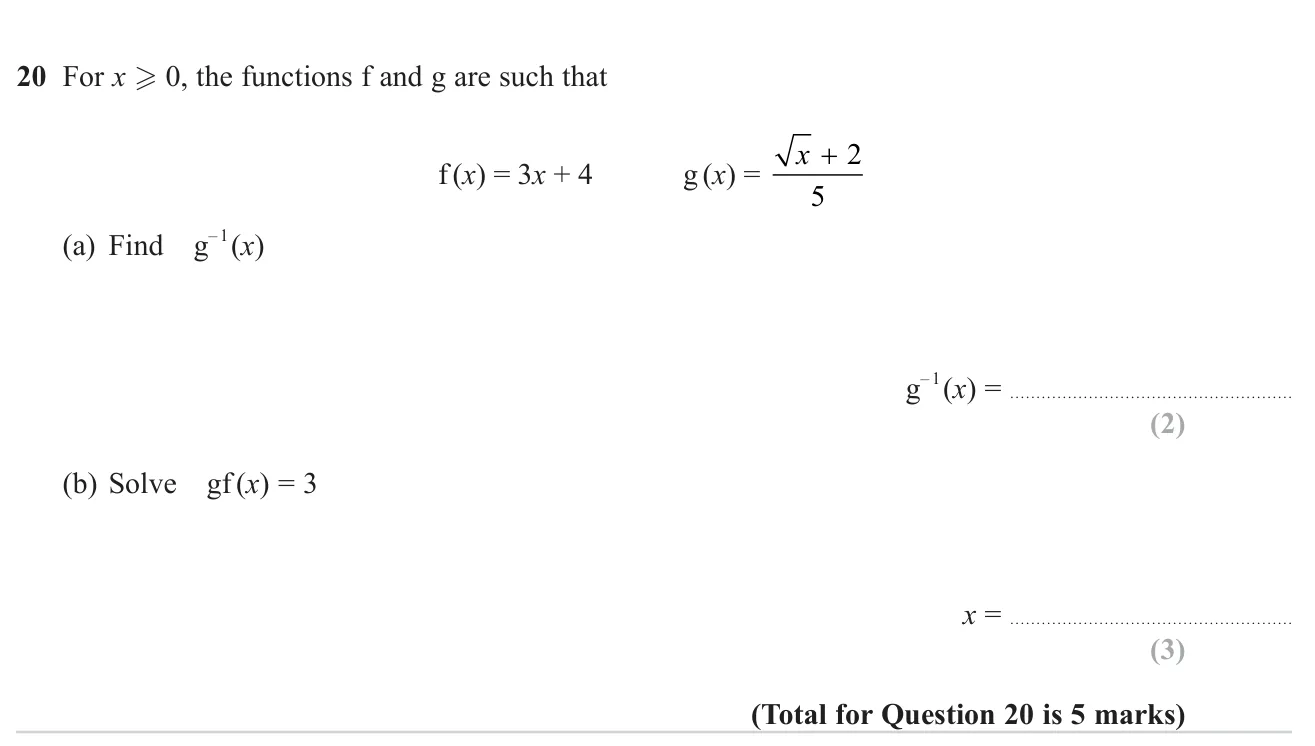
© Pearson Education Ltd. June 2023 Paper 1 (Higher, non-calculator), question 20.
Show answer
| (a) | (5x−2)2 | 2 marks |
|---|
| (b) | x=55 | 3 marks |
|---|
Worked solution Checked against the mark scheme
(a) Let y=5x+2. Then 5y=x+2, so x=5y−2 and x=(5y−2)2
g−1(x)=(5x−2)2
(b) gf(x)=3 means f(x)=g−1(3)=(15−2)2=169
3x+4=169, so 3x=165 and x=55
Watch out: Applying the functions in the wrong order (working out fg instead of gf).
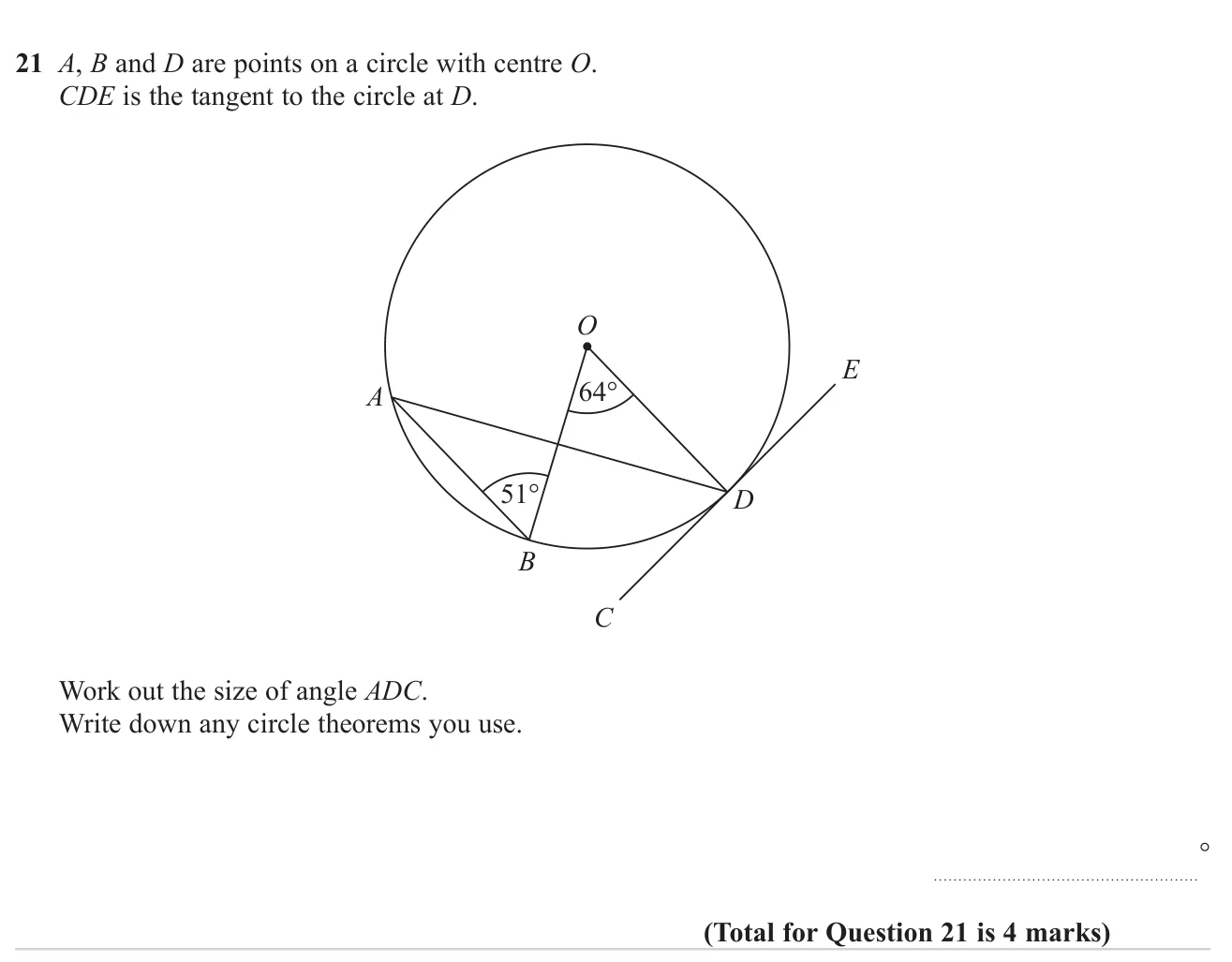
© Pearson Education Ltd. June 2023 Paper 1 (Higher, non-calculator), question 21.
Show answer
| Answer | 71∘ | 4 marks |
|---|
Worked solution Checked against the mark scheme
Angle BAD=64÷2=32∘ (angle at the centre is twice the angle at the circumference).
Let AD meet OB at P. In triangle ABP: angle APB=180−51−32=97∘, so angle OPD=97∘ (vertically opposite).
In triangle OPD: angle ODA=180−64−97=19∘
Angle ODC=90∘ (tangent is perpendicular to the radius), so angle ADC=90−19=71∘
Watch out: Not stating the circle theorems used, which loses the communication mark.
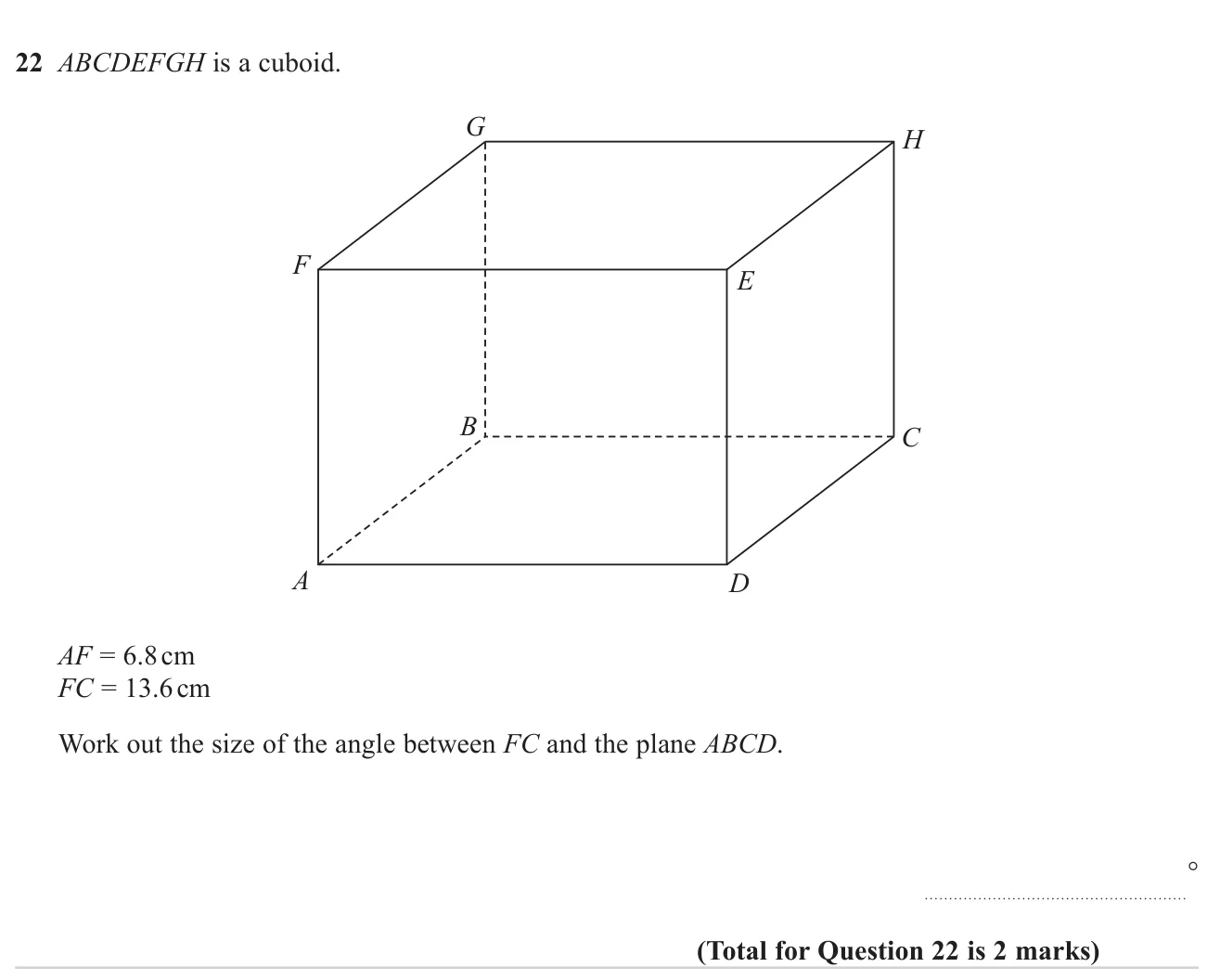
© Pearson Education Ltd. June 2023 Paper 1 (Higher, non-calculator), question 22.
Show answer
| Answer | 30∘ | 2 marks |
|---|
Worked solution Checked against the mark scheme
The angle is FCA in the right-angled triangle FAC (right angle at A).
sinx=hypopp=13.66.8=21
So x=30∘
Watch out: Using cos or tan with the wrong sides, or finding the angle with a vertical edge instead of the base.
Question 23
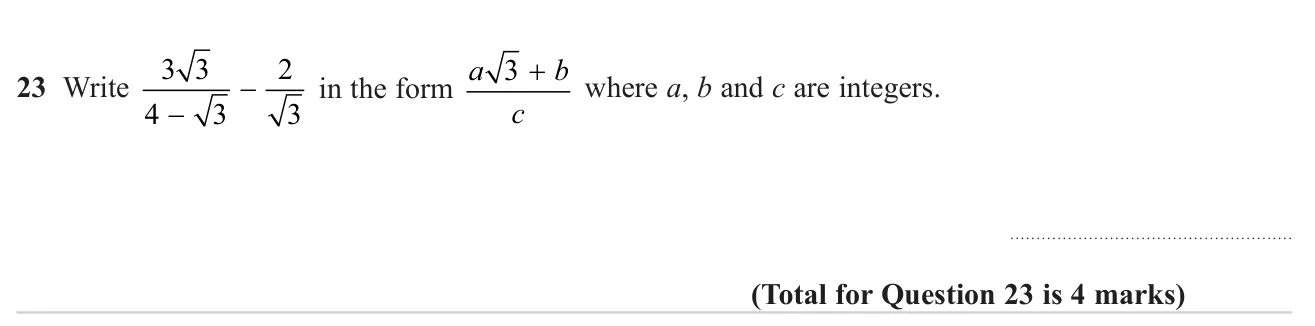
Surds4 marksGrade 9No calculator © Pearson Education Ltd. June 2023 Paper 1 (Higher, non-calculator), question 23.
Show answer
| Answer | 39103+27 | 4 marks |
|---|
Worked solution Checked against the mark scheme
4−333×4+34+3=13123+9
32=323
Common denominator 39: 39363+27−39263=39103+27
Watch out: Multiplying by 4−3 instead of the conjugate 4+3.
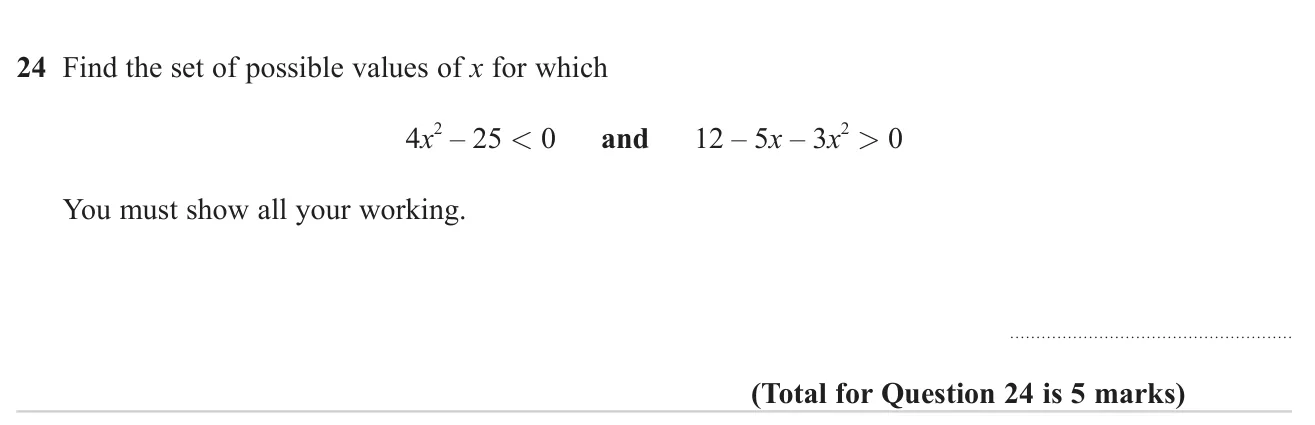
© Pearson Education Ltd. June 2023 Paper 1 (Higher, non-calculator), question 24.
Show answer
| Answer | −2.5<x<34 | 5 marks |
|---|
Worked solution Checked against the mark scheme
4x2−25=(2x+5)(2x−5)<0 gives −2.5<x<2.5
12−5x−3x2>0 is the same as 3x2+5x−12<0, i.e. (3x−4)(x+3)<0, giving −3<x<34
Both must hold, so −2.5<x<34
Watch out: Taking the outside region (x < a or x > b) instead of the region between the critical values.
Finished the paper?
Add up your marks for all three papers and see what grade that would have been.