© Pearson Education Ltd. November 2024 Paper 1 (Higher, non-calculator), question 1.
Show answer
Worked solution Checked against the mark scheme
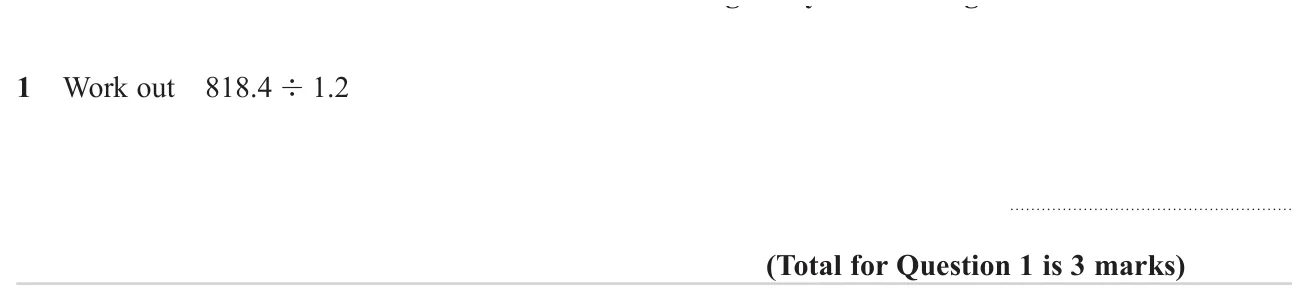
Multiply both numbers by 10: 8184÷12
81÷12=6 r 9, 98÷12=8 r 2, 24÷12=2
So the answer is 682.
Watch out: Giving 68.2 after misplacing the decimal point.
© Pearson Education Ltd. November 2024 Paper 1 (Higher, non-calculator), question 2.
Show answer
| (a) | 75 | 3 marks |
|---|
| (b) | The estimate would be greater than 75 | 1 mark |
|---|
Worked solution Checked against the mark scheme
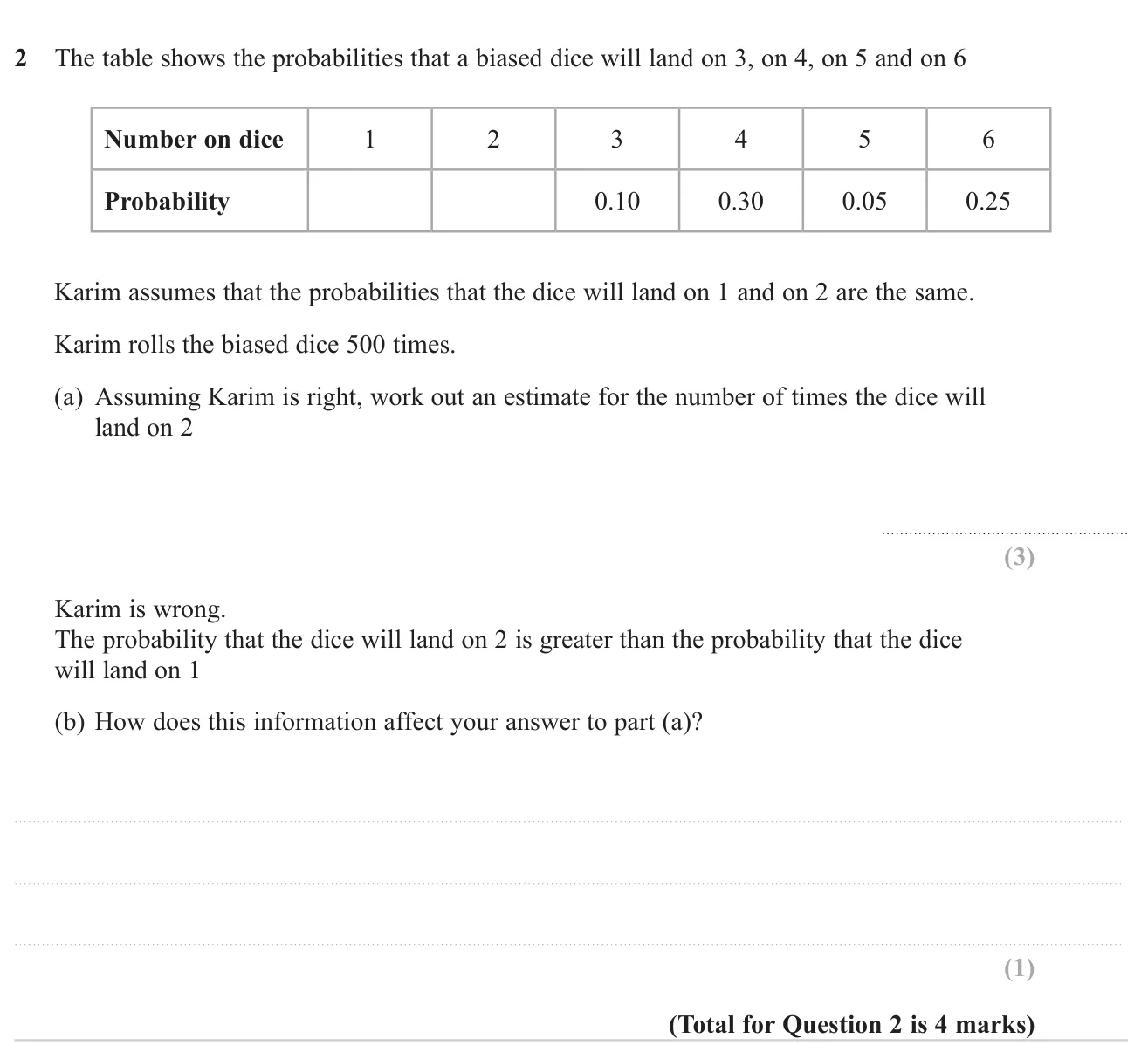
(a) 0.10+0.30+0.05+0.25=0.70, so P(1)+P(2)=0.30
P(2)=0.30÷2=0.15
Estimate =0.15×500=75
(b) P(2) is really more than 0.15, so the number of 2s would be more than 75.
Watch out: In (a), forgetting to halve 0.3 and getting 150.
Question 3
Fractions5 marksGrade 4No calculatorOn both tiers © Pearson Education Ltd. November 2024 Paper 1 (Higher, non-calculator), question 3.
Show answer
| (a) | 231 | 2 marks |
|---|
| (b) | Shown: 421×73=2863=49=241 | 3 marks |
|---|
Worked solution Checked against the mark scheme
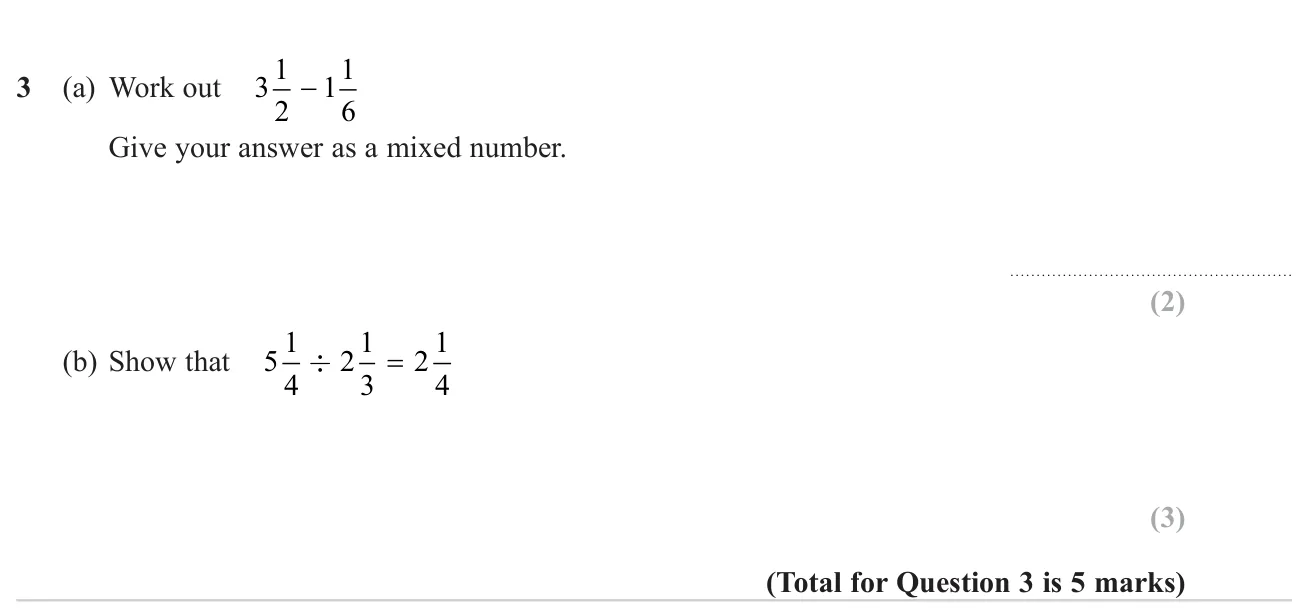
(a) 321−161=363−161=262=231
(b) 541=421 and 231=37
421÷37=421×73=2863=49=241
Watch out: In (b), dividing the whole numbers and fractions separately.
© Pearson Education Ltd. November 2024 Paper 1 (Higher, non-calculator), question 4.
Show answer
| Answer | 180−4e with reasons | 3 marks |
|---|
Worked solution Checked against the mark scheme
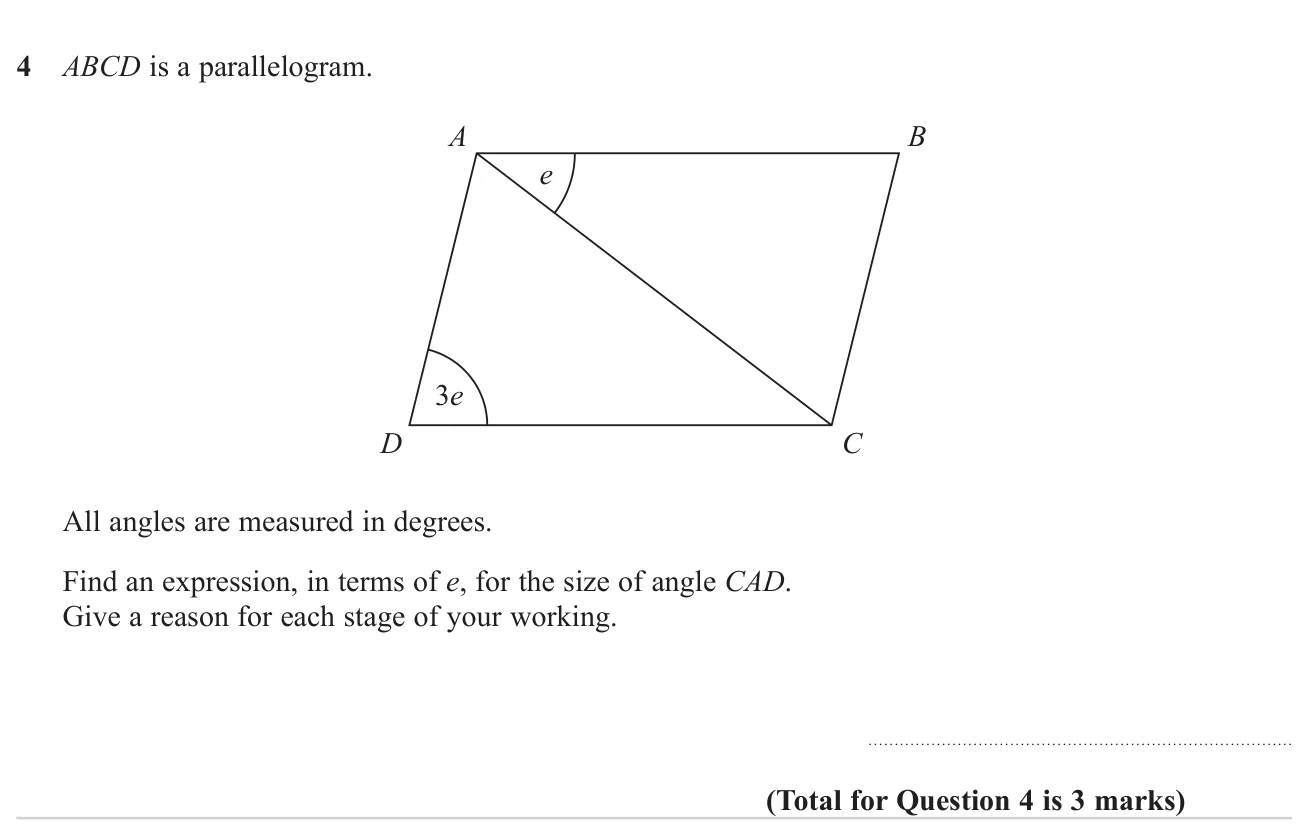
AB is parallel to DC, so angle ACD=e (alternate angles are equal).
Angles in triangle ACD add up to 180°:
angle CAD=180−3e−e=180−4e
Watch out: Giving the reason as 'Z angles' instead of alternate angles.
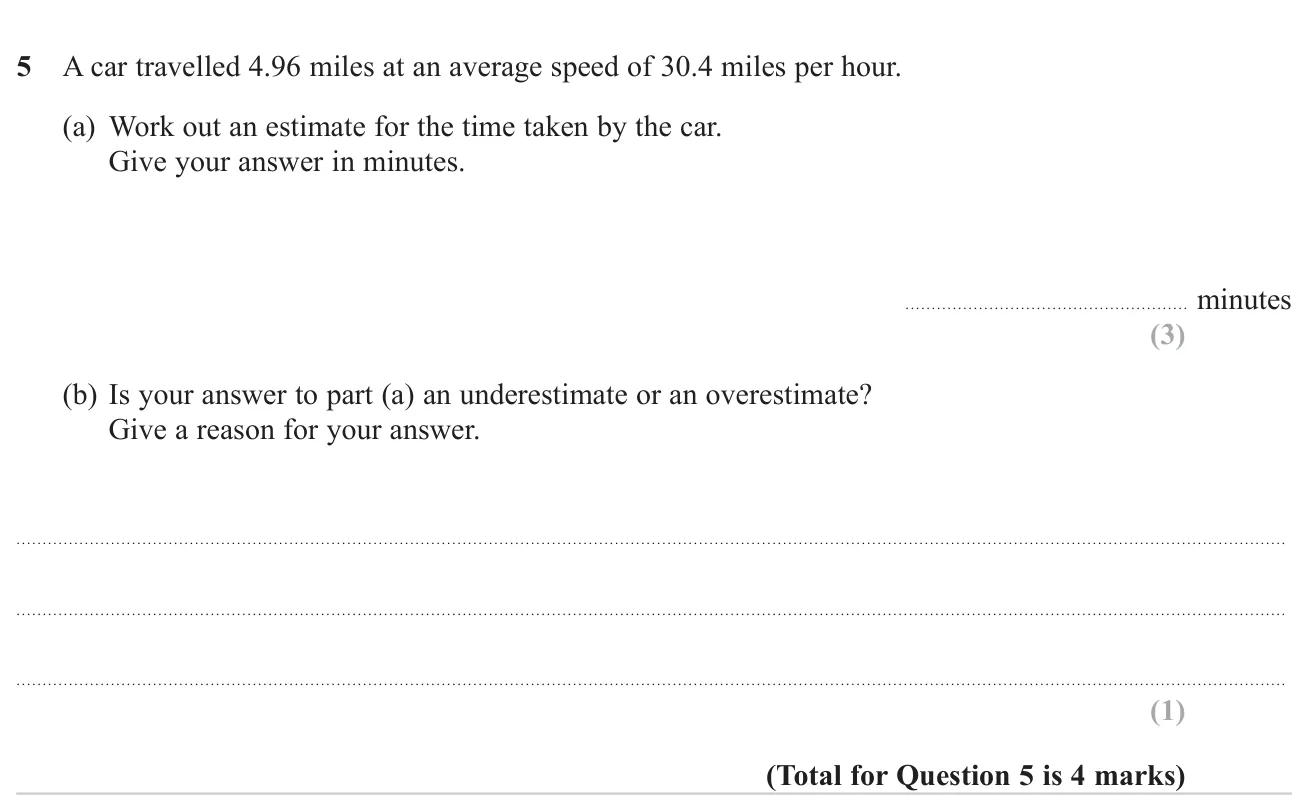
© Pearson Education Ltd. November 2024 Paper 1 (Higher, non-calculator), question 5.
Show answer
| (a) | 10 minutes | 3 marks |
|---|
| (b) | Overestimate: distance rounded up and speed rounded down | 1 mark |
|---|
Worked solution Checked against the mark scheme
(a) Round: 4.96≈5 miles, 30.4≈30 mph
Time =5÷30=61 hour =10 minutes
(b) The distance was rounded up and the speed rounded down, so the estimate is too big: an overestimate.
Watch out: In (a), leaving the answer as 0.17 hours or 1/6.
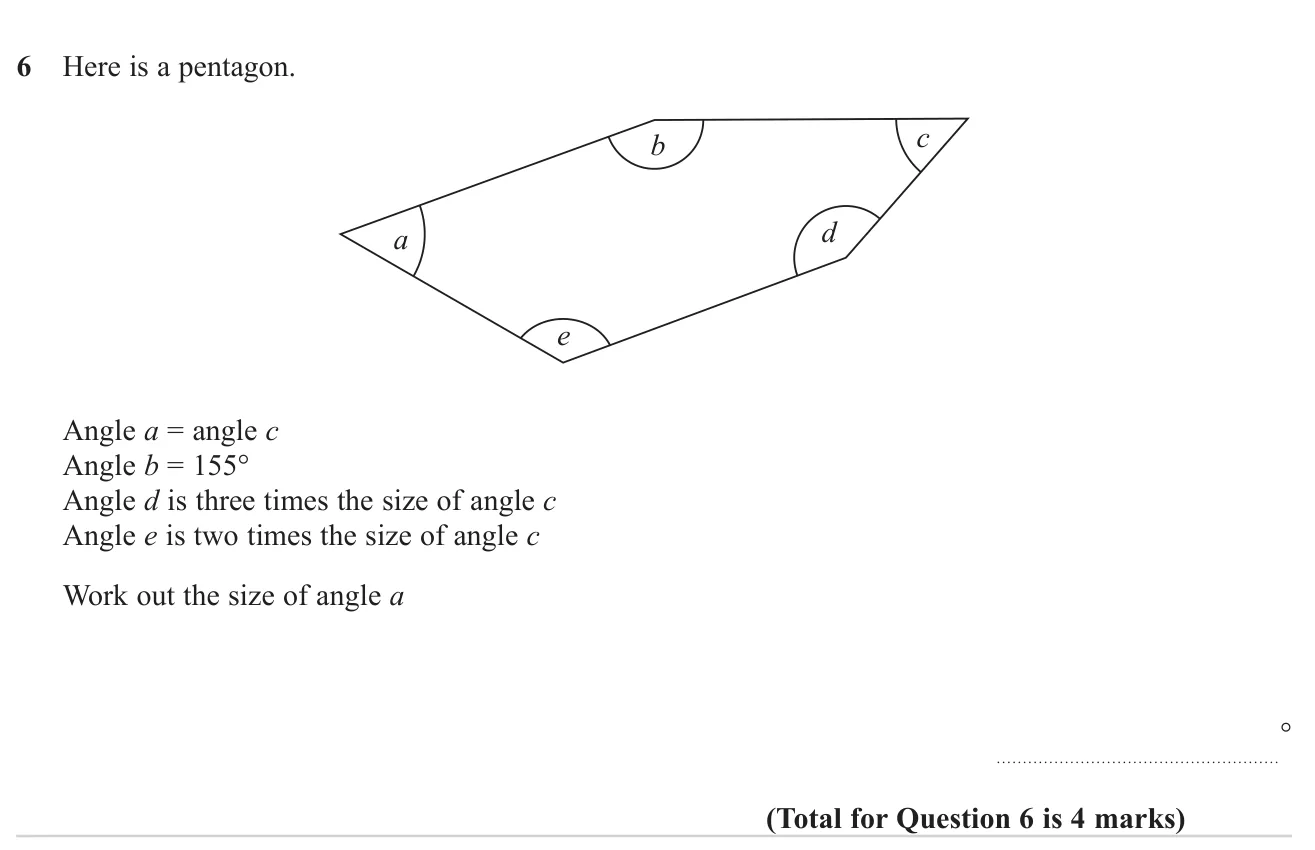
© Pearson Education Ltd. November 2024 Paper 1 (Higher, non-calculator), question 6.
Show answer
Worked solution Checked against the mark scheme
Angle sum =(5−2)×180=540°
c+155+c+3c+2c=540
7c=385, so c=55
Angle a=55°
Watch out: Using 360° as the angle sum.
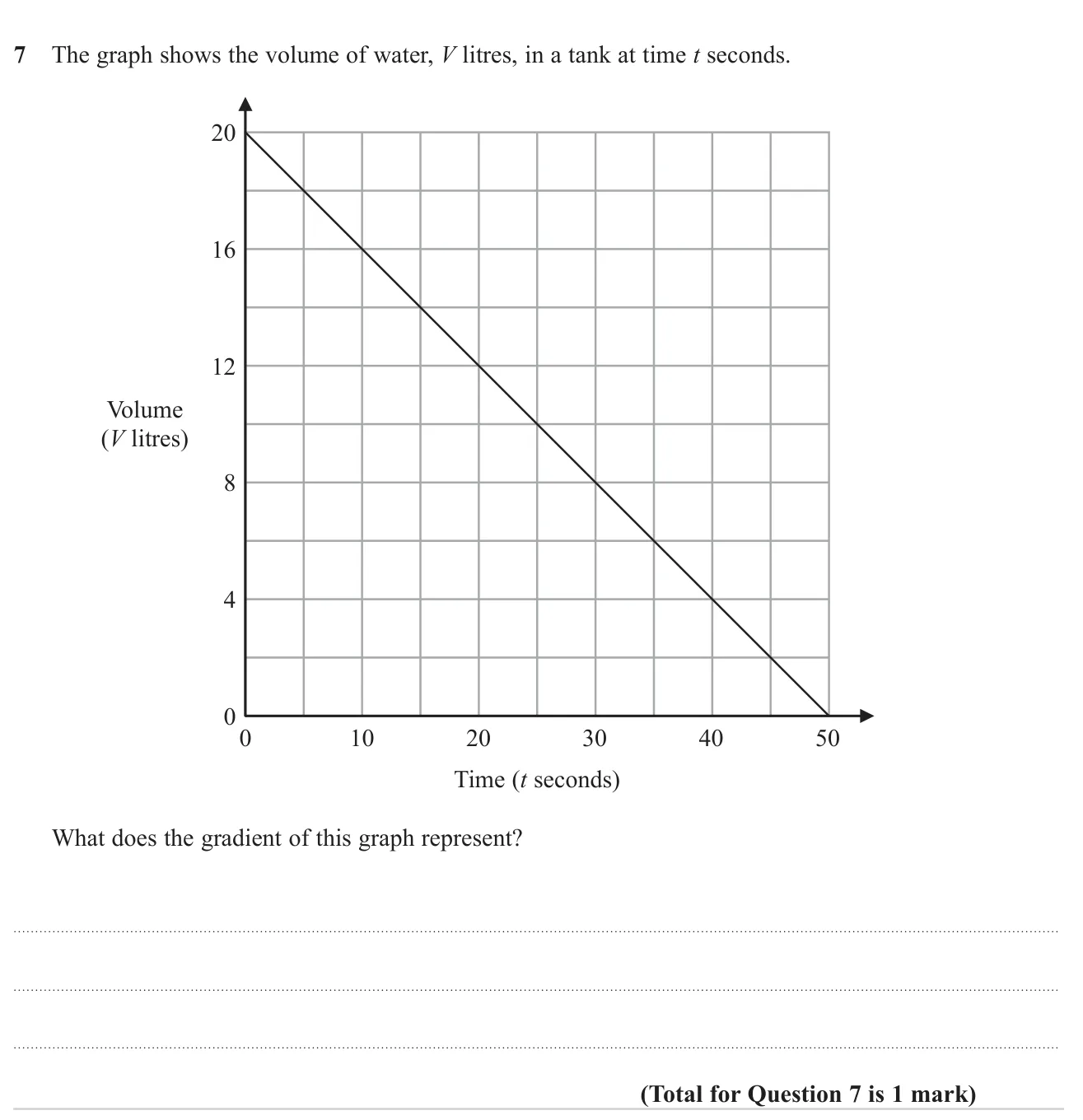
© Pearson Education Ltd. November 2024 Paper 1 (Higher, non-calculator), question 7.
Show answer
| Answer | The rate at which the volume of water changes (litres leaving per second) | 1 mark |
|---|
Worked solution Checked against the mark scheme
The gradient is change in volume ÷ change in time.
Here −20÷50=−0.4, so water leaves the tank at 0.4 litres per second: the rate of change of volume.
Watch out: Saying 'negative correlation' or just 'the volume goes down'.
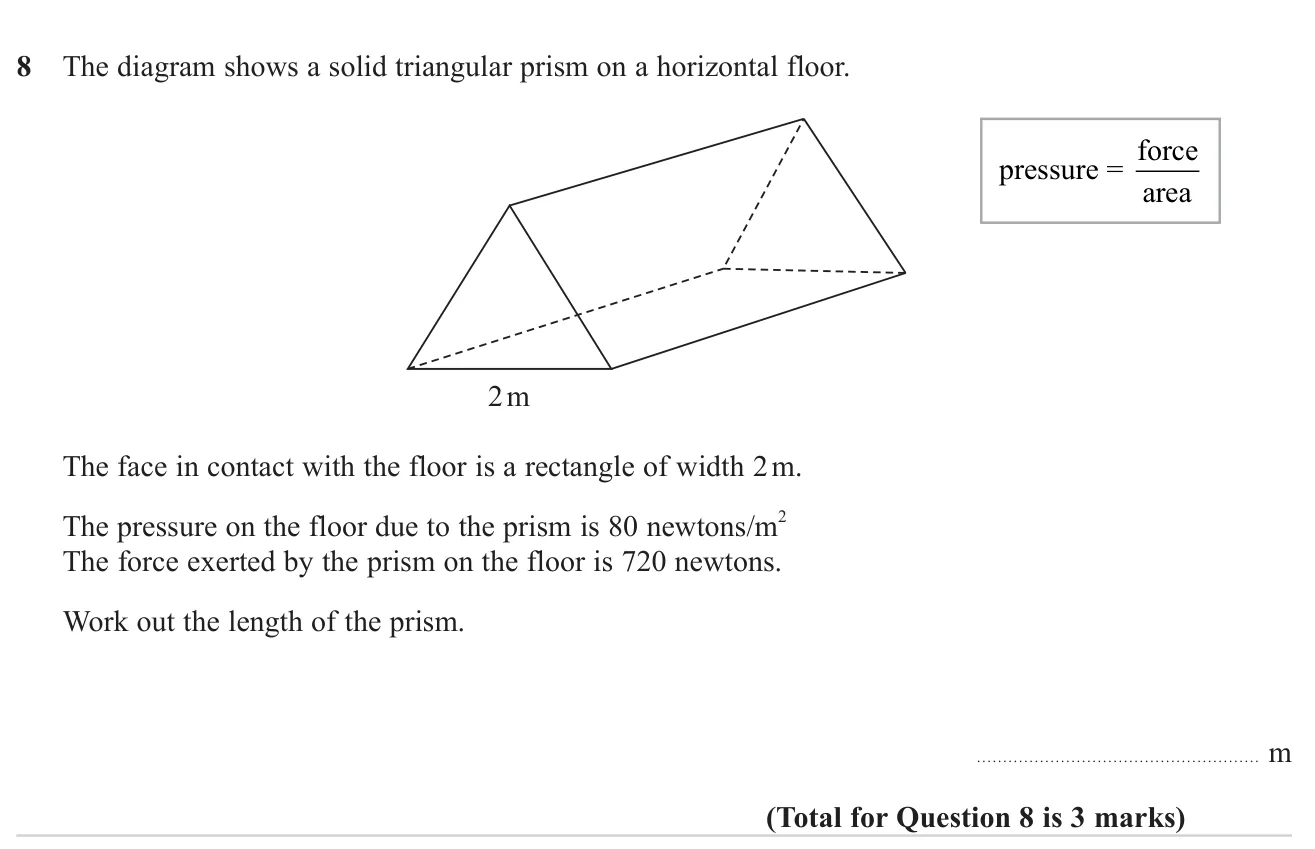
© Pearson Education Ltd. November 2024 Paper 1 (Higher, non-calculator), question 8.
Show answer
Worked solution Checked against the mark scheme
Area =force÷pressure=720÷80=9 m2
Length =9÷2=4.5 m
Watch out: Multiplying 720 by 80 instead of dividing.
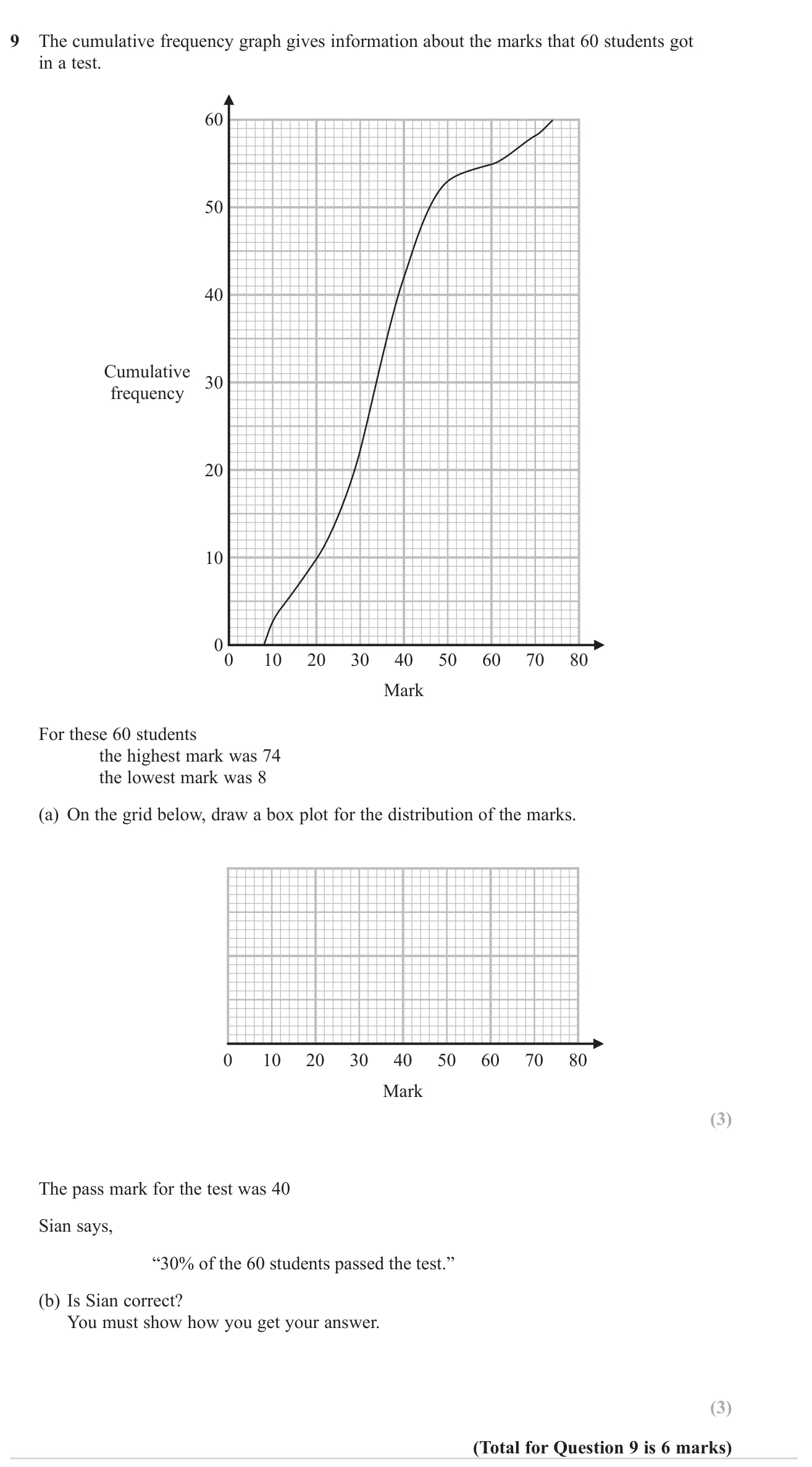
© Pearson Education Ltd. November 2024 Paper 1 (Higher, non-calculator), question 9.
Show answer
| (a) | Box plot: minimum 8, lower quartile 25, median 34, upper quartile 42, maximum 74 | 3 marks |
|---|
| (b) | Yes: about 42 students scored under 40, so 18 passed, and 18 is 30% of 60 | 3 marks |
|---|
Worked solution Checked against the mark scheme
(a) Read across at cf 15, 30 and 45:
LQ ≈25, median ≈34, UQ ≈42. Plot these with the lowest mark 8 and highest 74.
(b) At mark 40 the graph reads a cumulative frequency of about 42.
Passed: 60−42=18, and 6018×100=30%. So Sian is correct.
Watch out: Reading the quartiles at cf 20 and 40 instead of 15 and 45.
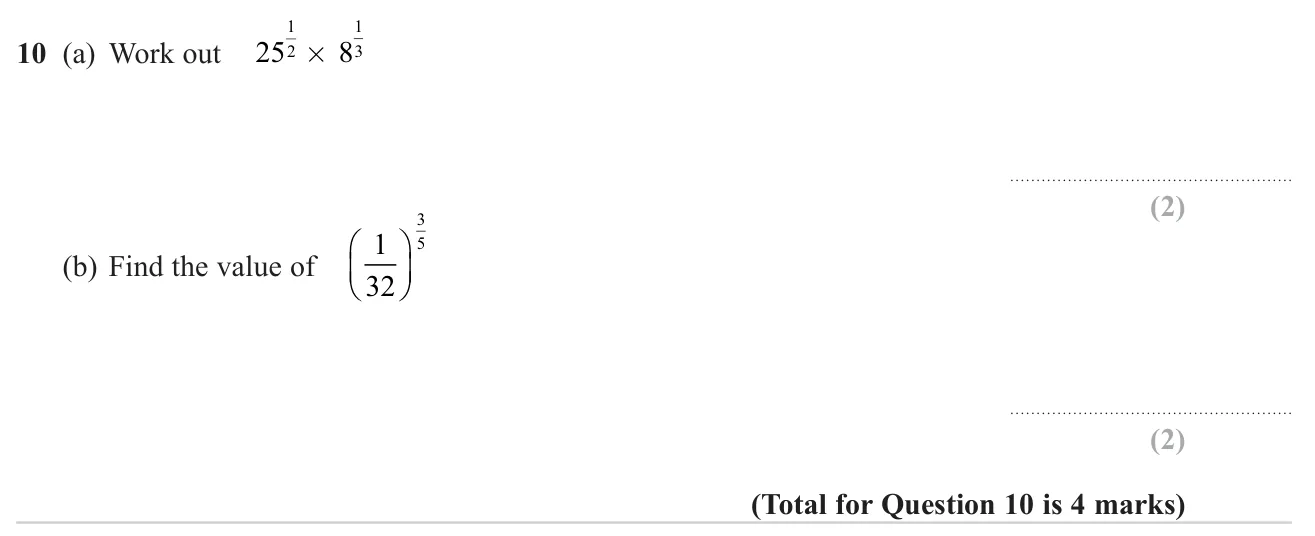
© Pearson Education Ltd. November 2024 Paper 1 (Higher, non-calculator), question 10.
Show answer
| (a) | 10 | 2 marks |
|---|
| (b) | 81 | 2 marks |
|---|
Worked solution Checked against the mark scheme
(a) 2521=25=5 and 831=38=2, so the product is 10.
(b) (321)51=21, then (21)3=81
Watch out: Treating the power 1/2 as 'divide by 2', giving 12.5.
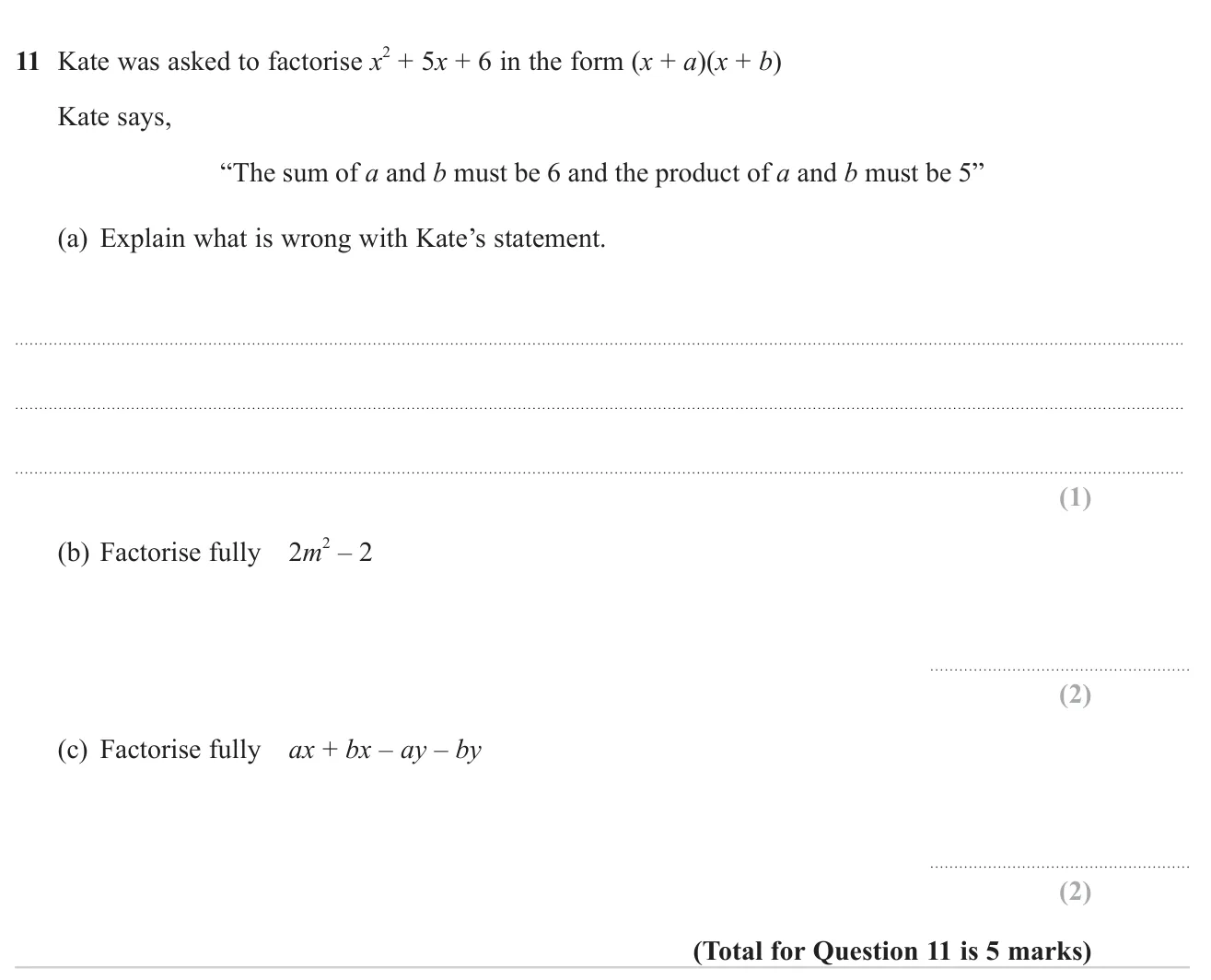
© Pearson Education Ltd. November 2024 Paper 1 (Higher, non-calculator), question 11.
Show answer
| (a) | The sum and product are swapped: a+b should be 5 and ab should be 6 | 1 mark |
|---|
| (b) | 2(m−1)(m+1) | 2 marks |
|---|
| (c) | (a+b)(x−y) | 2 marks |
|---|
Worked solution Checked against the mark scheme
(a) Expanding (x+a)(x+b) gives x2+(a+b)x+ab, so a+b=5 and ab=6. Kate has them the wrong way round.
(b) 2m2−2=2(m2−1)=2(m−1)(m+1)
(c) ax+bx−ay−by=x(a+b)−y(a+b)=(a+b)(x−y)
Watch out: In (b), stopping at 2(m² − 1) and not using the difference of two squares.
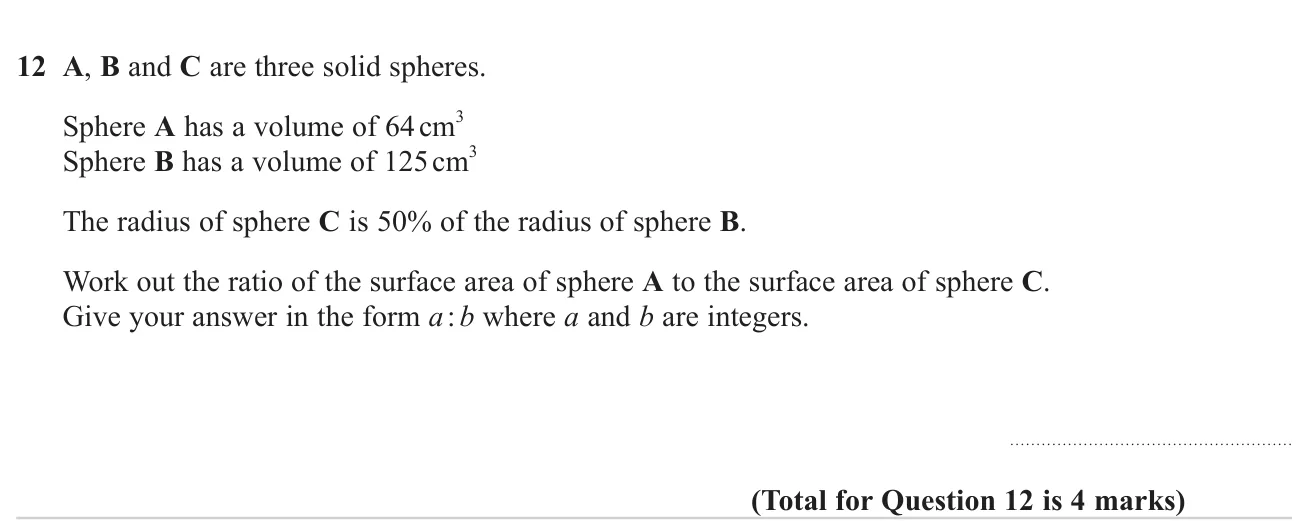
© Pearson Education Ltd. November 2024 Paper 1 (Higher, non-calculator), question 12.
Show answer
| Answer | 64:25 | 4 marks |
|---|
Worked solution Checked against the mark scheme
Spheres are similar. Volume ratio A:B=64:125, so radius ratio =364:3125=4:5
Radius of C is half of B's: 4:2.5 for A : C
Area ratio =42:2.52=16:6.25=64:25
Watch out: Using the volume ratio directly instead of cube-rooting first.
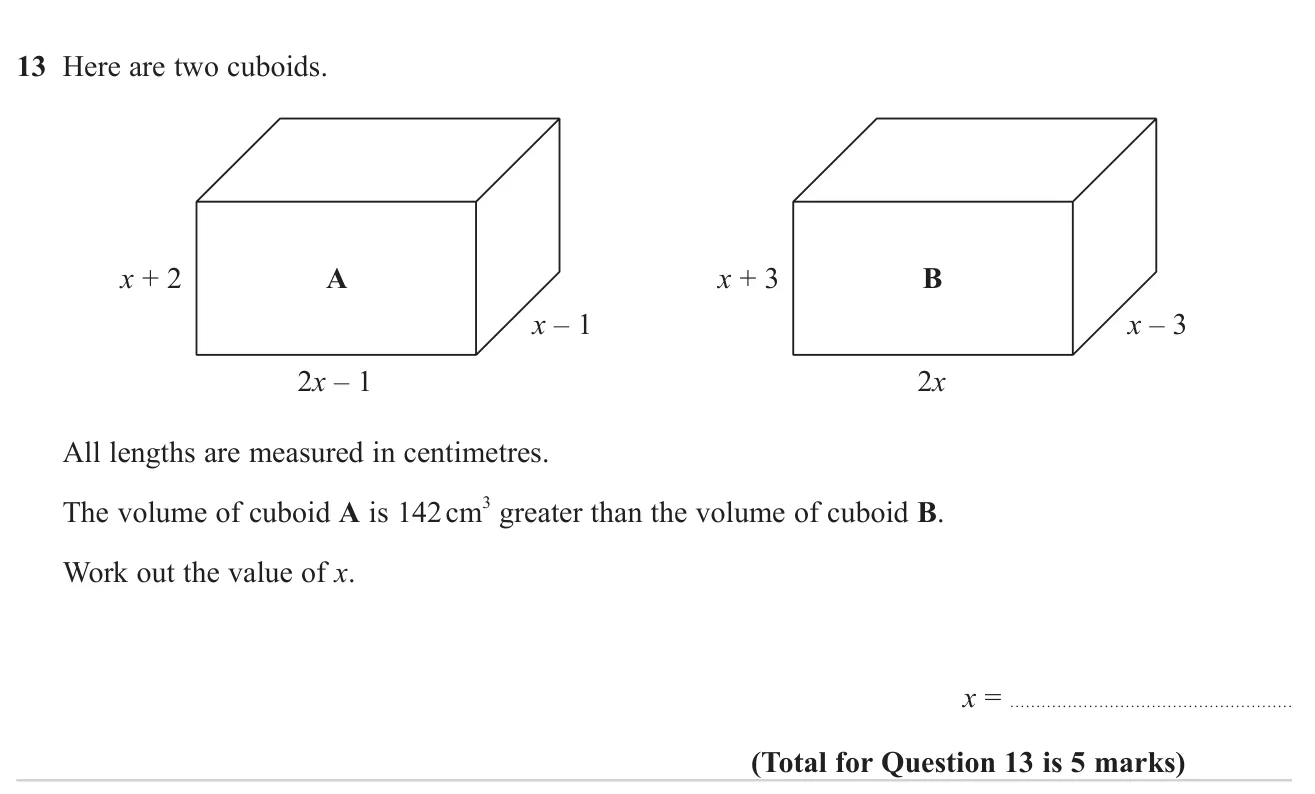
© Pearson Education Ltd. November 2024 Paper 1 (Higher, non-calculator), question 13.
Show answer
Worked solution Checked against the mark scheme
Volume A =(x+2)(2x−1)(x−1)=2x3+x2−5x+2
Volume B =2x(x+3)(x−3)=2x3−18x
2x3+x2−5x+2=2x3−18x+142
x2+13x−140=0, so (x+20)(x−7)=0
Lengths must be positive, so x=7.
Watch out: Sign errors when expanding the triple product.
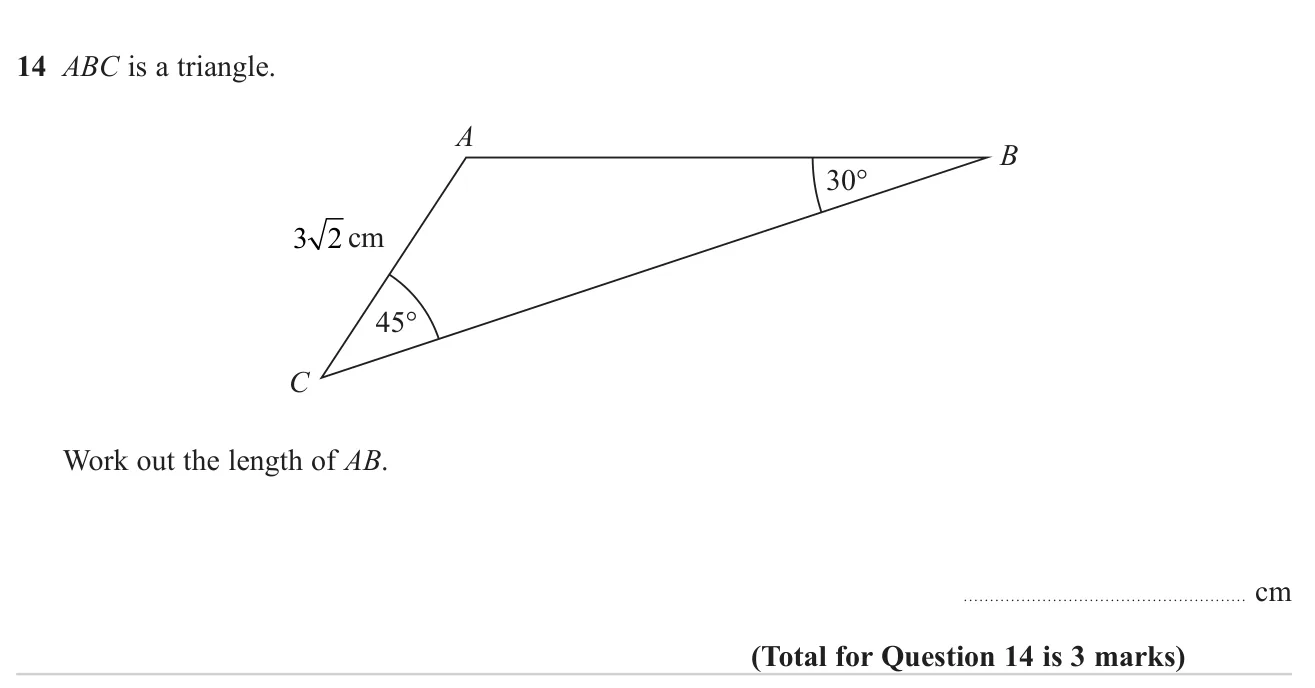
© Pearson Education Ltd. November 2024 Paper 1 (Higher, non-calculator), question 14.
Show answer
Worked solution Checked against the mark scheme
Sine rule: sin45°AB=sin30°32
sin45°=22, sin30°=21
AB=32×22÷21=32×2=6 cm
Watch out: Matching each side with the wrong opposite angle.
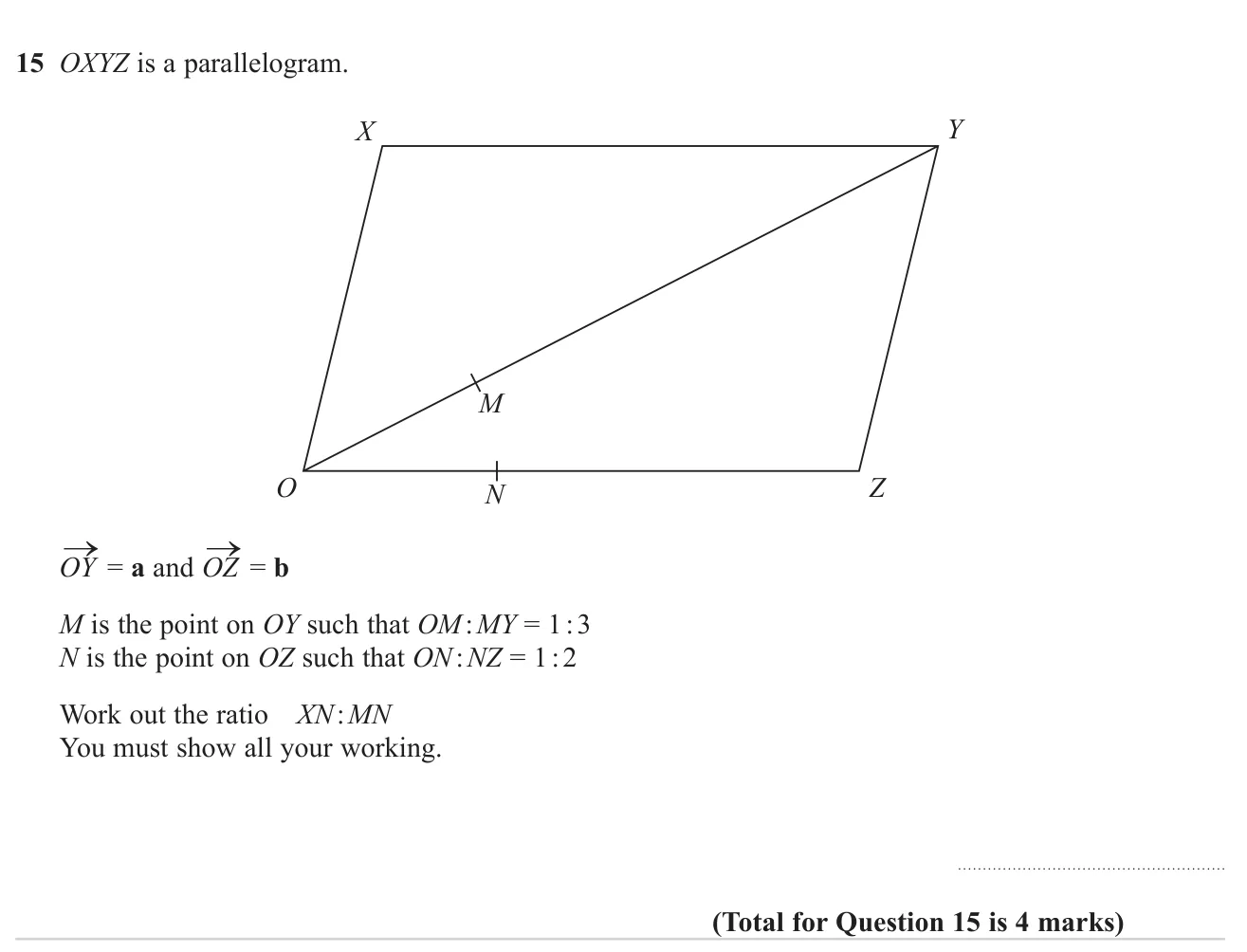
© Pearson Education Ltd. November 2024 Paper 1 (Higher, non-calculator), question 15.
Show answer
Worked solution Checked against the mark scheme
OM=41a, ON=31b, OX=ZY=a−b
XN=−(a−b)+31b=34b−a=31(4b−3a)
MN=−41a+31b=121(4b−3a)
XN:MN=31:121=4:1
Watch out: Taking OX as b − a (wrong direction).
Question 16
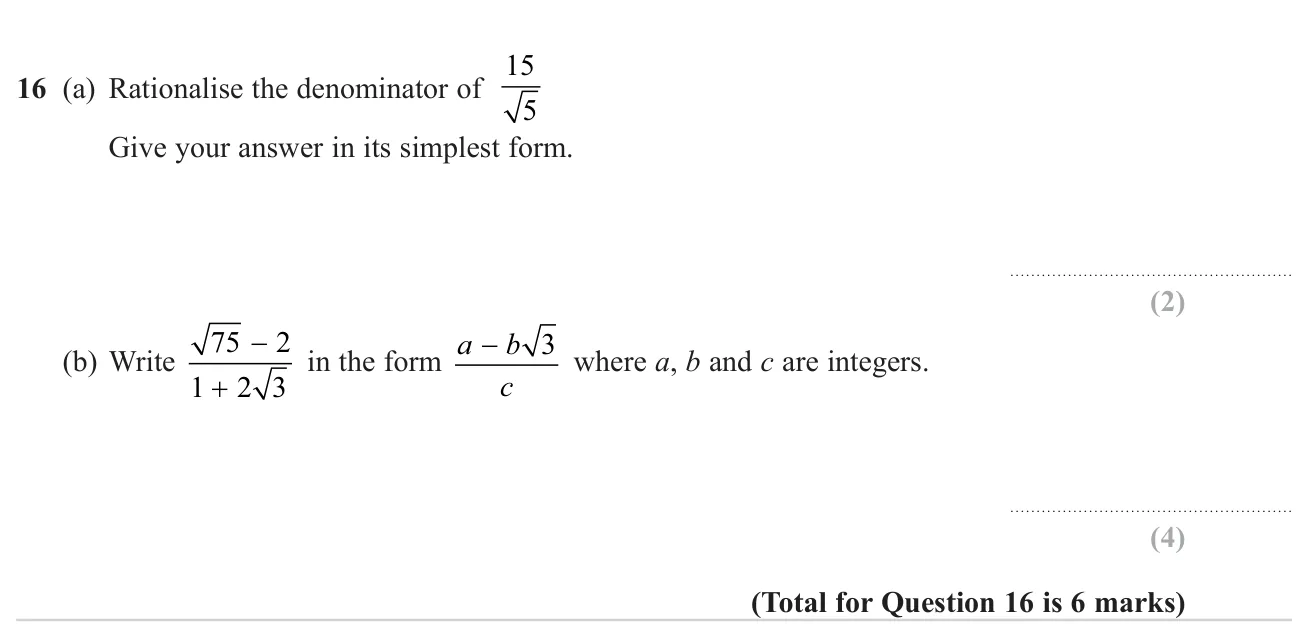
Surds6 marksGrade 8No calculator © Pearson Education Ltd. November 2024 Paper 1 (Higher, non-calculator), question 16.
Show answer
| (a) | 35 | 2 marks |
|---|
| (b) | 1132−93 | 4 marks |
|---|
Worked solution Checked against the mark scheme
(a) 515×55=5155=35
(b) 75=53. Multiply top and bottom by 1−23:
Top: (53−2)(1−23)=53−30−2+43=93−32
Bottom: 1−12=−11
−1193−32=1132−93
Watch out: Getting 23×23=6 instead of 12.
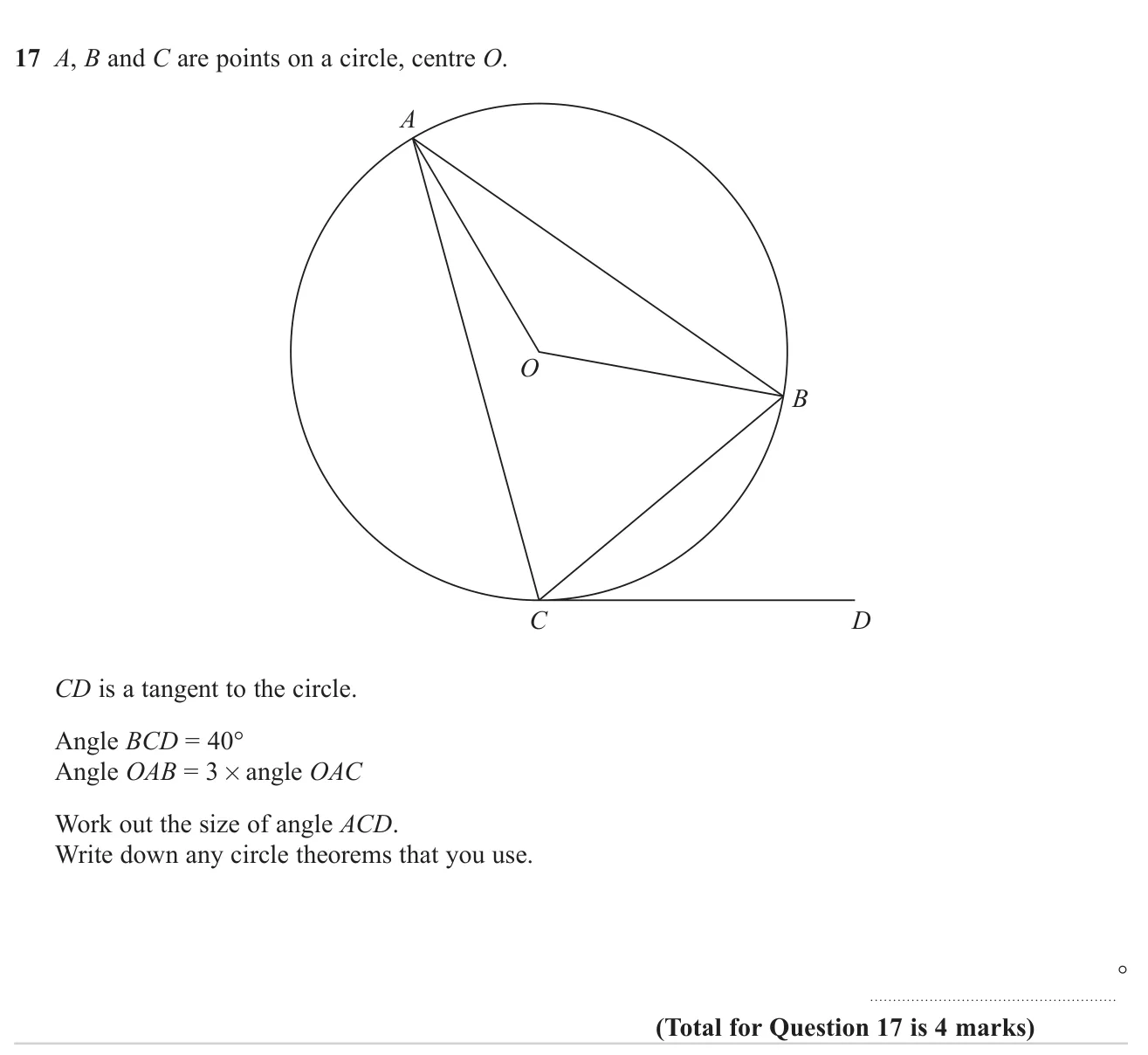
© Pearson Education Ltd. November 2024 Paper 1 (Higher, non-calculator), question 17.
Show answer
| Answer | 100° with a correct circle theorem | 4 marks |
|---|
Worked solution Checked against the mark scheme
Alternate segment theorem: angle BAC= angle BCD=40°
Angle OAB=3× angle OAC and they add to 40°, so angle OAC=10° and angle OAB=30°
Triangle OAB is isosceles, so angle AOB=180−30−30=120°
Angle at the centre is twice the angle at the circumference: angle ACB=60°
Angle ACD=60+40=100°
Watch out: Using 90° between tangent and chord rather than between tangent and radius.
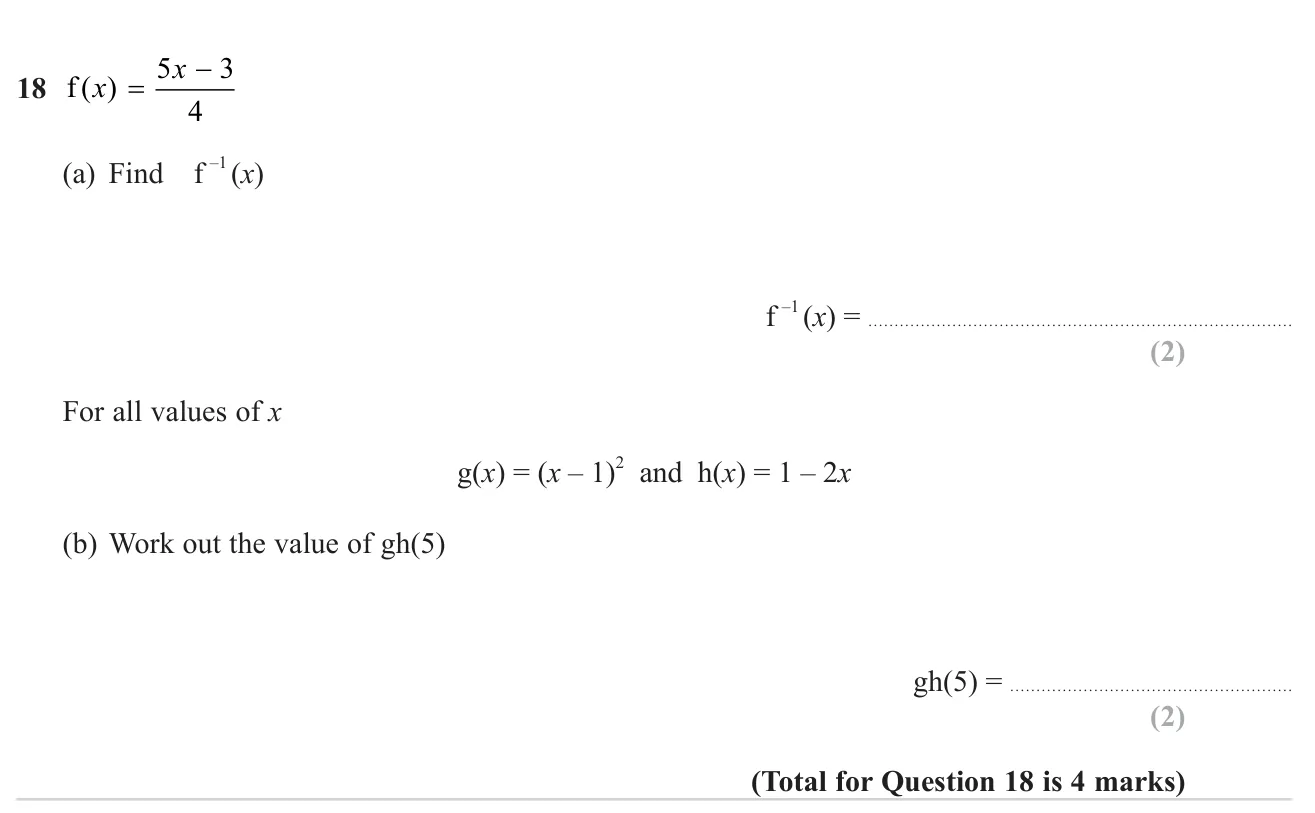
© Pearson Education Ltd. November 2024 Paper 1 (Higher, non-calculator), question 18.
Show answer
| (a) | 54x+3 | 2 marks |
|---|
| (b) | 100 | 2 marks |
|---|
Worked solution Checked against the mark scheme
(a) Let y=45x−3. Then 4y=5x−3, 5x=4y+3, x=54y+3
So f−1(x)=54x+3
(b) h(5)=1−10=−9
g(−9)=(−9−1)2=100
Watch out: In (b), working out h(g(5)) instead of g(h(5)).
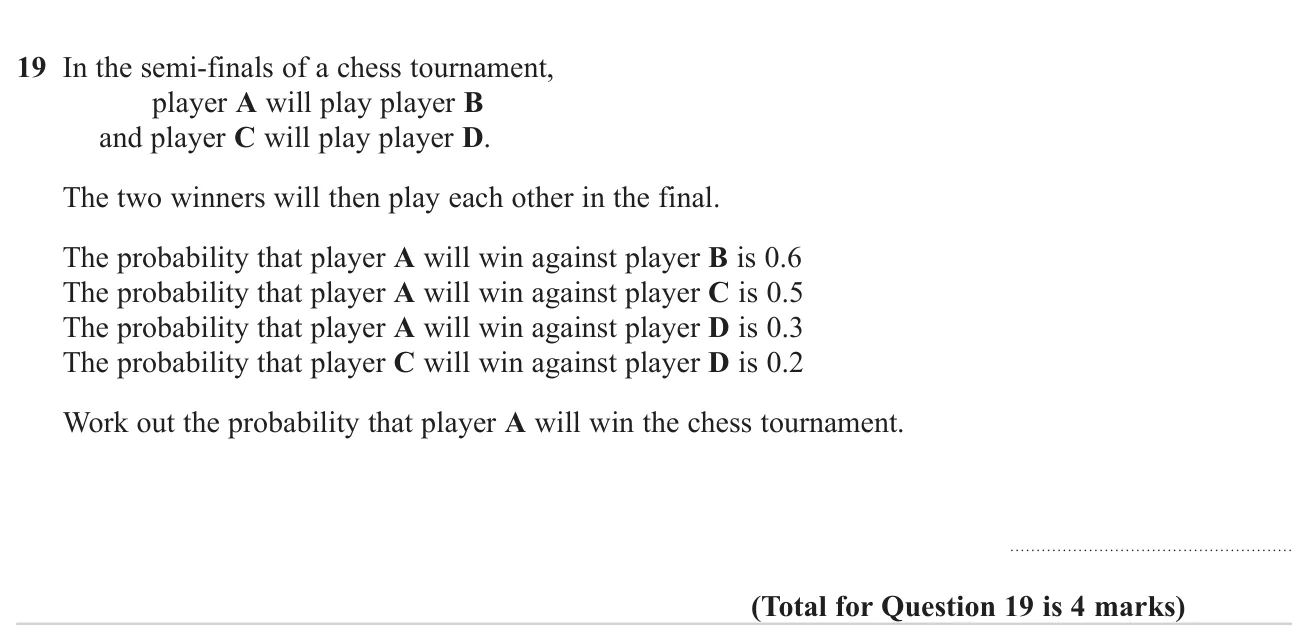
© Pearson Education Ltd. November 2024 Paper 1 (Higher, non-calculator), question 19.
Show answer
| Answer | 0.204 | 4 marks |
|---|
Worked solution Checked against the mark scheme
A must beat B: 0.6
Route 1: C reaches the final (0.2) and A beats C (0.5): 0.6×0.2×0.5=0.06
Route 2: D reaches the final (0.8) and A beats D (0.3): 0.6×0.8×0.3=0.144
Total: 0.06+0.144=0.204
Watch out: Ignoring who wins the other semi-final and multiplying all the probabilities together.
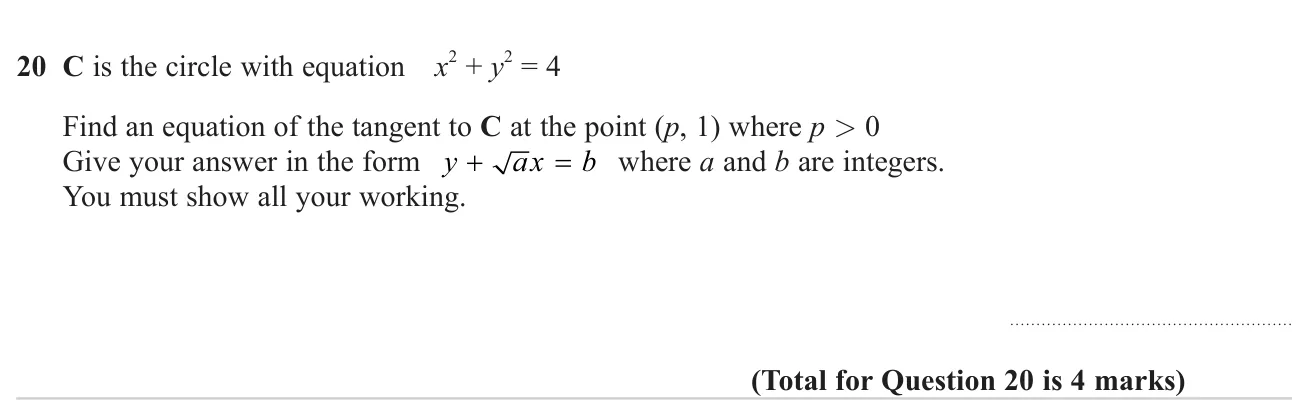
© Pearson Education Ltd. November 2024 Paper 1 (Higher, non-calculator), question 20.
Show answer
| Answer | y+3x=4 | 4 marks |
|---|
Worked solution Checked against the mark scheme
p2+12=4, so p=3 (as p>0)
Radius gradient =31, so tangent gradient =−3
y−1=−3(x−3), so y=−3x+3+1
y+3x=4
Watch out: Using the radius gradient as the tangent gradient.
Finished the paper?
Add up your marks for all three papers and see what grade that would have been.