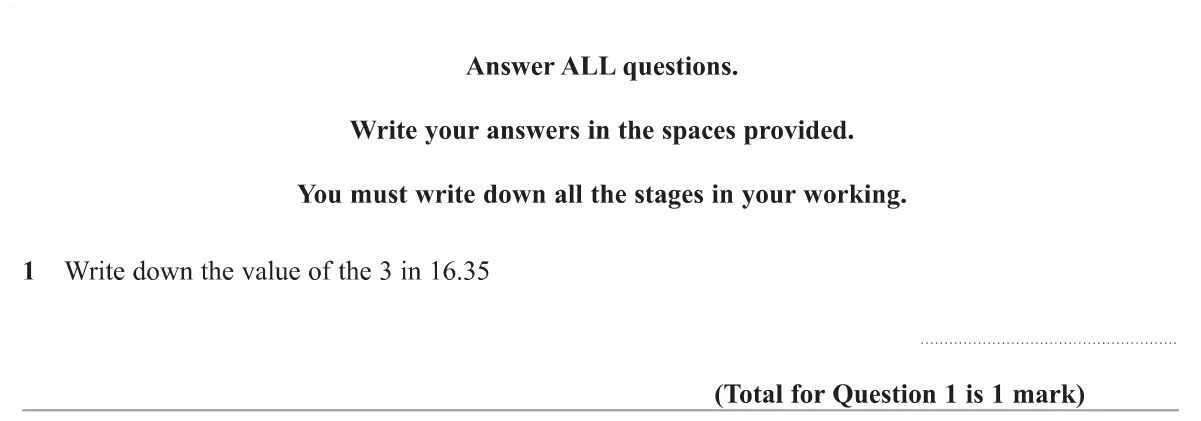
© Pearson Education Ltd. Specimen Paper 2 (Foundation, calculator), question 1.
Answer 3 tenths (3 10 \frac{3}{10} 10 3 1 mark
Worked solution Checked against the mark scheme
In 16.35 the digit after the decimal point is the tenths digit.
So the 3 is worth 3 tenths, which is 3 10 = 0.3 \frac{3}{10} = 0.3 10 3 = 0.3
Watch out: Saying 3 hundredths or just '3'.
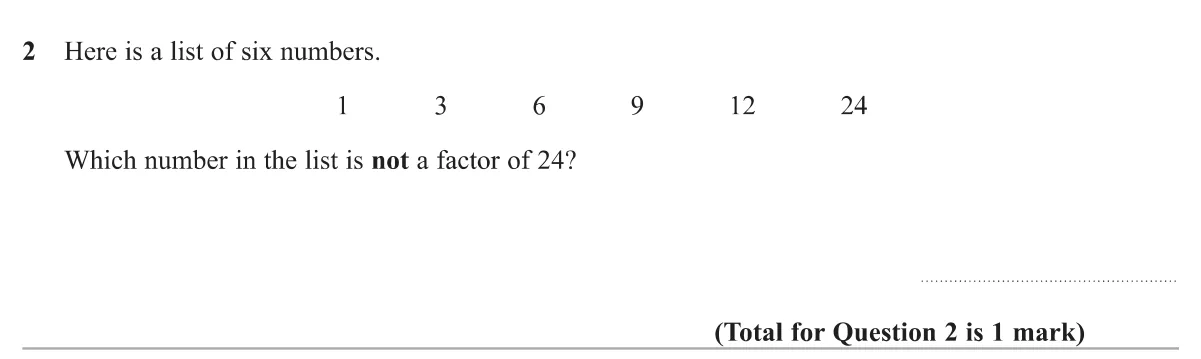
© Pearson Education Ltd. Specimen Paper 2 (Foundation, calculator), question 2.
Worked solution Checked against the mark scheme
Check each number: 24 ÷ 1 , 24 ÷ 3 , 24 ÷ 6 , 24 ÷ 12 , 24 ÷ 24 24 \div 1, 24 \div 3, 24 \div 6, 24 \div 12, 24 \div 24 24 ÷ 1 , 24 ÷ 3 , 24 ÷ 6 , 24 ÷ 12 , 24 ÷ 24
24 ÷ 9 = 2.66... 24 \div 9 = 2.66... 24 ÷ 9 = 2.66...
Watch out: Choosing 24 because it is the number itself.
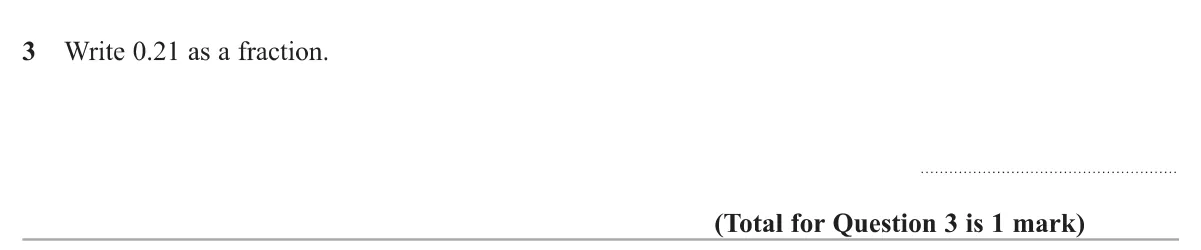
© Pearson Education Ltd. Specimen Paper 2 (Foundation, calculator), question 3.
Answer 21 100 \frac{21}{100} 100 21 1 mark
Worked solution Checked against the mark scheme
The last digit, 1, is in the hundredths column.
So 0.21 = 21 100 0.21 = \frac{21}{100} 0.21 = 100 21
Watch out: Writing 21 10 \frac{21}{10} 10 21
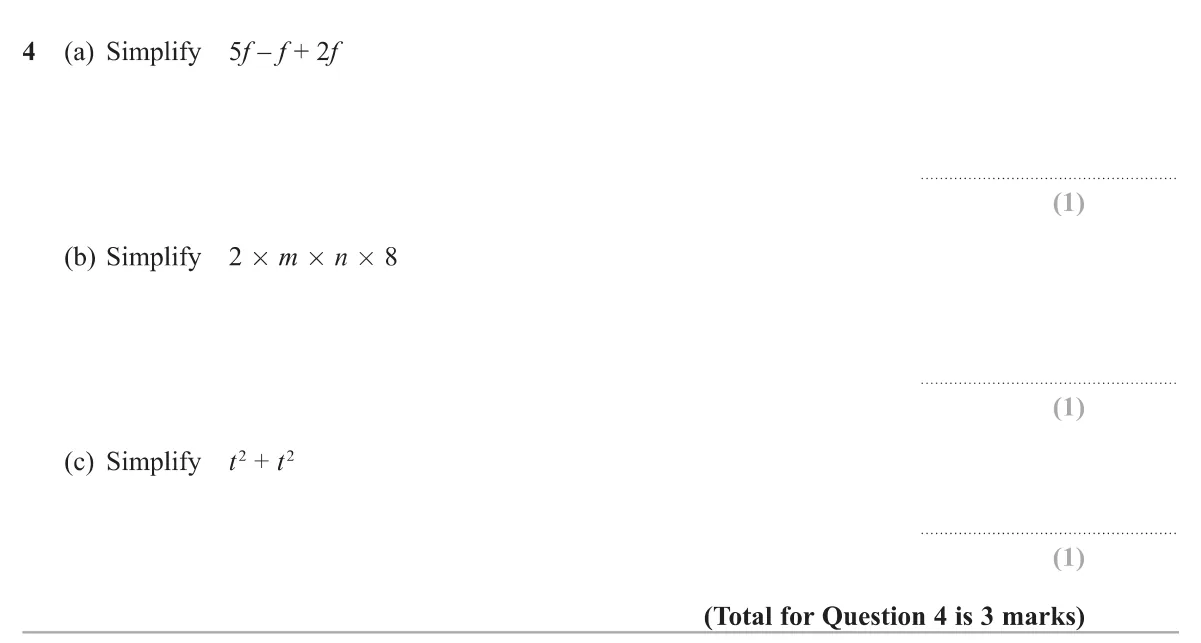
© Pearson Education Ltd. Specimen Paper 2 (Foundation, calculator), question 4.
(a) 6 f 6f 6 f 1 mark (b) 16 m n 16mn 16 mn 1 mark (c) 2 t 2 2t^2 2 t 2 1 mark
Worked solution Checked against the mark scheme
(a) 5 f − f + 2 f = 4 f + 2 f = 6 f 5f - f + 2f = 4f + 2f = 6f 5 f − f + 2 f = 4 f + 2 f = 6 f
(b) Multiply the numbers: 2 × 8 = 16 2 \times 8 = 16 2 × 8 = 16 16 m n 16mn 16 mn
(c) Two lots of t 2 t^2 t 2 2 t 2 2t^2 2 t 2
Watch out: In (c), writing t 4 t^4 t 4 2 t 4 2t^4 2 t 4
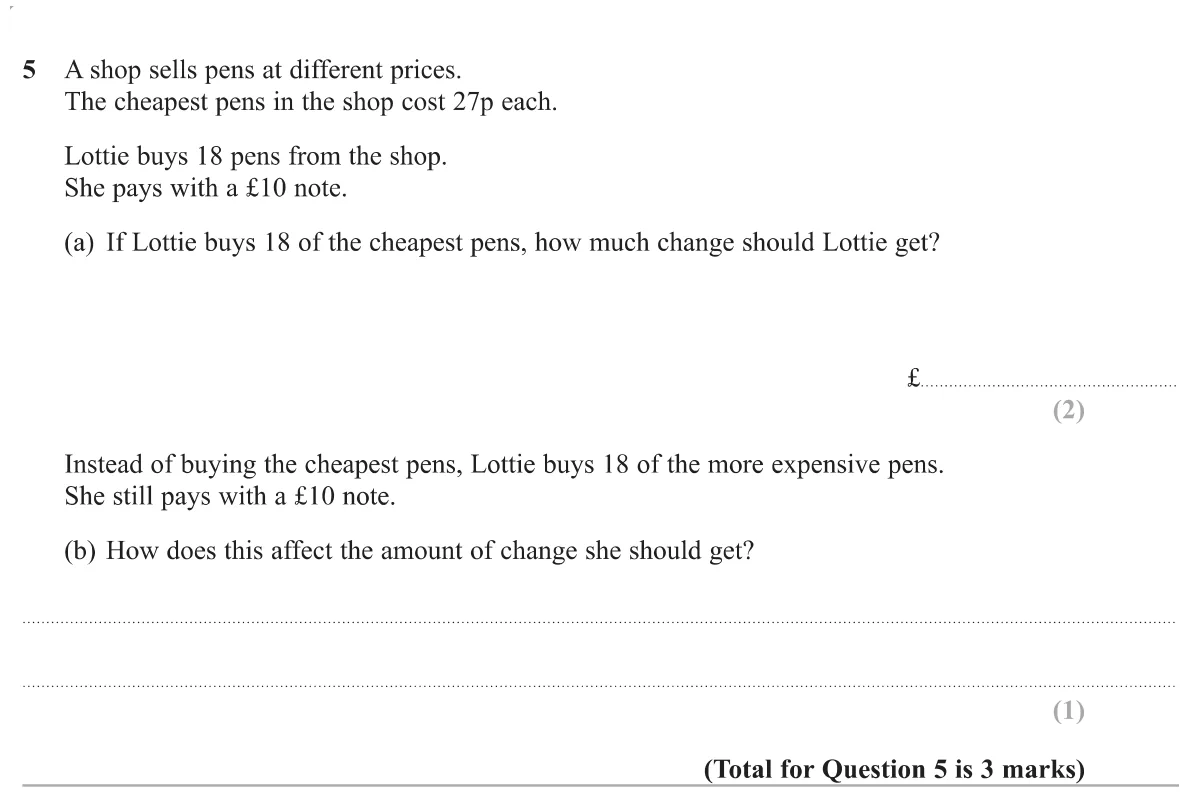
© Pearson Education Ltd. Specimen Paper 2 (Foundation, calculator), question 5.
(a) £5.14 2 marks (b) She gets less change 1 mark
Worked solution Checked against the mark scheme
(a) 18 × 27 = 486 18 \times 27 = 486 18 × 27 = 486 = £ 4.86 = £4.86 = £4.86
£ 10 − £ 4.86 = £ 5.14 £10 - £4.86 = £5.14 £10 − £4.86 = £5.14
(b) The pens cost more, so she spends more and gets less change.
Watch out: Mixing pence and pounds, e.g. 1000 − 4.86 1000 - 4.86 1000 − 4.86
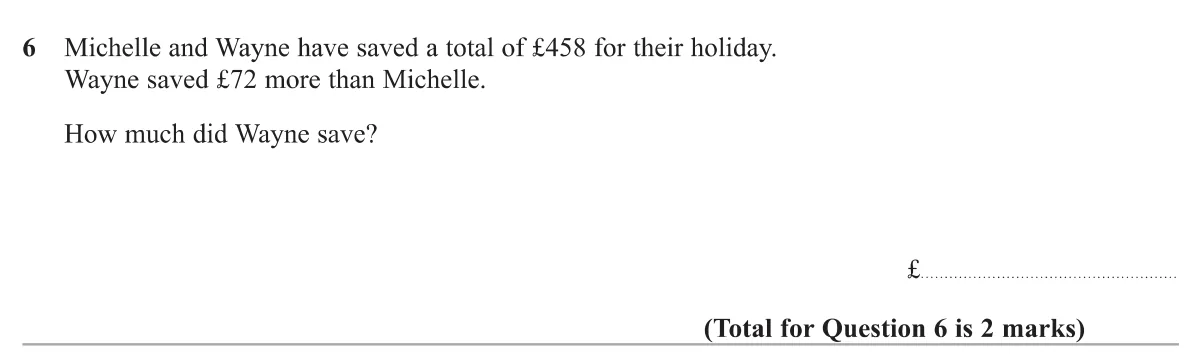
© Pearson Education Ltd. Specimen Paper 2 (Foundation, calculator), question 6.
Worked solution Checked against the mark scheme
Take off the extra £72: 458 − 72 = 386 458 - 72 = 386 458 − 72 = 386
Split equally: 386 ÷ 2 = 193 386 \div 2 = 193 386 ÷ 2 = 193
Wayne: 193 + 72 = £ 265 193 + 72 = £265 193 + 72 = £265
Watch out: Giving Michelle's amount (£193) instead of Wayne's.
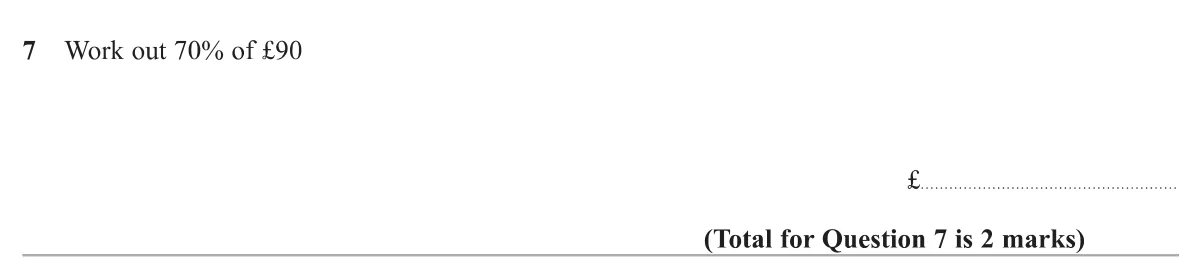
© Pearson Education Ltd. Specimen Paper 2 (Foundation, calculator), question 7.
Worked solution Checked against the mark scheme
10 % 10\% 10%
70 % = 7 × 9 = £ 63 70\% = 7 \times 9 = £63 70% = 7 × 9 = £63
Watch out: Finding 7% instead of 70%.
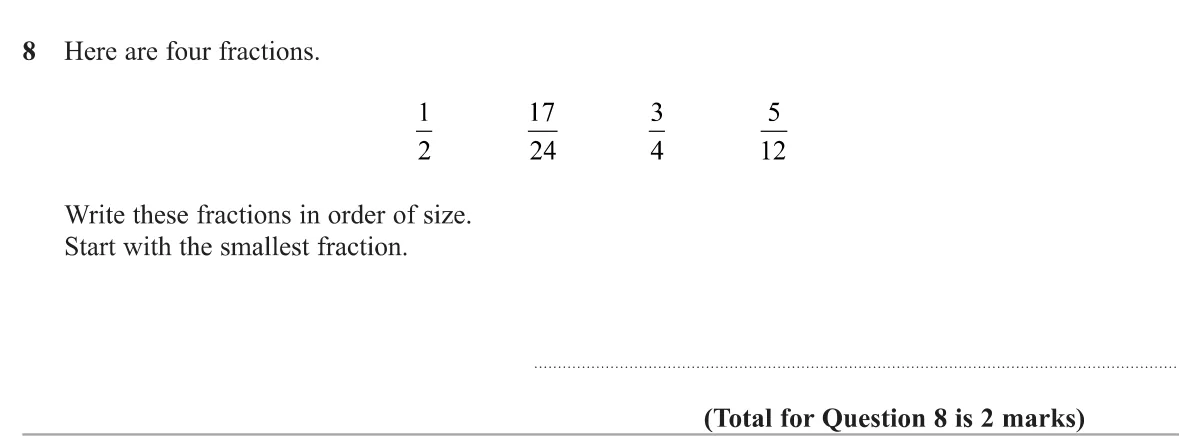
© Pearson Education Ltd. Specimen Paper 2 (Foundation, calculator), question 8.
Answer 5 12 , 1 2 , 17 24 , 3 4 \frac{5}{12}, \frac{1}{2}, \frac{17}{24}, \frac{3}{4} 12 5 , 2 1 , 24 17 , 4 3 2 marks
Worked solution Checked against the mark scheme
Use a denominator of 24:
1 2 = 12 24 \frac{1}{2} = \frac{12}{24} 2 1 = 24 12 3 4 = 18 24 \frac{3}{4} = \frac{18}{24} 4 3 = 24 18 5 12 = 10 24 \frac{5}{12} = \frac{10}{24} 12 5 = 24 10
Order: 10 24 , 12 24 , 17 24 , 18 24 \frac{10}{24}, \frac{12}{24}, \frac{17}{24}, \frac{18}{24} 24 10 , 24 12 , 24 17 , 24 18 5 12 , 1 2 , 17 24 , 3 4 \frac{5}{12}, \frac{1}{2}, \frac{17}{24}, \frac{3}{4} 12 5 , 2 1 , 24 17 , 4 3
Watch out: Ordering by the size of the denominator.
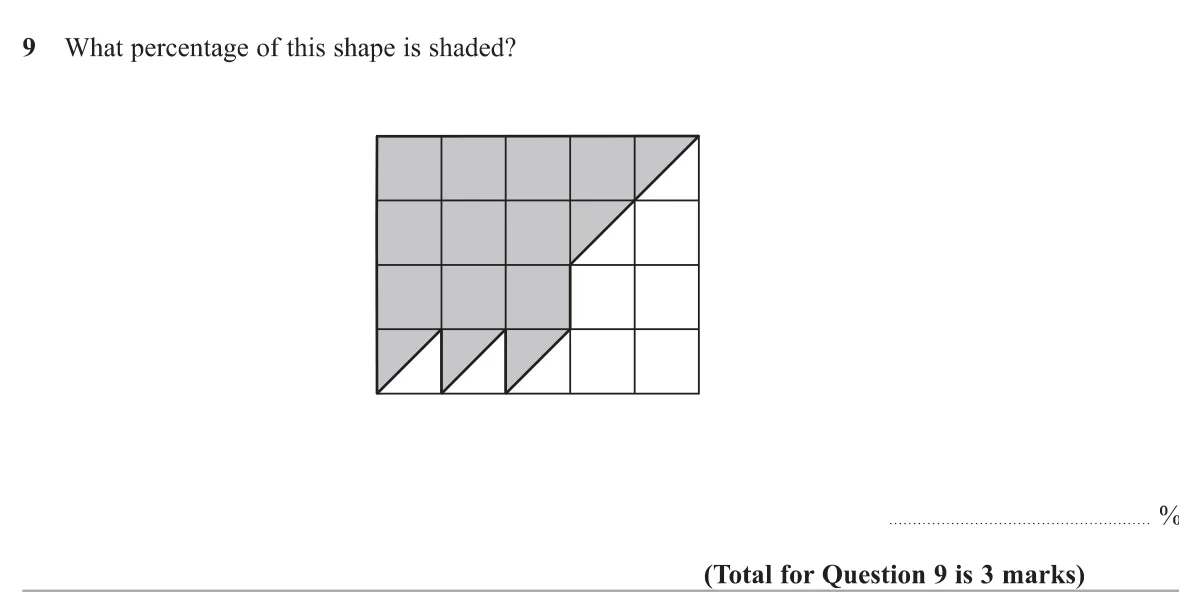
© Pearson Education Ltd. Specimen Paper 2 (Foundation, calculator), question 9.
Worked solution Checked against the mark scheme
There are 20 squares in the grid.
Shaded: 10 whole squares and 5 halves, so 10 + 2.5 = 12.5 10 + 2.5 = 12.5 10 + 2.5 = 12.5
12.5 20 × 100 = 62.5 % \frac{12.5}{20} \times 100 = 62.5\% 20 12.5 × 100 = 62.5%
Watch out: Counting each half square as a whole square.
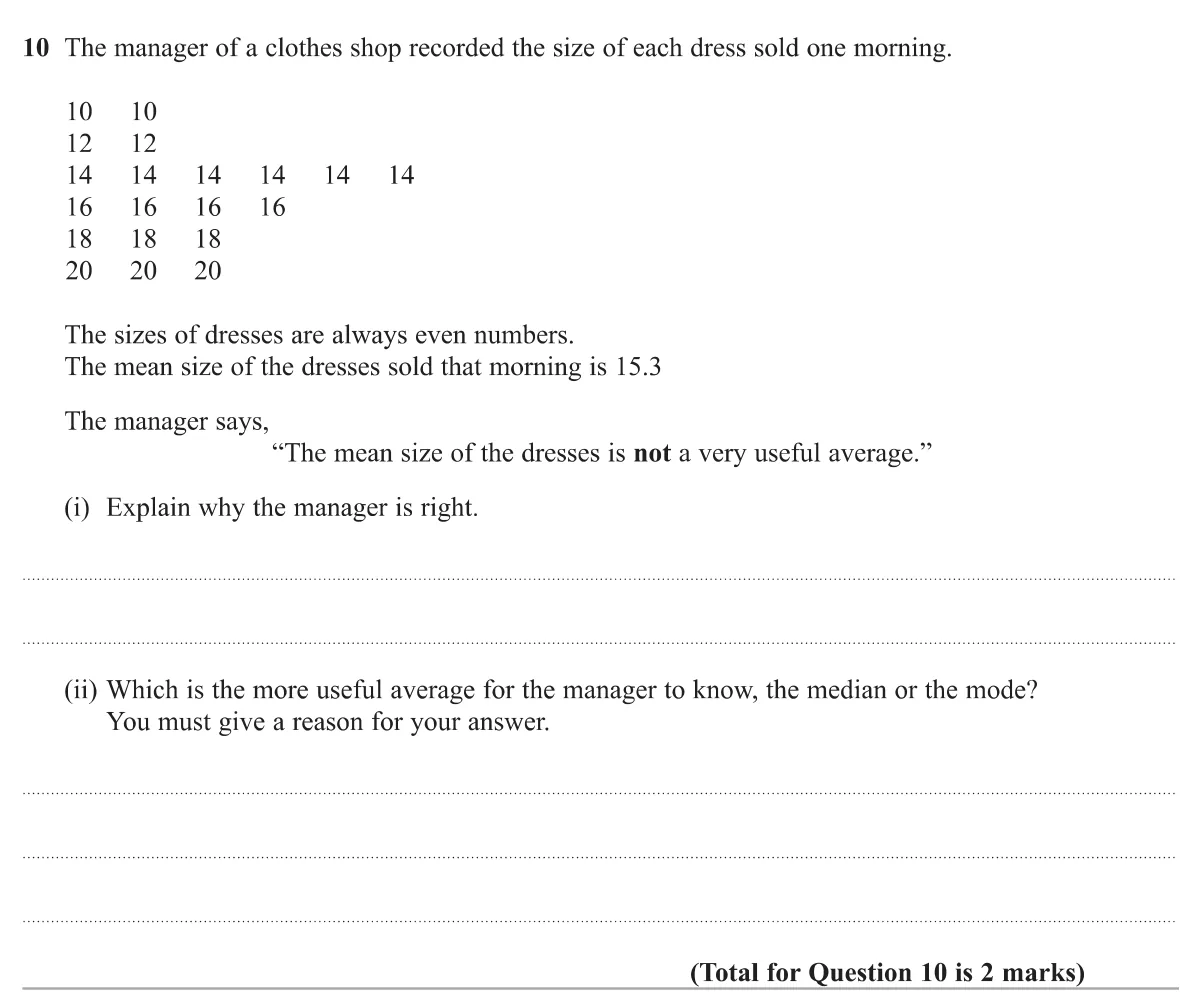
© Pearson Education Ltd. Specimen Paper 2 (Foundation, calculator), question 10.
((i)) Dress sizes are even numbers, so there is no size 15.3 1 mark ((ii)) Mode (14), because it shows the size that sells most 1 mark
Worked solution Checked against the mark scheme
(i) Dresses only come in even sizes, so a size of 15.3 does not exist.
(ii) The mode is 14. It tells the manager which size sells most often, so which to stock more of.
Watch out: Choosing the median without a reason linked to stock.
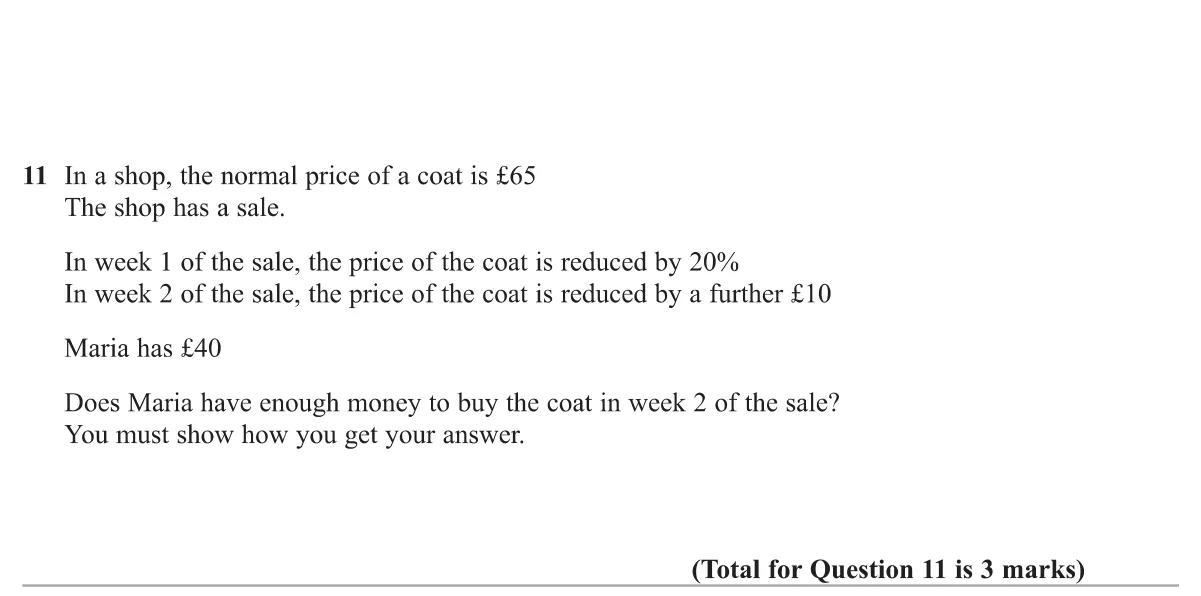
© Pearson Education Ltd. Specimen Paper 2 (Foundation, calculator), question 11.
Answer No: the week 2 price is £42 3 marks
Worked solution Checked against the mark scheme
Week 1: 65 × 0.8 = £ 52 65 \times 0.8 = £52 65 × 0.8 = £52
Week 2: 52 − 10 = £ 42 52 - 10 = £42 52 − 10 = £42
£42 is more than £40, so Maria does not have enough.
Watch out: Taking 20% and £10 off together from £65 as 30%.
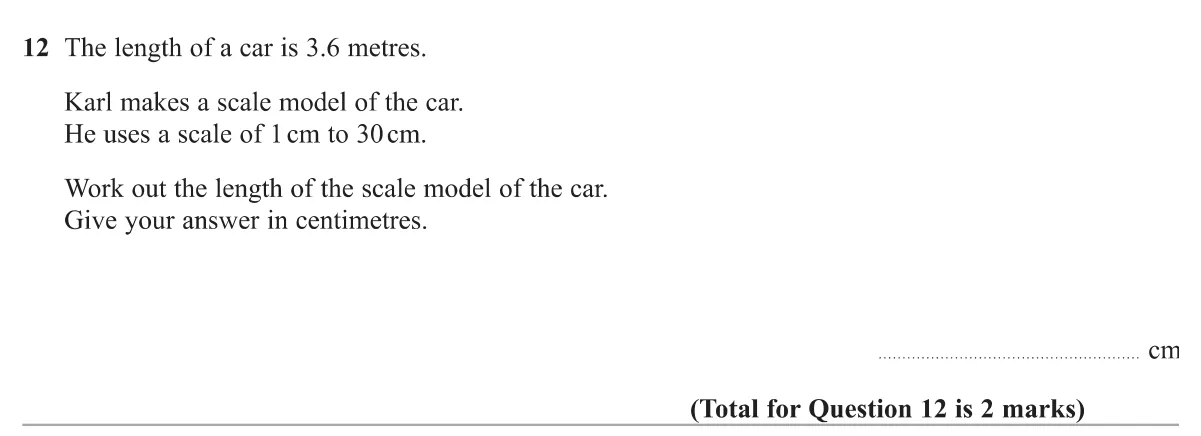
© Pearson Education Ltd. Specimen Paper 2 (Foundation, calculator), question 12.
Worked solution Checked against the mark scheme
3.6 3.6 3.6 = 360 = 360 = 360
360 ÷ 30 = 12 360 \div 30 = 12 360 ÷ 30 = 12
Watch out: Dividing 3.6 by 30 and getting 0.12.
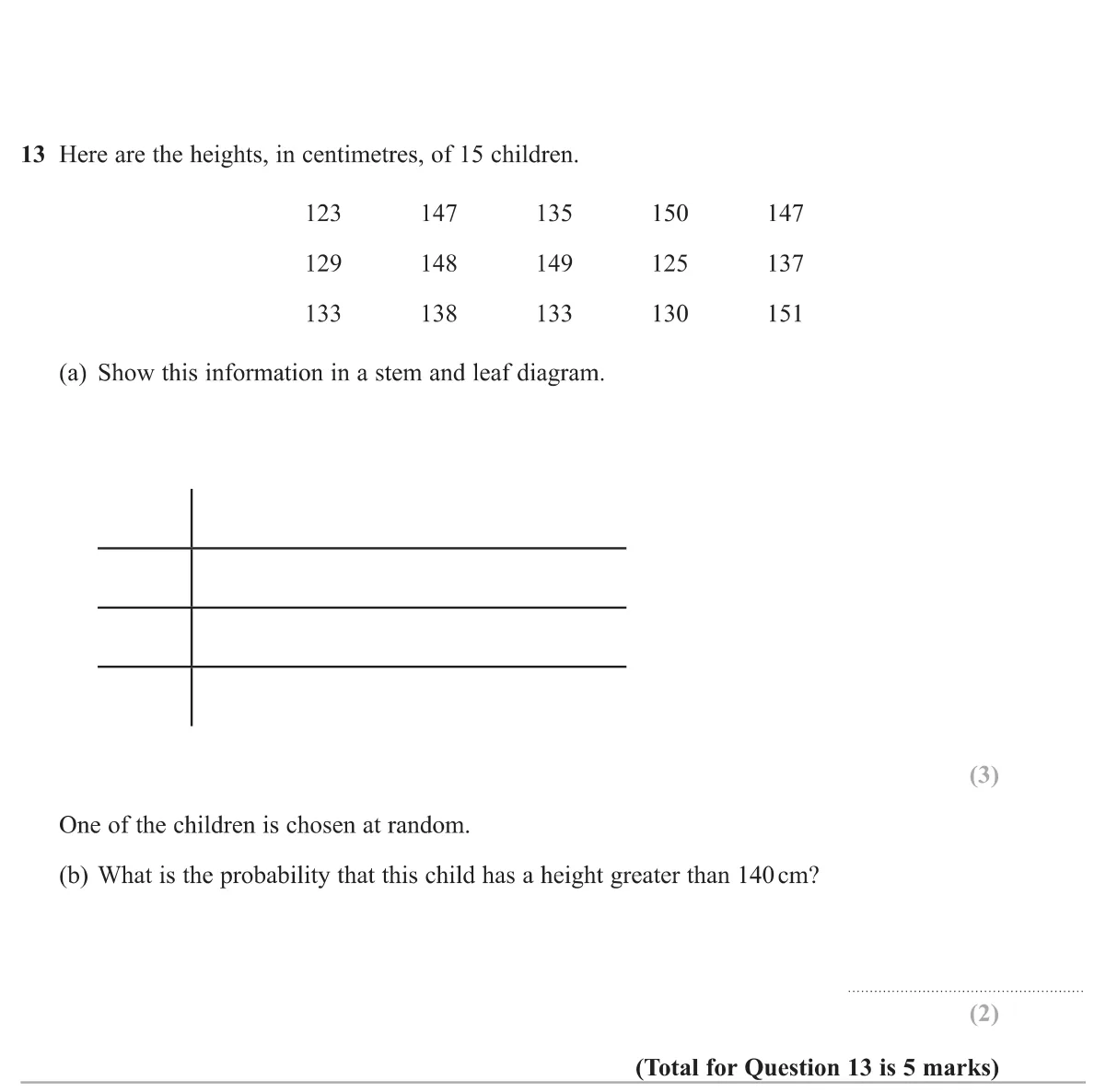
© Pearson Education Ltd. Specimen Paper 2 (Foundation, calculator), question 13.
(a) Stems 12–15 with ordered leaves and a key, e.g. 12 | 3 means 123 cm 3 marks (b) 6 15 \frac{6}{15} 15 6 2 marks
Worked solution Checked against the mark scheme
(a) 12 | 3 5 9
13 | 0 3 3 5 7 8
14 | 7 7 8 9
15 | 0 1
Key: 12 | 3 means 123 cm
(b) Heights over 140: 147, 147, 148, 149, 150, 151, which is 6 children.
P = 6 15 = 2 5 P = \frac{6}{15} = \frac{2}{5} P = 15 6 = 5 2
Watch out: Leaving out the key or not ordering the leaves.
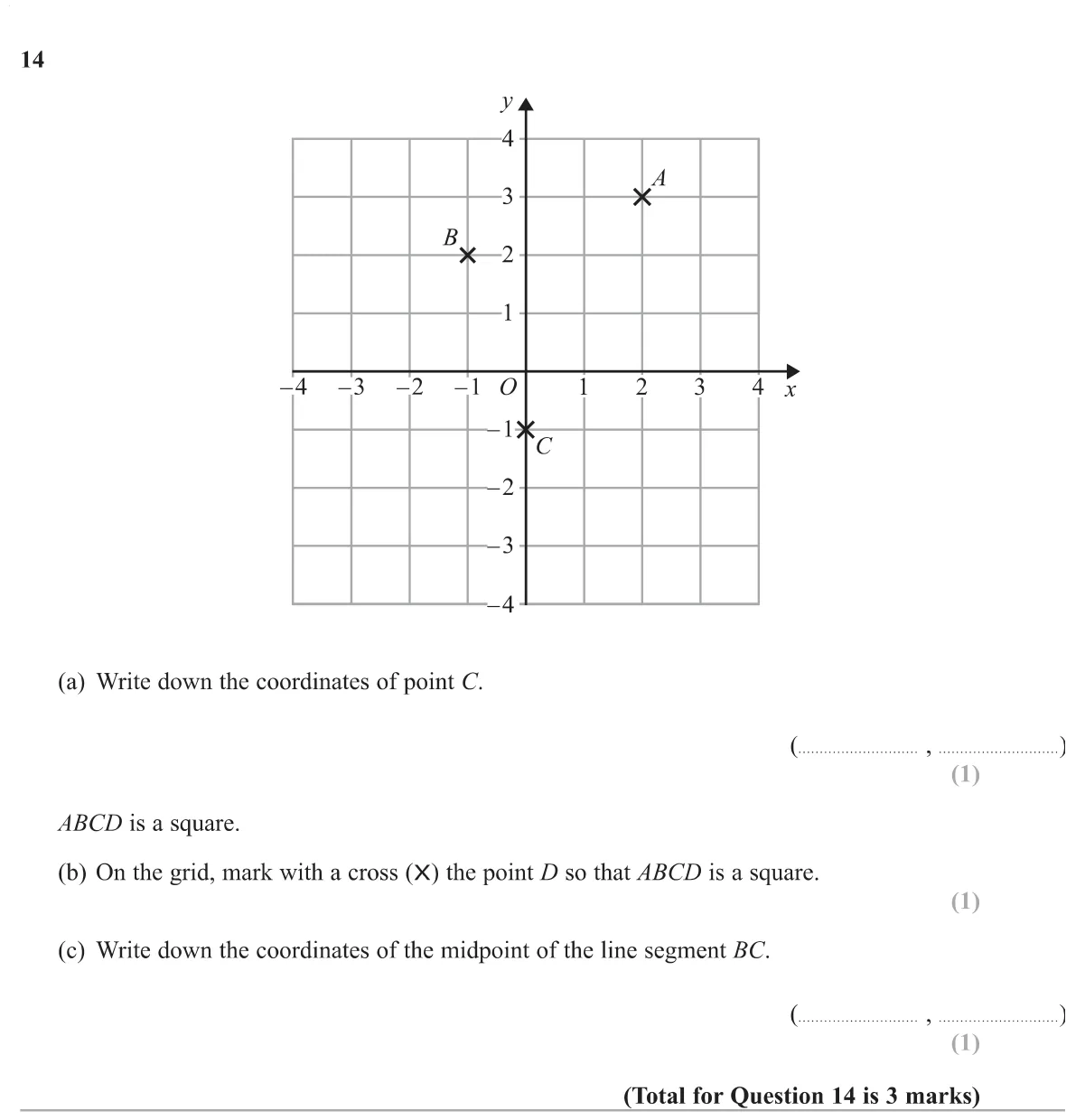
© Pearson Education Ltd. Specimen Paper 2 (Foundation, calculator), question 14.
(a) ( 0 , − 1 ) (0, -1) ( 0 , − 1 ) 1 mark (b) Cross at ( 3 , 0 ) (3, 0) ( 3 , 0 ) 1 mark (c) ( − 0.5 , 0.5 ) (-0.5, 0.5) ( − 0.5 , 0.5 ) 1 mark
Worked solution Checked against the mark scheme
(a) C is on the y y y − 1 -1 − 1 ( 0 , − 1 ) (0, -1) ( 0 , − 1 )
(b) From B to A is 3 right, 1 up. Do the same from C: D is at ( 3 , 0 ) (3, 0) ( 3 , 0 )
(c) Midpoint of B( − 1 , 2 ) (-1, 2) ( − 1 , 2 ) ( 0 , − 1 ) (0, -1) ( 0 , − 1 ) ( − 1 + 0 2 , 2 + ( − 1 ) 2 ) = ( − 0.5 , 0.5 ) \left(\frac{-1+0}{2}, \frac{2+(-1)}{2}\right) = (-0.5, 0.5) ( 2 − 1 + 0 , 2 2 + ( − 1 ) ) = ( − 0.5 , 0.5 )
Watch out: Writing coordinates the wrong way round, e.g. ( − 1 , 0 ) (-1, 0) ( − 1 , 0 )
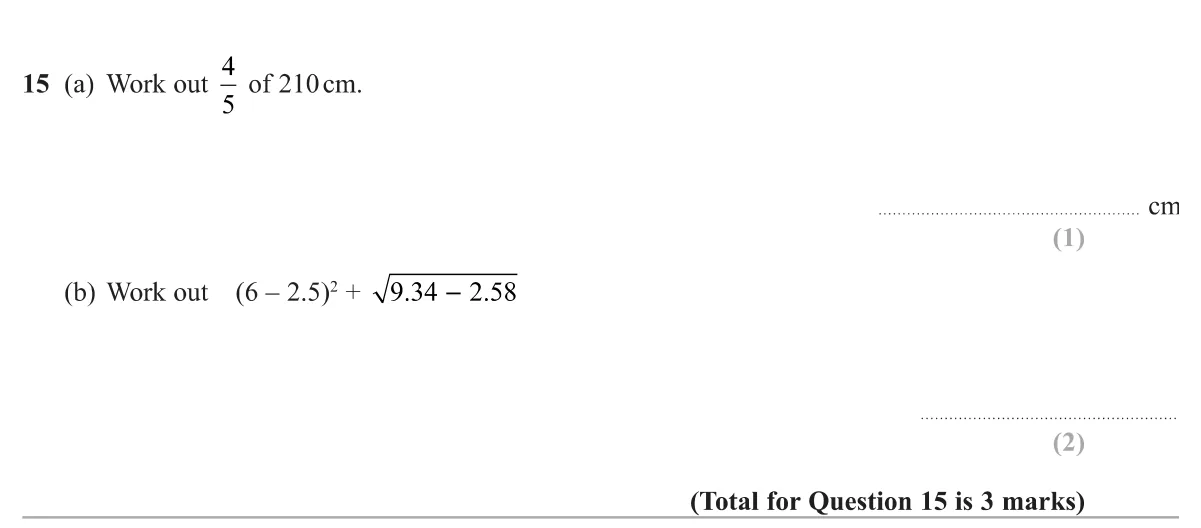
© Pearson Education Ltd. Specimen Paper 2 (Foundation, calculator), question 15.
(a) 168 cm 1 mark (b) 14.85 2 marks
Worked solution Checked against the mark scheme
(a) 210 ÷ 5 × 4 = 168 210 \div 5 \times 4 = 168 210 ÷ 5 × 4 = 168
(b) ( 6 − 2.5 ) 2 = 3.5 2 = 12.25 (6 - 2.5)^2 = 3.5^2 = 12.25 ( 6 − 2.5 ) 2 = 3. 5 2 = 12.25
9.34 − 2.58 = 6.76 = 2.6 \sqrt{9.34 - 2.58} = \sqrt{6.76} = 2.6 9.34 − 2.58 = 6.76 = 2.6
12.25 + 2.6 = 14.85 12.25 + 2.6 = 14.85 12.25 + 2.6 = 14.85
Watch out: Typing it in one go without brackets round the subtraction under the root.
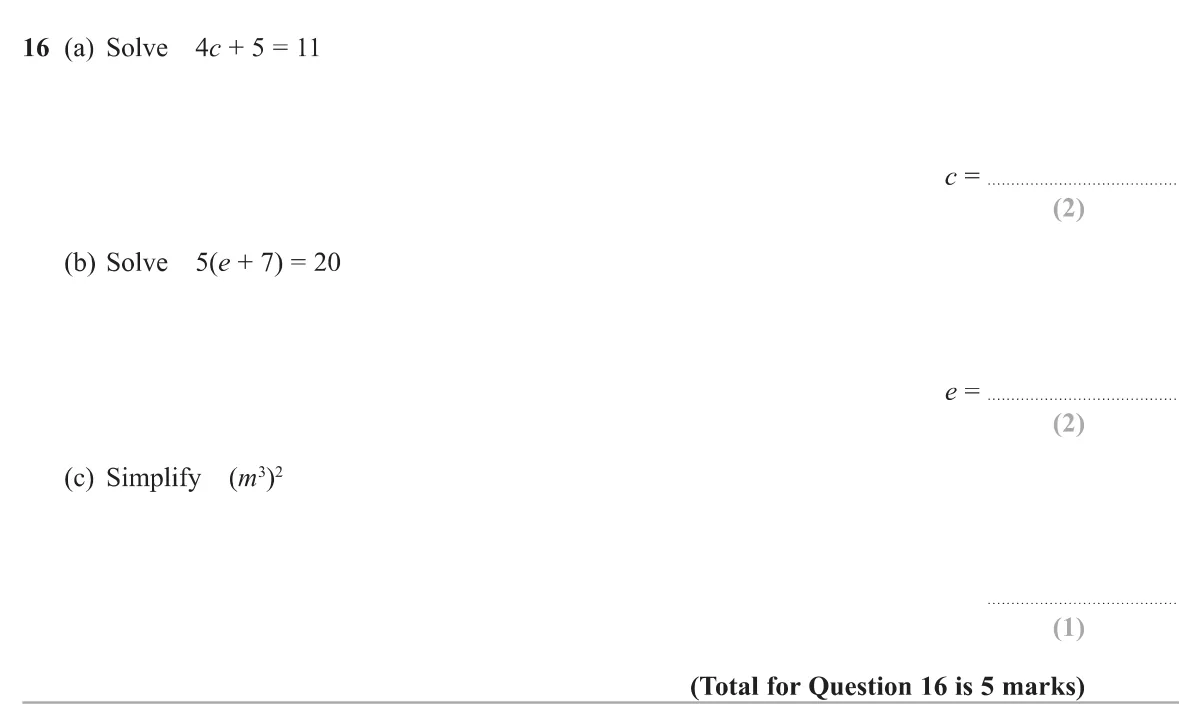
© Pearson Education Ltd. Specimen Paper 2 (Foundation, calculator), question 16.
(a) c = 1.5 c = 1.5 c = 1.5 2 marks (b) e = − 3 e = -3 e = − 3 2 marks (c) m 6 m^6 m 6 1 mark
Worked solution Checked against the mark scheme
(a) 4 c = 11 − 5 = 6 4c = 11 - 5 = 6 4 c = 11 − 5 = 6 c = 6 ÷ 4 = 1.5 c = 6 \div 4 = 1.5 c = 6 ÷ 4 = 1.5
(b) e + 7 = 20 ÷ 5 = 4 e + 7 = 20 \div 5 = 4 e + 7 = 20 ÷ 5 = 4 e = 4 − 7 = − 3 e = 4 - 7 = -3 e = 4 − 7 = − 3
(c) Multiply the powers: ( m 3 ) 2 = m 3 × 2 = m 6 (m^3)^2 = m^{3 \times 2} = m^6 ( m 3 ) 2 = m 3 × 2 = m 6
Watch out: In (c), adding the powers to get m 5 m^5 m 5
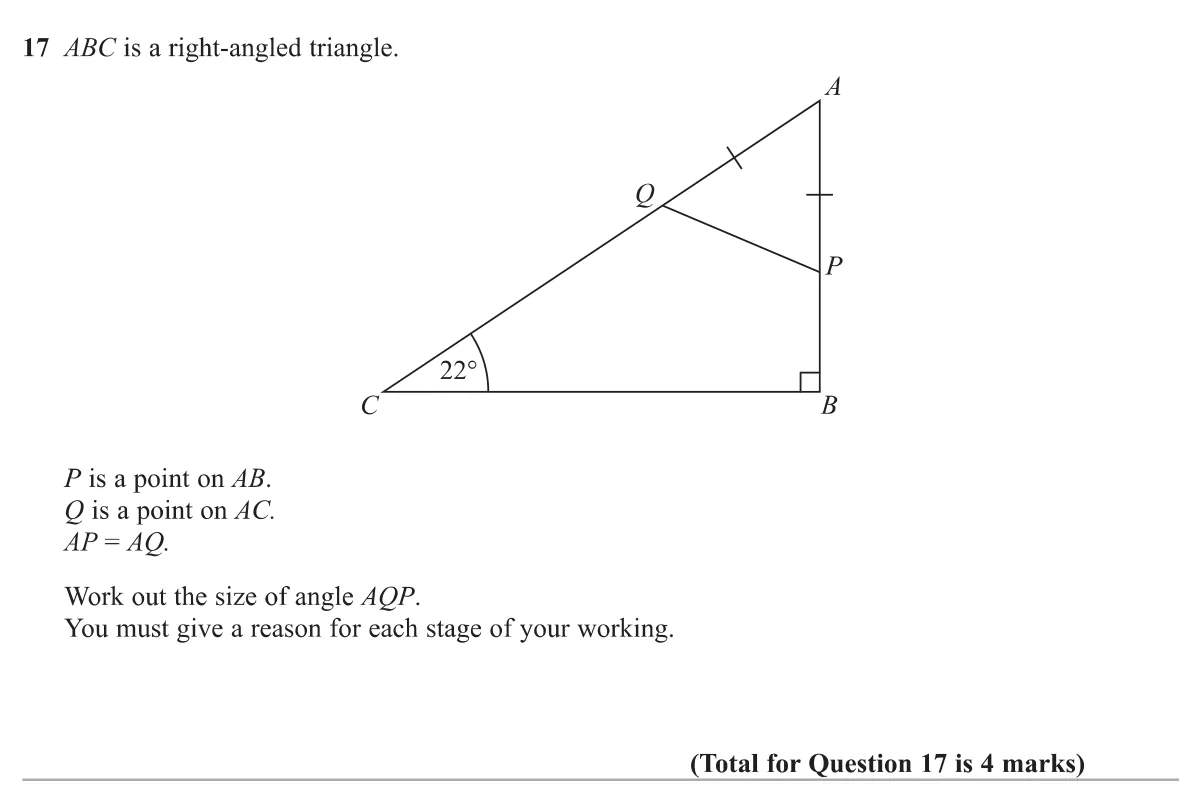
© Pearson Education Ltd. Specimen Paper 2 (Foundation, calculator), question 17.
Answer 56 ° 56° 56° 4 marks
Worked solution Checked against the mark scheme
Angle A = 180 − 90 − 22 = 68 ° A = 180 - 90 - 22 = 68° A = 180 − 90 − 22 = 68° 180 ° 180° 180°
Triangle APQ is isosceles since AP = AQ, so angles AQP and APQ are equal (base angles of an isosceles triangle).
Angle A Q P = ( 180 − 68 ) ÷ 2 = 56 ° AQP = (180 - 68) \div 2 = 56° A QP = ( 180 − 68 ) ÷ 2 = 56°
Watch out: Assuming angle AQP equals angle A.
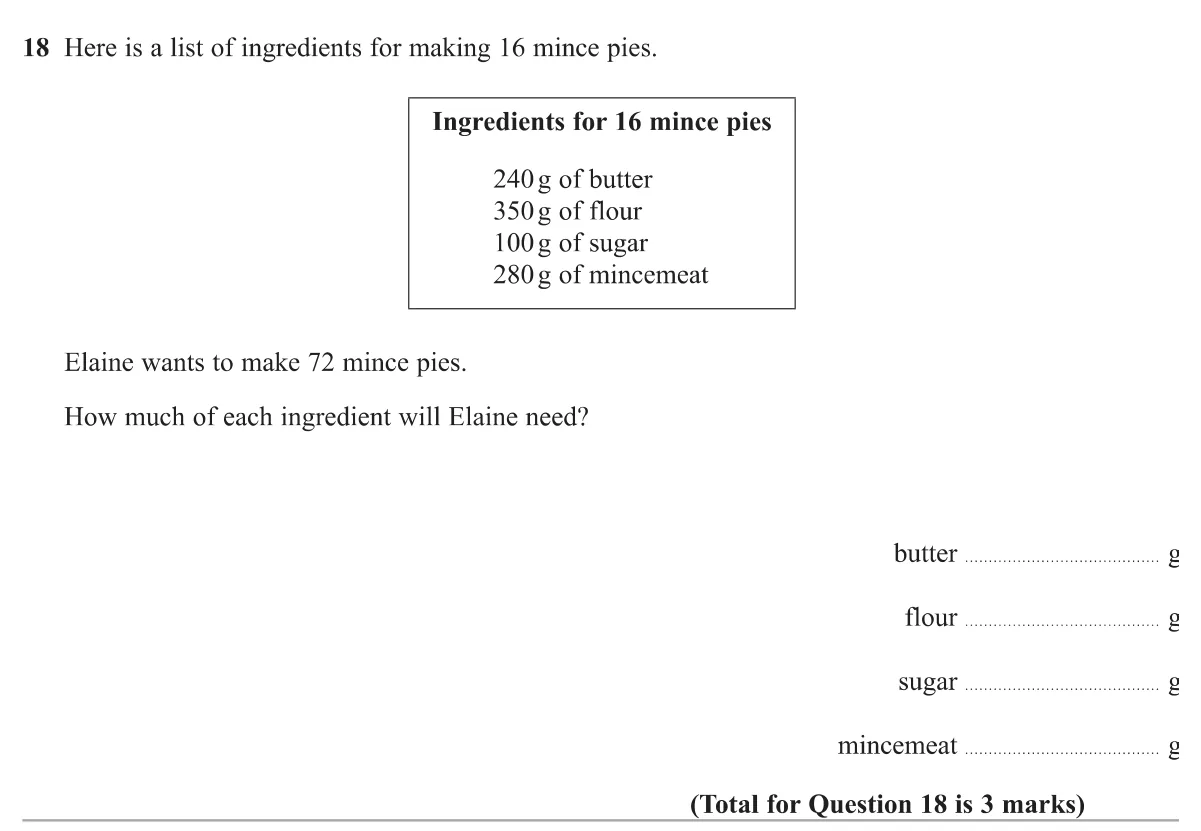
© Pearson Education Ltd. Specimen Paper 2 (Foundation, calculator), question 18.
Answer Butter 1080 g, flour 1575 g, sugar 450 g, mincemeat 1260 g 3 marks
Worked solution Checked against the mark scheme
Scale factor: 72 ÷ 16 = 4.5 72 \div 16 = 4.5 72 ÷ 16 = 4.5
Butter: 240 × 4.5 = 1080 240 \times 4.5 = 1080 240 × 4.5 = 1080
Flour: 350 × 4.5 = 1575 350 \times 4.5 = 1575 350 × 4.5 = 1575
Sugar: 100 × 4.5 = 450 100 \times 4.5 = 450 100 × 4.5 = 450
Mincemeat: 280 × 4.5 = 1260 280 \times 4.5 = 1260 280 × 4.5 = 1260
Watch out: Adding 56 to each amount instead of multiplying.
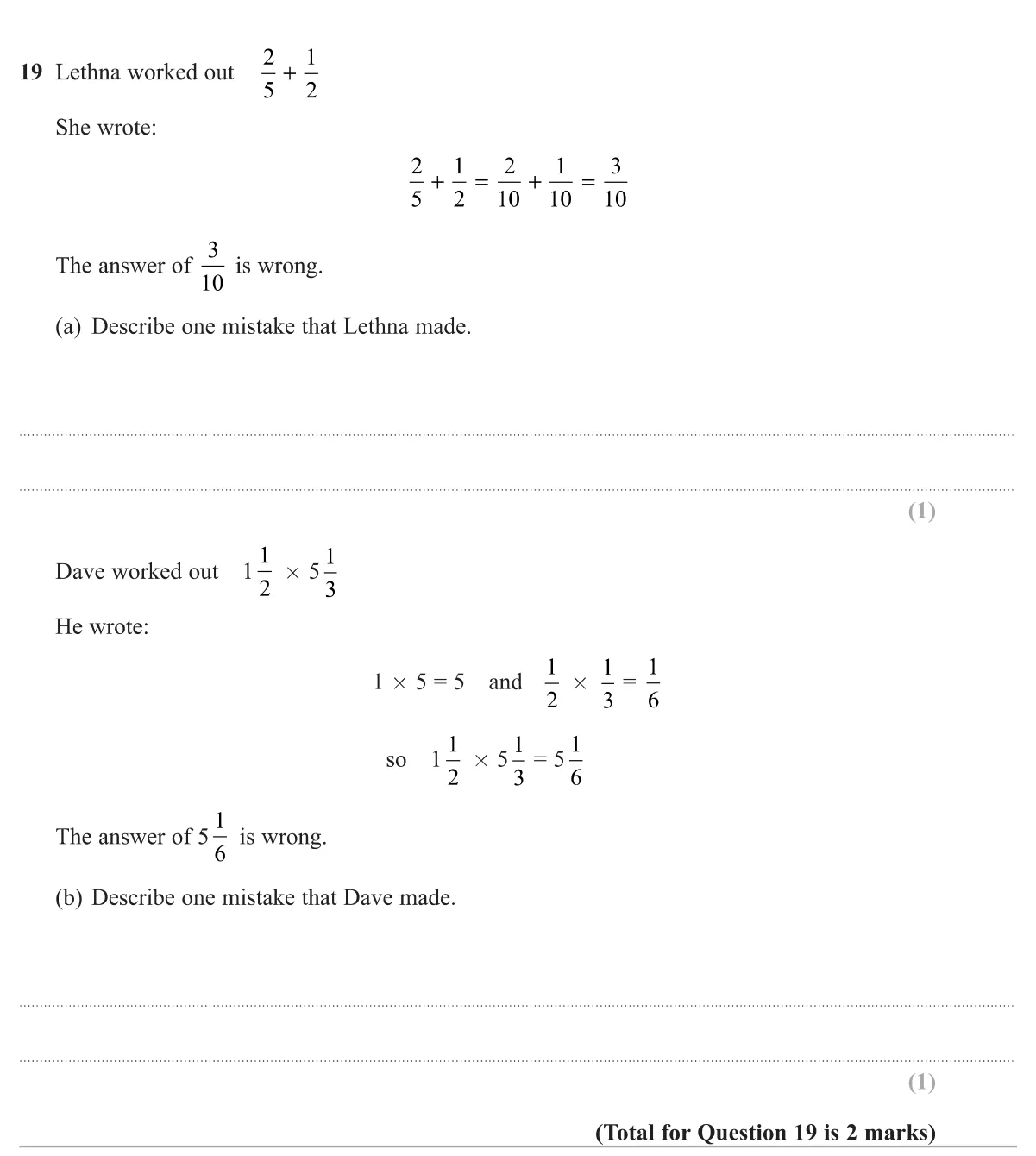
© Pearson Education Ltd. Specimen Paper 2 (Foundation, calculator), question 19.
(a) She did not multiply the numerators when changing to tenths (2 5 \frac{2}{5} 5 2 4 10 \frac{4}{10} 10 4 1 2 \frac{1}{2} 2 1 5 10 \frac{5}{10} 10 5 1 mark (b) You cannot multiply the whole numbers and fractions separately; change to improper fractions first 1 mark
Worked solution Checked against the mark scheme
(a) 2 5 = 4 10 \frac{2}{5} = \frac{4}{10} 5 2 = 10 4 1 2 = 5 10 \frac{1}{2} = \frac{5}{10} 2 1 = 10 5 9 10 \frac{9}{10} 10 9
(b) 1 1 2 × 5 1 3 = 3 2 × 16 3 = 48 6 = 8 1\frac{1}{2} \times 5\frac{1}{3} = \frac{3}{2} \times \frac{16}{3} = \frac{48}{6} = 8 1 2 1 × 5 3 1 = 2 3 × 3 16 = 6 48 = 8
Watch out: Describing the wrong answer rather than the mistake in the method.
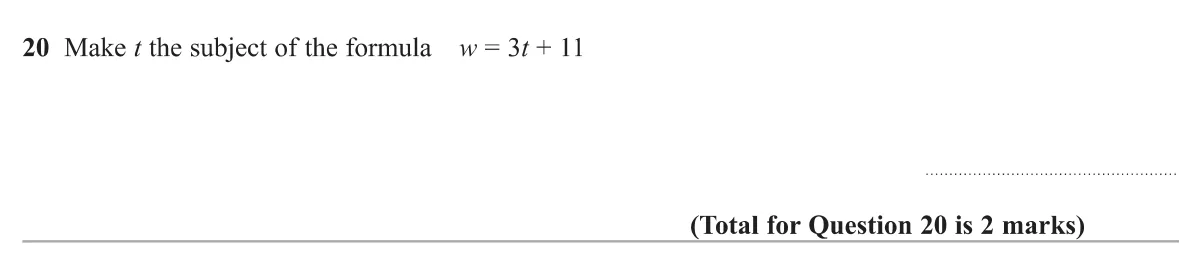
© Pearson Education Ltd. Specimen Paper 2 (Foundation, calculator), question 20.
Answer t = w − 11 3 t = \frac{w - 11}{3} t = 3 w − 11 2 marks
Worked solution Checked against the mark scheme
w = 3 t + 11 w = 3t + 11 w = 3 t + 11
Subtract 11: w − 11 = 3 t w - 11 = 3t w − 11 = 3 t
Divide by 3: t = w − 11 3 t = \frac{w - 11}{3} t = 3 w − 11
Watch out: Dividing only w w w t = w 3 − 11 t = \frac{w}{3} - 11 t = 3 w − 11
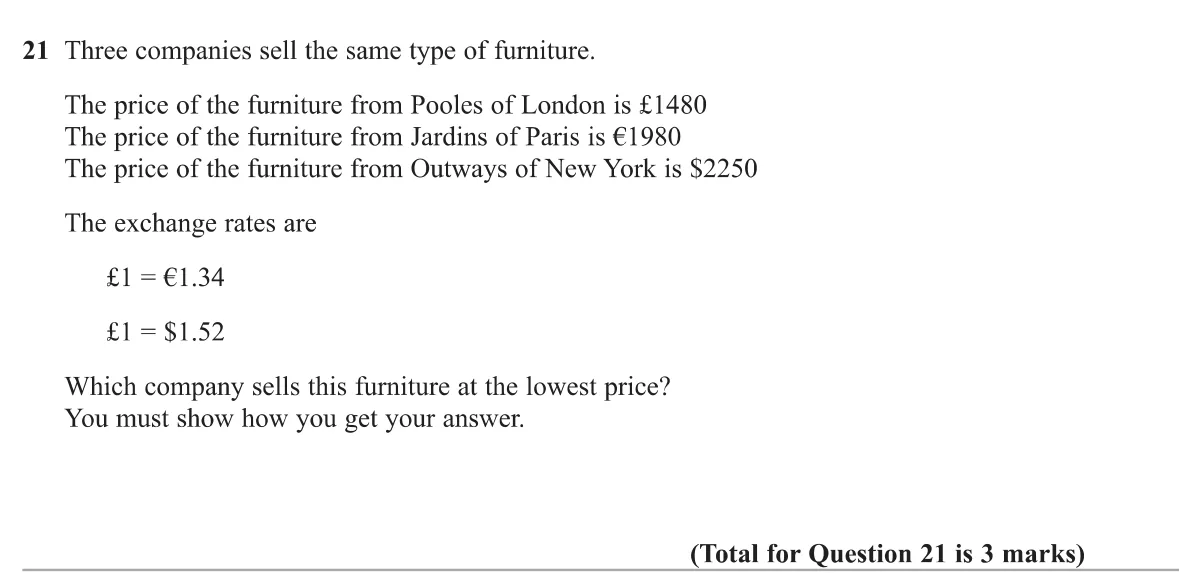
© Pearson Education Ltd. Specimen Paper 2 (Foundation, calculator), question 21.
Answer Jardins of Paris (about £1477.61) 3 marks
Worked solution Checked against the mark scheme
Paris: 1980 ÷ 1.34 = £ 1477.61 1980 \div 1.34 = £1477.61 1980 ÷ 1.34 = £1477.61
New York: 2250 ÷ 1.52 = £ 1480.26 2250 \div 1.52 = £1480.26 2250 ÷ 1.52 = £1480.26
London: £1480
The cheapest is Jardins of Paris.
Watch out: Multiplying by the exchange rate instead of dividing.
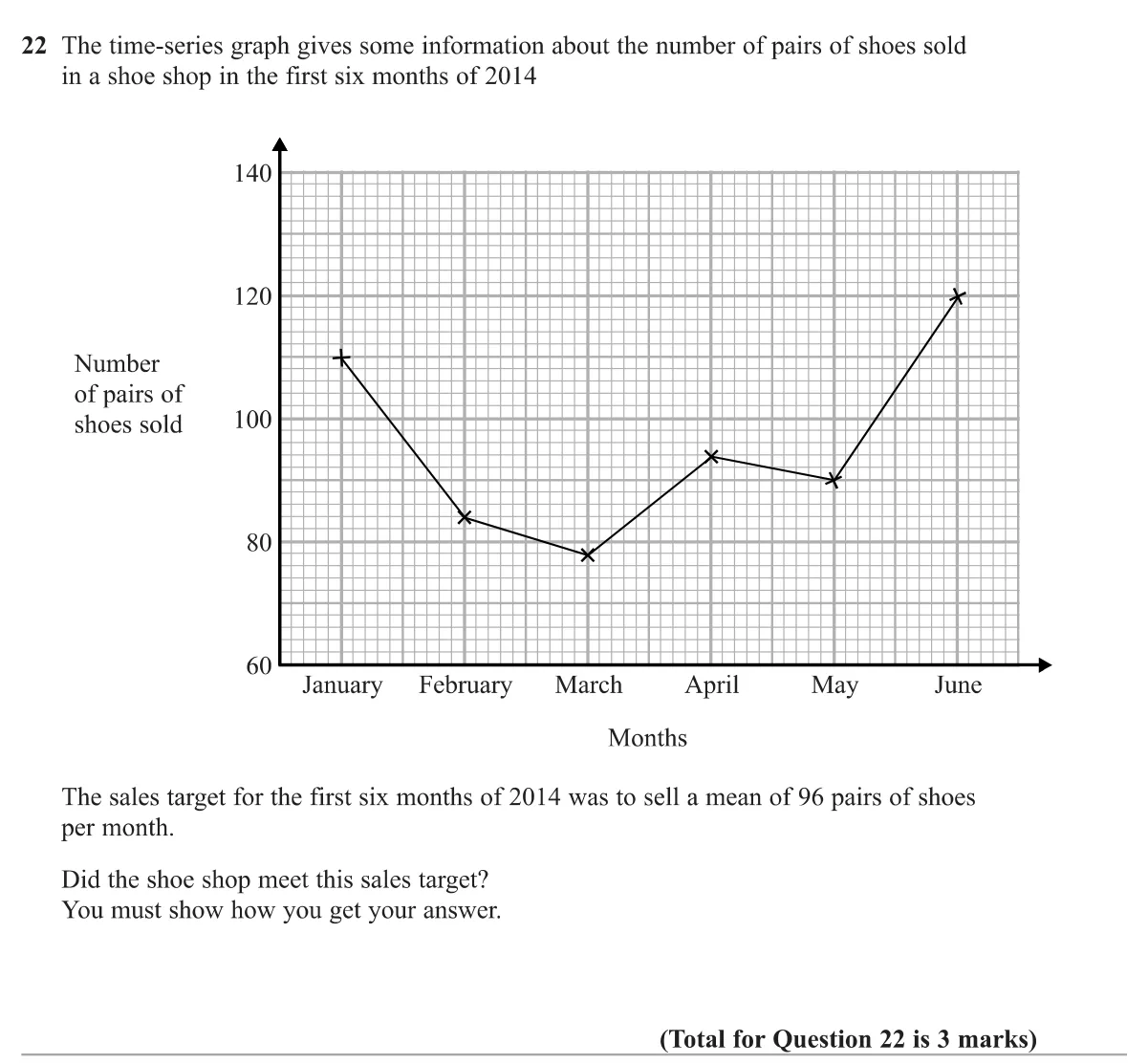
© Pearson Education Ltd. Specimen Paper 2 (Foundation, calculator), question 22.
Answer Yes: the mean is 96, so the target was met 3 marks
Worked solution Checked against the mark scheme
Readings: 110, 84, 78, 94, 90, 120
Total = 576 = 576 = 576
Mean = 576 ÷ 6 = 96 = 576 \div 6 = 96 = 576 ÷ 6 = 96
The mean equals 96, so the target was met.
Watch out: Misreading the scale, where each small square is 2 pairs.
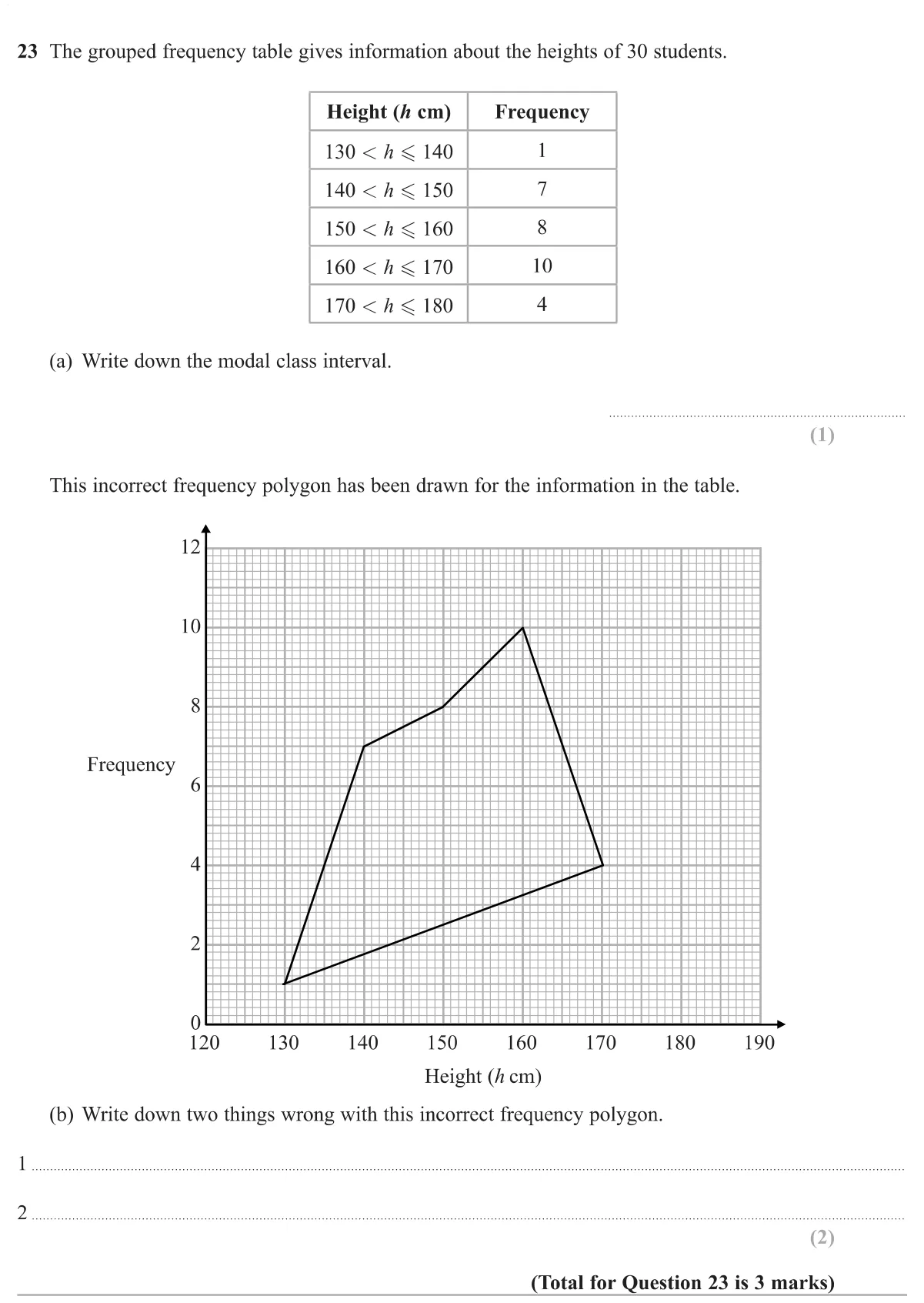
© Pearson Education Ltd. Specimen Paper 2 (Foundation, calculator), question 23.
(a) 160 < h ≤ 170 160 < h \le 170 160 < h ≤ 170 1 mark (b) Points should be at the midpoints of the classes; the polygon should not be joined back to the first point 2 marks
Worked solution Checked against the mark scheme
(a) The highest frequency is 10, in the class 160 < h ≤ 170 160 < h \le 170 160 < h ≤ 170
(b) The points are plotted at the ends of the classes instead of the middles (135, 145, ...).
The last point is joined back to the first, which a frequency polygon should not do.
Watch out: In (a), giving the frequency 10 instead of the class.
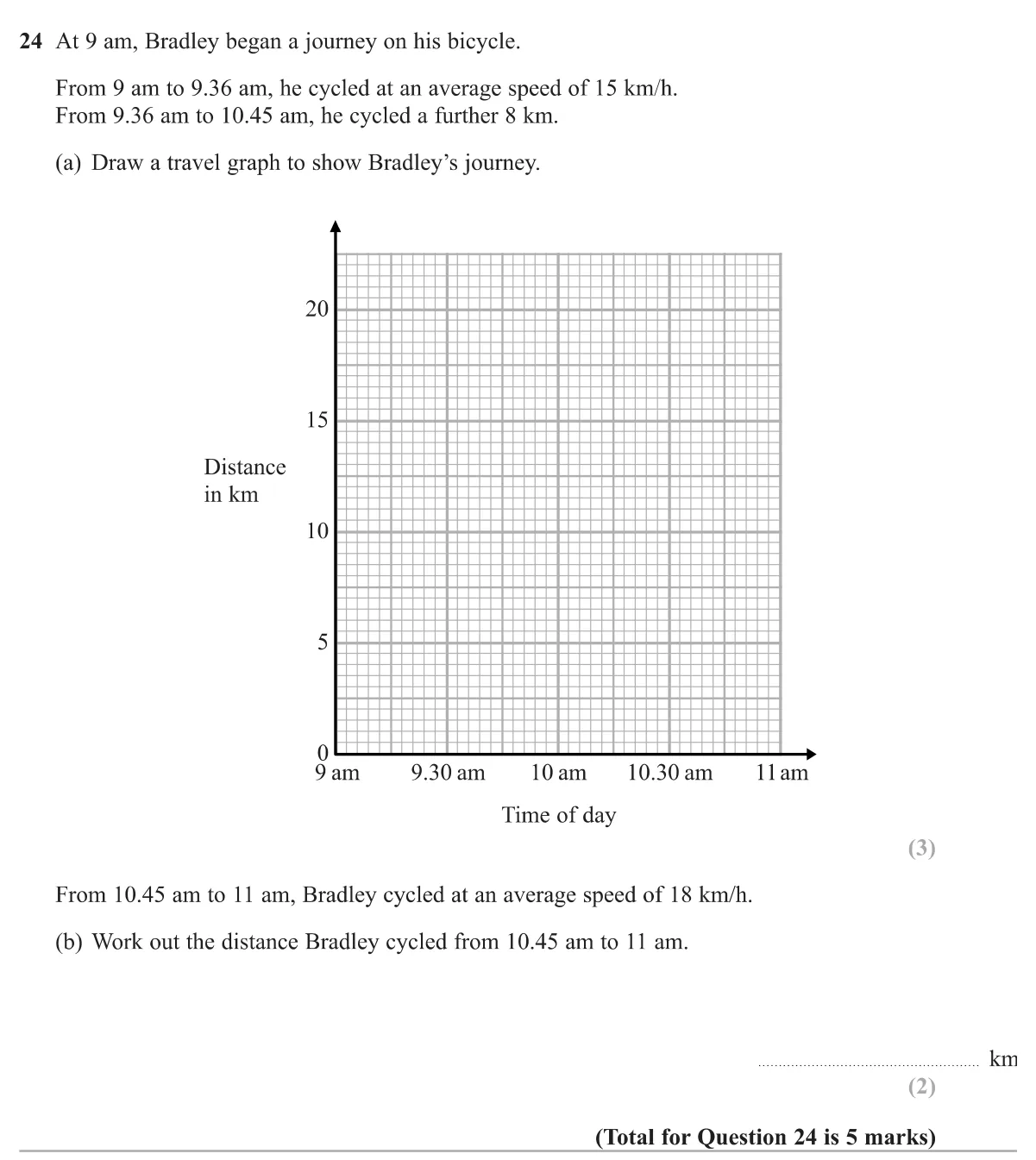
© Pearson Education Ltd. Specimen Paper 2 (Foundation, calculator), question 24.
(a) Line from (9 am, 0) to (9.36 am, 9 km), then to (10.45 am, 17 km) 3 marks (b) 4.5 km 2 marks
Worked solution Checked against the mark scheme
(a) 36 minutes = 0.6 = 0.6 = 0.6 = 15 × 0.6 = 9 = 15 \times 0.6 = 9 = 15 × 0.6 = 9
Plot (9 am, 0) to (9.36 am, 9), then on to (10.45 am, 17).
(b) 15 minutes = 0.25 = 0.25 = 0.25
Distance = 18 × 0.25 = 4.5 = 18 \times 0.25 = 4.5 = 18 × 0.25 = 4.5
Watch out: Using 0.36 hours for 36 minutes.
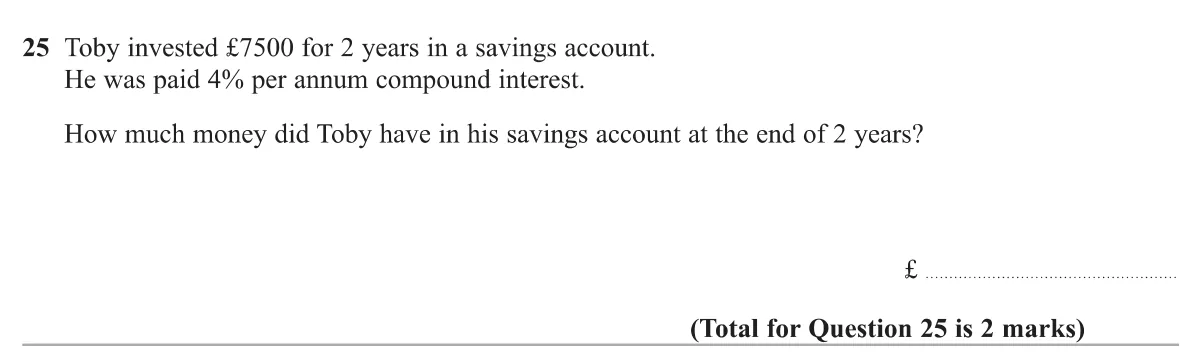
© Pearson Education Ltd. Specimen Paper 2 (Foundation, calculator), question 25.
Worked solution Checked against the mark scheme
Multiplier for 4% growth is 1.04
7500 × 1.04 2 = 7500 × 1.0816 = £ 8112 7500 \times 1.04^2 = 7500 \times 1.0816 = £8112 7500 × 1.0 4 2 = 7500 × 1.0816 = £8112
Watch out: Using simple interest to get £8100.
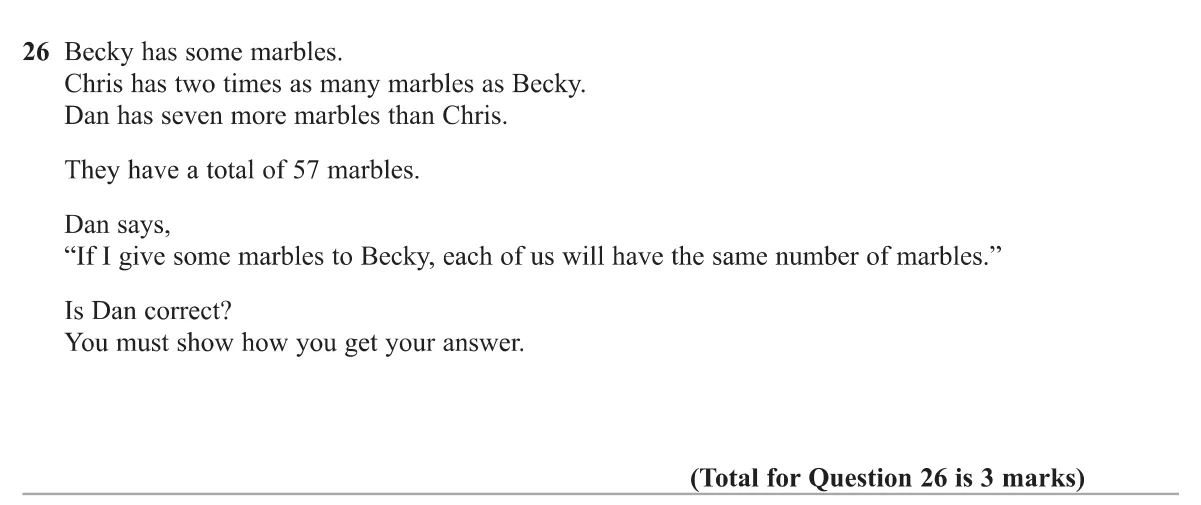
© Pearson Education Ltd. Specimen Paper 2 (Foundation, calculator), question 26.
Answer No: Becky 10, Chris 20, Dan 27; Chris already has more than a third (19) 3 marks
Worked solution Checked against the mark scheme
Let Becky have x x x 2 x 2x 2 x 2 x + 7 2x + 7 2 x + 7
x + 2 x + 2 x + 7 = 57 x + 2x + 2x + 7 = 57 x + 2 x + 2 x + 7 = 57 5 x = 50 5x = 50 5 x = 50 x = 10 x = 10 x = 10
Becky 10, Chris 20, Dan 27
Equal shares would be 57 ÷ 3 = 19 57 \div 3 = 19 57 ÷ 3 = 19
Watch out: Forgetting that only Dan gives marbles away.
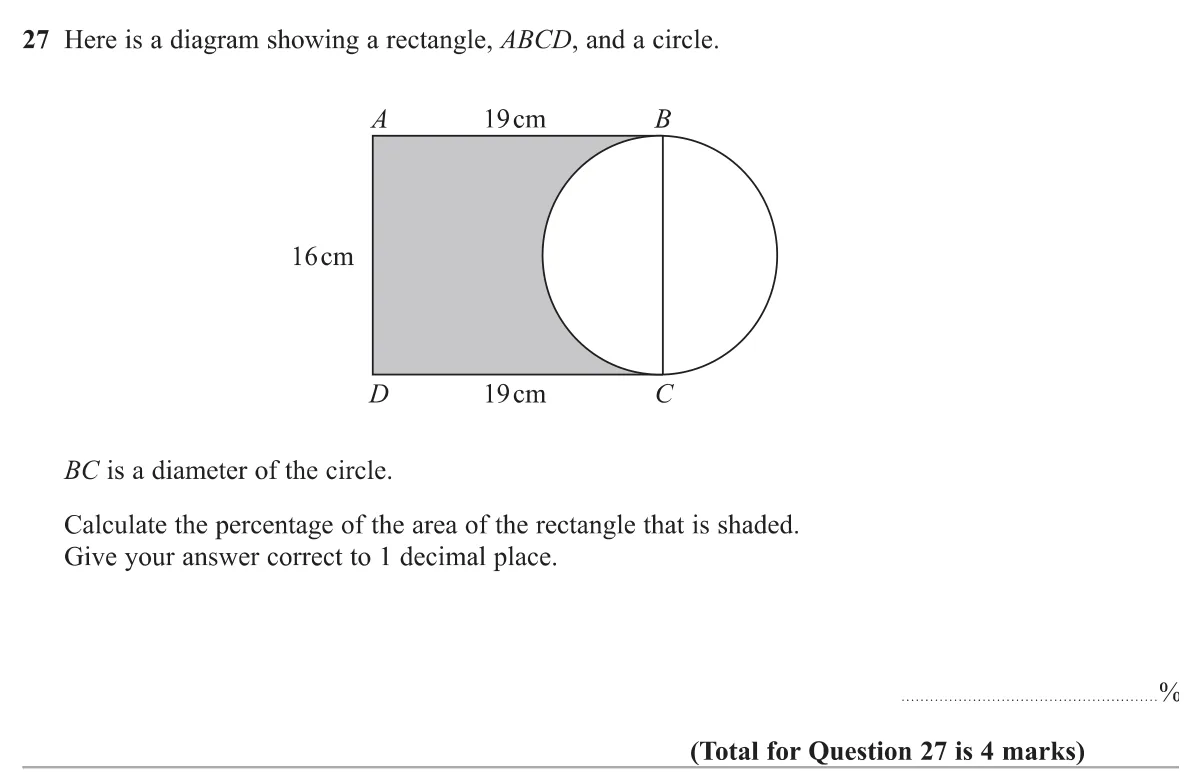
© Pearson Education Ltd. Specimen Paper 2 (Foundation, calculator), question 27.
Worked solution Checked against the mark scheme
Rectangle: 19 × 16 = 304 19 \times 16 = 304 19 × 16 = 304
Circle radius 8: half-circle area = 1 2 π × 8 2 = 100.53 = \frac{1}{2} \pi \times 8^2 = 100.53 = 2 1 π × 8 2 = 100.53
Shaded: 304 − 100.53 = 203.47 304 - 100.53 = 203.47 304 − 100.53 = 203.47
203.47 304 × 100 = 66.9 % \frac{203.47}{304} \times 100 = 66.9\% 304 203.47 × 100 = 66.9%
Watch out: Taking away the whole circle instead of half.
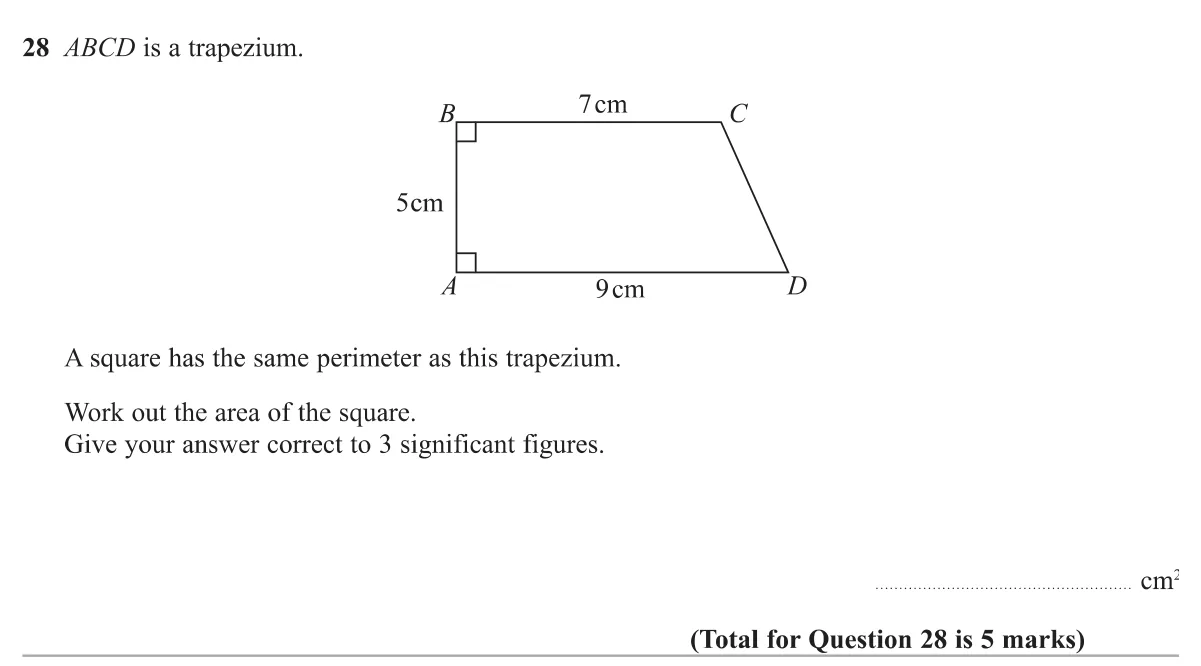
© Pearson Education Ltd. Specimen Paper 2 (Foundation, calculator), question 28.
Worked solution Checked against the mark scheme
Draw a right-angled triangle: across 9 − 7 = 2 9 - 7 = 2 9 − 7 = 2
C D = 5 2 + 2 2 = 29 = 5.385 CD = \sqrt{5^2 + 2^2} = \sqrt{29} = 5.385 C D = 5 2 + 2 2 = 29 = 5.385
Perimeter = 9 + 7 + 5 + 5.385 = 26.385 = 9 + 7 + 5 + 5.385 = 26.385 = 9 + 7 + 5 + 5.385 = 26.385
Side of square = 26.385 ÷ 4 = 6.596 = 26.385 \div 4 = 6.596 = 26.385 ÷ 4 = 6.596
Area = 6.596 2 = 43.5 = 6.596^2 = 43.5 = 6.59 6 2 = 43.5
Watch out: Squaring the whole perimeter instead of a quarter of it.
Finished the paper? Add up your marks for all three papers. Specimen papers were never sat, so they have no grade boundaries of their own, but the grade calculator shows what the same total earned in recent real exams, as a rough guide.