Revision guide by The Full Marks
Transformations: what you need to know A transformation moves or changes a shape: translation, reflection, rotation or enlargement. You need to draw them on a grid and describe them fully, and the describing marks are where most students slip.
Negative scale factors, and describing a combination of transformations as a single transformation (including invariant points), are Higher only; Foundation can still ask you to carry out one transformation after another, and everything else is on both tiers.
Key facts Translation: describe with a column vector, e.g. ( 4 − 3 ) \begin{pmatrix} 4 \\ -3 \end{pmatrix} ( 4 − 3 ) Reflection: give the mirror line as an equation, e.g. x = 2 x = 2 x = 2 y = − 1 y = -1 y = − 1 y = x y = x y = x Rotation: give the centre, the angle and the direction (clockwise or anticlockwise). Enlargement: give the scale factor and the centre. Scale factor = image length original length = \frac{\text{image length}}{\text{original length}} = original length image length Higher: a negative scale factor puts the image on the other side of the centre, turned through 180 ∘ 180^\circ 18 0 ∘ Translations, reflections and rotations give congruent shapes; enlargements give similar shapes. Enlarging from a centre From the centre, count across and up to each vertex. Multiply those distances by the scale factor (for a negative scale factor, go the opposite way). Plot the new vertices from the centre and join them. Describing a single transformation Same size and orientation: translation. Flipped: reflection. Turned: rotation. Different size: enlargement. Give every detail from the key facts. Use tracing paper for rotations. To find a centre of enlargement, draw straight lines through each vertex and its image; the centre is where they meet. To find a mirror line, it is halfway between each point and its image. Combining transformations (Higher) Carry out the first transformation on the grid, then the second on the new image. Label each image. Compare the original shape with the final image and describe the single transformation that maps one onto the other. An invariant point is a point that ends up where it started. Worked examples Example 1 Foundation · grade 3
Triangle T T T ( 1 , 2 ) (1, 2) ( 1 , 2 ) ( 3 , 2 ) (3, 2) ( 3 , 2 ) ( 1 , 5 ) (1, 5) ( 1 , 5 ) ( 4 − 3 ) \begin{pmatrix} 4 \\ -3 \end{pmatrix} ( 4 − 3 )
Show the solution Add 4 to each x x x y y y ( 1 , 2 ) → ( 5 , − 1 ) (1, 2) \to (5, -1) ( 1 , 2 ) → ( 5 , − 1 ) ( 3 , 2 ) → ( 7 , − 1 ) (3, 2) \to (7, -1) ( 3 , 2 ) → ( 7 , − 1 ) ( 1 , 5 ) → ( 5 , 2 ) (1, 5) \to (5, 2) ( 1 , 5 ) → ( 5 , 2 )
Example 2 Higher · grade 7
Triangle A A A ( 2 , 2 ) (2, 2) ( 2 , 2 ) ( 4 , 2 ) (4, 2) ( 4 , 2 ) ( 2 , 3 ) (2, 3) ( 2 , 3 ) − 2 -2 − 2 ( 1 , 1 ) (1, 1) ( 1 , 1 )
Show the solution From ( 1 , 1 ) (1, 1) ( 1 , 1 ) ( 2 , 2 ) (2, 2) ( 2 , 2 ) + 1 , + 1 +1, +1 + 1 , + 1 − 2 -2 − 2 − 2 , − 2 -2, -2 − 2 , − 2 ( − 1 , − 1 ) (-1, -1) ( − 1 , − 1 ) ( 1 , 1 ) (1, 1) ( 1 , 1 ) ( 4 , 2 ) (4, 2) ( 4 , 2 ) + 3 , + 1 +3, +1 + 3 , + 1 − 2 -2 − 2 − 6 , − 2 -6, -2 − 6 , − 2 ( − 5 , − 1 ) (-5, -1) ( − 5 , − 1 ) ( 1 , 1 ) (1, 1) ( 1 , 1 ) ( 2 , 3 ) (2, 3) ( 2 , 3 ) + 1 , + 2 +1, +2 + 1 , + 2 − 2 -2 − 2 − 2 , − 4 -2, -4 − 2 , − 4 ( − 1 , − 3 ) (-1, -3) ( − 1 , − 3 )
Common mistakes Describing two transformations when the question asks for a single one. You will get no marks. Leaving out the centre of a rotation or enlargement, or the direction of a rotation. Mixing up x = 3 x = 3 x = 3 y = 3 y = 3 y = 3 Getting an enlargement's scale factor the wrong way round: if the question maps the large shape onto the small one, the scale factor is a fraction, e.g. 1 2 \frac{1}{2} 2 1 Exam tips Describing a single transformation fully is usually worth 2 marks. Leaving out any detail (centre, angle, direction, scale factor or vector) costs marks. Ask for tracing paper in the exam to check rotations and reflections. Questions people ask How do you describe a rotation fully? State that it is a rotation, give the angle (e.g. 90 ∘ 90^\circ 9 0 ∘
What does a negative scale factor do? It enlarges the shape by that size, but the image appears on the opposite side of the centre and is turned upside down. This is Higher only.
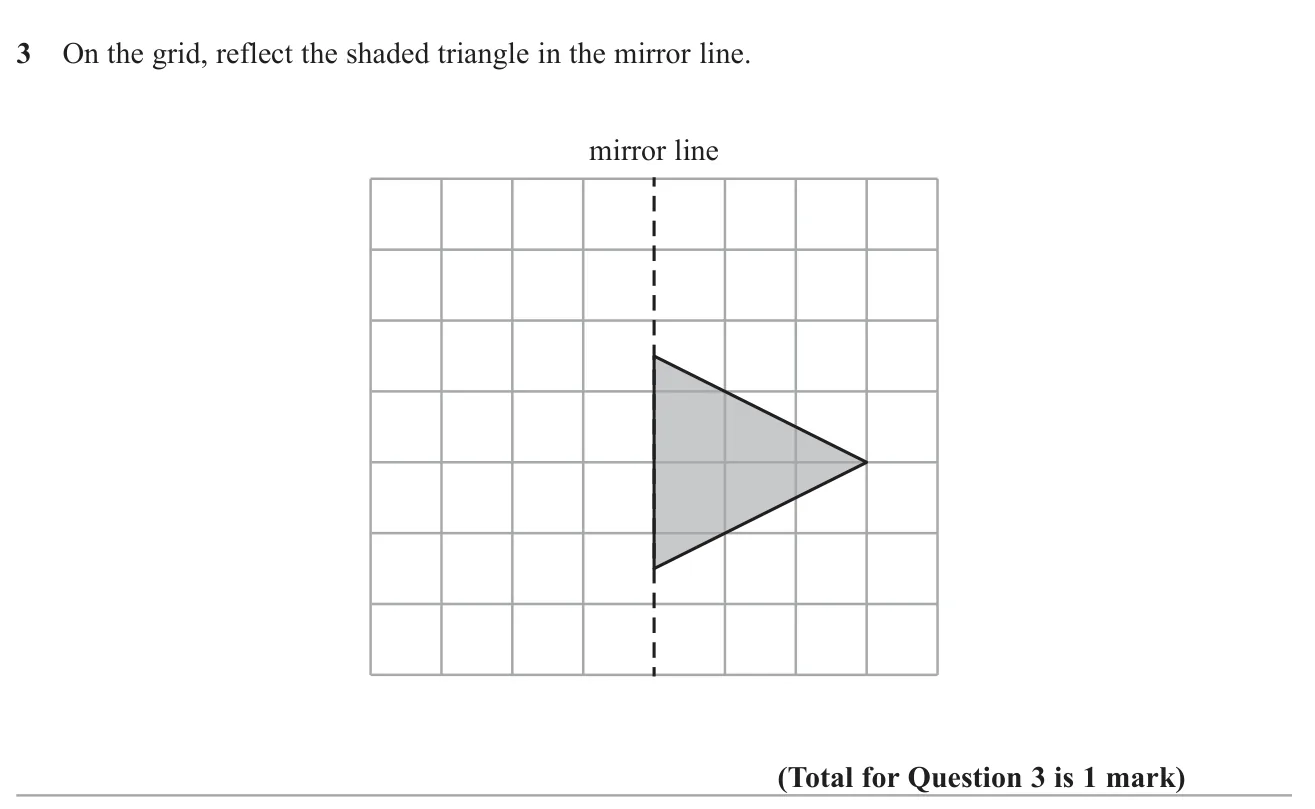
Exam questions: Transformations (41, easiest first) © Pearson Education Ltd. June 2022 Paper 1 (Foundation, non-calculator), question 3.
Answer Correct reflection drawn 1 mark
Worked solution Checked against the mark scheme
Take each corner of the triangle in turn.
Count how many squares it is from the mirror line, then plot the new corner the same distance on the other side.
Join the new corners to make the image.
Watch out: Translating the triangle across instead of flipping it.
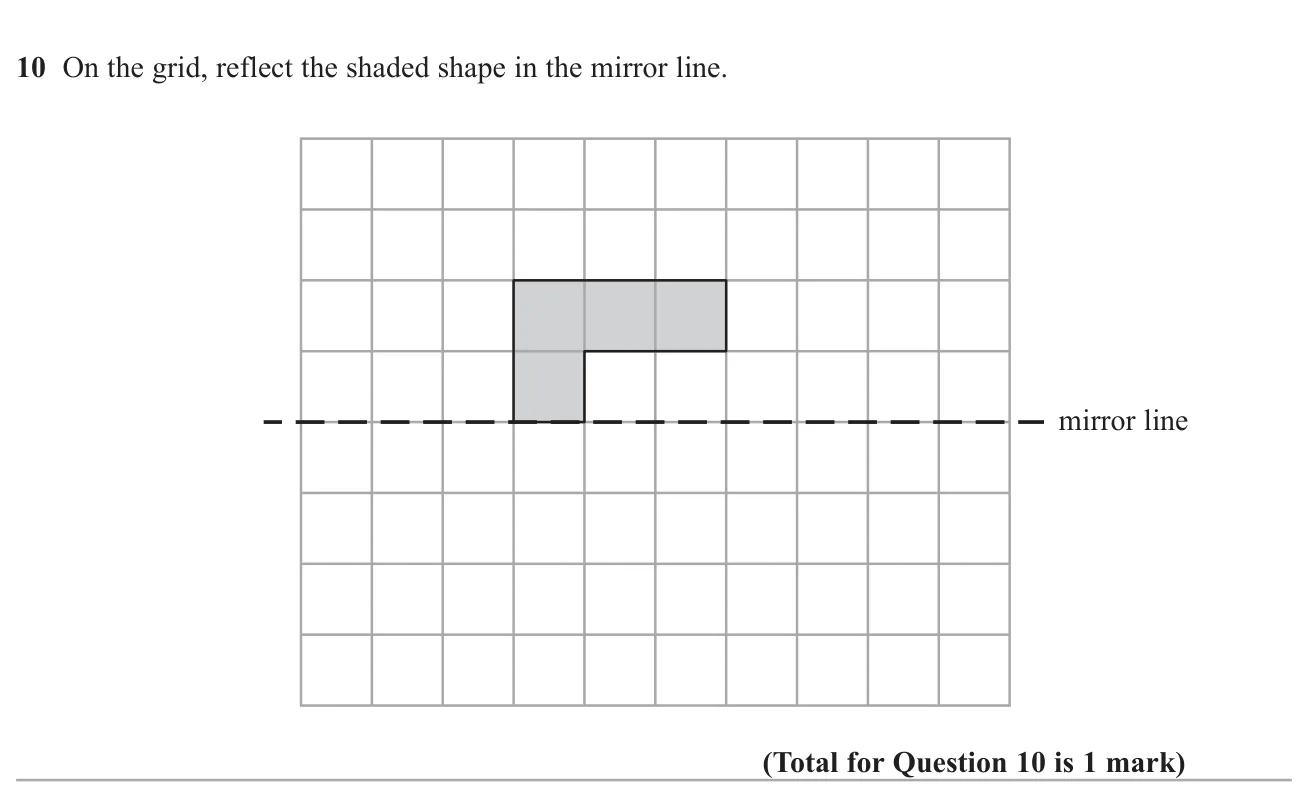
© Pearson Education Ltd. November 2018 Paper 3 (Foundation, calculator), question 10.
Answer Correct reflection drawn 1 mark
Worked solution Checked against the mark scheme
Take each corner of the shape in turn and count its distance to the mirror line.
Plot the image corner the same distance on the other side, then join the corners up.
Watch out: Translating the shape across the line instead of flipping it.
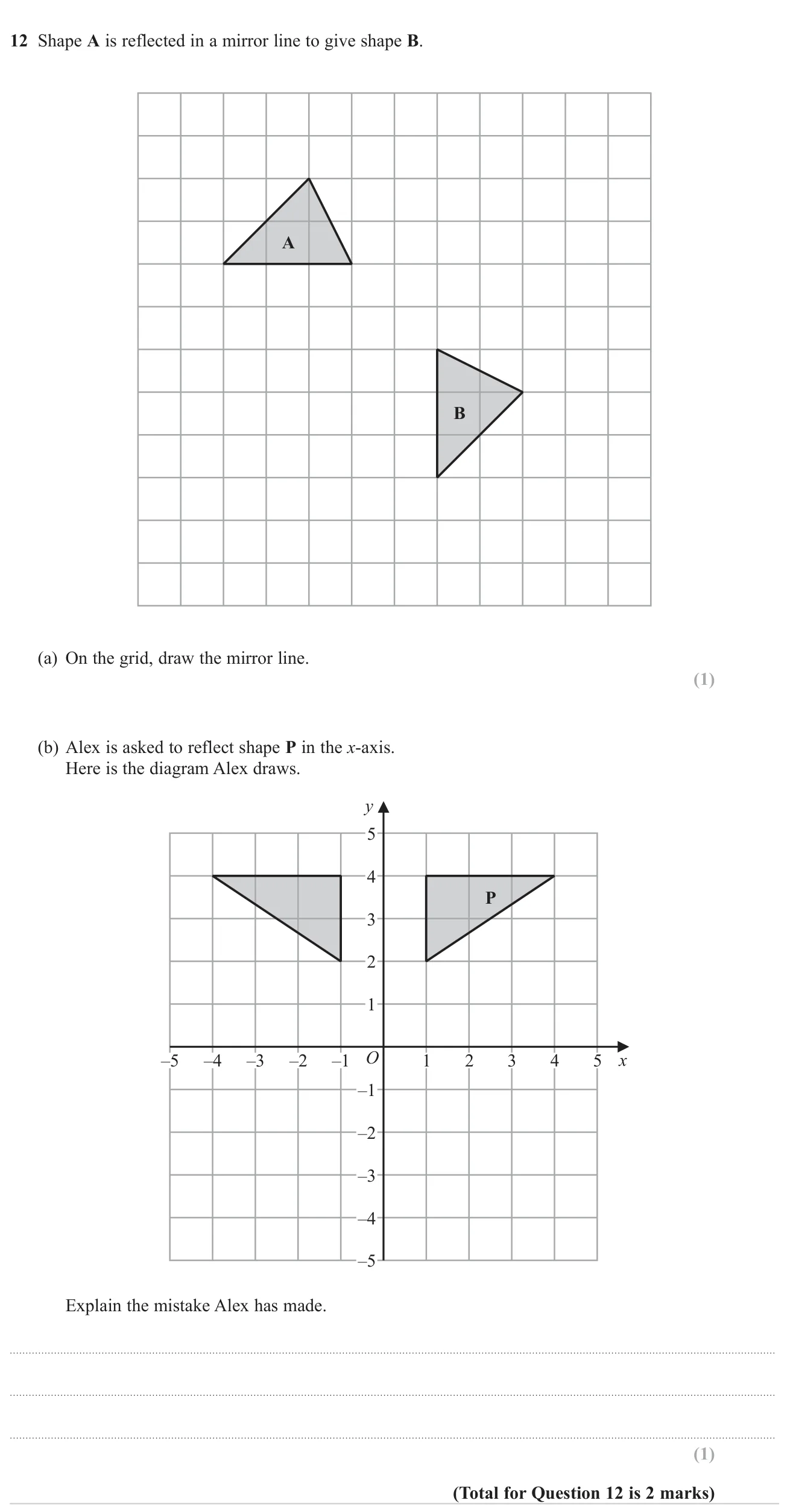
© Pearson Education Ltd. June 2023 Paper 2 (Foundation, calculator), question 12.
(a) The diagonal mirror line exactly halfway between A and B (sloping up to the right) 1 mark (b) Alex reflected in the y y y x x x 1 mark
Worked solution Checked against the mark scheme
(a) The horizontal edge of A becomes the vertical edge of B, so the mirror line is diagonal. Draw the line that is the same distance from each corner of A as from the matching corner of B.
(b) Reflecting in the x x x x x x y = − 2 y = -2 y = − 2 y = − 4 y = -4 y = − 4 y y y
Watch out: In (b), just saying 'it is the wrong way round' without naming the axis.
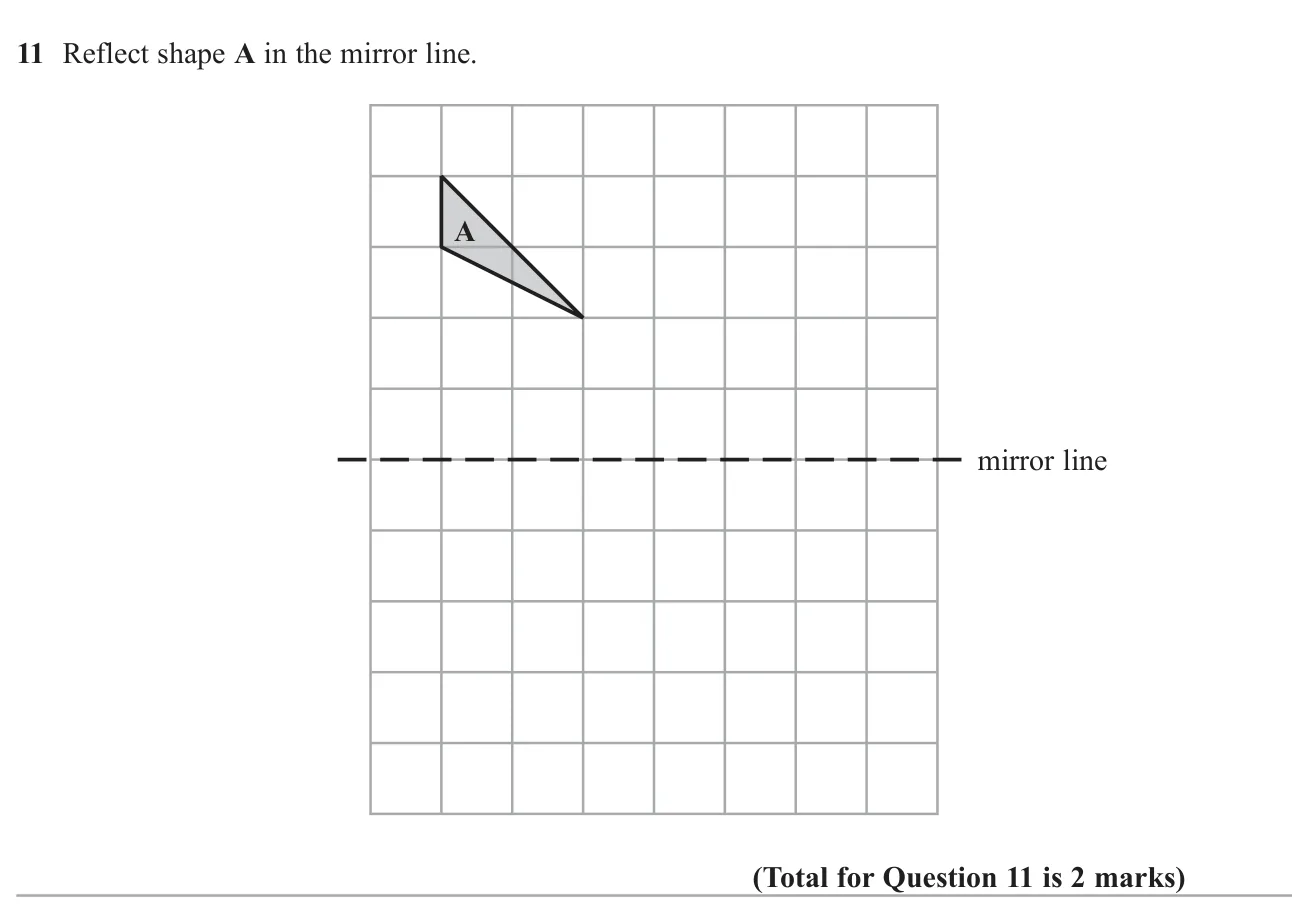
© Pearson Education Ltd. November 2021 Paper 2 (Foundation, calculator), question 11.
Answer Correct reflection of shape A in the mirror line 2 marks
Worked solution Checked against the mark scheme
Take each corner of A and count its distance to the mirror line.
Plot the image point the same distance on the other side, then join the points.
Watch out: Translating the shape across the line instead of flipping it.
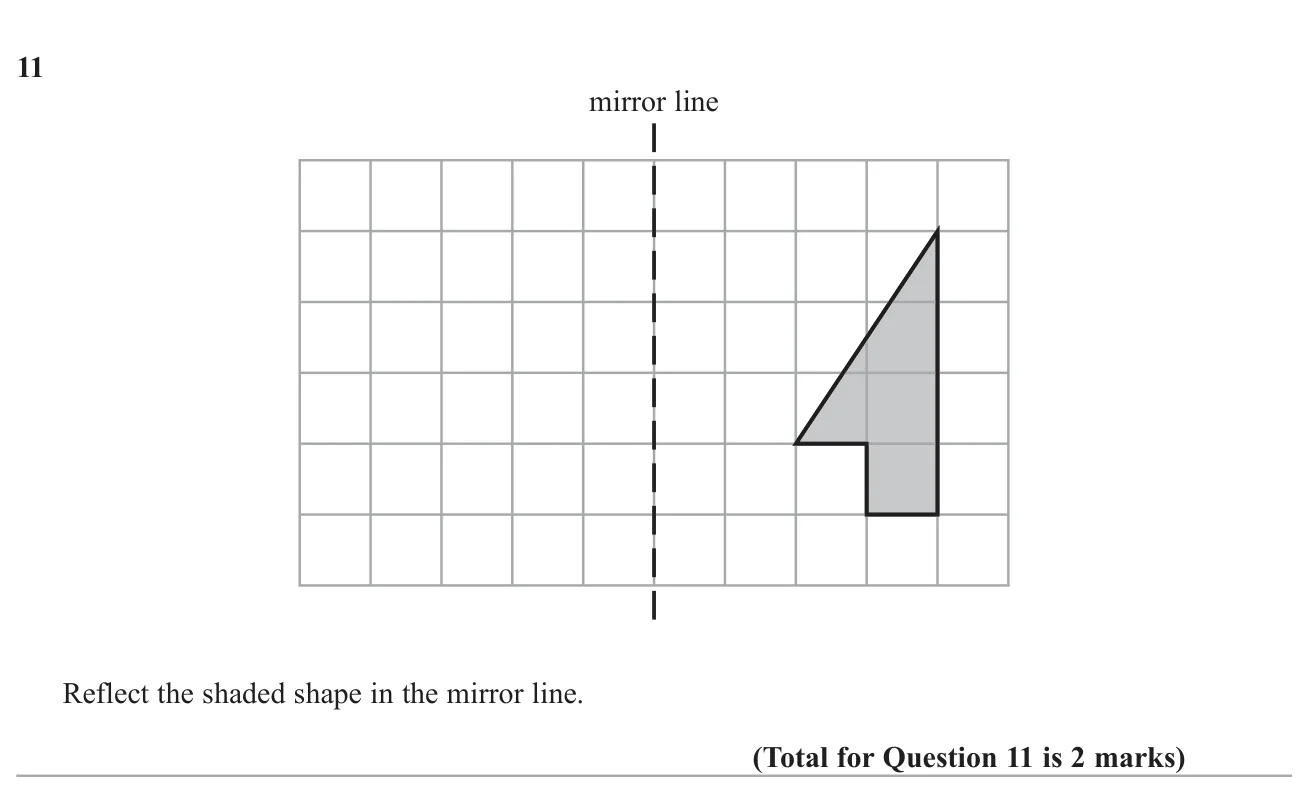
© Pearson Education Ltd. November 2020 Paper 1 (Foundation, non-calculator), question 11.
Answer Correct reflection on the left of the mirror line 2 marks
Worked solution Checked against the mark scheme
Take each corner in turn. Count how many squares it is from the mirror line, then plot the image the same distance on the other side.
The corner nearest the line (2 squares away) stays 2 squares away; the far edge (4 squares away) goes 4 squares to the left. Join the new corners.
Watch out: Sliding the shape across instead of flipping it, so it faces the wrong way.
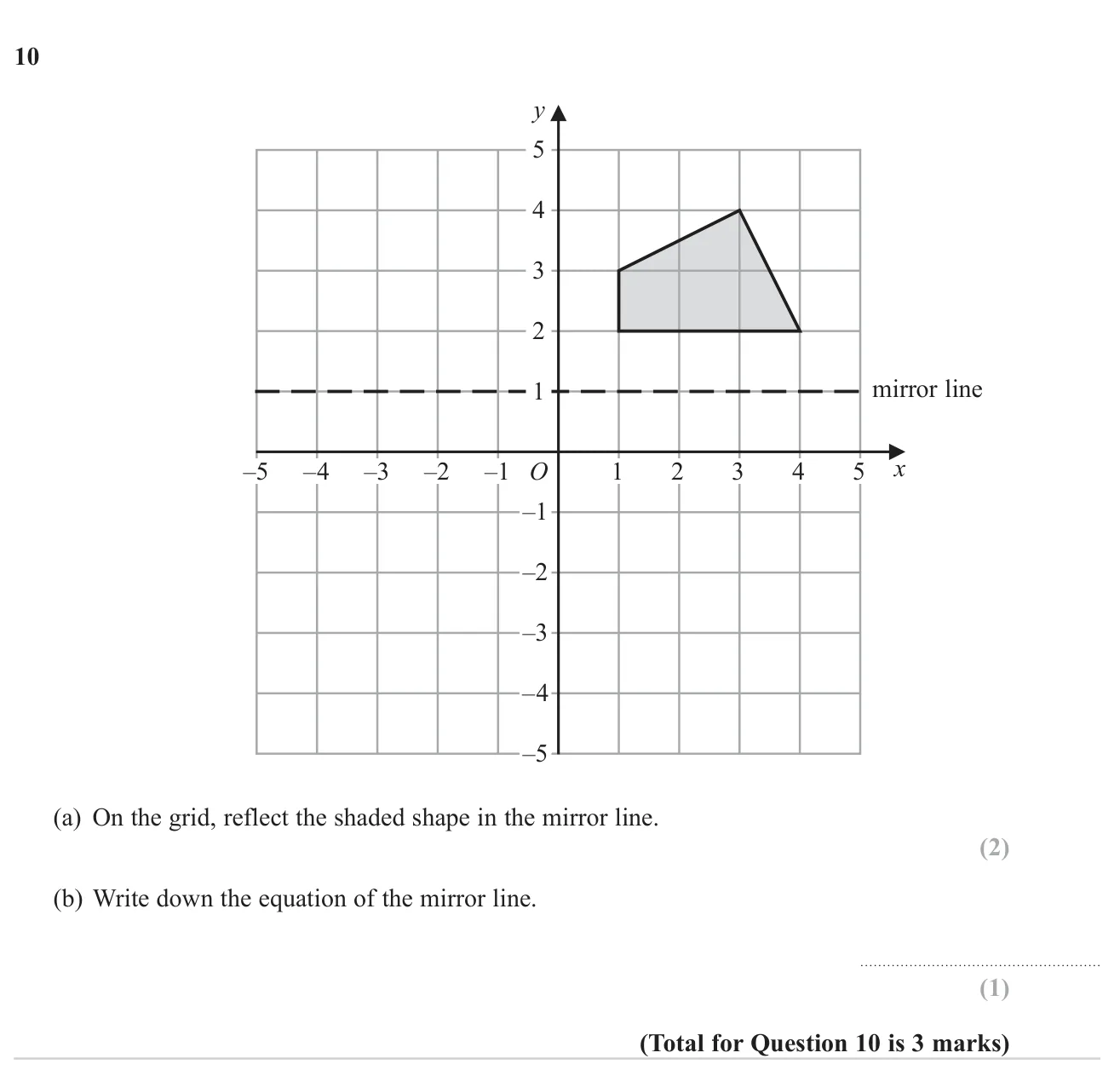
© Pearson Education Ltd. November 2024 Paper 1 (Foundation, non-calculator), question 10.
(a) Image with vertices ( 1 , 0 ) (1,0) ( 1 , 0 ) ( 1 , − 1 ) (1,-1) ( 1 , − 1 ) ( 3 , − 2 ) (3,-2) ( 3 , − 2 ) ( 4 , 0 ) (4,0) ( 4 , 0 ) 2 marks (b) y = 1 y = 1 y = 1 1 mark
Worked solution Checked against the mark scheme
(a) Each vertex keeps its x x x y = 1 y = 1 y = 1
( 1 , 2 ) → ( 1 , 0 ) (1,2)\to(1,0) ( 1 , 2 ) → ( 1 , 0 ) ( 1 , 3 ) → ( 1 , − 1 ) (1,3)\to(1,-1) ( 1 , 3 ) → ( 1 , − 1 ) ( 3 , 4 ) → ( 3 , − 2 ) (3,4)\to(3,-2) ( 3 , 4 ) → ( 3 , − 2 ) ( 4 , 2 ) → ( 4 , 0 ) (4,2)\to(4,0) ( 4 , 2 ) → ( 4 , 0 )
(b) Every point on the line has y y y y = 1 y = 1 y = 1
Watch out: Writing x = 1 for a horizontal line.
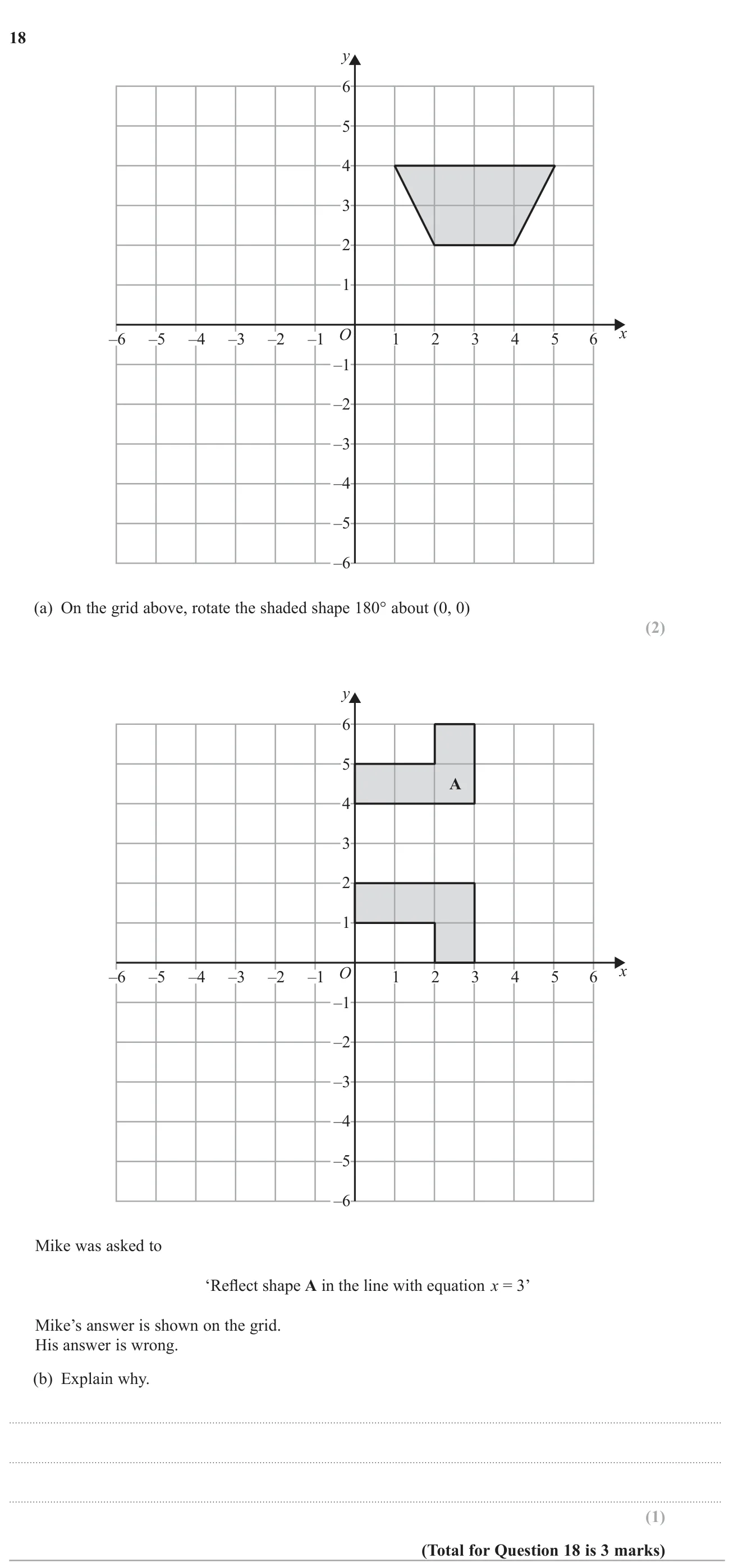
© Pearson Education Ltd. June 2024 Paper 3 (Foundation, calculator), question 18.
(a) Trapezium with vertices ( − 4 , − 2 ) , ( − 2 , − 2 ) , ( − 1 , − 4 ) , ( − 5 , − 4 ) (-4,-2), (-2,-2), (-1,-4), (-5,-4) ( − 4 , − 2 ) , ( − 2 , − 2 ) , ( − 1 , − 4 ) , ( − 5 , − 4 ) 2 marks (b) He reflected in the line y = 3 y = 3 y = 3 x = 3 x = 3 x = 3 x = 3 x = 3 x = 3 1 mark
Worked solution Checked against the mark scheme
(a) A 180° rotation about ( 0 , 0 ) (0,0) ( 0 , 0 ) ( x , y ) (x, y) ( x , y ) ( − x , − y ) (-x, -y) ( − x , − y )
( 1 , 4 ) → ( − 1 , − 4 ) (1,4)\to(-1,-4) ( 1 , 4 ) → ( − 1 , − 4 ) ( 5 , 4 ) → ( − 5 , − 4 ) (5,4)\to(-5,-4) ( 5 , 4 ) → ( − 5 , − 4 ) ( 4 , 2 ) → ( − 4 , − 2 ) (4,2)\to(-4,-2) ( 4 , 2 ) → ( − 4 , − 2 ) ( 2 , 2 ) → ( − 2 , − 2 ) (2,2)\to(-2,-2) ( 2 , 2 ) → ( − 2 , − 2 )
(b) x = 3 x = 3 x = 3 x x x y = 3 y = 3 y = 3
Watch out: Confusing x = 3 x = 3 x = 3 y = 3 y = 3 y = 3
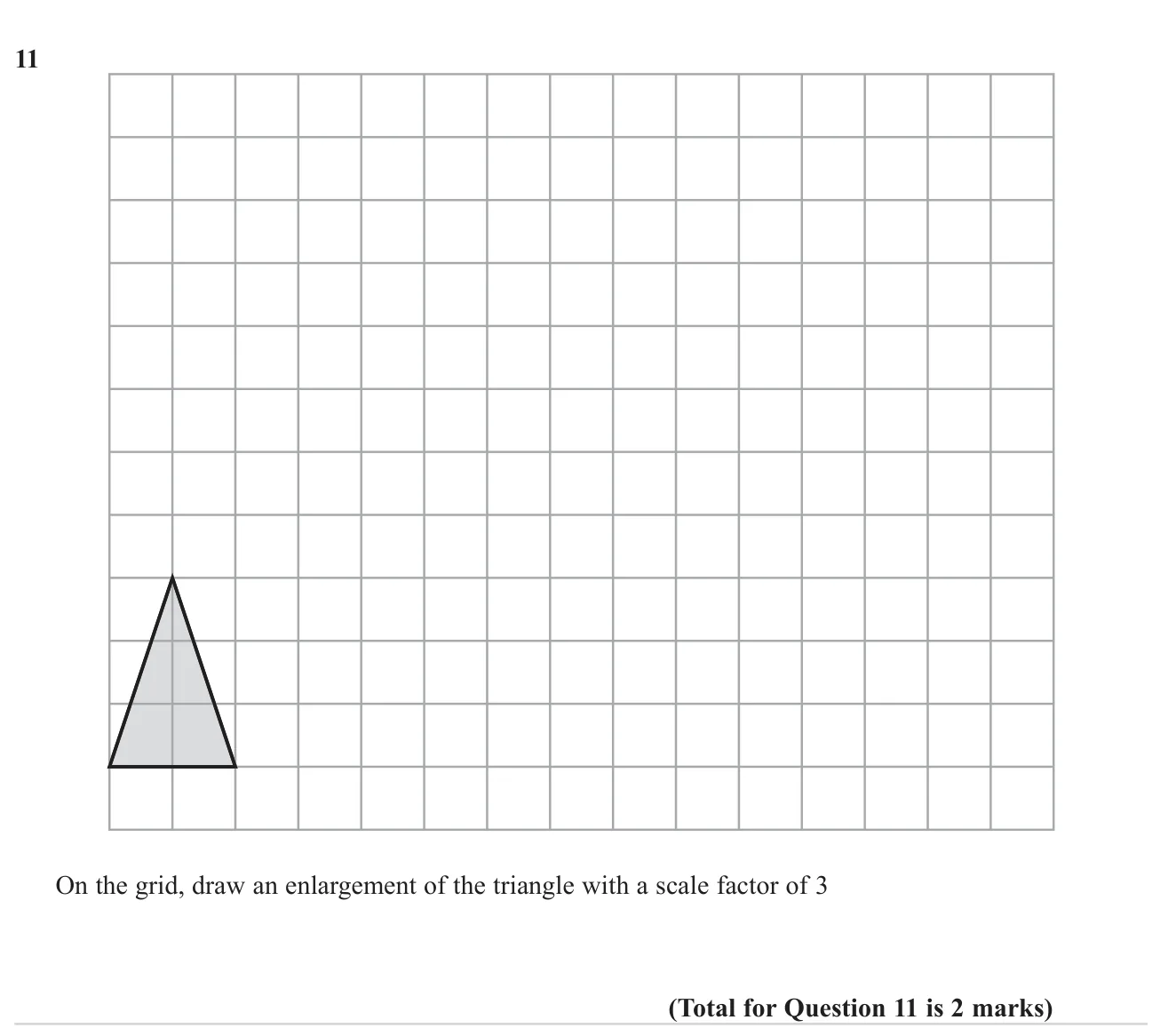
© Pearson Education Ltd. November 2023 Paper 1 (Foundation, non-calculator), question 11.
Answer Triangle with base 6 squares and height 9 squares, apex above the middle of the base 2 marks
Worked solution Checked against the mark scheme
The triangle has base 2 squares and height 3 squares, with its top above the middle of the base.
Multiply every length by 3: base 2 × 3 = 6 2 \times 3 = 6 2 × 3 = 6 3 × 3 = 9 3 \times 3 = 9 3 × 3 = 9
Draw a base of 6 squares and put the top 9 squares above its midpoint.
Watch out: Adding 3 to each length instead of multiplying.
© Pearson Education Ltd. November 2022 Paper 1 (Foundation, non-calculator), question 11.
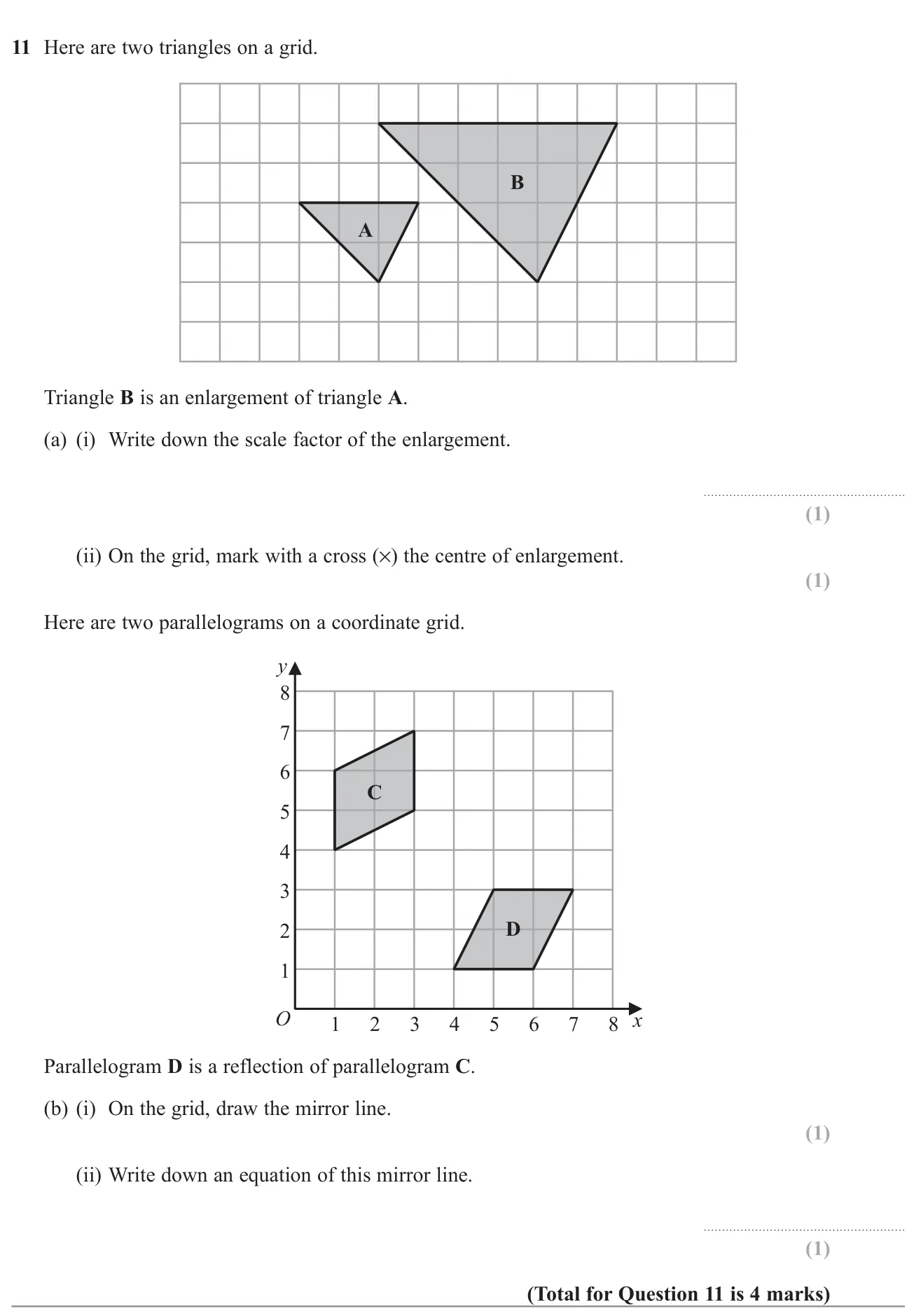
(a(i)) 2 2 2 1 mark (a(ii)) Cross at the centre of enlargement, found by joining matching vertices 1 mark (b(i)) The line y = x y = x y = x 1 mark (b(ii)) y = x y = x y = x 1 mark
Worked solution Checked against the mark scheme
(a)(i) The top side of A is 3 squares; in B it is 6 squares. 6 ÷ 3 = 2 6 \div 3 = 2 6 ÷ 3 = 2
(a)(ii) Draw lines through matching corners of B and A and extend them; they meet at the centre.
(b) Corner ( 1 , 4 ) (1, 4) ( 1 , 4 ) ( 4 , 1 ) (4, 1) ( 4 , 1 ) y = x y = x y = x
Watch out: Giving a vertical line such as x = 3.5 x = 3.5 x = 3.5 y = x y = x y = x
© Pearson Education Ltd. November 2019 Paper 2 (Foundation, calculator), question 13.
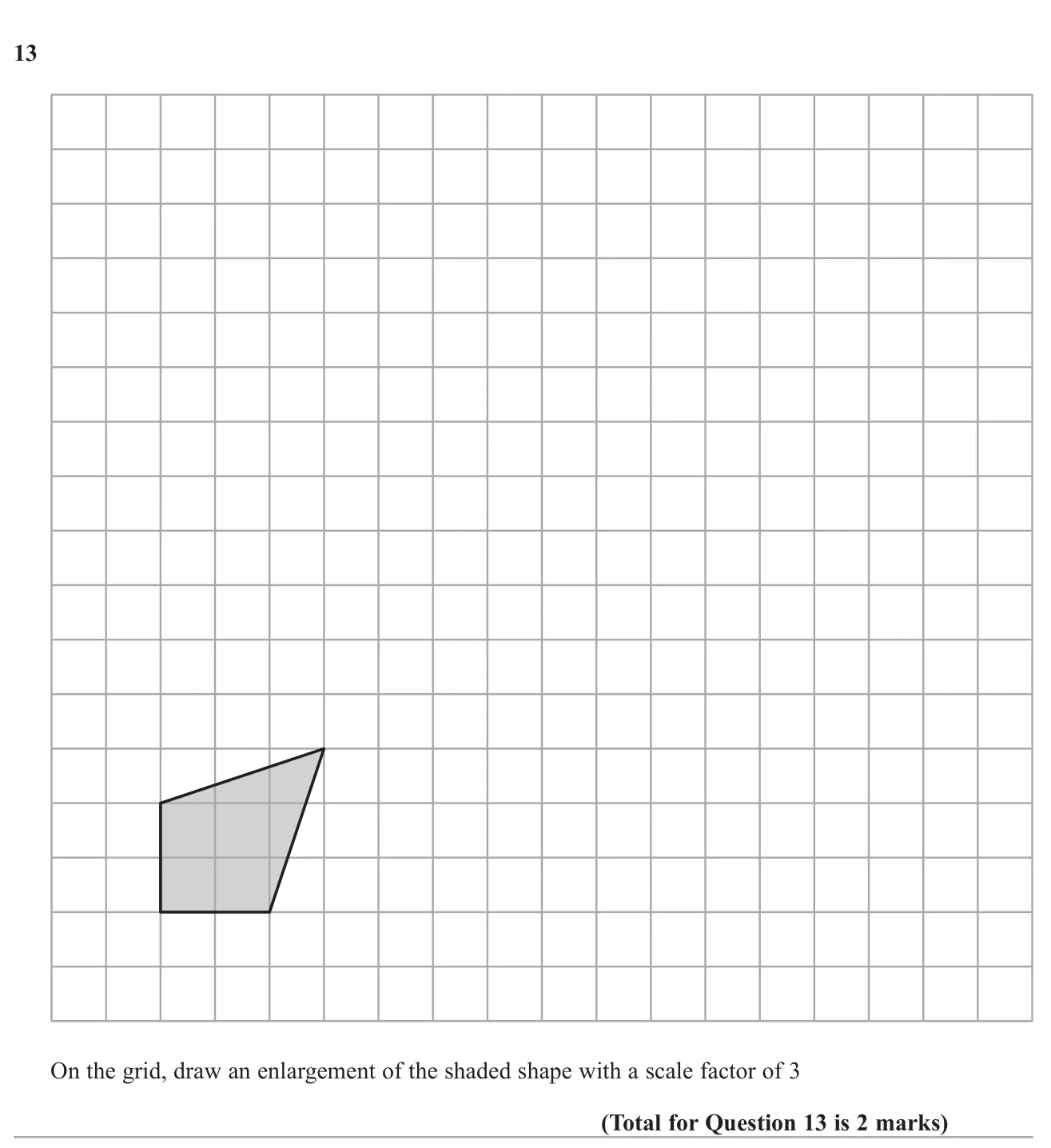
Answer Correct enlargement scale factor 3, any position 2 marks
Worked solution Checked against the mark scheme
Count the length of each side of the shape in squares, including how far across and up each sloping side goes.
Multiply every horizontal and vertical step by 3.
For example, a side 2 squares long becomes 6 squares long, and a slope of 3 across, 1 up becomes 9 across, 3 up.
Watch out: Adding 3 to each length instead of multiplying by 3.
© Pearson Education Ltd. November 2019 Paper 3 (Foundation, calculator), question 18.
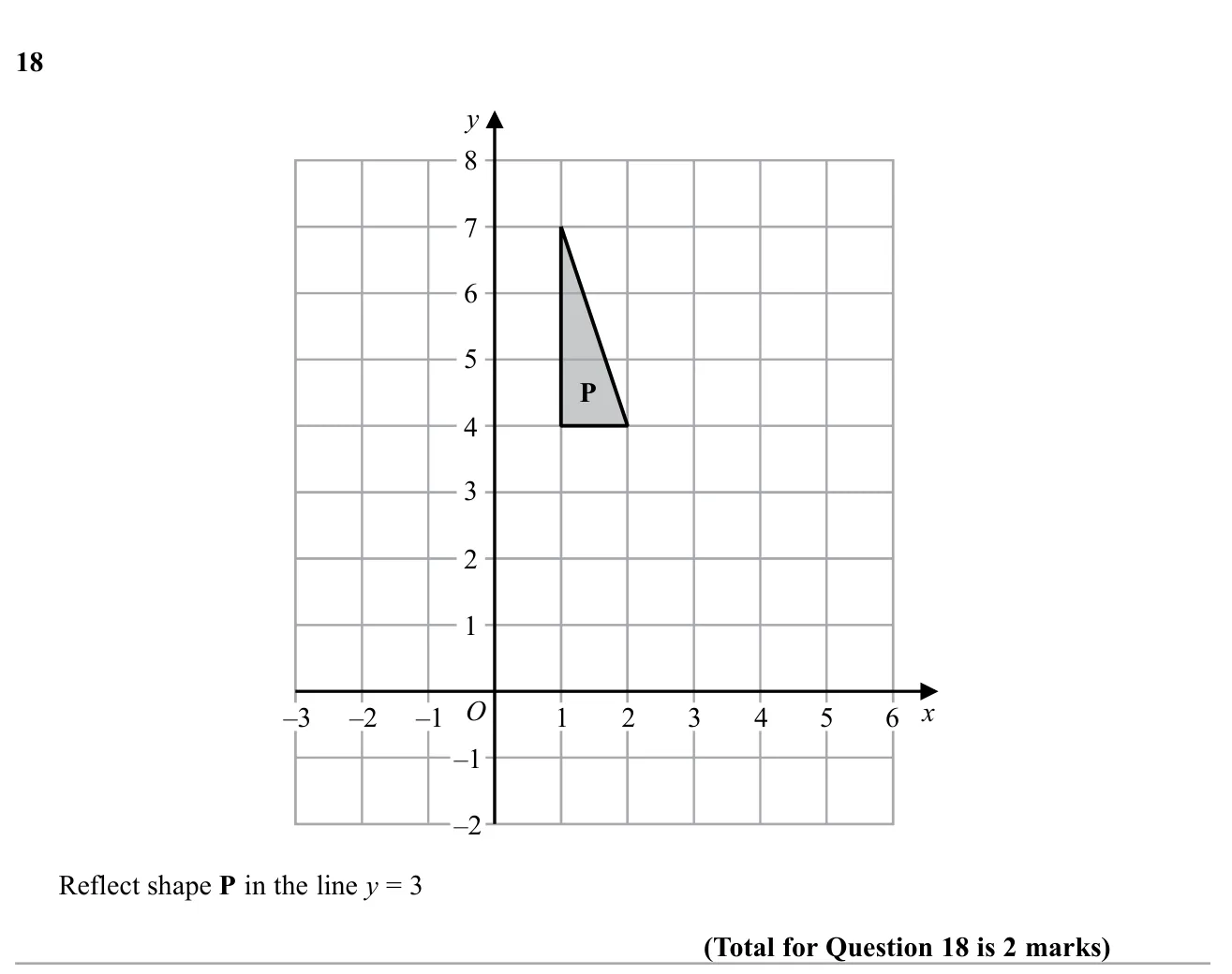
Answer Triangle with vertices ( 1 , 2 ) (1, 2) ( 1 , 2 ) ( 2 , 2 ) (2, 2) ( 2 , 2 ) ( 1 , − 1 ) (1, -1) ( 1 , − 1 ) 2 marks
Worked solution Checked against the mark scheme
Each point moves to the same distance on the other side of y = 3 y = 3 y = 3
( 1 , 4 ) (1, 4) ( 1 , 4 ) ( 1 , 2 ) (1, 2) ( 1 , 2 ) ( 2 , 4 ) (2, 4) ( 2 , 4 ) ( 2 , 2 ) (2, 2) ( 2 , 2 ) ( 1 , 7 ) (1, 7) ( 1 , 7 ) ( 1 , − 1 ) (1, -1) ( 1 , − 1 )
Watch out: Reflecting in the line x = 3 instead.
© Pearson Education Ltd. November 2018 Paper 2 (Foundation, calculator), question 16.
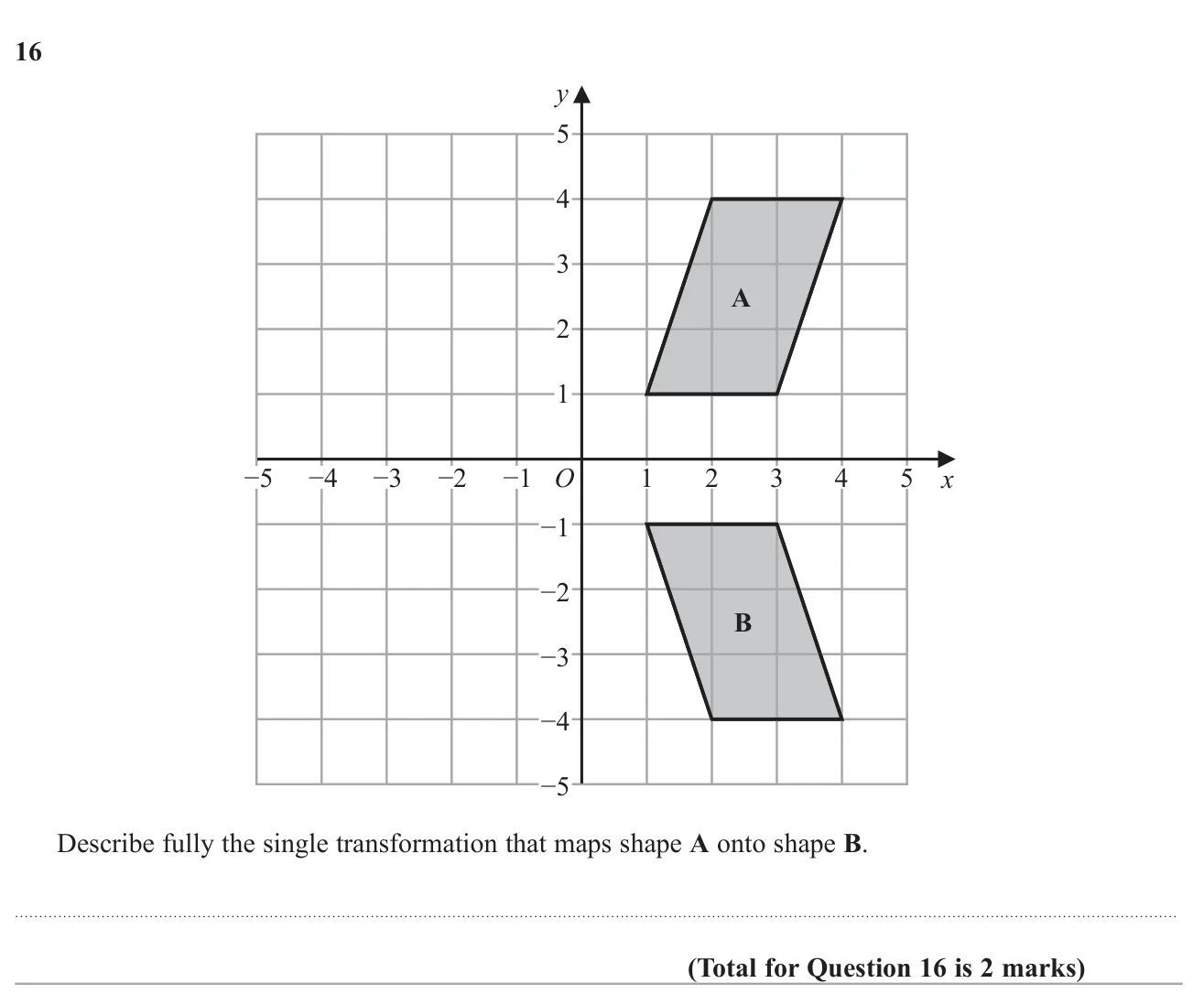
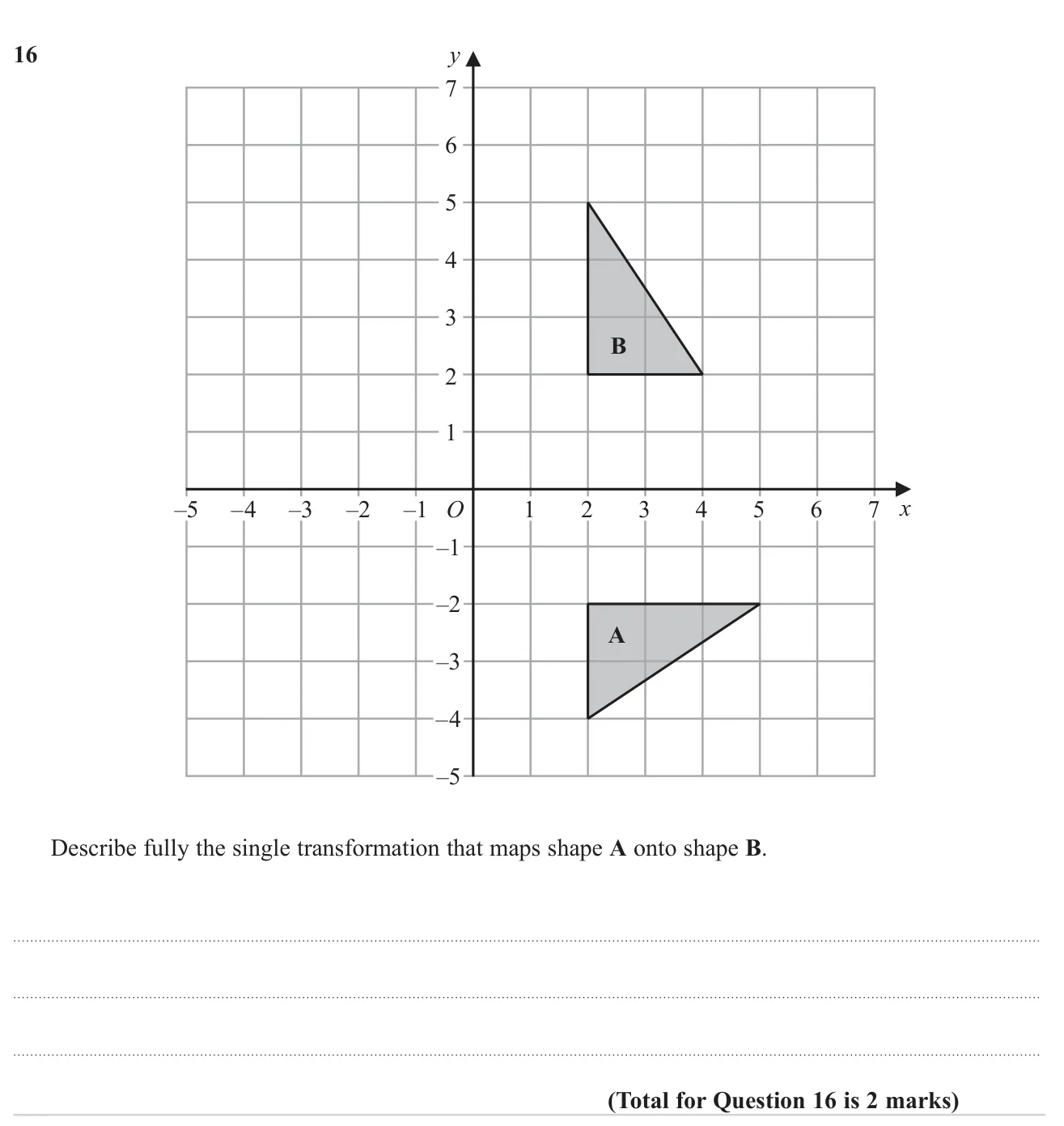
Answer Reflection in the x x x y = 0 y = 0 y = 0 2 marks
Worked solution Checked against the mark scheme
Each point of A has the same x x x y y y ( 1 , 1 ) → ( 1 , − 1 ) (1, 1) \to (1, -1) ( 1 , 1 ) → ( 1 , − 1 )
So it is a **reflection in the x x x
Watch out: Saying 'in the y-axis', or naming a rotation.
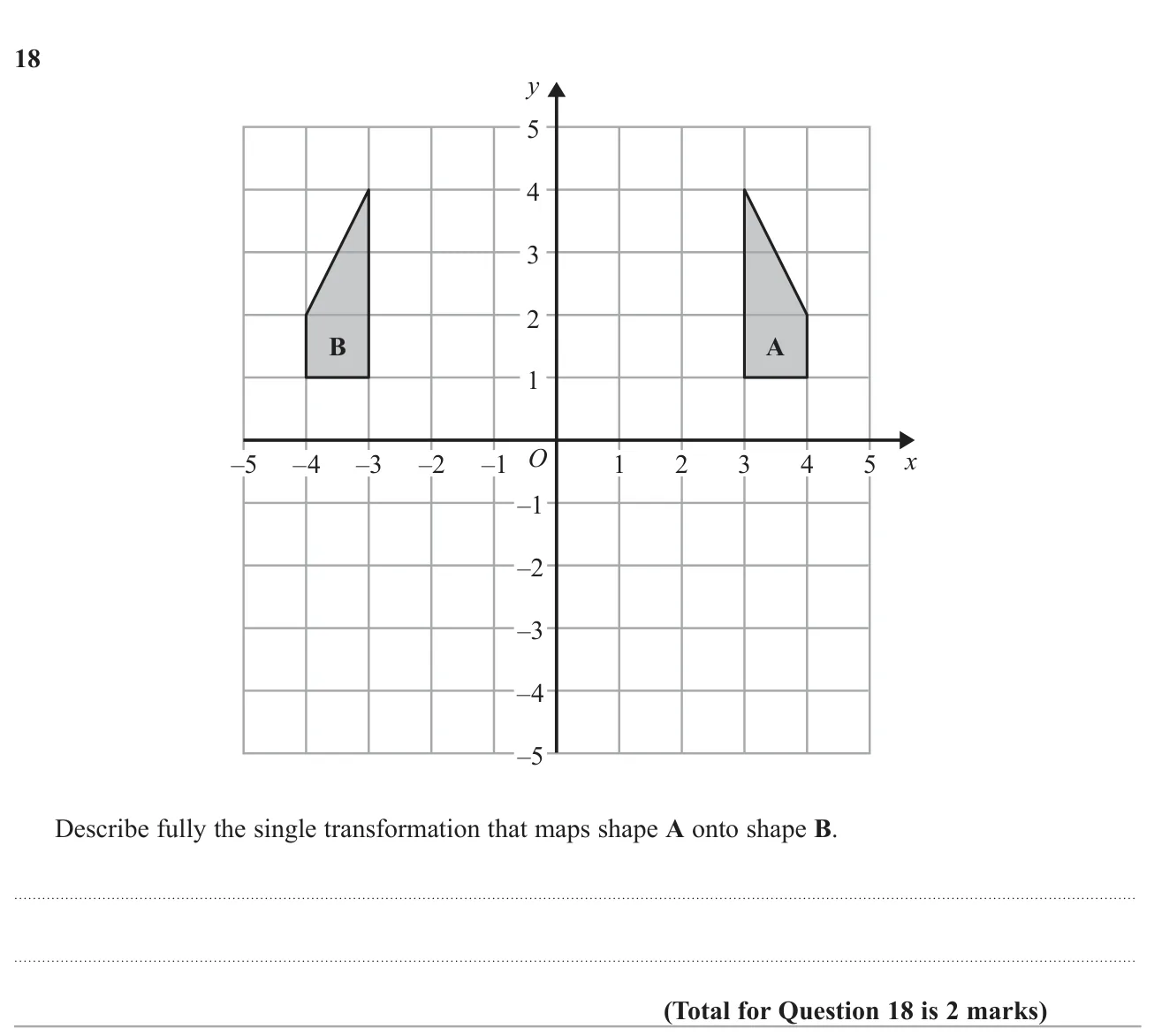
© Pearson Education Ltd. June 2018 Paper 2 (Foundation, calculator), question 18.
Answer Reflection in the y y y 2 marks
Worked solution Checked against the mark scheme
Shape B is a mirror image of A, the same distance from the y y y
So it is a reflection in the y y y x = 0 x = 0 x = 0
Watch out: Saying translation, or naming the x-axis as the mirror line.
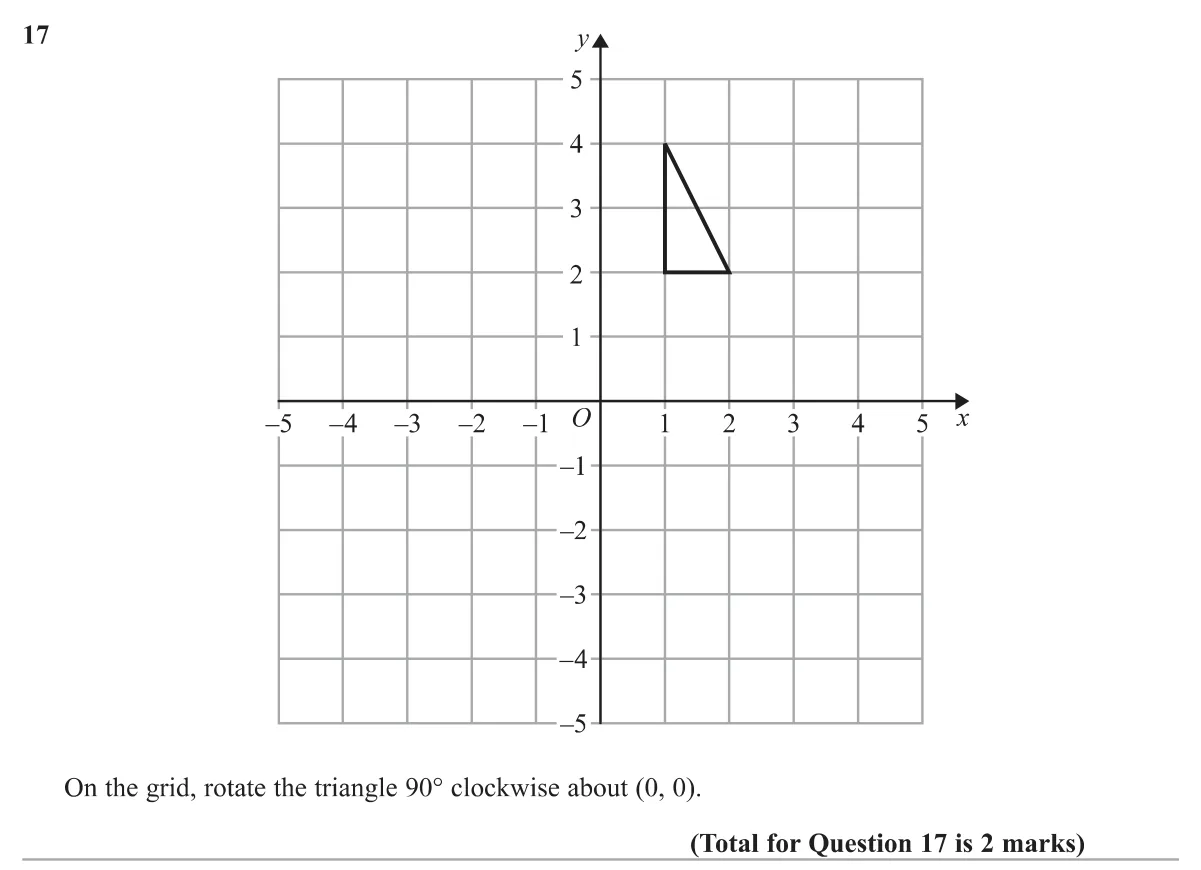
© Pearson Education Ltd. Specimen Paper 1 (Foundation, non-calculator), question 17.
Answer Triangle with vertices ( 2 , − 1 ) (2,-1) ( 2 , − 1 ) ( 4 , − 1 ) (4,-1) ( 4 , − 1 ) ( 2 , − 2 ) (2,-2) ( 2 , − 2 ) 2 marks
Worked solution Checked against the mark scheme
Rotating 90° clockwise about ( 0 , 0 ) (0,0) ( 0 , 0 ) ( x , y ) (x, y) ( x , y ) ( y , − x ) (y, -x) ( y , − x )
( 1 , 2 ) → ( 2 , − 1 ) (1,2) \to (2,-1) ( 1 , 2 ) → ( 2 , − 1 )
( 1 , 4 ) → ( 4 , − 1 ) (1,4) \to (4,-1) ( 1 , 4 ) → ( 4 , − 1 )
( 2 , 2 ) → ( 2 , − 2 ) (2,2) \to (2,-2) ( 2 , 2 ) → ( 2 , − 2 )
Plot and join these three points.
Watch out: Rotating anticlockwise instead of clockwise.
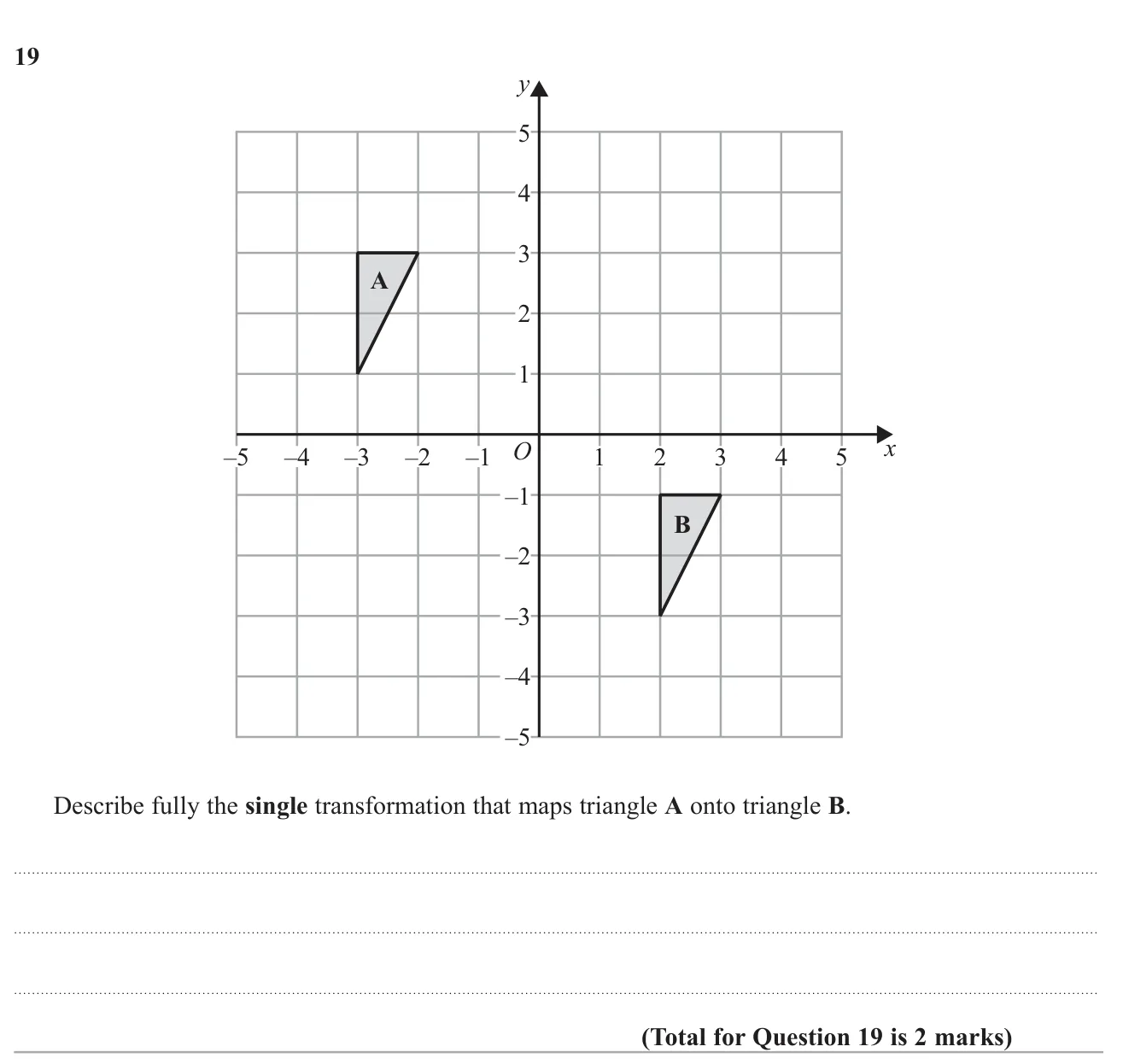
© Pearson Education Ltd. June 2024 Paper 1 (Foundation, non-calculator), question 19.
Answer Translation by ( 5 − 4 ) \begin{pmatrix}5\\-4\end{pmatrix} ( 5 − 4 ) 2 marks
Worked solution Checked against the mark scheme
Corner ( − 3 , 1 ) (-3, 1) ( − 3 , 1 ) ( 2 , − 3 ) (2, -3) ( 2 , − 3 )
That is 5 right and 4 down, with no turning or flipping.
Translation by ( 5 − 4 ) \begin{pmatrix}5\\-4\end{pmatrix} ( 5 − 4 )
Watch out: Writing the vector as a coordinate (5, −4) or giving two transformations.
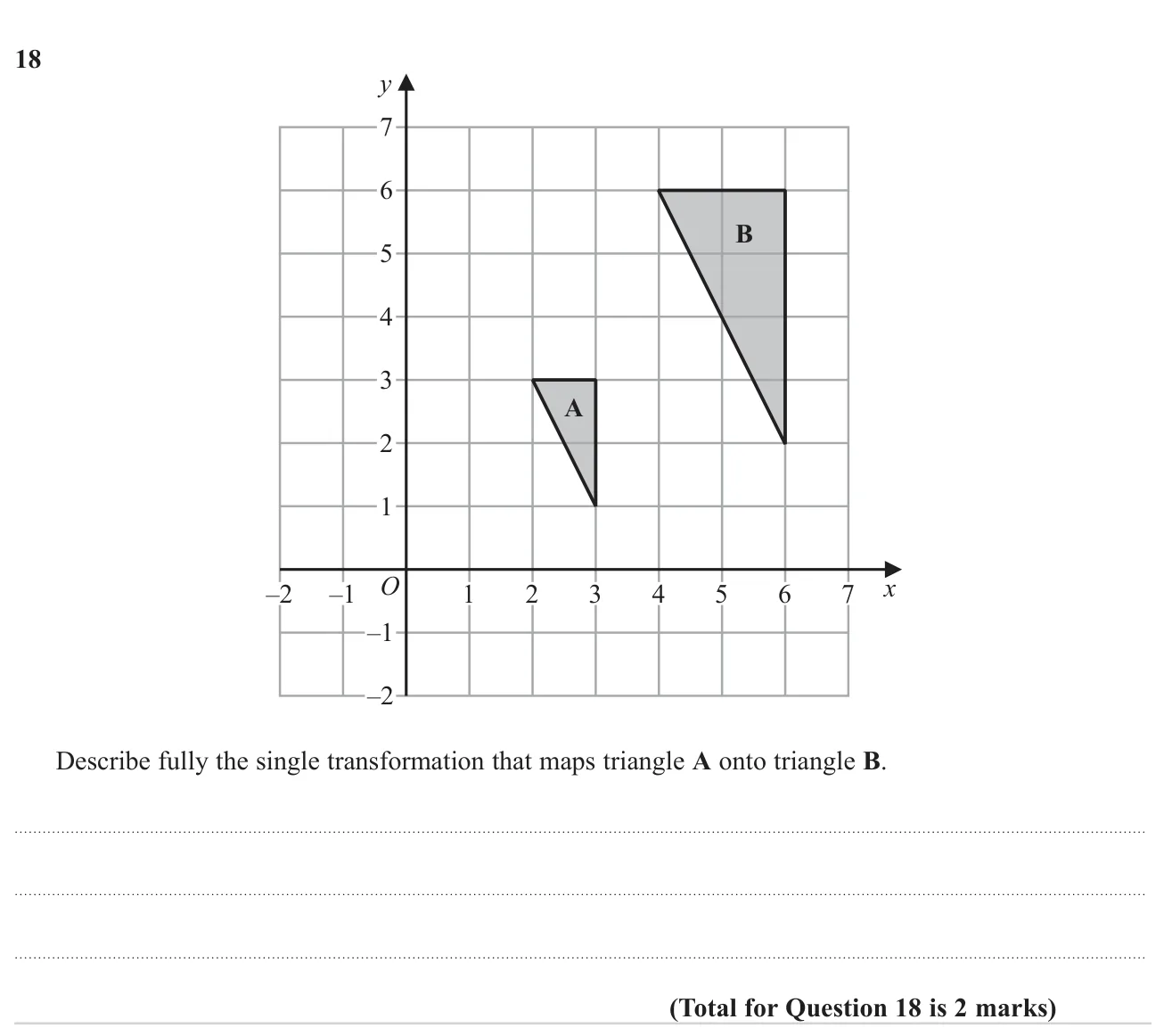
© Pearson Education Ltd. November 2024 Paper 2 (Foundation, calculator), question 18.
Answer Enlargement, scale factor 2, centre ( 0 , 0 ) (0, 0) ( 0 , 0 ) 2 marks
Worked solution Checked against the mark scheme
The triangle is bigger, so it is an enlargement.
Sides of A double in B (e.g. height 2 becomes 4), so the scale factor is 2.
Lines through matching corners, e.g. ( 3 , 1 ) (3, 1) ( 3 , 1 ) ( 6 , 2 ) (6, 2) ( 6 , 2 ) ( 0 , 0 ) (0, 0) ( 0 , 0 )
Watch out: Leaving out the centre of enlargement.
© Pearson Education Ltd. June 2023 Paper 3 (Foundation, calculator), question 16.
Answer Rotation 90 ° 90° 90° ( 0 , 0 ) (0, 0) ( 0 , 0 ) 2 marks
Worked solution Checked against the mark scheme
The shape has turned, so it is a rotation.
The vertex ( 2 , − 2 ) (2, -2) ( 2 , − 2 ) ( 2 , 2 ) (2, 2) ( 2 , 2 ) ( 5 , − 2 ) (5, -2) ( 5 , − 2 ) ( 2 , 5 ) (2, 5) ( 2 , 5 ) ( 2 , − 4 ) (2, -4) ( 2 , − 4 ) ( 4 , 2 ) (4, 2) ( 4 , 2 ) ( x , y ) (x, y) ( x , y ) ( − y , x ) (-y, x) ( − y , x )
That is a rotation of 90 ° 90° 90° ( 0 , 0 ) (0, 0) ( 0 , 0 )
Watch out: Leaving out the centre or the direction of the turn.
© Pearson Education Ltd. June 2022 Paper 2 (Foundation, calculator), question 22.
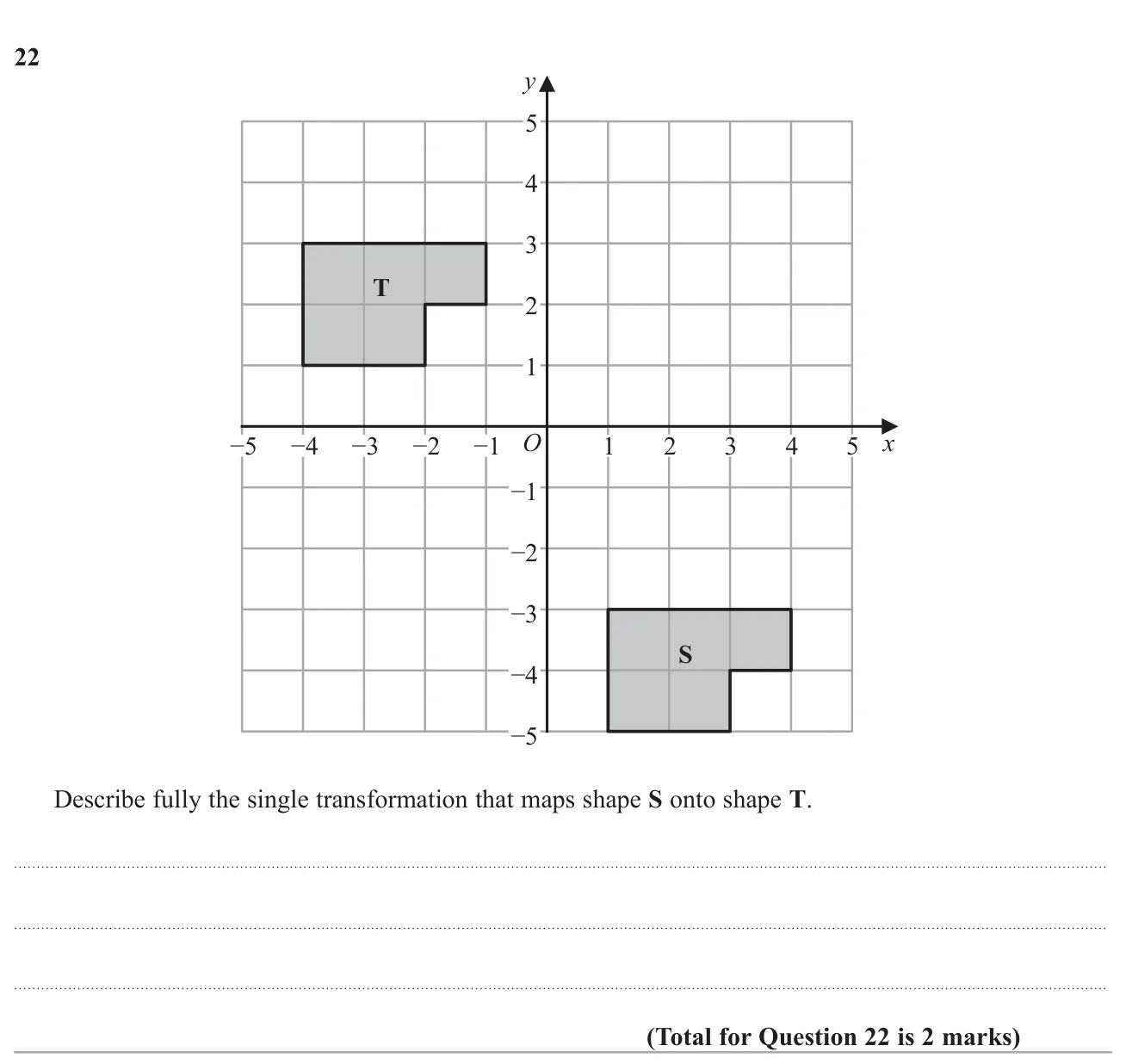
Answer Translation by ( − 5 6 ) \begin{pmatrix}-5\\6\end{pmatrix} ( − 5 6 ) 2 marks
Worked solution Checked against the mark scheme
The shape is the same size and way round, so it is a translation.
Pick a corner: ( 1 , − 5 ) (1, -5) ( 1 , − 5 ) ( − 4 , 1 ) (-4, 1) ( − 4 , 1 )
That is 5 left and 6 up: translation by ( − 5 6 ) \begin{pmatrix}-5\\6\end{pmatrix} ( − 5 6 )
Watch out: Writing the vector as a coordinate (−5, 6), or giving two transformations.
© Pearson Education Ltd. November 2022 Paper 3 (Foundation, calculator), question 18.
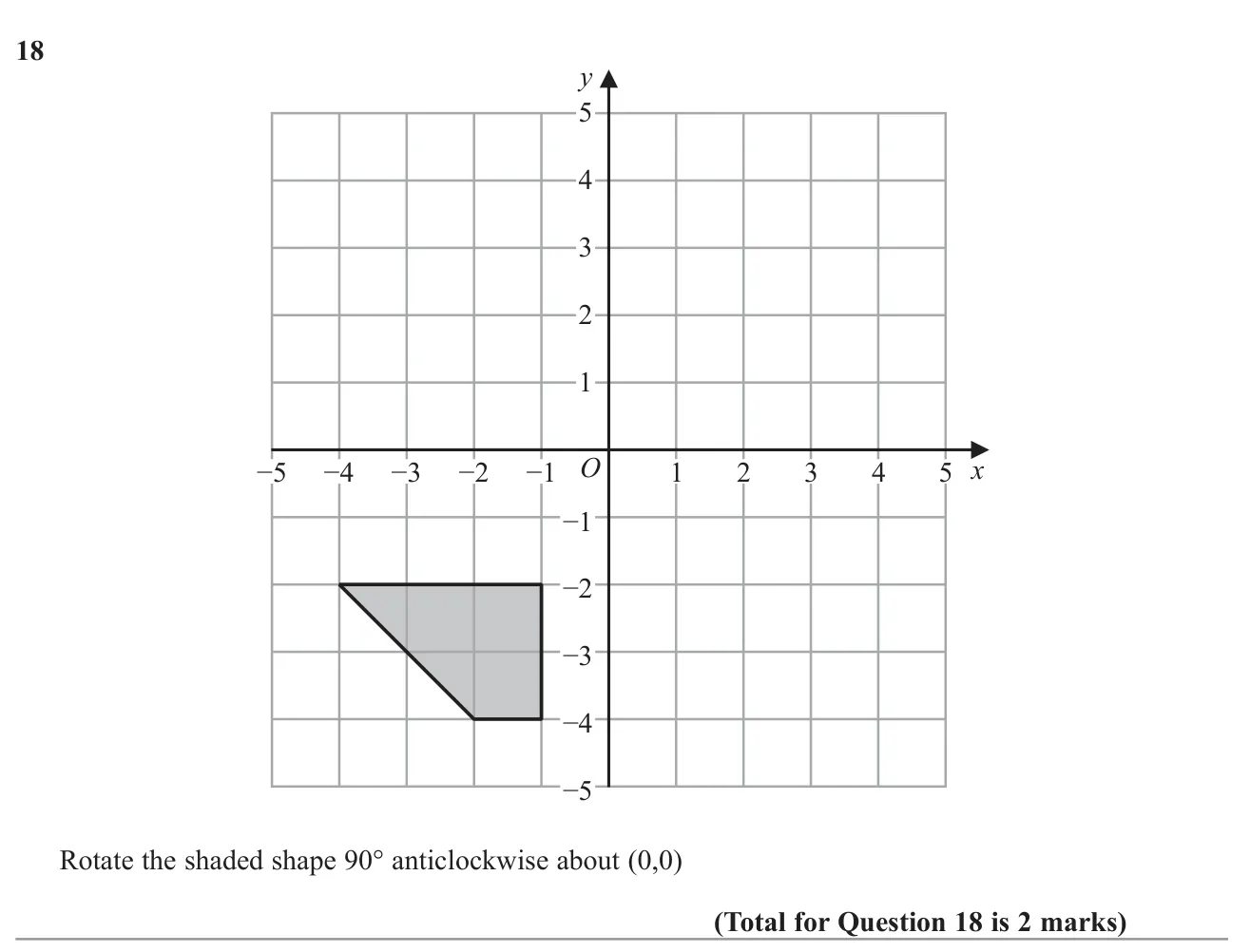
Answer Vertices at ( 2 , − 1 ) (2,-1) ( 2 , − 1 ) ( 2 , − 4 ) (2,-4) ( 2 , − 4 ) ( 4 , − 2 ) (4,-2) ( 4 , − 2 ) ( 4 , − 1 ) (4,-1) ( 4 , − 1 ) 2 marks
Worked solution Checked against the mark scheme
The shape has vertices ( − 4 , − 2 ) (-4,-2) ( − 4 , − 2 ) ( − 1 , − 2 ) (-1,-2) ( − 1 , − 2 ) ( − 1 , − 4 ) (-1,-4) ( − 1 , − 4 ) ( − 2 , − 4 ) (-2,-4) ( − 2 , − 4 )
A 90° anticlockwise turn about O sends ( x , y ) (x, y) ( x , y ) ( − y , x ) (-y, x) ( − y , x )
New vertices: ( 2 , − 4 ) (2,-4) ( 2 , − 4 ) ( 2 , − 1 ) (2,-1) ( 2 , − 1 ) ( 4 , − 1 ) (4,-1) ( 4 , − 1 ) ( 4 , − 2 ) (4,-2) ( 4 , − 2 )
Watch out: Rotating clockwise instead of anticlockwise.
© Pearson Education Ltd. November 2021 Paper 3 (Foundation, calculator), question 16.
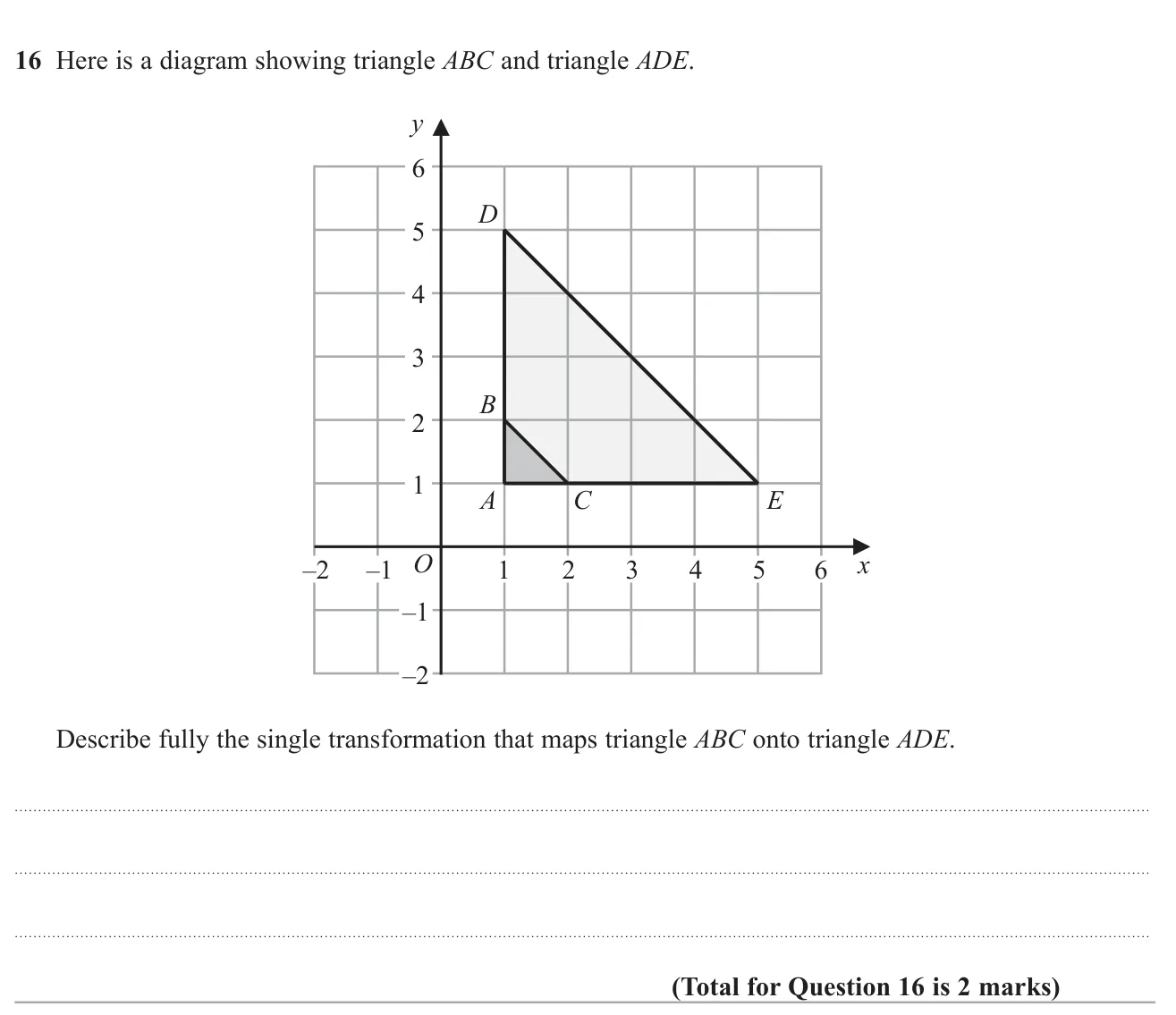
Answer Enlargement, scale factor 4, centre (1, 1) 2 marks
Worked solution Checked against the mark scheme
The shape keeps the same angles but gets bigger, so it is an enlargement.
AB is 1 unit and AD is 4 units, so the scale factor is 4.
Point A stays still at ( 1 , 1 ) (1, 1) ( 1 , 1 )
Enlargement, scale factor 4, centre ( 1 , 1 ) (1, 1) ( 1 , 1 )
Watch out: Leaving out the centre of enlargement, or mentioning a second transformation.
© Pearson Education Ltd. November 2023 Paper 2 (Foundation, calculator), question 21.
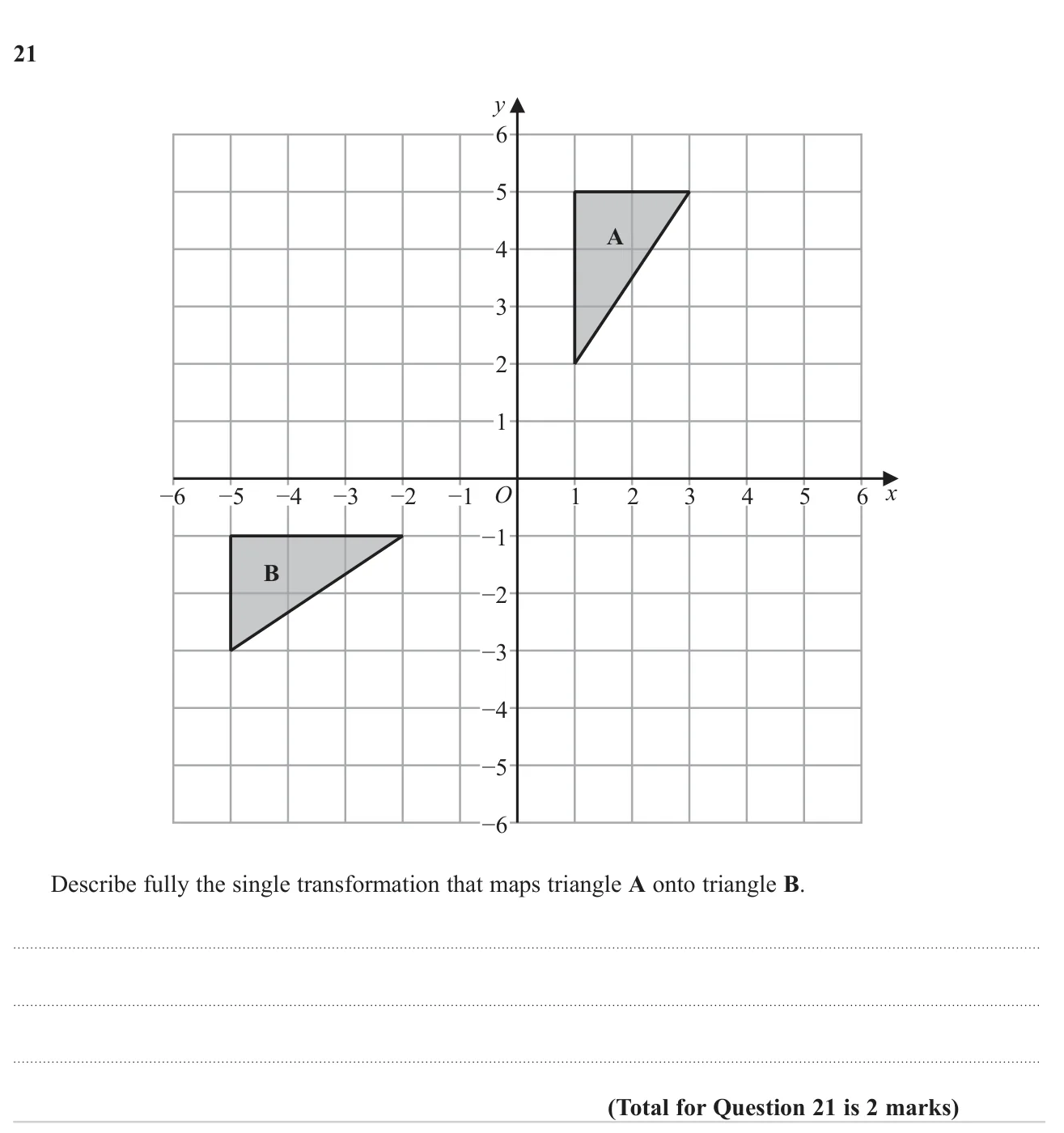
Answer Reflection in the line y = − x y = -x y = − x 2 marks
Worked solution Checked against the mark scheme
Corners of A: ( 1 , 5 ) , ( 3 , 5 ) , ( 1 , 2 ) (1,5), (3,5), (1,2) ( 1 , 5 ) , ( 3 , 5 ) , ( 1 , 2 ) ( − 5 , − 1 ) , ( − 5 , − 3 ) , ( − 2 , − 1 ) (-5,-1), (-5,-3), (-2,-1) ( − 5 , − 1 ) , ( − 5 , − 3 ) , ( − 2 , − 1 )
Each point ( a , b ) (a, b) ( a , b ) ( − b , − a ) (-b, -a) ( − b , − a )
The mirror line is y = − x y = -x y = − x y = − x y = -x y = − x
Watch out: Calling it a rotation of 180° or using the line y = x.
© Pearson Education Ltd. November 2020 Paper 2 (Foundation, calculator), question 18.
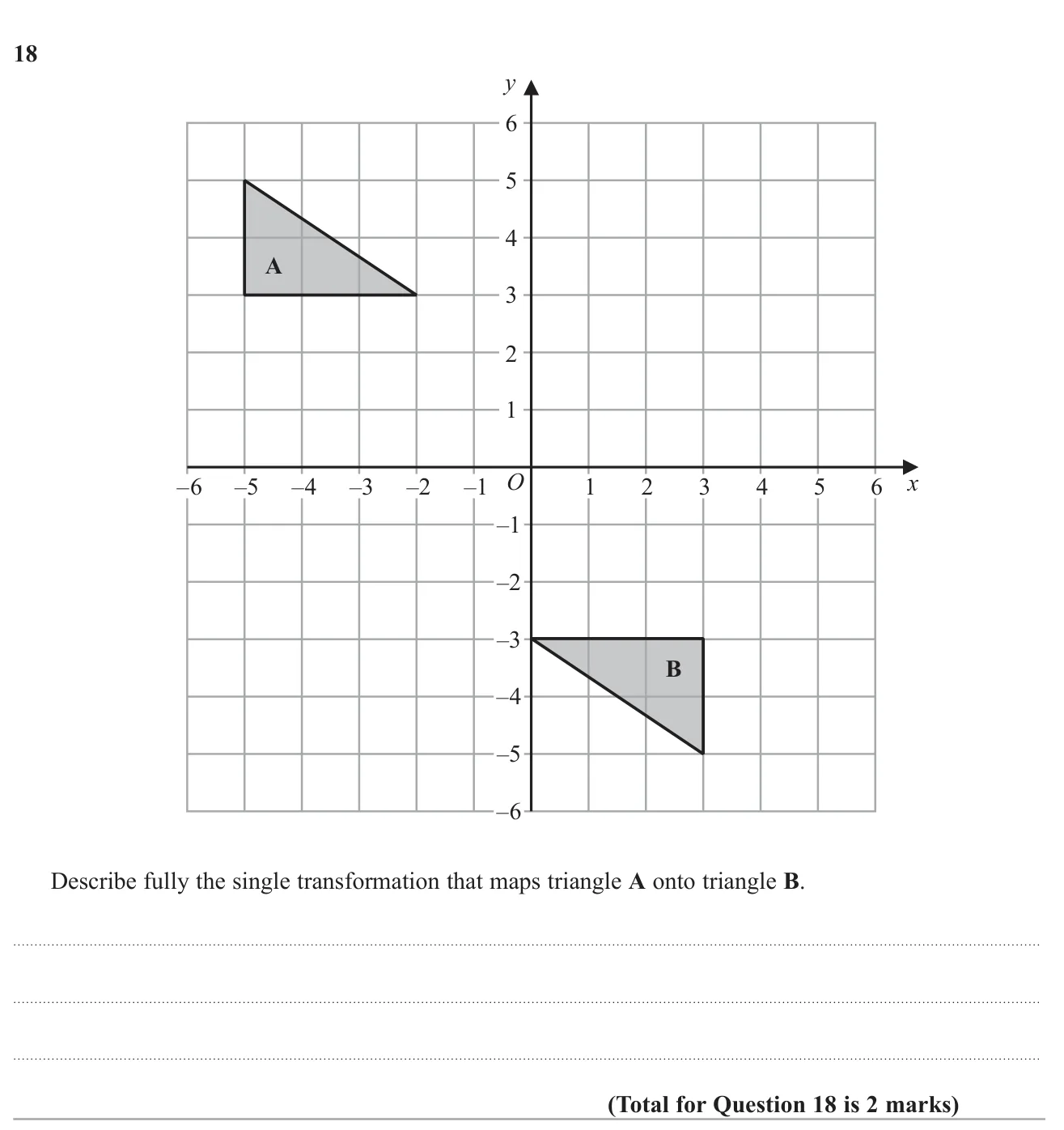
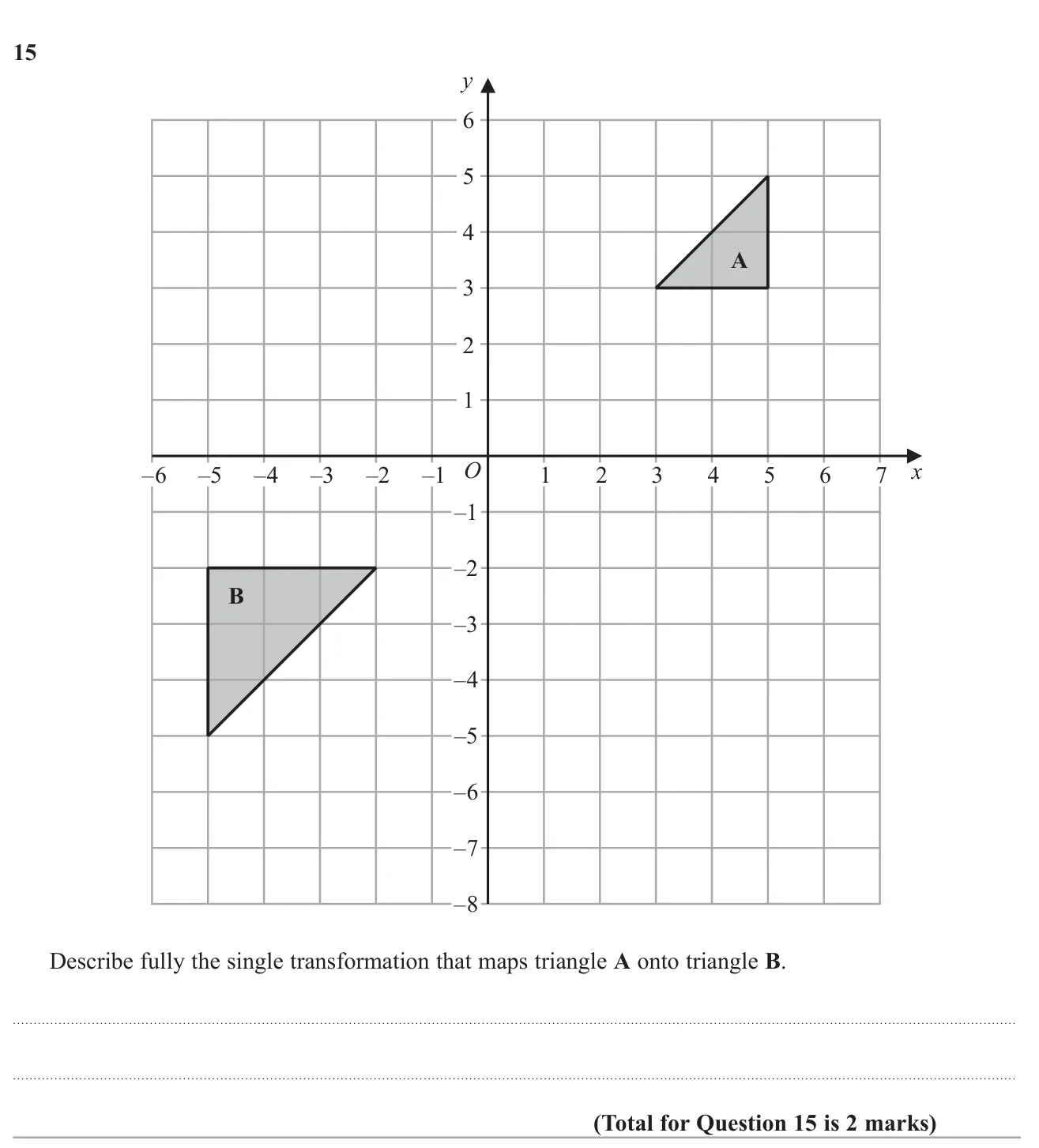
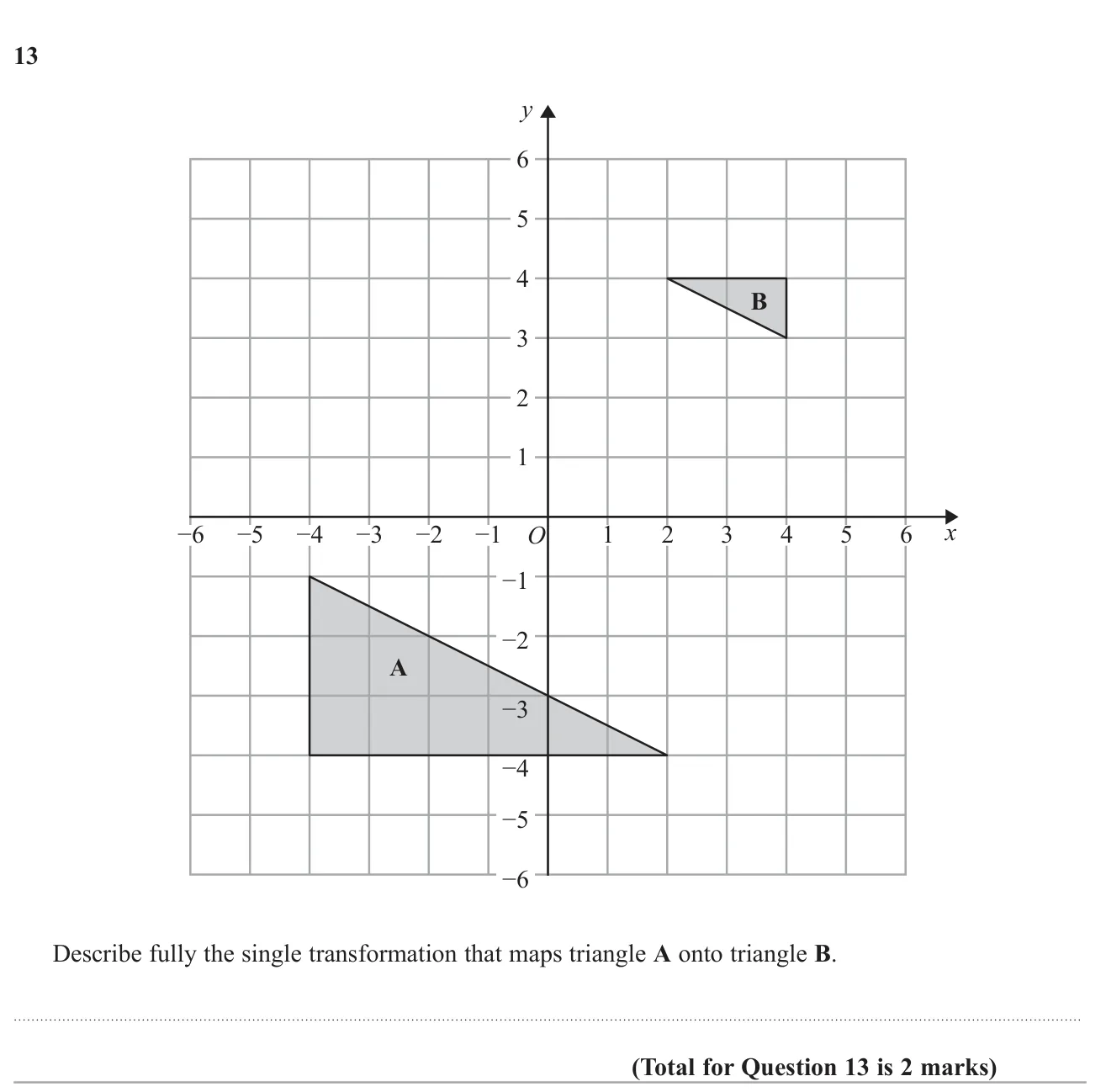
Answer Rotation 180 ∘ 180^\circ 18 0 ∘ ( − 1 , 0 ) (-1, 0) ( − 1 , 0 ) 2 marks
Worked solution Checked against the mark scheme
Triangle B is triangle A turned upside down, so it is a half-turn.
A vertex at ( − 5 , 5 ) (-5, 5) ( − 5 , 5 ) ( 3 , − 5 ) (3, -5) ( 3 , − 5 ) ( − 5 + 3 2 , 5 − 5 2 ) = ( − 1 , 0 ) \left(\frac{-5+3}{2}, \frac{5-5}{2}\right) = (-1, 0) ( 2 − 5 + 3 , 2 5 − 5 ) = ( − 1 , 0 )
Rotation 180 ∘ 180^\circ 18 0 ∘ ( − 1 , 0 ) (-1, 0) ( − 1 , 0 )
Watch out: Giving two transformations, such as a reflection and a translation.
© Pearson Education Ltd. June 2019 Paper 1 (Foundation, non-calculator), question 26.
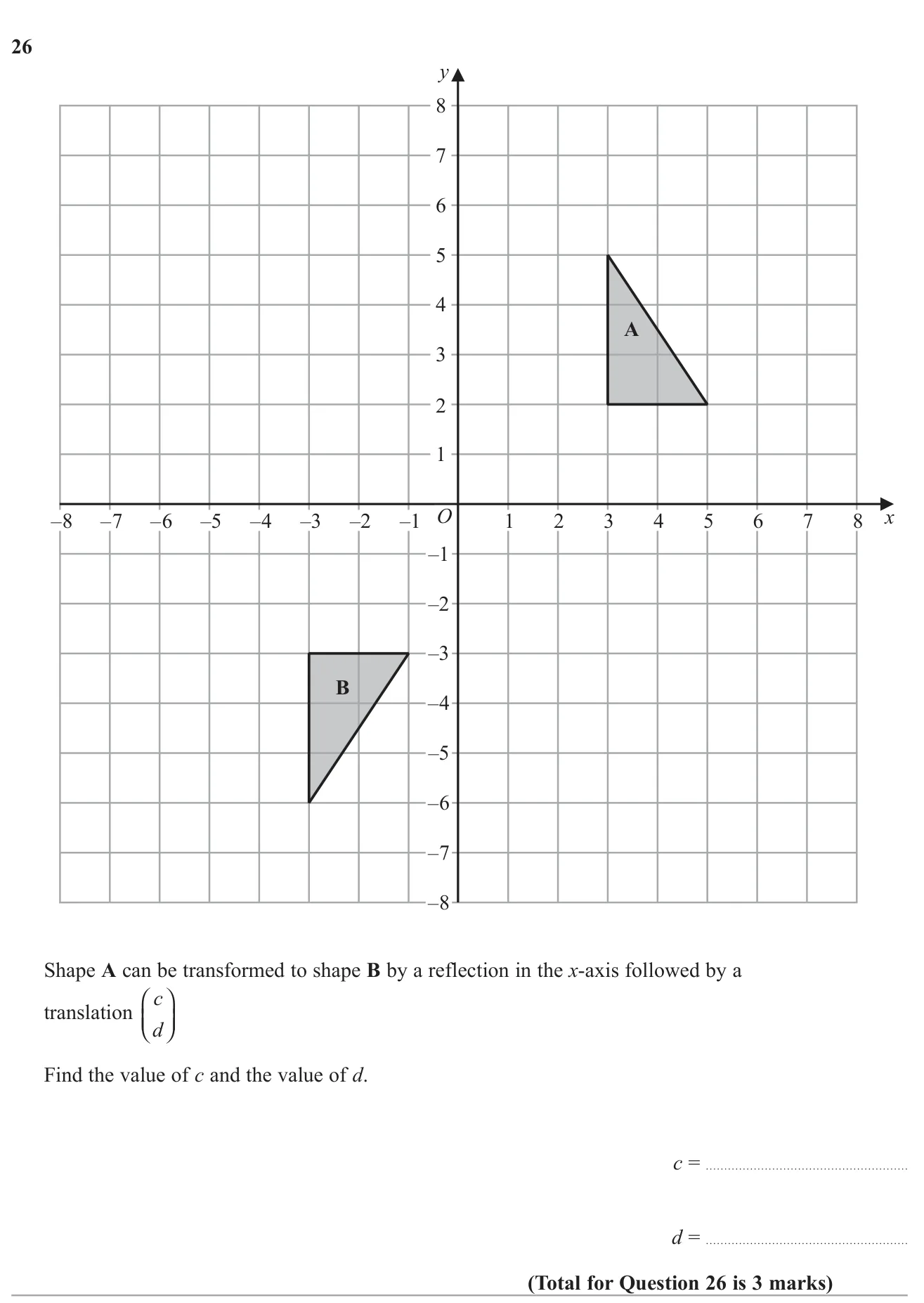
Answer c = − 6 c = -6 c = − 6 d = − 1 d = -1 d = − 1 3 marks
Worked solution Checked against the mark scheme
Reflect A in the x x x ( 3 , 2 ) → ( 3 , − 2 ) (3, 2) \to (3, -2) ( 3 , 2 ) → ( 3 , − 2 ) ( 5 , 2 ) → ( 5 , − 2 ) (5, 2) \to (5, -2) ( 5 , 2 ) → ( 5 , − 2 ) ( 3 , 5 ) → ( 3 , − 5 ) (3, 5) \to (3, -5) ( 3 , 5 ) → ( 3 , − 5 )
B has matching corners at ( − 3 , − 3 ) (-3, -3) ( − 3 , − 3 ) ( − 1 , − 3 ) (-1, -3) ( − 1 , − 3 ) ( − 3 , − 6 ) (-3, -6) ( − 3 , − 6 )
Move from ( 3 , − 2 ) (3, -2) ( 3 , − 2 ) ( − 3 , − 3 ) (-3, -3) ( − 3 , − 3 )
So c = − 6 c = -6 c = − 6 d = − 1 d = -1 d = − 1
Watch out: Swapping c and d, or reflecting in the y-axis.
© Pearson Education Ltd. November 2018 Paper 1 (Foundation, non-calculator), question 19.
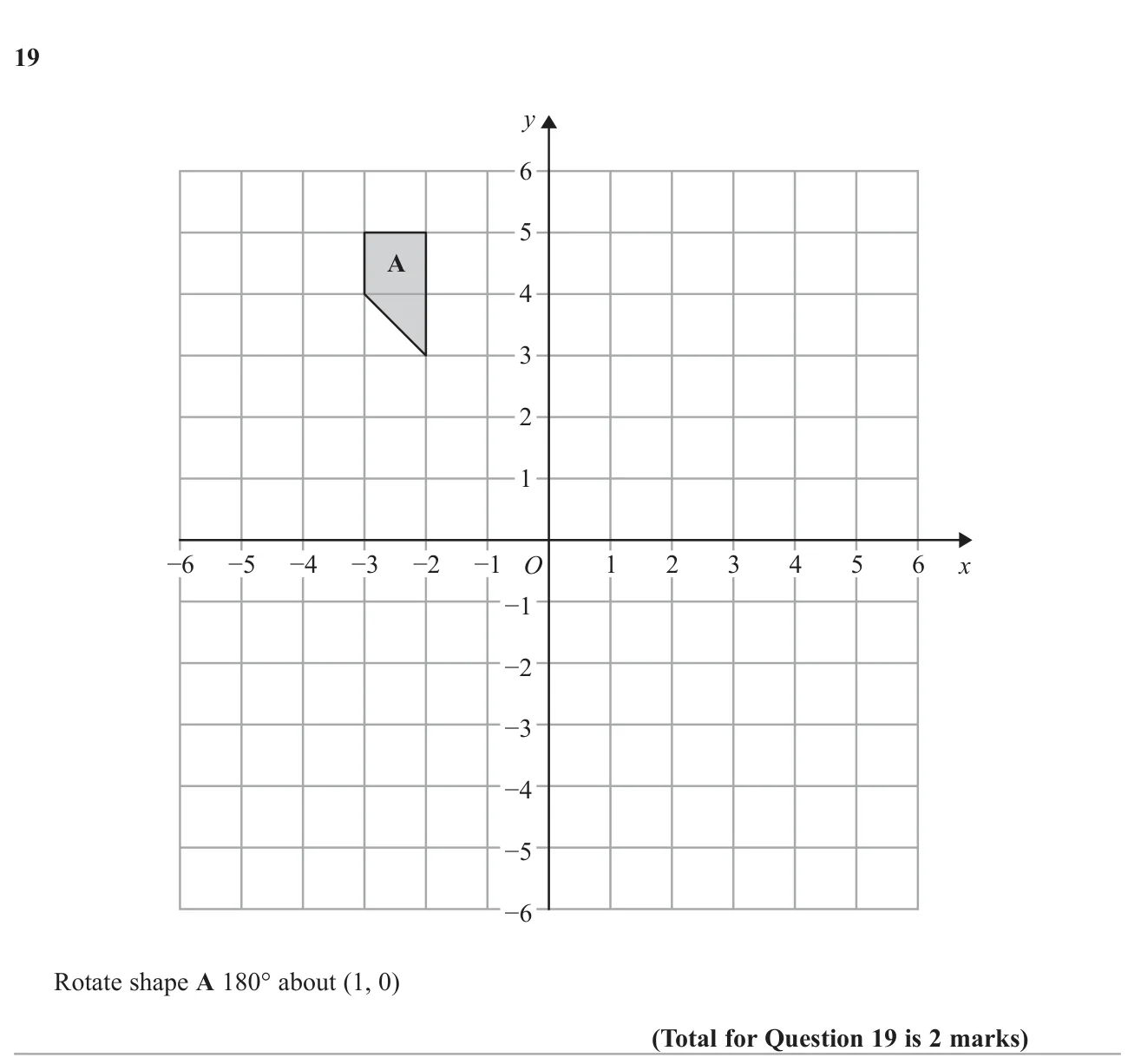
Answer Shape with vertices ( 4 , − 3 ) (4, -3) ( 4 , − 3 ) ( 5 , − 4 ) (5, -4) ( 5 , − 4 ) ( 5 , − 5 ) (5, -5) ( 5 , − 5 ) ( 4 , − 5 ) (4, -5) ( 4 , − 5 ) 2 marks
Worked solution Checked against the mark scheme
A 180° turn about ( 1 , 0 ) (1, 0) ( 1 , 0 ) ( x , y ) (x, y) ( x , y ) ( 2 − x , − y ) (2 - x, -y) ( 2 − x , − y )
( − 3 , 5 ) → ( 5 , − 5 ) (-3, 5) \to (5, -5) ( − 3 , 5 ) → ( 5 , − 5 ) ( − 2 , 5 ) → ( 4 , − 5 ) (-2, 5) \to (4, -5) ( − 2 , 5 ) → ( 4 , − 5 ) ( − 2 , 3 ) → ( 4 , − 3 ) (-2, 3) \to (4, -3) ( − 2 , 3 ) → ( 4 , − 3 ) ( − 3 , 4 ) → ( 5 , − 4 ) (-3, 4) \to (5, -4) ( − 3 , 4 ) → ( 5 , − 4 )
Plot and join these points.
Watch out: Rotating about the origin instead of ( 1 , 0 ) (1, 0) ( 1 , 0 )
© Pearson Education Ltd. November 2024 Paper 2 (Higher, calculator), question 11.
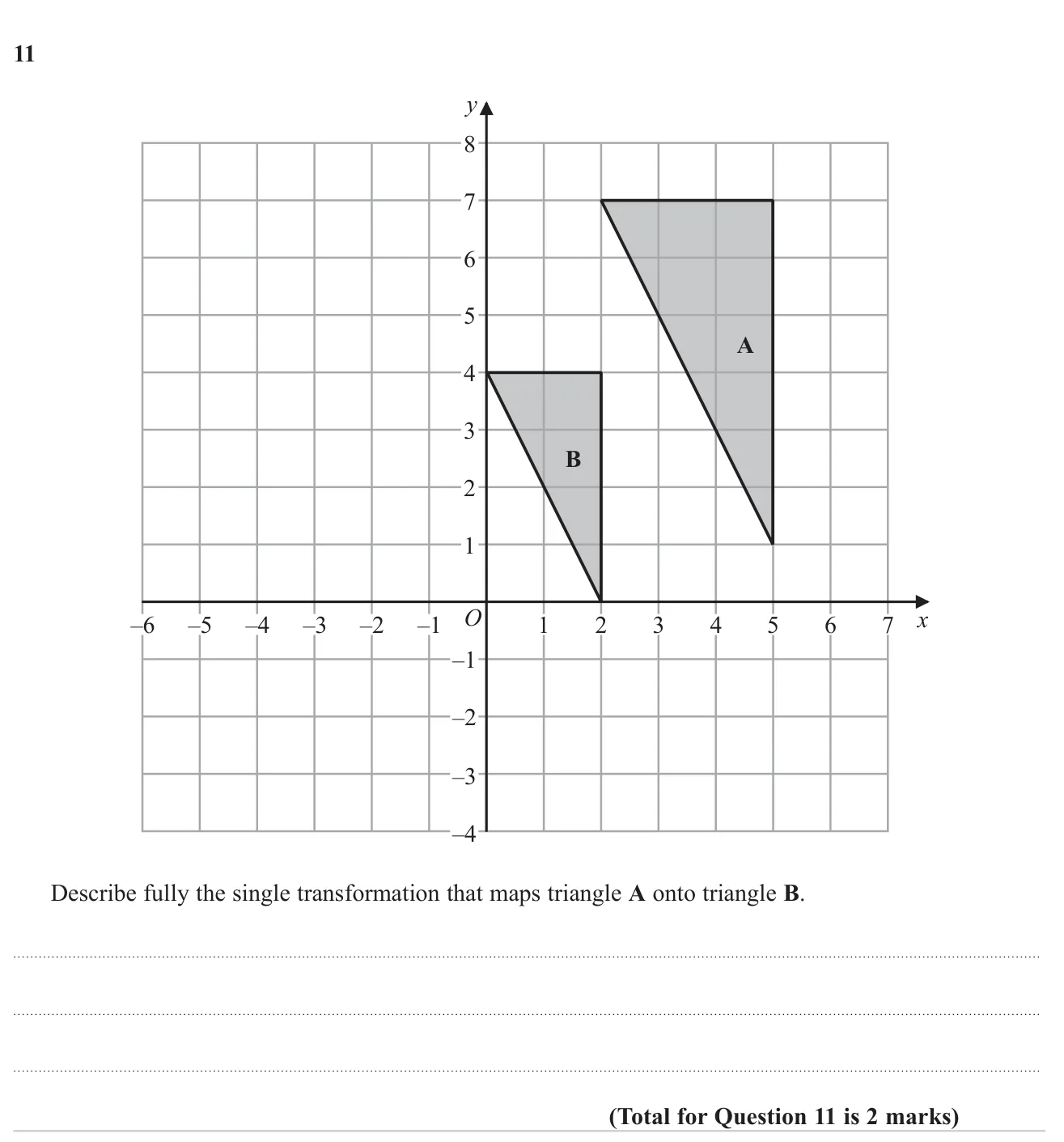
Answer Enlargement, scale factor 2 3 \frac{2}{3} 3 2 ( − 4 , − 2 ) (-4, -2) ( − 4 , − 2 ) 2 marks
Worked solution Checked against the mark scheme
B's sides are 2 3 \frac{2}{3} 3 2 2 3 \frac{2}{3} 3 2
Join matching corners, e.g. ( 5 , 7 ) (5, 7) ( 5 , 7 ) ( 2 , 4 ) (2, 4) ( 2 , 4 ) ( 5 , 1 ) (5, 1) ( 5 , 1 ) ( 2 , 0 ) (2, 0) ( 2 , 0 ) ( − 4 , − 2 ) (-4, -2) ( − 4 , − 2 )
Watch out: Giving scale factor 3 2 \frac{3}{2} 2 3
© Pearson Education Ltd. November 2022 Paper 1 (Higher, non-calculator), question 11.
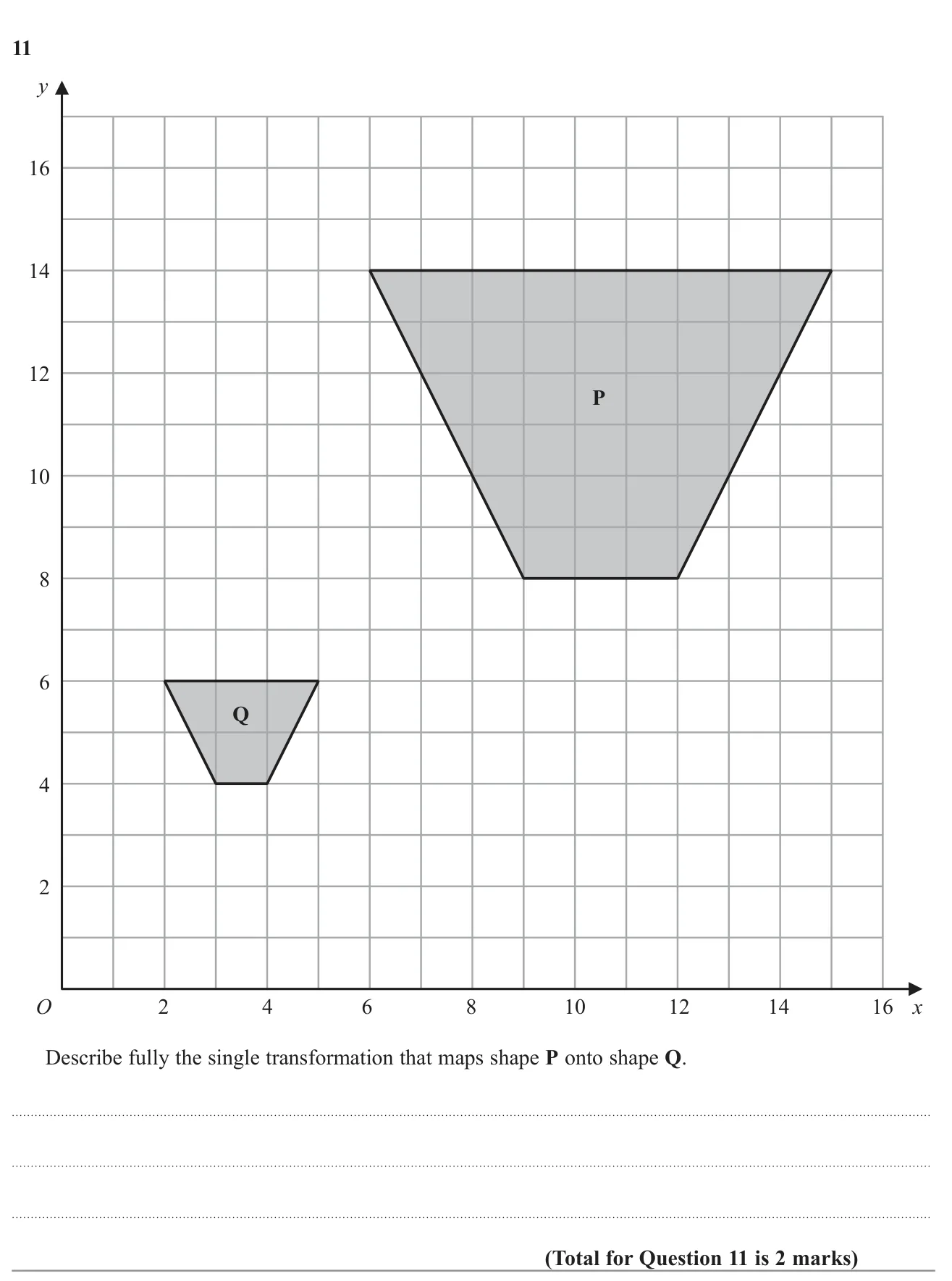
Answer Enlargement, scale factor 1 3 \frac{1}{3} 3 1 ( 0 , 2 ) (0, 2) ( 0 , 2 ) 2 marks
Worked solution Checked against the mark scheme
Q's top edge is 3 units, P's is 9 units, so the scale factor is 3 9 = 1 3 \frac{3}{9} = \frac{1}{3} 9 3 = 3 1
Draw lines through matching corners, e.g. ( 6 , 14 ) (6, 14) ( 6 , 14 ) ( 2 , 6 ) (2, 6) ( 2 , 6 ) ( 15 , 14 ) (15, 14) ( 15 , 14 ) ( 5 , 6 ) (5, 6) ( 5 , 6 ) ( 0 , 2 ) (0, 2) ( 0 , 2 )
Enlargement, scale factor 1 3 \frac{1}{3} 3 1 ( 0 , 2 ) (0, 2) ( 0 , 2 )
Watch out: Giving scale factor 3 because the shapes are compared the wrong way round.
© Pearson Education Ltd. November 2022 Paper 3 (Higher, calculator), question 18.
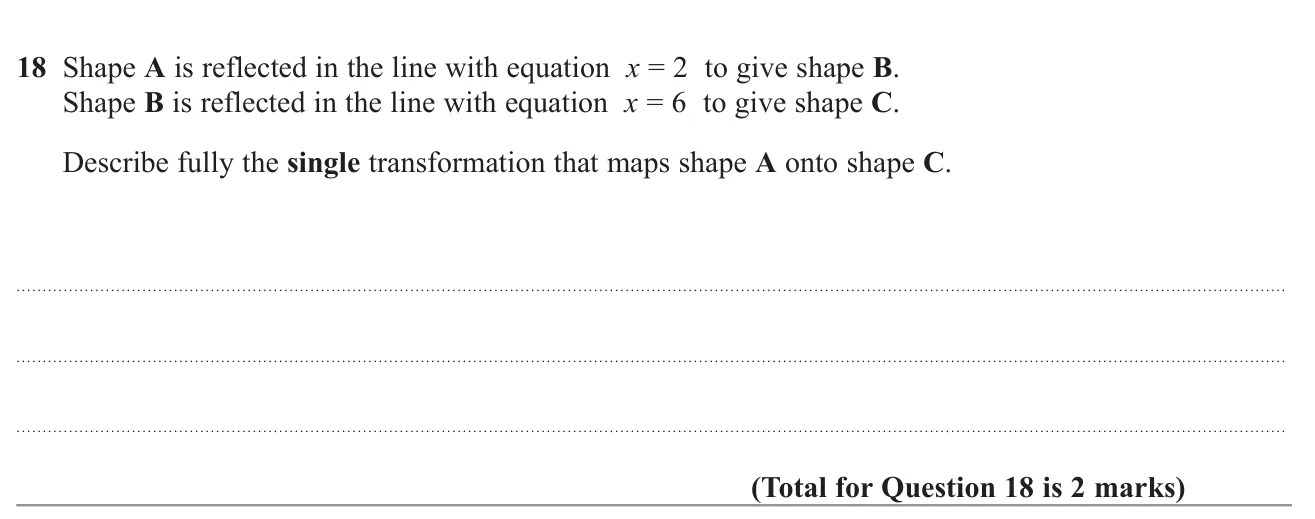
Answer Translation by ( 8 0 ) \begin{pmatrix} 8 \\ 0 \end{pmatrix} ( 8 0 ) 2 marks
Worked solution Checked against the mark scheme
Reflecting in two parallel lines gives a translation.
The distance moved is twice the gap between the lines: 2 × ( 6 − 2 ) = 8 2 \times (6 - 2) = 8 2 × ( 6 − 2 ) = 8
Translation by ( 8 0 ) \begin{pmatrix} 8 \\ 0 \end{pmatrix} ( 8 0 )
Watch out: Giving the vector as ( 4 0 ) \begin{pmatrix} 4 \\ 0 \end{pmatrix} ( 4 0 )
© Pearson Education Ltd. November 2020 Paper 3 (Higher, calculator), question 11.
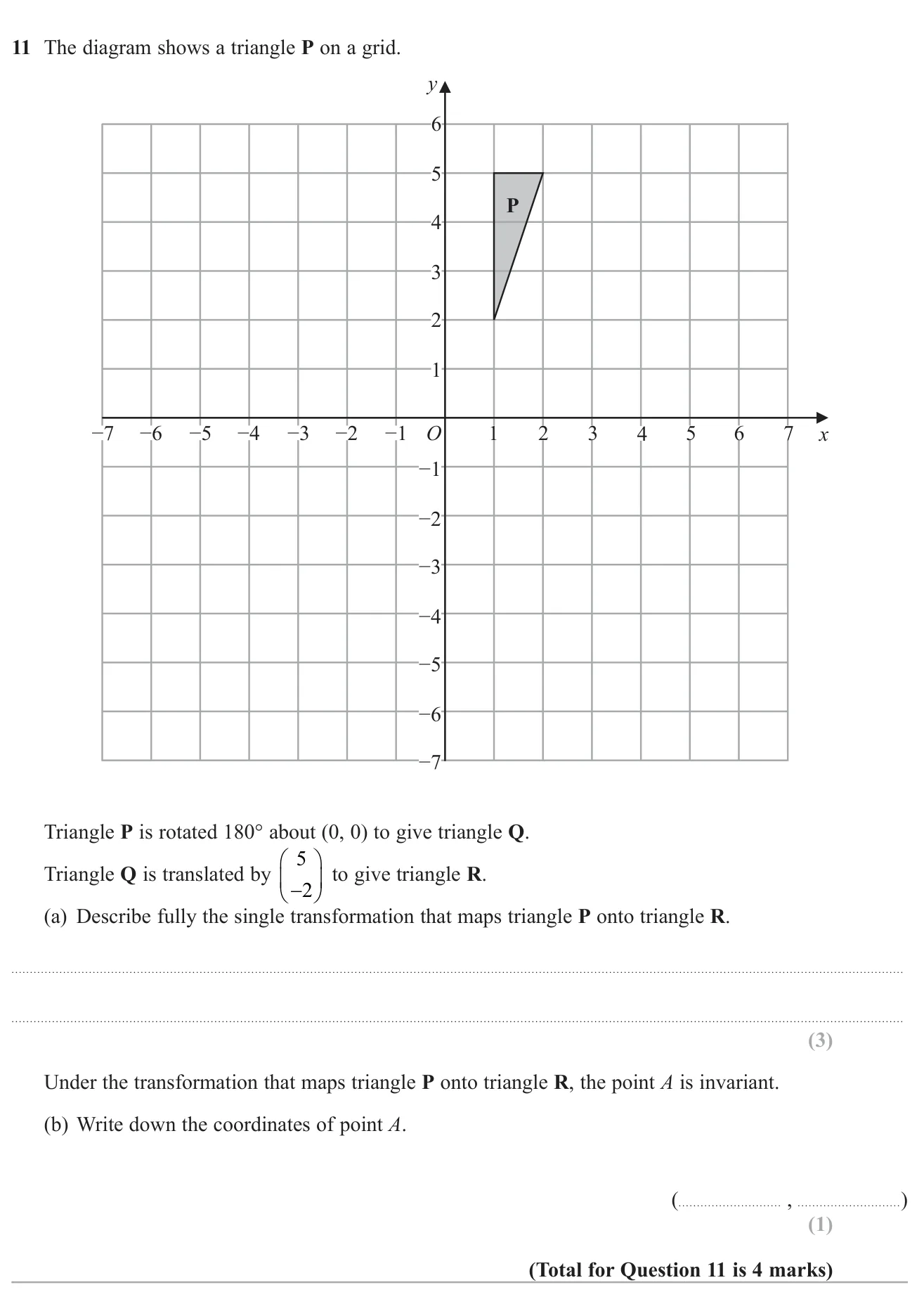
(a) Rotation 180 ∘ 180^\circ 18 0 ∘ ( 2.5 , − 1 ) (2.5, -1) ( 2.5 , − 1 ) 3 marks (b) ( 2.5 , − 1 ) (2.5, -1) ( 2.5 , − 1 ) 1 mark
Worked solution Checked against the mark scheme
(a) P has vertices ( 1 , 2 ) , ( 1 , 5 ) , ( 2 , 5 ) (1,2), (1,5), (2,5) ( 1 , 2 ) , ( 1 , 5 ) , ( 2 , 5 )
Rotating 180 ∘ 180^\circ 18 0 ∘ ( − 1 , − 2 ) , ( − 1 , − 5 ) , ( − 2 , − 5 ) (-1,-2), (-1,-5), (-2,-5) ( − 1 , − 2 ) , ( − 1 , − 5 ) , ( − 2 , − 5 )
Translating by ( 5 − 2 ) \binom{5}{-2} ( − 2 5 ) ( 4 , − 4 ) , ( 4 , − 7 ) , ( 3 , − 7 ) (4,-4), (4,-7), (3,-7) ( 4 , − 4 ) , ( 4 , − 7 ) , ( 3 , − 7 )
R is upside down relative to P, so it is a rotation of 180 ∘ 180^\circ 18 0 ∘ ( 1 , 2 ) (1,2) ( 1 , 2 ) ( 4 , − 4 ) (4,-4) ( 4 , − 4 ) ( 2.5 , − 1 ) (2.5, -1) ( 2.5 , − 1 )
(b) The centre of rotation does not move, so A = ( 2.5 , − 1 ) A = (2.5, -1) A = ( 2.5 , − 1 )
Watch out: Describing two transformations instead of one single transformation.
© Pearson Education Ltd. November 2019 Paper 3 (Higher, calculator), question 9.
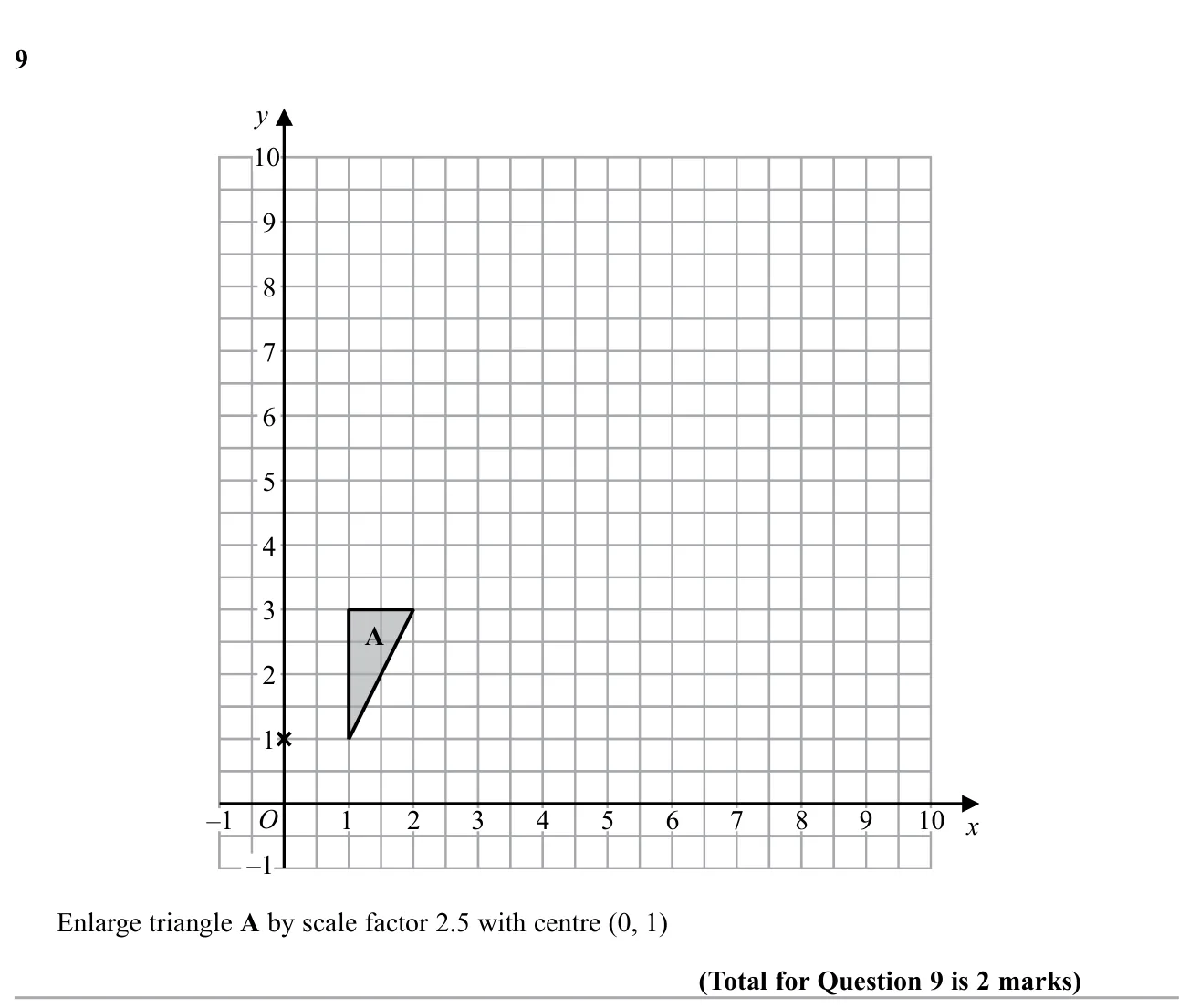
Answer Triangle with vertices ( 2.5 , 1 ) (2.5, 1) ( 2.5 , 1 ) ( 2.5 , 6 ) (2.5, 6) ( 2.5 , 6 ) ( 5 , 6 ) (5, 6) ( 5 , 6 ) 2 marks
Worked solution Checked against the mark scheme
Centre ( 0 , 1 ) (0, 1) ( 0 , 1 ) ( 1 , 1 ) (1, 1) ( 1 , 1 ) ( 1 , 3 ) (1, 3) ( 1 , 3 ) ( 2 , 3 ) (2, 3) ( 2 , 3 )
From the centre, these are ( 1 , 0 ) (1, 0) ( 1 , 0 ) ( 1 , 2 ) (1, 2) ( 1 , 2 ) ( 2 , 2 ) (2, 2) ( 2 , 2 ) ( 2.5 , 0 ) (2.5, 0) ( 2.5 , 0 ) ( 2.5 , 5 ) (2.5, 5) ( 2.5 , 5 ) ( 5 , 5 ) (5, 5) ( 5 , 5 )
Add back to the centre: ( 2.5 , 1 ) (2.5, 1) ( 2.5 , 1 ) ( 2.5 , 6 ) (2.5, 6) ( 2.5 , 6 ) ( 5 , 6 ) (5, 6) ( 5 , 6 )
Watch out: Measuring from the origin instead of from ( 0 , 1 ) (0, 1) ( 0 , 1 )
© Pearson Education Ltd. June 2018 Paper 1 (Higher, non-calculator), question 7.
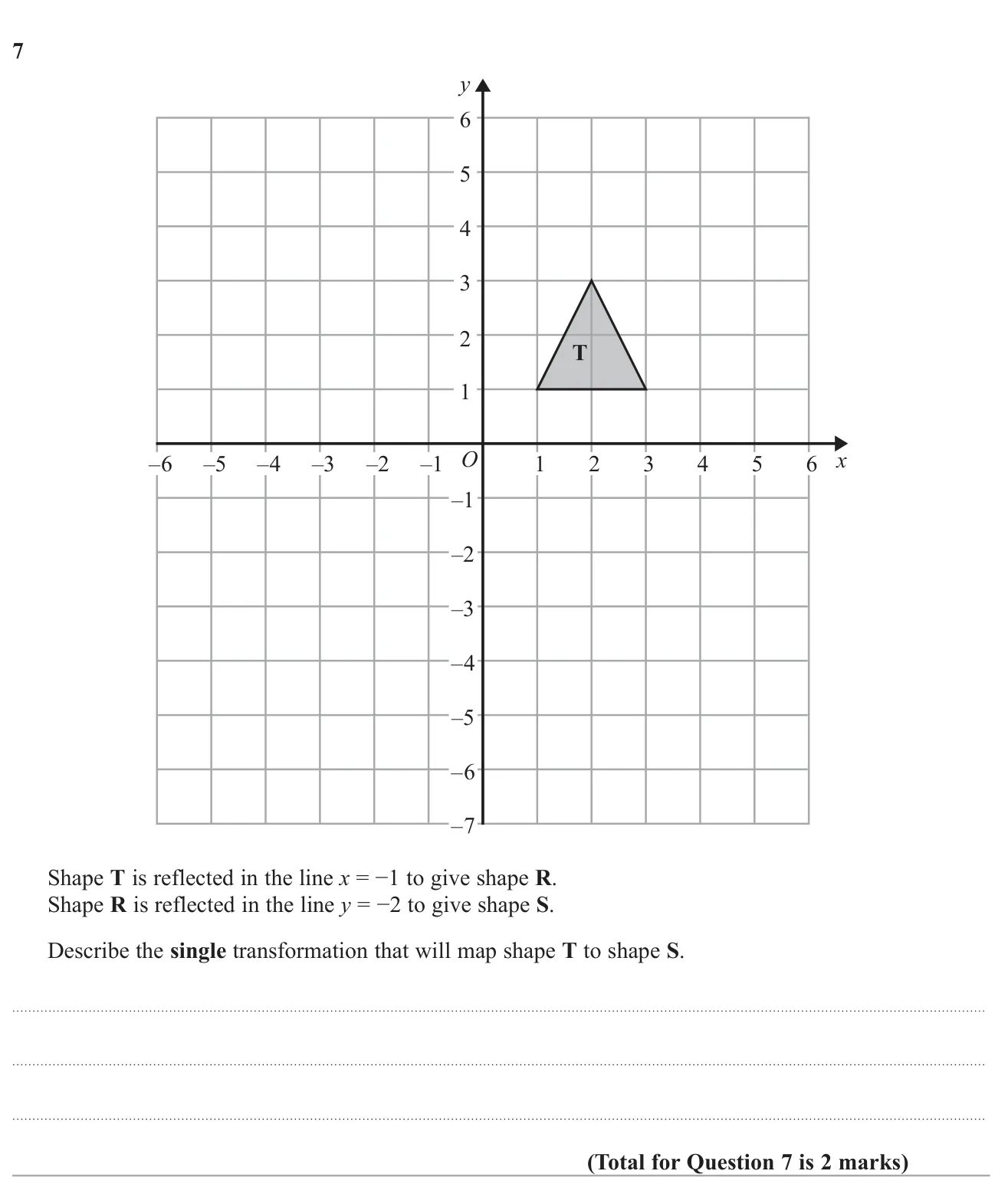
Answer Rotation 180 ∘ 180^\circ 18 0 ∘ ( − 1 , − 2 ) (-1, -2) ( − 1 , − 2 ) − 1 -1 − 1 ( − 1 , − 2 ) (-1, -2) ( − 1 , − 2 ) 2 marks
Worked solution Checked against the mark scheme
Reflect T in x = − 1 x = -1 x = − 1 y = − 2 y = -2 y = − 2
Two reflections in perpendicular lines make a half turn about the point where the lines cross.
The lines meet at ( − 1 , − 2 ) (-1, -2) ( − 1 , − 2 ) 180 ∘ 180^\circ 18 0 ∘ ( − 1 , − 2 ) (-1, -2) ( − 1 , − 2 )
Watch out: Describing two transformations, or writing 'half turn' without the angle and centre.
© Pearson Education Ltd. June 2018 Paper 2 (Higher, calculator), question 7.
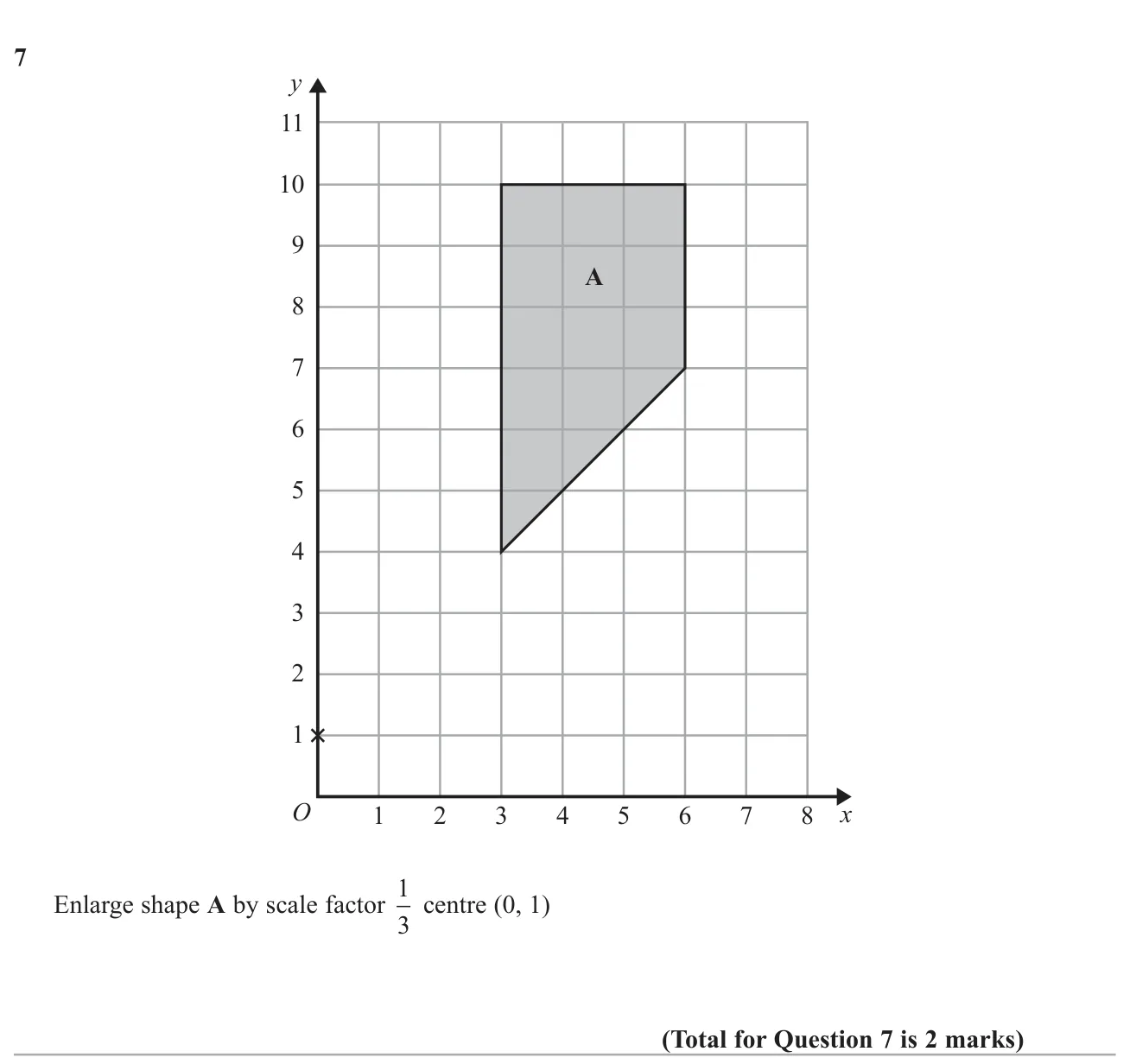
Answer Vertices at ( 1 , 2 ) (1, 2) ( 1 , 2 ) ( 1 , 4 ) (1, 4) ( 1 , 4 ) ( 2 , 4 ) (2, 4) ( 2 , 4 ) ( 2 , 3 ) (2, 3) ( 2 , 3 ) 2 marks
Worked solution Checked against the mark scheme
Measure each vertex from the centre ( 0 , 1 ) (0, 1) ( 0 , 1 ) 1 3 \frac{1}{3} 3 1
( 3 , 4 ) (3, 4) ( 3 , 4 ) ( 3 , 3 ) (3, 3) ( 3 , 3 ) ( 1 , 1 ) (1, 1) ( 1 , 1 ) ( 1 , 2 ) (1, 2) ( 1 , 2 )
( 3 , 10 ) (3, 10) ( 3 , 10 ) ( 1 , 3 ) (1, 3) ( 1 , 3 ) ( 1 , 4 ) (1, 4) ( 1 , 4 ) ( 6 , 10 ) (6, 10) ( 6 , 10 ) ( 2 , 3 ) (2, 3) ( 2 , 3 ) ( 2 , 4 ) (2, 4) ( 2 , 4 ) ( 6 , 7 ) (6, 7) ( 6 , 7 ) ( 2 , 2 ) (2, 2) ( 2 , 2 ) ( 2 , 3 ) (2, 3) ( 2 , 3 )
Watch out: Making the shape three times bigger instead of a third of the size.
© Pearson Education Ltd. November 2018 Paper 2 (Higher, calculator), question 8.
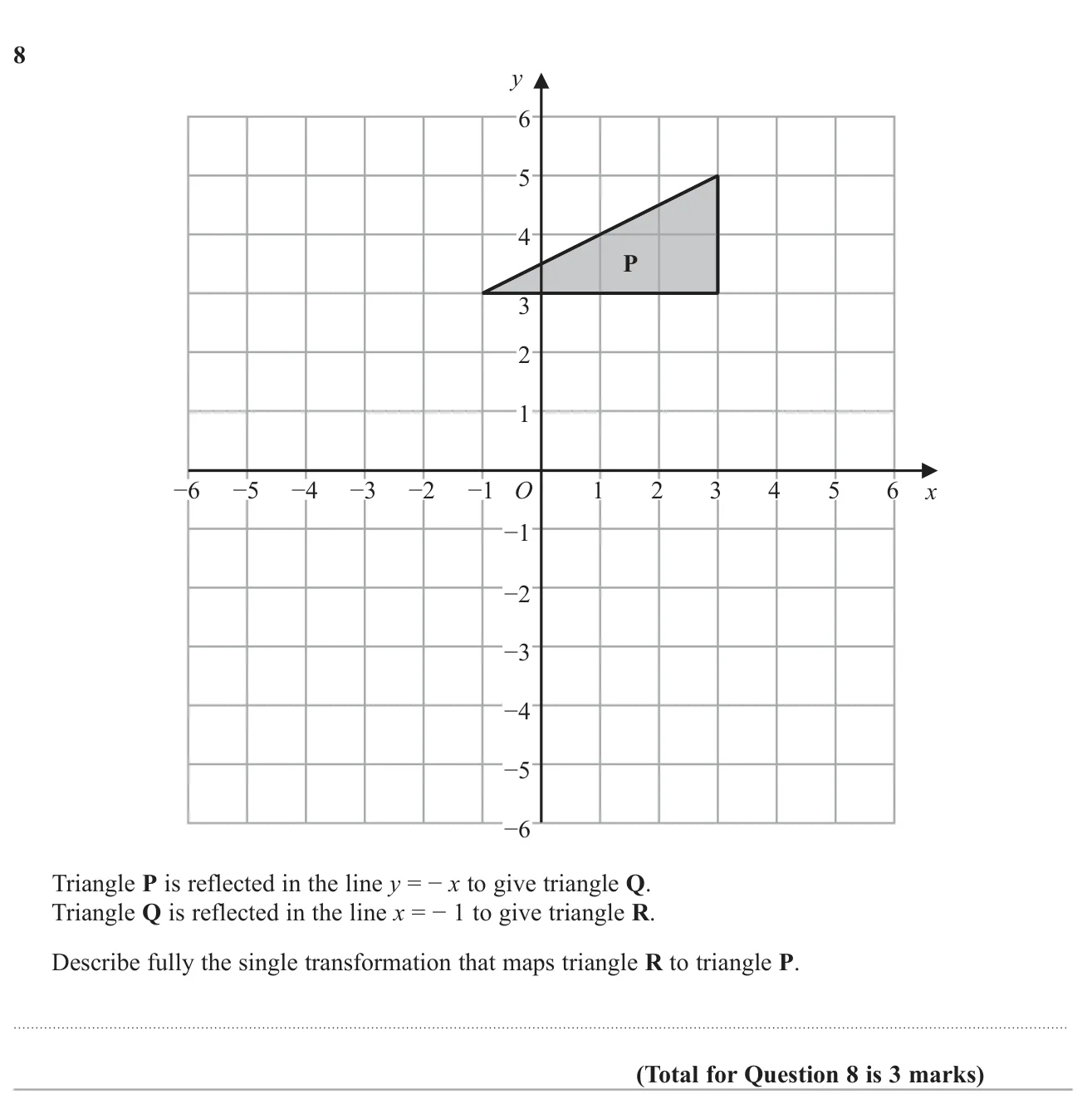
Answer Rotation 90 ° 90° 90° ( − 1 , 1 ) (-1, 1) ( − 1 , 1 ) 3 marks
Worked solution Checked against the mark scheme
P has vertices ( − 1 , 3 ) , ( 3 , 3 ) , ( 3 , 5 ) (-1, 3), (3, 3), (3, 5) ( − 1 , 3 ) , ( 3 , 3 ) , ( 3 , 5 )
Reflect in y = − x y = -x y = − x ( − 3 , 1 ) , ( − 3 , − 3 ) , ( − 5 , − 3 ) (-3, 1), (-3, -3), (-5, -3) ( − 3 , 1 ) , ( − 3 , − 3 ) , ( − 5 , − 3 )
Reflect in x = − 1 x = -1 x = − 1 ( 1 , 1 ) , ( 1 , − 3 ) , ( 3 , − 3 ) (1, 1), (1, -3), (3, -3) ( 1 , 1 ) , ( 1 , − 3 ) , ( 3 , − 3 )
Turning R through 90 ° 90° 90° ( − 1 , 1 ) (-1, 1) ( − 1 , 1 )
Watch out: Giving two transformations or leaving out the centre of rotation.
© Pearson Education Ltd. June 2024 Paper 1 (Higher, non-calculator), question 11.
Answer Rotation 90 ∘ 90^\circ 9 0 ∘ ( − 4 , 1 ) (-4, 1) ( − 4 , 1 ) 3 marks
Worked solution Checked against the mark scheme
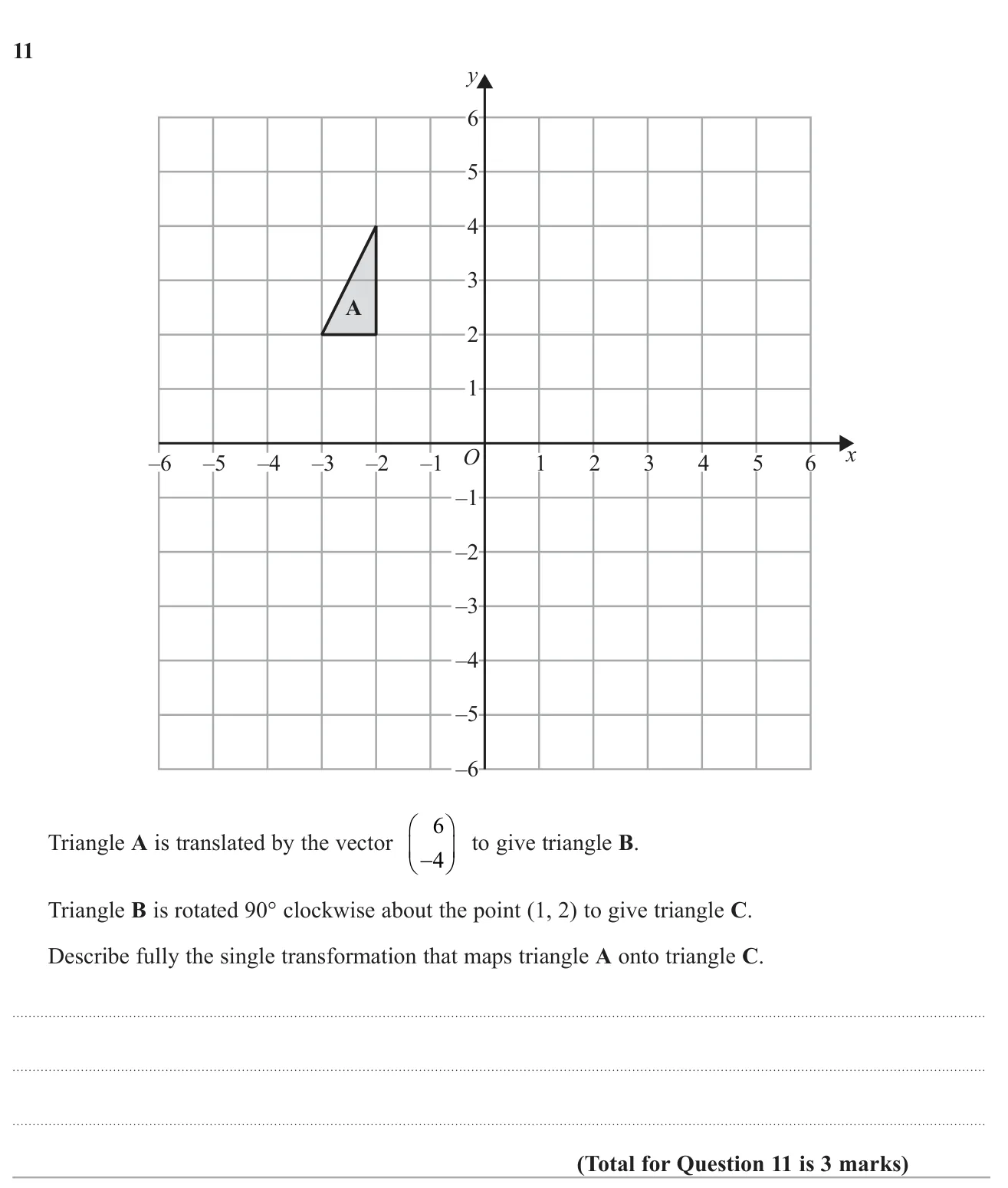
A has vertices ( − 3 , 2 ) , ( − 2 , 2 ) , ( − 2 , 4 ) (-3, 2), (-2, 2), (-2, 4) ( − 3 , 2 ) , ( − 2 , 2 ) , ( − 2 , 4 )
Translate by ( 6 − 4 ) \binom{6}{-4} ( − 4 6 ) ( 3 , − 2 ) , ( 4 , − 2 ) , ( 4 , 0 ) (3, -2), (4, -2), (4, 0) ( 3 , − 2 ) , ( 4 , − 2 ) , ( 4 , 0 )
Rotate B 90 ∘ 90^\circ 9 0 ∘ ( 1 , 2 ) (1, 2) ( 1 , 2 ) ( − 3 , 0 ) , ( − 3 , − 1 ) , ( − 1 , − 1 ) (-3, 0), (-3, -1), (-1, -1) ( − 3 , 0 ) , ( − 3 , − 1 ) , ( − 1 , − 1 )
Comparing A and C, C is A turned 90 ∘ 90^\circ 9 0 ∘ ( − 4 , 1 ) (-4, 1) ( − 4 , 1 )
Single transformation: **rotation 90 ∘ 90^\circ 9 0 ∘ ( − 4 , 1 ) (-4, 1) ( − 4 , 1 )
Watch out: Describing it as two transformations, or leaving out the centre of rotation.
© Pearson Education Ltd. June 2024 Paper 3 (Higher, calculator), question 12.
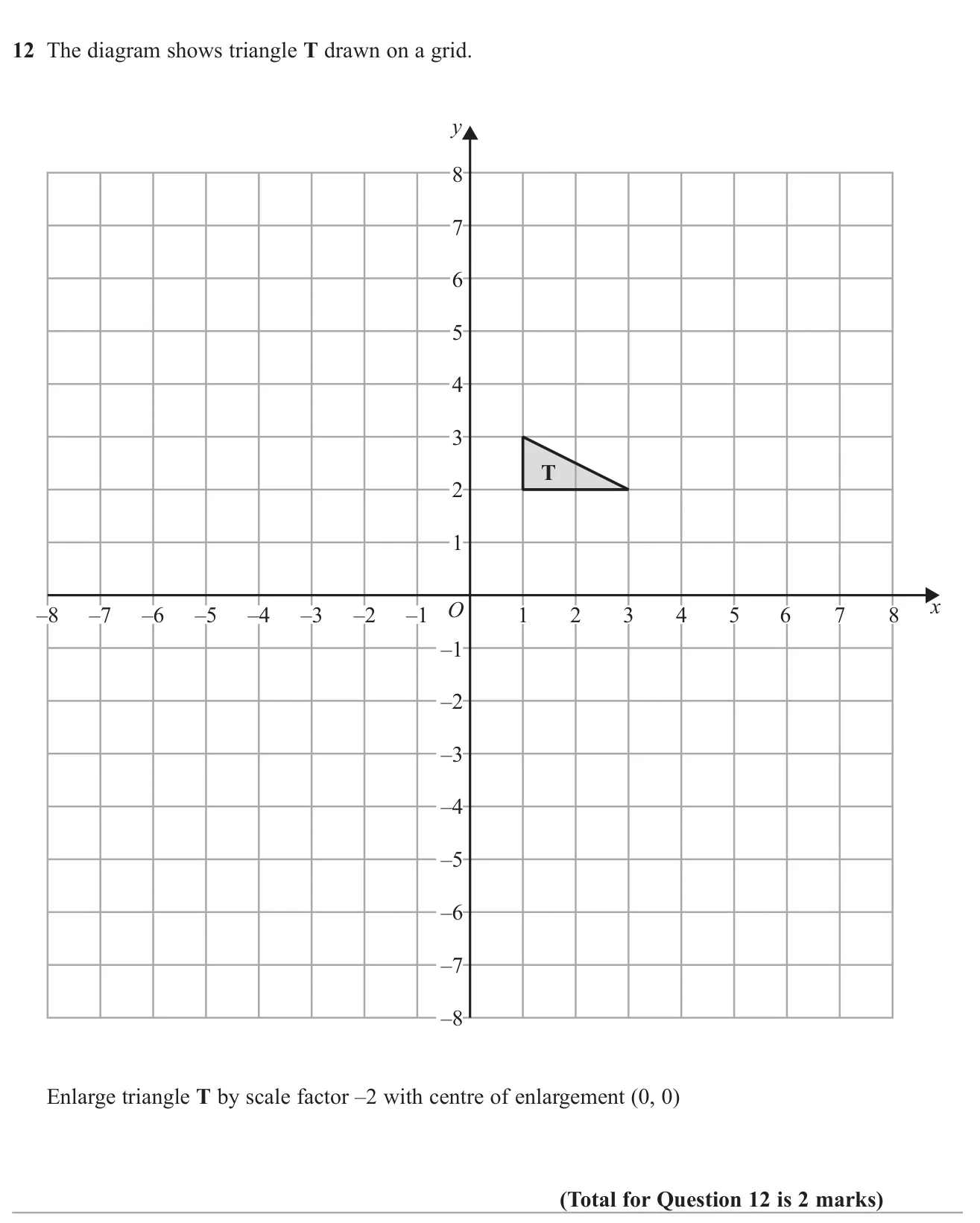
Answer Triangle with vertices ( − 2 , − 4 ) (-2,-4) ( − 2 , − 4 ) ( − 2 , − 6 ) (-2,-6) ( − 2 , − 6 ) ( − 6 , − 4 ) (-6,-4) ( − 6 , − 4 ) 2 marks
Worked solution Checked against the mark scheme
T has vertices ( 1 , 2 ) (1, 2) ( 1 , 2 ) ( 1 , 3 ) (1, 3) ( 1 , 3 ) ( 3 , 2 ) (3, 2) ( 3 , 2 )
Multiply each coordinate by − 2 -2 − 2 ( − 2 , − 4 ) (-2, -4) ( − 2 , − 4 ) ( − 2 , − 6 ) (-2, -6) ( − 2 , − 6 ) ( − 6 , − 4 ) (-6, -4) ( − 6 , − 4 )
Plot and join these points.
Watch out: Using scale factor 2 and forgetting the image must be on the opposite side of the centre (rotated through 180°).
© Pearson Education Ltd. June 2022 Paper 2 (Higher, calculator), question 13.
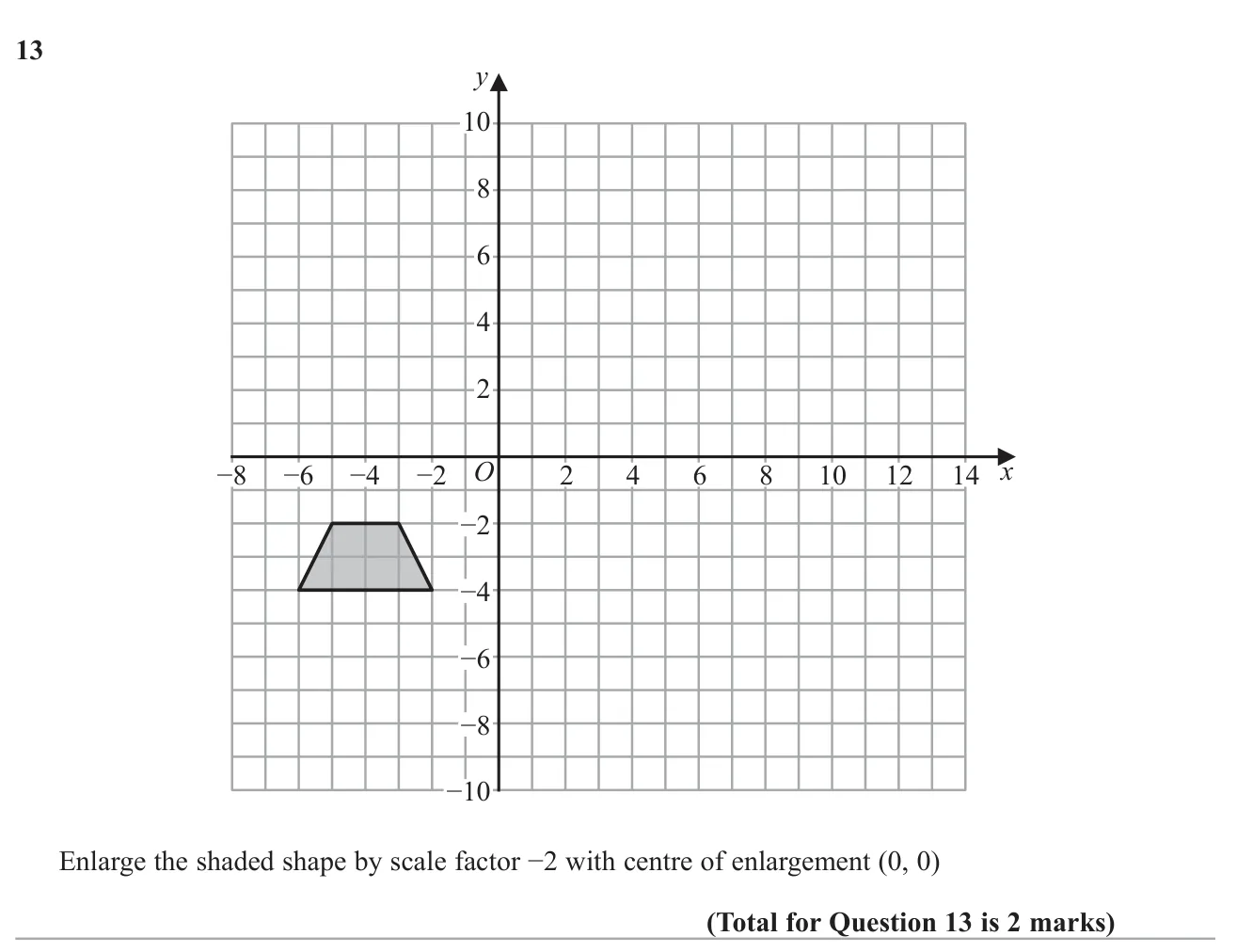
Answer Trapezium with vertices ( 4 , 8 ) (4, 8) ( 4 , 8 ) ( 6 , 4 ) (6, 4) ( 6 , 4 ) ( 10 , 4 ) (10, 4) ( 10 , 4 ) ( 12 , 8 ) (12, 8) ( 12 , 8 ) 2 marks
Worked solution Checked against the mark scheme
The shape's vertices are ( − 6 , − 4 ) (-6, -4) ( − 6 , − 4 ) ( − 5 , − 2 ) (-5, -2) ( − 5 , − 2 ) ( − 3 , − 2 ) (-3, -2) ( − 3 , − 2 ) ( − 2 , − 4 ) (-2, -4) ( − 2 , − 4 )
Multiply each coordinate by − 2 -2 − 2 ( 12 , 8 ) (12, 8) ( 12 , 8 ) ( 10 , 4 ) (10, 4) ( 10 , 4 ) ( 6 , 4 ) (6, 4) ( 6 , 4 ) ( 4 , 8 ) (4, 8) ( 4 , 8 )
The image is twice as big, upside down, on the opposite side of the origin.
Watch out: Enlarging by scale factor 2 without turning the shape through the centre.
© Pearson Education Ltd. November 2020 Paper 2 (Higher, calculator), question 15.
Answer Enlargement, scale factor − 1.5 -1.5 − 1.5 ( 1 , 1 ) (1, 1) ( 1 , 1 ) 2 marks
Worked solution Checked against the mark scheme
B is upside down and on the opposite side, and its sides are longer: A's short sides are 2, B's are 3. So it is an enlargement with scale factor − 3 2 = − 1.5 -\frac{3}{2} = -1.5 − 2 3 = − 1.5
Join matching corners, e.g. ( 5 , 5 ) (5, 5) ( 5 , 5 ) ( − 5 , − 5 ) (-5, -5) ( − 5 , − 5 ) ( 3 , 3 ) (3, 3) ( 3 , 3 ) ( − 2 , − 2 ) (-2, -2) ( − 2 , − 2 ) ( 1 , 1 ) (1, 1) ( 1 , 1 )
Enlargement, scale factor − 1.5 -1.5 − 1.5 ( 1 , 1 ) (1, 1) ( 1 , 1 )
Watch out: Calling it a rotation of 180°, which ignores the change in size.
© Pearson Education Ltd. November 2018 Paper 1 (Higher, non-calculator), question 13.
Answer Enlargement, scale factor − 1 3 -\frac{1}{3} − 3 1 ( 2 , 2 ) (2, 2) ( 2 , 2 ) 2 marks
Worked solution Checked against the mark scheme
B is smaller and upside down compared with A, so it is an enlargement with a negative scale factor.
A's side of length 6 becomes 2, so the scale factor is − 1 3 -\frac{1}{3} − 3 1
Join matching corners, e.g. ( − 4 , − 4 ) (-4,-4) ( − 4 , − 4 ) ( 4 , 4 ) (4,4) ( 4 , 4 ) ( 2 , − 4 ) (2,-4) ( 2 , − 4 ) ( 2 , 4 ) (2,4) ( 2 , 4 ) ( 2 , 2 ) (2, 2) ( 2 , 2 )
Enlargement, scale factor − 1 3 -\frac{1}{3} − 3 1 ( 2 , 2 ) (2, 2) ( 2 , 2 )
Watch out: Giving a scale factor of 1 3 \frac{1}{3} 3 1
© Pearson Education Ltd. June 2023 Paper 3 (Higher, calculator), question 16.
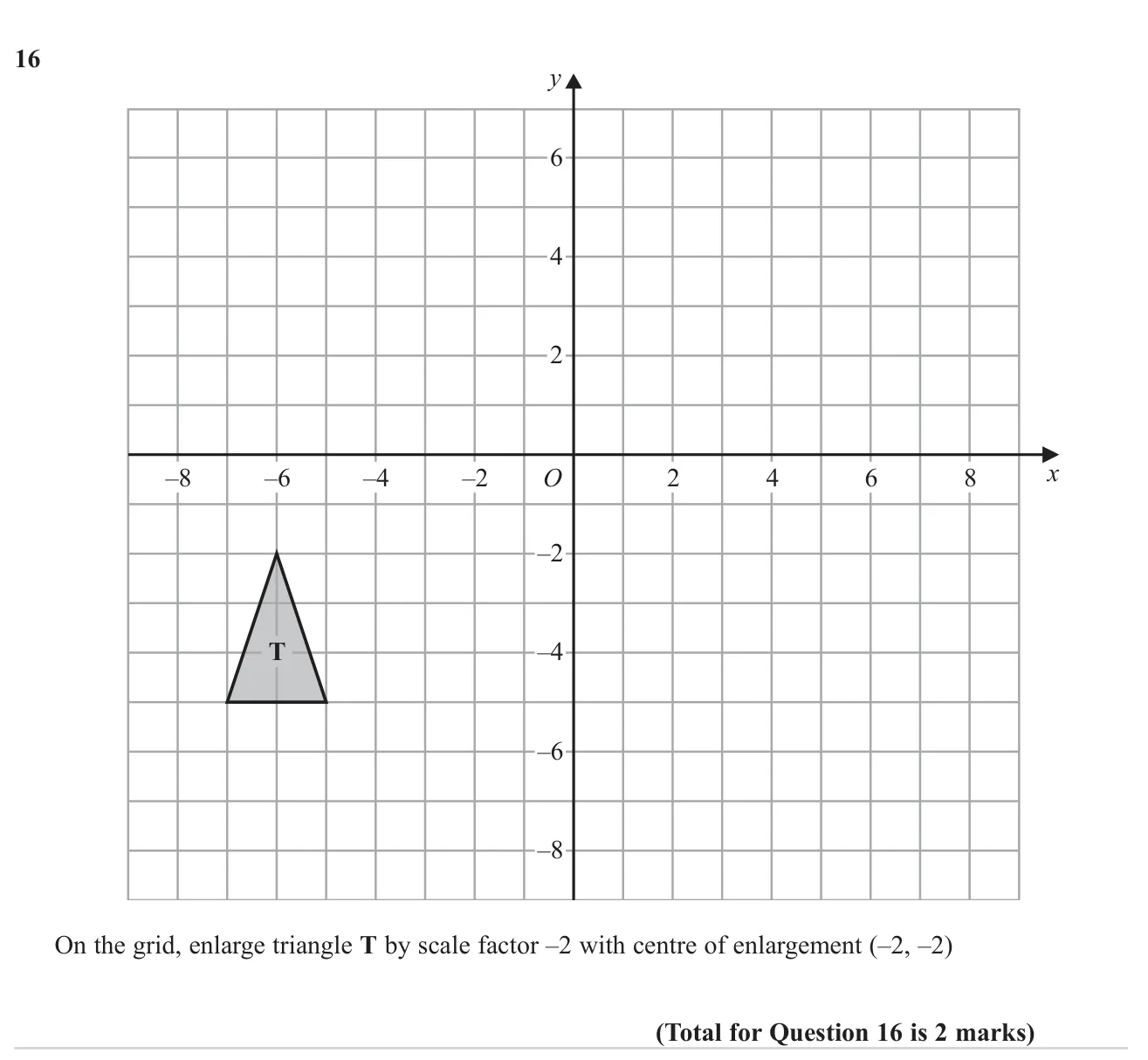
Answer Triangle with vertices ( 6 , − 2 ) (6, -2) ( 6 , − 2 ) ( 4 , 4 ) (4, 4) ( 4 , 4 ) ( 8 , 4 ) (8, 4) ( 8 , 4 ) 2 marks
Worked solution Checked against the mark scheme
Triangle T has vertices ( − 6 , − 2 ) (-6, -2) ( − 6 , − 2 ) ( − 7 , − 5 ) (-7, -5) ( − 7 , − 5 ) ( − 5 , − 5 ) (-5, -5) ( − 5 , − 5 )
From the centre ( − 2 , − 2 ) (-2, -2) ( − 2 , − 2 ) ( − 4 , 0 ) (-4, 0) ( − 4 , 0 ) ( − 5 , − 3 ) (-5, -3) ( − 5 , − 3 ) ( − 3 , − 3 ) (-3, -3) ( − 3 , − 3 )
Multiply by − 2 -2 − 2 ( 8 , 0 ) (8, 0) ( 8 , 0 ) ( 10 , 6 ) (10, 6) ( 10 , 6 ) ( 6 , 6 ) (6, 6) ( 6 , 6 )
Add back to the centre: ( 6 , − 2 ) (6, -2) ( 6 , − 2 ) ( 8 , 4 ) (8, 4) ( 8 , 4 ) ( 4 , 4 ) (4, 4) ( 4 , 4 )
Watch out: Enlarging by + 2 +2 + 2
© Pearson Education Ltd. November 2023 Paper 3 (Higher, calculator), question 18.
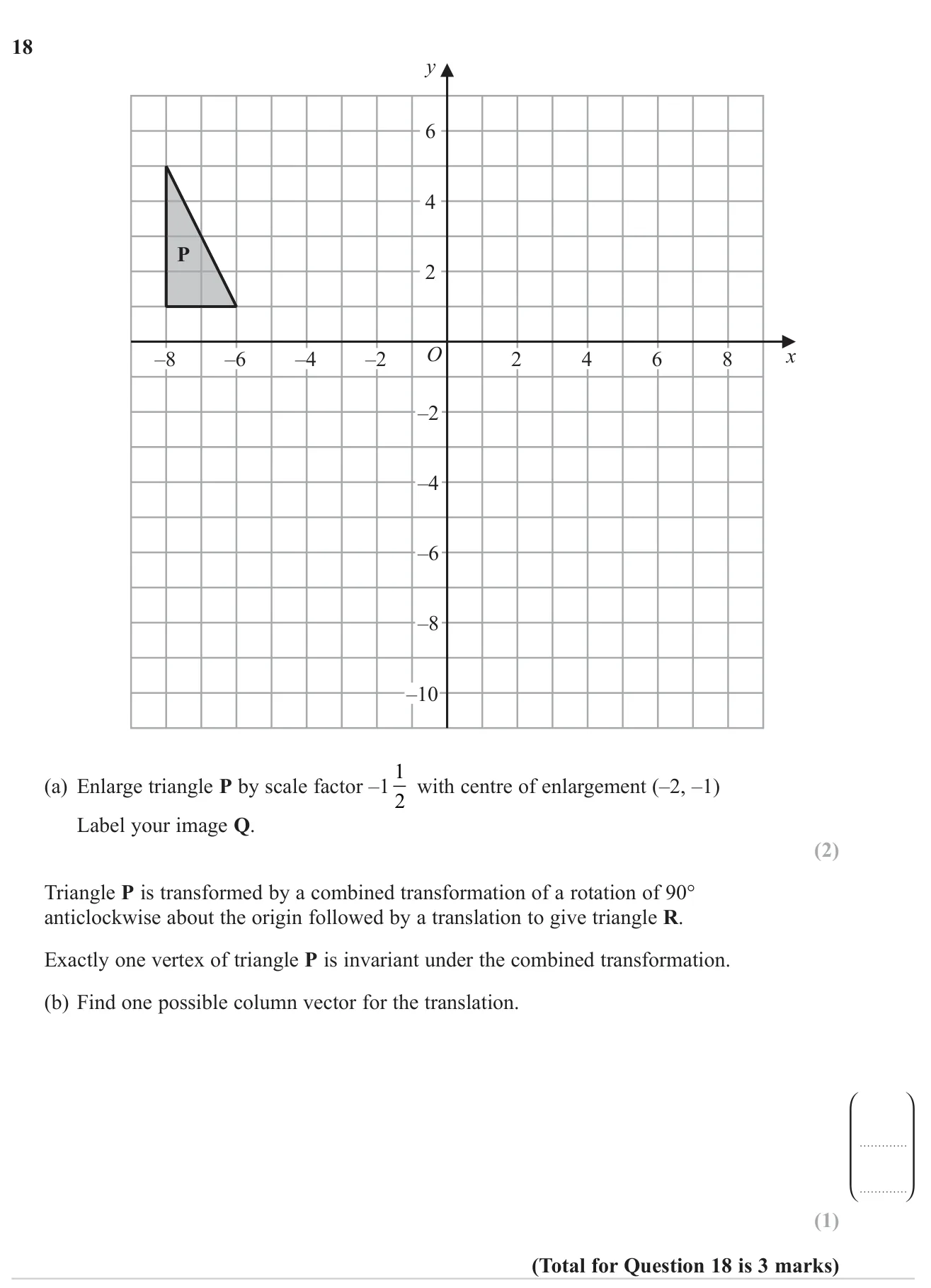
(a) Triangle Q Q Q ( 7 , − 4 ) (7, -4) ( 7 , − 4 ) ( 7 , − 10 ) (7, -10) ( 7 , − 10 ) ( 4 , − 4 ) (4, -4) ( 4 , − 4 ) 2 marks (b) ( − 7 9 ) \begin{pmatrix} -7 \\ 9 \end{pmatrix} ( − 7 9 ) ( − 5 7 ) \begin{pmatrix} -5 \\ 7 \end{pmatrix} ( − 5 7 ) ( − 3 13 ) \begin{pmatrix} -3 \\ 13 \end{pmatrix} ( − 3 13 ) 1 mark
Worked solution Checked against the mark scheme
(a) P P P ( − 8 , 1 ) (-8, 1) ( − 8 , 1 ) ( − 8 , 5 ) (-8, 5) ( − 8 , 5 ) ( − 6 , 1 ) (-6, 1) ( − 6 , 1 ) ( − 2 , − 1 ) (-2, -1) ( − 2 , − 1 ) ( − 6 , 2 ) (-6, 2) ( − 6 , 2 ) ( − 6 , 6 ) (-6, 6) ( − 6 , 6 ) ( − 4 , 2 ) (-4, 2) ( − 4 , 2 )
Multiply by − 1.5 -1.5 − 1.5 ( 9 , − 3 ) (9, -3) ( 9 , − 3 ) ( 9 , − 9 ) (9, -9) ( 9 , − 9 ) ( 6 , − 3 ) (6, -3) ( 6 , − 3 ) ( − 2 , − 1 ) (-2, -1) ( − 2 , − 1 ) Q Q Q ( 7 , − 4 ) (7, -4) ( 7 , − 4 ) ( 7 , − 10 ) (7, -10) ( 7 , − 10 ) ( 4 , − 4 ) (4, -4) ( 4 , − 4 )
(b) Rotating 90 ° 90° 90° O O O ( x , y ) (x, y) ( x , y ) ( − y , x ) (-y, x) ( − y , x ) ( − 8 , 1 ) → ( − 1 , − 8 ) (-8, 1) \to (-1, -8) ( − 8 , 1 ) → ( − 1 , − 8 )
To send it back to ( − 8 , 1 ) (-8, 1) ( − 8 , 1 ) ( − 7 9 ) \begin{pmatrix} -7 \\ 9 \end{pmatrix} ( − 7 9 )
Watch out: Placing the image on the same side of the centre, ignoring the negative sign of the scale factor.
© Pearson Education Ltd. November 2018 Paper 3 (Higher, calculator), question 20.
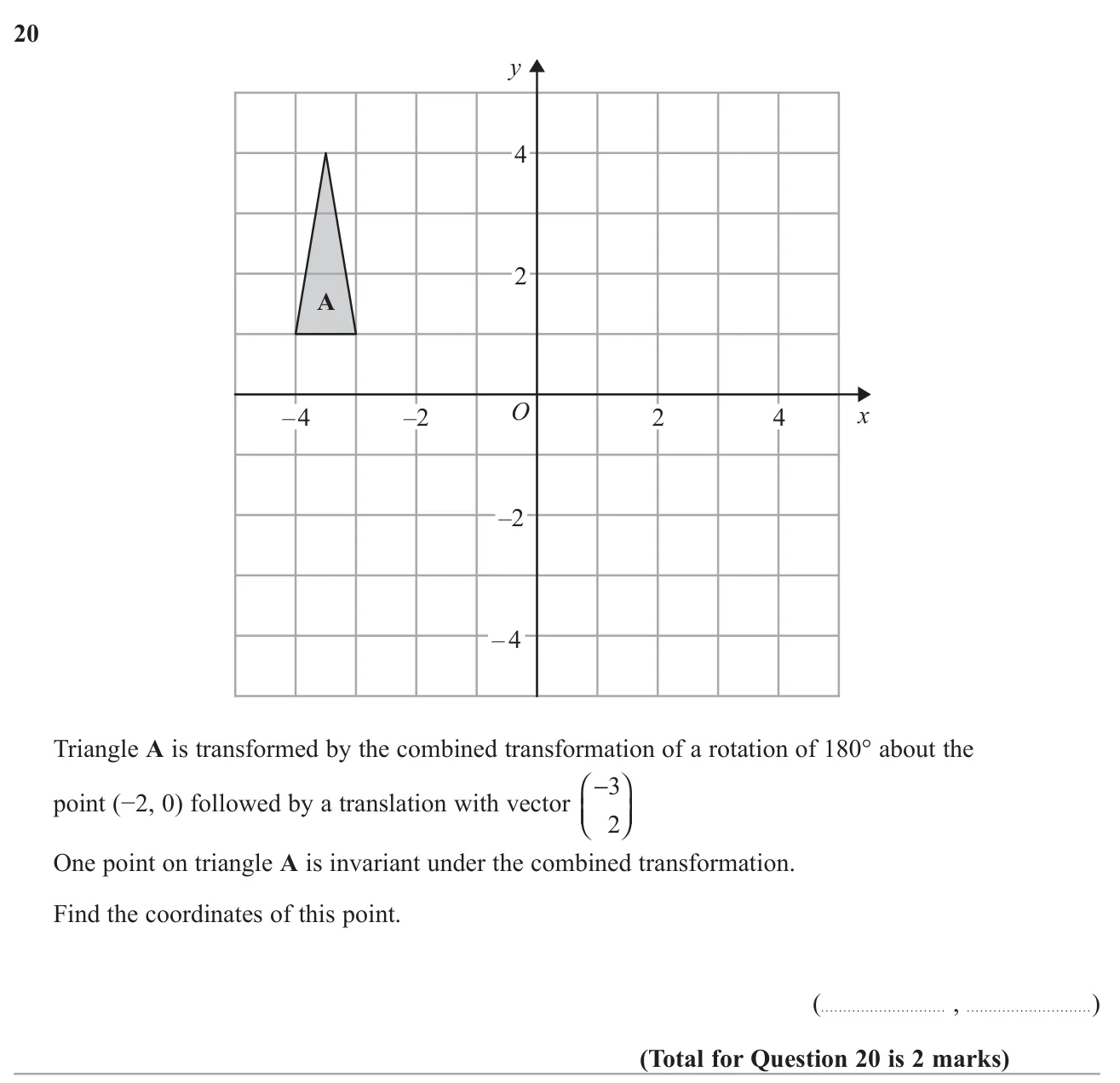
Answer ( − 3.5 , 1 ) (-3.5, 1) ( − 3.5 , 1 ) 2 marks
Worked solution Checked against the mark scheme
Triangle A has corners ( − 4 , 1 ) (-4, 1) ( − 4 , 1 ) ( − 3 , 1 ) (-3, 1) ( − 3 , 1 ) ( − 3.5 , 4 ) (-3.5, 4) ( − 3.5 , 4 )
Rotating 180° about ( − 2 , 0 ) (-2, 0) ( − 2 , 0 ) ( x , y ) (x, y) ( x , y ) ( − 4 − x , − y ) (-4 - x, -y) ( − 4 − x , − y ) ( − 3 2 ) \binom{-3}{2} ( 2 − 3 ) ( − 7 − x , 2 − y ) (-7 - x, 2 - y) ( − 7 − x , 2 − y )
The corners go to ( − 3 , 1 ) (-3, 1) ( − 3 , 1 ) ( − 4 , 1 ) (-4, 1) ( − 4 , 1 ) ( − 3.5 , − 2 ) (-3.5, -2) ( − 3.5 , − 2 )
Check: − 7 − ( − 3.5 ) = − 3.5 -7 - (-3.5) = -3.5 − 7 − ( − 3.5 ) = − 3.5 2 − 1 = 1 2 - 1 = 1 2 − 1 = 1 ( − 3.5 , 1 ) (-3.5, 1) ( − 3.5 , 1 )
Watch out: Rotating about the origin instead of ( − 2 , 0 ) (-2, 0) ( − 2 , 0 )
© Pearson Education Ltd. November 2019 Paper 2 (Higher, calculator), question 24.
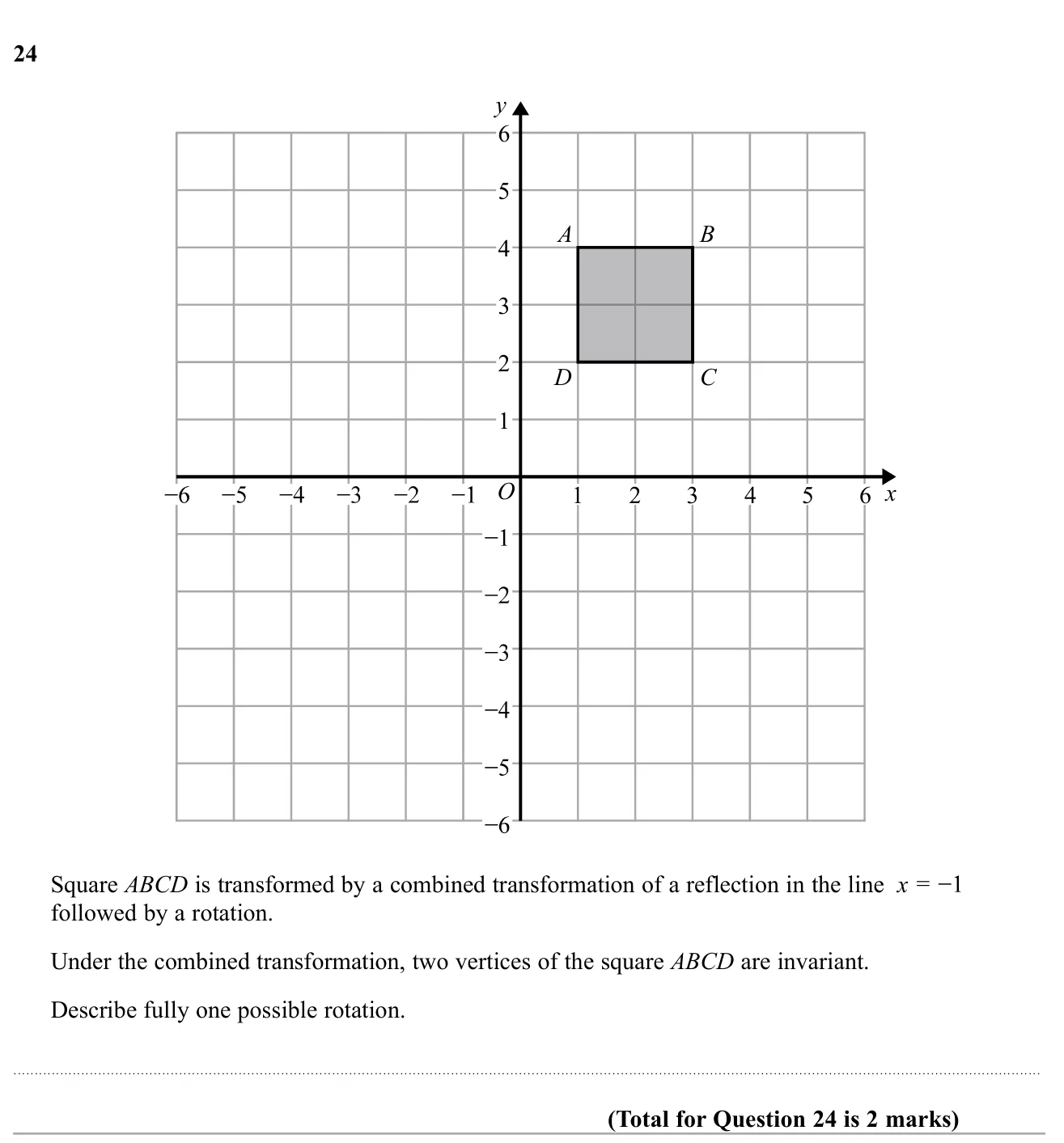
Answer Rotation 90° clockwise about ( − 1 , 0 ) (-1, 0) ( − 1 , 0 ) ( − 1 , 6 ) (-1, 6) ( − 1 , 6 ) ( − 1 , 2 ) (-1, 2) ( − 1 , 2 ) ( − 1 , 4 ) (-1, 4) ( − 1 , 4 ) 2 marks
Worked solution Checked against the mark scheme
Reflecting in x = − 1 x = -1 x = − 1 A ( 1 , 4 ) → ( − 3 , 4 ) A(1, 4) \to (-3, 4) A ( 1 , 4 ) → ( − 3 , 4 ) B ( 3 , 4 ) → ( − 5 , 4 ) B(3, 4) \to (-5, 4) B ( 3 , 4 ) → ( − 5 , 4 ) C ( 3 , 2 ) → ( − 5 , 2 ) C(3, 2) \to (-5, 2) C ( 3 , 2 ) → ( − 5 , 2 ) D ( 1 , 2 ) → ( − 3 , 2 ) D(1, 2) \to (-3, 2) D ( 1 , 2 ) → ( − 3 , 2 )
To bring B B B D D D ( − 1 , 0 ) (-1, 0) ( − 1 , 0 ) ( − 5 , 4 ) → ( 3 , 4 ) (-5, 4) \to (3, 4) ( − 5 , 4 ) → ( 3 , 4 ) ( − 3 , 2 ) → ( 1 , 2 ) (-3, 2) \to (1, 2) ( − 3 , 2 ) → ( 1 , 2 )
So B and D are invariant.
Watch out: Leaving out the centre or the direction of rotation.
Also tested in these questions Their main topic is different, but part of each one tests this topic.