Algebra

Factorising

10 past-paper questions, easiest first. Try each one, then reveal the answer.

Foundation & Higher4 of 10 from Foundation papers

Revision guide by The Full Marks

Factorising: what you need to know

Factorising is the reverse of expanding: you put an expression back into brackets. It is used to solve quadratics, simplify algebraic fractions and write proofs, so it is worth getting quick at.

Foundation covers common factors, x2+bx+cx^2 + bx + c and the difference of two squares; quadratics with a≠1a \neq 1, like 3x2−10x−83x^2 - 10x - 8, are Higher only.

Key facts

  • Always take out the highest common factor first: 12y2+18y=6y(2y+3)12y^2 + 18y = 6y(2y + 3).
  • x2+bx+c=(x+p)(x+q)x^2 + bx + c = (x + p)(x + q) where p+q=bp + q = b and pq=cpq = c.
  • Difference of two squares: a2−b2=(a+b)(a−b)a^2 - b^2 = (a + b)(a - b). It works with numbers and coefficients too: 9x2−16=(3x+4)(3x−4)9x^2 - 16 = (3x + 4)(3x - 4).
  • You can always check a factorisation by expanding it again.

Factorising x2+bx+cx^2 + bx + c

  1. Find two numbers that multiply to cc and add to bb.
  2. Write them in the brackets: (x+p)(x+q)(x + p)(x + q).
  3. Expand to check.

Factorising ax2+bx+cax^2 + bx + c (Higher)

  1. Find two numbers that multiply to acac and add to bb.
  2. Split the middle term using those numbers.
  3. Factorise each pair, then take out the common bracket. This is called grouping, and it also works on four-term expressions like xy+3x+2y+6=x(y+3)+2(y+3)=(x+2)(y+3)xy + 3x + 2y + 6 = x(y + 3) + 2(y + 3) = (x + 2)(y + 3).

Worked examples

Example 1 Foundation · grade 4

Factorise fully (a) 12y2+18y12y^2 + 18y (b) x2+2x−15x^2 + 2x - 15 (c) x2−64x^2 - 64

Show the solution

(a) HCF of 12y212y^2 and 18y18y is 6y6y.
12y2+18y=6y(2y+3)12y^2 + 18y = 6y(2y + 3)
(b) Two numbers that multiply to −15-15 and add to 22: 55 and −3-3.
x2+2x−15=(x+5)(x−3)x^2 + 2x - 15 = (x + 5)(x - 3)
(c) x2−64=x2−82x^2 - 64 = x^2 - 8^2, a difference of two squares.
x2−64=(x+8)(x−8)x^2 - 64 = (x + 8)(x - 8)

Example 2 Higher · grade 6

Factorise 3x2−10x−83x^2 - 10x - 8

Show the solution

ac=3×−8=−24ac = 3 \times -8 = -24. Numbers that multiply to −24-24 and add to −10-10: −12-12 and 22.
Split: 3x2−12x+2x−83x^2 - 12x + 2x - 8
Factorise pairs: 3x(x−4)+2(x−4)3x(x - 4) + 2(x - 4)
=(3x+2)(x−4)= (3x + 2)(x - 4)

Common mistakes

  • Not factorising fully: 3(3x2+2x)3(3x^2 + 2x) still has a common factor xx, so the answer is 3x(3x+2)3x(3x + 2).
  • Stopping at 2(x2−25)2(x^2 - 25). Spot the difference of two squares: 2(x+5)(x−5)2(x + 5)(x - 5).
  • Mixing up the sum and product, or getting the signs the wrong way round: x2−3x−4x^2 - 3x - 4 is (x−4)(x+1)(x - 4)(x + 1), not (x+4)(x−1)(x + 4)(x - 1). Expand your answer to check.

Exam tips

  • "Factorise fully" is a hint that there is more than one factor to take out. A partial factorisation usually earns only some of the marks.
  • If a question says "hence", use the factorised form from the previous part.
  • Higher papers use the difference of two squares in other questions too, e.g. to simplify (x+5)2−(x−1)2(x + 5)^2 - (x - 1)^2 or in a proof. Look out for one square minus another.

Questions people ask

How do you factorise a quadratic?

For x2+bx+cx^2 + bx + c, find two numbers that multiply to cc and add to bb, then put them in two brackets with xx. Expand your answer to check it.

What is the difference of two squares?

It is one square minus another, like x2−49x^2 - 49. It always factorises as (a+b)(a−b)(a + b)(a - b), so x2−49=(x+7)(x−7)x^2 - 49 = (x + 7)(x - 7).

Exam questions: Factorising (10, easiest first)

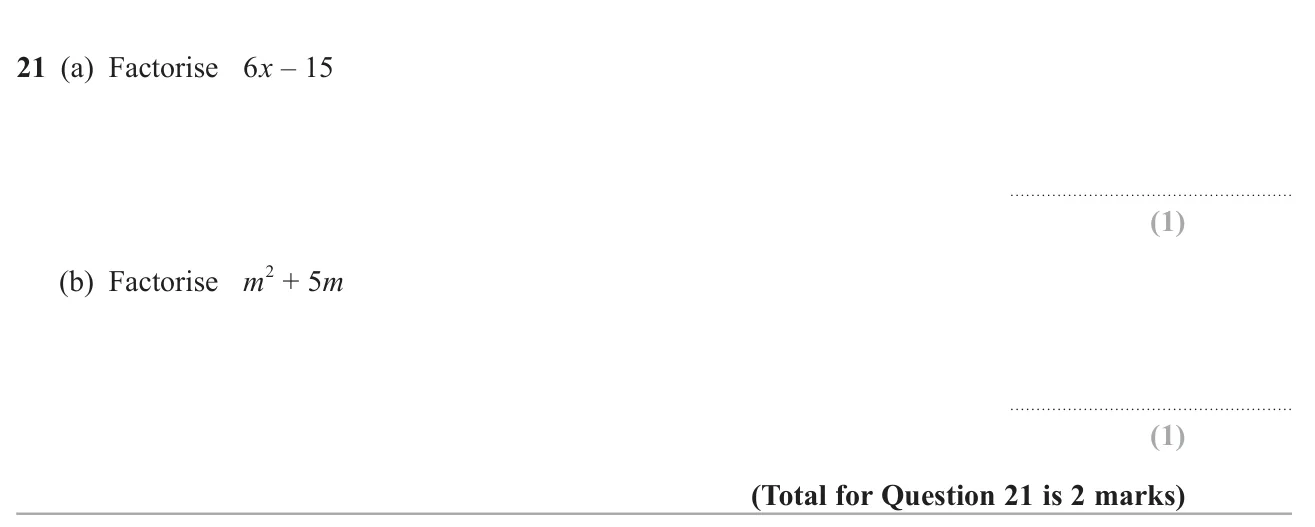
Factorising2 marksGrade 4CalculatorFoundation
June 2024 · Paper 3 Foundation · Q21
Factorise a linear expression and a simple quadratic expression.

© Pearson Education Ltd. June 2024 Paper 3 (Foundation, calculator), question 21.

Show answer
(a)3(2x−5)3(2x - 5)1 mark
(b)m(m+5)m(m + 5)1 mark

Worked solution Checked against the mark scheme

(a) The HCF of 6 and 15 is 3: 6x−15=3(2x−5)6x - 15 = 3(2x - 5)

(b) Both terms contain mm: m2+5m=m(m+5)m^2 + 5m = m(m + 5)

Watch out: Only partly factorising, or writing m(m+5m)m(m + 5m).

Factorising4 marksGrade 4CalculatorFoundation
November 2024 · Paper 2 Foundation · Q19
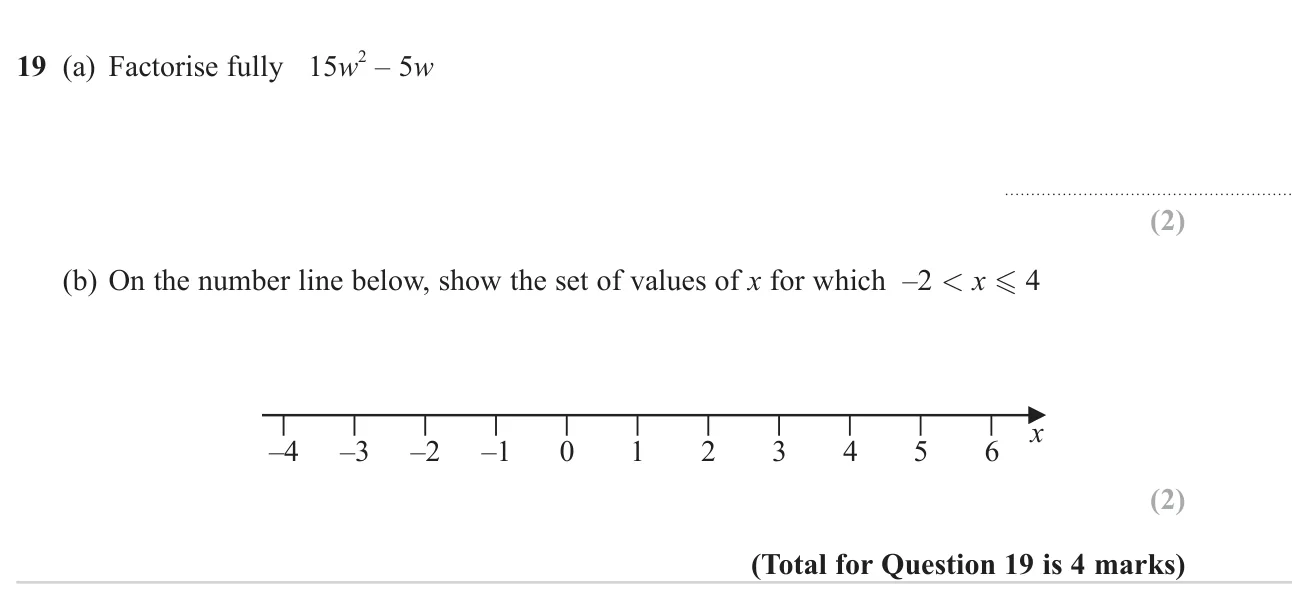
Factorise a quadratic expression fully and show an inequality on a number line.

© Pearson Education Ltd. November 2024 Paper 2 (Foundation, calculator), question 19.

Show answer
(a)5w(3w−1)5w(3w - 1)2 marks
(b)Open circle at −2-2, closed circle at 44, joined by a line2 marks

Worked solution Checked against the mark scheme

(a) The HCF of 15w215w^2 and 5w5w is 5w5w.

15w2−5w=5w(3w−1)15w^2 - 5w = 5w(3w - 1)

(b) −2-2 is not included: open circle. 44 is included: filled circle. Join them with a line.

Watch out: In (a), taking out only 5 or only ww, which is not fully factorised.

Factorising1 markGrade 5No calculatorFoundation
Specimen · Paper 1 Foundation · Q28
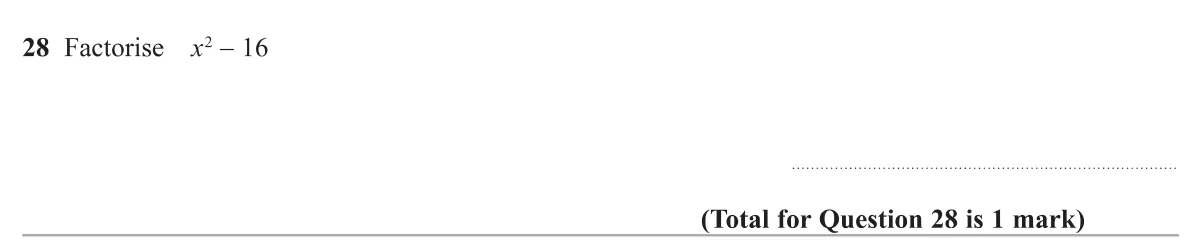
Factorise a difference of two squares.

© Pearson Education Ltd. Specimen Paper 1 (Foundation, non-calculator), question 28.

Show answer
Answer(x+4)(x−4)(x + 4)(x - 4)1 mark

Worked solution Checked against the mark scheme

x2−16=x2−42x^2 - 16 = x^2 - 4^2, a difference of two squares.

So x2−16=(x+4)(x−4)x^2 - 16 = (x + 4)(x - 4)

Watch out: Writing (x − 4)(x − 4) or (x − 8)(x + 8).

Factorising2 marksGrade 5CalculatorFoundation
Specimen · Paper 3 Foundation · Q26
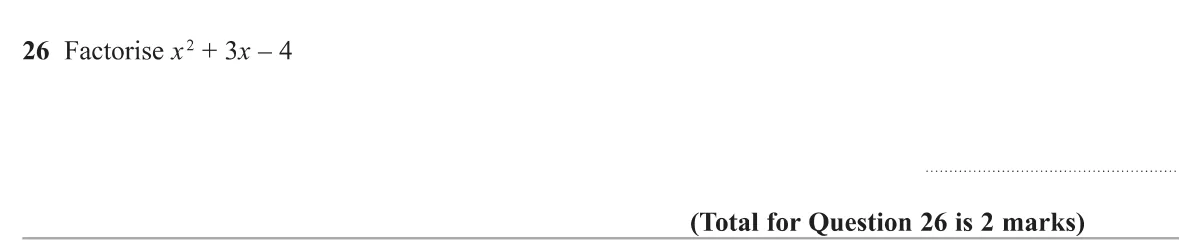
Factorise a quadratic expression with a coefficient of 1 on x squared.

© Pearson Education Ltd. Specimen Paper 3 (Foundation, calculator), question 26.

Show answer
Answer(x−1)(x+4)(x - 1)(x + 4)2 marks

Worked solution Checked against the mark scheme

Find two numbers that multiply to −4 and add to 3: 44 and −1-1.

x2+3x−4=(x+4)(x−1)x^2 + 3x - 4 = (x + 4)(x - 1)

Watch out: Getting the signs the wrong way round: (x+1)(x−4)(x + 1)(x - 4).

Factorising2 marksGrade 5CalculatorHigher
Specimen · Paper 3 Higher · Q6
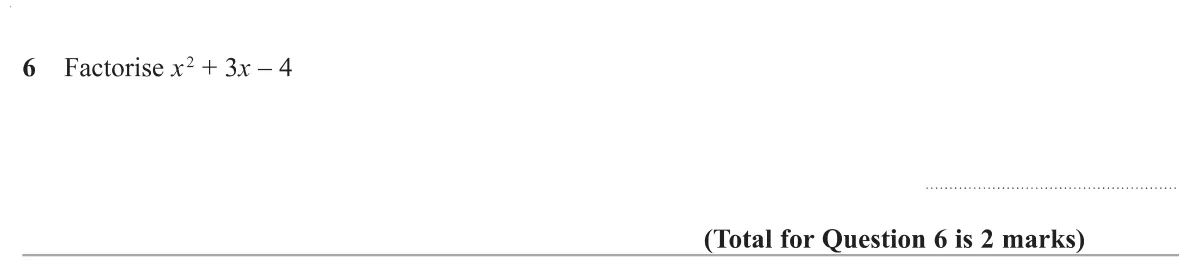
Factorise a quadratic expression with a coefficient of 1 on the squared term.

© Pearson Education Ltd. Specimen Paper 3 (Higher, calculator), question 6.

Show answer
Answer(x+4)(x−1)(x + 4)(x - 1)2 marks

Worked solution Checked against the mark scheme

Find two numbers that multiply to −4-4 and add to 33: these are 44 and −1-1.

x2+3x−4=(x+4)(x−1)x^2 + 3x - 4 = (x + 4)(x - 1)

Watch out: Getting the signs the wrong way round: (x − 4)(x + 1).

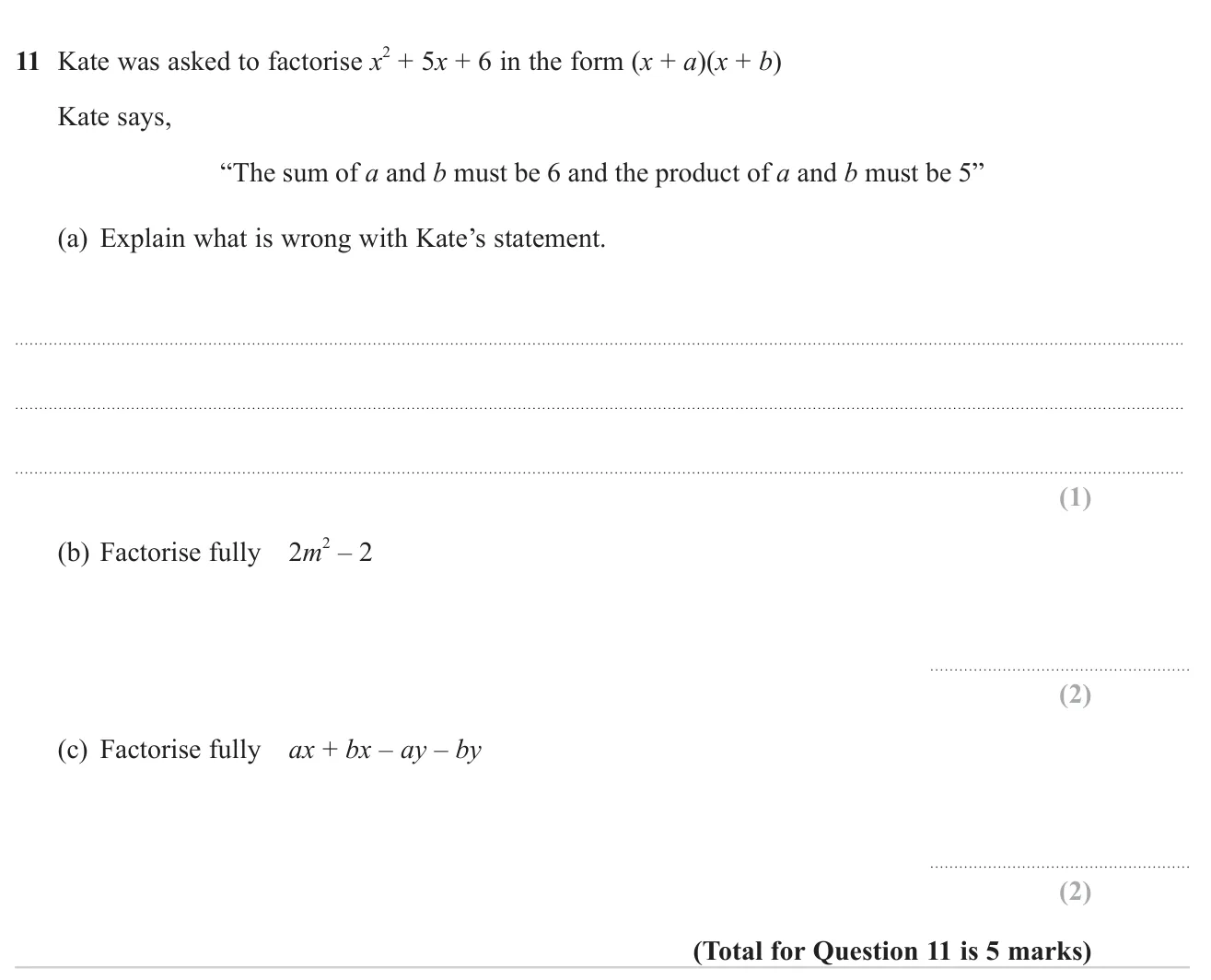
Factorising5 marksGrade 6No calculatorHigher
November 2024 · Paper 1 Higher · Q11
Correct a mix-up about the sum and product when factorising a quadratic, then factorise a difference of two squares and an expression by grouping.

© Pearson Education Ltd. November 2024 Paper 1 (Higher, non-calculator), question 11.

Show answer
(a)The sum and product are swapped: a+ba + b should be 5 and abab should be 61 mark
(b)2(m−1)(m+1)2(m - 1)(m + 1)2 marks
(c)(a+b)(x−y)(a + b)(x - y)2 marks

Worked solution Checked against the mark scheme

(a) Expanding (x+a)(x+b)(x + a)(x + b) gives x2+(a+b)x+abx^2 + (a + b)x + ab, so a+b=5a + b = 5 and ab=6ab = 6. Kate has them the wrong way round.

(b) 2m2−2=2(m2−1)=2(m−1)(m+1)2m^2 - 2 = 2(m^2 - 1) = 2(m - 1)(m + 1)

(c) ax+bx−ay−by=x(a+b)−y(a+b)=(a+b)(x−y)ax + bx - ay - by = x(a + b) - y(a + b) = (a + b)(x - y)

Watch out: In (b), stopping at 2(m² − 1) and not using the difference of two squares.

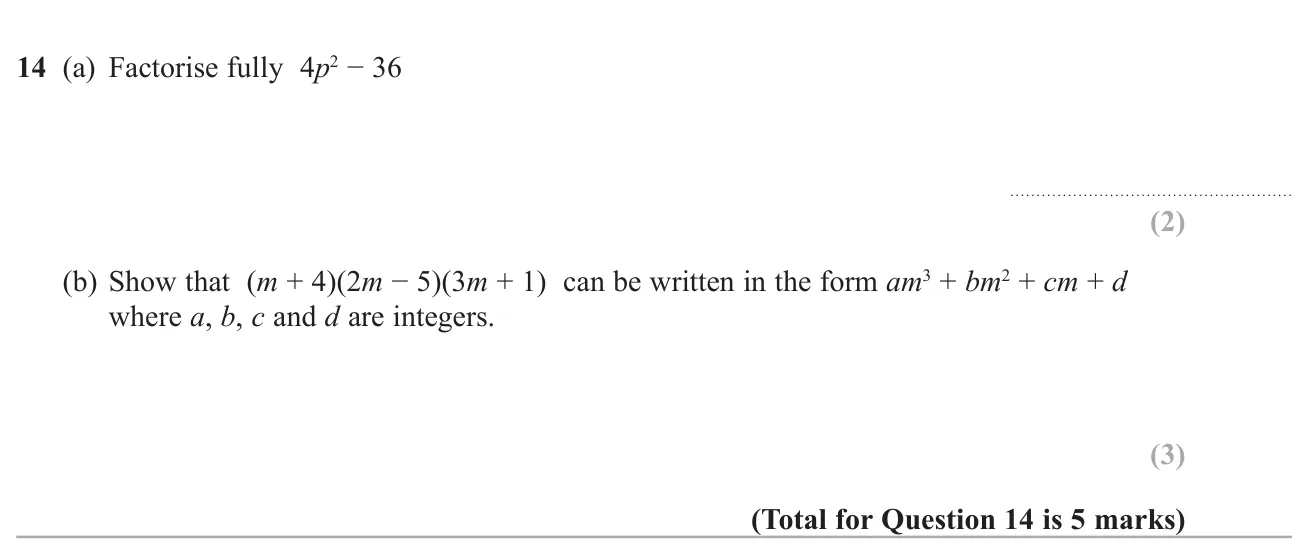
Factorising5 marksGrade 6CalculatorHigher
June 2022 · Paper 3 Higher · Q14
Fully factorise a difference of two squares with a common factor, and expand a product of three brackets into a cubic.

© Pearson Education Ltd. June 2022 Paper 3 (Higher, calculator), question 14.

Show answer
(a)4(p−3)(p+3)4(p-3)(p+3)2 marks
(b)6m3+11m2−57m−206m^3 + 11m^2 - 57m - 203 marks

Worked solution Checked against the mark scheme

(a) 4p2−36=4(p2−9)=4(p−3)(p+3)4p^2 - 36 = 4(p^2 - 9) = 4(p - 3)(p + 3)

(b) (m+4)(2m−5)=2m2+3m−20(m + 4)(2m - 5) = 2m^2 + 3m - 20

(2m2+3m−20)(3m+1)=6m3+2m2+9m2+3m−60m−20(2m^2 + 3m - 20)(3m + 1) = 6m^3 + 2m^2 + 9m^2 + 3m - 60m - 20

=6m3+11m2−57m−20= 6m^3 + 11m^2 - 57m - 20

Watch out: In (a), stopping at 4(p² − 9) without factorising fully.

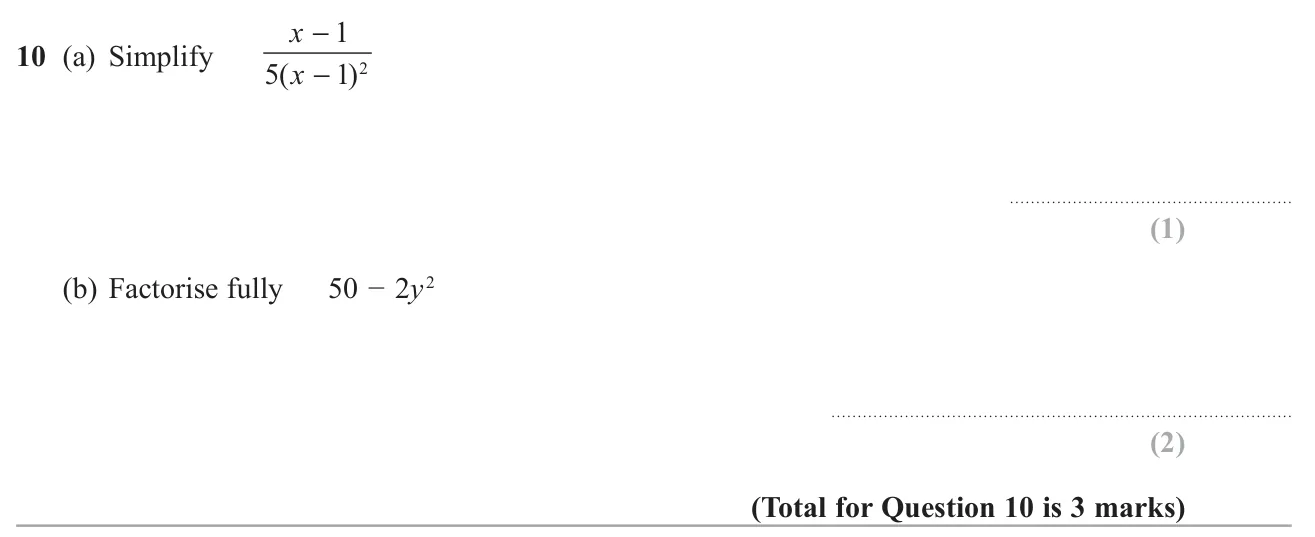
Factorising3 marksGrade 6No calculatorHigher
November 2018 · Paper 1 Higher · Q10
Simplify an algebraic fraction and factorise an expression fully using the difference of two squares.

© Pearson Education Ltd. November 2018 Paper 1 (Higher, non-calculator), question 10.

Show answer
(a)15(x−1)\dfrac{1}{5(x-1)}1 mark
(b)2(5+y)(5−y)2(5+y)(5-y)2 marks

Worked solution Checked against the mark scheme

(a) Cancel one factor of (x−1)(x-1) from top and bottom: 15(x−1)\dfrac{1}{5(x-1)}

(b) Take out the common factor 2: 2(25−y2)2(25 - y^2)

25−y225 - y^2 is a difference of two squares: 2(5+y)(5−y)2(5+y)(5-y)

Watch out: Stopping at 2(25−y2)2(25 - y^2) without factorising fully.

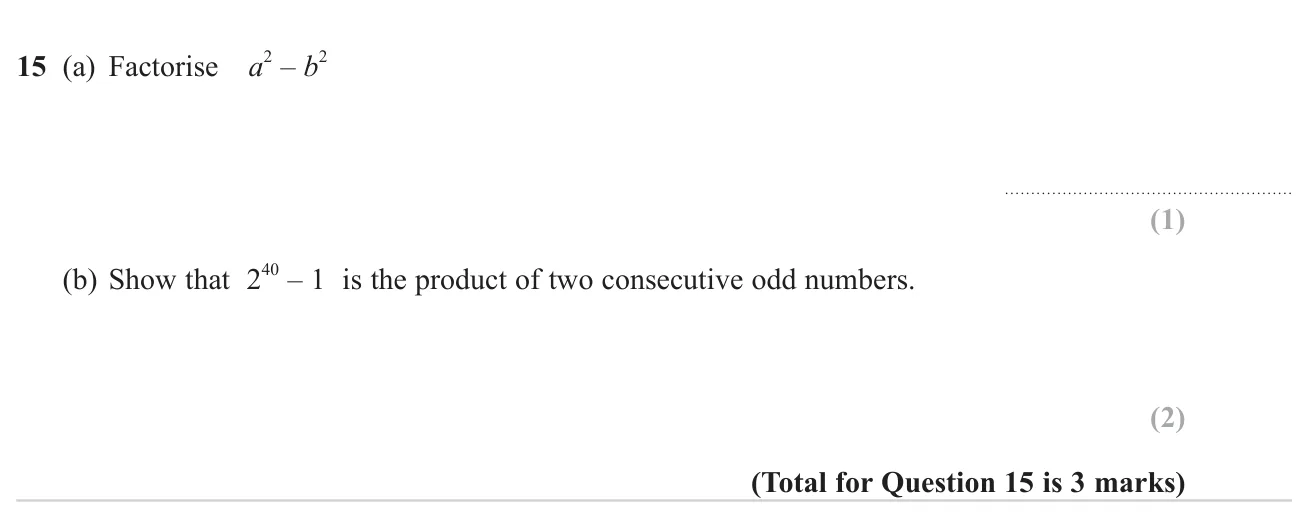
Factorising3 marksGrade 7CalculatorHigher
June 2023 · Paper 3 Higher · Q15
Factorise a difference of two squares, then use it to show that a power of 2 minus 1 is the product of two consecutive odd numbers.

© Pearson Education Ltd. June 2023 Paper 3 (Higher, calculator), question 15.

Show answer
(a)(a−b)(a+b)(a - b)(a + b)1 mark
(b)240−1=(220−1)(220+1)2^{40} - 1 = (2^{20} - 1)(2^{20} + 1); 2202^{20} is even, so both factors are odd and differ by 22 marks

Worked solution Checked against the mark scheme

(a) a2−b2=(a−b)(a+b)a^2 - b^2 = (a - b)(a + b)

(b) 240=(220)22^{40} = (2^{20})^2, so 240−1=(220−1)(220+1)2^{40} - 1 = (2^{20} - 1)(2^{20} + 1)

2202^{20} is even, so 220−12^{20} - 1 and 220+12^{20} + 1 are both odd, and they differ by 2, so they are consecutive odd numbers (1 048 5751\,048\,575 and 1 048 5771\,048\,577).

Watch out: In (b), factorising but not explaining why the two factors are odd and consecutive.

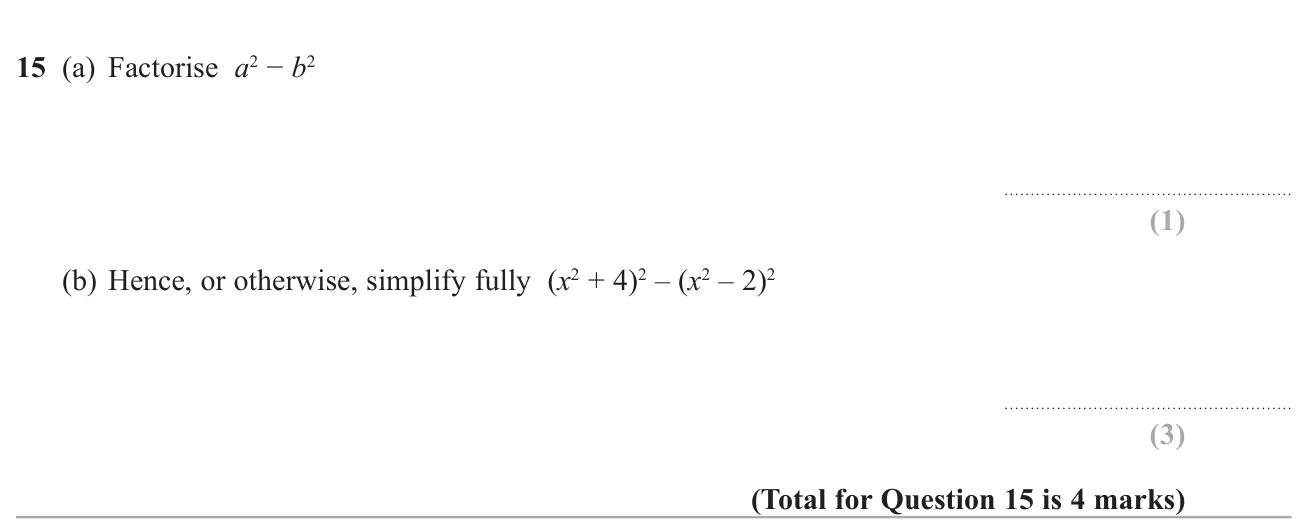
Factorising4 marksGrade 7No calculatorHigher
June 2018 · Paper 1 Higher · Q15
Factorise a difference of two squares and use it to simplify the difference of two squared brackets.

© Pearson Education Ltd. June 2018 Paper 1 (Higher, non-calculator), question 15.

Show answer
(a)(a−b)(a+b)(a - b)(a + b)1 mark
(b)12(x2+1)12(x^2 + 1)3 marks

Worked solution Checked against the mark scheme

(a) a2−b2=(a−b)(a+b)a^2 - b^2 = (a - b)(a + b)

(b) Let a=x2+4a = x^2 + 4 and b=x2−2b = x^2 - 2.

a+b=2x2+2a + b = 2x^2 + 2 and a−b=6a - b = 6

(a+b)(a−b)=6(2x2+2)=12x2+12=12(x2+1)(a + b)(a - b) = 6(2x^2 + 2) = 12x^2 + 12 = 12(x^2 + 1)

Watch out: Not changing the sign of the −2 when subtracting the second bracket.

Also tested in these questions

Their main topic is different, but part of each one tests this topic.