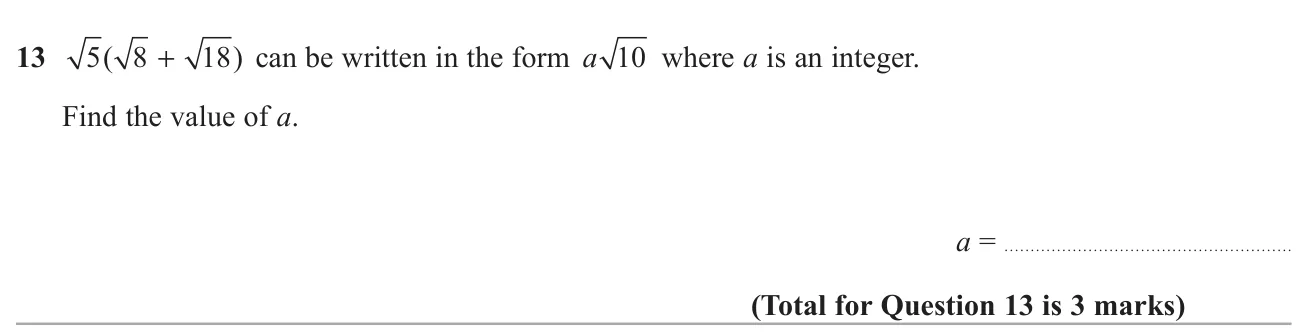
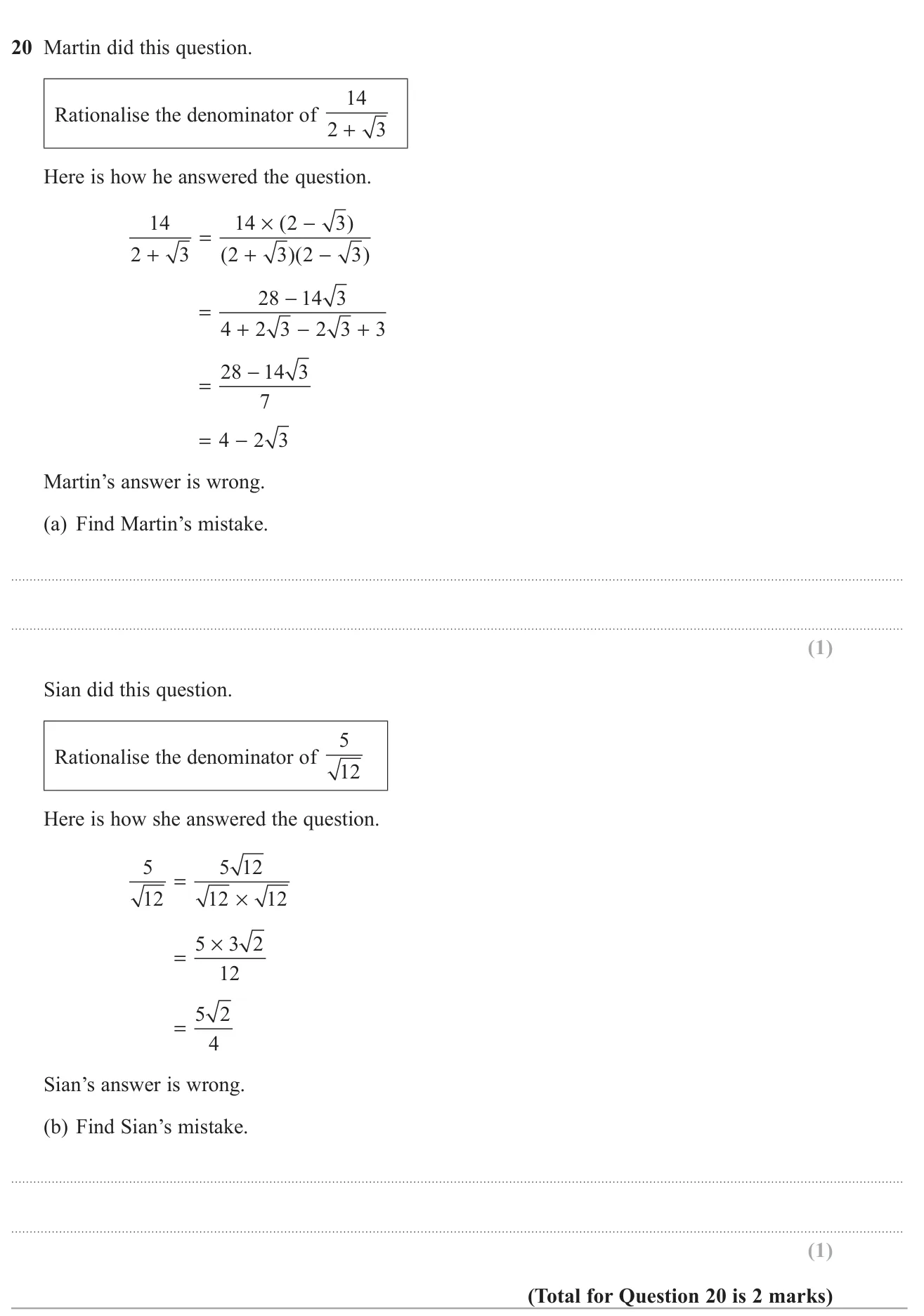
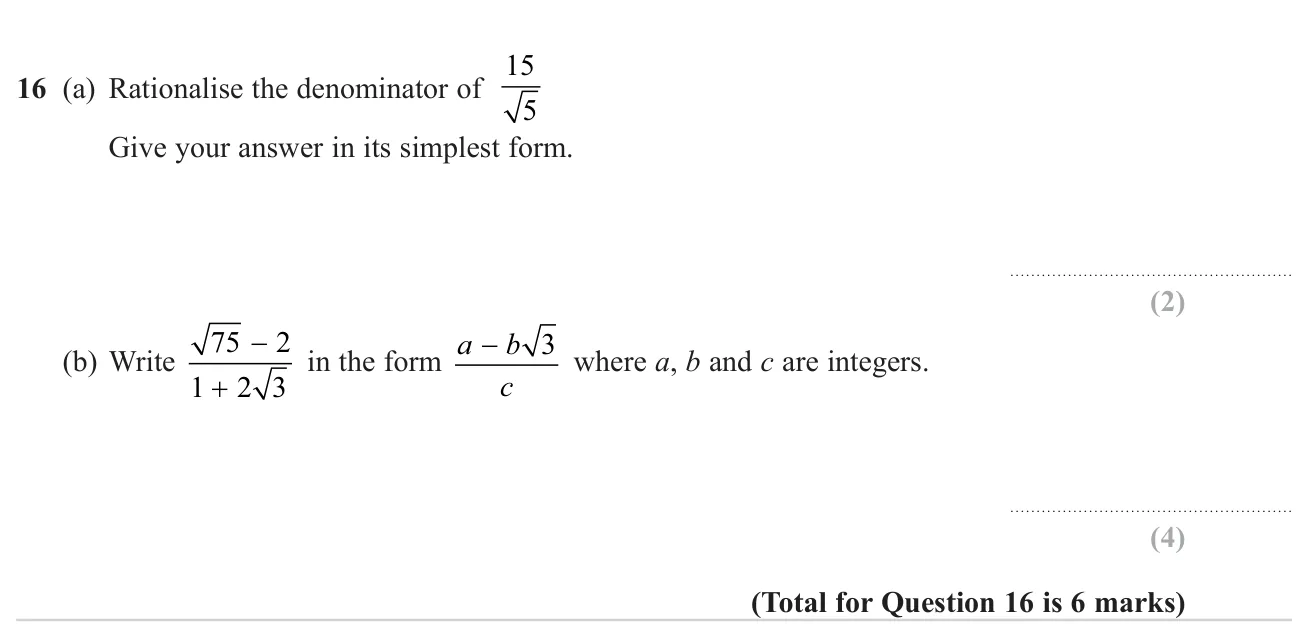
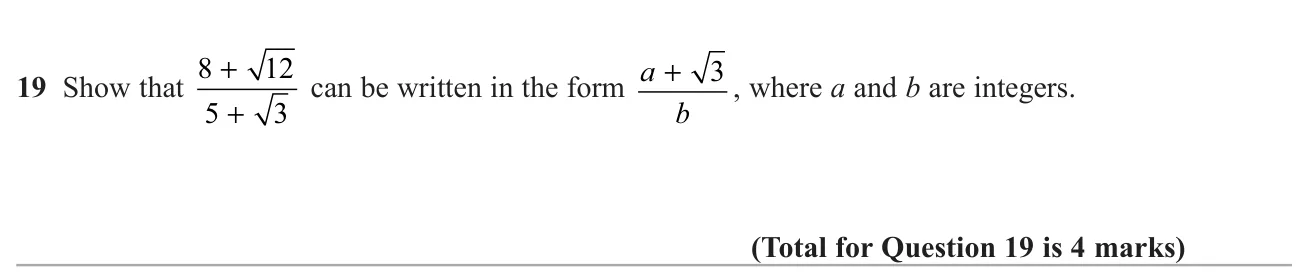
A surd is a square root that cannot be simplified to a whole number or fraction, such as 2. Surds let you give exact answers, and Higher papers test simplifying them and rationalising denominators, usually on the non-calculator paper.
Key facts
ab=a×b and ba=ba.
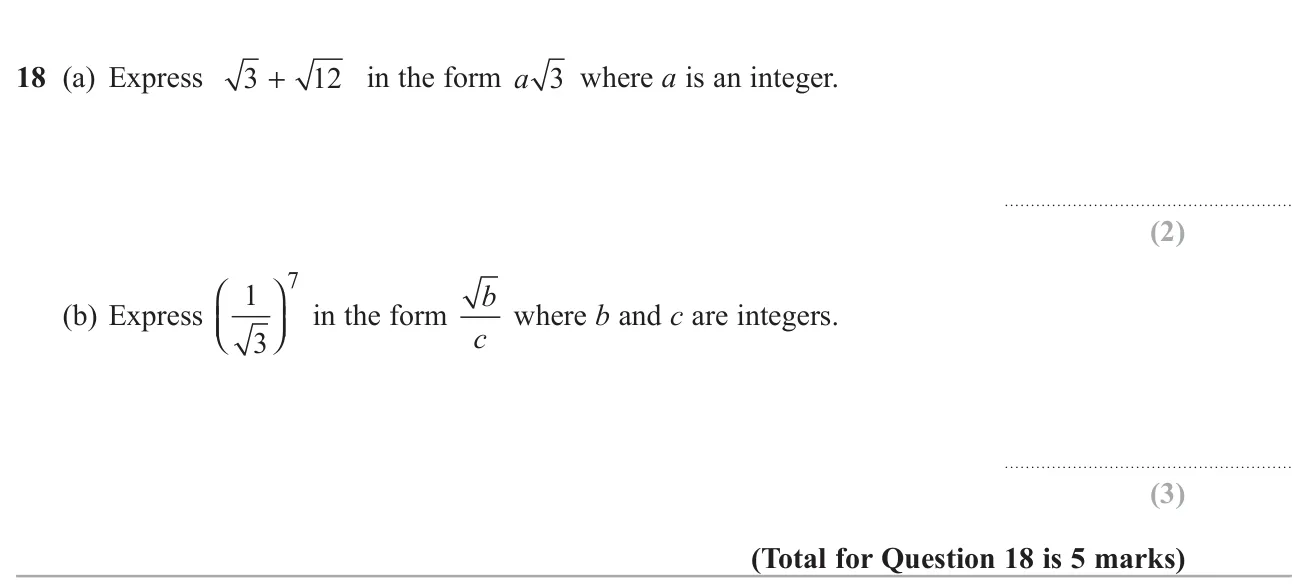
a×a=a, so 32×32=18.
You can only add like surds: 23+53=73, but 2+3 stays as it is.
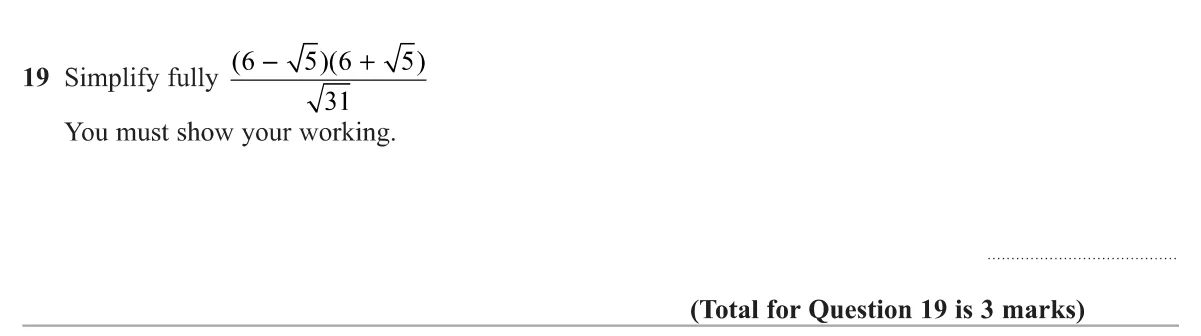
(a+b)(a−b)=a2−b, which has no surd.
Simplifying a surd
Find the largest square number that is a factor of the number under the root.
Split the root: 48=16×3.
Square root the square number: 43.
Expanding brackets with surds
Multiply every term in the first bracket by every term in the second, as with (x+3)(x+5).
Use a×a=a and a×b=ab.
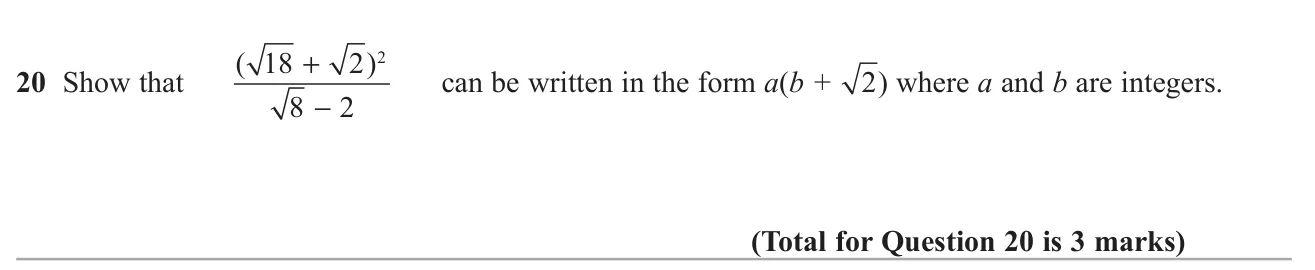
Collect the whole numbers and the surd terms separately: (3+5)2=9+35+35+5=14+65.
Rationalising the denominator
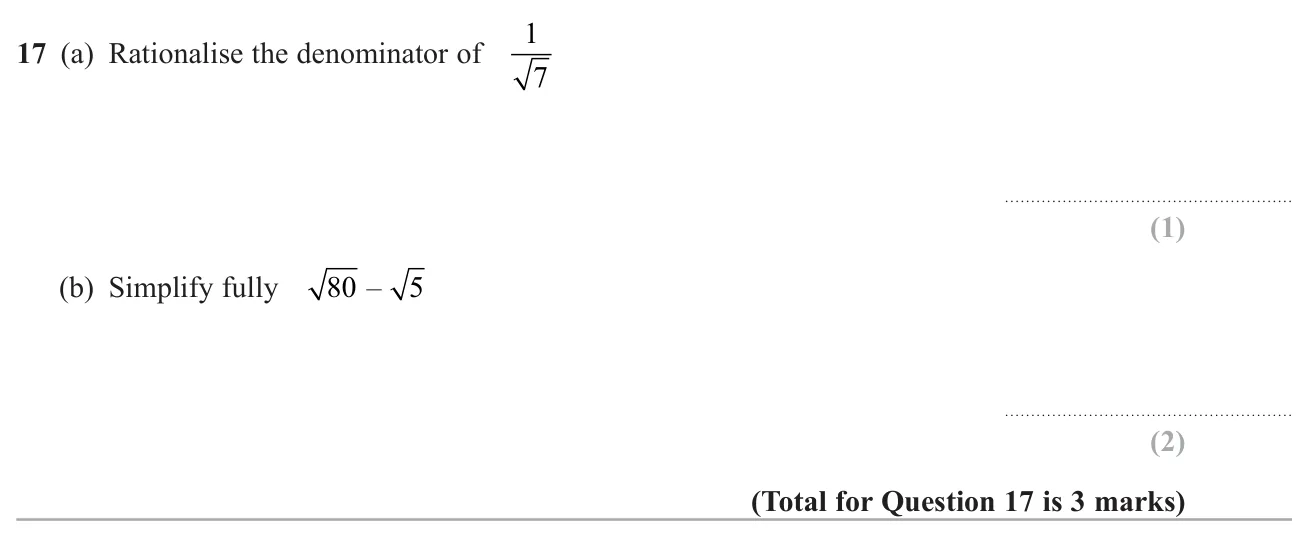
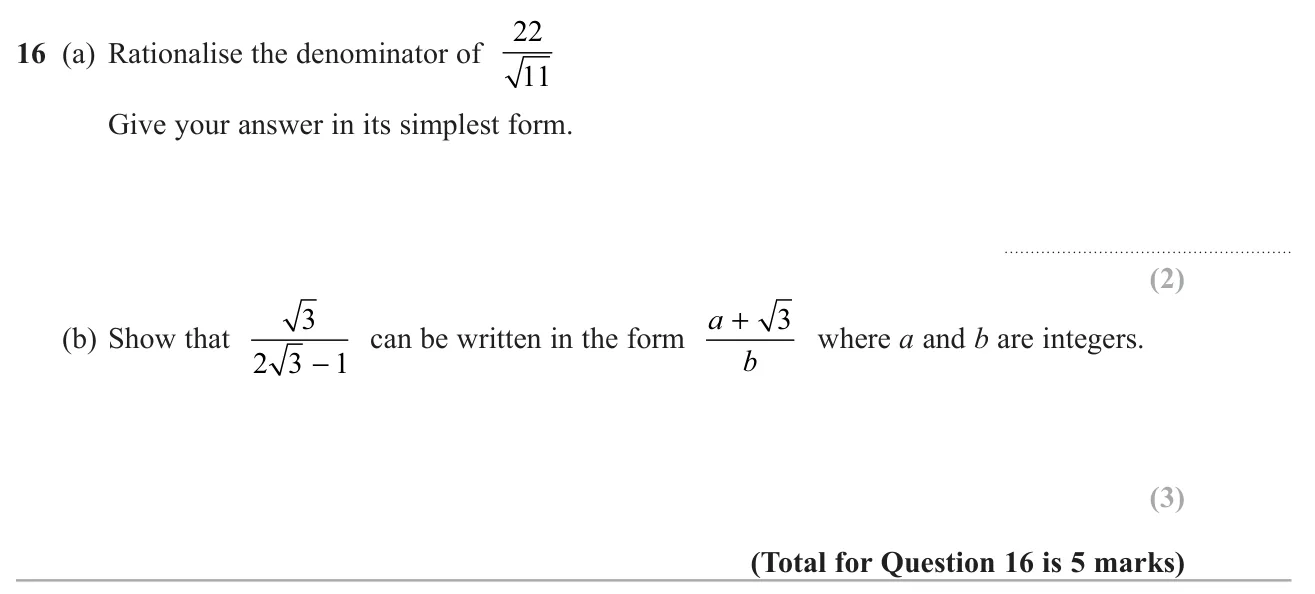
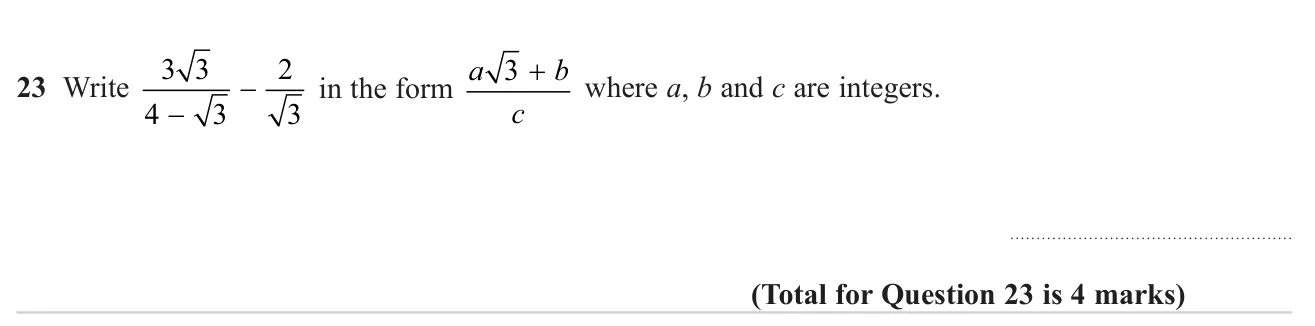
If the bottom is b, multiply top and bottom by b.
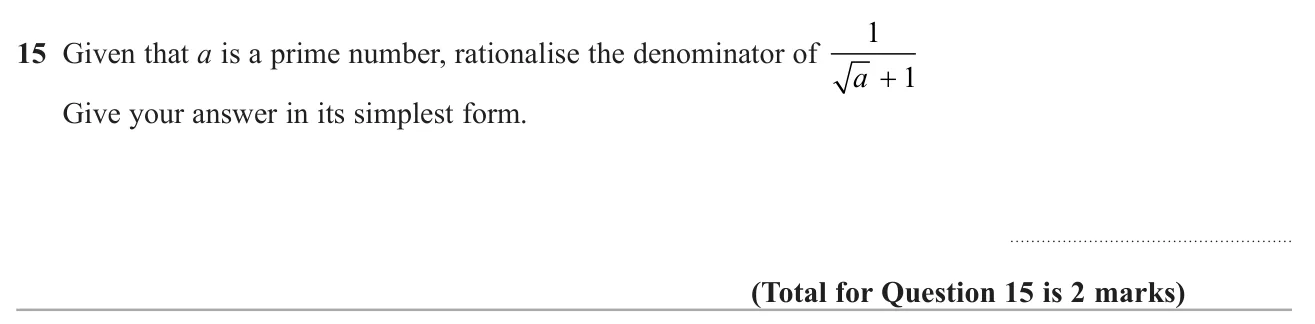
If the bottom is a−b, multiply top and bottom by a+b (swap the sign).
Expand, simplify and cancel any common factors.
Worked examples
Example 1Higher · grade 6
Simplify 75+12
Show the solution
75=25×3=53 12=4×3=23 53+23=73
Example 2Higher · grade 8
Write 3−36 in the form a+b, where a and b are integers.
Show the solution
Multiply top and bottom by 3+3: Top: 6(3+3)=18+63 Bottom: (3−3)(3+3)=9−3=6 618+63=3+3 So a=3 and b=3
Common mistakes
Adding under the root: 8+2 is not 10. Simplify first: 22+2=32.
Multiplying by the same bracket instead of the one with the opposite sign when rationalising.
Forgetting to square the whole number: (23)2=4×3=12, not 6.
Squaring a bracket term by term: (3+5)2 is not 9+5. Write it as (3+5)(3+5) and include the middle terms.
Exam tips
These are usually non-calculator questions, and you must show the surd steps to get the marks.
Check the form the question asks for, e.g. ab, and state the values of a and b.
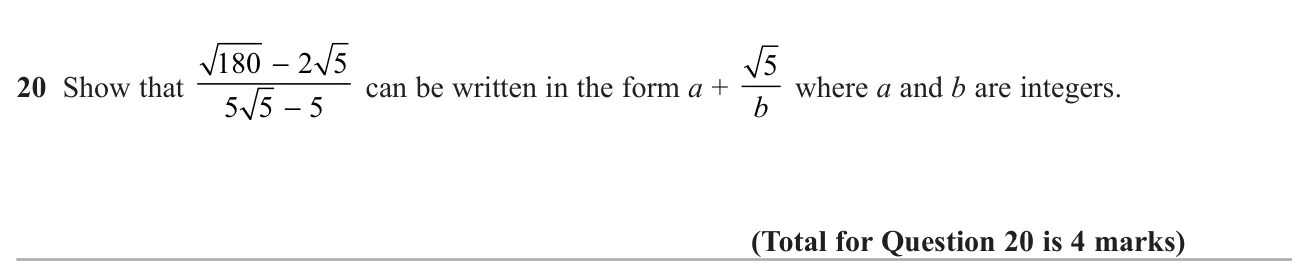
Simplify any surd such as 180=65 before expanding or rationalising; it keeps the numbers small. In a "show that" question, write every line of working down to the exact form given.
Questions people ask
What is a surd?
A surd is a root that cannot be written as a whole number or fraction, like 5. Leaving it as a surd keeps the answer exact.
How do you rationalise the denominator?
Multiply the top and bottom of the fraction by something that removes the root from the bottom: b for a single surd, or the bracket with the opposite sign for a±b.
Are surds on the Foundation paper?
No. Simplifying surds and rationalising denominators are Higher tier only.
June 2024 · Paper 3 Higher · Q21: Compare the perimeters of inscribed and circumscribed regular hexagons with a circle's circumference to show bounds for pi.
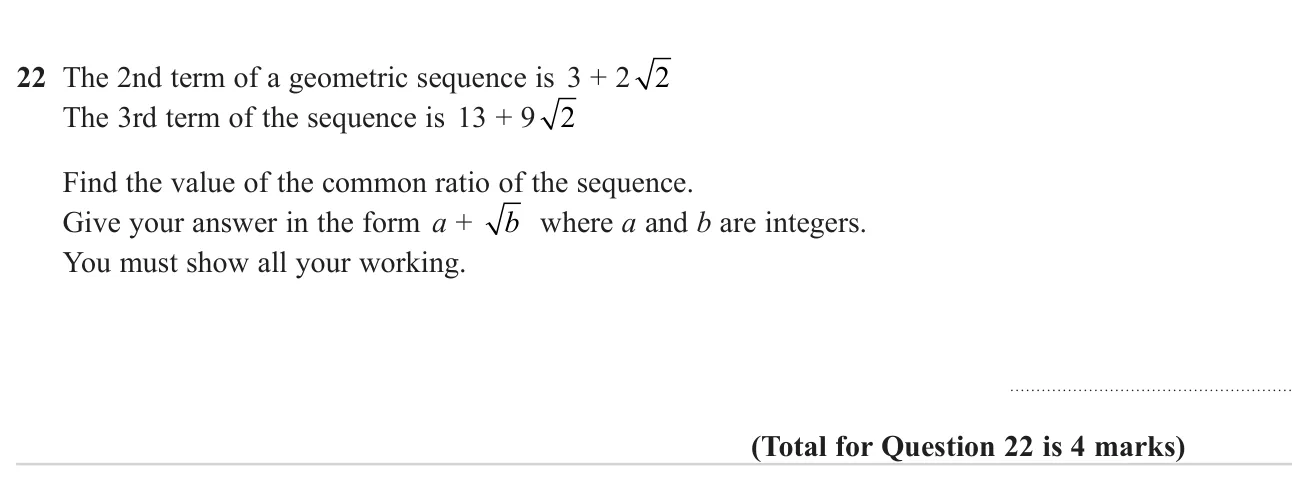
November 2022 · Paper 1 Higher · Q23: Find the next term of a geometric sequence with surds, then find the first term of another from its 4th and 6th terms.
November 2022 · Paper 1 Higher · Q24: Find the ratio of radius to height when a sphere and cone have equal volumes, then when a sphere's surface area equals a cone's total surface area.
June 2022 · Paper 1 Higher · Q18: Evaluate an expression with a negative fractional power of a mixed number, a mixed-number product and a negative power of 2.
June 2022 · Paper 1 Higher · Q21: Find the exact area of the two shaded regions formed inside the middle of three overlapping equal circles.
Specimen · Paper 1 Foundation · Q19: Find the cheapest combination of milk bottles to cover a week, then explain how using more milk would affect the cost.