Ratio, proportion and rates of change

Scale factors, scale diagrams and maps

14 past-paper questions, easiest first. Try each one, then reveal the answer.

Foundation & Higher12 of 14 from Foundation papers

Revision guide by The Full Marks

Scale factors, scale diagrams and maps: what you need to know

Scale drawings and maps shrink real objects by a fixed amount so they fit on paper. You need to go both ways: from the drawing to real life and back, getting the units right.

Key facts

  • A scale of 1:25 0001 : 25\,000 means 11 cm on the map is 25 00025\,000 cm in real life.
  • A scale like '1 cm to 4 m' already includes a unit change.
  • Real length == map length ×\times scale factor; map length == real length ÷\div scale factor.
  • No scale given? Find it from a length you know: scale factor == real length ÷\div drawing length.
  • Areas scale by the scale factor squared: with 11 cm to 44 m, 1 cm21\text{ cm}^2 is 16 m216\text{ m}^2.

Map or drawing to real life

  1. Measure the length on the map carefully in cm.
  2. Multiply by the scale number.
  3. Convert to sensible units: divide by 100 for m, then by 1000 for km (or by 100 000100\,000 from cm to km).

Real life to drawing

  1. Put the real length in the same unit as the scale.
  2. Divide by the scale number.
  3. Draw with a sharp pencil and ruler; drawn lengths are usually marked to within about 2 mm.

Worked examples

Example 1 Foundation · grade 3

A map has a scale of 1:25 0001 : 25\,000. Two villages are 6.46.4 cm apart on the map. How far apart are they in real life, in km?

Show the solution

6.4×25 000=160 0006.4 \times 25\,000 = 160\,000 cm
160 000÷100=1600160\,000 \div 100 = 1600 m
1600÷1000=1.61600 \div 1000 = 1.6 km

Example 2 Foundation · grade 5

Ella makes a scale drawing of a rectangular garden using 11 cm to 44 m. The garden is 2626 m by 1818 m. (a) What size is the drawing? (b) The drawing's area is 29.25 cm229.25\text{ cm}^2. Use it to find the real area.

Show the solution

(a) 26÷4=6.526 \div 4 = 6.5 cm and 18÷4=4.518 \div 4 = 4.5 cm
(b) 11 cm2^2 represents 4×4=16 m24 \times 4 = 16\text{ m}^2
29.25×16=468 m229.25 \times 16 = 468\text{ m}^2 (check: 26×18=46826 \times 18 = 468)

Common mistakes

  • Multiplying when you should divide (or the other way round). Real things are bigger than drawings.
  • Not converting first: with a scale of 1:301 : 30, a real length of 3.63.6 m must become 360360 cm before you divide, giving 1212 cm.
  • Dividing by 1000 to go from cm to km. It's 100 000100\,000.
  • Scaling an area by the length factor instead of its square.
  • Measuring the wrong length on the drawing, e.g. a height when the known length is a width. Use the matching length to find the scale.

Exam tips

  • Write units with every answer; a map answer without km or m can lose the final mark.
  • If you have to measure, show the length you measured so the examiner can follow your method.

Questions people ask

What does a map scale of 1:50 000 mean?

Every 1 cm on the map is 50 000 cm, which is 500 m, in real life. So 2 cm on the map is 1 km.

How do you use a scale drawing to find a real length?

Measure the length on the drawing, then multiply by the scale factor and convert to sensible units.

Exam questions: Scale factors, scale diagrams and maps (14, easiest first)

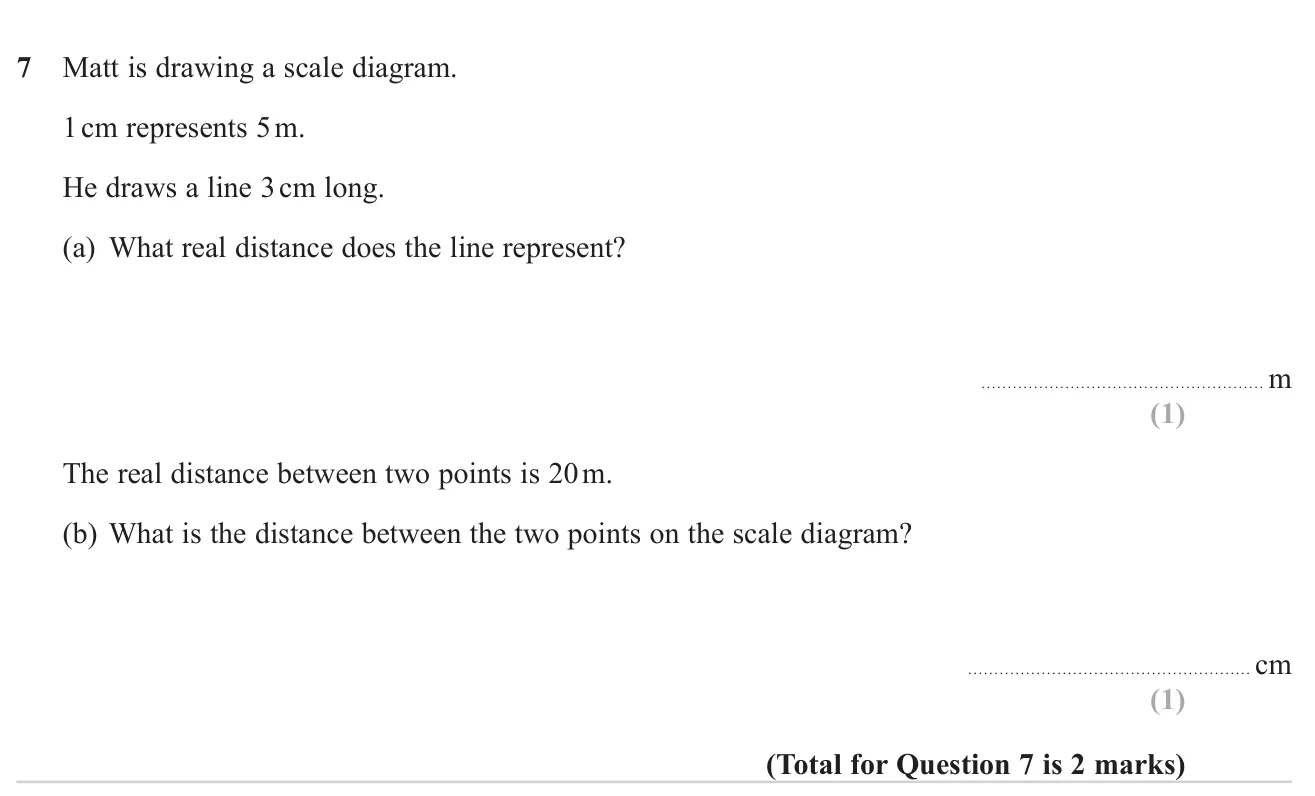
Scale factors, scale diagrams and maps2 marksGrade 2No calculatorFoundation
November 2023 · Paper 1 Foundation · Q7
Use a map scale to change a drawn length to a real distance and back again.

© Pearson Education Ltd. November 2023 Paper 1 (Foundation, non-calculator), question 7.

Show answer
(a)15 m1 mark
(b)4 cm1 mark

Worked solution Checked against the mark scheme

(a) Each cm is 5 m, so 3×5=153 \times 5 = 15 m.

(b) 20÷5=420 \div 5 = 4 cm.

Watch out: Multiplying in (b) to get 100 cm.

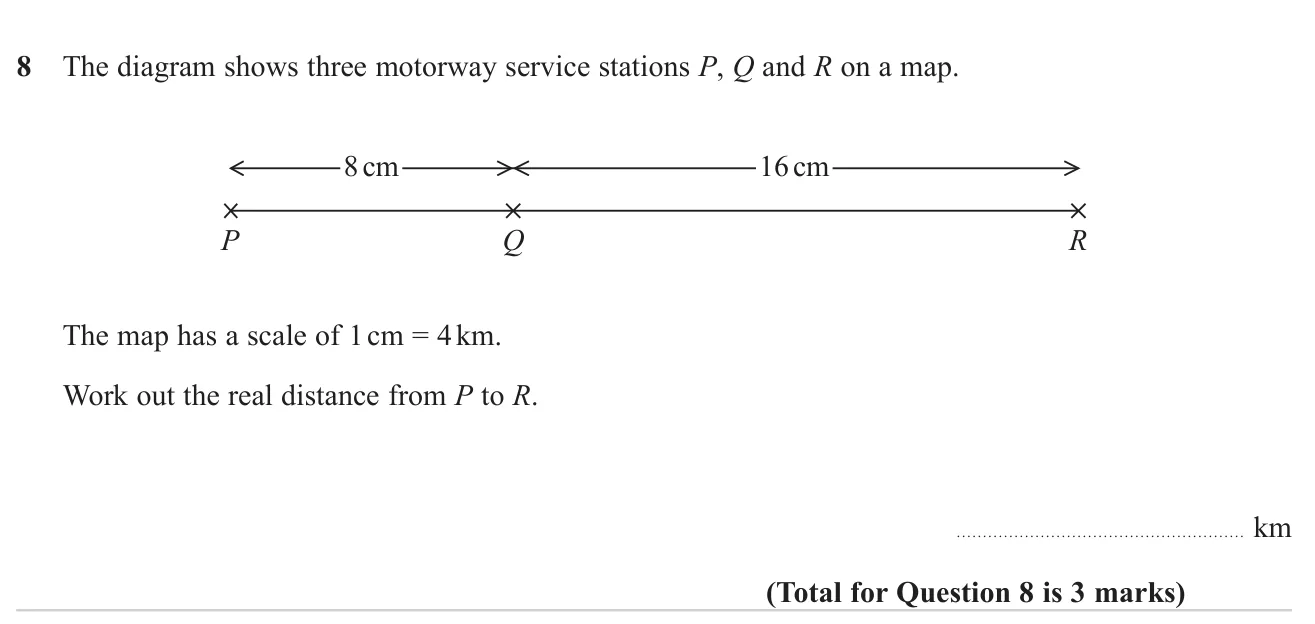
Scale factors, scale diagrams and maps3 marksGrade 2CalculatorFoundation
June 2023 · Paper 2 Foundation · Q8
Use a map scale to find the real distance of a journey made of two measured legs.

© Pearson Education Ltd. June 2023 Paper 2 (Foundation, calculator), question 8.

Show answer
Answer96 km3 marks

Worked solution Checked against the mark scheme

Total map distance: 8+16=248 + 16 = 24 cm

Each cm is 4 km: 24×4=9624 \times 4 = 96 km

Watch out: Only converting one leg of the journey, e.g. 16×4=6416 \times 4 = 64.

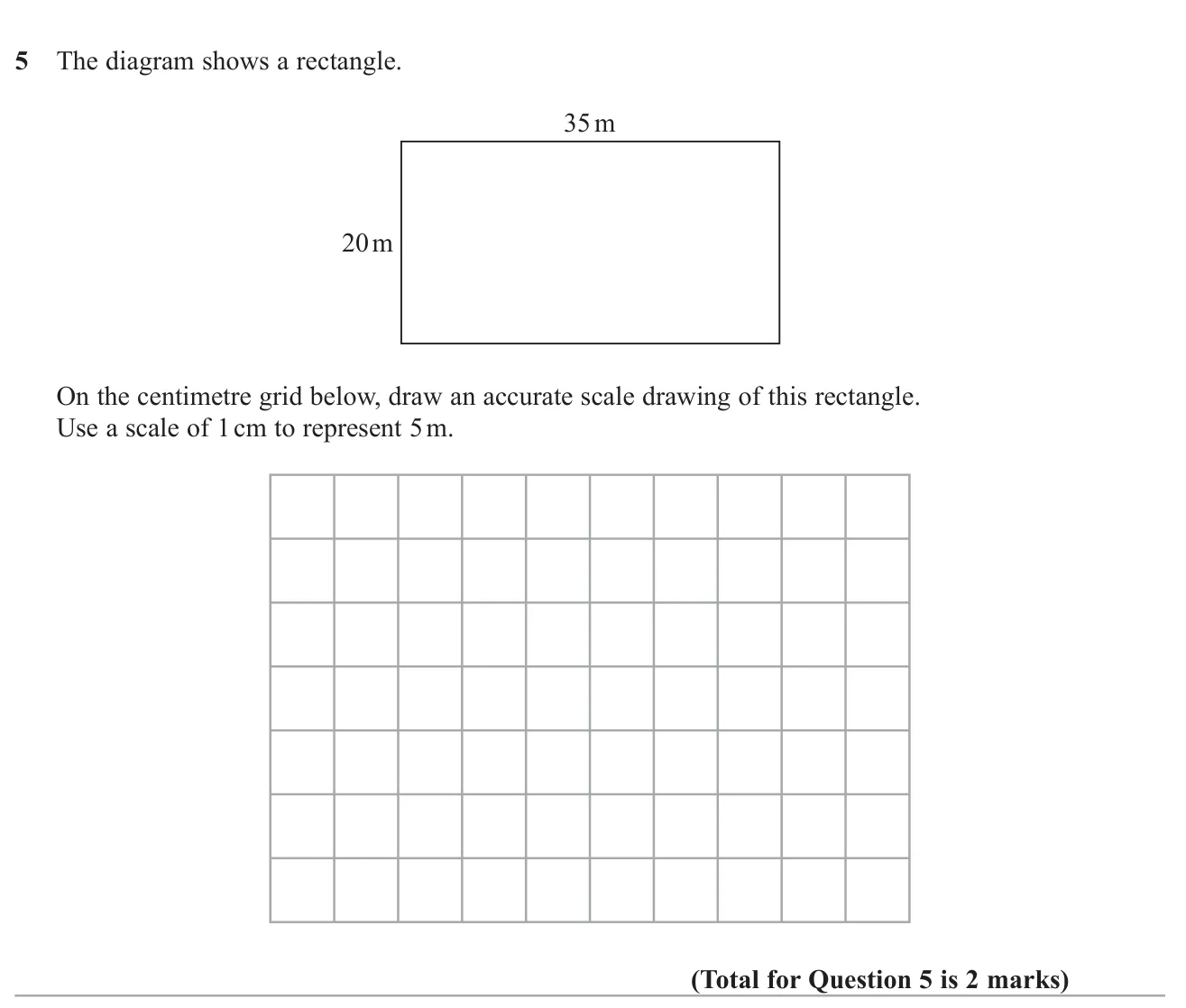
Scale factors, scale diagrams and maps2 marksGrade 2CalculatorFoundation
November 2021 · Paper 2 Foundation · Q5
Make a scale drawing of a rectangle using a given scale.

© Pearson Education Ltd. November 2021 Paper 2 (Foundation, calculator), question 5.

Show answer
AnswerA rectangle 7 cm by 4 cm drawn on the grid2 marks

Worked solution Checked against the mark scheme

Each 5 m becomes 1 cm.

35÷5=735 \div 5 = 7 cm and 20÷5=420 \div 5 = 4 cm.

Draw a rectangle 7 cm long and 4 cm wide.

Watch out: Multiplying by 5 instead of dividing.

Scale factors, scale diagrams and maps4 marksGrade 2CalculatorFoundation
June 2024 · Paper 3 Foundation · Q6
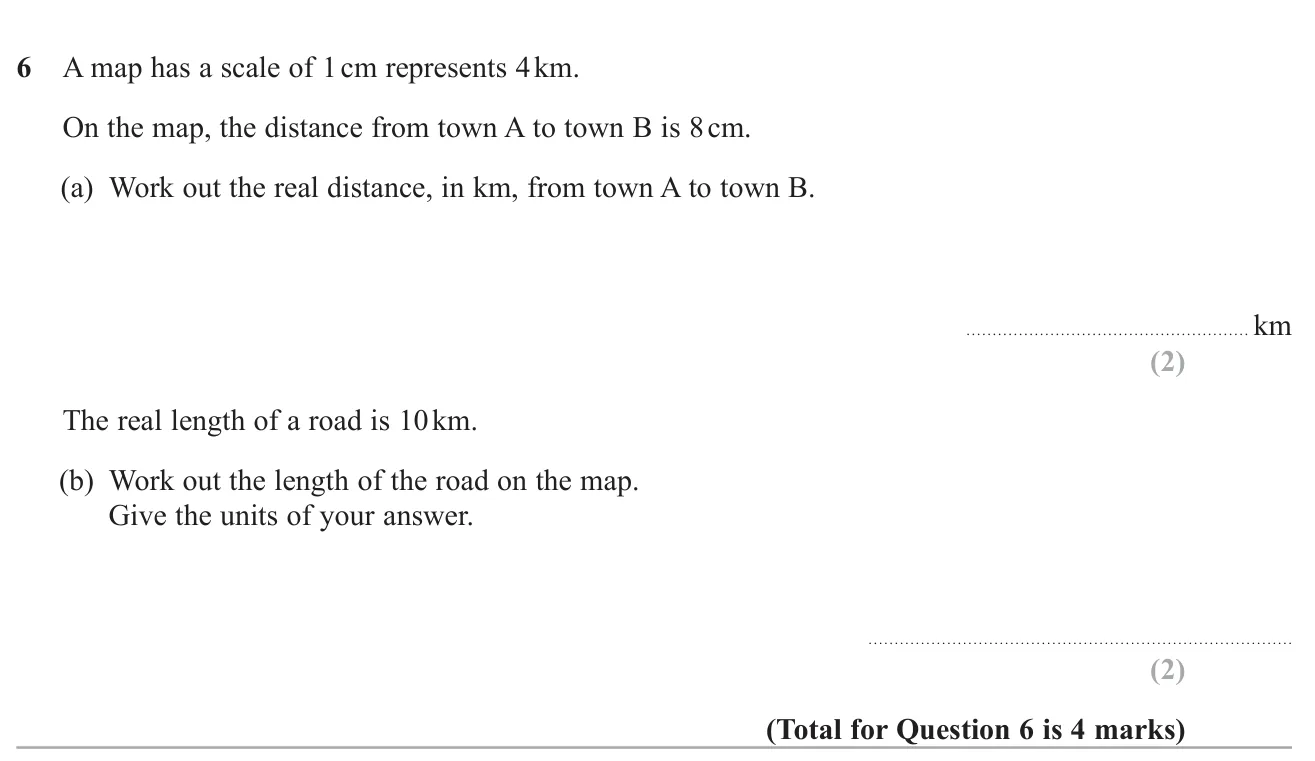
Use a map scale to find a real distance and a map length.

© Pearson Education Ltd. June 2024 Paper 3 (Foundation, calculator), question 6.

Show answer
(a)3232 km2 marks
(b)2.52.5 cm (or 25 mm)2 marks

Worked solution Checked against the mark scheme

(a) Each 1 cm is 4 km, so 8×4=328 \times 4 = 32 km.

(b) 10÷4=2.510 \div 4 = 2.5, so the road is 2.52.5 cm long on the map.

Watch out: Leaving off the units in (b), which loses the accuracy mark.

Scale factors, scale diagrams and maps3 marksGrade 3CalculatorFoundation
June 2022 · Paper 2 Foundation · Q16
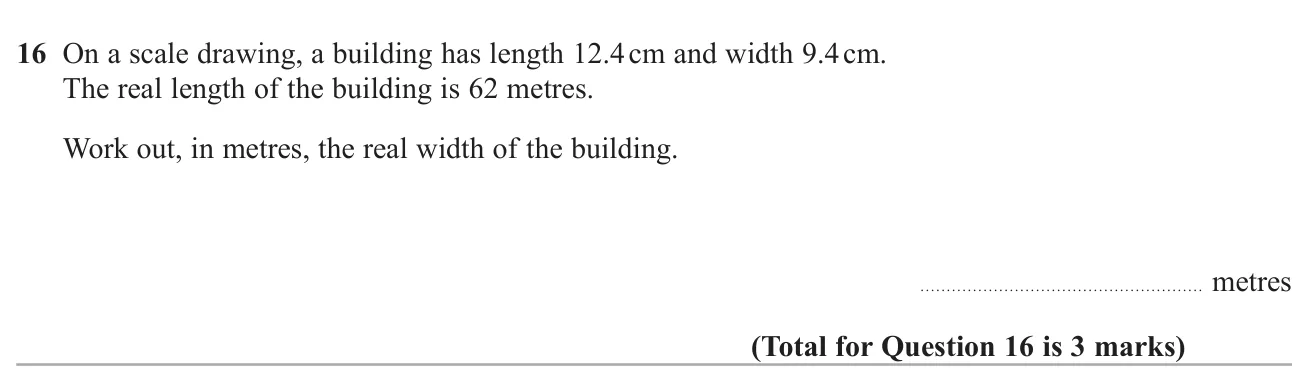
Use a scale drawing to find the real width of a building from its real length.

© Pearson Education Ltd. June 2022 Paper 2 (Foundation, calculator), question 16.

Show answer
Answer47 metres3 marks

Worked solution Checked against the mark scheme

Scale: 62÷12.4=562 \div 12.4 = 5, so 1 cm on the drawing is 5 m in real life.

Real width: 9.4×5=479.4 \times 5 = 47 m.

Watch out: Mixing units, e.g. treating 62 m as 62 cm with the wrong scale factor.

Scale factors, scale diagrams and maps4 marksGrade 3CalculatorFoundation
November 2021 · Paper 3 Foundation · Q12
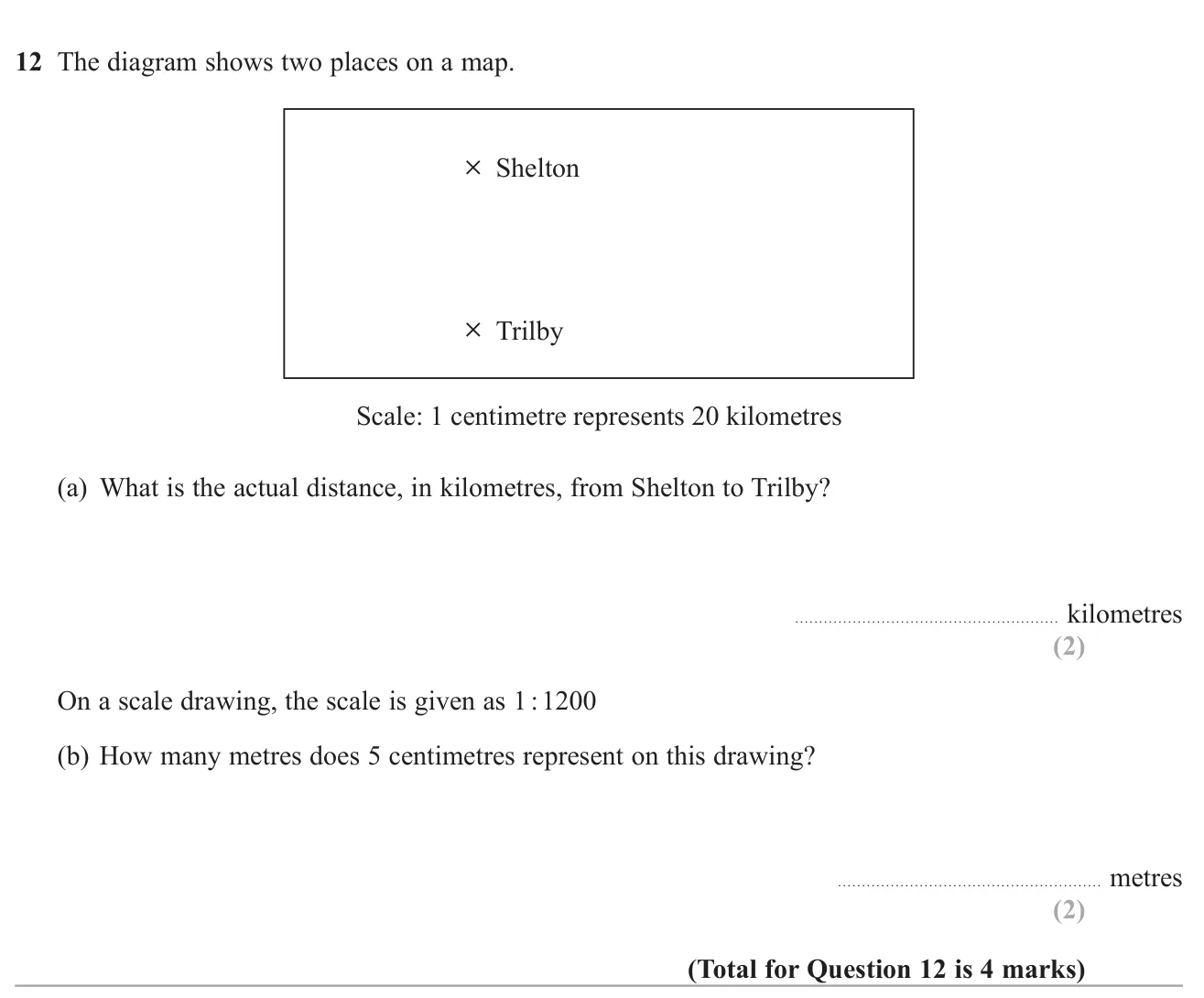
Measure a map distance and use a scale to find the real distance, then use a ratio scale to convert a drawing length to metres.

© Pearson Education Ltd. November 2021 Paper 3 (Foundation, calculator), question 12.

Show answer
(a)50 km2 marks
(b)60 m2 marks

Worked solution Checked against the mark scheme

(a) Measure the distance on the map: about 2.5 cm.

2.5×20=502.5 \times 20 = 50 km

(b) 5×1200=60005 \times 1200 = 6000 cm on the ground.

6000÷100=606000 \div 100 = 60 m

Watch out: In (b), giving 6000 without converting centimetres to metres.

Scale factors, scale diagrams and maps2 marksGrade 3CalculatorFoundation
June 2019 · Paper 3 Foundation · Q17
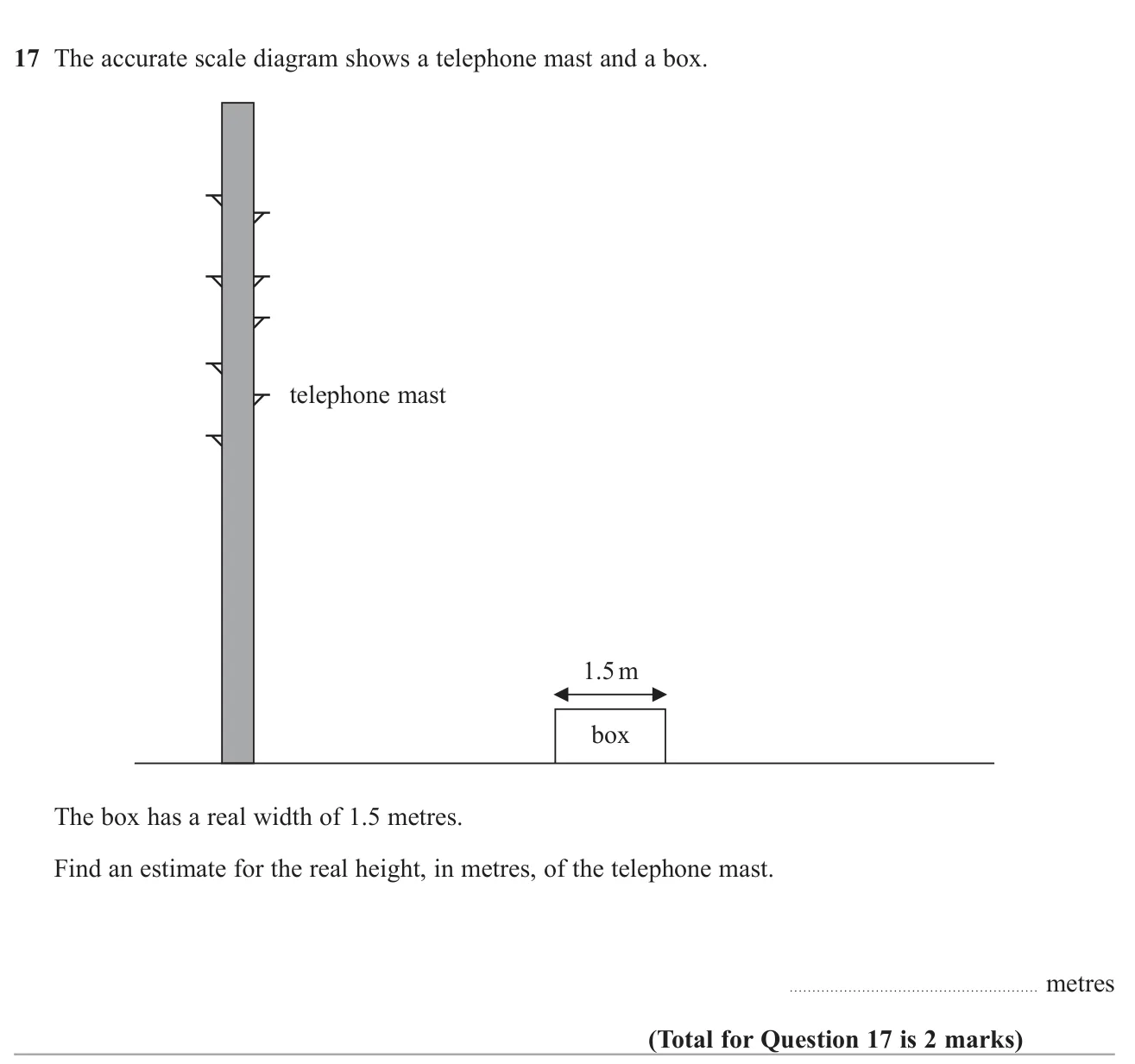
Use a scale drawing to estimate the real height of a mast from a box of known width.

© Pearson Education Ltd. June 2019 Paper 3 (Foundation, calculator), question 17.

Show answer
Answer9 (accept 8 to 10)2 marks

Worked solution Checked against the mark scheme

Measure: the box is about 1.8 cm wide and the mast about 10.8 cm tall.

The mast is about 10.8÷1.8=610.8 \div 1.8 = 6 times the box width.

Height ≈6×1.5=9\approx 6 \times 1.5 = 9 m

Watch out: Measuring the box's height instead of its width.

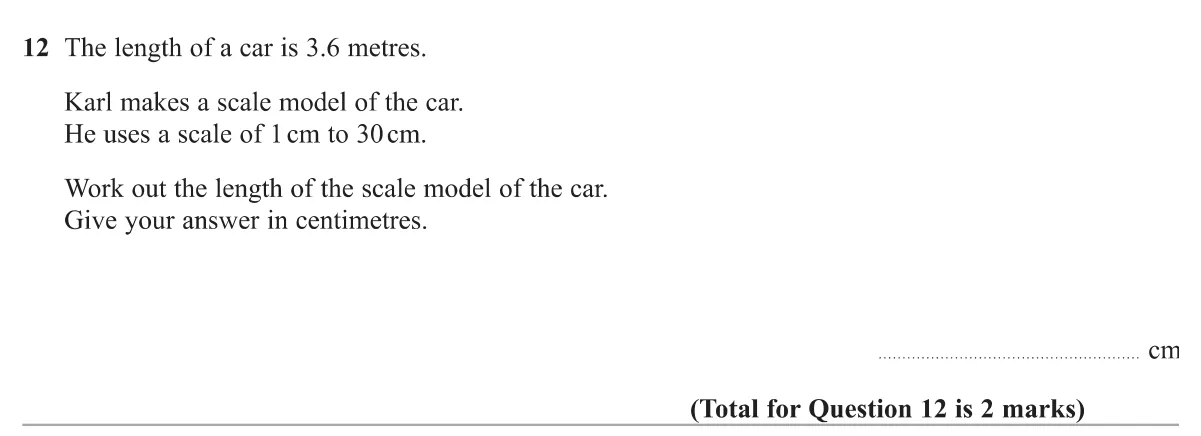
Scale factors, scale diagrams and maps2 marksGrade 3CalculatorFoundation
Specimen · Paper 2 Foundation · Q12
Use a model scale to find a model's length in centimetres from a length in metres.

© Pearson Education Ltd. Specimen Paper 2 (Foundation, calculator), question 12.

Show answer
Answer12 cm2 marks

Worked solution Checked against the mark scheme

3.63.6 m =360= 360 cm

360÷30=12360 \div 30 = 12 cm

Watch out: Dividing 3.6 by 30 and getting 0.12.

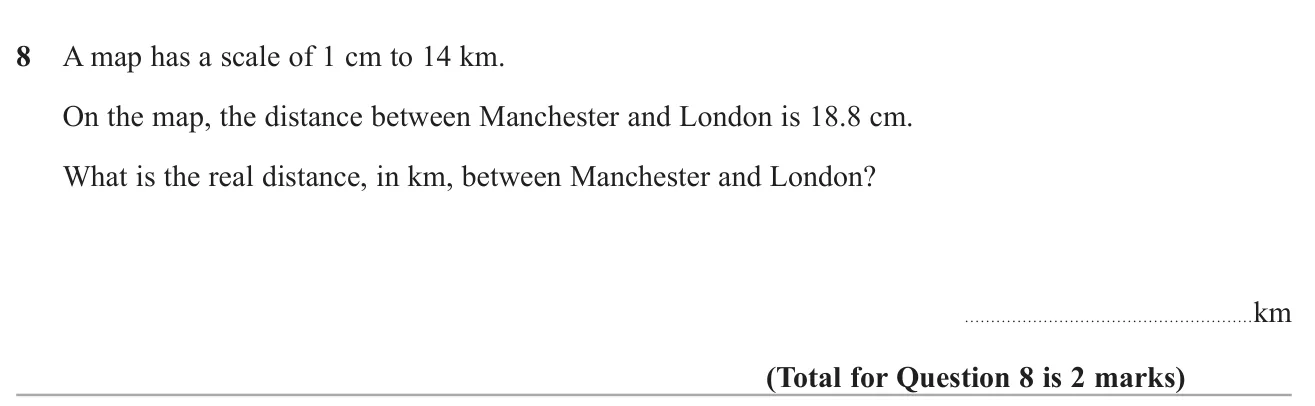
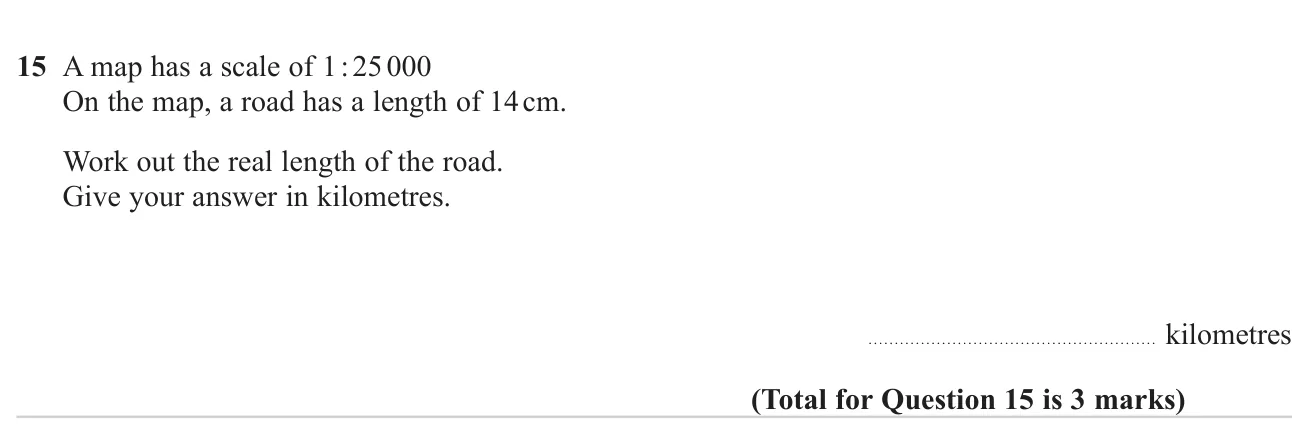
Scale factors, scale diagrams and maps3 marksGrade 4CalculatorFoundation
November 2024 · Paper 2 Foundation · Q15
Use a map scale to find a real length in kilometres.

© Pearson Education Ltd. November 2024 Paper 2 (Foundation, calculator), question 15.

Show answer
Answer3.53 marks

Worked solution Checked against the mark scheme

Real length =14×25 000=350 000= 14 \times 25\,000 = 350\,000 cm.

There are 100 000100\,000 cm in 1 km, so 350 000÷100 000=3.5350\,000 \div 100\,000 = 3.5 km.

Watch out: Dividing by 1000 as if converting metres to kilometres.

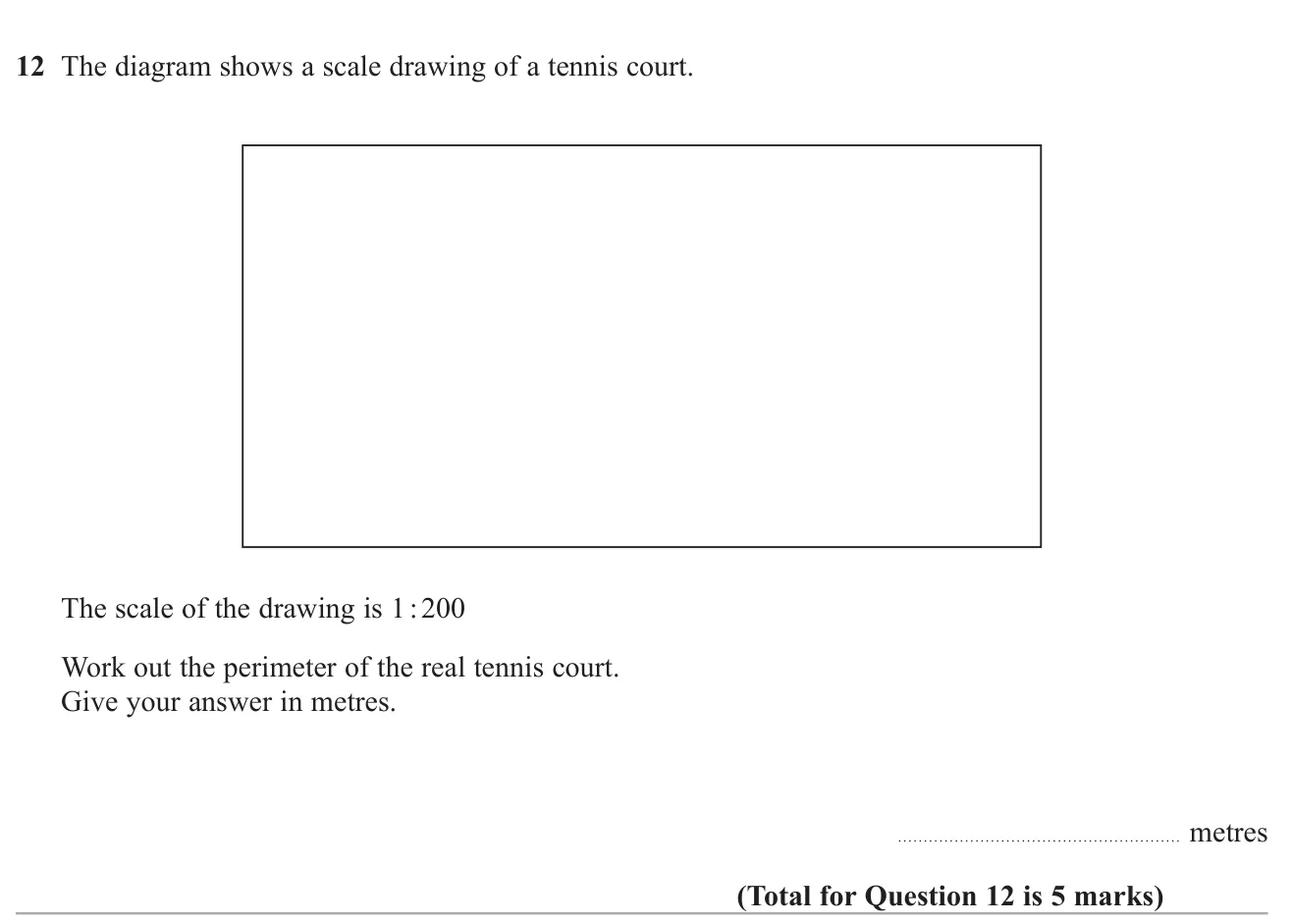
Scale factors, scale diagrams and maps5 marksGrade 4CalculatorFoundation
June 2018 · Paper 3 Foundation · Q12
Measure a scale drawing, use a 1 : 200 scale, and find the real perimeter in metres.

© Pearson Education Ltd. June 2018 Paper 3 (Foundation, calculator), question 12.

Show answer
Answer69.269.2 m (accept 67.6 to 70.8)5 marks

Worked solution Checked against the mark scheme

Measure the drawing: length about 11.5 cm, width about 5.8 cm.

Real length: 11.5×200=230011.5 \times 200 = 2300 cm =23= 23 m.

Real width: 5.8×200=11605.8 \times 200 = 1160 cm =11.6= 11.6 m.

Perimeter: 2×23+2×11.6=69.22 \times 23 + 2 \times 11.6 = 69.2 m.

Watch out: Forgetting to convert from centimetres to metres.

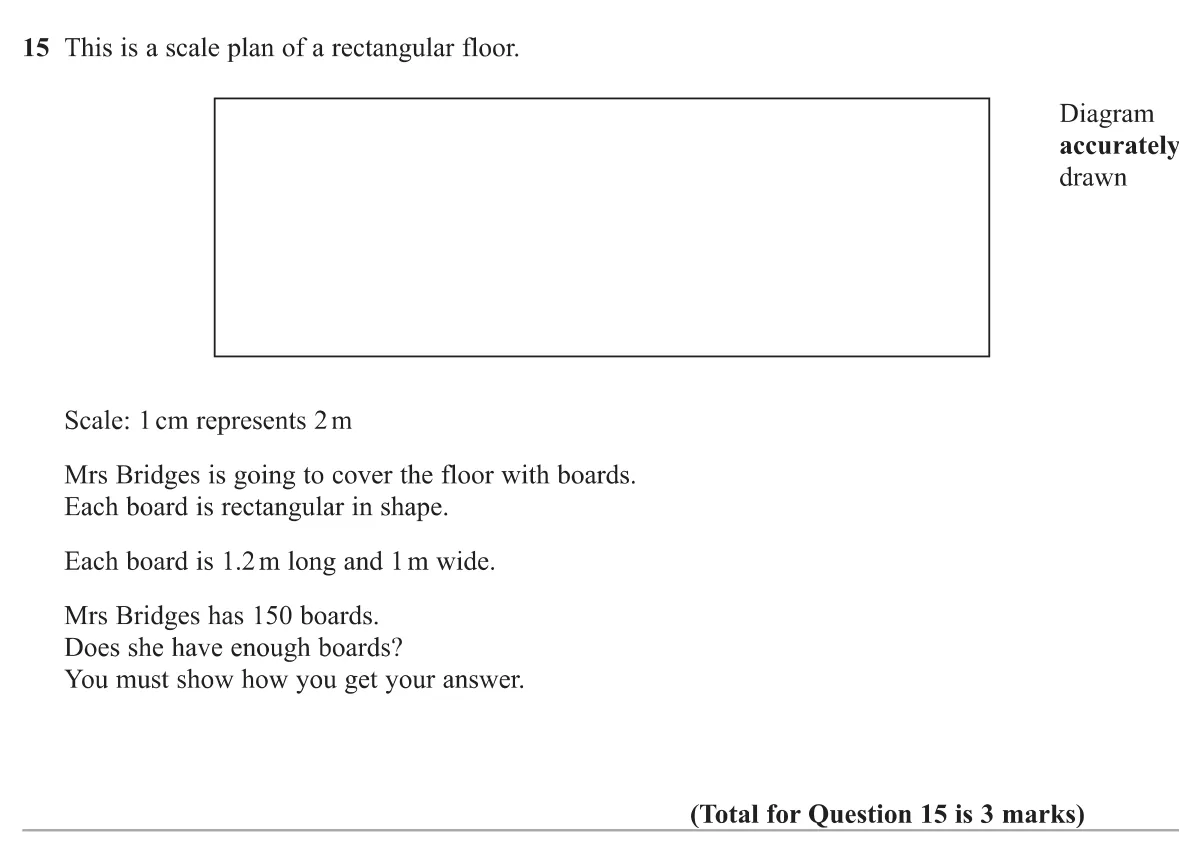
Scale factors, scale diagrams and maps3 marksGrade 4No calculatorFoundation
Specimen · Paper 1 Foundation · Q15
Use a scale plan to find the real size of a floor and decide whether 150 boards are enough to cover it.

© Pearson Education Ltd. Specimen Paper 1 (Foundation, non-calculator), question 15.

Show answer
AnswerNo: the floor is 24 m by 8 m, so 160 boards are needed3 marks

Worked solution Checked against the mark scheme

Measure the plan: about 12 cm by 4 cm.

Scale 1 cm : 2 m, so the floor is 2424 m by 88 m.

Area =24×8=192= 24 \times 8 = 192 m². Each board covers 1.2×1=1.21.2 \times 1 = 1.2 m².

192÷1.2=160192 \div 1.2 = 160 boards are needed (2020 along ×\times 88 across), which is more than 150. So she does not have enough.

Watch out: Forgetting to apply the scale to both lengths, or dividing by the scale instead of multiplying.

Scale factors, scale diagrams and maps3 marksGrade 6CalculatorHigher
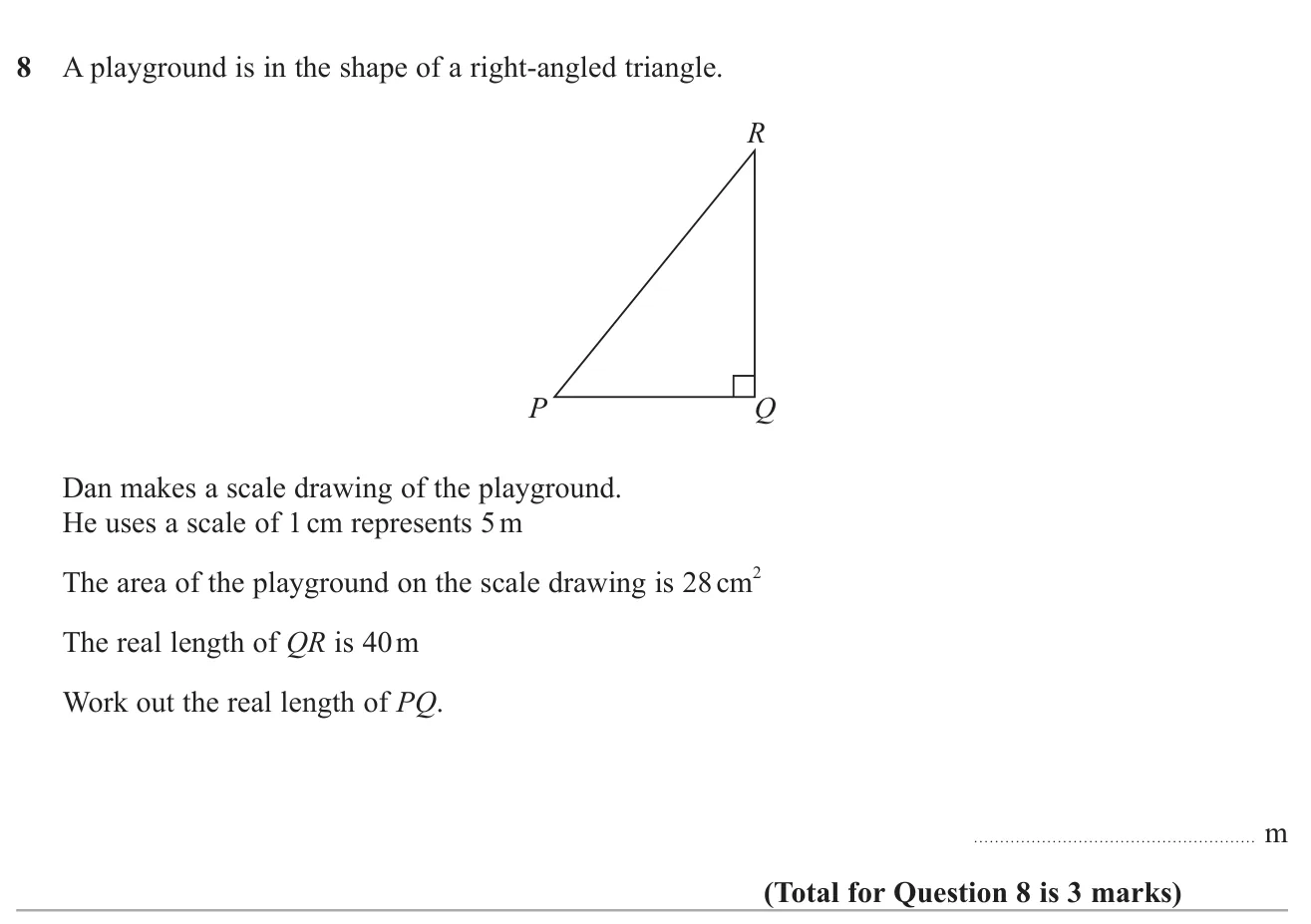
June 2024 · Paper 2 Higher · Q8
Use a scale drawing's area and one real side of a right-angled triangle to find another real side.

© Pearson Education Ltd. June 2024 Paper 2 (Higher, calculator), question 8.

Show answer
Answer3535 m3 marks

Worked solution Checked against the mark scheme

On the drawing, QR=40÷5=8QR = 40 \div 5 = 8 cm.

Area =12×PQ×8=28= \frac12 \times PQ \times 8 = 28, so PQ=7PQ = 7 cm on the drawing.

Real length =7×5=35= 7 \times 5 = 35 m.

Watch out: Scaling the area by 5 instead of 52=255^2 = 25 when converting between real and drawing areas.

Scale factors, scale diagrams and maps3 marksGrade 6CalculatorHigher
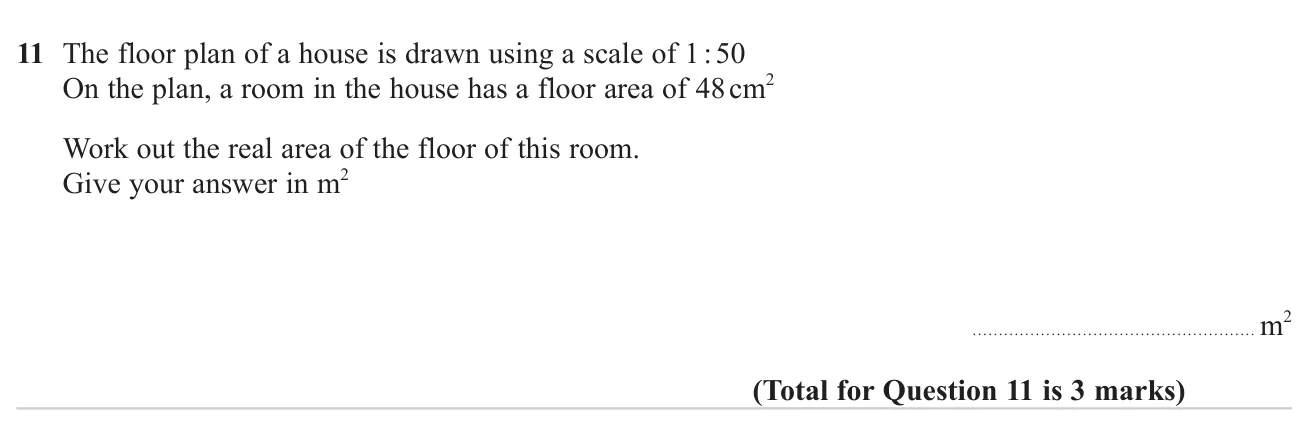
November 2023 · Paper 3 Higher · Q11
Use a scale to convert an area on a plan into a real area in square metres.

© Pearson Education Ltd. November 2023 Paper 3 (Higher, calculator), question 11.

Show answer
Answer12123 marks

Worked solution Checked against the mark scheme

Length scale factor 50, so area scale factor 502=250050^2 = 2500.

Real area =48×2500=120 000 cm2= 48 \times 2500 = 120\,000\text{ cm}^2

1 m2=10 000 cm21\text{ m}^2 = 10\,000\text{ cm}^2, so 120 000÷10 000=12 m2120\,000 \div 10\,000 = 12\text{ m}^2

Watch out: Multiplying by 50 instead of 50², or dividing by 100 instead of 10 000 to convert to square metres.

Also tested in these questions

Their main topic is different, but part of each one tests this topic.