Algebra

Solving quadratics

9 past-paper questions, easiest first. Try each one, then reveal the answer.

Foundation & Higher2 of 9 from Foundation papers

Revision guide by The Full Marks

Solving quadratics: what you need to know

A quadratic equation has an x2x^2 term and usually two solutions. Factorising is the quickest method; at Higher you also need the quadratic formula and completing the square for ones that won't factorise.

Foundation solves by factorising (with x2x^2 on its own) and from graphs; the quadratic formula, completing the square and harder factorising are Higher.

Key facts

  • Always rearrange to ax2+bx+c=0ax^2 + bx + c = 0 first.
  • If two brackets multiply to 0, one of them must be 0.
  • Higher: quadratic formula x=−b±b2−4ac2ax = \frac{-b \pm \sqrt{b^2 - 4ac}}{2a}.
  • Higher: completing the square: x2+bx+c=(x+b2)2−(b2)2+cx^2 + bx + c = (x + \frac{b}{2})^2 - (\frac{b}{2})^2 + c.
  • On a graph, the solutions are where the curve crosses the xx-axis.

Solving by factorising

  1. Rearrange so one side is 0.
  2. Find two numbers that multiply to cc and add to bb (when a=1a = 1).
  3. Write the brackets and set each one equal to 0.

Higher: harder factorising and completing the square

  1. When a≠1a \ne 1, e.g. 2x2−3x−5=02x^2 - 3x - 5 = 0: find two numbers that multiply to ac=−10ac = -10 and add to b=−3b = -3 (−5-5 and 22). Split the middle term and factorise in pairs: (2x−5)(x+1)=0(2x - 5)(x + 1) = 0, so x=2.5x = 2.5 or x=−1x = -1.
  2. Completing the square: write it as (x+p)2=q(x + p)^2 = q, then square root both sides, remembering ±\pm. E.g. x2+6x−2=0x^2 + 6x - 2 = 0 gives (x+3)2=11(x + 3)^2 = 11, so x=−3±11x = -3 \pm \sqrt{11}.

Higher: using the quadratic formula

  1. Write down aa, bb and cc, including their signs.
  2. Substitute into the formula, putting negatives in brackets.
  3. Work out both answers (the ++ and the −-) and round as asked.

Worked examples

Example 1 Foundation · grade 5

Solve x2+2x−15=0x^2 + 2x - 15 = 0.

Show the solution

Two numbers that multiply to −15-15 and add to 22: 55 and −3-3.
(x+5)(x−3)=0(x + 5)(x - 3) = 0
x+5=0x + 5 = 0 or x−3=0x - 3 = 0
x=−5x = -5 or x=3x = 3

Example 2 Higher · grade 7

Solve 2x2−5x−4=02x^2 - 5x - 4 = 0. Give your answers to 2 decimal places.

Show the solution

a=2a = 2, b=−5b = -5, c=−4c = -4
x=5±(−5)2−4(2)(−4)2(2)=5±574x = \frac{5 \pm \sqrt{(-5)^2 - 4(2)(-4)}}{2(2)} = \frac{5 \pm \sqrt{57}}{4}
x=5+7.5498…4=3.14x = \frac{5 + 7.5498\ldots}{4} = 3.14
x=5−7.5498…4=−0.64x = \frac{5 - 7.5498\ldots}{4} = -0.64

Common mistakes

  • Getting the signs the wrong way round: (x+5)(x−3)=0(x + 5)(x - 3) = 0 gives x=−5x = -5 and 33, not 55 and −3-3.
  • Trying to factorise before rearranging to equal 0.
  • Forgetting that −4ac-4ac with a negative cc becomes positive, or dividing only part of the top by 2a2a.
  • Dividing both sides of x2=5xx^2 = 5x by xx, which loses the solution x=0x = 0. Rearrange to x2−5x=0x^2 - 5x = 0 and factorise: x(x−5)=0x(x - 5) = 0.

Exam tips

  • Write the formula with your numbers substituted before using a calculator: that line usually earns a method mark.
  • In context questions, reject a negative solution if it can't be a length, and say why.

Questions people ask

How do you solve a quadratic equation?

Rearrange it to equal 0, then factorise into two brackets and set each to 0. If it won't factorise, use the quadratic formula.

When should I use the quadratic formula?

When the question asks for answers to decimal places or significant figures, that's a strong hint it won't factorise, so use the formula.

Exam questions: Solving quadratics (9, easiest first)

Solving quadratics3 marksGrade 5No calculatorFoundation
November 2024 · Paper 1 Foundation · Q26
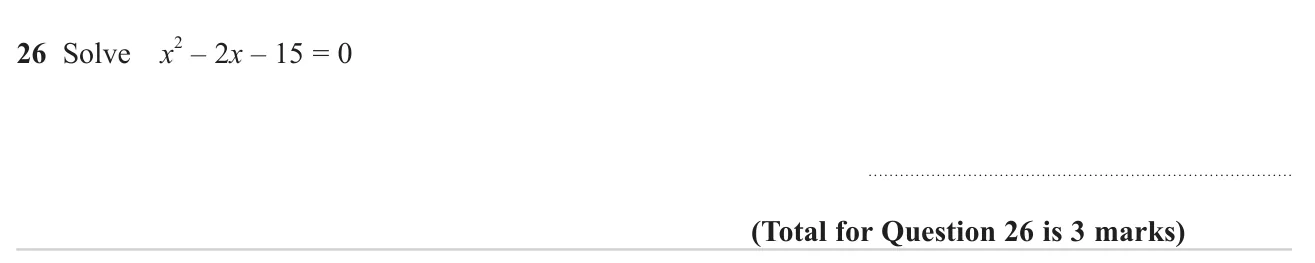
Solve a quadratic equation by factorising.

© Pearson Education Ltd. November 2024 Paper 1 (Foundation, non-calculator), question 26.

Show answer
Answerx=5x = 5, x=−3x = -33 marks

Worked solution Checked against the mark scheme

Find two numbers that multiply to −15-15 and add to −2-2: −5-5 and 33.

(x−5)(x+3)=0(x - 5)(x + 3) = 0

x=5x = 5 or x=−3x = -3

Watch out: Getting the signs the wrong way round: x = −5 and x = 3.
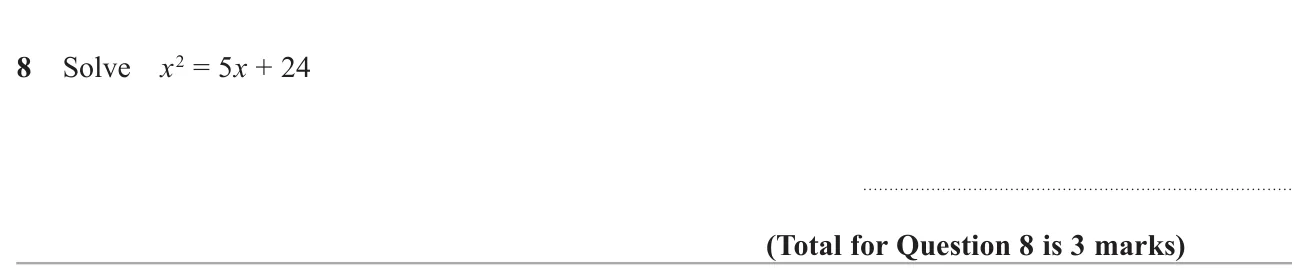
Solving quadratics3 marksGrade 5No calculatorHigher
November 2021 · Paper 1 Higher · Q8
Rearrange a quadratic equation to equal zero and solve it by factorising.

© Pearson Education Ltd. November 2021 Paper 1 (Higher, non-calculator), question 8.

Show answer
Answerx=8x = 8 or x=−3x = -33 marks

Worked solution Checked against the mark scheme

x2−5x−24=0x^2 - 5x - 24 = 0

Find two numbers that multiply to −24-24 and add to −5-5: −8-8 and 33

(x−8)(x+3)=0(x - 8)(x + 3) = 0

x=8x = 8 or x=−3x = -3

Watch out: Getting the signs the wrong way round and writing −8-8 and 3.

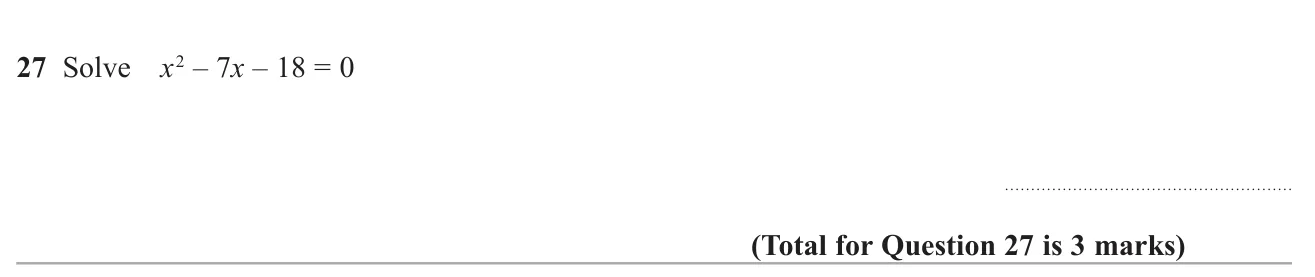
Solving quadratics3 marksGrade 5CalculatorFoundation
November 2021 · Paper 2 Foundation · Q27
Solve a quadratic equation by factorising.

© Pearson Education Ltd. November 2021 Paper 2 (Foundation, calculator), question 27.

Show answer
Answerx=−2x = -2 or x=9x = 93 marks

Worked solution Checked against the mark scheme

Find two numbers that multiply to −18-18 and add to −7-7: +2+2 and −9-9.

(x+2)(x−9)=0(x + 2)(x - 9) = 0

x=−2x = -2 or x=9x = 9

Watch out: Getting the signs the wrong way round: x=2x = 2 and x=−9x = -9.

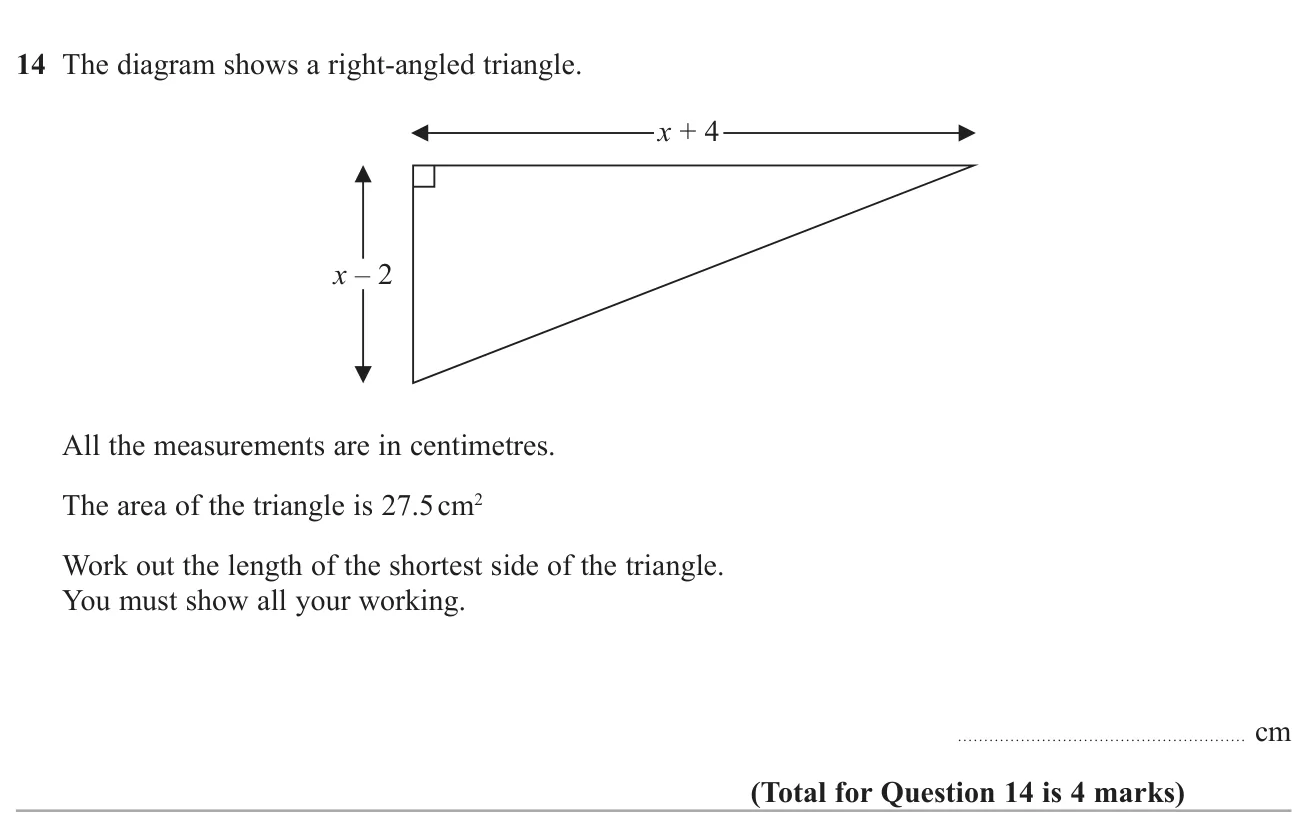
Solving quadratics4 marksGrade 6No calculatorHigher
November 2019 · Paper 1 Higher · Q14
Form and solve a quadratic from the area of a right-angled triangle to find its shortest side.

© Pearson Education Ltd. November 2019 Paper 1 (Higher, non-calculator), question 14.

Show answer
Answer55 cm4 marks

Worked solution Checked against the mark scheme

12(x+4)(x−2)=27.5\frac{1}{2}(x+4)(x-2) = 27.5

(x+4)(x−2)=55⇒x2+2x−8=55(x+4)(x-2) = 55 \Rightarrow x^2 + 2x - 8 = 55

x2+2x−63=0⇒(x+9)(x−7)=0x^2 + 2x - 63 = 0 \Rightarrow (x+9)(x-7) = 0

Lengths are positive, so x=7x = 7

Shortest side =x−2=5= x - 2 = 5 cm

Watch out: Giving x = 7 as the answer instead of the side length.

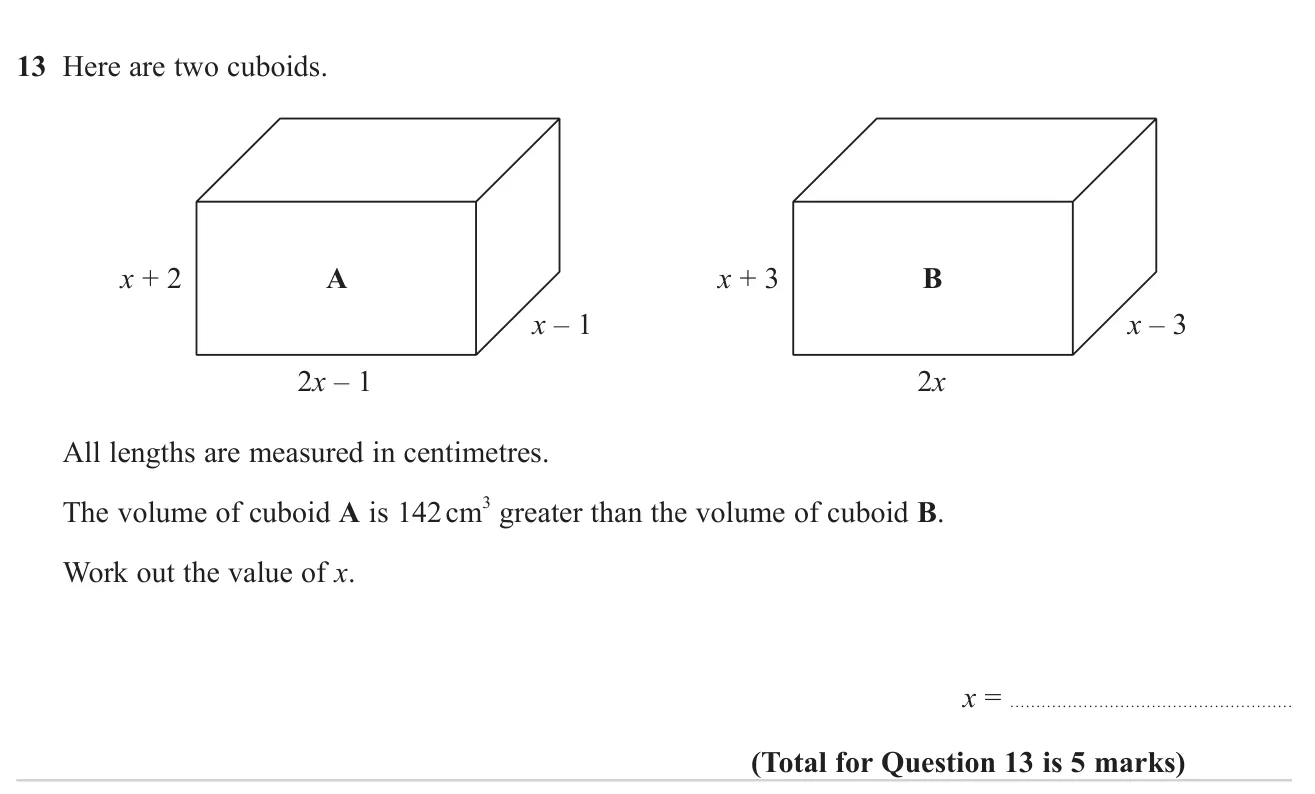
Solving quadratics5 marksGrade 7No calculatorHigher
November 2024 · Paper 1 Higher · Q13
Form and solve an equation from the difference in volume of two cuboids with algebraic side lengths.

© Pearson Education Ltd. November 2024 Paper 1 (Higher, non-calculator), question 13.

Show answer
Answerx=7x = 75 marks

Worked solution Checked against the mark scheme

Volume A =(x+2)(2x−1)(x−1)=2x3+x2−5x+2= (x + 2)(2x - 1)(x - 1) = 2x^3 + x^2 - 5x + 2

Volume B =2x(x+3)(x−3)=2x3−18x= 2x(x + 3)(x - 3) = 2x^3 - 18x

2x3+x2−5x+2=2x3−18x+1422x^3 + x^2 - 5x + 2 = 2x^3 - 18x + 142

x2+13x−140=0x^2 + 13x - 140 = 0, so (x+20)(x−7)=0(x + 20)(x - 7) = 0

Lengths must be positive, so x=7x = 7.

Watch out: Sign errors when expanding the triple product.

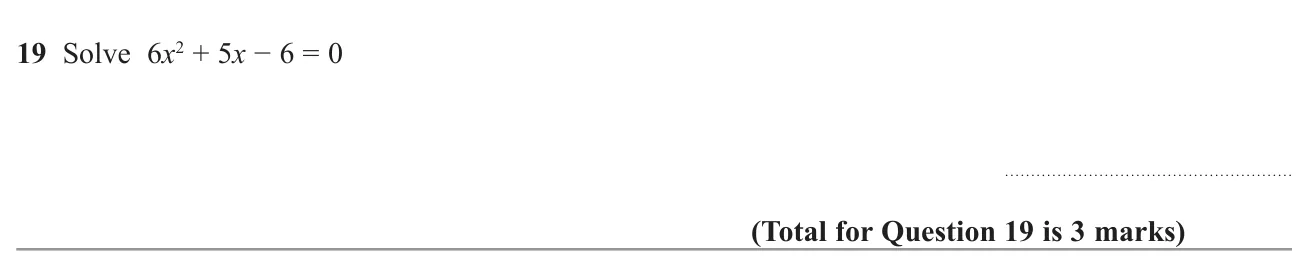
Solving quadratics3 marksGrade 7CalculatorHigher
November 2022 · Paper 2 Higher · Q19
Solve a quadratic equation whose leading coefficient is not 1.

© Pearson Education Ltd. November 2022 Paper 2 (Higher, calculator), question 19.

Show answer
Answerx=−32x = -\frac{3}{2} or x=23x = \frac{2}{3}3 marks

Worked solution Checked against the mark scheme

Factorise: 6x2+5x−6=(2x+3)(3x−2)6x^2 + 5x - 6 = (2x + 3)(3x - 2)

2x+3=0⇒x=−322x + 3 = 0 \Rightarrow x = -\frac{3}{2}

3x−2=0⇒x=233x - 2 = 0 \Rightarrow x = \frac{2}{3}

Watch out: Sign errors when solving each bracket, e.g. giving 3/2 and −2/3.

Solving quadratics4 marksGrade 7No calculatorHigher
June 2019 · Paper 1 Higher · Q17
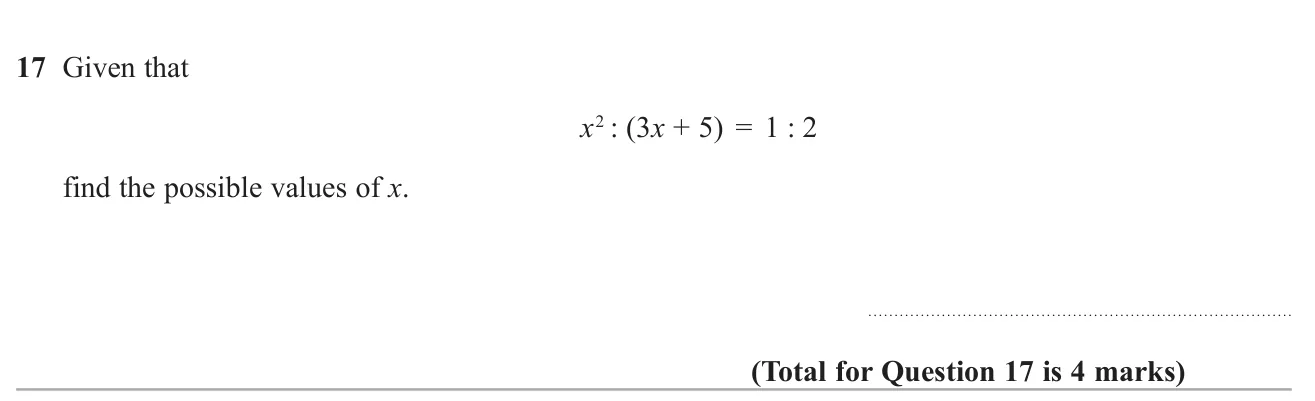
Turn a ratio of two algebraic expressions into a quadratic equation and solve it.

© Pearson Education Ltd. June 2019 Paper 1 (Higher, non-calculator), question 17.

Show answer
Answerx=−1x = -1 or x=2.5x = 2.54 marks

Worked solution Checked against the mark scheme

x23x+5=12\frac{x^2}{3x + 5} = \frac{1}{2}, so 2x2=3x+52x^2 = 3x + 5

2x2−3x−5=02x^2 - 3x - 5 = 0

(2x−5)(x+1)=0(2x - 5)(x + 1) = 0

x=2.5x = 2.5 or x=−1x = -1

Watch out: Cross-multiplying the wrong way to get x2=2(3x+5)x^2 = 2(3x + 5).

Solving quadratics5 marksGrade 8CalculatorHigher
June 2018 · Paper 3 Higher · Q19
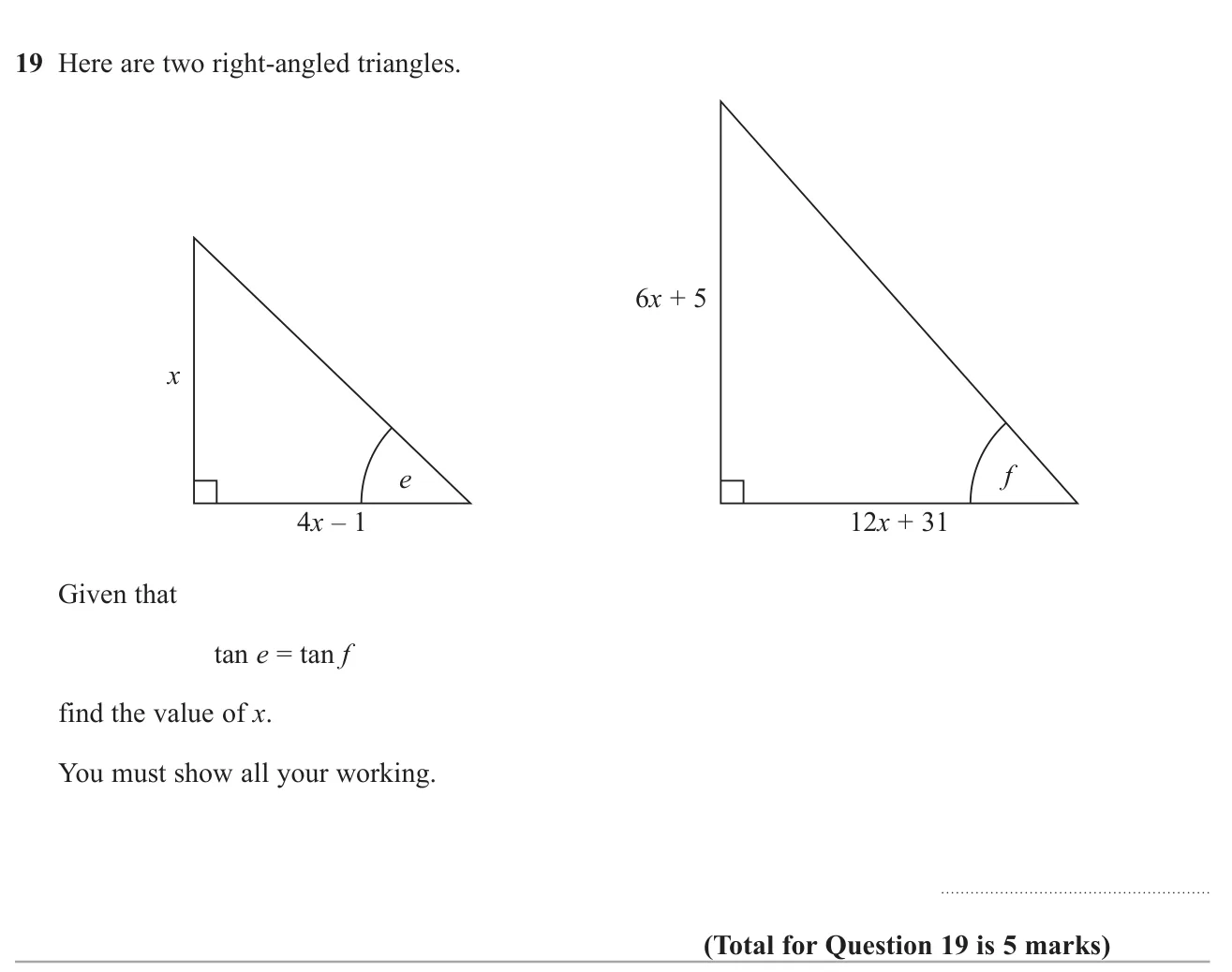
Set two tangent ratios equal to form and solve a quadratic equation for x.

© Pearson Education Ltd. June 2018 Paper 3 (Higher, calculator), question 19.

Show answer
Answerx=53x = \frac{5}{3}5 marks

Worked solution Checked against the mark scheme

tan⁡e=x4x−1\tan e = \frac{x}{4x-1} and tan⁡f=6x+512x+31\tan f = \frac{6x+5}{12x+31}

x(12x+31)=(6x+5)(4x−1)x(12x+31) = (6x+5)(4x-1)

12x2+31x=24x2+14x−512x^2 + 31x = 24x^2 + 14x - 5

12x2−17x−5=0⇒(3x−5)(4x+1)=012x^2 - 17x - 5 = 0 \Rightarrow (3x-5)(4x+1) = 0

x=53x = \frac{5}{3} (reject x=−14x = -\frac{1}{4}, since xx is a length)

Watch out: Giving both roots without rejecting the negative one.

Solving quadratics6 marksGrade 8CalculatorHigher
Specimen · Paper 2 Higher · Q19
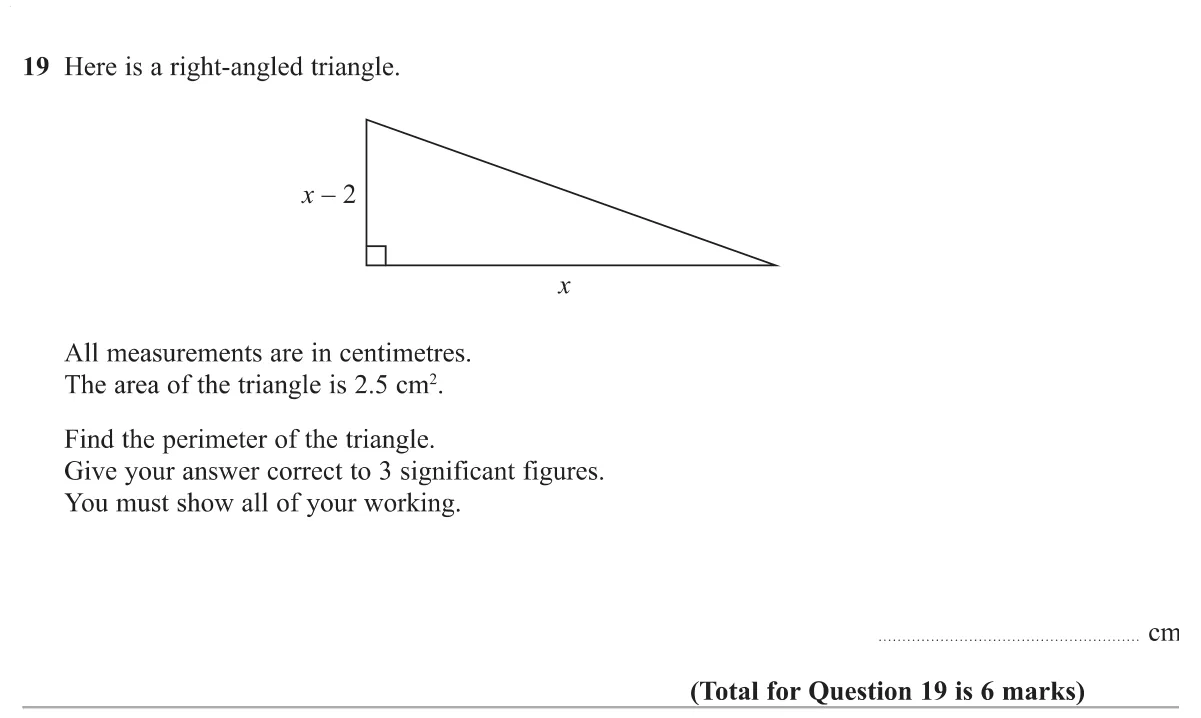
Form and solve a quadratic from the area of a right-angled triangle, then use Pythagoras to find its perimeter.

© Pearson Education Ltd. Specimen Paper 2 (Higher, calculator), question 19.

Show answer
Answer8.64 cm6 marks

Worked solution Checked against the mark scheme

12x(x−2)=2.5⇒x2−2x−5=0\frac{1}{2}x(x - 2) = 2.5 \Rightarrow x^2 - 2x - 5 = 0

x=2±4+202=1±6x = \frac{2 \pm \sqrt{4 + 20}}{2} = 1 \pm \sqrt{6}, so x=3.449x = 3.449 (positive)

Sides: 3.449 and 1.449

Hypotenuse =3.4492+1.4492=3.742= \sqrt{3.449^2 + 1.449^2} = 3.742

Perimeter =3.449+1.449+3.742=8.64= 3.449 + 1.449 + 3.742 = 8.64 cm

Watch out: Forgetting the ½ in the area of a triangle.

Also tested in these questions

Their main topic is different, but part of each one tests this topic.