Geometry and measures

Angles in polygons

11 past-paper questions, easiest first. Try each one, then reveal the answer.

Foundation & Higher9 of 11 from Foundation papers

Revision guide by The Full Marks

Angles in polygons: what you need to know

A polygon is a flat shape with straight sides. By splitting any polygon into triangles you can find the total of its interior angles, and for regular polygons you can find each angle. Both tiers see this, often mixed with other angle facts.

Key facts

  • Sum of interior angles =(n−2)×180∘= (n - 2) \times 180^\circ, where nn is the number of sides.
  • Exterior angles of any polygon add up to 360∘360^\circ.
  • Interior angle ++ exterior angle =180∘= 180^\circ.
  • Regular polygon: each exterior angle =360∘n= \frac{360^\circ}{n}, so n=360∘exterior anglen = \frac{360^\circ}{\text{exterior angle}}, and each interior angle =180∘−= 180^\circ - exterior angle.
  • Triangle 180∘180^\circ, quadrilateral 360∘360^\circ, pentagon 540∘540^\circ, hexagon 720∘720^\circ.

Missing angle in any polygon

  1. Count the sides and work out (n−2)×180(n - 2) \times 180.
  2. Add up the angles you know and subtract from the total.

Regular polygons

  1. Find the exterior angle: 360÷n360 \div n.
  2. Interior angle =180−= 180 - exterior angle.
  3. To find nn, always divide 360 by the exterior angle, not the interior one.

Worked examples

Example 1 Foundation · grade 3

A pentagon has angles 100∘100^\circ, 110∘110^\circ, 95∘95^\circ, 120∘120^\circ and xx. Find xx.

Show the solution

Sum of angles =(5−2)×180=540∘= (5 - 2) \times 180 = 540^\circ.
100+110+95+120=425100 + 110 + 95 + 120 = 425
x=540−425=115∘x = 540 - 425 = 115^\circ.

Example 2 Higher · grade 6

Each interior angle of a regular polygon is 4 times its exterior angle. How many sides does it have?

Show the solution

Let the exterior angle be ee. Then the interior angle is 4e4e.
e+4e=180e + 4e = 180, so 5e=1805e = 180 and e=36∘e = 36^\circ.
n=360÷36=10n = 360 \div 36 = 10.
The polygon has 10 sides (a decagon).

Common mistakes

  • Dividing 360 by the interior angle to find nn. Use the exterior angle.
  • Using the wrong angle sum: 180∘180^\circ for a quadrilateral or 360∘360^\circ for a pentagon. Work it out each time with (n−2)×180(n-2) \times 180.
  • Using the exterior angle (e.g. 72∘72^\circ for a regular pentagon) where the diagram needs the interior angle (108∘108^\circ).
  • Using the total angle sum as if it were one angle, or forgetting a right angle marked on the diagram.

Exam tips

  • Write the angle sum line, e.g. (6−2)×180=720(6 - 2) \times 180 = 720. It shows your method clearly, and method marks are given for correct working like this.
  • When two regular polygons meet at a point, find each interior angle first, then use the fact that angles around a point add up to 360∘360^\circ.
  • If a question says 'give a reason', write the fact in words, e.g. 'angles in a quadrilateral add up to 360∘360^\circ'.

Questions people ask

How do you find the interior angle of a regular polygon?

Divide 360 by the number of sides to get the exterior angle, then subtract that from 180. A regular octagon has exterior 45∘45^\circ and interior 135∘135^\circ.

What do the angles in a hexagon add up to?

(6−2)×180=720∘(6 - 2) \times 180 = 720^\circ. In a regular hexagon each angle is 120∘120^\circ.

Exam questions: Angles in polygons (11, easiest first)

Angles in polygons3 marksGrade 3CalculatorFoundation
November 2022 · Paper 3 Foundation · Q13
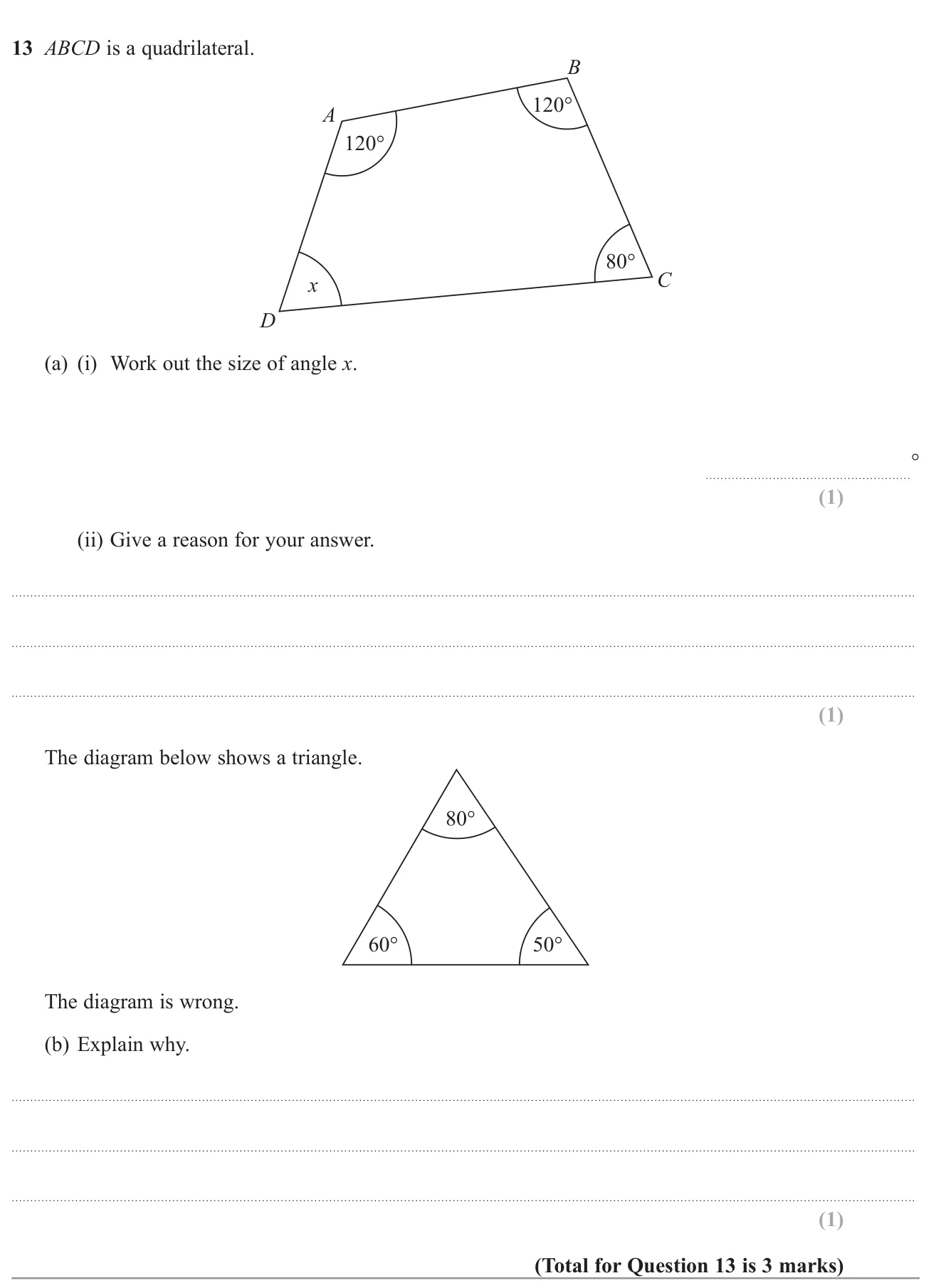
Find a missing angle in a quadrilateral with a reason, and explain why a triangle's labelled angles are impossible.

© Pearson Education Ltd. November 2022 Paper 3 (Foundation, calculator), question 13.

Show answer
(a(i))40°1 mark
(a(ii))Angles in a quadrilateral add up to 360°1 mark
(b)80+60+50=19080 + 60 + 50 = 190, but angles in a triangle add up to 180°1 mark

Worked solution Checked against the mark scheme

(a) x=360−120−120−80=40°x = 360 - 120 - 120 - 80 = 40° because the angles in a quadrilateral add up to 360°.

(b) 80+60+50=190°80 + 60 + 50 = 190°. Angles in a triangle must add up to 180°, so the diagram cannot be right.

Watch out: Using 180° for the quadrilateral.
Angles in polygons3 marksGrade 3CalculatorFoundation
November 2020 · Paper 3 Foundation · Q11
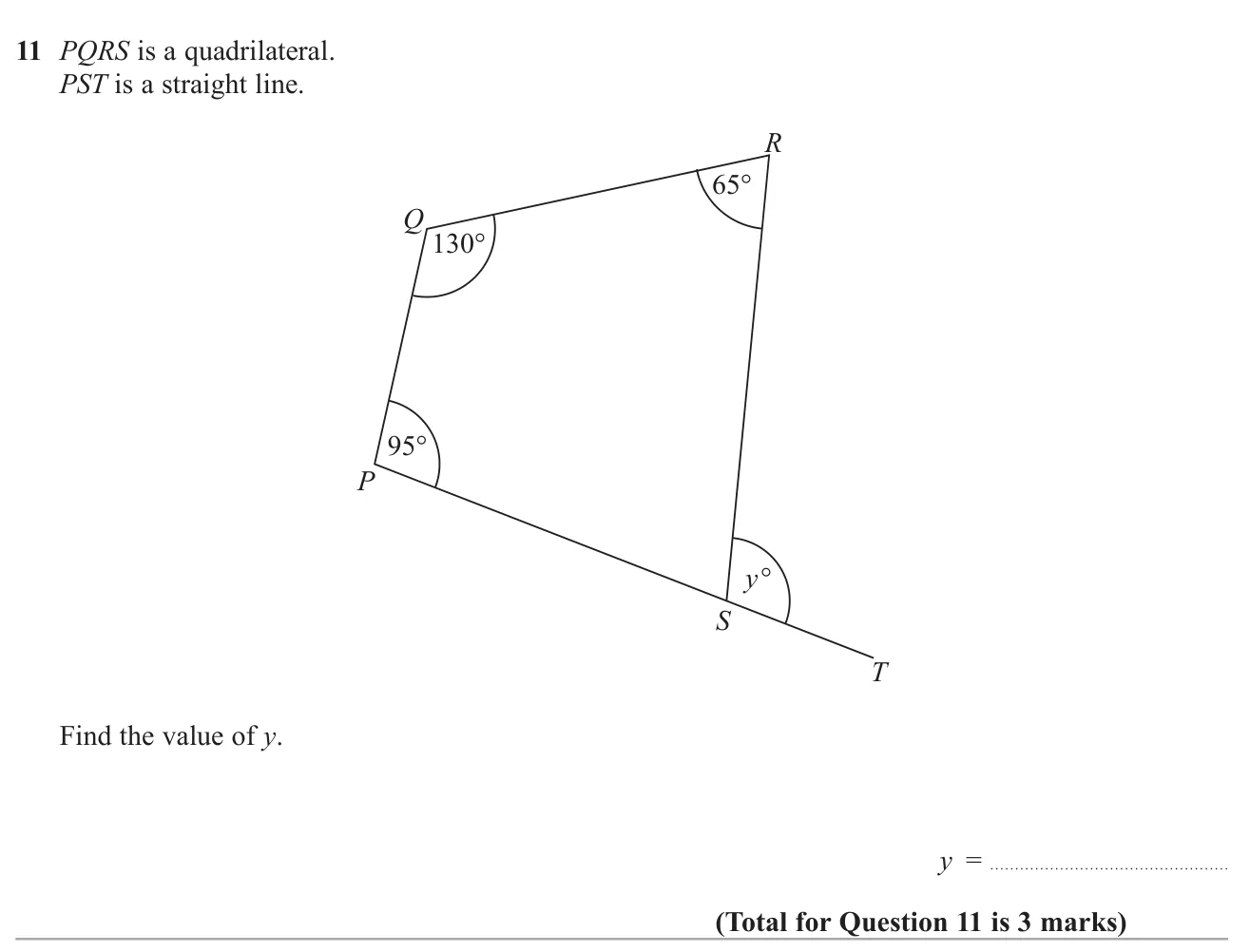
Use the angle sum of a quadrilateral and angles on a straight line to find an exterior angle.

© Pearson Education Ltd. November 2020 Paper 3 (Foundation, calculator), question 11.

Show answer
Answer1103 marks

Worked solution Checked against the mark scheme

Angles in a quadrilateral add to 360°360°:

360−130−95−65=70°360 - 130 - 95 - 65 = 70°

Angles on a straight line add to 180°180°:

y=180−70=110y = 180 - 70 = 110

Watch out: Stopping at 70, the interior angle.

Angles in polygons4 marksGrade 5No calculatorOn both tiers
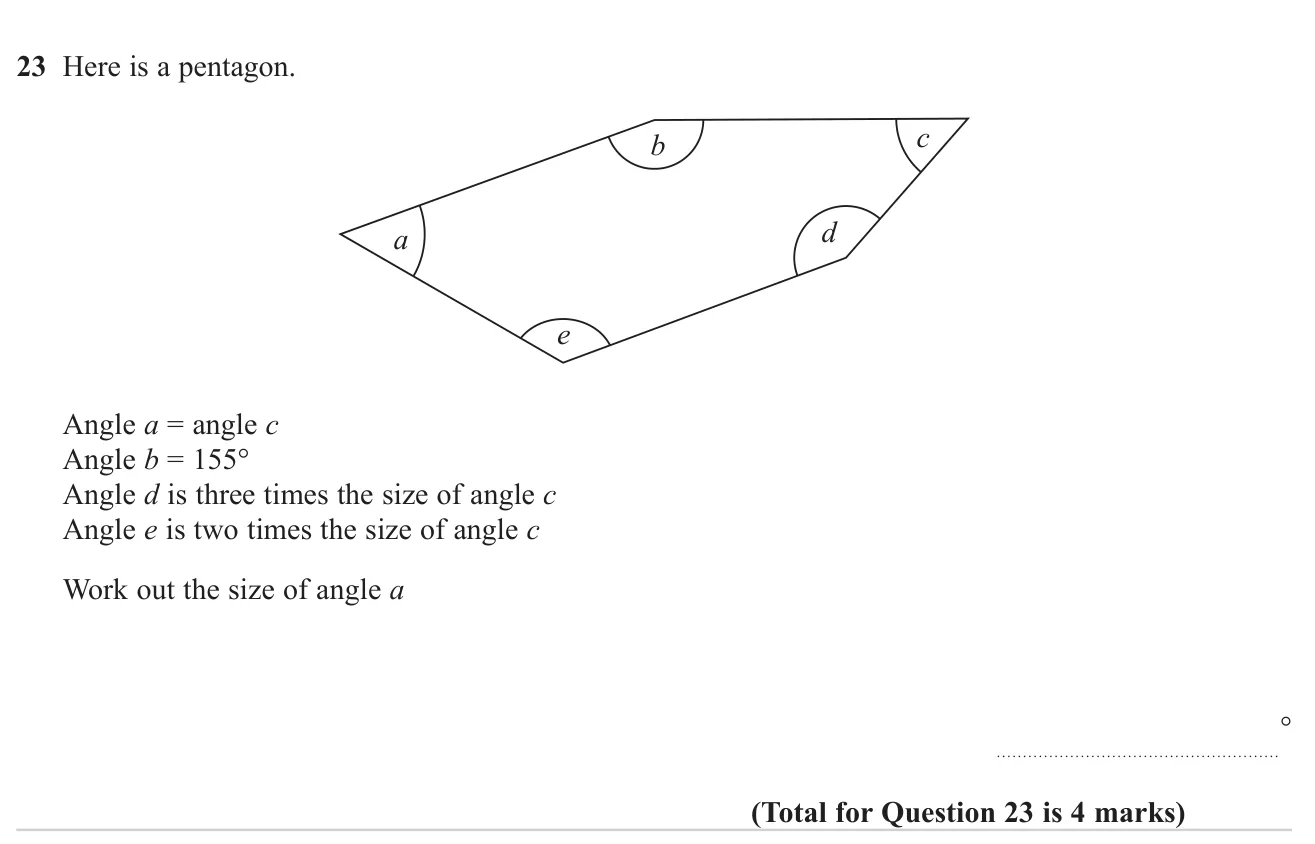
November 2024 · Paper 1 Foundation · Q23
Use the angle sum of a pentagon with angles given in terms of one unknown to find that angle.

© Pearson Education Ltd. November 2024 Paper 1 (Foundation, non-calculator), question 23.

Show answer
Answer55554 marks

Worked solution Checked against the mark scheme

Angle sum =(5−2)×180=540°= (5 - 2) \times 180 = 540°

c+155+c+3c+2c=540c + 155 + c + 3c + 2c = 540

7c=3857c = 385, so c=55c = 55

Angle a=55°a = 55°

Watch out: Using 360° as the angle sum.

Angles in polygons3 marksGrade 5CalculatorHigher
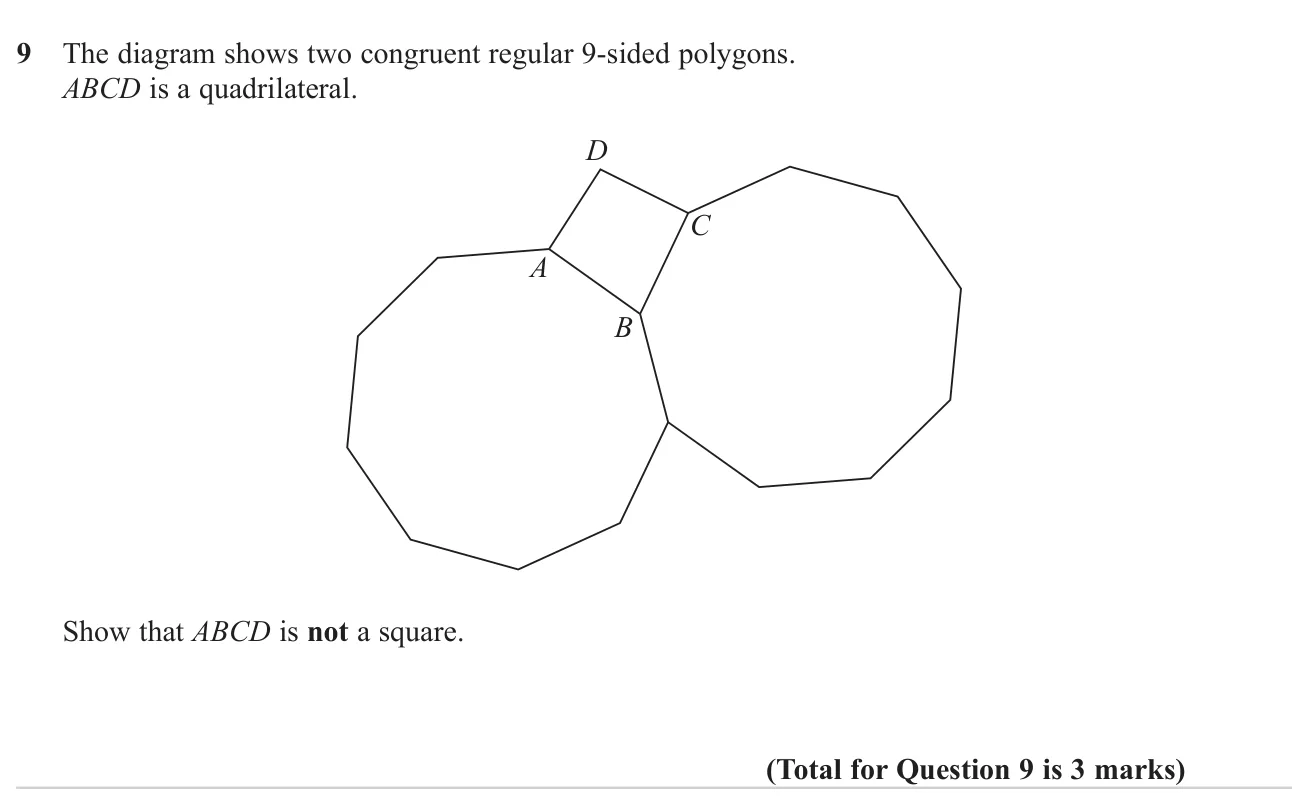
November 2024 · Paper 2 Higher · Q9
Use the angles of two regular nine-sided polygons to prove a quadrilateral between them is not a square.

© Pearson Education Ltd. November 2024 Paper 2 (Higher, calculator), question 9.

Show answer
AnswerAngle ABC=80°ABC = 80°, not 90°90°, so ABCD is not a square3 marks

Worked solution Checked against the mark scheme

Exterior angle =360÷9=40°= 360 \div 9 = 40°, so interior angle =140°= 140°.

Angles at point B add to 360°: 360−140−140=80°360 - 140 - 140 = 80°.

A square has all angles 90°, but angle ABC=80°ABC = 80°, so ABCD is not a square.

Watch out: Using the angle sum of the nonagon (1260°) as if it were one angle.

Angles in polygons4 marksGrade 5No calculatorHigher
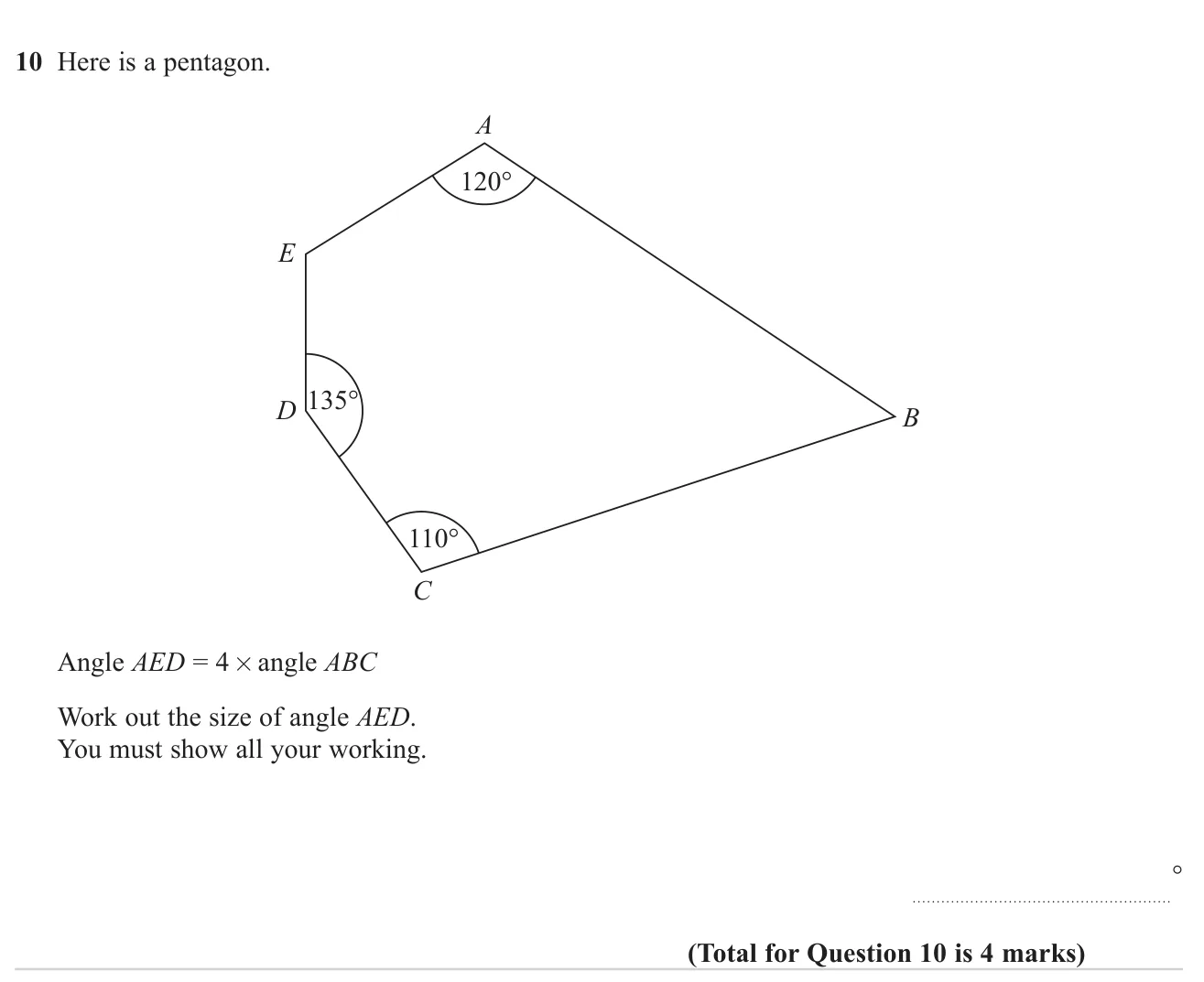
June 2023 · Paper 1 Higher · Q10
Use the angle sum of a pentagon and a given multiple between two unknown angles to find one of them.

© Pearson Education Ltd. June 2023 Paper 1 (Higher, non-calculator), question 10.

Show answer
Answer140∘140^\circ4 marks

Worked solution Checked against the mark scheme

Angles in a pentagon add to (5−2)×180=540∘(5 - 2) \times 180 = 540^\circ

The two unknown angles total 540−120−135−110=175∘540 - 120 - 135 - 110 = 175^\circ

Let angle ABC=xABC = x, so angle AED=4xAED = 4x. Then 5x=1755x = 175, so x=35x = 35

Angle AED=4×35=140∘AED = 4 \times 35 = 140^\circ

Watch out: Using 360° as the angle sum of a pentagon.

Angles in polygons3 marksGrade 5No calculatorOn both tiers
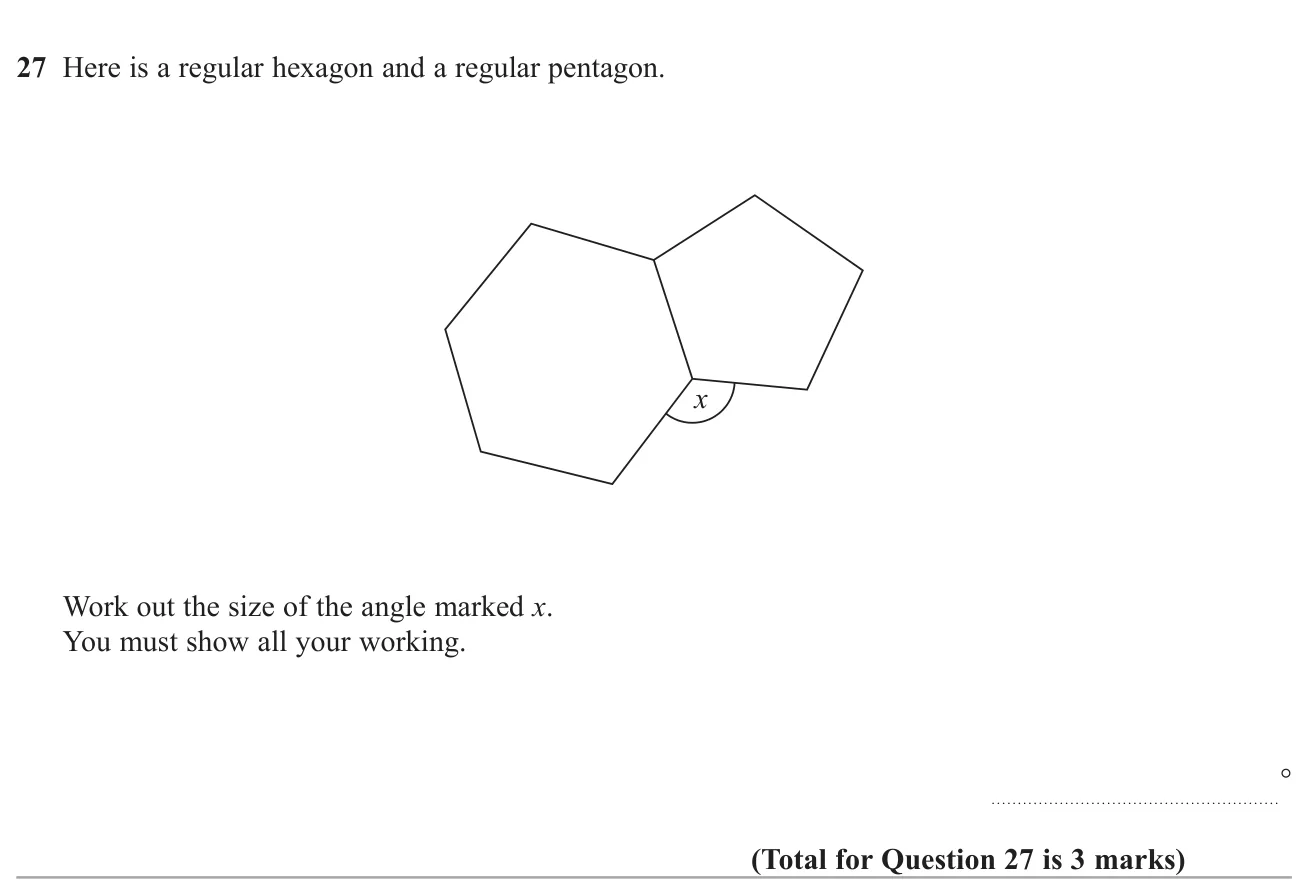
June 2022 · Paper 1 Foundation · Q27
Find the angle between a regular hexagon and a regular pentagon that share a side.

© Pearson Education Ltd. June 2022 Paper 1 (Foundation, non-calculator), question 27.

Show answer
Answer1323 marks

Worked solution Checked against the mark scheme

Hexagon interior angle: 180−360÷6=120∘180 - 360 \div 6 = 120^\circ

Pentagon interior angle: 180−360÷5=108∘180 - 360 \div 5 = 108^\circ

Angles round a point add to 360∘360^\circ: x=360−120−108=132∘x = 360 - 120 - 108 = 132^\circ

Watch out: Using exterior angles in place of interior ones and getting 228.

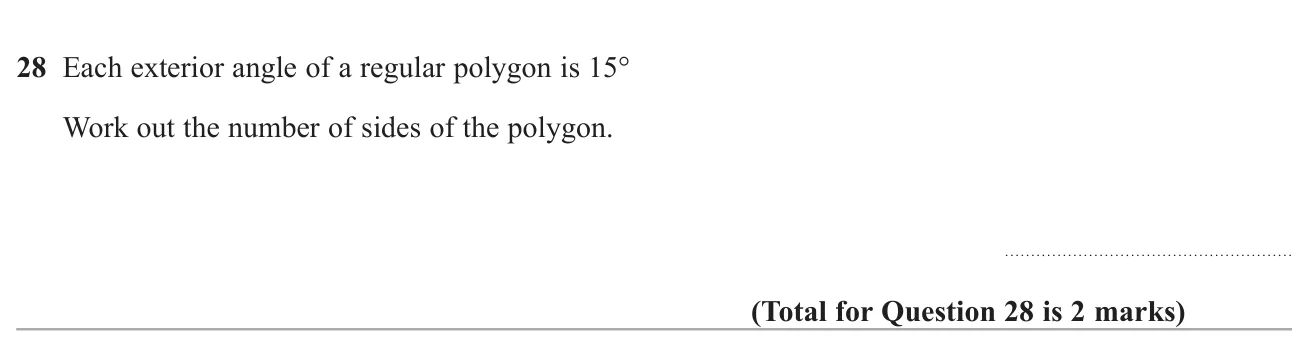
Angles in polygons2 marksGrade 5CalculatorFoundation
November 2020 · Paper 2 Foundation · Q28
Find the number of sides of a regular polygon from its exterior angle.

© Pearson Education Ltd. November 2020 Paper 2 (Foundation, calculator), question 28.

Show answer
Answer242 marks

Worked solution Checked against the mark scheme

Exterior angles of any polygon add up to 360∘360^\circ.

360÷15=24360 \div 15 = 24 sides.

Watch out: Dividing 180 by 15 to get 12.

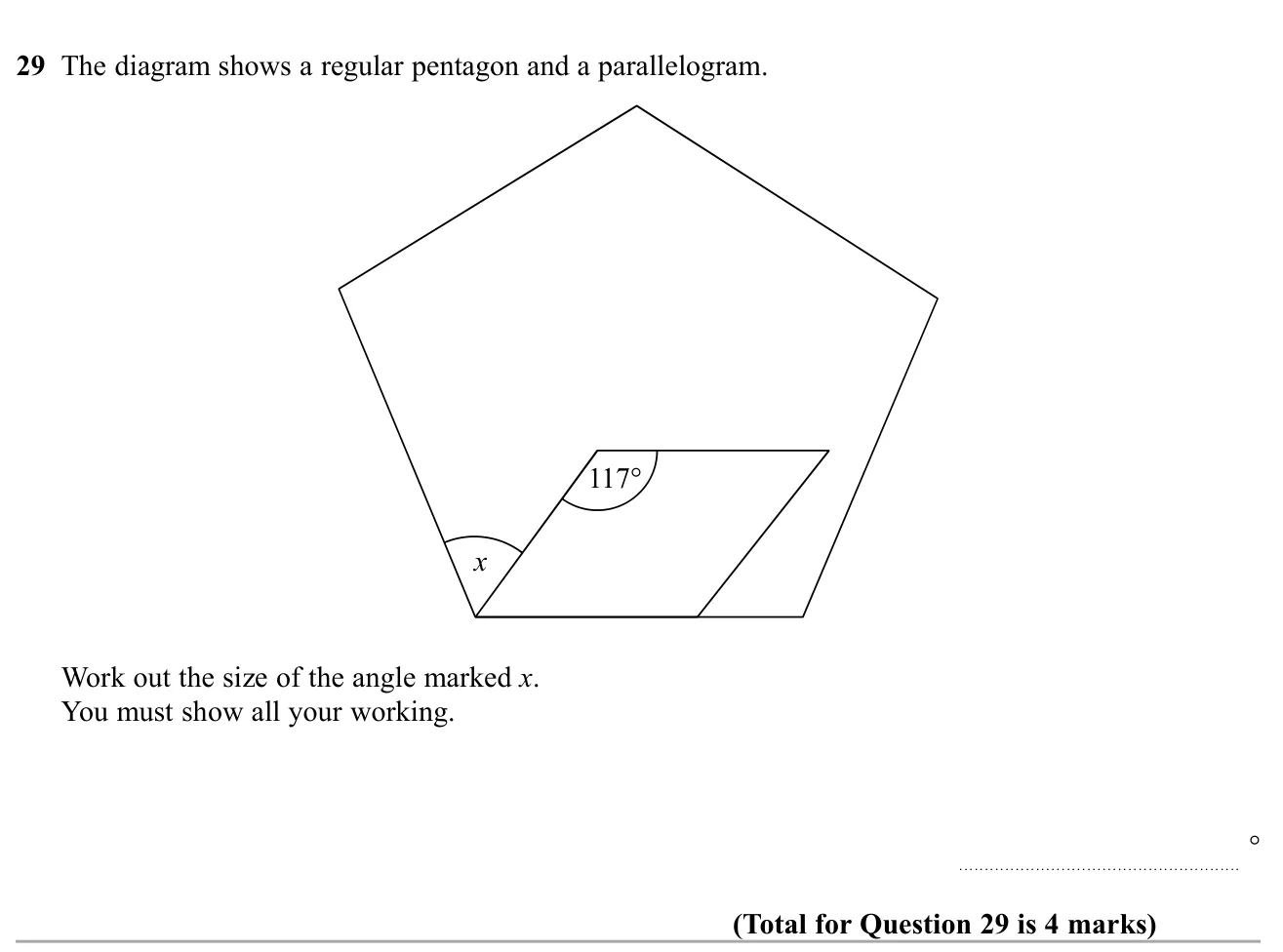
Angles in polygons4 marksGrade 5CalculatorOn both tiers
November 2019 · Paper 3 Foundation · Q29
Find an angle in a diagram combining a regular pentagon and a parallelogram.

© Pearson Education Ltd. November 2019 Paper 3 (Foundation, calculator), question 29.

Show answer
Answer45°4 marks

Worked solution Checked against the mark scheme

Co-interior angles in the parallelogram add to 180°: 180−117=63°180 - 117 = 63°

Interior angle of a regular pentagon: (5−2)×180÷5=108°(5-2) \times 180 \div 5 = 108°

x=108−63=45°x = 108 - 63 = 45°

Watch out: Using 72° (the exterior angle) as the pentagon's interior angle.

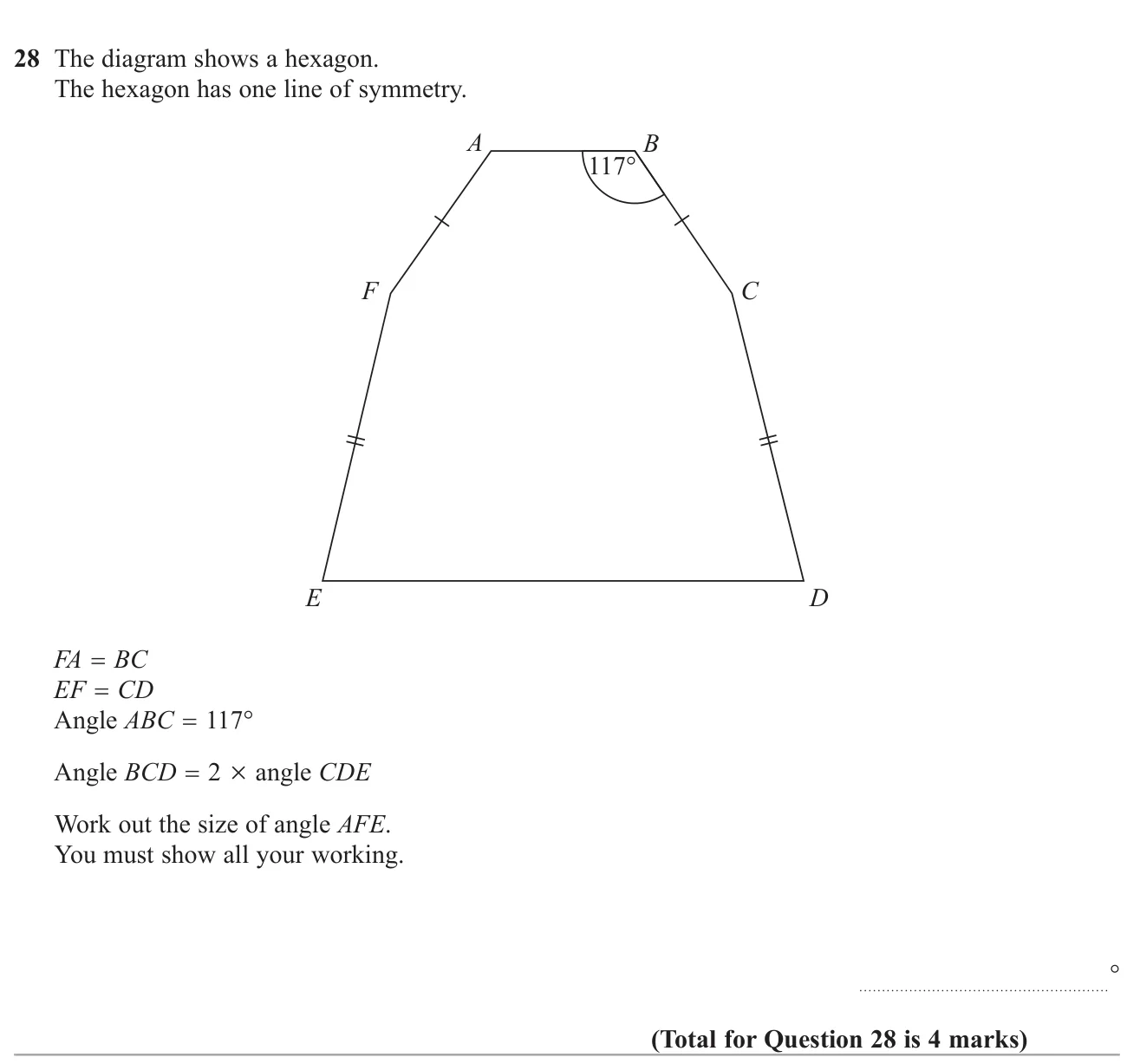
Angles in polygons4 marksGrade 5CalculatorOn both tiers
June 2019 · Paper 3 Foundation · Q28
Use symmetry, the hexagon angle sum and a 2 : 1 angle relation to find an angle in a hexagon.

© Pearson Education Ltd. June 2019 Paper 3 (Foundation, calculator), question 28.

Show answer
Answer1624 marks

Worked solution Checked against the mark scheme

Interior angles of a hexagon: (6−2)×180=720∘(6 - 2) \times 180 = 720^\circ

By symmetry A=B=117∘A = B = 117^\circ; let D=E=xD = E = x and C=F=2xC = F = 2x.

117+117+2x+2x+x+x=720117 + 117 + 2x + 2x + x + x = 720, so 6x=4866x = 486 and x=81x = 81

Angle AFE=2×81=162∘AFE = 2 \times 81 = 162^\circ

Watch out: Giving 81°, the value of angle CDE, as the answer.

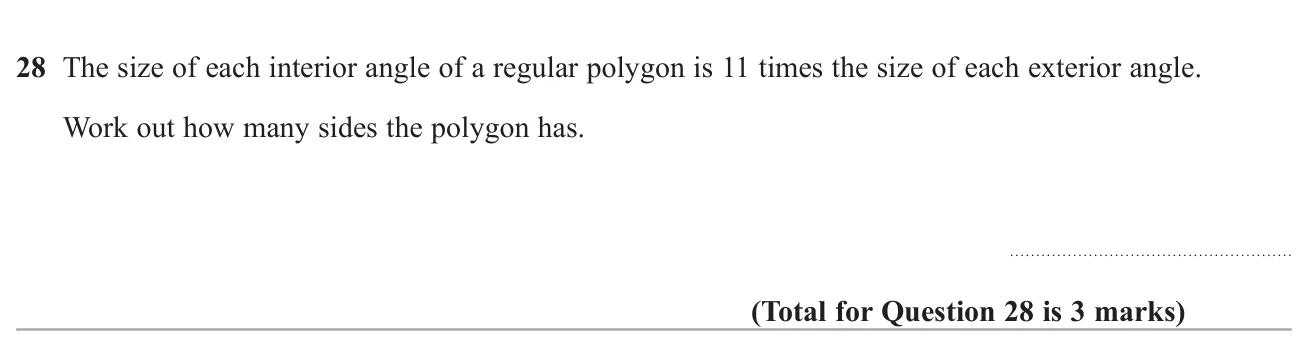
Angles in polygons3 marksGrade 5No calculatorFoundation
November 2018 · Paper 1 Foundation · Q28
Find the number of sides of a regular polygon whose interior angle is 11 times its exterior angle.

© Pearson Education Ltd. November 2018 Paper 1 (Foundation, non-calculator), question 28.

Show answer
Answer243 marks

Worked solution Checked against the mark scheme

Interior + exterior = 180°, so x+11x=180x + 11x = 180.

12x=180⇒x=15°12x = 180 \Rightarrow x = 15° (exterior angle)

Number of sides =360÷15=24= 360 \div 15 = 24

Watch out: Dividing 360 by the interior angle.

Angles in polygons5 marksGrade 5CalculatorOn both tiers
June 2018 · Paper 3 Foundation · Q26
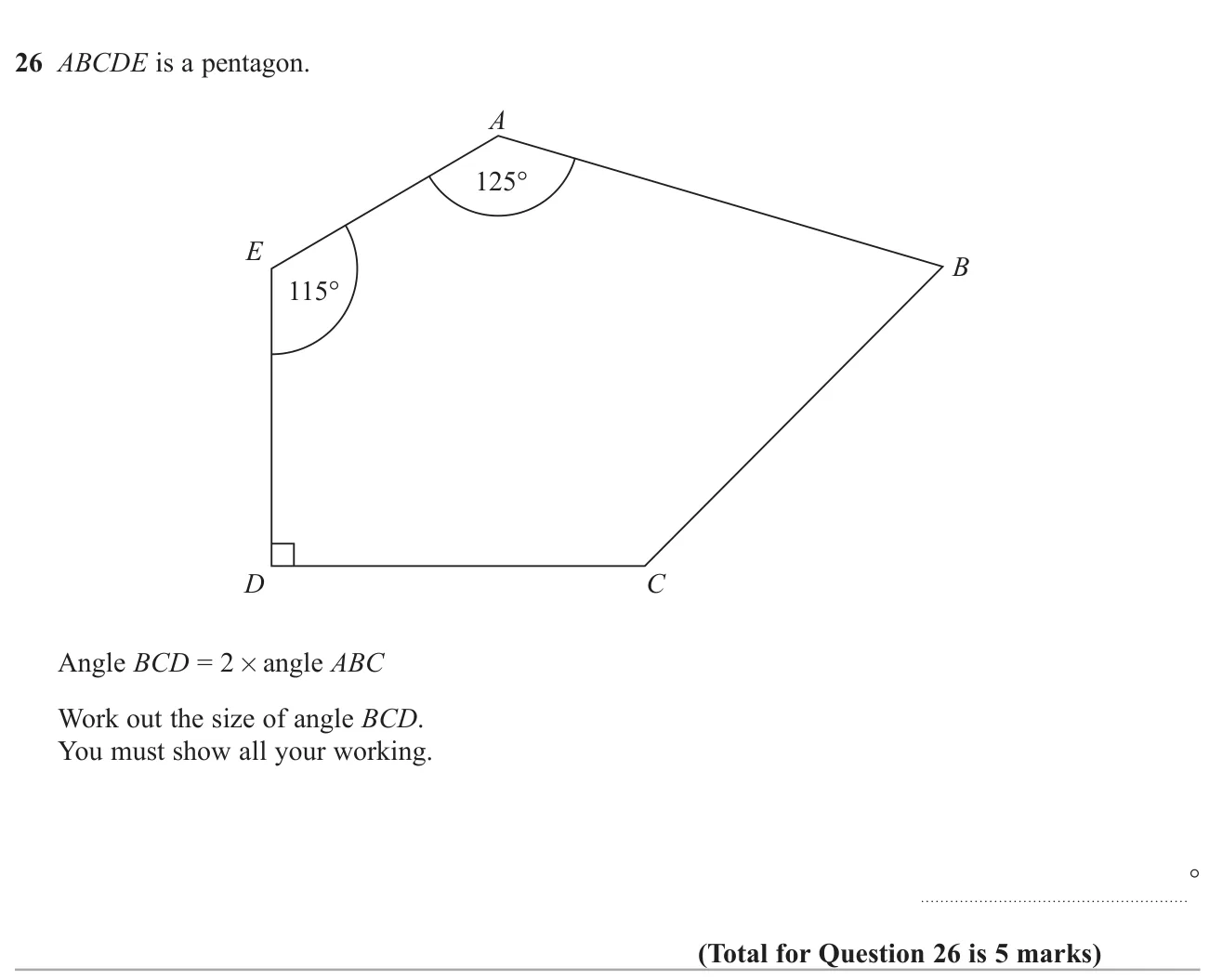
Use the angle sum of a pentagon with one angle twice another to find a missing angle.

© Pearson Education Ltd. June 2018 Paper 3 (Foundation, calculator), question 26.

Show answer
Answer140∘140^\circ5 marks

Worked solution Checked against the mark scheme

Angle sum of a pentagon: (5−2)×180=540∘(5 - 2) \times 180 = 540^\circ.

Known angles: 125+115+90=330125 + 115 + 90 = 330, so 540−330=210∘540 - 330 = 210^\circ remains.

If ABC=xABC = x, then x+2x=210x + 2x = 210, so x=70x = 70.

BCD=2×70=140∘BCD = 2 \times 70 = 140^\circ.

Watch out: Forgetting the right angle at D.

Also tested in these questions

Their main topic is different, but part of each one tests this topic.