
© Pearson Education Ltd. November 2024 Paper 1 (Foundation, non-calculator), question 3.
Show answer
| Answer | 1 mark |
|---|
Worked solution Checked against the mark scheme
There are 10 mm in 1 cm.
mm
Watch out: Dividing by 10 to get 1.5.
Ratio, proportion and rates of change
46 past-paper questions, easiest first. Try each one, then reveal the answer.
Revision guide by The Full Marks
Converting units means changing a measurement into different units without changing its size, like metres to centimetres or hours to minutes. It turns up in almost every paper, often hidden inside a longer question, so a slip here can cost marks on something else.
Example 1 Foundation · grade 2
A jug holds litres of juice. Priya pours out ml. How many millilitres are left?
Put both amounts in ml: ml.
Answer: ml
Example 2 Foundation · grade 5
(a) Change into .
(b) A train travels at km/h. Change this to m/s.
(a)
(b) km/h m per hour
m/s
. A cube of side 1 m is 100 cm each way, so its volume is cm³.
Multiply by 1000 to get metres per hour, then divide by 3600 to get metres per second. A quick shortcut is dividing by 3.6.
© Pearson Education Ltd. November 2024 Paper 1 (Foundation, non-calculator), question 3.
| Answer | 1 mark |
|---|
Worked solution Checked against the mark scheme
There are 10 mm in 1 cm.
mm
Watch out: Dividing by 10 to get 1.5.
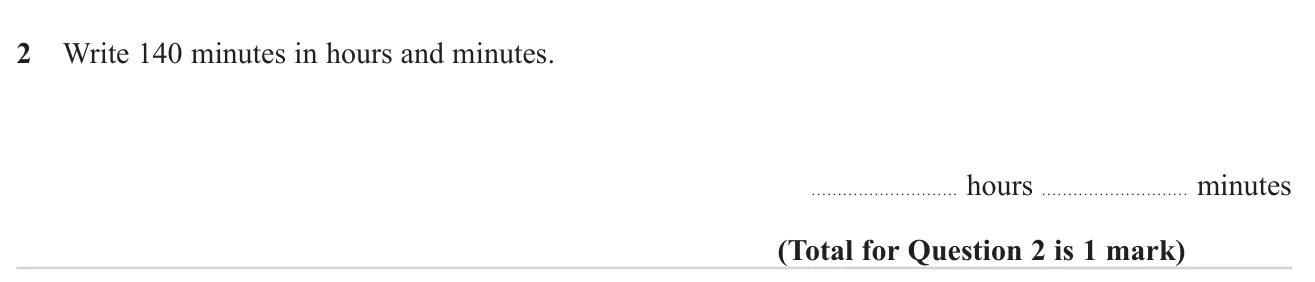
© Pearson Education Ltd. November 2024 Paper 2 (Foundation, calculator), question 2.
| Answer | 2 hours 20 minutes | 1 mark |
|---|
Worked solution Checked against the mark scheme
There are 60 minutes in an hour.
, so it is 2 hours 20 minutes.
Watch out: Using 100 minutes in an hour and writing 1 hour 40 minutes.
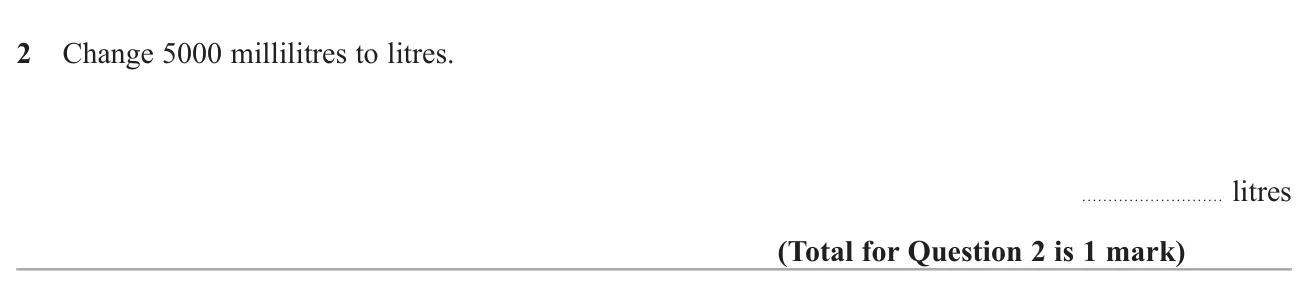
© Pearson Education Ltd. June 2024 Paper 2 (Foundation, calculator), question 2.
| Answer | litres | 1 mark |
|---|
Worked solution Checked against the mark scheme
There are ml in a litre.
litres.
Watch out: Multiplying by 1000 instead of dividing.

© Pearson Education Ltd. June 2024 Paper 3 (Foundation, calculator), question 2.
| Answer | metres | 1 mark |
|---|
Worked solution Checked against the mark scheme
There are 100 cm in 1 m.
m
Watch out: Multiplying by 100 to get 80 000.
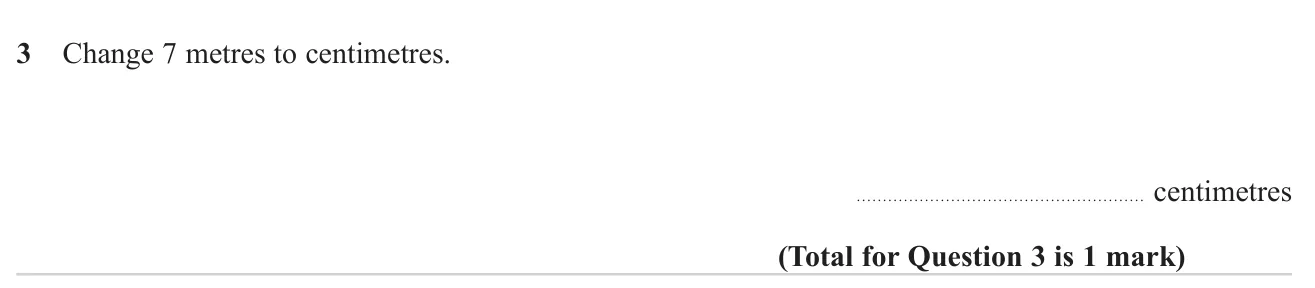
© Pearson Education Ltd. November 2023 Paper 2 (Foundation, calculator), question 3.
| Answer | 700 cm | 1 mark |
|---|
Worked solution Checked against the mark scheme
There are 100 cm in 1 m.
cm
Watch out: Multiplying by 10 or 1000 instead of 100.

© Pearson Education Ltd. June 2023 Paper 2 (Foundation, calculator), question 3.
| Answer | 900 | 1 mark |
|---|
Worked solution Checked against the mark scheme
There are 100 cm in 1 m, so cm.
Watch out: Multiplying by 10 or 1000 instead of 100.

© Pearson Education Ltd. June 2023 Paper 3 (Foundation, calculator), question 4.
| Answer | 4 | 1 mark |
|---|
Worked solution Checked against the mark scheme
There are 1000 g in 1 kg.
kg
Watch out: Multiplying by 1000 instead of dividing.
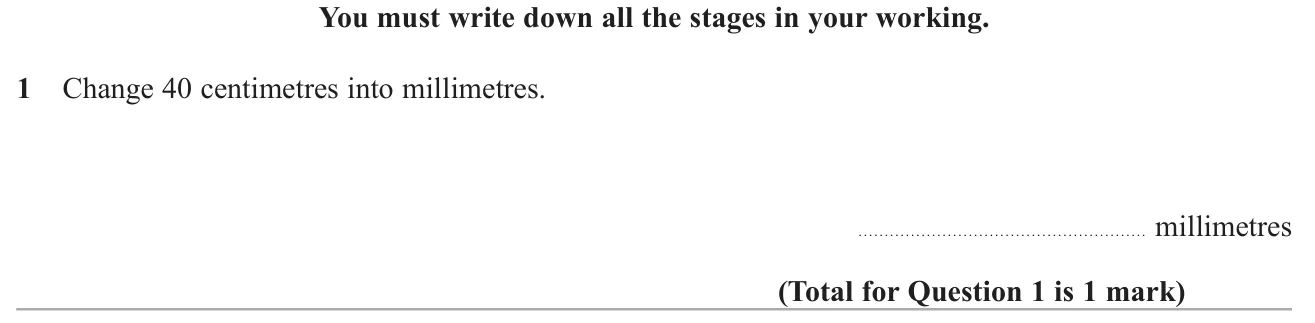
© Pearson Education Ltd. June 2022 Paper 1 (Foundation, non-calculator), question 1.
| Answer | 400 | 1 mark |
|---|
Worked solution Checked against the mark scheme
There are 10 mm in 1 cm.
mm
Watch out: Dividing by 10 to get 4.
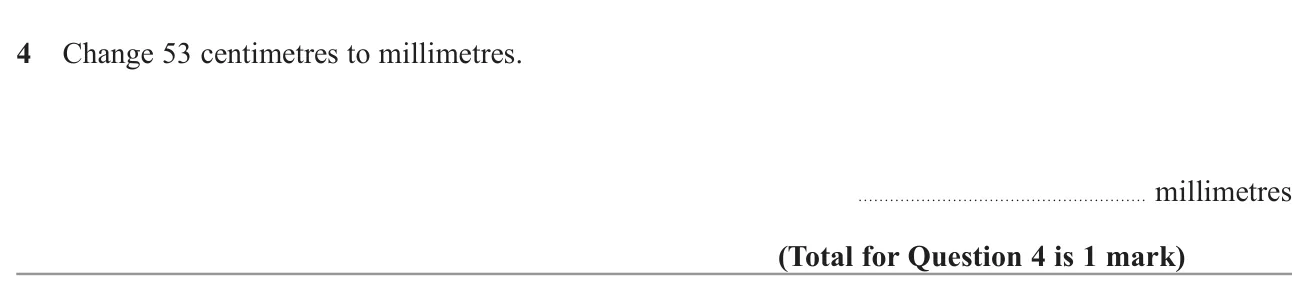
© Pearson Education Ltd. November 2022 Paper 2 (Foundation, calculator), question 4.
| Answer | 530 | 1 mark |
|---|
Worked solution Checked against the mark scheme
There are 10 mm in 1 cm.
mm
Watch out: Dividing by 10 to get 5.3.
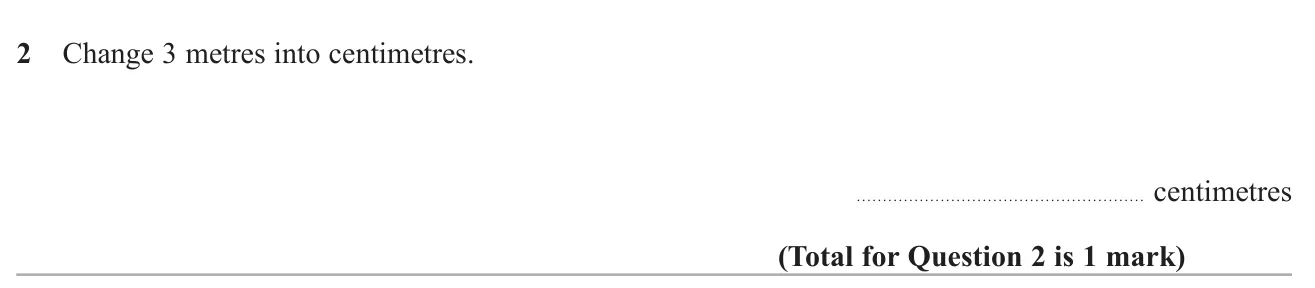
© Pearson Education Ltd. November 2021 Paper 2 (Foundation, calculator), question 2.
| Answer | 300 | 1 mark |
|---|
Worked solution Checked against the mark scheme
There are 100 cm in 1 m, so cm.
Watch out: Multiplying by 10 or 1000 instead of 100.
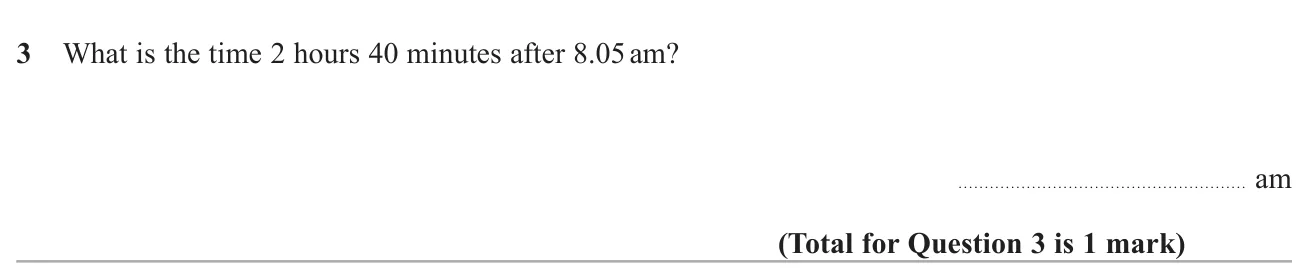
© Pearson Education Ltd. November 2021 Paper 3 (Foundation, calculator), question 3.
| Answer | 10.45 am | 1 mark |
|---|
Worked solution Checked against the mark scheme
Add the 2 hours first: 8.05 am → 10.05 am.
Then add 40 minutes: 10.05 am → 10.45 am.
Watch out: Treating time as decimal and getting a wrong carry, e.g. 10.85.
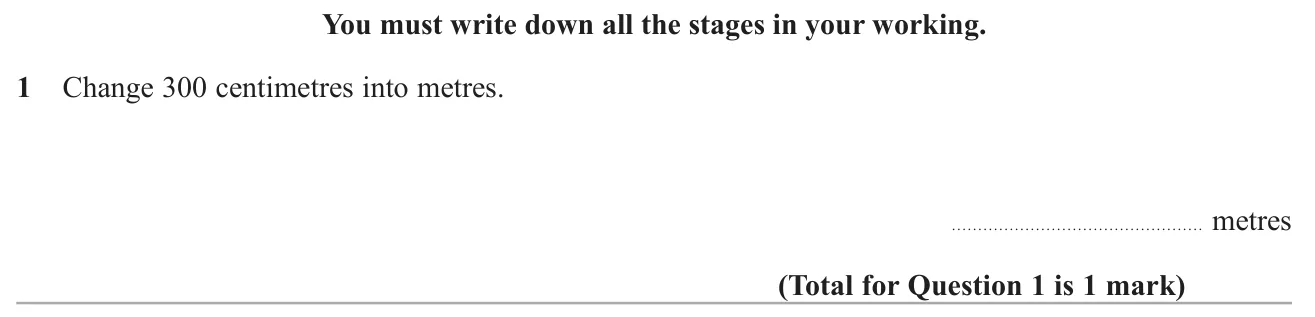
© Pearson Education Ltd. November 2020 Paper 3 (Foundation, calculator), question 1.
| Answer | 3 | 1 mark |
|---|
Worked solution Checked against the mark scheme
There are 100 cm in 1 m, so divide by 100.
metres
Watch out: Multiplying by 100 instead of dividing.
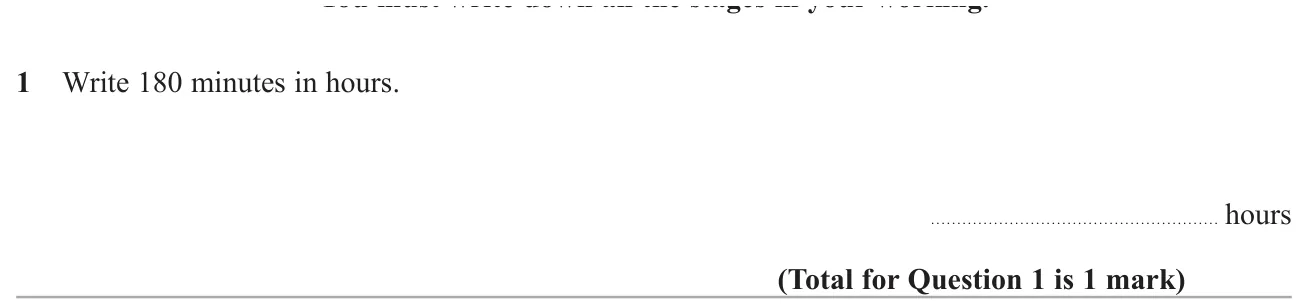
© Pearson Education Ltd. June 2019 Paper 1 (Foundation, non-calculator), question 1.
| Answer | 3 | 1 mark |
|---|
Worked solution Checked against the mark scheme
There are 60 minutes in an hour.
hours
Watch out: Dividing by 100 instead of 60.
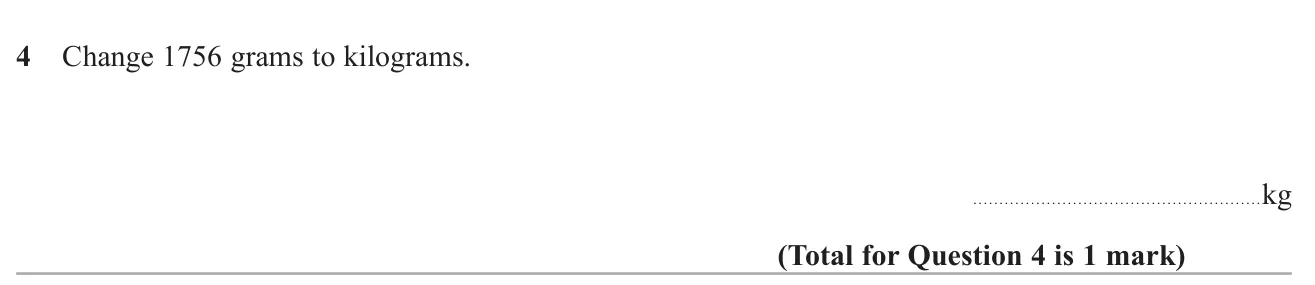
© Pearson Education Ltd. June 2019 Paper 2 (Foundation, calculator), question 4.
| Answer | kg | 1 mark |
|---|
Worked solution Checked against the mark scheme
There are 1000 g in 1 kg, so divide by 1000.
kg
Watch out: Multiplying by 1000 or dividing by 100.
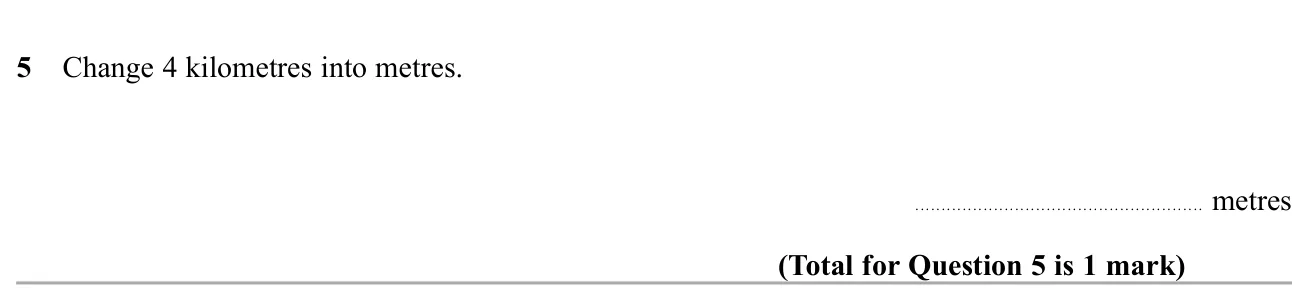
© Pearson Education Ltd. November 2019 Paper 3 (Foundation, calculator), question 5.
| Answer | 4000 | 1 mark |
|---|
Worked solution Checked against the mark scheme
There are 1000 metres in a kilometre.
metres
Watch out: Multiplying by 100 to get 400.
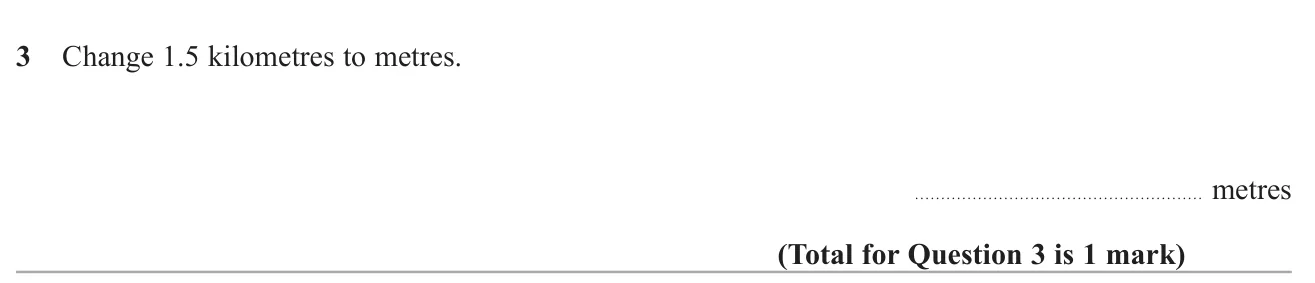
© Pearson Education Ltd. June 2019 Paper 3 (Foundation, calculator), question 3.
| Answer | 1500 | 1 mark |
|---|
Worked solution Checked against the mark scheme
1 km = 1000 m
metres.
Watch out: Multiplying by 100 instead of 1000.
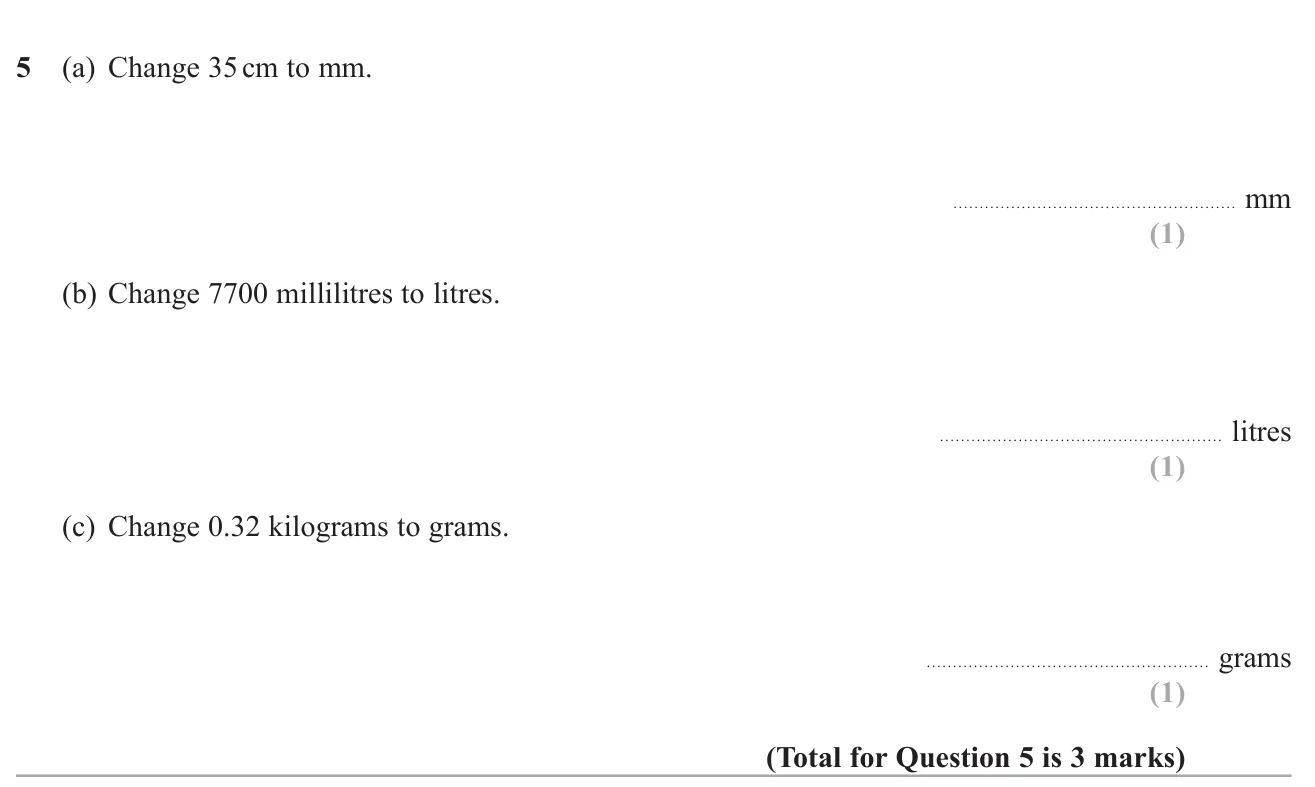
© Pearson Education Ltd. June 2018 Paper 2 (Foundation, calculator), question 5.
| (a) | mm | 1 mark |
|---|---|---|
| (b) | litres | 1 mark |
| (c) | grams | 1 mark |
Worked solution Checked against the mark scheme
(a) 1 cm = 10 mm, so mm
(b) 1 litre = 1000 ml, so litres
(c) 1 kg = 1000 g, so g
Watch out: Multiplying by 100 instead of 10 when changing cm to mm.
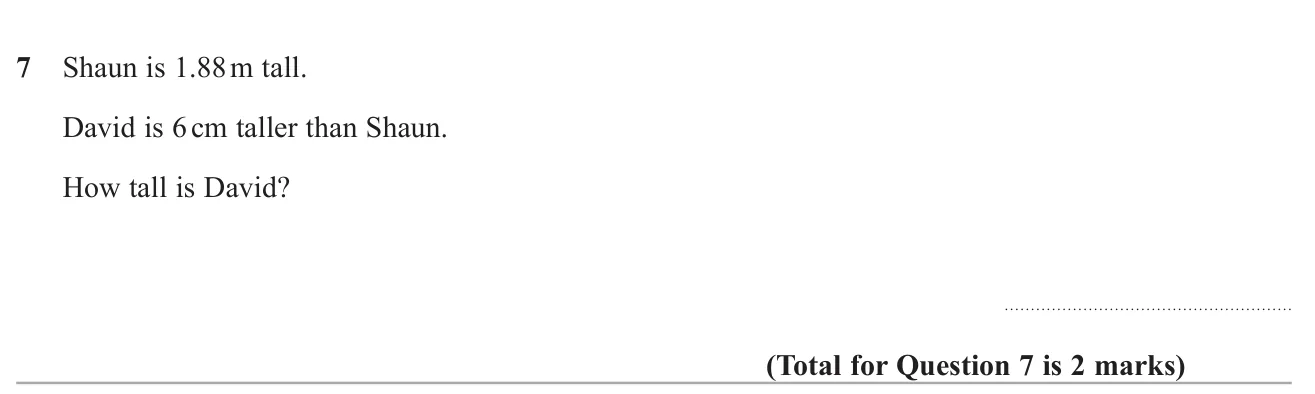
© Pearson Education Ltd. November 2018 Paper 3 (Foundation, calculator), question 7.
| Answer | m (or cm) | 2 marks |
|---|
Worked solution Checked against the mark scheme
Change 6 cm to metres: m.
m (or cm).
Watch out: Adding 6 straight on to 1.88 to get 7.88.
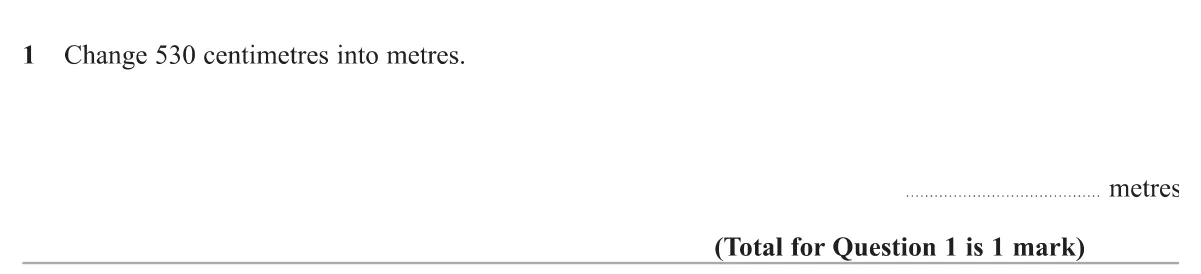
© Pearson Education Ltd. Specimen Paper 1 (Foundation, non-calculator), question 1.
| Answer | m | 1 mark |
|---|
Worked solution Checked against the mark scheme
There are 100 cm in 1 m, so divide by 100.
m
Watch out: Dividing by 10 to get 53.
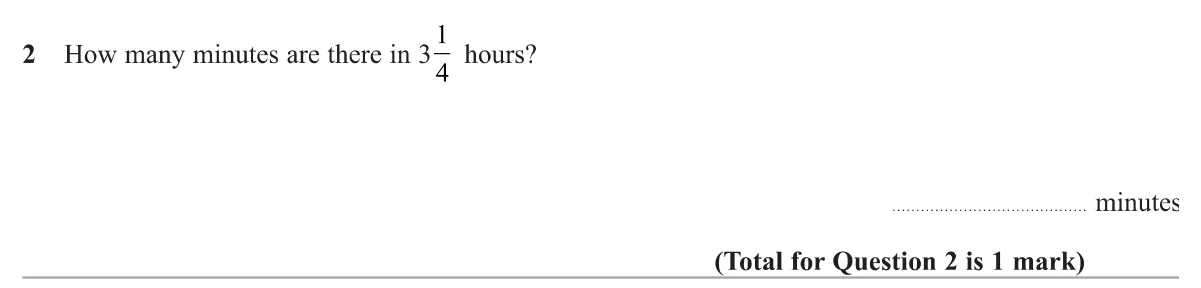
© Pearson Education Ltd. Specimen Paper 1 (Foundation, non-calculator), question 2.
| Answer | 1 mark |
|---|
Worked solution Checked against the mark scheme
3 hours is minutes.
of an hour is minutes.
minutes
Watch out: Treating a quarter of an hour as 25 minutes, giving 205.
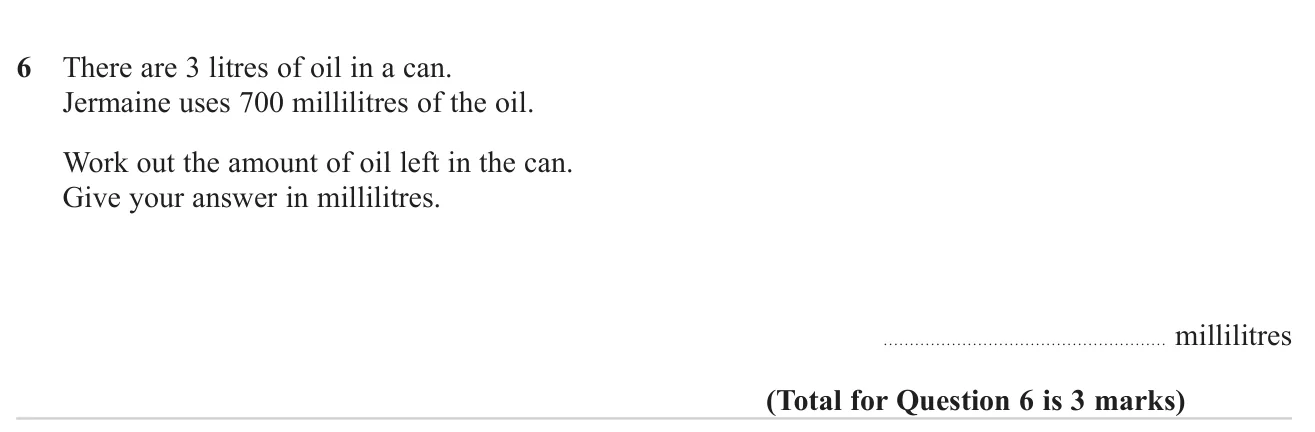
© Pearson Education Ltd. November 2023 Paper 1 (Foundation, non-calculator), question 6.
| Answer | 2300 ml | 3 marks |
|---|
Worked solution Checked against the mark scheme
1 litre = 1000 ml, so 3 litres = 3000 ml.
ml
Watch out: Subtracting 700 from 3 without changing units first.
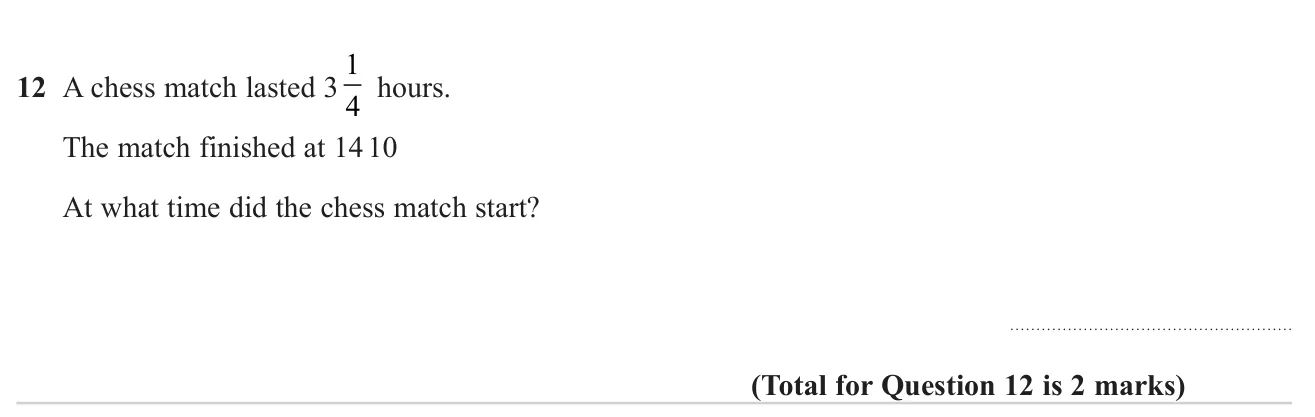
© Pearson Education Ltd. November 2023 Paper 3 (Foundation, calculator), question 12.
| Answer | 10 55 (am) | 2 marks |
|---|
Worked solution Checked against the mark scheme
hours hours 15 minutes.
14 10 back 3 hours is 11 10; back 15 more minutes is 10 55.
Watch out: Treating ¼ hour as 25 minutes, giving 10 45.
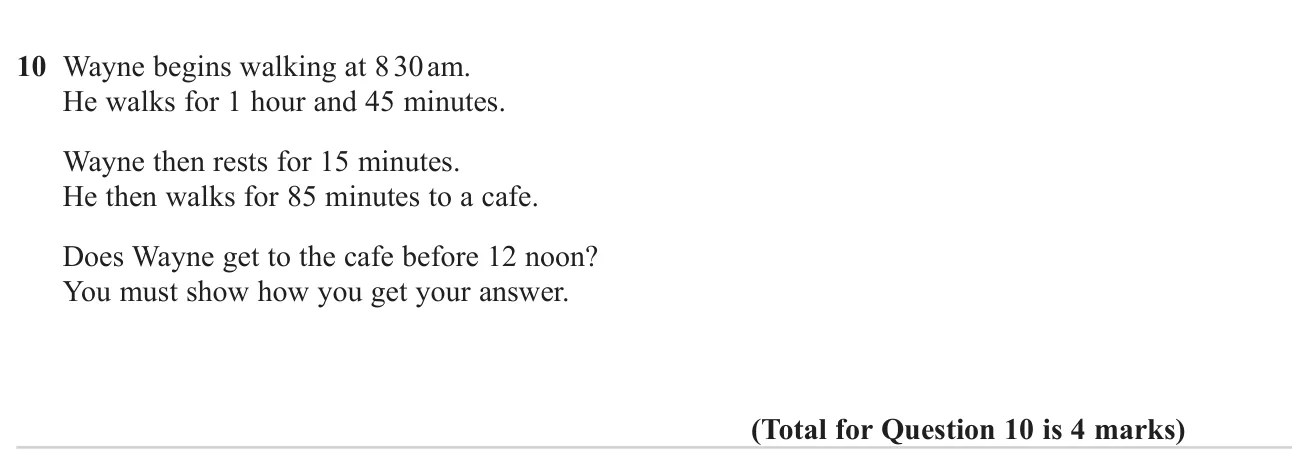
© Pearson Education Ltd. June 2023 Paper 3 (Foundation, calculator), question 10.
| Answer | Yes, he arrives at 11:55 am | 4 marks |
|---|
Worked solution Checked against the mark scheme
8:30 am + 1 h 45 min = 10:15 am
Rest 15 min: 10:30 am
85 min = 1 h 25 min, so 10:30 + 1 h 25 min = 11:55 am
11:55 am is before noon, so yes.
Watch out: Treating 85 minutes as 85 hundredths of an hour, i.e. adding 0.85.
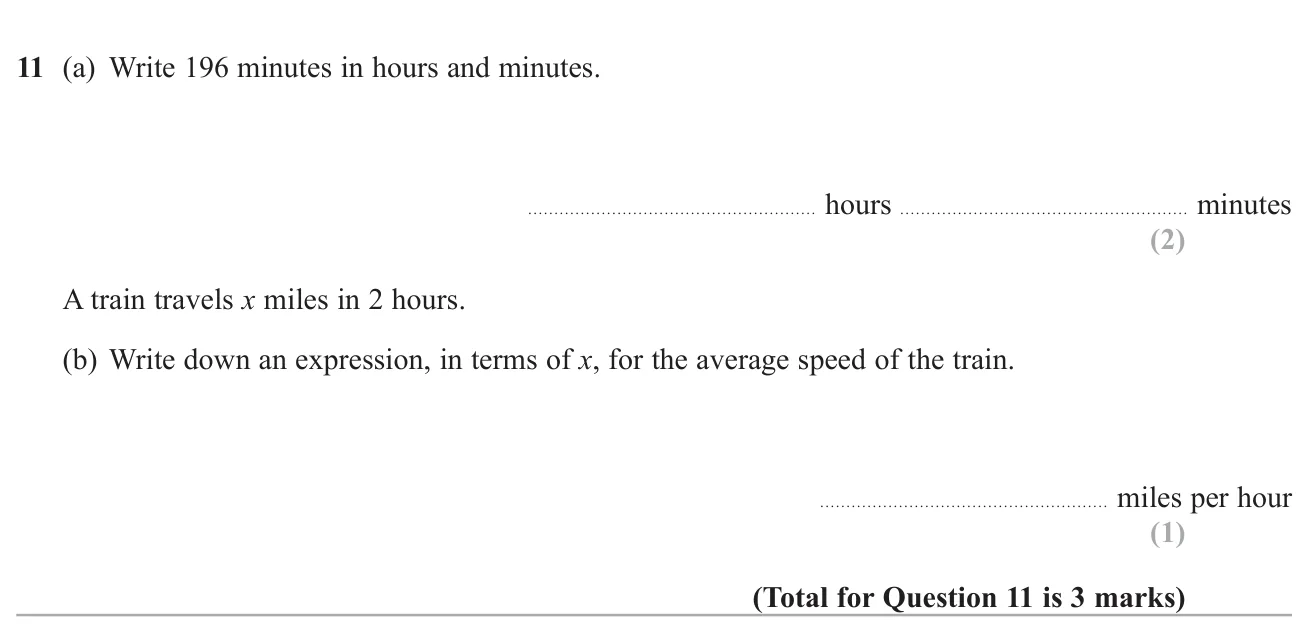
© Pearson Education Ltd. November 2021 Paper 3 (Foundation, calculator), question 11.
| (a) | 3 hours 16 minutes | 2 marks |
|---|---|---|
| (b) | 1 mark |
Worked solution Checked against the mark scheme
(a) minutes, and .
So 196 minutes is 3 hours 16 minutes.
(b) Speed = distance ÷ time, so the speed is miles per hour.
Watch out: In (a), writing 3.26 hours as 3 hours 26 minutes.
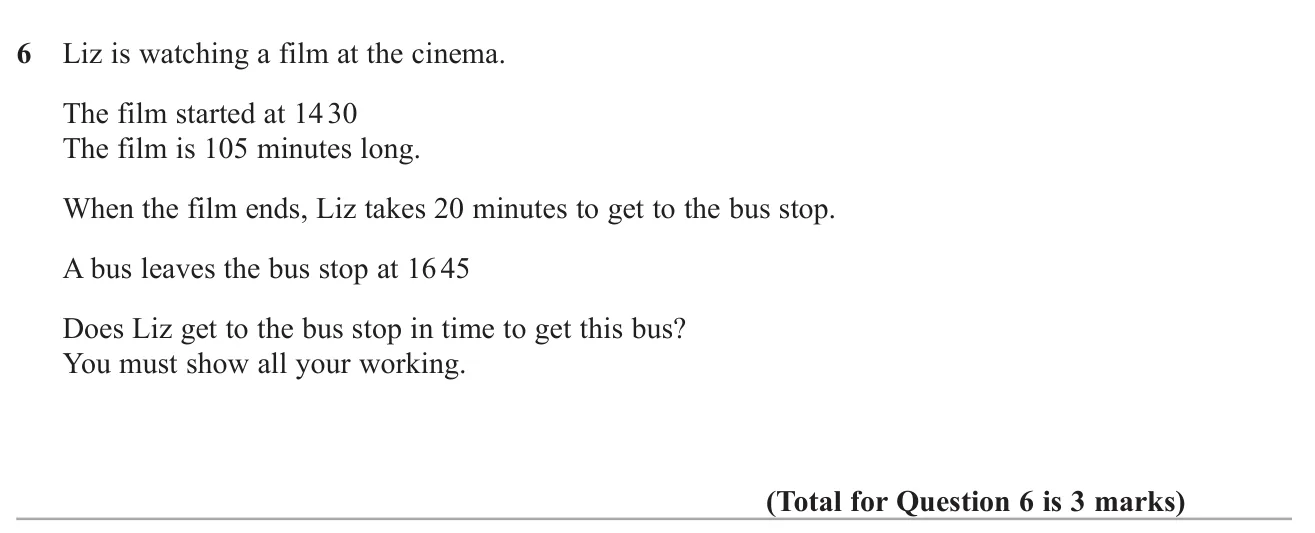
© Pearson Education Ltd. November 2020 Paper 2 (Foundation, calculator), question 6.
| Answer | Yes: she reaches the stop at 16 35, 10 minutes before the bus | 3 marks |
|---|
Worked solution Checked against the mark scheme
105 minutes = 1 hour 45 minutes.
Film ends: 14 30 + 1 h 45 min = 16 15
At the bus stop: 16 15 + 20 min = 16 35
16 35 is before 16 45, so yes, with 10 minutes to spare.
Watch out: Treating 105 minutes as 1 hour 5 minutes, or adding times as decimals.
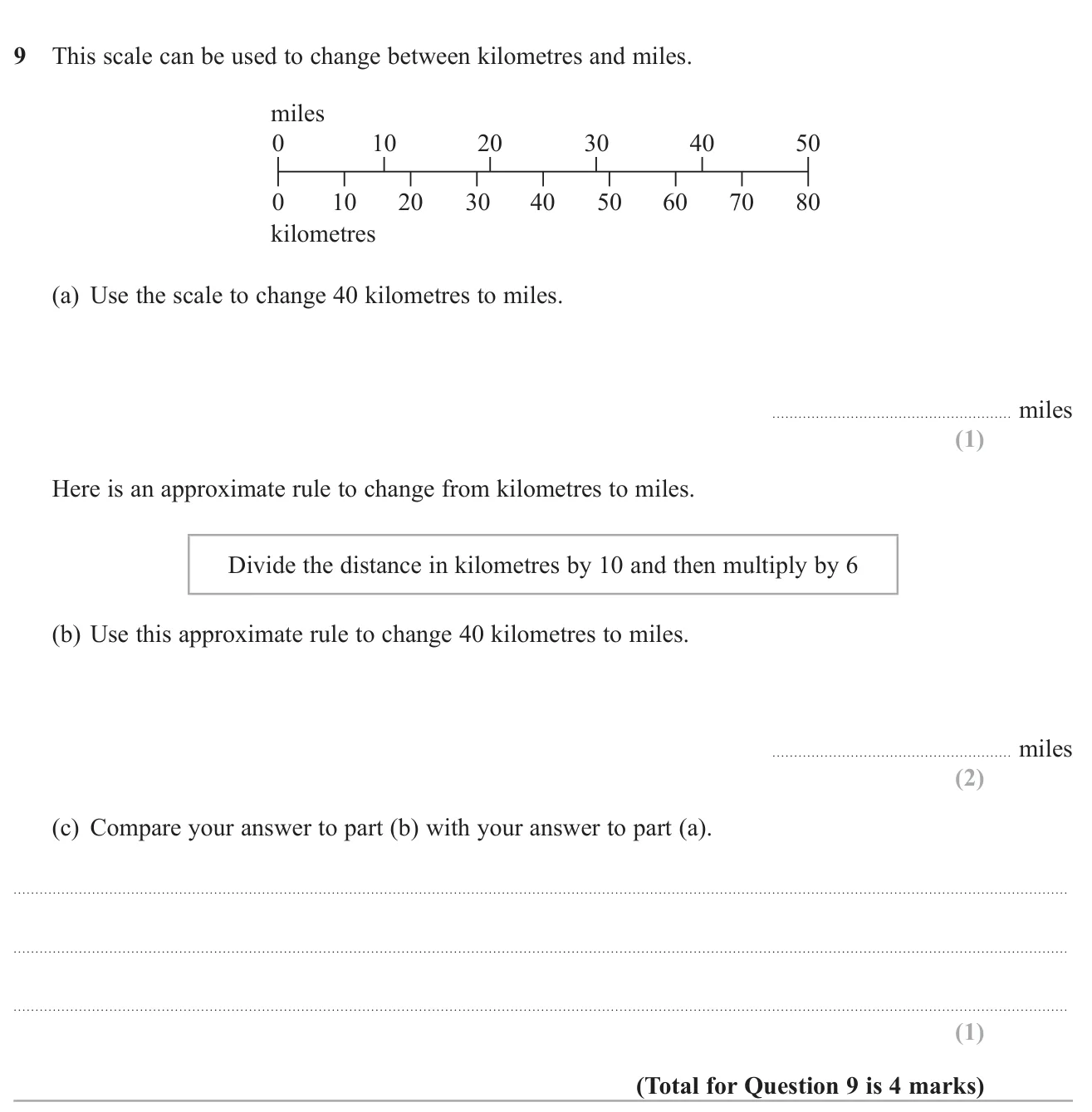
© Pearson Education Ltd. November 2020 Paper 2 (Foundation, calculator), question 9.
| (a) | 25 miles (24 to 26) | 1 mark |
|---|---|---|
| (b) | 24 miles | 2 marks |
| (c) | The two answers are close; the rule gives a slightly smaller value | 1 mark |
Worked solution Checked against the mark scheme
(a) Read across from 40 km on the scale: about 25 miles.
(b) , then miles.
(c) 24 is close to 25, but the rule gives a slightly smaller answer.
Watch out: In (a), misreading the scale's intervals.
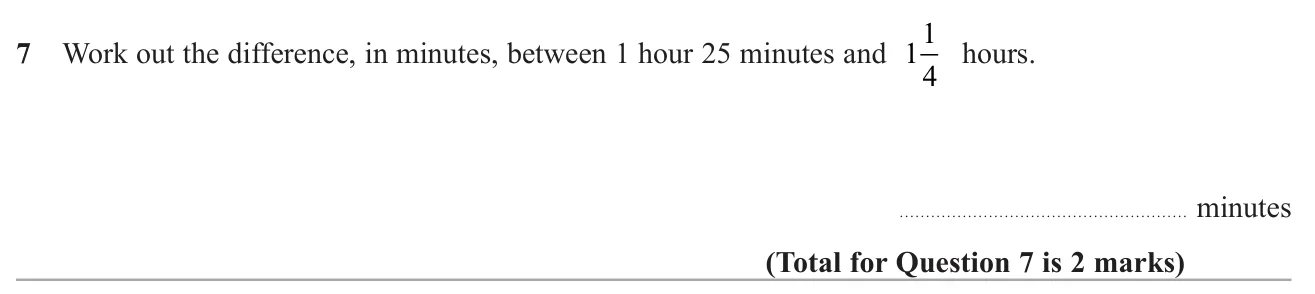
© Pearson Education Ltd. November 2019 Paper 1 (Foundation, non-calculator), question 7.
| Answer | minutes | 2 marks |
|---|
Worked solution Checked against the mark scheme
hours minutes
1 hour 25 minutes minutes
Difference minutes
Watch out: Thinking a quarter of an hour is 25 minutes.
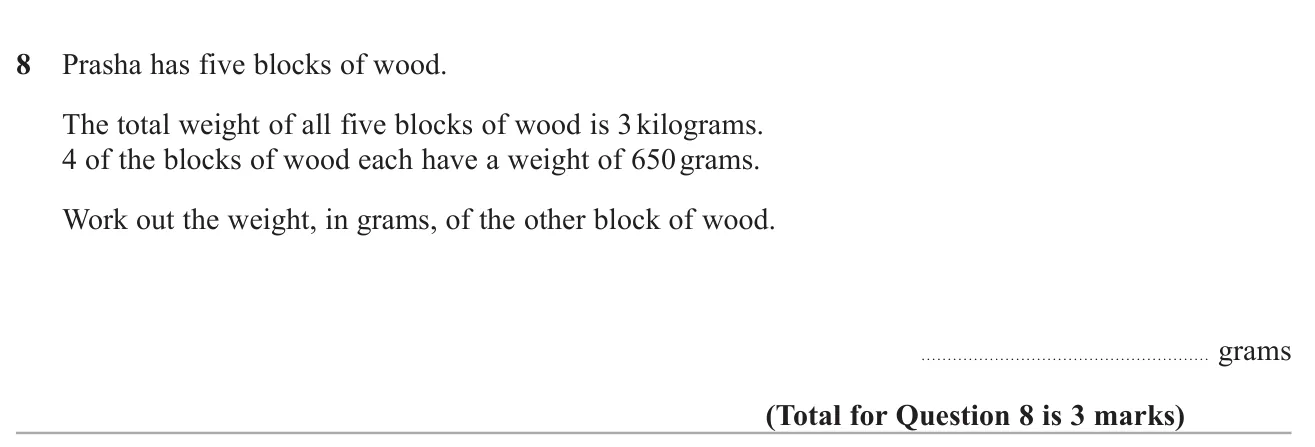
© Pearson Education Ltd. November 2019 Paper 1 (Foundation, non-calculator), question 8.
| Answer | grams | 3 marks |
|---|
Worked solution Checked against the mark scheme
Four blocks: g
Total: kg g
Last block: g
Watch out: Forgetting to convert kilograms to grams.
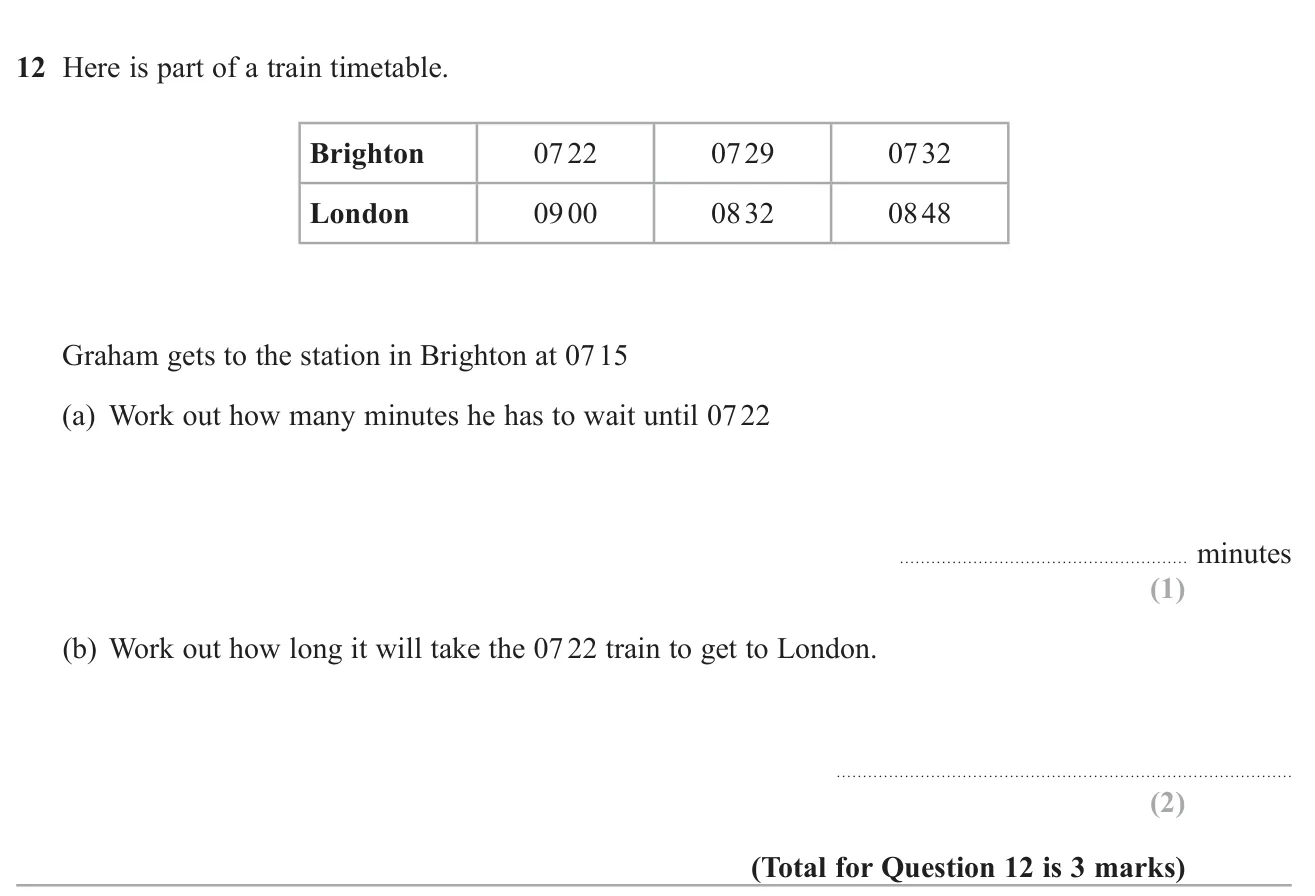
© Pearson Education Ltd. June 2019 Paper 2 (Foundation, calculator), question 12.
| (a) | 7 minutes | 1 mark |
|---|---|---|
| (b) | 1 hour 38 minutes | 2 marks |
Worked solution Checked against the mark scheme
(a) From 07 15 to 07 22 is 7 minutes.
(b) The 07 22 train reaches London at 09 00.
07 22 to 08 00 is 38 minutes; 08 00 to 09 00 is 1 hour.
Journey time: 1 hour 38 minutes (98 minutes).
Watch out: Subtracting like decimals: .
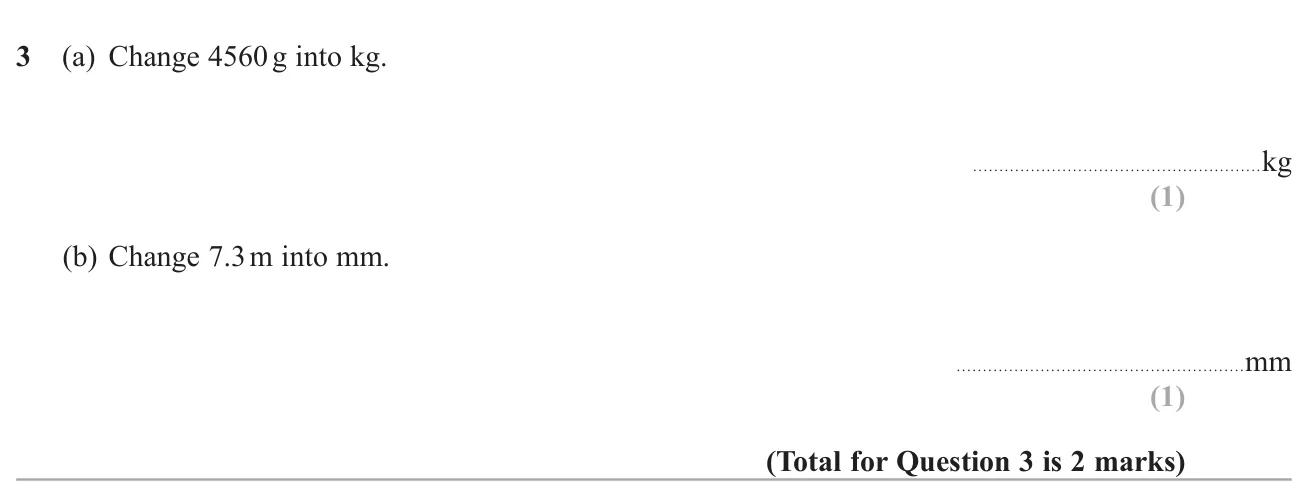
© Pearson Education Ltd. November 2018 Paper 2 (Foundation, calculator), question 3.
| (a) | 4.56 | 1 mark |
|---|---|---|
| (b) | 7300 | 1 mark |
Worked solution Checked against the mark scheme
(a) 1 kg = 1000 g, so kg.
(b) 1 m = 1000 mm, so mm.
Watch out: Using 100 instead of 1000 in (b), giving 730.
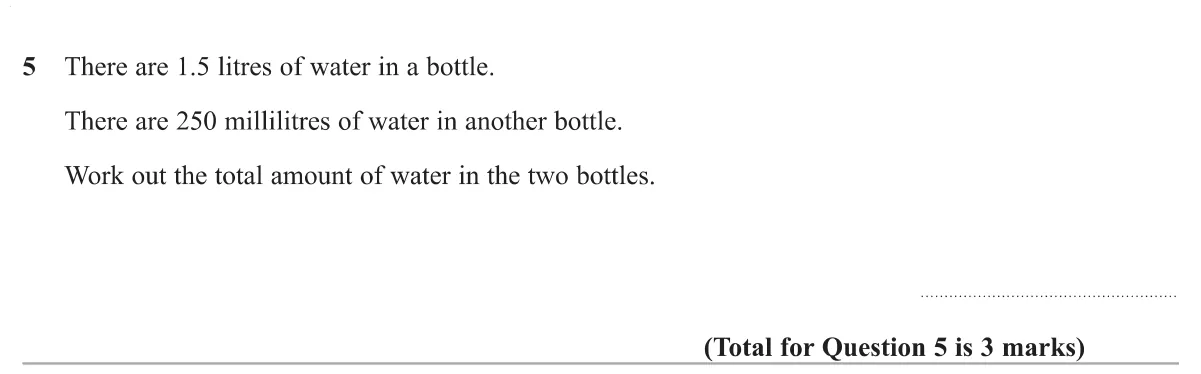
© Pearson Education Ltd. Specimen Paper 3 (Foundation, calculator), question 5.
| Answer | 1.75 litres or 1750 ml | 3 marks |
|---|
Worked solution Checked against the mark scheme
1 litre = 1000 ml, so 1.5 litres = 1500 ml.
ml, which is 1750 ml (or 1.75 litres).
Watch out: Adding 1.5 + 250 without converting, or leaving out the units.
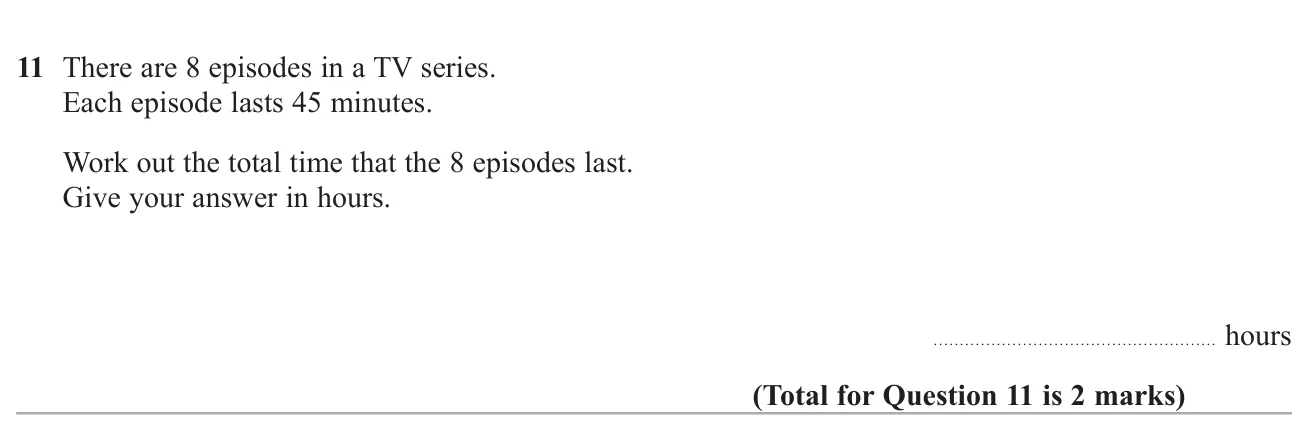
© Pearson Education Ltd. June 2024 Paper 3 (Foundation, calculator), question 11.
| Answer | hours | 2 marks |
|---|
Worked solution Checked against the mark scheme
minutes
hours
Watch out: Dividing by 100 instead of 60, giving 3.6 hours.
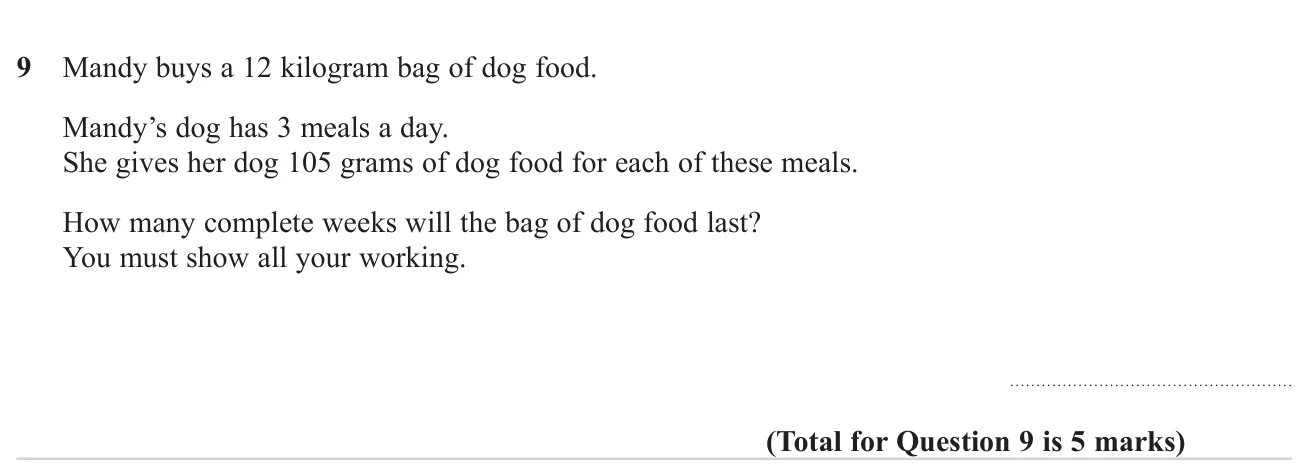
© Pearson Education Ltd. November 2023 Paper 3 (Foundation, calculator), question 9.
| Answer | 5 | 5 marks |
|---|
Worked solution Checked against the mark scheme
Food per day g; per week g
, so the bag lasts 5 complete weeks.
Watch out: Rounding 5.44 up to 6, or forgetting to change kg into g.
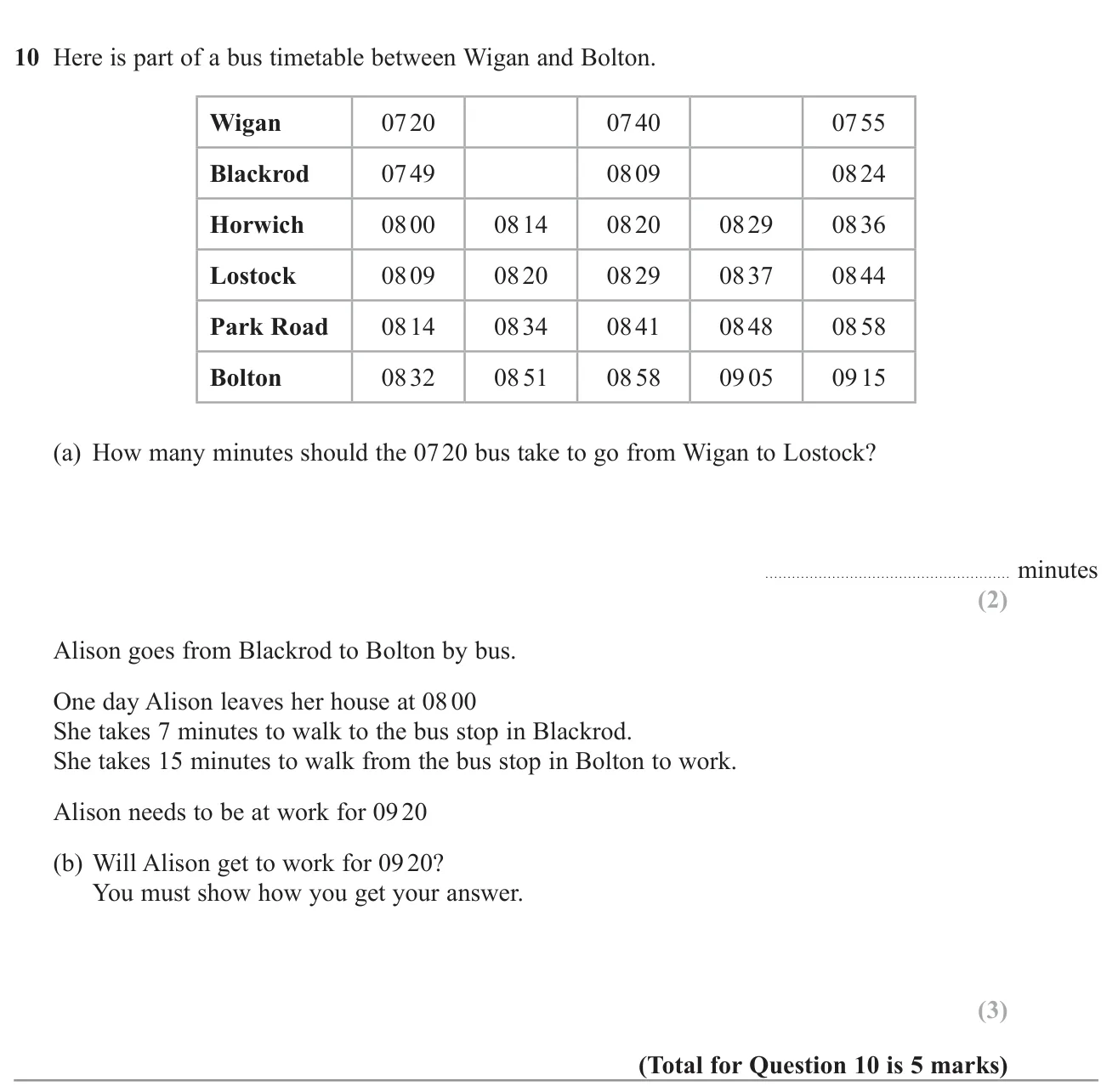
© Pearson Education Ltd. November 2022 Paper 2 (Foundation, calculator), question 10.
| (a) | 49 minutes | 2 marks |
|---|---|---|
| (b) | Yes: she catches the 08 09 bus, arrives in Bolton at 08 58 and reaches work at 09 13 | 3 marks |
Worked solution Checked against the mark scheme
(a) 07 20 to 08 00 is 40 minutes, then 08 00 to 08 09 is 9 more: 49 minutes.
(b) She reaches Blackrod at , so she catches the 08 09 bus.
That bus reaches Bolton at 08 58, and .
09 13 is before 09 20, so yes.
Watch out: Treating times as decimals, e.g. .
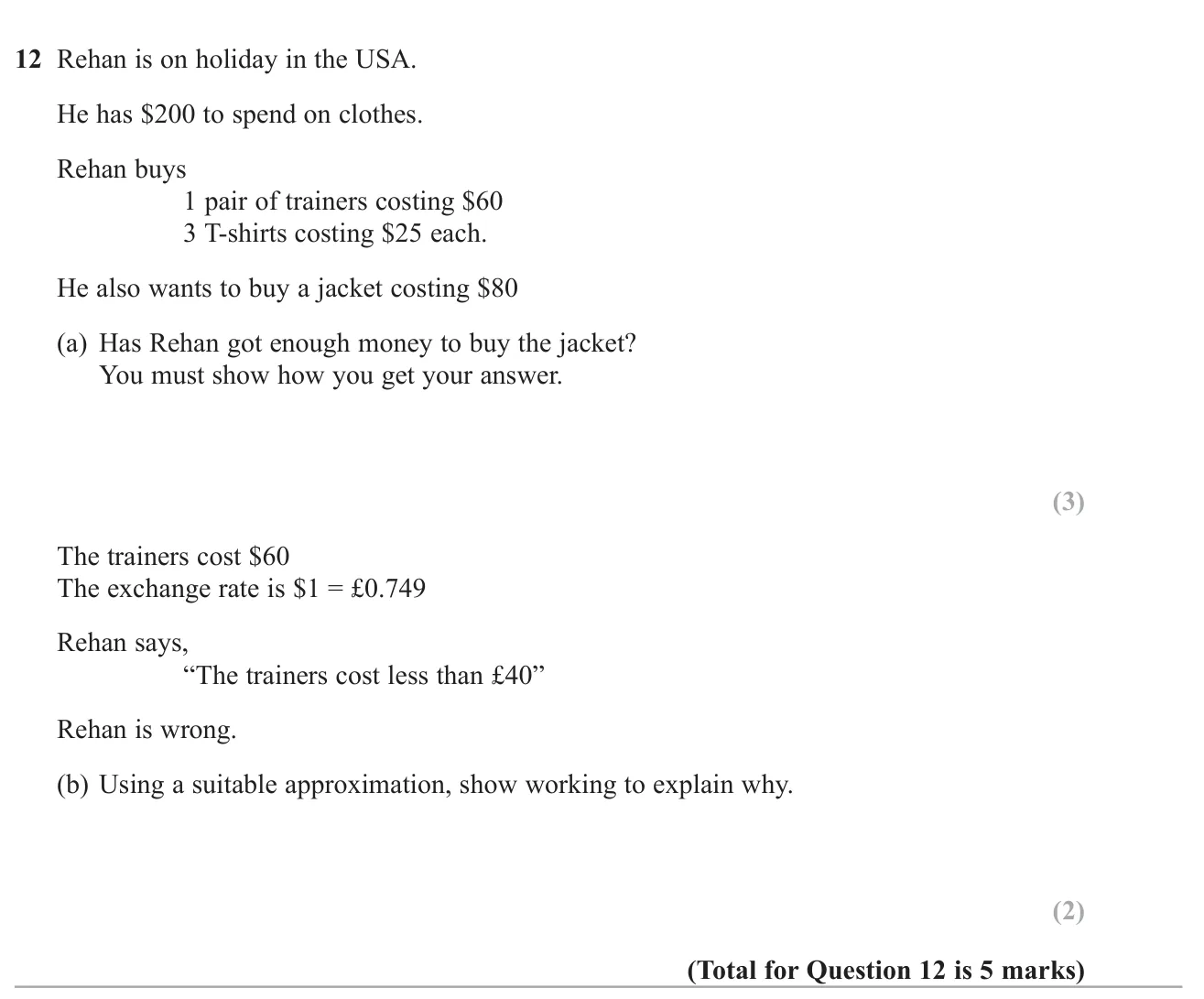
© Pearson Education Ltd. November 2019 Paper 1 (Foundation, non-calculator), question 12.
| (a) | No: the items cost 215 dollars but he only has 200 dollars | 3 marks |
|---|---|---|
| (b) | , which is more than £40 even though 0.7 is an underestimate | 2 marks |
Worked solution Checked against the mark scheme
(a) T-shirts:
Total with the jacket:
, so no, he is 15 dollars short.
(b) Round the rate down:
. This is already an underestimate and is more than £40, so he is wrong.
Watch out: In (b), rounding up to 0.75 or 0.8: an overestimate cannot prove the price is more than £40.
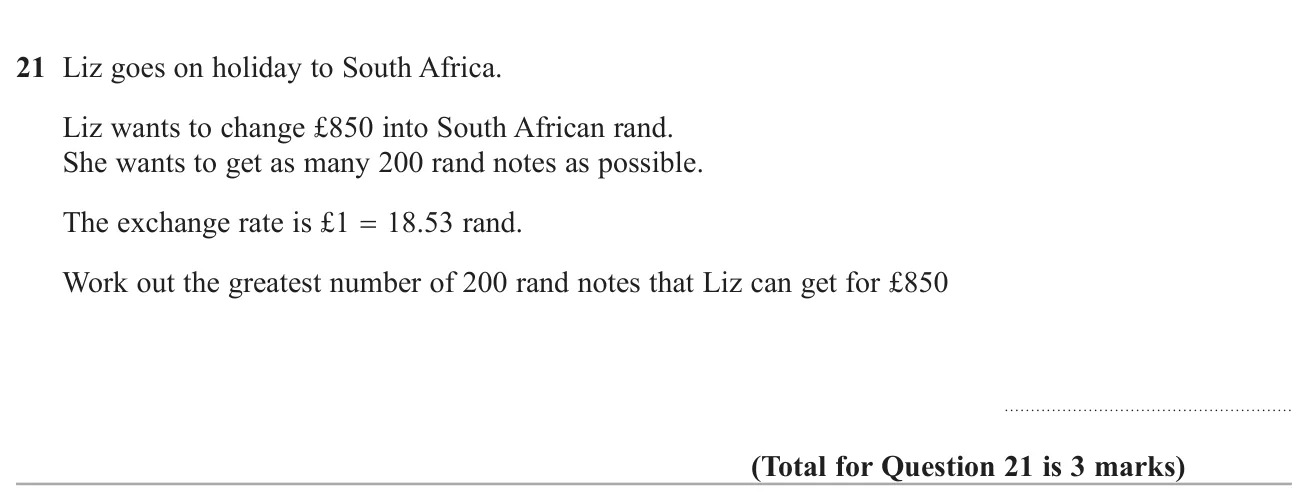
© Pearson Education Ltd. June 2019 Paper 3 (Foundation, calculator), question 21.
| Answer | 78 | 3 marks |
|---|
Worked solution Checked against the mark scheme
rand
Only whole notes count, so 78 notes.
Watch out: Rounding 78.75 up to 79.
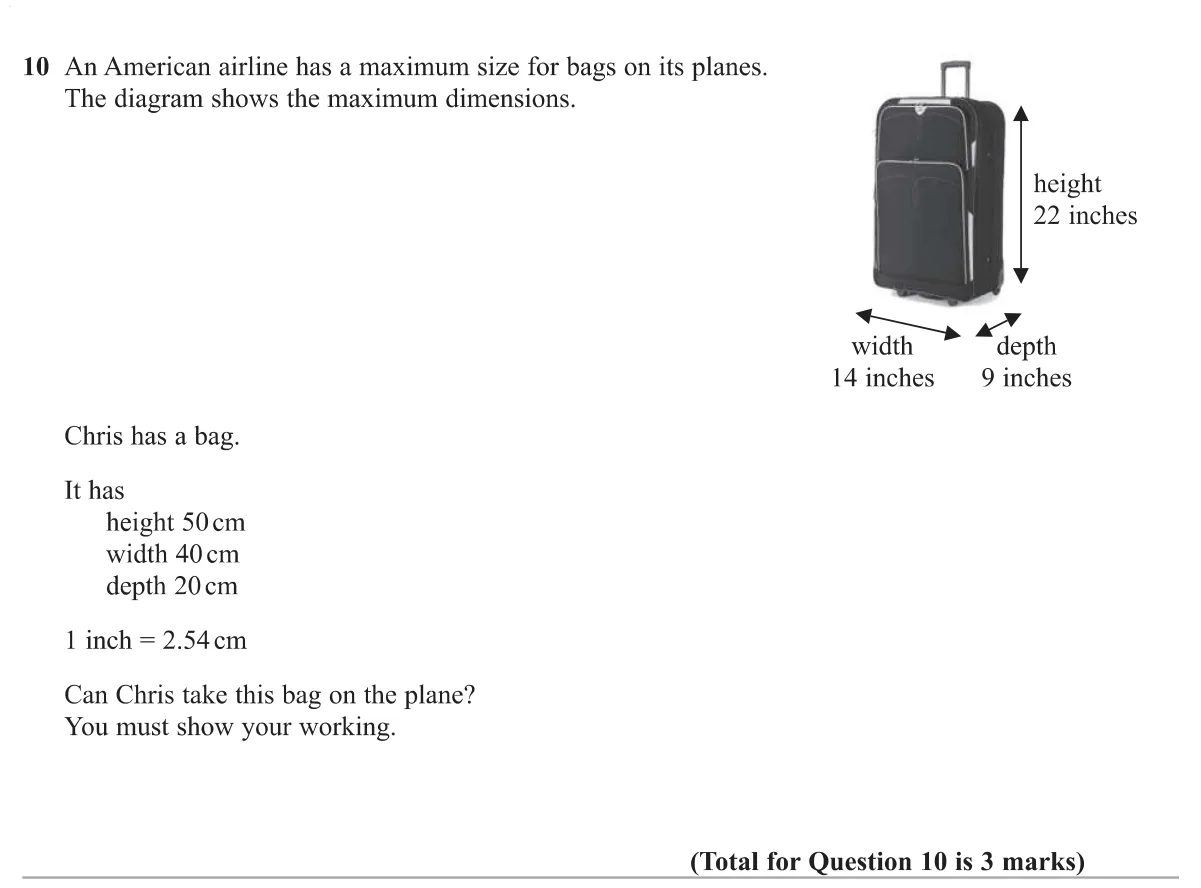
© Pearson Education Ltd. Specimen Paper 1 (Foundation, non-calculator), question 10.
| Answer | No: the width limit is cm, but the bag is 40 cm wide | 3 marks |
|---|
Worked solution Checked against the mark scheme
Convert each limit to cm ():
- height: cm (bag 50 cm, fine)
- width: cm (bag 40 cm, too wide)
- depth: cm (bag 20 cm, fine)
The bag is too wide, so Chris cannot take it.
Watch out: Dividing by 2.54 instead of multiplying, or only checking the height.
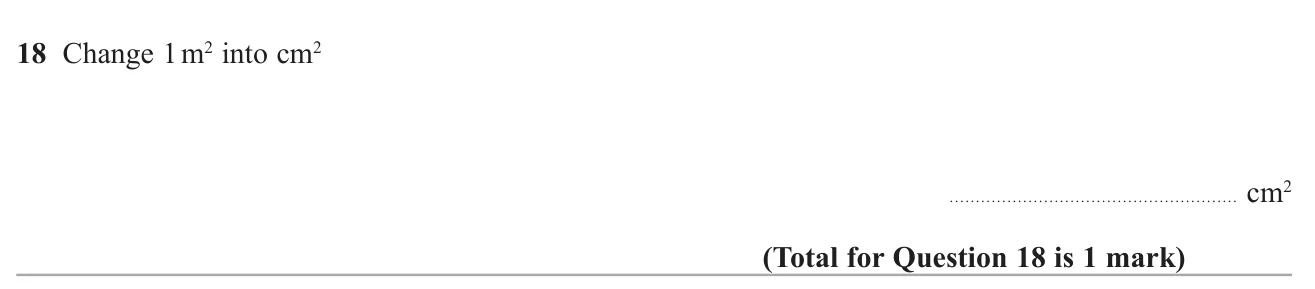
© Pearson Education Ltd. November 2021 Paper 3 (Foundation, calculator), question 18.
| Answer | 10 000 cm² | 1 mark |
|---|
Worked solution Checked against the mark scheme
1 m = 100 cm, so a 1 m by 1 m square is 100 cm by 100 cm.
cm²
Watch out: Giving 100, forgetting that area uses two dimensions.
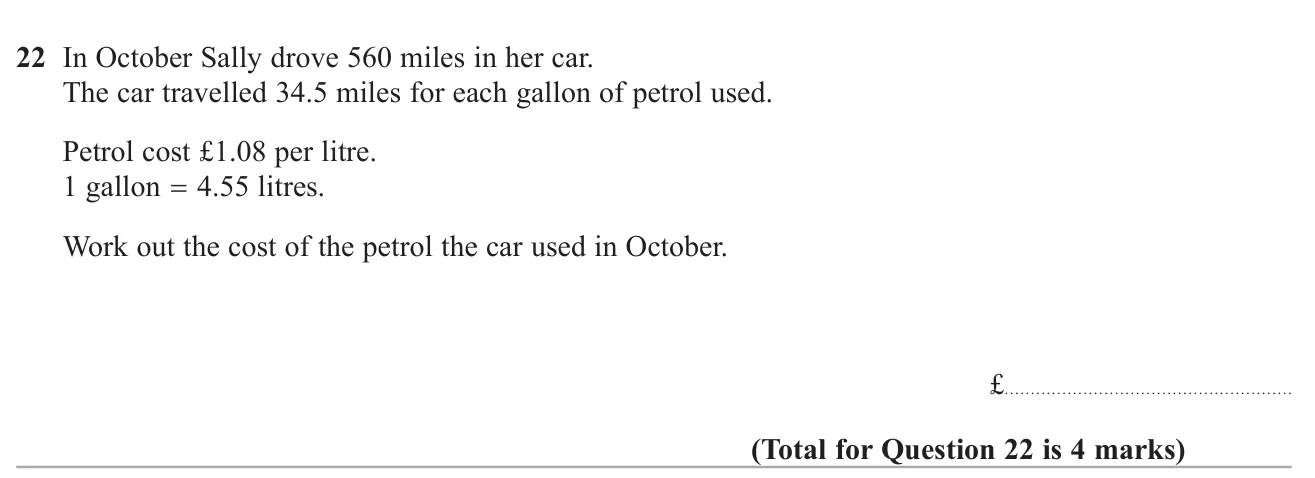
© Pearson Education Ltd. June 2019 Paper 3 (Foundation, calculator), question 22.
| Answer | £79.76 | 4 marks |
|---|
Worked solution Checked against the mark scheme
Gallons:
Litres:
Cost:
Watch out: Multiplying by 4.55 in the wrong place, e.g. dividing gallons by 4.55.
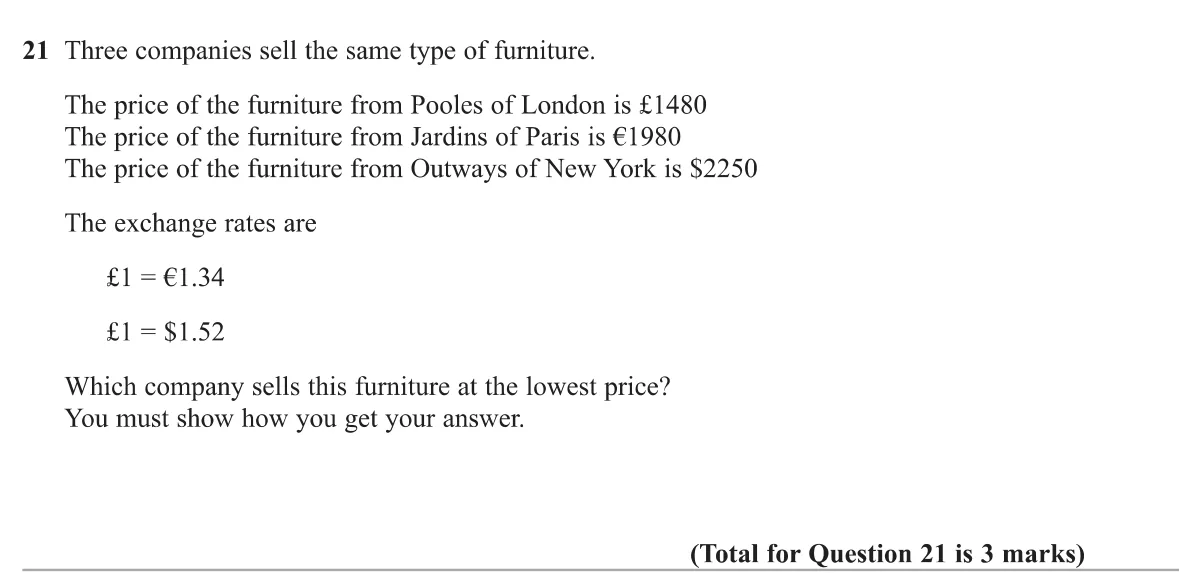
© Pearson Education Ltd. Specimen Paper 2 (Foundation, calculator), question 21.
| Answer | Jardins of Paris (about £1477.61) | 3 marks |
|---|
Worked solution Checked against the mark scheme
Paris:
New York:
London: £1480
The cheapest is Jardins of Paris.
Watch out: Multiplying by the exchange rate instead of dividing.
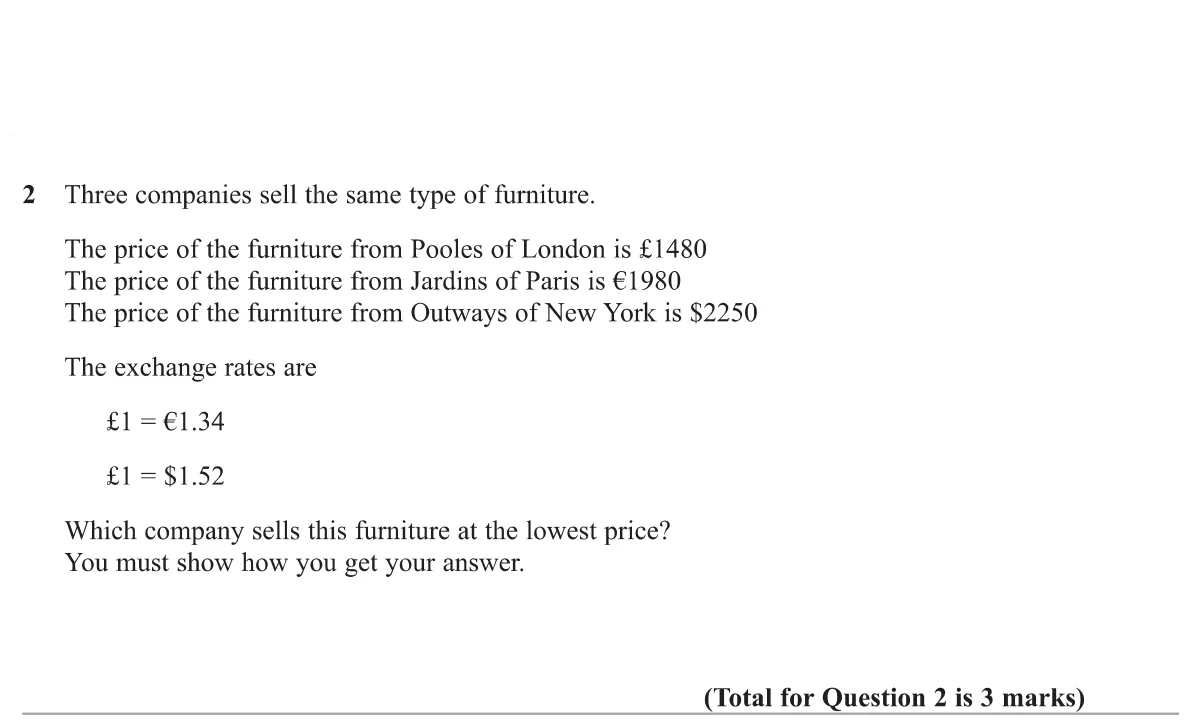
© Pearson Education Ltd. Specimen Paper 2 (Higher, calculator), question 2.
| Answer | Jardins of Paris (about £1477.61, against £1480 and about £1480.26) | 3 marks |
|---|
Worked solution Checked against the mark scheme
Put every price in pounds.
Paris:
New York:
London: £1480
The lowest is Jardins of Paris.
Watch out: Multiplying by the exchange rate instead of dividing when changing euros or dollars into pounds.
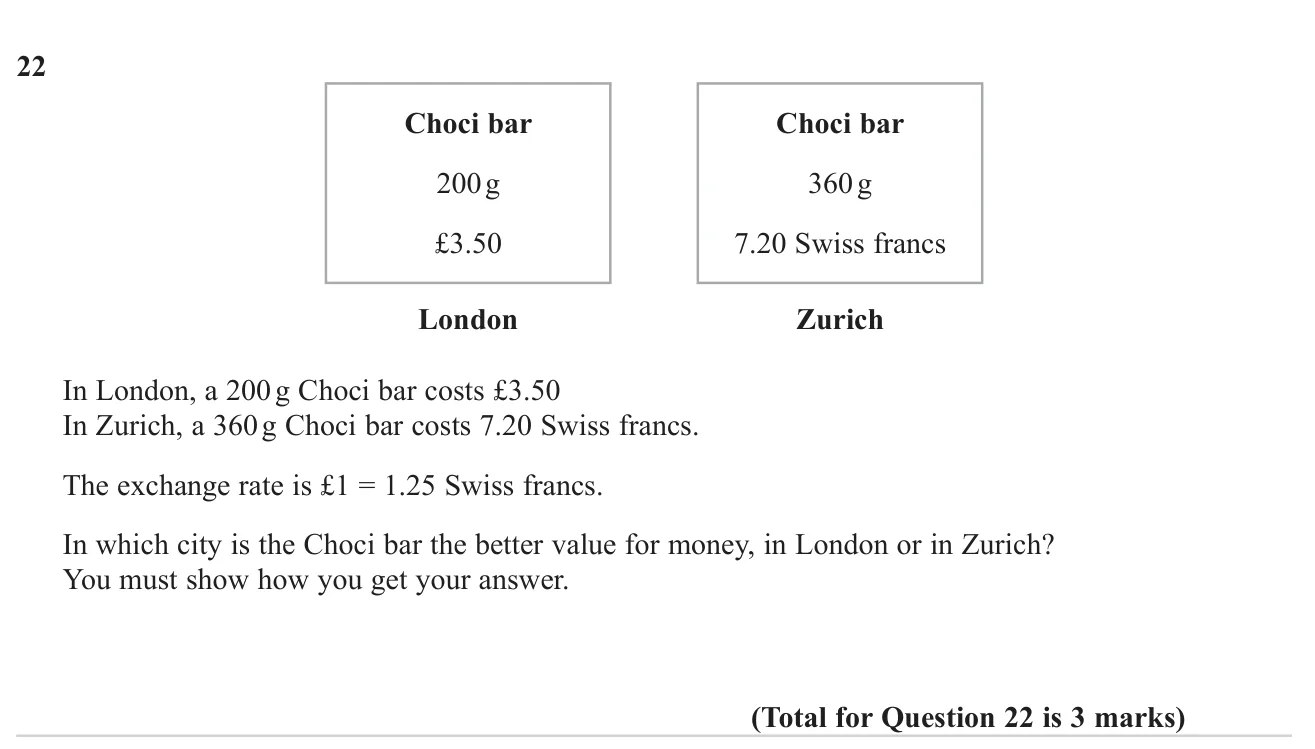
© Pearson Education Ltd. November 2024 Paper 2 (Foundation, calculator), question 22.
| Answer | Zurich (e.g. 200 g costs 4.00 francs in Zurich against 4.375 francs in London) | 3 marks |
|---|
Worked solution Checked against the mark scheme
Change the London price to francs: francs for 200 g.
Zurich price for 200 g: francs.
, so Zurich is better value.
Watch out: Dividing by 1.25 when changing pounds to francs.
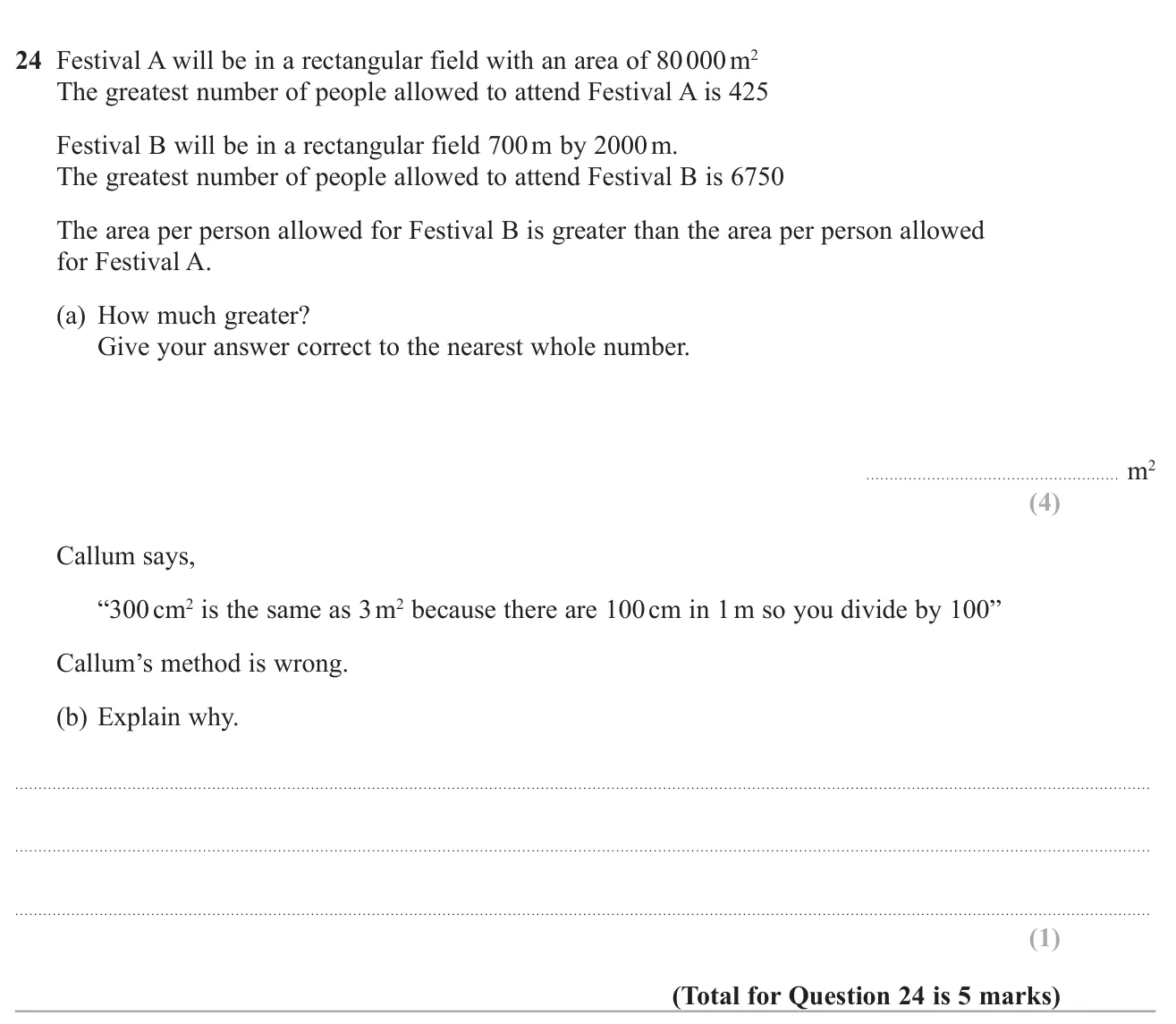
© Pearson Education Ltd. June 2022 Paper 2 (Foundation, calculator), question 24.
| (a) | 4 marks | |
|---|---|---|
| (b) | 1 m² is 100 × 100 = 10 000 cm², so he should divide by 10 000, not 100 | 1 mark |
Worked solution Checked against the mark scheme
(a) Field B:
B per person:
A per person:
Difference:
(b) A square metre is , so .
Watch out: Dividing people by area instead of area by people.
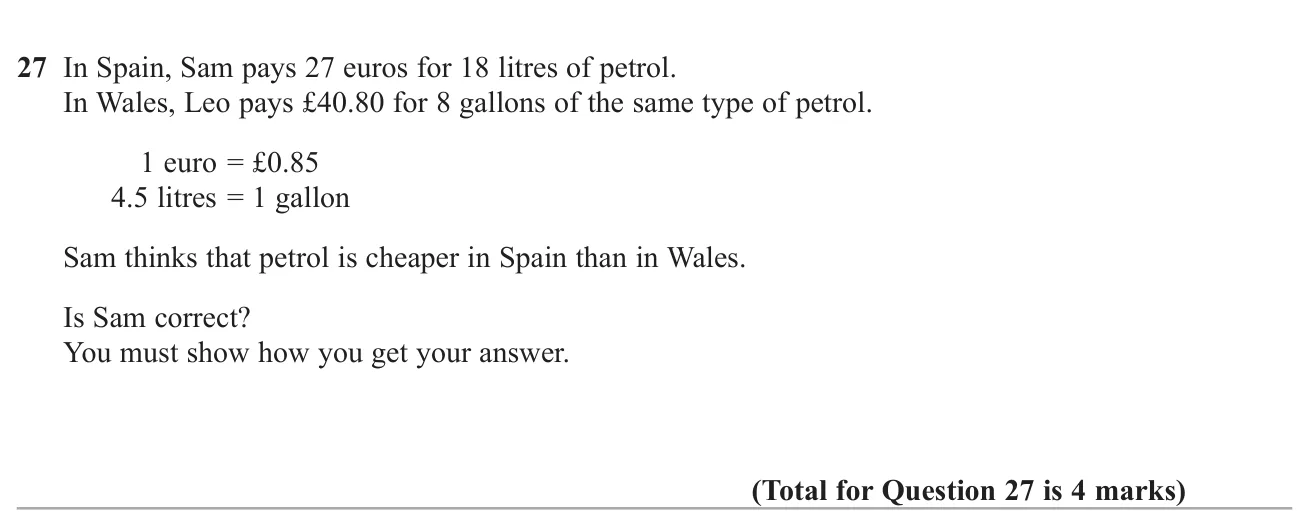
© Pearson Education Ltd. June 2022 Paper 2 (Foundation, calculator), question 27.
| Answer | No: Spain £1.275 per litre, Wales about £1.13 per litre | 4 marks |
|---|
Worked solution Checked against the mark scheme
Spain in £: , so per litre .
Wales: litres, so per litre
£1.13 < £1.275, so petrol is cheaper in Wales. Sam is not correct.
Watch out: Converting euros to pounds by dividing by 0.85 instead of multiplying.
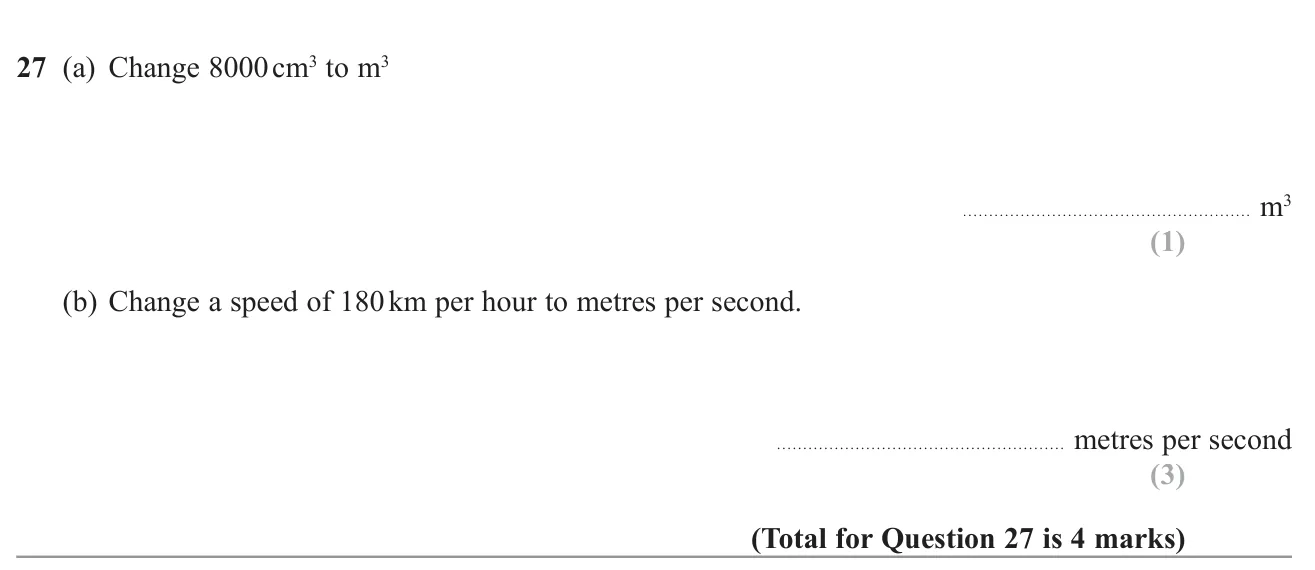
© Pearson Education Ltd. November 2022 Paper 3 (Foundation, calculator), question 27.
| (a) | 0.008 m³ | 1 mark |
|---|---|---|
| (b) | 50 m/s | 3 marks |
Worked solution Checked against the mark scheme
(a) , so
(b) km m, and 1 hour s
m/s
Watch out: Dividing by 100 in (a) instead of by 1 000 000.
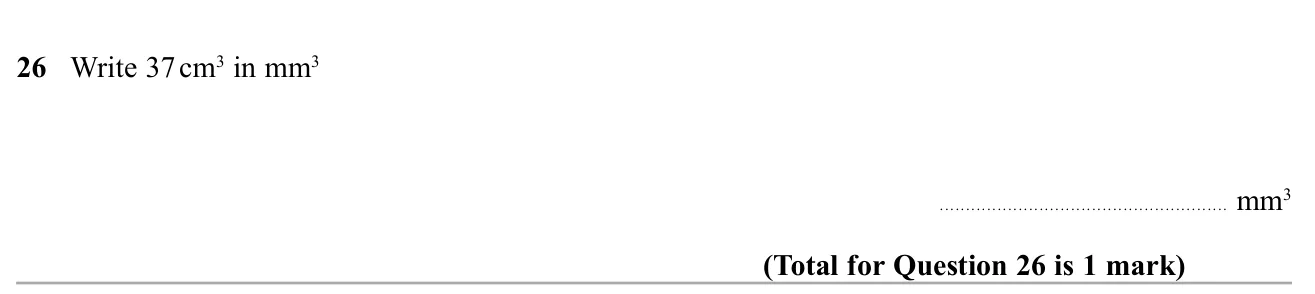
© Pearson Education Ltd. November 2019 Paper 3 (Foundation, calculator), question 26.
| Answer | 37 000 | 1 mark |
|---|
Worked solution Checked against the mark scheme
1 cm mm, so .
Watch out: Multiplying by 10 to get 370.
Their main topic is different, but part of each one tests this topic.